Works › Prior Analytics, Books I–II
Volume 1 · pp. 623–625
Chapter VI. On propositions which are easily proved, and on those which are proved with difficulty.
A marker with ≈ is an approximate page boundary, placed by measure of the text; the page photographs remain the authority. In the paired views, clicking a page marker brings that page into view.
CAPUT VI. De propositionibus quae faciliter, et de his quae difficulter probantur.
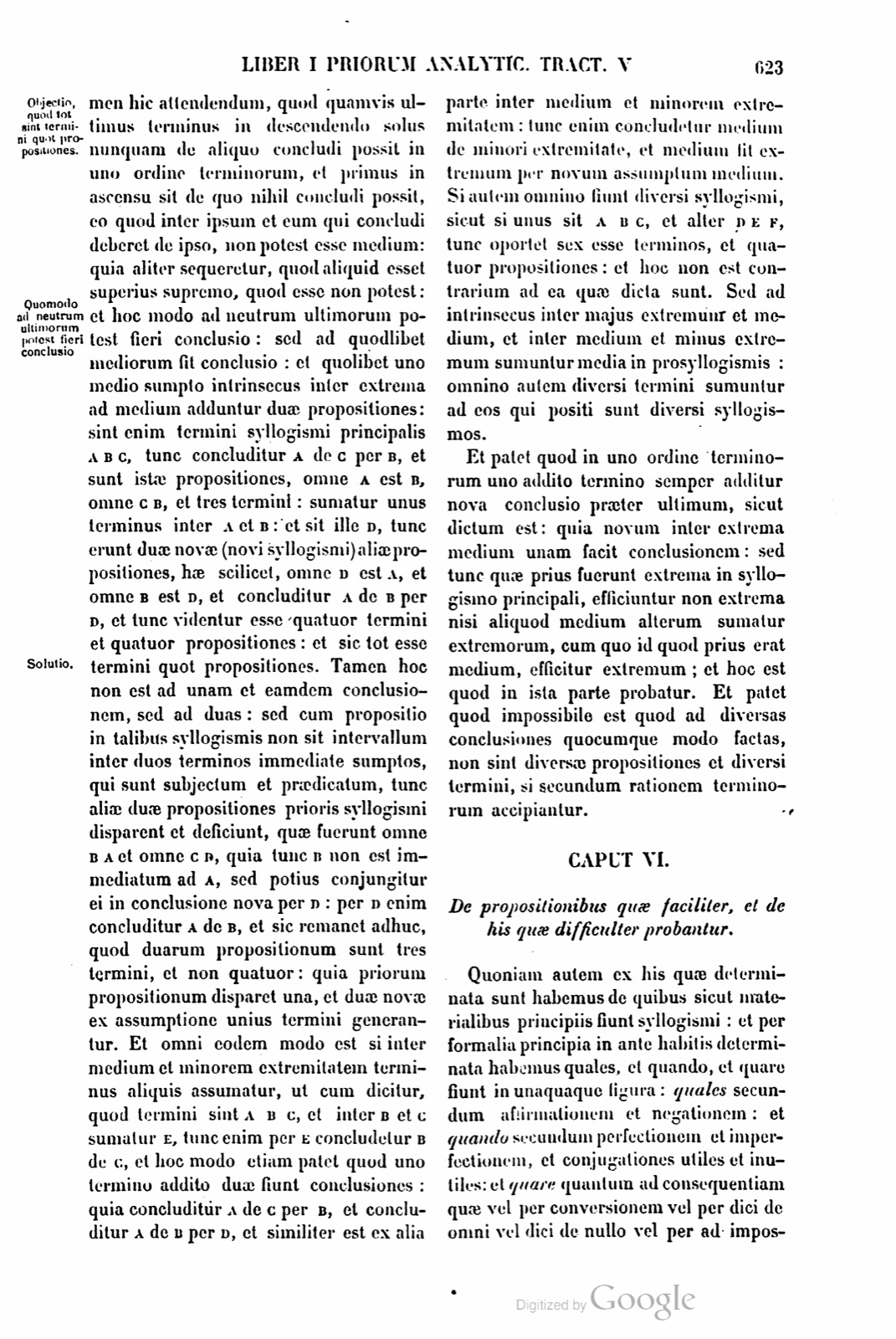
Quoniam autem ex his quae determinata sunt habemus de quibus sicut materialibus principiis fiunt syllogismi: et per formalia principia in ante habitis determinata habemus quales, et quando, et quare fiunt in unaquaque figura: quales secundum affirmationem et negationem: et quando secundum perfectionem et imperfectionem, et conjugationes utiles et inutiles: et quare quantum ad consequentiam quae vel per conversionem vel per dici de omni vel dici de nullo vel per ad impossibile deductionem. Habemus etiam quot modis fit et quot modis demonstratur in qualibet figura. Ex his etiam facile manifestum est nobis etiam quae propositio sit difficilis, et quae facile sit argumentabilis per syllogismum. Illa enim propositio ad quam sunt plures viae, et in pluribus figuris, et per plures casus sive modos figurarum concluditur, facilis est ad arguendum: quae autem in paucis concluditur figuris, et per pauciores figurae modos, difficilius est argumentalis, quia pauciores viae rationis habentur ad ipsam.
Ergo affirmativa universalis per primam solam figuram monstratur: et per hanc etiam non nisi simpliciter, hoc est, in uno solo modo primo concluditur: et ideo non nisi una via rationis habetur ad illam. Privativa vero propositio universalis quamvis per inductionem particularium aequaliter probetur cum universali affirmativa, tamen per syllogismum plures viae habentur ad ipsam probandam quam ad universalem affirmativam: quia et per primam figuram probatur, et per mediam figuram: per primam quidem simpliciter in uno modo, secundo scilicet: per mediam autem probatur dupliciter, per primum secundum modum, et secundum secundae figurae. Particularis autem affirmativa adhuc dictis duabus facilius probatur syllogistice: quia probatur et per primam figuram, et per postremam: simpliciter quidem sive uno modo concluditur per primam, quia in tertio primae tantum particularis affirmativa: tripliciter vero concluditur per postremam, quia per primum modum tertiae, et per tertium et per quartum. Omnibus autem facilius probatur particularis negativa sive privativa, quia illa in omnibus figuris monstratur: simpliciter quidem in prima, dupliciter in secunda, et tripliciter in tertia, scilicet in secundo modo et quinto et sexto: unde in prima quidem semel concluditur: in media autem et postrema etiam concluditur: in media quidem dupliciter, et in postrema tripliciter concluditur.
CHAPTER VI. On propositions which are easily proved, and on those which are proved with difficulty.
But because from the things that have been determined we have those things from which, as from material principles, syllogisms are made, and through the formal principles determined in the preceding matters we have what sorts of syllogisms are made, and when, and why, in each figure: what sorts according to affirmation and negation, and when according to perfection and imperfection, and useful and useless conjugations, and why with respect to the consequence which is either through conversion or through being said of every or being said of none or through deduction to the impossible. We also have in how many modes it is made and in how many modes it is demonstrated in each figure. From these things it is also easily manifest to us which proposition is difficult and which is easily arguable through syllogism. For that proposition for which there are more ways, and which is concluded in more figures and through more cases or modes of figures, is easy for arguing; but that which is concluded in few figures and through fewer modes of the figure is more difficult to argue, because fewer ways of reason are had for it.
Therefore the universal affirmative is shown through the first figure alone, and through this also only simply, that is, it is concluded in the first mode alone; and therefore only one way of reason is had for it. But although the universal privative proposition is proved equally with the universal affirmative through induction of particulars, nevertheless through syllogism more ways are had for proving it than for proving the universal affirmative, because it is proved both through the first figure and through the middle figure: through the first indeed simply in one mode, namely the second; but through the middle figure it is proved doubly, through the first mode and the second of the second figure. But the particular affirmative is still more easily proved syllogistically than those two which have been mentioned, because it is proved both through the first figure and through the last: simply or in one mode it is concluded through the first, because the particular affirmative is only in the third mode of the first; but it is concluded triply through the last, because through the first mode of the third, and through the third and fourth. But easiest of all is proved the particular negative or privative, because it is shown in all figures: simply indeed in the first, doubly in the second, and triply in the third, namely in the second, fifth, and sixth mode. Hence in the first it is concluded once; but in the middle and last it is also concluded: in the middle indeed doubly, and in the last triply.
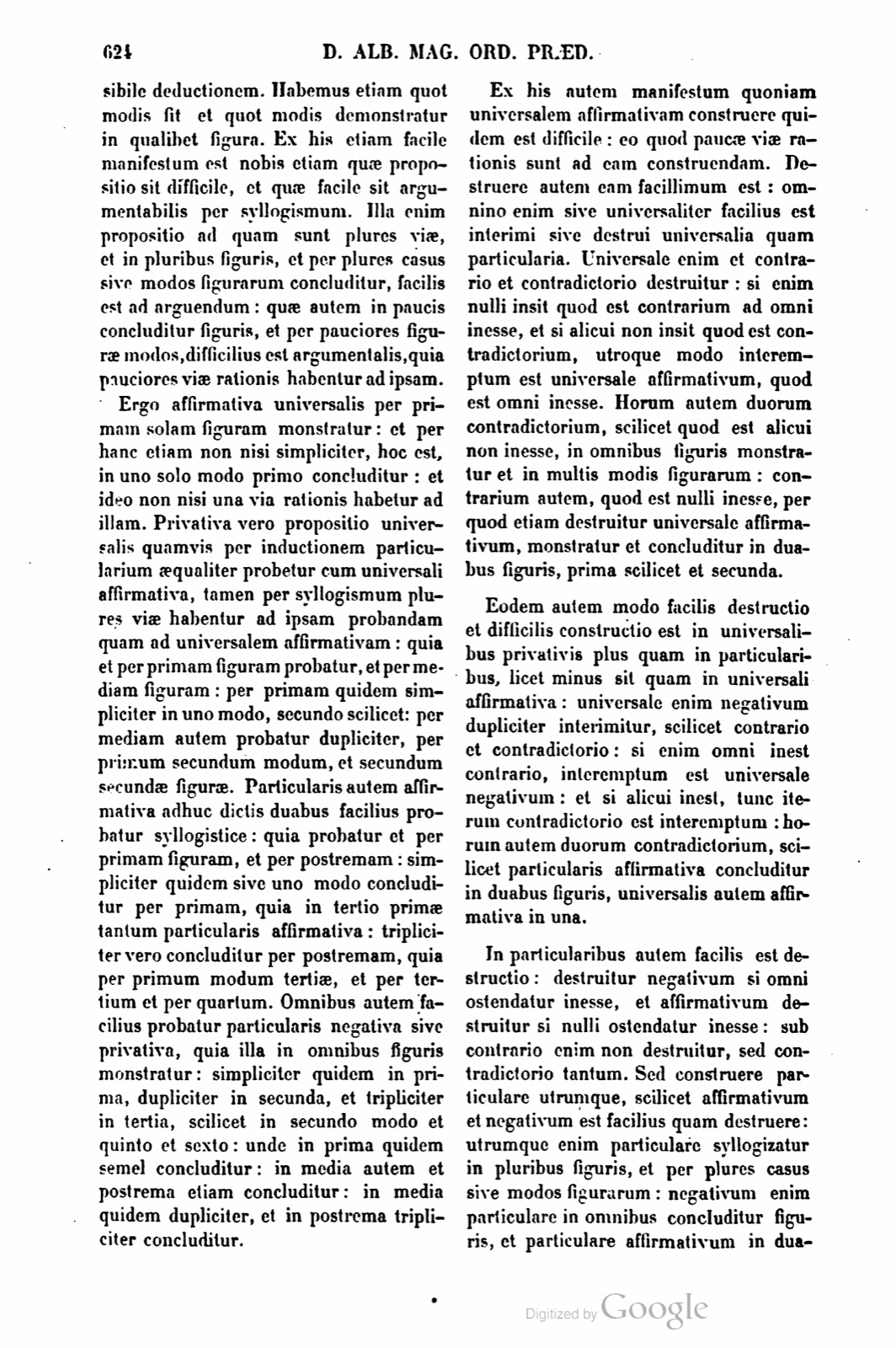
Ex his autem manifestum quoniam universalem affirmativam construere quidem est difficile: eo quod paucae viae rationis sunt ad eam construendam. Destruere autem eam facillimum est: omnino enim sive universaliter facilius est interimi sive destrui universalia quam particularia. Universale enim et contrario et contradictorio destruitur: si enim nulli insit quod est contrarium ad omni inesse, et si alicui non insit quod est contradictorium, utroque modo interemptum est universale affirmativum, quod est omni inesse. Horum autem duorum contradictorium, scilicet quod est alicui non inesse, in omnibus figuris monstratur et in multis modis figurarum: contrarium autem, quod est nulli inesse, per quod etiam destruitur universale affirmativum, monstratur et concluditur in duabus figuris, prima scilicet et secunda.
Eodem autem modo facilis destructio et difficilis constructio est in universalibus privativis plus quam in particularibus, licet minus sit quam in universali affirmativa: universale enim negativum dupliciter interimitur, scilicet contrario et contradictorio: si enim omni inest contrario, interemptum est universale negativum: et si alicui inest, tunc iterum contradictorio est interemptum: horum autem duorum contradictorium, scilicet particularis affirmativa concluditur in duabus figuris, universalis autem affirmativa in una.
In particularibus autem facilis est destructio: destruitur negativum si omni ostendatur inesse, et affirmativum destruitur si nulli ostendatur inesse: sub contrario enim non destruitur, sed contradictorio tantum. Sed construere particulare utrumque, scilicet affirmativum et negativum est facilius quam destruere: utrumque enim particulare syllogizatur in pluribus figuris, et per plures casus sive modos figurarum: negativum enim particulare in omnibus concluditur figuris, et particulare affirmativum in duabus, et concluduntur per plures casus sive modos figurarum.
From these things it is manifest that constructing the universal affirmative is indeed difficult, because there are few ways of reason for constructing it. But destroying it is very easy; for wholly or universally it is easier for universals to be taken away or destroyed than particulars. For the universal is destroyed both by the contrary and by the contradictory. For if what is contrary to inhering in every one inheres in none, and if what is contradictory does not inhere in some one, the universal affirmative, which is inhering in every one, has been removed in either way. Of these two, the contradictory, namely that which is not inhering in some one, is shown in all figures and in many modes of the figures; but the contrary, which is inhering in none, through which the universal affirmative is also destroyed, is shown and concluded in two figures, namely the first and the second.
But in the same way there is easy destruction and difficult construction in universal privatives more than in particulars, although less than in the universal affirmative. For the universal negative is destroyed in two ways, namely by contrary and contradictory. For if it inheres in every one contrary-wise, the universal negative has been removed; and if it inheres in some one, then again it has been removed by the contradictory. But of these two, the contradictory, namely the particular affirmative, is concluded in two figures, while the universal affirmative is concluded in one.
But in particulars destruction is easy: the negative is destroyed if it is shown to inhere in every one, and the affirmative is destroyed if it is shown to inhere in none. For it is not destroyed by the subcontrary, but only by the contradictory. But constructing each particular, namely affirmative and negative, is easier than destroying it, because each particular is syllogized in several figures and through several cases or modes of figures: for the particular negative is concluded in all figures, and the particular affirmative in two, and they are concluded through several cases or modes of figures.
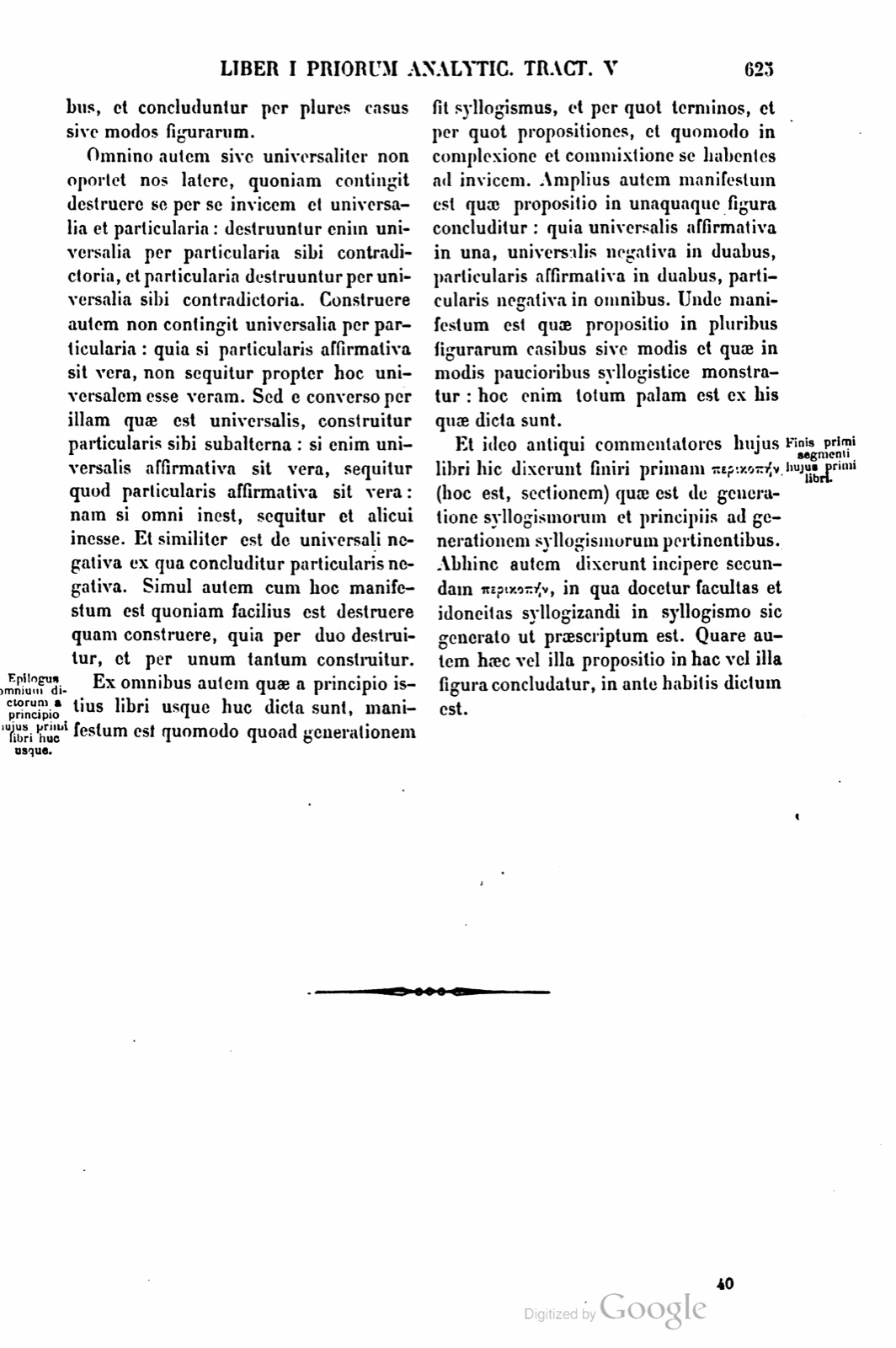
Omnino autem sive universaliter non oportet nos latere, quoniam contingit destruere se per se invicem et universalia et particularia: destruuntur enim universalia per particularia sibi contradictoria, et particularia destruuntur per universalia sibi contradictoria. Construere autem non contingit universalia per particularia: quia si particularis affirmativa sit vera, non sequitur propter hoc universalem esse veram. Sed e converso per illam quae est universalis, construitur particularis sibi subalterna: si enim universalis affirmativa sit vera, sequitur quod particularis affirmativa sit vera: nam si omni inest, sequitur et alicui inesse. Et similiter est de universali negativa ex qua concluditur particularis negativa. Simul autem cum hoc manifestum est quoniam facilius est destruere quam construere, quia per duo destruitur, et per unum tantum construitur.
Ex omnibus autem quae a principio istius libri usque huc dicta sunt, manifestum est quomodo quoad generationem fit syllogismus, et per quot terminos, et per quot propositiones, et quomodo in complexione et commixtione se habentes ad invicem. Amplius autem manifestum est quae propositio in unaquaque figura concluditur: quia universalis affirmativa in una, universalis negativa in duabus, particularis affirmativa in duabus, particularis negativa in omnibus. Unde manifestum est quae propositio in pluribus figurarum casibus sive modis et quae in modis paucioribus syllogistice monstratur: hoc enim totum palam est ex his quae dicta sunt.
Et ideo antiqui commentatores hujus libri hic dixerunt finiri primam pericopen, hoc est, sectionem, quae est de generatione syllogismorum et principiis ad generationem syllogismorum pertinentibus. Abhinc autem dixerunt incipere secundam pericopen, in qua docetur facultas et idoneitas syllogizandi in syllogismo sic generato ut praescriptum est. Quare autem haec vel illa propositio in hac vel illa figura concludatur, in ante habitis dictum est.
But wholly or universally it ought not escape us that universals and particulars can destroy one another through themselves: for universals are destroyed through particulars contradictory to them, and particulars are destroyed through universals contradictory to them. But universals cannot be constructed through particulars, because if a particular affirmative is true, the universal does not follow as true for this reason. But conversely, through the universal, the particular subaltern to it is constructed: for if the universal affirmative is true, it follows that the particular affirmative is true; for if it inheres in every one, it follows that it also inheres in some one. And it is similar concerning the universal negative from which the particular negative is concluded. Together with this it is also manifest that it is easier to destroy than to construct, because it is destroyed through two, and constructed through one only.
But from all things that have been said from the beginning of this book up to here, it is manifest how syllogism is made with respect to generation, and through how many terms, and through how many propositions, and how they have themselves to one another in composition and mixing. Furthermore it is manifest which proposition is concluded in each figure, because the universal affirmative is concluded in one, the universal negative in two, the particular affirmative in two, and the particular negative in all. Hence it is manifest which proposition is shown syllogistically in more cases or modes of figures and which in fewer modes; for this whole matter is plain from what has been said.
And therefore the ancient commentators of this book said that here the first pericope, that is, section, ends, which is about the generation of syllogisms and the principles pertaining to the generation of syllogisms. But from here they said that the second pericope begins, in which the faculty and aptitude of syllogizing in a syllogism thus generated, as has been prescribed, is taught. But why this or that proposition is concluded in this or that figure has been said in the preceding matters.
If a page does not appear, its photograph has not been uploaded yet.