Works › Prior Analytics, Books I–II
Volume 1 · pp. 613–614
Chapter III. That there can be no syllogism to the proposed point without a universal proposition, which is the principle of syllogism with respect to mode.
A marker with ≈ is an approximate page boundary, placed by measure of the text; the page photographs remain the authority. In the paired views, clicking a page marker brings that page into view.
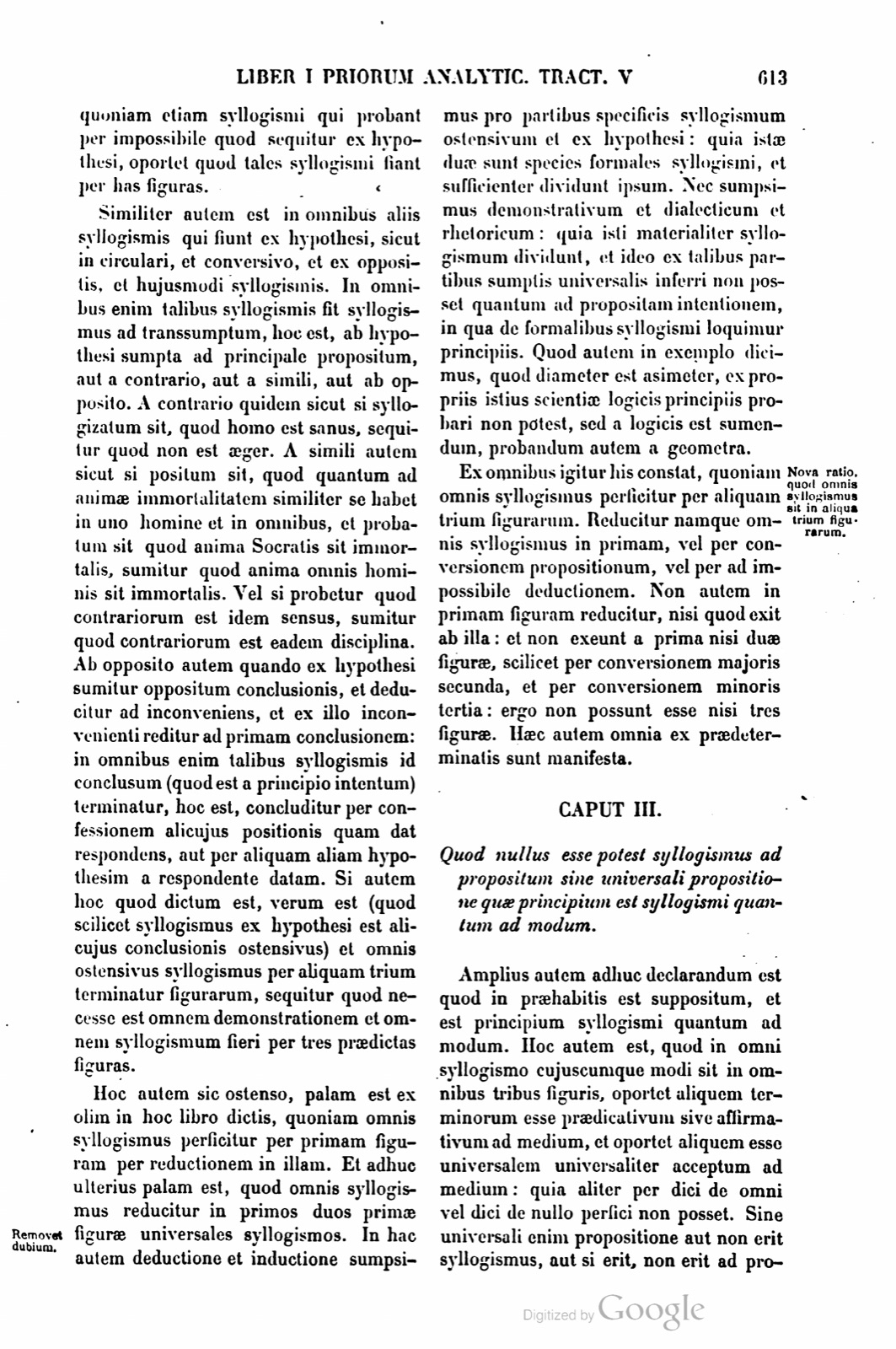
CAPUT III. Quod nullus esse potest syllogismus ad propositum sine universali propositione quae principium est syllogismi quantum ad modum.
Amplius autem adhuc declarandum est quod in prae habitis est suppositum, et est principium syllogismi quantum ad modum. Hoc autem est, quod in omni syllogismo cujuscumque modi sit in omnibus tribus figuris, oportet aliquem terminorum esse praedicativum sive affirmativum ad medium, et oportet aliquem esse universalem universaliter acceptum ad medium: quia aliter per dici de omni vel dici de nullo perfici non posset. Sine universali enim propositione aut non erit syllogismus, aut si erit, non erit ad propositum probandum quod intenditur, aut erit petere quod est in principio.
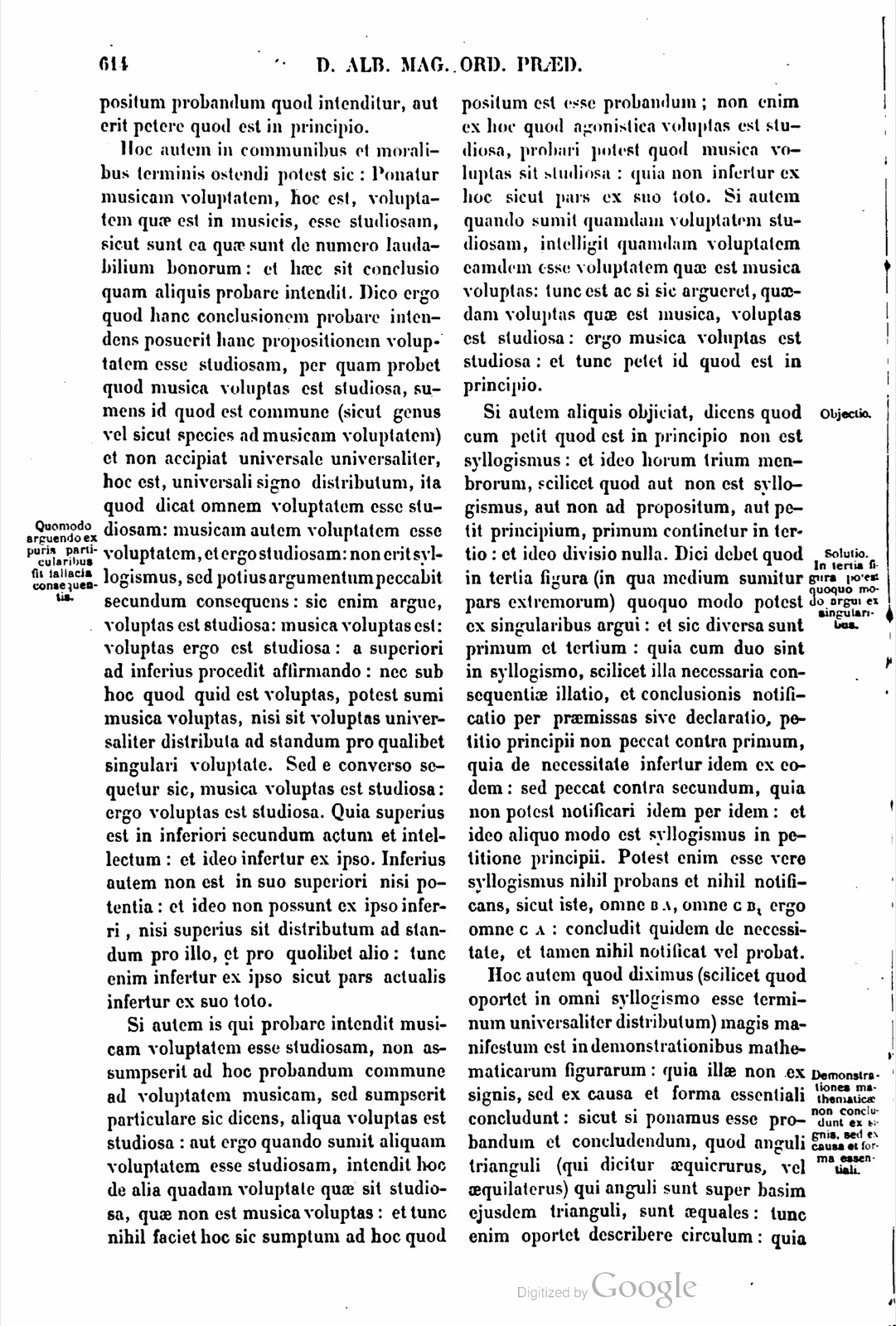
Hoc autem in communibus et moralibus terminis ostendi potest sic: Ponatur musicam voluptatem, hoc est, voluptatem quae est in musicis, esse studiosam, sicut sunt ea quae sunt de numero laudabilium bonorum: et haec sit conclusio quam aliquis probare intendit. Dico ergo quod hanc conclusionem probare intendens posuerit hanc propositionem voluptatem esse studiosam, per quam probet quod musica voluptas est studiosa, sumens id quod est commune, sicut genus vel sicut species ad musicam voluptatem, et non accipiat universale universaliter, hoc est, universali signo distributum, ita quod dicat omnem voluptatem esse studiosam: musicam autem voluptatem esse voluptatem, et ergo studiosam: non erit syllogismus, sed potius argumentum peccabit secundum consequens: sic enim argue, voluptas est studiosa: musica voluptas est: voluptas ergo est studiosa: a superiori ad inferius procedit affirmando: nec sub hoc quod quid est voluptas, potest sumi musica voluptas, nisi sit voluptas universaliter distributa ad standum pro qualibet singulari voluptate. Sed e converso sequetur sic, musica voluptas est studiosa: ergo voluptas est studiosa. Quia superius est in inferiori secundum actum et intellectum: et ideo infertur ex ipso. Inferius autem non est in suo superiori nisi potentia: et ideo non possunt ex ipso inferri, nisi superius sit distributum ad standum pro illo, et pro quolibet alio: tunc enim infertur ex ipso sicut pars actualis infertur ex suo toto.
Si autem is qui probare intendit musicam voluptatem esse studiosam, non assumpserit ad hoc probandum commune ad voluptatem musicam, sed sumpserit particulare sic dicens, aliqua voluptas est studiosa: aut ergo quando sumit aliquam voluptatem esse studiosam, intendit hoc de alia quadam voluptate quae sit studiosa, quae non est musica voluptas: et tunc nihil faciet hoc sic sumptum ad hoc quod positum est esse probandum; non enim ex hoc quod agonistica voluptas est studiosa, probari potest quod musica voluptas sit studiosa: quia non infertur ex hoc sicut pars ex suo toto. Si autem quando sumit quamdam voluptatem studiosam, intelligit quamdam voluptatem eamdem esse voluptatem quae est musica voluptas: tunc est ac si sic argueret, quaedam voluptas quae est musica, voluptas est studiosa: ergo musica voluptas est studiosa: et tunc petet id quod est in principio.
CHAPTER III. That there can be no syllogism to the proposed point without a universal proposition, which is the principle of syllogism with respect to mode.
Furthermore, it must still be declared what has been supposed in the preceding matters and is the principle of syllogism with respect to mode. This is that, in every syllogism, of whatever mode it may be in all three figures, one of the terms must be predicative or affirmative toward the middle, and one must be universal, universally accepted toward the middle, because otherwise it could not be perfected through being said of every or being said of none. For without a universal proposition, either there will not be a syllogism, or, if there is, it will not be for proving the proposed point that is intended, or it will be begging what is in the beginning.
But this can be shown in common and moral terms thus. Let musical pleasure, that is, the pleasure which is in musical things, be posited as morally good, as are those things which are among the number of praiseworthy goods; and let this be the conclusion which someone intends to prove. Therefore I say that one intending to prove this conclusion has posited this proposition, that pleasure is morally good, through which he proves that musical pleasure is morally good, taking what is common, as a genus or as a species toward musical pleasure, and does not accept the universal universally, that is, distributed by a universal sign, so that he says that every pleasure is morally good, and that musical pleasure is pleasure, and therefore morally good. There will not be a syllogism, but rather the argument will err according to the consequent. For thus he argues: pleasure is morally good; musical pleasure is; therefore pleasure is morally good. It proceeds affirmatively from the superior to the inferior; nor under this quiddity which is pleasure can musical pleasure be taken, unless pleasure is universally distributed so as to stand for any singular pleasure whatever. But conversely it will follow thus: musical pleasure is morally good; therefore pleasure is morally good. For the superior is in the inferior according to act and understanding, and therefore it is inferred from it. But the inferior is not in its superior except potentially; and therefore things cannot be inferred from it unless the superior is distributed so as to stand for it and for every other; for then it is inferred from it as an actual part is inferred from its whole.
But if the one who intends to prove that musical pleasure is morally good has not assumed for proving this something common to musical pleasure, but has taken a particular, saying thus, some pleasure is morally good: then either, when he takes some pleasure to be morally good, he intends this about some other pleasure which is morally good and is not musical pleasure, and then what has been taken in this way will do nothing for that which has been posited as needing to be proved; for from the fact that agonistic pleasure is morally good, it cannot be proved that musical pleasure is morally good, because this is not inferred as a part from its whole. But if, when he takes a certain morally good pleasure, he understands a certain same pleasure to be the pleasure which is musical pleasure, then it is as if he argued thus: a certain pleasure which is musical, pleasure is morally good; therefore musical pleasure is morally good; and then he will beg what is in the beginning.
Si autem aliquis objiciat, dicens quod cum petit quod est in principio non est syllogismus: et ideo horum trium membrorum, scilicet quod aut non est syllogismus, aut non ad propositum, aut petit principium, primum continetur in tertio: et ideo divisio nulla. Dici debet quod in tertia figura, in qua medium sumitur pars extremorum, quoquo modo potest ex singularibus argui: et sic diversa sunt primum et tertium: quia cum duo sint in syllogismo, scilicet illa necessaria consequentiae illatio, et conclusionis notificatio per praemissas sive declaratio, petitio principii non peccat contra primum, quia de necessitate infertur idem ex eodem: sed peccat contra secundum, quia non potest notificari idem per idem: et ideo aliquo modo est syllogismus in petitione principii. Potest enim esse vere syllogismus nihil probans et nihil notificans, sicut iste, omne B A, omne C B, ergo omne C A: concludit quidem de necessitate, et tamen nihil notificat vel probat.
Hoc autem quod diximus, scilicet quod oportet in omni syllogismo esse terminum universaliter distributum, magis manifestum est in demonstrationibus mathematicarum figurarum: quia illae non ex signis, sed ex causa et forma essentiali concludunt: sicut si ponamus esse probandum et concludendum, quod anguli trianguli, qui dicitur aequicrurus, vel aequilaterus, qui anguli sunt super basim ejusdem trianguli, sunt aequales: tunc enim oportet describere circulum: quia
But if someone objects, saying that when he begs what is in the beginning, there is no syllogism, and therefore, of these three members, namely that either there is no syllogism, or not to the proposed point, or it begs the principle, the first is contained in the third, and therefore the division is null, it ought to be said that in the third figure, in which the middle is taken as a part of the extremes, in whatever way one can argue from singulars. And thus the first and the third are diverse, because, since there are two things in a syllogism, namely that necessary inference of the consequence and the notification or declaration of the conclusion through the premises, begging the principle does not sin against the first, because the same is inferred from the same by necessity; but it sins against the second, because the same cannot be made known through the same. And therefore in some way there is a syllogism in a begging of the principle. For there can truly be a syllogism proving nothing and making nothing known, such as this: every B is A; every C is B; therefore every C is A. It concludes indeed of necessity, and nevertheless makes known or proves nothing.
But this which we have said, namely that in every syllogism there must be a universally distributed term, is more manifest in demonstrations of mathematical figures, because they conclude not from signs, but from the cause and essential form. For example, if we posit that it is to be proved and concluded that the angles of the triangle which is called isosceles or equilateral, the angles which are upon the base of the same triangle, are equal, then it is necessary to describe a circle, because
If a page does not appear, its photograph has not been uploaded yet.