Works › Prior Analytics, Books I–II
Volume 1 · pp. 612–613
Chapter II. Here it is declared that a syllogism from hypothesis is in one of the three figures.
A marker with ≈ is an approximate page boundary, placed by measure of the text; the page photographs remain the authority. In the paired views, clicking a page marker brings that page into view.
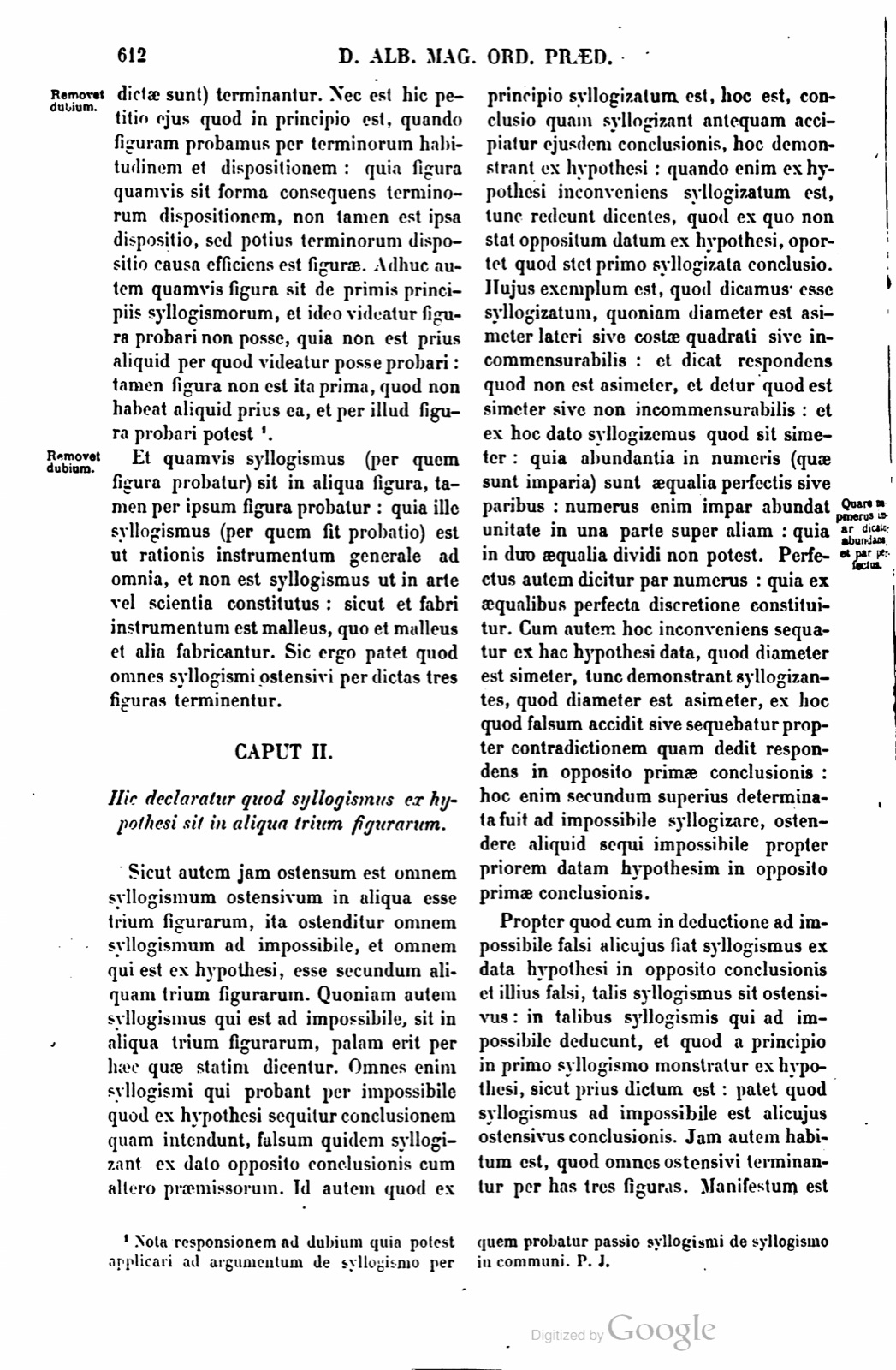
CAPUT II. Hic declaratur quod syllogismus ex hypothesi sit in aliqua trium figurarum.
Sicut autem jam ostensum est omnem syllogismum ostensivum in aliqua esse trium figurarum, ita ostenditur omnem syllogismum ad impossibile, et omnem qui est ex hypothesi, esse secundum aliquam trium figurarum. Quoniam autem syllogismus qui est ad impossibile, sit in aliqua trium figurarum, palam erit per haec quae statim dicentur. Omnes enim syllogismi qui probant per impossibile quod ex hypothesi sequitur conclusionem quam intendunt, falsum quidem syllogizant ex dato opposito conclusionis cum altero praemissorum. Id autem quod ex principio syllogizatum est, hoc est, conclusio quam syllogizant antequam accipiatur ejusdem conclusionis, hoc demonstrant ex hypothesi: quando enim ex hypothesi inconveniens syllogizatum est, tunc redeunt dicentes, quod ex quo non stat oppositum datum ex hypothesi, oportet quod stet primo syllogizata conclusio. Hujus exemplum est, quod dicamus esse syllogizatum, quoniam diameter est asimeter lateri sive costae quadrati sive incommensurabilis: et dicat respondens quod non est asimeter, et detur quod est simeter sive non incommensurabilis: et ex hoc dato syllogizemus quod sit simeter: quia abundantia in numeris, quae sunt imparia, sunt aequalia perfectis sive paribus: numerus enim impar abundat unitate in una parte super aliam: quia in duo aequalia dividi non potest. Perfectus autem dicitur par numerus: quia ex aequalibus perfecta discretione constituitur. Cum autem hoc inconveniens sequatur ex hac hypothesi data, quod diameter est simeter, tunc demonstrant syllogizantes, quod diameter est asimeter, ex hoc quod falsum accidit sive sequebatur propter contradictionem quam dedit respondens in opposito primae conclusionis: hoc enim secundum superius determinata fuit ad impossibile syllogizare, ostendere aliquid sequi impossibile propter priorem datam hypothesim in opposito primae conclusionis.
Propter quod cum in deductione ad impossibile falsi alicujus fiat syllogismus ex data hypothesi in opposito conclusionis et illius falsi, talis syllogismus sit ostensivus: in talibus syllogismis qui ad impossibile deducunt, et quod a principio in primo syllogismo monstratur ex hypothesi, sicut prius dictum est: patet quod syllogismus ad impossibile est alicujus ostensivus conclusionis. Jam autem habitum est, quod omnes ostensivi terminantur per has tres figuras. Manifestum est quoniam etiam syllogismi qui probant per impossibile quod sequitur ex hypothesi, oportet quod tales syllogismi fiant per has figuras.
Similiter autem est in omnibus aliis syllogismis qui fiunt ex hypothesi, sicut in circulari, et conversivo, et ex oppositis, et hujusmodi syllogismis. In omnibus enim talibus syllogismis fit syllogismus ad transsumptum, hoc est, ab hypothesi sumpta ad principale propositum, aut a contrario, aut a simili, aut ab opposito. A contrario quidem sicut si syllogizatum sit, quod homo est sanus, sequitur quod non est aeger. A simili autem sicut si positum sit, quod quantum ad animae immortalitatem similiter se habet in uno homine et in omnibus, et probatum sit quod anima Socratis sit immortalis, sumitur quod anima omnis hominis sit immortalis. Vel si probetur quod contrariorum est idem sensus, sumitur quod contrariorum est eadem disciplina. Ab opposito autem quando ex hypothesi sumitur oppositum conclusionis, et deducitur ad inconveniens, et ex illo inconvenienti reditur ad primam conclusionem: in omnibus enim talibus syllogismis id conclusum, quod est a principio intentum, terminatur, hoc est, concluditur per confessionem alicujus positionis quam dat respondens, aut per aliquam aliam hypothesim a respondente datam. Si autem hoc quod dictum est, verum est, quod scilicet syllogismus ex hypothesi est alicujus conclusionis ostensivus, et omnis ostensivus syllogismus per aliquam trium terminatur figurarum, sequitur quod necesse est omnem demonstrationem et omnem syllogismum fieri per tres praedictas figuras.
CHAPTER II. Here it is declared that a syllogism from hypothesis is in one of the three figures.
But just as it has now been shown that every ostensive syllogism is in one of the three figures, so it is shown that every syllogism to the impossible, and every one which is from hypothesis, is according to one of the three figures. But that the syllogism which is to the impossible is in one of the three figures will be plain through the things which will immediately be said. For all syllogisms which prove through the impossible that the conclusion which they intend follows from hypothesis indeed syllogize something false from the given opposite of the conclusion together with one of the premises. But that which was syllogized from the beginning, that is, the conclusion which they syllogize before the opposite of the same conclusion is accepted, they demonstrate from hypothesis; for when an unacceptable consequence has been syllogized from hypothesis, then they return saying that, since the opposite given from hypothesis does not stand, it is necessary that the conclusion first syllogized stand. An example of this is that we say it has been syllogized that the diameter is asymmetrical to the side or edge of a square, that is, incommensurable; and let the respondent say that it is not asymmetrical, and let it be granted that it is symmetrical or not incommensurable; and from this granted let us syllogize that it is symmetrical, because excesses in numbers which are odd are equal to perfect or even numbers. For an odd number exceeds by a unit in one part over the other, because it cannot be divided into two equal parts. But an even number is called perfect because it is constituted from equals by a perfect distinction. But when this unacceptable consequence follows from this given hypothesis, that the diameter is symmetrical, then those syllogizing demonstrate that the diameter is asymmetrical from the fact that something false happened or followed because of the contradiction which the respondent gave in the opposite of the first conclusion. For this, according to what was determined above, was to syllogize to the impossible: to show something impossible following on account of the prior hypothesis given in the opposite of the first conclusion.
For this reason, since in a deduction to the impossible a syllogism of some false thing is made from a given hypothesis in the opposite of the conclusion and of that false thing, such a syllogism is ostensive. In such syllogisms which lead to the impossible, and in which what from the beginning is shown in the first syllogism is shown from hypothesis, as was said before, it is clear that the syllogism to the impossible is ostensive of some conclusion. But it has already been had that all ostensive syllogisms are terminated through these three figures. It is manifest that also syllogisms which prove through the impossible what follows from hypothesis must be made through these figures.
But it is similar in all other syllogisms which are made from hypothesis, as in the circular, the conversive, from opposites, and syllogisms of this sort. For in all such syllogisms a syllogism is made to what is transferred over, that is, from a hypothesis taken to the principal proposition, either from a contrary, or from a like case, or from an opposite. From a contrary, indeed, as if it has been syllogized that a man is healthy, it follows that he is not sick. From a like case, as if it is posited that with respect to the immortality of the soul it has itself similarly in one man and in all, and it has been proved that the soul of Socrates is immortal, it is taken that the soul of every man is immortal. Or if it is proved that there is the same sense of contraries, it is taken that there is the same discipline of contraries. But from an opposite, when from hypothesis the opposite of the conclusion is taken, and it is led to an unacceptable consequence, and from that unacceptable consequence one returns to the first conclusion. For in all such syllogisms that which is concluded, which is intended from the beginning, is terminated, that is, concluded, through the confession of some position which the respondent gives, or through some other hypothesis given by the respondent. But if what has been said is true, namely that a syllogism from hypothesis is ostensive of some conclusion, and every ostensive syllogism is terminated through some one of the three figures, it follows that every demonstration and every syllogism must be made through the three aforesaid figures.
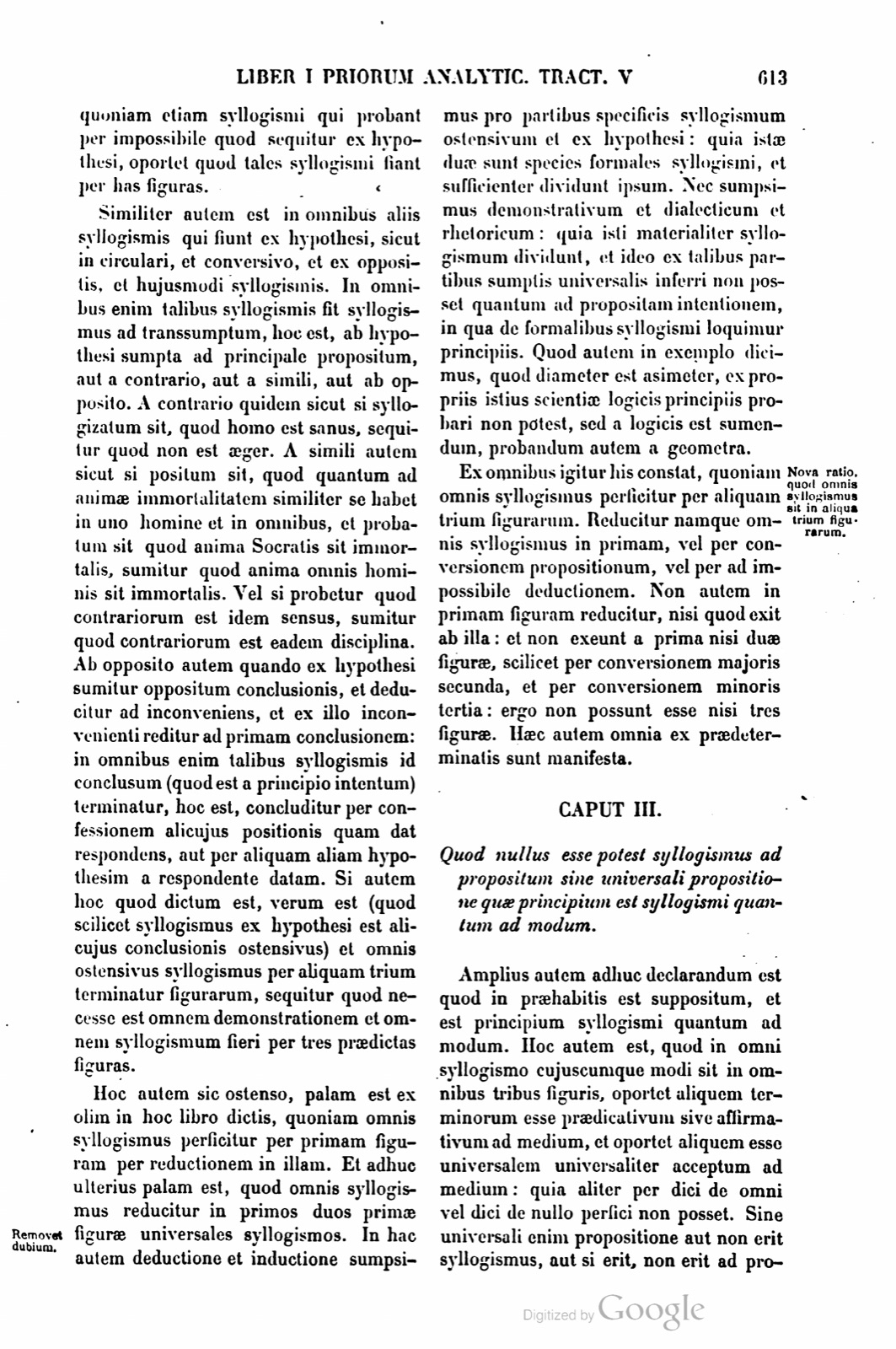
Hoc autem sic ostenso, palam est ex olim in hoc libro dictis, quoniam omnis syllogismus perficitur per primam figuram per reductionem in illam. Et adhuc ulterius palam est, quod omnis syllogismus reducitur in primos duos primae figurae universales syllogismos. In hac autem deductione et inductione sumpsimus pro partibus specificis syllogismum ostensivum et ex hypothesi: quia istae duae sunt species formales syllogismi, et sufficienter dividunt ipsum. Nec sumpsimus demonstrativum et dialecticum et rhetoricum: quia isti materialiter syllogismum dividunt, et ideo ex talibus partibus sumptis universalis inferri non posset quantum ad propositam intentionem, in qua de formalibus syllogismi loquimur principiis. Quod autem in exemplo dicimus, quod diameter est asimeter, ex propriis istius scientiae logicis principiis probari non potest, sed a logicis est sumendum, probandum autem a geometra.
Ex omnibus igitur his constat, quoniam omnis syllogismus perficitur per aliquam trium figurarum. Reducitur namque omnis syllogismus in primam, vel per conversionem propositionum, vel per ad impossibile deductionem. Non autem in primam figuram reducitur, nisi quod exit ab illa: et non exeunt a prima nisi duae figurae, scilicet per conversionem majoris secunda, et per conversionem minoris tertia: ergo non possunt esse nisi tres figurae. Haec autem omnia ex praedeterminatis sunt manifesta.
But when this has thus been shown, it is plain from what was said earlier in this book that every syllogism is perfected through the first figure by reduction into it. And still further it is plain that every syllogism is reduced into the first two universal syllogisms of the first figure. But in this deduction and induction we have taken as specific parts the ostensive syllogism and the syllogism from hypothesis, because these two are the formal species of syllogism and divide it sufficiently. Nor have we taken the demonstrative, the dialectical, and the rhetorical, because these divide syllogism materially; and therefore, if parts of this sort were taken, the universal could not be inferred with respect to the proposed intention, in which we speak about the formal principles of syllogism. But what we say in the example, that the diameter is asymmetrical, cannot be proved from the proper logical principles of this science, but must be taken from logicians and proved by a geometer.
Therefore from all these things it is established that every syllogism is perfected through one of the three figures. For every syllogism is reduced into the first figure, either through conversion of propositions or through deduction to the impossible. But nothing is reduced into the first figure except what goes out from it; and only two figures go out from the first, namely the second through conversion of the major, and the third through conversion of the minor. Therefore there cannot be more than three figures. But all these things are manifest from what has been predetermined.
If a page does not appear, its photograph has not been uploaded yet.