Works › Prior Analytics, Books I–II
Volume 1 · pp. 615–617
Continuation and end of Chapter III
A marker with ≈ is an approximate page boundary, placed by measure of the text; the page photographs remain the authority. In the paired views, clicking a page marker brings that page into view.
aequicrurus esse aequicrurum non potest probari nisi per circulum et per lineas quae a centro ducuntur ad circumferentiam: et hoc supponit probanda conclusio, quod aequicrurus sit aequicrurus.
Sit ergo circulus A B C D, et ducantur lineae diametraliter per centrum circuli A C et B D, et deinde ducatur linea ex C in D quae claudit triangulum in una quarta circuli portione: et sic erit illa linea basis trianguli aequilateri, cui basi subtenditur quarta circuli portio quae est C D, qui triangulus super basim versus angulum trianguli qui est in centro circuli habebit duos angulos: et sint illi E unus, et F alius; et sic in hac figura sunt duo genera angulorum, anguli scilicet portionum, qui vocantur anguli incisionum qui fiunt ex linea curva portionis circuli et linea recta quae est semidiameter: sicut est angulus A B in una portione, et angulus B C in alia portione, et angulus C D in tertia, et angulus A D in quarta: et vocantur isti anguli portionum circuli ad diametrum clausi. Sunt etiam anguli trianguli qui in centro per duas diametros se orthogonaliter secantes clauduntur in circuli centro. Alii autem duo acuti clauduntur basi trianguli ad duas semidiametros. Adhuc sunt duo alii acuti anguli, quia clauduntur basi trianguli et circumferentia: quia basis trianguli chorda est subtensa arcui qui est quarta portio circuli: quae portio est C D, et ideo illi duo anguli signantur per D C. Et ideo hi duo anguli vocantur et sunt anguli incisionum sive portionum circuli: quia unus in una parte ubi linea E F incidit circulum in puncto D, et alius est ubi eadem linea incidit circulum in puncto C.
His ergo sic descriptis, ponamus quod aliquis volens probare, quod anguli trianguli sunt aequales, assumpserit primo in prosyllogismo angulum A C lineae diametralis, quam facit diameter cum linea circuli in A una parte, et in C alia sui parte, aequalem esse ei angulo qui est B D, hoc est, ei quem facit alia diameter cum circumferentia: et sumat hoc particulariter, et non sumpserit universaliter, probans quod omnes anguli se in circulorum vel quartarum circuli ex diametro et circulari clausi sunt aequales: sed dicat angulum C esse aequalem ei qui est D vel B, et non assumit universaliter dicens, quod omnes anguli incisionum qui claudunt ad diametrum in puncto ubi incidit vel secat circulum, sunt aequales.
Amplius si volens concludere, quod anguli aequicruri super basim sunt aequales, et sumpserit singulariter, quod ab istis angulis per conum [portionum] qui sunt D C aequalibus demptis quae relinquuntur sunt aequalia, et non sumpserit universaliter sic, quod ab omnibus aequalibus demptis aequalibus quae relinquuntur sunt aequalia: ille petit quod est ex principio.
isosceles cannot be proved to be isosceles except through a circle and through lines which are drawn from the center to the circumference; and this supposes the conclusion to be proved, that the isosceles is isosceles.
Therefore let there be a circle A B C D, and let diametral lines A C and B D be drawn through the center of the circle, and then let a line be drawn from C to D which encloses the triangle in one fourth part of the circle. And thus that line will be the base of the equilateral triangle, to which base the fourth portion of the circle, which is C D, is subtended. This triangle upon the base, toward the angle of the triangle which is in the center of the circle, will have two angles; and let one of them be E and the other F. And thus in this figure there are two genera of angles, namely angles of portions, which are called angles of incisions, which are made from the curved line of the portion of the circle and the straight line which is a semidiameter, as is angle A B in one portion, angle B C in another portion, angle C D in the third, and angle A D in the fourth. And these are called angles of portions of the circle closed at the diameter. There are also the angles of the triangle which are enclosed in the center of the circle by two diameters cutting one another orthogonally. But two other acute angles are enclosed by the base of the triangle toward two semidiameters. Again, there are two other acute angles, because they are enclosed by the base of the triangle and the circumference; for the base of the triangle is a chord subtended to the arc which is the fourth portion of the circle, which portion is C D, and therefore those two angles are marked by D C. And therefore these two angles are called and are angles of incisions or portions of the circle, because one is in one part where line E F enters the circle at point D, and the other is where the same line enters the circle at point C.
Therefore, with these things thus described, let us suppose that someone wishing to prove that the angles of the triangle are equal first assumed in a prosyllogism that angle A C of the diametral line, which the diameter makes with the line of the circle in one part at A and in the other part at C, is equal to that angle which is B D, that is, to the one which the other diameter makes with the circumference; and let him take this particularly and not universally, proving that all angles in circles, or in fourth parts of the circle, enclosed from the diameter and the circular line, are equal. But let him say that angle C is equal to that which is D or B, and let him not assume universally by saying that all angles of incisions which enclose at the diameter at the point where it enters or cuts the circle are equal.
Moreover, if, wishing to conclude that the angles of the isosceles over the base are equal, he takes singularly that, from these angles through the cone [of the portions], which are the equal D C, when equals are subtracted, what remain are equal, and he does not take it universally in this way, that from all equals, when equals are subtracted, what remain are equal, he begs what is from the beginning. Textual note: the Latin reads `per conum`; context seems to require `portionum`, "of the portions," as in the later phrase `anguli portionum D et C`.
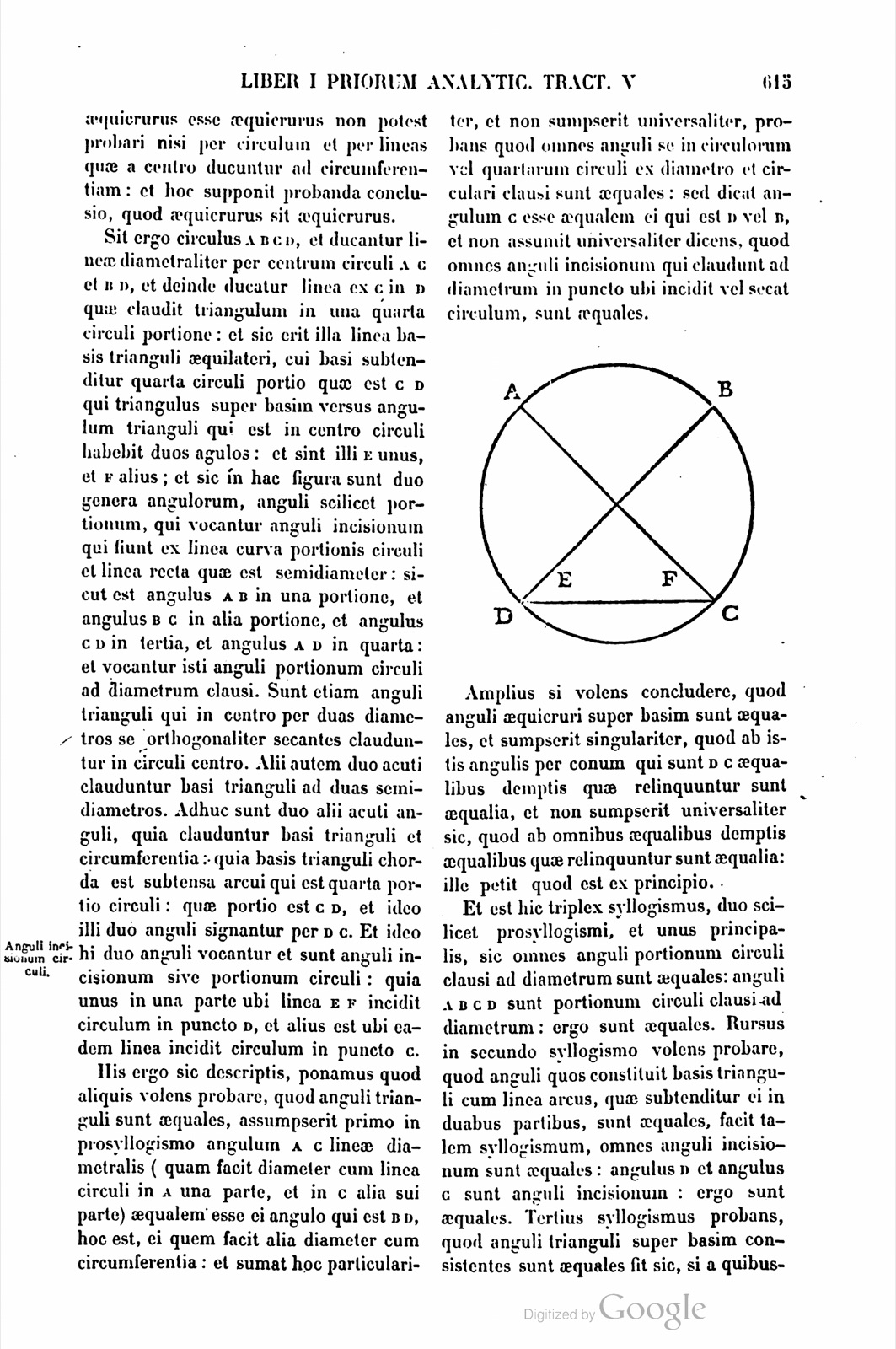
Et est hic triplex syllogismus, duo scilicet prosyllogismi, et unus principalis, sic, omnes anguli portionum circuli clausi ad diametrum sunt aequales: anguli A B C D sunt portionum circuli clausi ad diametrum: ergo sunt aequales. Rursus in secundo syllogismo volens probare, quod anguli quos constituit basis trianguli cum linea arcus, quae subtenditur ei in duabus partibus, sunt aequales, facit talem syllogismum, omnes anguli incisionum sunt aequales: angulus D et angulus C sunt anguli incisionum: ergo sunt aequales. Tertius syllogismus probans, quod anguli trianguli super basim consistentes sunt aequales fit sic, si a quibuslibet aequalibus aequalia demantur, quae relinquuntur sunt aequalia: sunt autem aequalia anguli portionum D et C, ergo demptis aequalibus ab eis, quae relinquuntur adhuc erunt aequalia: demuntur autem D et C anguli qui clauduntur ex basi tanquam chorda, et C D arcu: ergo quae relinquuntur sunt aequalia: relinquuntur autem E F anguli trianguli qui sunt super basim: ergo anguli duo E F, qui super basim sunt, erunt aequales. Et in quolibet istorum syllogismorum si universalis propositio non sumatur, non erit syllogismus. Et si idem particulare sumatur quod concluditur, erit petitio principii. Et si commune sine distributione sumatur, quod pro alio particulari verificari potest, non erit syllogismus ad propositum. Et si commune secundum se sumatur ad probandum, erit fallacia consequentis.
Manifestum est igitur, quoniam in omni syllogismo oportet esse universalem terminum universaliter sumptum. Manifestum est etiam, quoniam universale in conclusione, quod est propositio universalis conclusa, oportet monstrare et concludere ex omnibus terminis sive ex ambabus praemissis universalibus. Particulare autem sive propositio particularis, et concluditur ex ambabus universalibus, sicut in primo et secundo tertiae figurae: et concluditur aliter, ex altera scilicet universali, et altera particulari, tam in prima quam in secunda et tertia figuris. Propter quod si conclusio quidem in syllogismo sit universalis, necesse est ambos terminos ad medium universales esse: sed non convertitur: contingit enim quod universales sint termini ad medium, et tamen conclusio non erit universalis, sicut in tertia figura. Et hujus causa jam determinata est: quia scilicet medium in tertia figura est sicut pars extremorum et ideo extremum cum extremo non potest universaliter copulare et conjungere.
And here there is a threefold syllogism, namely two prosyllogisms and one principal syllogism, thus: all angles of portions of the circle enclosed at the diameter are equal; angles A B C D are portions of the circle enclosed at the diameter; therefore they are equal. Again, in the second syllogism, wishing to prove that the angles which the base of the triangle constitutes with the line of the arc which is subtended to it in two parts are equal, he makes such a syllogism: all angles of incisions are equal; angle D and angle C are angles of incisions; therefore they are equal. The third syllogism, proving that the angles of the triangle standing upon the base are equal, is made thus: if from any equals whatever equals are subtracted, the things which remain are equal. But angles of portions D and C are equal; therefore, when equals have been subtracted from them, what remain will still be equal. But angles D and C, which are enclosed from the base as from a chord and from the C D arc, are subtracted; therefore what remain are equal. But E F remain, the angles of the triangle which are upon the base; therefore the two angles E F which are upon the base will be equal. And in any of those syllogisms, if the universal proposition is not taken, there will not be a syllogism. And if the same particular is taken which is concluded, there will be a begging of the principle. And if the common term is taken without distribution, which can be verified for another particular, there will not be a syllogism to the proposed point. And if the common term is taken according to itself for proving, there will be a fallacy of the consequent.
Therefore it is manifest that in every syllogism there must be a universal term taken universally. It is also manifest that the universal in the conclusion, which is the concluded universal proposition, must be shown and concluded from all the terms or from both universal premises. But the particular, or particular proposition, is both concluded from both universal premises, as in the first and second modes of the third figure, and is concluded in another way, namely from one universal and the other particular, both in the first and in the second and third figures. For this reason, if the conclusion in a syllogism is universal, both terms must be universal toward the middle. But it is not converted: for it happens that the terms are universal toward the middle, and nevertheless the conclusion will not be universal, as in the third figure. And the cause of this has already been determined: namely because the middle in the third figure is as a part of the extremes, and therefore one extreme cannot universally join and connect with the other extreme.
Patet etiam quod alteram oportet esse affirmativam: quia negatio nihil copulat, et non dividit et removet aliquid ab aliquo, nisi per aliquid quod affirmatum est de altero, et inest ei: et ideo medium non conjungeret extrema nec separaret, nisi affirmative se haberet ad alterum extremorum.
Palam etiam est quoniam in omni syllogismo aut utramque aut alteram praemissarum necesse est esse similem conclusioni in compositione. Dico autem quod non solum similem esse necesse sit in affirmatione vel negatione, sed etiam in eo quod sit cum modo necessitatis vel contingentis aut inesse conclusio similis sit alicui praemissarum. Nihilominus tamen in hac similitudine considerare etiam oportet alia praedicamenta sive modos praedicandi, sicut est verum, et falsum, et hujusmodi.
Manifestum est etiam ex praedictis quando erit simpliciter et universaliter syllogismus in omnibus figuris quoad modum et figuram, et quando non erit syllogismus, sicut in conjugationibus inutilibus. Adhuc autem manifestum est quando erit syllogismus imperfectus, possibilis tamen ad perfectionem, sicut in secunda et tertia figuris: et manifestum est quando erit perfectus, sicut in prima figura. Manifestum est etiam, quod quando est syllogismus, necessarium est quod termini in praemissis se habeant in figura et modo secundum aliquid in praedictis dictorum modorum.
Quod autem dictum est, quod oportet conclusionem esse particularem, quando altera praemissarum particularis est, ideo est: quia quando medium conjungitur alteri extremorum particulariter, non potest esse unitivum et copulativum universaliter: quia id quod est in parte, non infert id quod est in toto, sed e converso.
Adhuc autem cum altera praemissarum est negativa, oportet conclusionem esse negativam: quia cum alterum extremorum dividitur a medio, vel e converso, non potest medium conjungere extrema per unionem quam extrema habeant cum ipso: et ideo particulariter conjunctum uni et remotum ab altero, causa est separationis extremi ab extremo.
Adhuc autem quod dictum est, quod idem non potest probari per seipsum, non intelligitur de his quae sunt eadem per substantiam, sed de his quae eadem sunt secundum principia quibus sumuntur et cognoscuntur: et ideo diffinitio probat diffinitum, quia sub notioribus principiis est diffinitio quam diffinitum: sic est hic in probatione quam induximus. Haec est igitur vera sententia de illis.
It is also clear that one premise must be affirmative, because negation joins nothing, and it does not divide and remove something from something except through something which has been affirmed of the other and inheres in it; and therefore the middle would neither join the extremes nor separate them unless it had itself affirmatively to one of the extremes.
It is plain also that in every syllogism either both premises or one of the premises must be similar to the conclusion in composition. But I say that it must be similar not only in affirmation or negation, but also in this, that the conclusion is similar to one of the premises with the mode of necessity, contingency, or inherence. Nevertheless in this likeness it is also necessary to consider other predicaments or modes of predicating, such as true and false and the like.
It is also manifest from the aforesaid when there will be a syllogism simply and universally in all figures with respect to mode and figure, and when there will not be a syllogism, as in useless conjugations. Again it is manifest when there will be an imperfect syllogism, nevertheless possible for perfection, as in the second and third figures; and it is manifest when it will be perfect, as in the first figure. It is also manifest that, when there is a syllogism, it is necessary that the terms in the premises have themselves in figure and mode according to something among the aforesaid modes that have been stated.
But what has been said, that the conclusion must be particular when one of the premises is particular, is so for this reason: because when the middle is joined particularly to one of the extremes, it cannot be unitive and connective universally, because what is in the part does not infer what is in the whole, but conversely.
Again, when one of the premises is negative, the conclusion must be negative, because when one of the extremes is divided from the middle, or conversely, the middle cannot join the extremes through the union which the extremes have with it; and therefore what is particularly joined to one and removed from the other is the cause of the separation of extreme from extreme.
Again, what was said, that the same thing cannot be proved through itself, is not understood of those things which are the same through substance, but of those things which are the same according to the principles by which they are taken and known. And therefore the definition proves the thing defined, because the definition is under principles better known than the thing defined; so it is here in the proof which we have introduced. This therefore is the true opinion about those things.
If a page does not appear, its photograph has not been uploaded yet.