Works › Prior Analytics, Books I–II
Volume 1 · pp. 609–612
Treatise V. On the sufficiency of the three figures that have been treated. Chapter I. That every syllogism is according to one of the three figures.
A marker with ≈ is an approximate page boundary, placed by measure of the text; the page photographs remain the authority. In the paired views, clicking a page marker brings that page into view.
TRACTATUS V. DE SUFFICIENTIA FIGURARUM TRIUM HABITARUM.
CAPUT I. Quod omnis syllogismus est secundum aliquam trium figurarum.
In generatione sive formatione syllogismorum quaedam sunt principia supposita quoad figuram, et quaedam quantum ad modum in figura. Quantum ad figuram quidem sicut illud, quod omnis syllogismus est in aliqua trium figurarum, et quod fit figura ex dispositione trium terminorum, et quod omnis syllogismus fit ex duabus propositionibus et una conclusione: quae perfecte ostendi et declarari non poterant, nisi omnibus syllogismis in figura et modis formatis. Quia igitur syllogismi omnes secundum diversitates figurarum positi sunt, consequenter nunc illa principia declaranda sunt, et quantum ad formalia, et quantum ad materialia principia generalia syllogismorum. Et formalia quae sunt de figura, et formalia quantum ad modum, in hoc tractatu sunt declaranda: et ad hoc specialem oportet inducere tractatum.
Dicamus igitur, quoniam omnes qui in dictis figuris sunt syllogismi, perficiuntur per eos syllogismos universales duos qui sunt in prima figura, universalem scilicet affirmativam primum, et universalem negativam secundum, palam est ex praedictis in tractatu praecedenti. Quoniam autem omnis syllogismus semper sic se habebit, quod sit in aliquo modo trium figurarum, hoc nunc in hoc tractatu erit manifestum, postquam ostensum fuerit quod omnis syllogismus est et fit per aliquam trium figurarum.
Ad hoc autem ostendendum, primo proponimus hanc propositionem a finali causa omnis syllogismi sumptam, scilicet quod necesse est omnem syllogismum in conclusione demonstrare alterum duorum, scilicet aut inesse aliquod praedicatum alicui subjecto, sicut syllogismus affirmativus, aut non inesse aliquod praedicatum alicui subjecto, sicut syllogismus negativus: et hoc aut universaliter, aut particulariter: universaliter quidem quando concludit universaliter, particulariter autem quando concludit particulariter.
Adhuc accipiendo partes dividentes formaliter syllogismum in species, dicimus quod necesse est omnem syllogismum esse vel ostensivum, vel ex hypothesi. Si enim disputatur ad rem declarandam, necesse est ostensivum esse. Si autem disputatur ad positionem aliquam datam, necesse est syllogismum esse ex hypothesi. Unde ejus syllogismi qui est ex hypothesi pars essentialis et species est ille syllogismus qui est ad impossibile. Syllogismus enim ad impossibile, qui datum ex hypothesi, sumit conclusionis oppositum, et ex illo et altera praemissarum syllogizat oppositum alterius praemissarum. Unde quoad illam conclusionem quam infert ex opposito conclusionis, est ipse ex hypothesi, quamvis quantum ad primam conclusionem quam probat et probare intendit, sit ostensivus.
Primo ergo dicamus de syllogismis ostensivis, probantes quod omnis syllogismus ostensivus est in aliqua trium figurarum. His enim ostensis quod sint in aliqua trium figurarum, manifestum erit quod hi qui ad impossibile sunt, etiam sunt in aliqua trium figurarum: et omnino sive universaliter erit hoc manifestum de syllogismis qui sunt ex hypothesi. Ad probandum ergo quod omnis syllogismus ostensivus est in aliqua trium figurarum, primo sumimus hanc propositionem, quod si in syllogismi conclusione oporteat A praedicatum de B subjecto syllogizare secundum esse affirmativum, vel non esse negativum, necesse est ad hoc probandum sumere aliquid de aliquo in propositionibus: quia complexum, sicut in principio hujus scientiae ostensum est, non probatur nisi per complexum aliquid de aliquo enuntians affirmative vel negative: aut ergo sumetur idem quod concluditur, sic quod ad probandum A de B sumatur A de B sic, B est A, ergo B est A, et sic erit sumere id quod est in principio, et peccatum erit in argumentatione tali: quia idem per seipsum non potest probari: quia sic idem esset notius et ignotius seipso, quod esse non potest.
TREATISE V. ON THE SUFFICIENCY OF THE THREE FIGURES THAT HAVE BEEN TREATED.
CHAPTER I. That every syllogism is according to one of the three figures.
In the generation or formation of syllogisms, certain principles are supposed with respect to the figure, and certain ones with respect to the mode in the figure. With respect to the figure, indeed, there is such a principle as this, that every syllogism is in one of the three figures, and that a figure is made from the disposition of three terms, and that every syllogism is made from two propositions and one conclusion. These could not perfectly be shown and declared unless all syllogisms had been formed in figure and modes. Therefore, because all syllogisms have been posited according to the diversities of the figures, consequently now those principles must be declared, both with respect to the formal principles and with respect to the general material principles of syllogisms. And the formal principles which concern figure, and the formal principles with respect to mode, must be declared in this treatise; and for this it is necessary to introduce a special treatise.
Therefore let us say that all syllogisms which are in the figures mentioned are perfected through those two universal syllogisms which are in the first figure, namely the first universal affirmative and the second universal negative; this is plain from the things said before in the preceding treatise. But that every syllogism will always have itself in such a way that it is in some mode of the three figures will now be manifest in this treatise, after it has been shown that every syllogism is and is made through one of the three figures.
But to show this, first we propose this proposition taken from the final cause of every syllogism, namely that every syllogism must demonstrate in the conclusion one of two things, namely either that some predicate inheres in some subject, as an affirmative syllogism does, or that some predicate does not inhere in some subject, as a negative syllogism does; and this either universally or particularly, universally indeed when it concludes universally, and particularly when it concludes particularly.
Again, taking the parts which divide syllogism formally into species, we say that every syllogism must be either ostensive or from hypothesis. For if one disputes in order to declare the thing, it must be ostensive. But if one disputes toward some given position, the syllogism must be from hypothesis. Hence an essential part and species of the syllogism which is from hypothesis is that syllogism which is to the impossible. For a syllogism to the impossible, which is given from hypothesis, takes the opposite of the conclusion, and from that and one of the premises syllogizes the opposite of the other premise. Hence with respect to that conclusion which it infers from the opposite of the conclusion, it is itself from hypothesis, although with respect to the first conclusion which it proves and intends to prove, it is ostensive.
Therefore first let us speak about ostensive syllogisms, proving that every ostensive syllogism is in one of the three figures. For when it has been shown that these are in one of the three figures, it will be manifest that those which are to the impossible also are in one of the three figures; and wholly or universally this will be manifest about syllogisms which are from hypothesis. Therefore, to prove that every ostensive syllogism is in one of the three figures, we first take this proposition: that if in the conclusion of a syllogism it is necessary to syllogize A, the predicate, of B, the subject, according to affirmative being or negative non-being, for proving this it is necessary to take something of something in the propositions. For a complex, as was shown in the beginning of this science, is proved only through a complex enunciating something of something affirmatively or negatively. Therefore either the same thing that is concluded will be taken, so that in order to prove A of B, A of B is taken thus, B is A, therefore B is A, and thus it will be to take what is in the beginning, and there will be a fault in such argumentation; because the same thing cannot be proved through itself, because in this way the same thing would be better known and less known than itself, which cannot be.
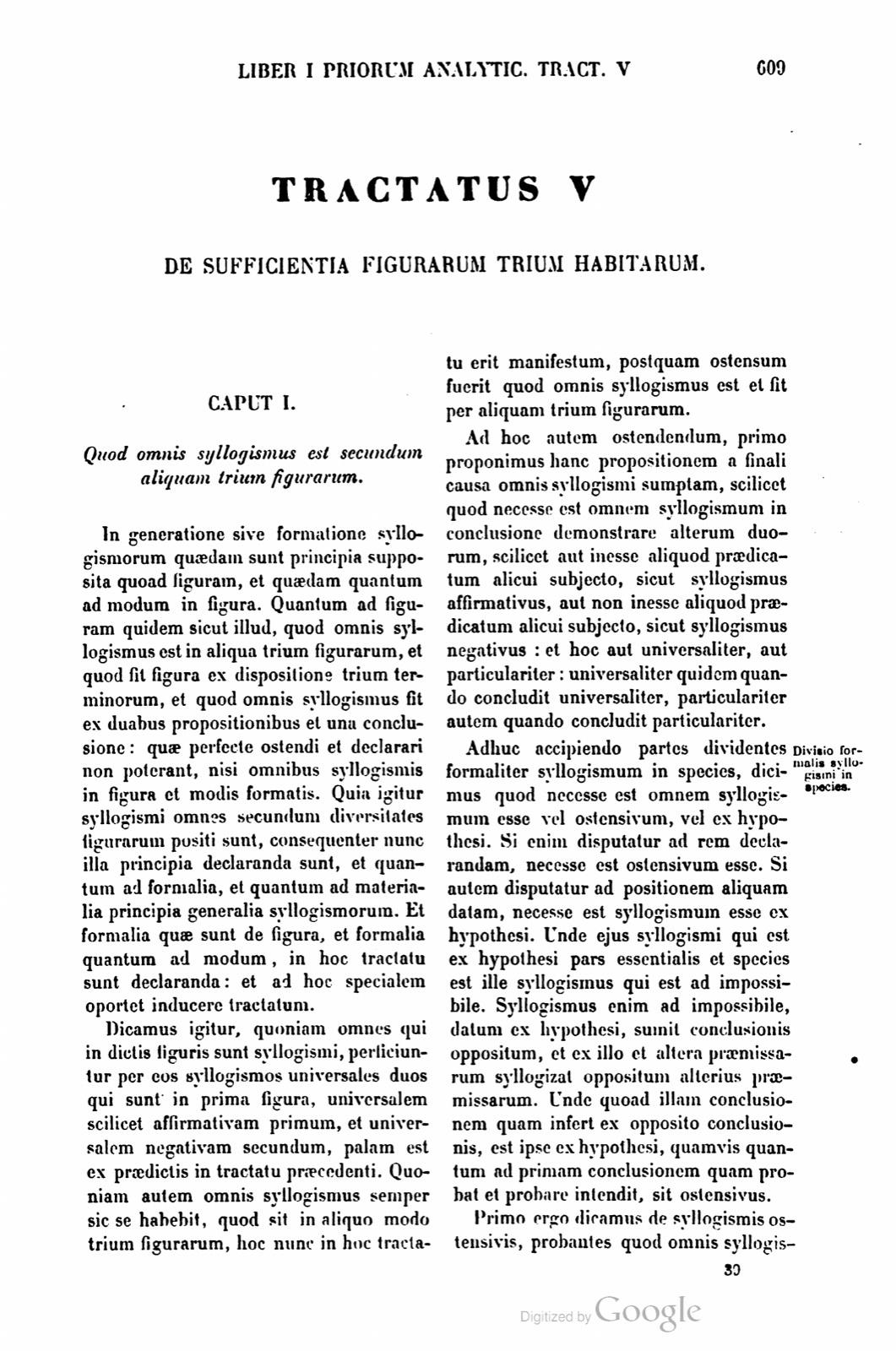
Si autem non idem erit assumendum, hoc iterum potest esse duobus modis: aut enim accipitur aliquod quod est communicans cum A et B, aut non. Si est non communicans utrique extremo quod est in conclusione, erit sicut si sumatur sub uno extremorum, sicut si dicam, quod sumitur A de C quod sub A continetur. Si autem sic sumatur A quod C de nullo praedicetur, eo quod nihil accipiatur sub ipso C de quo A sumptum est, sicut fit in prima figura: nec iterum aliquod communius illo sumatur de C quod sub A sumptum est, sicut fit in tertia figura: nec etiam sumatur alterum aliquod praedicatum de A sicut fit in secunda figura, in qua unum praedicatum ad duo refertur subjecta, nullus erit syllogismus: quia medium sumptum ad extrema in nullo communicat extremis: quia nec est praedicatum unius et alterius subjectum, nec subjectum amborum, nec utriusque praedicatum: et ideo in nulla complexione et terminorum dispositione communicat cum ipsis: incommunicans autem ex incommunicante concludi non potest. Dico autem incommunicans secundum dispositionem et complexionem enuntiantis aliquid de aliquo, vel aliquid dividi ab aliquo: secundum hoc enim etiam differentia et opposita communicant. In eo enim quod unum praedicatum de uno sumitur subjecto, nihil accidit sive sequitur ex necessitate syllogistica, sicut in ante habitis ostensum est: quia si concluditur aliquid de aliquo, oportet quod concludatur per aliquid, quod sit utrique communicans: oportet igitur assumere etiam alteram propositionem, ut in una medium se habeat ad unum extremorum, et in altera ad alterum extremorum.
Si igitur hoc modo sumatur A extremum de alio aliquo cui insit ut praedicatum: aut sumatur aliud praedicatum de A quod quidem sit C, et si de C, quod est praedicatum de A, sumatur alterum praedicatum: tunc nihil prohibet fieri syllogismum ad aliquid cui communicat C; sed ille syllogismus non erit ad A probandum de B, quia C non communicat cum B neque sicut subjectum ipsius, neque sicut praedicatum: et ideo de B nihil potest probari per C sic sumptum, per ea quae sic sumpta sunt, cum in nullo sint communicantia.
But if the same thing is not to be assumed, this again can be in two ways: for either something is accepted which communicates with A and B, or not. If it does not communicate with either extreme which is in the conclusion, it will be as if it were taken under one of the extremes, as if I say that A is taken of C, which is contained under A. But if A is taken in such a way that C is predicated of nothing, because nothing is accepted under C itself of which A has been taken, as happens in the first figure; nor again is something more common than it taken of C which has been taken under A, as happens in the third figure; nor is some other predicate of A taken, as happens in the second figure, in which one predicate is referred to two subjects, there will be no syllogism, because the middle taken toward the extremes communicates with the extremes in nothing. For it is neither the predicate of one and the subject of the other, nor the subject of both, nor the predicate of both. And therefore in no complex and disposition of terms does it communicate with them; but what is non-communicating cannot be concluded from what is non-communicating. But I call it non-communicating according to the disposition and complex of one enunciating something of something, or something divided from something; for according to this even difference and opposites communicate. For in the fact that one predicate is taken of one subject, nothing happens or follows from syllogistic necessity, as was shown in the matters had before; because if something is concluded of something, it must be concluded through something which communicates with both. Therefore it is necessary to assume another proposition also, so that in one the middle has itself to one of the extremes, and in the other to the other extreme.
Therefore if in this way A, the extreme, is taken of some other thing in which it inheres as predicate, or some other predicate is taken of A, which indeed is C, and if of C, which is the predicate of A, another predicate is taken, then nothing prevents a syllogism being made for something with which C communicates; but that syllogism will not be for proving A of B, because C does not communicate with B either as its subject or as predicate. And therefore nothing can be proved of B through C thus taken, through those things which are thus taken, since they are communicating in nothing.
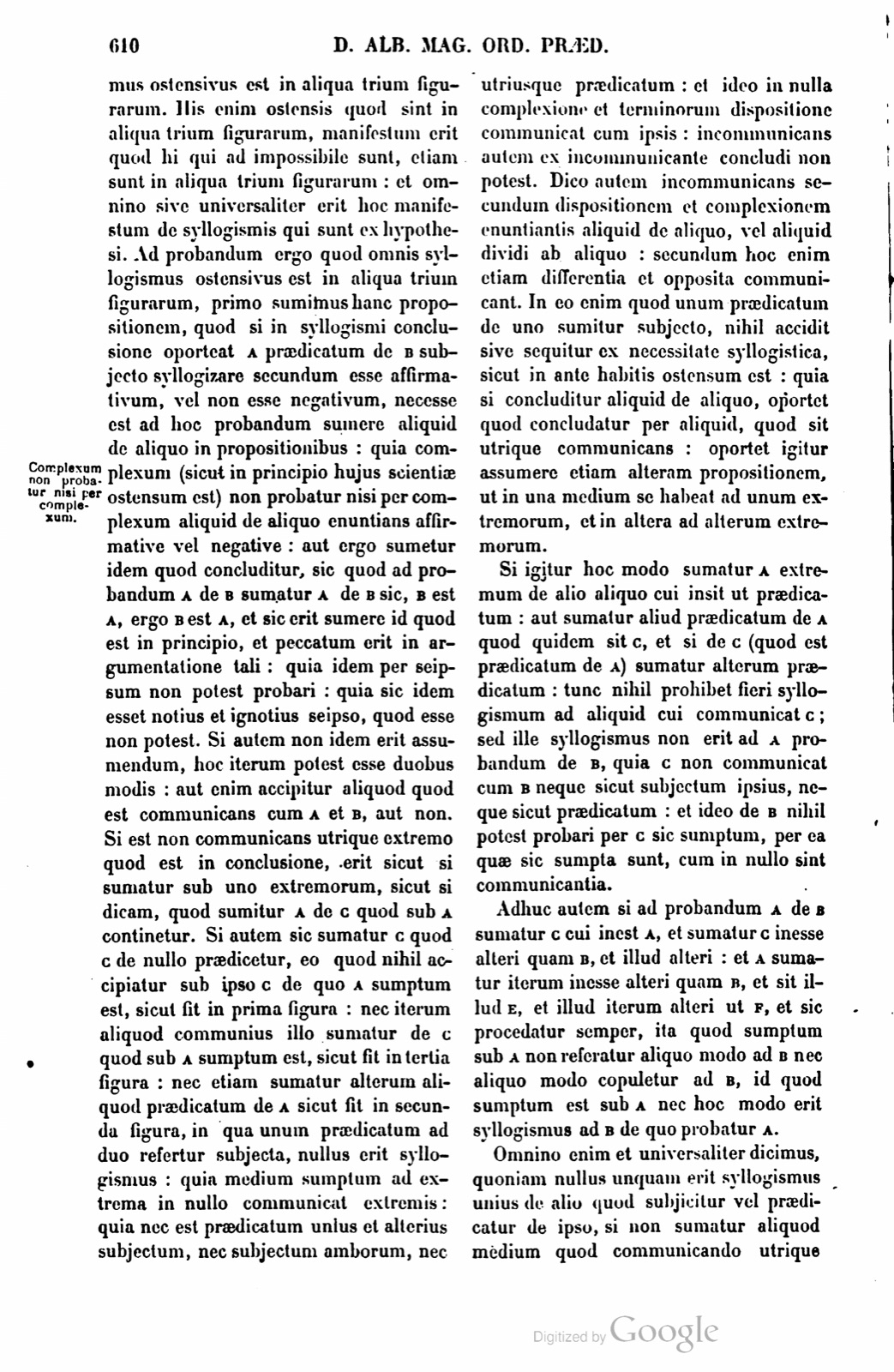
Adhuc autem si ad probandum A de B sumatur C cui inest A, et sumatur C inesse alteri quam B, et illud alteri: et A sumatur iterum inesse alteri quam B, et sit illud E, et illud iterum alteri ut F, et sic procedatur semper, ita quod sumptum sub A non referatur aliquo modo ad B nec aliquo modo copuletur ad B, id quod sumptum est sub A nec hoc modo erit syllogismus ad B de quo probatur A.
Omnino enim et universaliter dicimus, quoniam nullus unquam erit syllogismus unius de alio quod subjicitur vel praedicatur de ipso, si non sumatur aliquod medium quod communicando utrique extremorum non se habeat ad utrumque extremorum, vel ut praedicatum de uno et subjectum alteri, vel praedicatum de utroque, vel ut subjectum utrique. Oportet igitur quod quoquo modo praedicationibus, sive secundum aliquem modum praedicandi, se habeat ad utrumque extremorum. Cujus probatio est ex fine et ratione syllogismi. Syllogismus simpliciter, hoc est, absolute et in sua communitate sumptus, est ex propositionibus enuntiantibus aliquid de aliquo. Syllogismus autem hic et ille qui est ad probandum hoc determinatum praedicatum de hoc determinato subjecto, est ex propositionibus determinatis, quae sunt ad probandum et enuntiandum hoc de hoc determinate. Syllogismus autem qui est hujus extremi ad hoc extremum, est ex propositionibus determinatis habentibus medium, quod est habitudo hujus ad hoc. Est autem impossibile sumere propositionem quae probet de B A, sumendo talem in qua nihil praedicetur, neque negetur de B. Aut rursum dicendo, quod impossibile sumere propositionem talem, quae sit probans A de B, ita quod sumatur talis in qua nulla sit habitudo communitatis ad A et ad B, ita quod ad utrumque talis propositio, quae nihil communitatis habet cum A et B, sumatur, et si utriusque istorum sumuntur propria in quibus cum altera non communicat, neque secundum affirmationem, neque secundum negationem. Propter quod oportet quod tale sumatur medium ad extrema, quod copulet et uniat ea secundum praedicationes, sive secundum aliquem modum praedicationis: quia etiam in negativis aliquis est modus praedicationis, si debeat esse hujus extremi ad hoc alterum extremum syllogismus.
Sic ergo necesse est sumere medium quod ad utraque extrema se habeat in aliqua communitate sive communicatione. Si autem sic se habeat habitudo medii ad extrema, statim probatur numerus figurarum. Communicationem enim medii fieri ad extrema ambo non contingit nisi tripliciter.1 Aut sic communicat medium, sicut sit A majus extremum praedicatum de C medio, et A medium sit praedicatum de B minori extremo: et sic est prima figura. Aut A medium praedicatum est de utrisque extremis, sicut in secunda figura. Aut utraque extrema sunt praedicata de C medio, sicut in tertia figura. Hae medii communicationes cum extremis sunt tres dictae figurae, secundum quas determinatae sunt syllogismorum generationes. Et causa hujus est: quia praedicationis et enuntiationis modo non potest communicare medium cum extremis pluribus modis. In enuntiatione enim hujus de hoc non est habitudo nisi subjectionis vel praedicationis: unde communicatio medii ad extrema non est nisi per alteram istarum habitudinum, vel per utramque. Si autem per alteram est: aut est per subjectionem, aut per praedicationem. Et si est per utramque, non potest esse per utramque ad utrumque. Oportet ergo quod per unum modum se habeat ad unum, et per alterum modum ad alterum. Non autem potest ad majus se habere nisi modo subjectionis, quia aliter primum non esset primum: nec ad minus se potest habere nisi praedicando, quia aliter postremum non esset postremum.
Again, if to prove A of B, C is taken, to which A belongs, and C is taken to inhere in another than B, and that in another, and A is taken again to inhere in another than B, and let that be E, and that again in another as F, and so let it proceed always, so that what is taken under A is not referred in any way to B nor in any way joined to B, that which is taken under A will not in this way either be a syllogism for B, of which A is proved.
For wholly and universally we say that there will never be a syllogism of one thing about another which is subjected or predicated of it, unless some middle is taken which, by communicating with each extreme, has itself to both extremes either as predicate of one and subject of the other, or as predicate of both, or as subject of both. Therefore it is necessary that in some way, by predications or according to some mode of predicating, it have itself to both extremes. The proof of this is from the end and reason of the syllogism. A syllogism simply, that is, taken absolutely and in its commonality, is from propositions enunciating something of something. But this or that syllogism which is for proving this determinate predicate of this determinate subject is from determinate propositions which are for proving and enunciating this of this determinately. But a syllogism which is of this extreme to this extreme is from determinate propositions having a middle, which is the relation of this to this. But it is impossible to take a proposition which proves A of B by taking such a proposition in which nothing is predicated or negated of B. Or, saying it again, it is impossible to take such a proposition which is proving A of B, so that such a proposition is taken in which there is no relation of commonality to A and to B, so that such a proposition, which has no commonality with A and B, is taken toward each, even if the proper features of each of these are taken in which it does not communicate with the other, neither according to affirmation nor according to negation. For this reason it is necessary that such a middle be taken toward the extremes as joins and unites them according to predications or according to some mode of predication; for also in negatives there is some mode of predication, if there ought to be a syllogism of this extreme to that other extreme.
Thus therefore it is necessary to take a middle which has itself to both extremes in some commonality or communication. But if the relation of the middle to the extremes has itself in this way, the number of the figures is immediately proved. For communication of the middle to both extremes happens only in three ways.1 Either the middle communicates in this way: let A, the greater extreme, be predicated of C, the middle, and let A, the middle, be predicated of B, the lesser extreme; and thus there is the first figure. Or A, the middle, is predicated of both extremes, as in the second figure. Or both extremes are predicated of C, the middle, as in the third figure. These communications of the middle with the extremes are the three figures mentioned, according to which the generations of syllogisms have been determined. And the cause of this is that by the mode of predication and enunciation the middle cannot communicate with the extremes in more ways. For in the enunciation of this about this there is no relation except that of subjection or predication; hence the communication of the middle to the extremes is only through one of those relations, or through both. But if it is through one of them, it is either through subjection or through predication. And if it is through both, it cannot be through both to each extreme. Therefore it is necessary that it have itself to one in one mode and to the other in the other mode. But it cannot have itself to the greater except in the mode of subjection, because otherwise the first would not be first; nor can it have itself to the lesser except by predicating, because otherwise the last would not be last.
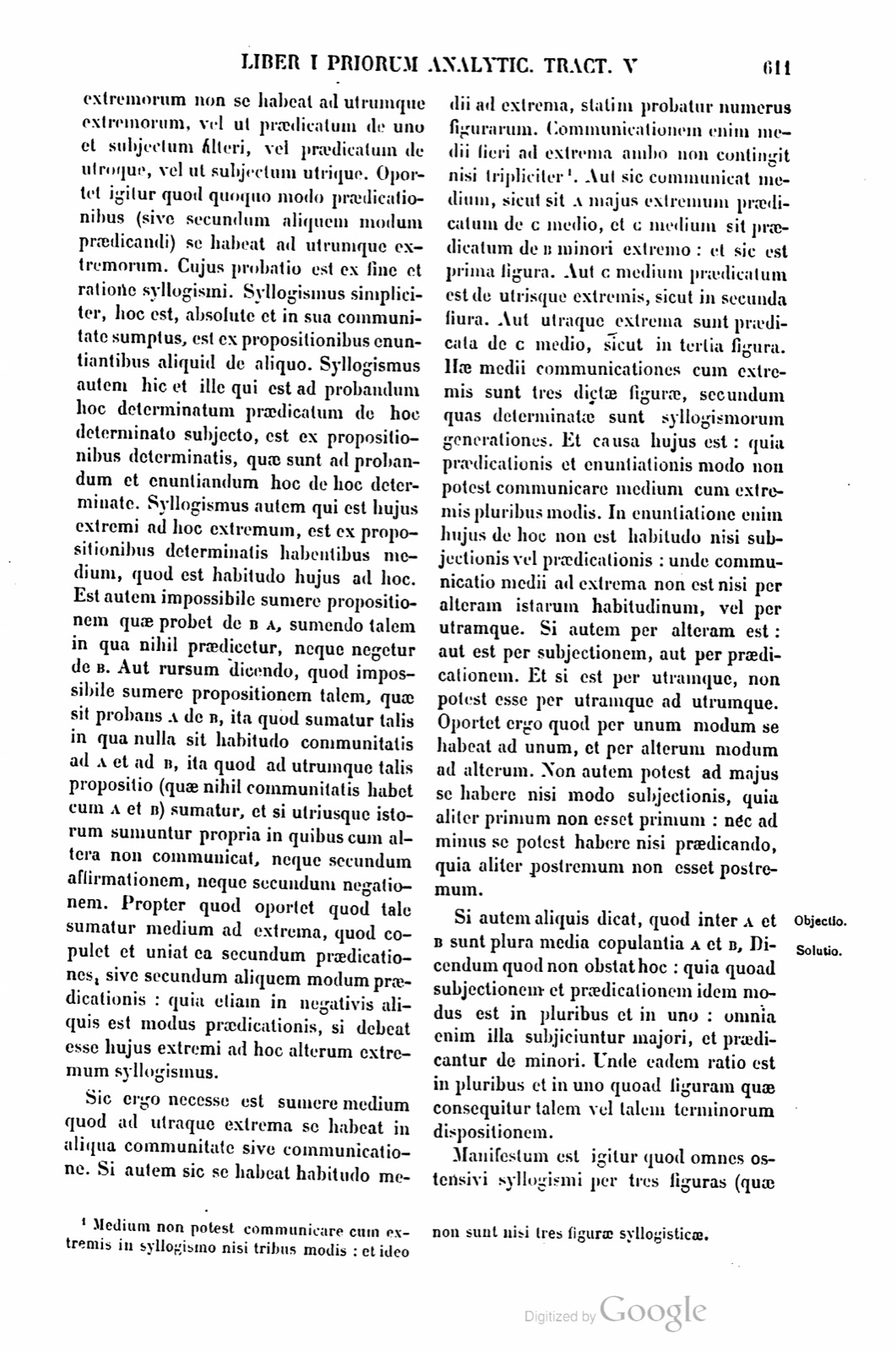
Si autem aliquis dicat, quod inter A et B sunt plura media copulantia A et B, dicendum quod non obstat hoc: quia quoad subjectionem et praedicationem idem modus est in pluribus et in uno: omnia enim illa subjiciuntur majori, et praedicantur de minori. Unde eadem ratio est in pluribus et in uno quoad figuram quae consequitur talem vel talem terminorum dispositionem.
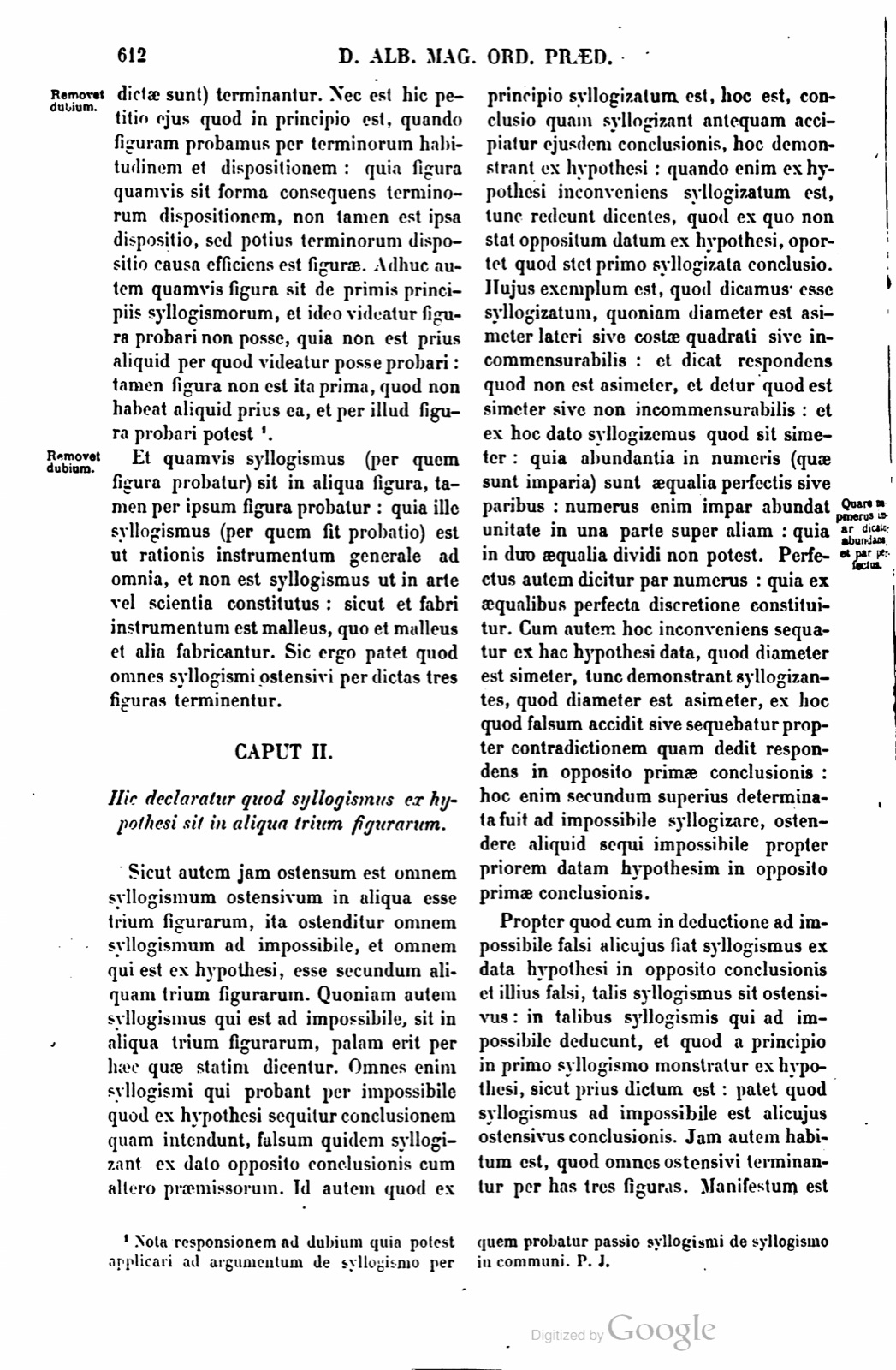
Manifestum est igitur quod omnes ostensivi syllogismi per tres figuras, quae dictae sunt, terminantur. Nec est hic petitio ejus quod in principio est, quando figuram probamus per terminorum habitudinem et dispositionem: quia figura quamvis sit forma consequens terminorum dispositionem, non tamen est ipsa dispositio, sed potius terminorum dispositio causa efficiens est figurae. Adhuc autem quamvis figura sit de primis principiis syllogismorum, et ideo videatur figura probari non posse, quia non est prius aliquid per quod videatur posse probari: tamen figura non est ita prima, quod non habeat aliquid prius ea, et per illud figura probari potest.2
Et quamvis syllogismus, per quem figura probatur, sit in aliqua figura, tamen per ipsum figura probatur: quia ille syllogismus, per quem fit probatio, est ut rationis instrumentum generale ad omnia, et non est syllogismus ut in arte vel scientia constitutus: sicut et fabri instrumentum est malleus, quo et malleus et alia fabricantur. Sic ergo patet quod omnes syllogismi ostensivi per dictas tres figuras terminentur.
But if someone says that between A and B there are several middles joining A and B, one must say that this does not prevent the argument, because with respect to subjection and predication the same mode is in many as in one; for all those middles are subjected to the major and are predicated of the minor. Hence the same reasoning holds in many and in one with respect to the figure which follows such or such a disposition of terms.
Therefore it is manifest that all ostensive syllogisms are terminated by the three figures which have been mentioned. Nor is there here a begging of what is in the beginning when we prove figure through the relation and disposition of terms, because, although figure is a form following upon the disposition of terms, nevertheless it is not the disposition itself, but rather the disposition of terms is the efficient cause of the figure. Again, although figure belongs to the first principles of syllogisms, and therefore it seems that figure cannot be proved, because there is not something prior through which it could seem able to be proved, nevertheless figure is not so first that it does not have something prior to it, and through that figure can be proved.2
And although the syllogism through which figure is proved is in some figure, nevertheless figure is proved through it, because that syllogism through which the proof is made is as a general instrument of reason for all things, and is not a syllogism as constituted in an art or science, just as the instrument of a craftsman is a hammer, with which both the hammer and other things are fashioned. Thus therefore it is clear that all ostensive syllogisms are terminated through the said three figures.
Notes
- The middle cannot communicate with the extremes in a syllogism except in three ways; and therefore there are only three syllogistic figures. (Medium non potest communicare cum extremis in syllogismo nisi tribus modis: et ideo non sunt nisi tres figurae syllogisticae.) ↩
- Note the response to the doubt, because it can be applied to the argument about the syllogism through which a property of syllogism is proved of syllogism in common. P. J. (Nota responsionem ad dubium quia potest applicari ad argumentum de syllogismo per quem probatur passio syllogismi de syllogismo in communi. P. J.) ↩
If a page does not appear, its photograph has not been uploaded yet.