Works › Prior Analytics, Books I–II
Volume 1 · pp. 607–608
Chapter XXIX. The usefulness of these mixings is briefly gathered.
A marker with ≈ is an approximate page boundary, placed by measure of the text; the page photographs remain the authority. In the paired views, clicking a page marker brings that page into view.
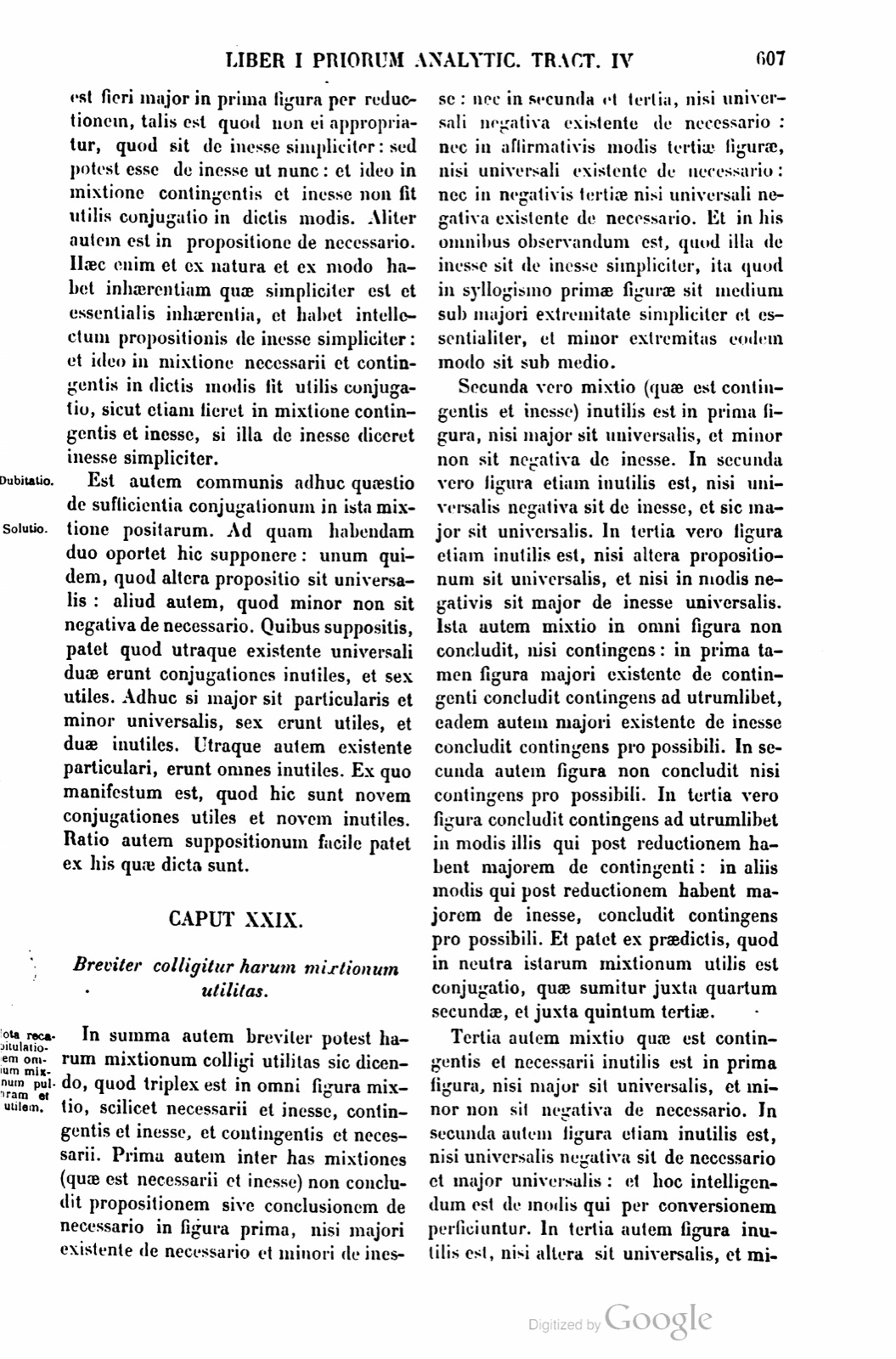
CAPUT XXIX. Breviter colligitur harum mixtionum utilitas.
In summa autem breviter potest harum mixtionum colligi utilitas sic dicendo, quod triplex est in omni figura mixtio, scilicet necessarii et inesse, contingentis et inesse, et contingentis et necessarii. Prima autem inter has mixtiones, quae est necessarii et inesse, non concludit propositionem sive conclusionem de necessario in figura prima, nisi majori existente de necessario et minori de inesse: nec in secunda et tertia, nisi universali negativa existente de necessario: nec in affirmativis modis tertiae figurae, nisi universali existente de necessario: nec in negativis tertiae nisi universali negativa existente de necessario. Et in his omnibus observandum est, quod illa de inesse sit de inesse simpliciter, ita quod in syllogismo primae figurae sit medium sub majori extremitate simpliciter et essentialiter, et minor extremitas eodem modo sit sub medio.
Secunda vero mixtio, quae est contingentis et inesse, inutilis est in prima figura, nisi major sit universalis, et minor non sit negativa de inesse. In secunda vero figura etiam inutilis est, nisi universalis negativa sit de inesse, et sic major sit universalis. In tertia vero figura etiam inutilis est, nisi altera propositionum sit universalis, et nisi in modis negativis sit major de inesse universalis. Ista autem mixtio in omni figura non concludit, nisi contingens: in prima tamen figura majori existente de contingenti concludit contingens ad utrumlibet, eadem autem majori existente de inesse concludit contingens pro possibili. In secunda autem figura non concludit nisi contingens pro possibili. In tertia vero figura concludit contingens ad utrumlibet in modis illis qui post reductionem habent majorem de contingenti: in aliis modis qui post reductionem habent majorem de inesse, concludit contingens pro possibili. Et patet ex praedictis, quod in neutra istarum mixtionum utilis est conjugatio, quae sumitur juxta quartum secundae, et juxta quintum tertiae.
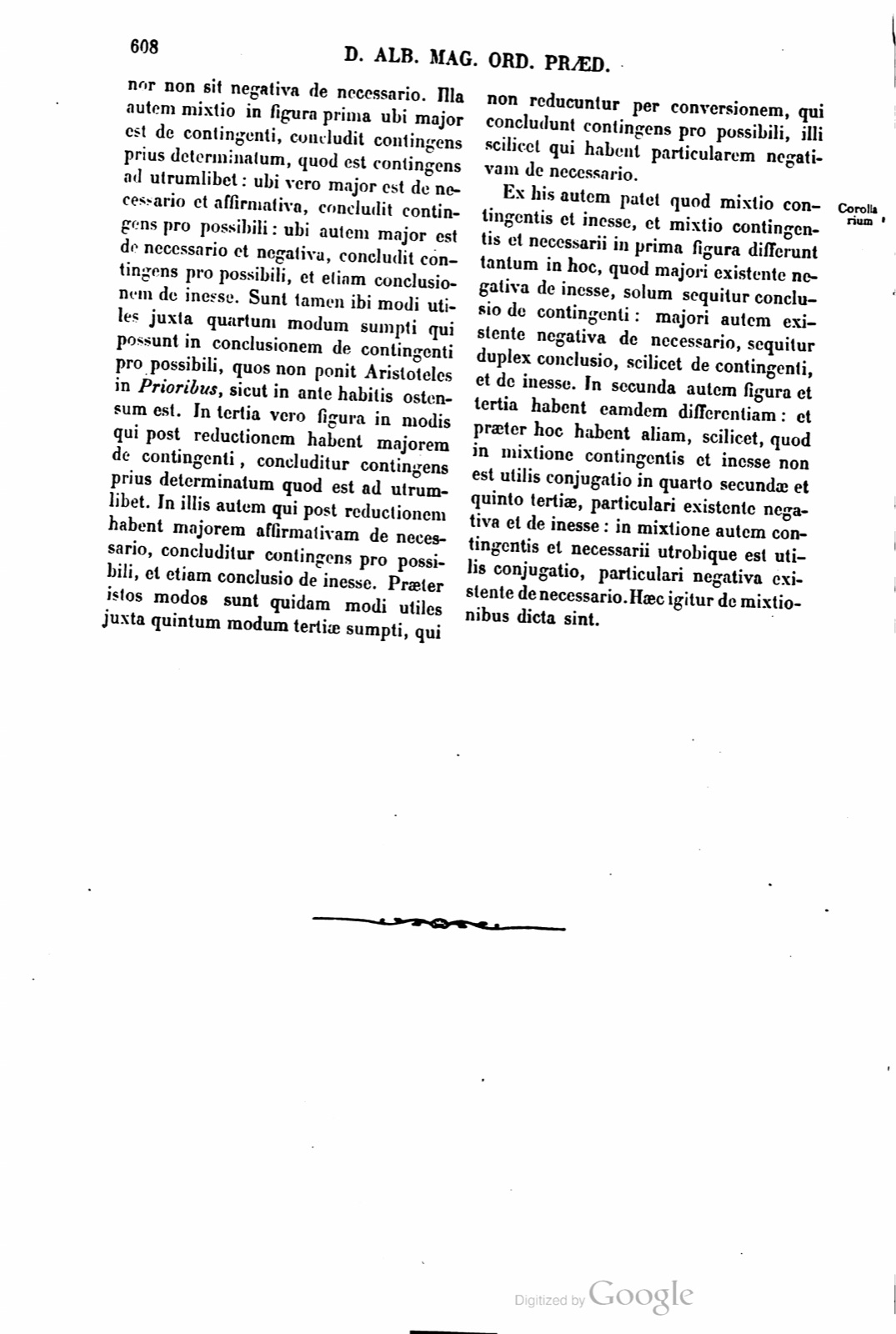
Tertia autem mixtio quae est contingentis et necessarii inutilis est in prima figura, nisi major sit universalis, et minor non sit negativa de necessario. In secunda autem figura etiam inutilis est, nisi universalis negativa sit de necessario et major universalis: et hoc intelligendum est de modis qui per conversionem perficiuntur. In tertia autem figura inutilis est, nisi altera sit universalis, et minor non sit negativa de necessario. Illa autem mixtio in figura prima ubi major est de contingenti, concludit contingens prius determinatum, quod est contingens ad utrumlibet: ubi vero major est de necessario et affirmativa, concludit contingens pro possibili: ubi autem major est de necessario et negativa, concludit contingens pro possibili, et etiam conclusionem de inesse. Sunt tamen ibi modi utiles juxta quartum modum sumpti qui possunt in conclusionem de contingenti pro possibili, quos non ponit Aristoteles in Prioribus, sicut in ante habitis ostensum est. In tertia vero figura in modis qui post reductionem habent majorem de contingenti, concluditur contingens prius determinatum quod est ad utrumlibet. In illis autem qui post reductionem habent majorem affirmativam de necessario, concluditur contingens pro possibili, et etiam conclusio de inesse. Praeter istos modos sunt quidam modi utiles juxta quintum modum tertiae sumpti, qui non reducuntur per conversionem, qui concludunt contingens pro possibili, illi scilicet qui habent particularem negativam de necessario.
CHAPTER XXIX. The usefulness of these mixings is briefly gathered.
But in summary the usefulness of these mixings can briefly be gathered by saying that there is a threefold mixing in every figure, namely of the necessary and inherence, of the contingent and inherence, and of the contingent and the necessary. But the first among these mixings, which is of the necessary and inherence, does not conclude a proposition or conclusion of necessity in the first figure unless the major is of necessity and the minor of inherence; nor in the second and third figure unless there is a universal negative of necessity; nor in the affirmative modes of the third figure unless there is a universal of necessity; nor in the negative modes of the third unless there is a universal negative of necessity. And in all these it must be observed that that proposition of inherence is of inherence simply, so that in the syllogism of the first figure the middle is under the greater extreme simply and essentially, and the lesser extreme is under the middle in the same way.
But the second mixing, which is of the contingent and inherence, is useless in the first figure unless the major is universal and the minor is not negative of inherence. In the second figure it is also useless unless a universal negative is of inherence, and thus the major is universal. In the third figure it is also useless unless one of the propositions is universal, and unless in negative modes the major is a universal of inherence. But this mixing in every figure concludes nothing except the contingent. Yet in the first figure, when the major is about the contingent, it concludes the contingent toward either alternative; but when the same major is of inherence, it concludes the contingent for the possible. But in the second figure it concludes only the contingent for the possible. But in the third figure it concludes the contingent toward either alternative in those modes which after reduction have the major about the contingent; in the other modes which after reduction have the major of inherence, it concludes the contingent for the possible. And it is clear from the aforesaid that in neither of those mixings is the conjugation useful which is taken according to the fourth mode of the second figure and according to the fifth of the third.
But the third mixing, which is of the contingent and the necessary, is useless in the first figure unless the major is universal and the minor is not negative of necessity. But in the second figure it is also useless unless a universal negative is of necessity and the major is universal; and this must be understood of the modes which are perfected through conversion. But in the third figure it is useless unless one proposition is universal and the minor is not negative of necessity. But that mixing in the first figure, where the major is about the contingent, concludes the contingent determined before, which is the contingent toward either alternative; but where the major is of necessity and affirmative, it concludes the contingent for the possible; and where the major is of necessity and negative, it concludes the contingent for the possible and also a conclusion of inherence. Yet there are useful modes there taken according to the fourth mode which can lead to a conclusion about the contingent for the possible, which Aristotle does not posit in the Prior Analytics, as was shown in the things had before. But in the third figure, in the modes which after reduction have the major about the contingent, the contingent determined before, which is toward either alternative, is concluded. But in those which after reduction have the major affirmative of necessity, the contingent for the possible is concluded, and also a conclusion of inherence. Besides these modes there are certain useful modes taken according to the fifth mode of the third which are not reduced through conversion, which conclude the contingent for the possible, namely those which have the particular negative of necessity.
Ex his autem patet quod mixtio contingentis et inesse, et mixtio contingentis et necessarii in prima figura differunt tantum in hoc, quod majori existente negativa de inesse, solum sequitur conclusio de contingenti: majori autem existente negativa de necessario, sequitur duplex conclusio, scilicet de contingenti, et de inesse. In secunda autem figura et tertia habent eamdem differentiam: et praeter hoc habent aliam, scilicet, quod in mixtione contingentis et inesse non est utilis conjugatio in quarto secundae et quinto tertiae, particulari existente negativa et de inesse: in mixtione autem contingentis et necessarii utrobique est utilis conjugatio, particulari negativa existente de necessario. Haec igitur de mixtionibus dicta sint.
But from these things it is clear that the mixing of the contingent and inherence and the mixing of the contingent and the necessary in the first figure differ only in this: that when the major is negative of inherence, only a conclusion about the contingent follows; but when the major is negative of necessity, a double conclusion follows, namely about the contingent and about inherence. But in the second and third figure they have the same difference; and besides this they have another, namely that in the mixing of the contingent and inherence there is no useful conjugation in the fourth mode of the second and the fifth of the third when the particular is negative and of inherence, while in the mixing of the contingent and the necessary a useful conjugation exists in both cases when the particular negative is of necessity. Therefore let these things have been said about the mixings.
If a page does not appear, its photograph has not been uploaded yet.