Works › Prior Analytics, Books I–II
Volume 1 · pp. 605–607
Chapter XXVIII. On the mixing of the necessary and the contingent in the third figure for particular syllogisms.
A marker with ≈ is an approximate page boundary, placed by measure of the text; the page photographs remain the authority. In the paired views, clicking a page marker brings that page into view.
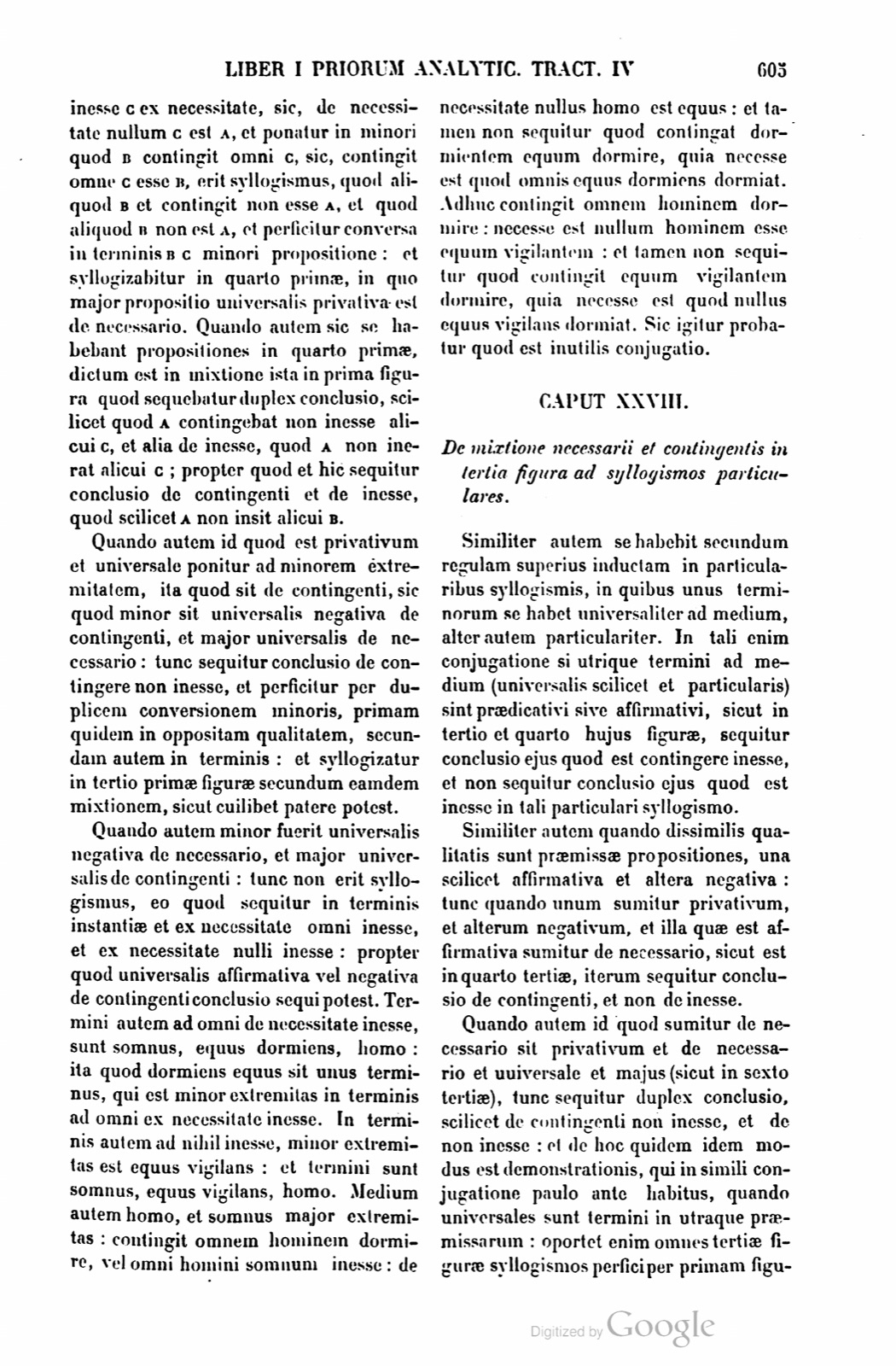
CAPUT XXVIII. De mixtione necessarii et contingentis in tertia figura ad syllogismos particulares.
Similiter autem se habebit secundum regulam superius inductam in particularibus syllogismis, in quibus unus terminorum se habet universaliter ad medium, alter autem particulariter. In tali enim conjugatione si utrique termini ad medium, universalis scilicet et particularis, sint praedicativi sive affirmativi, sicut in tertio et quarto hujus figurae, sequitur conclusio ejus quod est contingere inesse, et non sequitur conclusio ejus quod est inesse in tali particulari syllogismo.
Similiter autem quando dissimilis qualitatis sunt praemissae propositiones, una scilicet affirmativa et altera negativa: tunc quando unum sumitur privativum, et alterum negativum, et illa quae est affirmativa sumitur de necessario, sicut est in quarto tertiae, iterum sequitur conclusio de contingenti, et non de inesse.
Quando autem id quod sumitur de necessario sit privativum et de necessario et universale et majus, sicut in sexto tertiae, tunc sequitur duplex conclusio, scilicet de contingenti non inesse, et de non inesse: et de hoc quidem idem modus est demonstrationis, qui in simili conjugatione paulo ante habitus, quando universales sunt termini in utraque praemissarum: oportet enim omnes tertiae figurae syllogismos perfici per primam figuram: et propter hoc quod in hac mixtione sequitur in illis qui sunt particulares primae figurae, necesse est quod sequatur etiam in istis, quia isti ab illis descendunt et reducuntur in illos.
Quando autem universalis privativa ponitur ad minorem extremitatem, ita quod minor est universalis negativa, et sumitur de contingenti, erit syllogismus per duplicem conversionem minoris ad oppositam qualitatem, et in terminis, sicut ante dictum est.
Si autem minor fuerit de necessario, non erit syllogismus alicujus conclusionis: et inutilitas istius conjugationis ostendetur eodem modo, sicut est ostensa in simili conjugatione in universalibus syllogismis, et per eosdem terminos ad inesse omni, et ad inesse nulli, qui sunt somnus, dormiens equus, homo: et somnus, equus vigilans, homo: et eodem modo, ut prius formetur instantiae syllogismus, nisi quod loco unius universalis propositionis ponitur particularis ejusdem modi propositio.
CHAPTER XXVIII. On the mixing of the necessary and the contingent in the third figure for particular syllogisms.
But it will have itself similarly according to the rule introduced above in particular syllogisms, in which one of the terms has itself universally to the middle and the other particularly. For in such a conjugation, if each term toward the middle, namely the universal and the particular, is predicative or affirmative, as in the third and fourth modes of this figure, a conclusion of that which is contingently to inhere follows, and a conclusion of that which is inherence does not follow in such a particular syllogism.
Likewise, when the premise-propositions are of dissimilar quality, namely one affirmative and the other negative, then when one is taken as privative and the other as negative, and that which is affirmative is taken of necessity, as happens in the fourth mode of the third figure, again a conclusion about the contingent follows and not about inherence.
But when that which is taken of necessity is privative, and of necessity, and universal, and greater, as in the sixth mode of the third figure, then a double conclusion follows, namely about the contingent not to inhere and about not-inhering. And concerning this the mode of demonstration is the same as that which was had a little before in the similar conjugation, when the terms are universal in both premises; for all syllogisms of the third figure must be perfected through the first figure. And for this reason, because in this mixing it follows in those which are particular modes of the first figure, it is necessary that it also follow in these, because these descend from those and are reduced into them.
But when a universal privative is placed at the lesser extreme, so that the minor is universal negative and is taken about the contingent, there will be a syllogism through the double conversion of the minor to the opposite quality and in terms, as was said before.
But if the minor is of necessity, there will not be a syllogism of any conclusion. And the uselessness of this conjugation will be shown in the same way as it was shown in the similar conjugation in universal syllogisms, and through the same terms for inhering in every one and for inhering in none, which are sleep, sleeping horse, man, and sleep, waking horse, man; and in the same way as before let the syllogism of instance be formed, except that in place of one universal proposition a particular proposition of the same mode is posited.
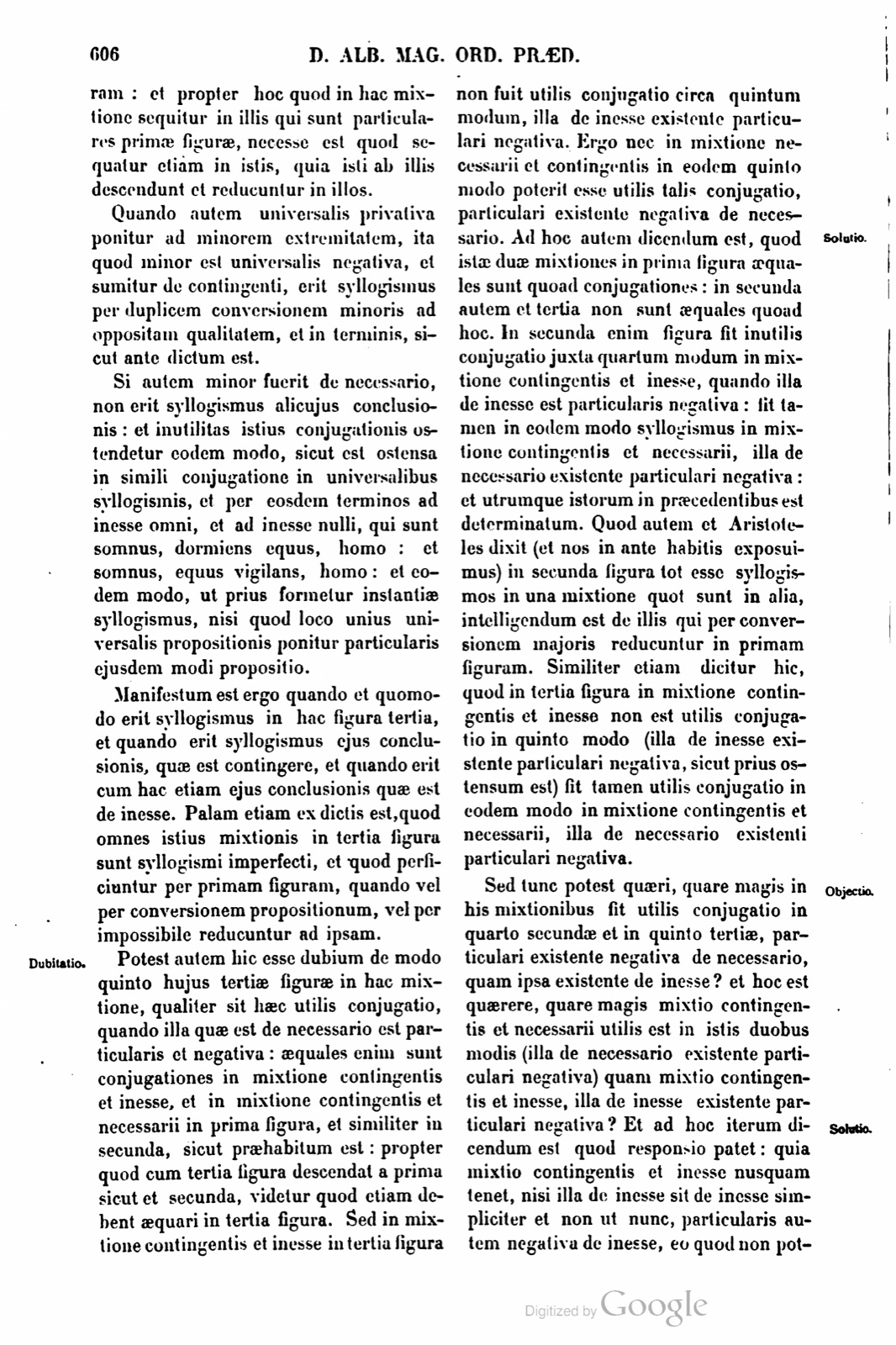
Manifestum est ergo quando et quomodo erit syllogismus in hac figura tertia, et quando erit syllogismus ejus conclusionis, quae est contingere, et quando erit cum hac etiam ejus conclusionis quae est de inesse. Palam etiam ex dictis est, quod omnes istius mixtionis in tertia figura sunt syllogismi imperfecti, et quod perficiuntur per primam figuram, quando vel per conversionem propositionum, vel per impossibile reducuntur ad ipsam.
Potest autem hic esse dubium de modo quinto hujus tertiae figurae in hac mixtione, qualiter sit haec utilis conjugatio, quando illa quae est de necessario est particularis et negativa: aequales enim sunt conjugationes in mixtione contingentis et inesse, et in mixtione contingentis et necessarii in prima figura, et similiter in secunda, sicut prae habitum est: propter quod cum tertia figura descendat a prima sicut et secunda, videtur quod etiam debent aequari in tertia figura. Sed in mixtione contingentis et inesse in tertia figura non fuit utilis conjugatio circa quintum modum, illa de inesse existente particulari negativa. Ergo nec in mixtione necessarii et contingentis in eodem quinto modo poterit esse utilis talis conjugatio, particulari existente negativa de necessario. Ad hoc autem dicendum est, quod istae duae mixtiones in prima figura aequales sunt quoad conjugationes: in secunda autem et tertia non sunt aequales quoad hoc. In secunda enim figura fit inutilis conjugatio juxta quartum modum in mixtione contingentis et inesse, quando illa de inesse est particularis negativa: fit tamen in eodem modo syllogismus in mixtione contingentis et necessarii, illa de necessario existente particulari negativa: et utrumque istorum in praecedentibus est determinatum. Quod autem et Aristoteles dixit, et nos in ante habitis exposuimus, in secunda figura tot esse syllogismos in una mixtione quot sunt in alia, intelligendum est de illis qui per conversionem majoris reducuntur in primam figuram. Similiter etiam dicitur hic, quod in tertia figura in mixtione contingentis et inesse non est utilis conjugatio in quinto modo, illa de inesse existente particulari negativa, sicut prius ostensum est, fit tamen utilis conjugatio in eodem modo in mixtione contingentis et necessarii, illa de necessario existenti particulari negativa.
Therefore it is manifest when and how there will be a syllogism in this third figure, and when there will be a syllogism of that conclusion which is contingently to be, and when there will also be with this its conclusion which is of inherence. It is also plain from what has been said that all syllogisms of this mixing in the third figure are imperfect syllogisms, and that they are perfected through the first figure, when either through conversion of propositions or through the impossible they are reduced to it.
But here there can be a doubt about the fifth mode of this third figure in this mixing, how this is a useful conjugation when that which is of necessity is particular and negative. For the conjugations are equal in the mixing of the contingent and inherence and in the mixing of the contingent and the necessary in the first figure, and similarly in the second, as has been had before. For this reason, since the third figure descends from the first just as the second does, it seems that they also ought to be equal in the third figure. But in the mixing of the contingent and inherence in the third figure there was not a useful conjugation around the fifth mode, when the proposition of inherence was particular negative. Therefore neither in the mixing of the necessary and the contingent in the same fifth mode will such a conjugation be able to be useful, when the particular is negative of necessity. To this one must say that these two mixings are equal in the first figure with respect to conjugations; but in the second and third they are not equal in this respect. For in the second figure a conjugation according to the fourth mode is useless in the mixing of the contingent and inherence when that proposition of inherence is particular negative; yet in the same mode a syllogism is made in the mixing of the contingent and the necessary when the proposition of necessity is particular negative; and each of these things has been determined in the preceding matters. But what Aristotle said, and what we explained in the things had before, that in the second figure there are as many syllogisms in one mixing as in another, must be understood of those which are reduced into the first figure through the conversion of the major. Likewise it is also said here that in the third figure in the mixing of the contingent and inherence there is no useful conjugation in the fifth mode, when the proposition of inherence is particular negative, as was shown before; yet a useful conjugation is made in the same mode in the mixing of the contingent and the necessary, when the proposition of necessity is particular negative.
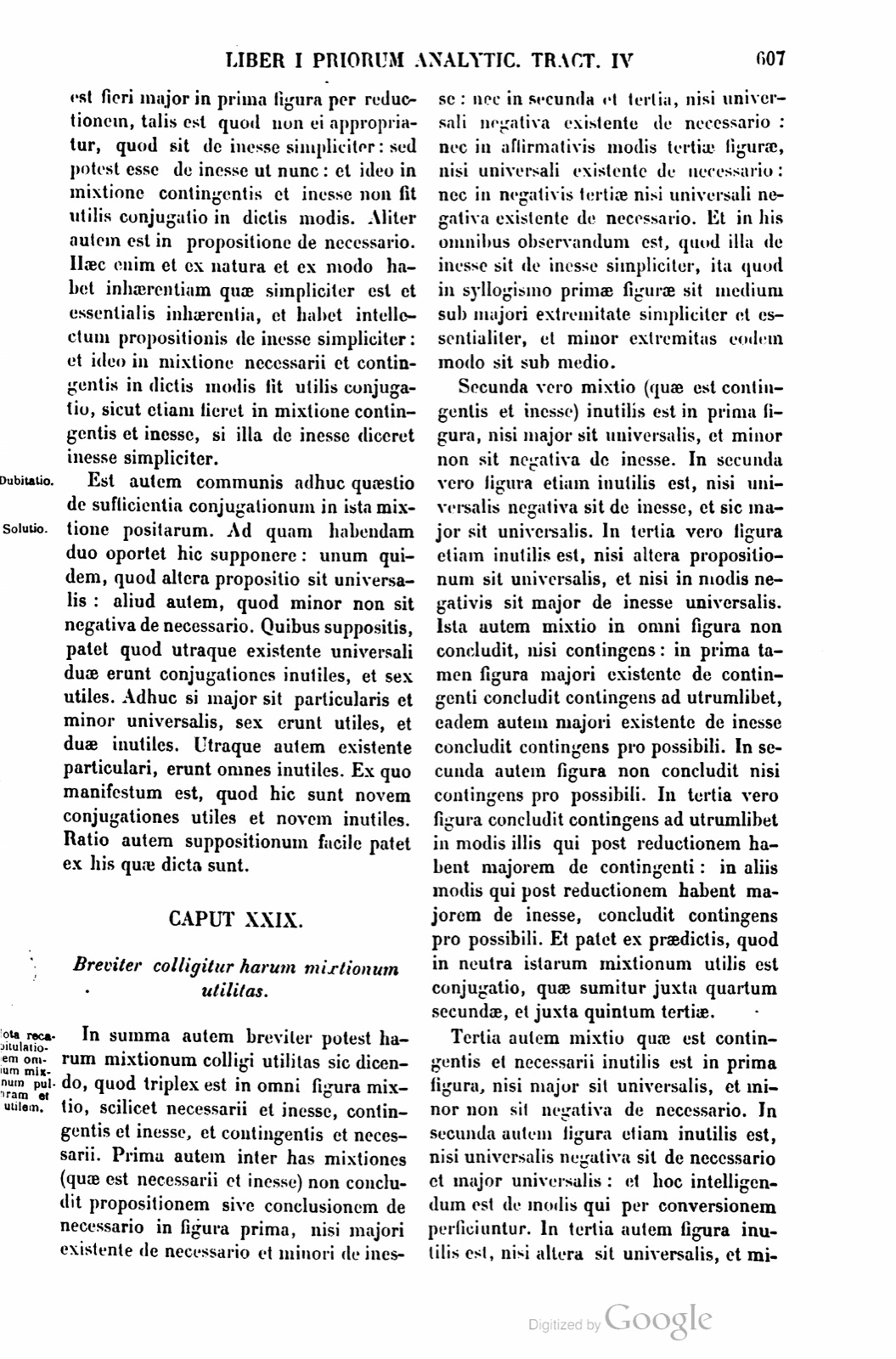
Sed tunc potest quaeri, quare magis in his mixtionibus fit utilis conjugatio in quarto secundae et in quinto tertiae, particulari existente negativa de necessario, quam ipsa existente de inesse? et hoc est quaerere, quare magis mixtio contingentis et necessarii utilis est in istis duobus modis, illa de necessario existente particulari negativa, quam mixtio contingentis et inesse, illa de inesse existente particulari negativa? Et ad hoc iterum dicendum est quod responsio patet: quia mixtio contingentis et inesse nusquam tenet, nisi illa de inesse sit de inesse simpliciter et non ut nunc, particularis autem negativa de inesse, eo quod non potest fieri major in prima figura per reductionem, talis est quod non ei appropriatur, quod sit de inesse simpliciter: sed potest esse de inesse ut nunc: et ideo in mixtione contingentis et inesse non fit utilis conjugatio in dictis modis. Aliter autem est in propositione de necessario. Haec enim et ex natura et ex modo habet inhaerentiam quae simpliciter est et essentialis inhaerentia, et habet intellectum propositionis de inesse simpliciter: et ideo in mixtione necessarii et contingentis in dictis modis fit utilis conjugatio, sicut etiam fieret in mixtione contingentis et inesse, si illa de inesse diceret inesse simpliciter.
Est autem communis adhuc quaestio de sufficientia conjugationum in ista mixtione positarum. Ad quam habendam duo oportet hic supponere: unum quidem, quod altera propositio sit universalis: aliud autem, quod minor non sit negativa de necessario. Quibus suppositis, patet quod utraque existente universali duae erunt conjugationes inutiles, et sex utiles. Adhuc si major sit particularis et minor universalis, sex erunt utiles, et duae inutiles. Utraque autem existente particulari, erunt omnes inutiles. Ex quo manifestum est, quod hic sunt novem conjugationes utiles et novem inutiles. Ratio autem suppositionum facile patet ex his quae dicta sunt.
But then it can be asked why, in these mixings, a useful conjugation is made more in the fourth mode of the second figure and in the fifth of the third when the particular is negative of necessity than when it is of inherence. And this is to ask why the mixing of the contingent and the necessary is more useful in those two modes, when the proposition of necessity is particular negative, than the mixing of the contingent and inherence, when the proposition of inherence is particular negative. And to this again one must say that the response is clear, because the mixing of the contingent and inherence never holds unless that proposition of inherence is of inherence simply and not as now. But a particular negative of inherence, because it cannot be made the major in the first figure through reduction, is such that it is not appropriated to it that it be of inherence simply, but it can be of inherence as now. And therefore in the mixing of the contingent and inherence a useful conjugation is not made in the said modes. But it is otherwise in a proposition of necessity. For this, both from its nature and from its mode, has an inherence which is simple and essential inherence, and it has the understanding of a proposition of inherence simply; and therefore in the mixing of the necessary and the contingent in the said modes a useful conjugation is made, just as one would also be made in the mixing of the contingent and inherence if that proposition of inherence said inherence simply.
But there is still a common question about the sufficiency of the conjugations posited in this mixing. In order to have this, two things must be supposed here: one, indeed, that one of the propositions is universal; the other, that the minor is not negative of necessity. With these supposed, it is clear that when each proposition is universal, there will be two useless conjugations and six useful ones. Again, if the major is particular and the minor universal, there will be six useful and two useless. But when each is particular, all will be useless. From this it is manifest that here there are nine useful conjugations and nine useless. But the reason of the suppositions is easily clear from the things that have been said.
If a page does not appear, its photograph has not been uploaded yet.