Works › Prior Analytics, Books I–II
Volume 1 · pp. 603–605
Chapter XXVII. On the mixing of the necessary and the contingent in the third figure for universal syllogisms.
A marker with ≈ is an approximate page boundary, placed by measure of the text; the page photographs remain the authority. In the paired views, clicking a page marker brings that page into view.
CAPUT XXVII. De mixtione necessarii et contingentis in tertia figura ad syllogismos universales.
In mixtione autem necessarii et contingentis in tertia figura oportet primum resumere regulam secundum quam haec debet fieri mixtio, deinde modos hujus figurae secundum illam mixtionem ad regulam verificare. Regula igitur haec est, quod si una quidem propositionum fuerit de necessario, et altera de contingenti, et praedicativae sive affirmativae fuerint propositiones, semper erit syllogismus ejus quod est contingere, hoc est, conclusionis de contingenti. Si autem in una propositionum ad unum terminum fuerit affirmativus, et ad alterum terminum sive extremum fuerit negativus sive privativus: si ille fuerit de necessario qui est affirmativus, ita quod propositio affirmativa fuerit de necessario, sequitur conclusio negativa de contingenti, ejus scilicet quod est contingere non inesse. Si autem privativus terminus sive privativa propositio sit de necessario, et affirmativa de contingenti, sequitur duplex conclusio, scilicet et de contingenti negativa, et negativa de inesse, et hoc est quod dicitur, quod sequitur conclusio ejus quod est contingere non inesse, et ejus quod est ex necessitate non inesse: quia nunquam sequitur conclusio de necessario, sicut nec in aliis figuris in hac mixtione sequitur conclusio de necessario.
Hac regula sic posita, modos hujus mixtionis in tertia verificemus figura, et primo primum, qui constat ex duabus universalibus affirmativis: sint enim primum praedicativi ambo termini, ita quod in majori A, quod est major extremitas, insit omni C medio ex necessitate, B autem, quod est minor extremitas, contingat inesse omni C, ita quod major sit universalis affirmativa de necessario, et minor sit universalis affirmativa de contingenti, sic, ex necessitate omne C est A, contingit omne C esse B, sequitur conclusio affirmativa de contingenti quod A contingit alicui B inesse. Et perficitur hic syllogismus per conversionem minoris in terminis factam, et fit talis syllogismus in tertio primae: quia cum A omni C inest ex necessitate, sicut dicitur in majori, et contingit quoddam B esse C, sicut dicit conversa minoris, sequitur in tertio primae quod A contingens erit inesse alicui B, et non sequitur conclusio de inesse, scilicet haec, quod A inerit alicui B sine modo contingentis: et hoc quidem est veritas.
Sunt tamen qui nituntur probare, quod in isto modo sequitur etiam conclusio de inesse, et non tantum de contingenti, sic, de necessitate omne C est A, contingit omne C esse B, ergo aliquod B est A. Si non sequitur, detur oppositum, hoc scilicet, nullum B est A, ex quo et minori sequitur oppositum majoris per mixtionem contingentis et inesse in prima figura, sic, nullum B est A, contingit omne C esse B, ergo contingit nullum C esse A, quod non stat cum majori, quae dicit quod de necessitate omne C est A.
Sic etiam quidam probare nituntur, quod sequitur conclusio de necessario, sic, omne C de necessitate est A, contingit omne C esse B, ergo aliquod B de necessitate est A: aut detur oppositum, hoc scilicet, non de necessitate aliquod B est A, quae aequipollet isti, contingit nullum B esse A, ex qua et minori sequitur oppositum majoris in prima figura ex utraque de contingenti, sic, contingit nullum B esse A, contingit omne C esse B, ergo contingit nullum C esse A.
CHAPTER XXVII. On the mixing of the necessary and the contingent in the third figure for universal syllogisms.
But in the mixing of the necessary and the contingent in the third figure, one must first resume the rule according to which this mixing ought to be made, and then verify the modes of this figure according to that mixing by the rule. Therefore the rule is this: if one of the propositions is of necessity and the other about the contingent, and the propositions are predicative or affirmative, there will always be a syllogism of that which is contingently to be, that is, of a conclusion about the contingent. But if in one of the propositions there is something affirmative toward one term, and toward the other term or extreme there is something negative or privative, if that which is affirmative is of necessity, so that the affirmative proposition is of necessity, a negative conclusion about the contingent follows, namely of that which is contingently not to inhere. But if the privative term or privative proposition is of necessity and the affirmative is about the contingent, a double conclusion follows, namely both a negative conclusion about the contingent and a negative conclusion of inherence; and this is what is said, that a conclusion of that which is contingently not to inhere follows, and of that which is from necessity not to inhere, because a conclusion of necessity never follows, just as in the other figures in this mixing a conclusion of necessity does not follow.
With this rule thus posited, let us verify the modes of this mixing in the third figure, and first the first, which consists of two universal affirmatives. For let both terms first be predicative, so that in the major A, which is the greater extreme, inheres in every C, the middle, from necessity, while B, which is the lesser extreme, contingently inheres in every C, so that the major is a universal affirmative of necessity and the minor is a universal affirmative about the contingent, thus: of necessity every C is A; every C contingently is B. An affirmative conclusion about the contingent follows, that A contingently inheres in some B. And this syllogism is perfected through the conversion of the minor made in terms, and such a syllogism is made in the third mode of the first figure; because, since A inheres in every C from necessity, as is said in the major, and some B contingently is C, as the converse of the minor says, it follows in the third mode of the first that A will contingently inhere in some B, and a conclusion of inherence does not follow, namely this, that A will inhere in some B without the mode of contingency; and this indeed is the truth.
Yet there are some who try to prove that in this mode a conclusion of inherence also follows, and not only one about the contingent, thus: of necessity every C is A; every C contingently is B; therefore some B is A. If it does not follow, let the opposite be granted, namely this: no B is A. From this and the minor the opposite of the major follows through the mixing of the contingent and inherence in the first figure, thus: no B is A; every C contingently is B; therefore no C contingently is A, which does not stand with the major, which says that of necessity every C is A.
Thus certain people also try to prove that a conclusion of necessity follows, thus: every C of necessity is A; every C contingently is B; therefore some B of necessity is A. Or let the opposite be granted, namely this: not of necessity is some B A, which is equipollent to this, no B contingently is A. From this and the minor the opposite of the major follows in the first figure from both propositions about the contingent, thus: no B contingently is A; every C contingently is B; therefore no C contingently is A.
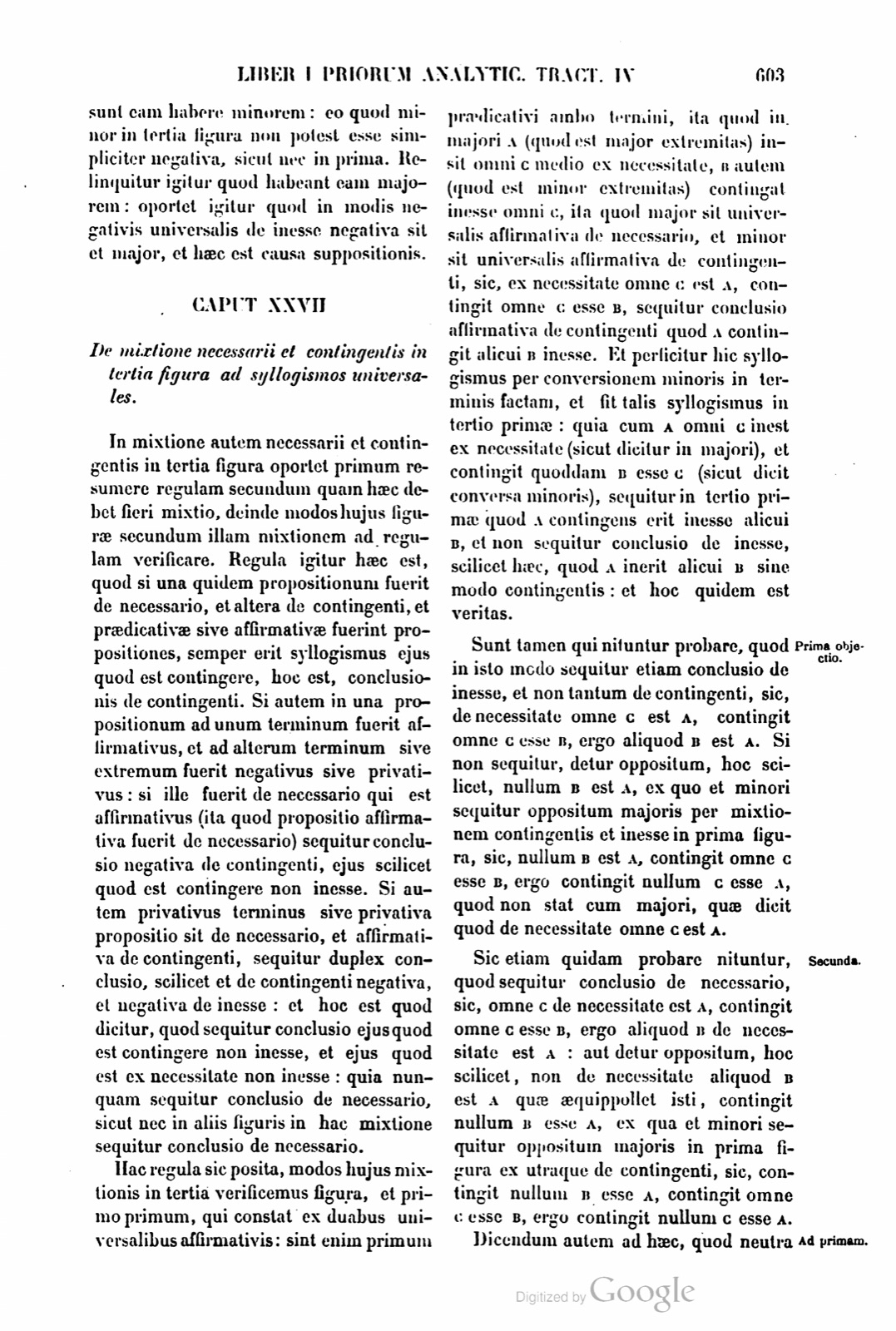
Dicendum autem ad haec, quod neutra istarum conclusionum sequitur: cum enim datur oppositum conclusionis de inesse, illud potest esse de inesse ut nunc: et quando propositio de inesse miscetur cum propositione de contingenti, oportet quod propositio de inesse sit de inesse simpliciter: et ideo mixtio quam inducit non valet. Quod autem oppositum conclusionis possit esse de inesse ut nunc, ex hoc probatur: quia ex tali conjugatione, qualis est inducta, sequitur contingens pro possibili, quod si ponatur inesse, aliquando erit de inesse ut nunc, et aliquando de inesse simpliciter.
Ad id autem quod inducitur ad hoc quod sequatur conclusio de necessario, dicendum quod in uniformi generatione syllogismorum de contingenti in prima figura, oportet quod accipiatur contingens superius determinatum, hoc est, ad utrumlibet. Major autem in syllogismo deducente ad impossibile fuit oppositum conclusionis de contingente pro possibili: et ideo et ipsa est de contingenti pro possibili. Non valet talis processus: quia si aliquid sequitur ad antecedens, non propter hoc oportet quod sequatur ad consequens: unde quamvis sequatur conclusio de contingenti superius determinato, conclusio dico syllogismi ad impossibile ducentis: non tamen sequitur ex contingenti pro possibili. Sicut autem sequitur conclusio de contingenti et non de inesse, quoniam ambae sunt affirmativae et universales, et major de necessario et minor de contingenti: ita sequitur conclusio de contingenti et non de inesse in primo tertiae figurae, quando fuerit major de contingenti et minor de necessario, scilicet quando B C minor propositio fuerit de necessario, et A C de contingenti quae est major propositio.
Quamvis contra hoc iterum objiciatur, et videatur probari, quod sequatur conclusio de inesse, sic, contingit omne C esse A, necesse est omne C esse B, ergo aliquod B est A: aut detur oppositum, hoc scilicet, nullum B est A, et accipiatur cum majori, sic, nullum B est A, contingit omne C esse A, patet quod sequitur oppositum minoris per mixtionem contingentis et inesse in secunda figura. Patet autem solutio ad hoc sicut prius: quia illa de inesse, quae est oppositum conclusionis de inesse, potest esse de inesse ut nunc: et ideo mixtio non valet.
Haec autem objectio de conclusione de inesse et conclusione de necessario, fere contra omnes istius figurae et mixtionis modos fieri posset: sed in omnibus est una et eadem solutio.
Accedamus igitur ad secundum modum istius figurae ponendum: ille enim est de majori universali negativa et minori universali affirmativa, ita quod dissimiles in qualitate sunt propositiones. Rursum ergo dicamus quod si unum quidem terminorum ad medium aliquis ponat privativum majorem, illud vero quod est minor terminus ponat quis affirmativum, et de necessario, ita quod A quidem contingat nulli C inesse in majori de contingenti, B autem omni C insit ex necessitate in minori sumpta de necessario: tunc rursum erit prima figura per conversionem minoris in terminis factam. Et hoc ideo, quia privativa propositio quae major est, significat contingere: et propterea cum prima propositio influat in totam syllogismi consequentiam, oportet quod conclusio sit de contingenti negativa. Cujus causa est, quia quando in prima figura, ad quam ista reducitur, propositiones istius mixtionis hoc modo se habebant, sequebatur conclusio de contingenti: et ideo oportet quod hic similiter fiat.
But to these things one must say that neither of those conclusions follows. For when the opposite of the conclusion of inherence is granted, that can be of inherence as now; and when a proposition of inherence is mixed with a proposition about the contingent, the proposition of inherence must be of inherence simply. Therefore the mixing which it introduces is not valid. But that the opposite of the conclusion can be of inherence as now is proved from this: because from such a conjugation as has been introduced, the contingent for the possible follows, which, if it is posited as inherence, will sometimes be of inherence as now and sometimes of inherence simply.
But to that which is introduced so that a conclusion of necessity may follow, one must say that in the uniform generation of syllogisms about the contingent in the first figure, the contingent determined above, that is, toward either alternative, must be accepted. But the major in the syllogism leading to the impossible was the opposite of the conclusion about the contingent for the possible; and therefore it too is about the contingent for the possible. Such a process is not valid, because if something follows upon an antecedent, it is not for that reason necessary that it follow upon the consequent. Hence although a conclusion about the contingent determined above follows, I mean the conclusion of the syllogism leading to the impossible, nevertheless it does not follow from the contingent for the possible. But just as a conclusion about the contingent and not about inherence follows because both premises are affirmative and universal, and the major is of necessity and the minor about the contingent, so also a conclusion about the contingent and not about inherence follows in the first mode of the third figure when the major is about the contingent and the minor of necessity, namely when the B C minor proposition is of necessity and A C, which is the major proposition, is about the contingent.
Although against this again it is objected, and it seems to be proved that a conclusion of inherence follows, thus: every C contingently is A; it is necessary that every C be B; therefore some B is A. Or let the opposite be granted, namely this, no B is A, and let it be accepted with the major, thus: no B is A; every C contingently is A; it is clear that the opposite of the minor follows through the mixing of the contingent and inherence in the second figure. But the solution to this is clear as before, because that proposition of inherence, which is the opposite of the conclusion of inherence, can be of inherence as now; and therefore the mixing is not valid.
But this objection about the conclusion of inherence and the conclusion of necessity could be made against nearly all the modes of this figure and mixing; but in all of them there is one and the same solution.
Therefore let us proceed to posit the second mode of this figure; for it is from a universal negative major and a universal affirmative minor, so that the propositions are dissimilar in quality. Therefore let us say again that if someone posits one of the terms toward the middle as privative and the major, but someone posits that which is the lesser term as affirmative and of necessity, so that A indeed contingently belongs to no C in the major about the contingent, while B inheres in every C from necessity in the minor taken of necessity, then again there will be the first figure through the conversion of the minor made in terms. And this is because the privative proposition which is the major signifies contingently belonging; and therefore, since the first proposition flows into the whole consequence of the syllogism, the conclusion must be negative about the contingent. The cause of this is that when in the first figure, to which this is reduced, the propositions of this mixing had themselves in this way, a conclusion about the contingent followed; and therefore it must happen similarly here.
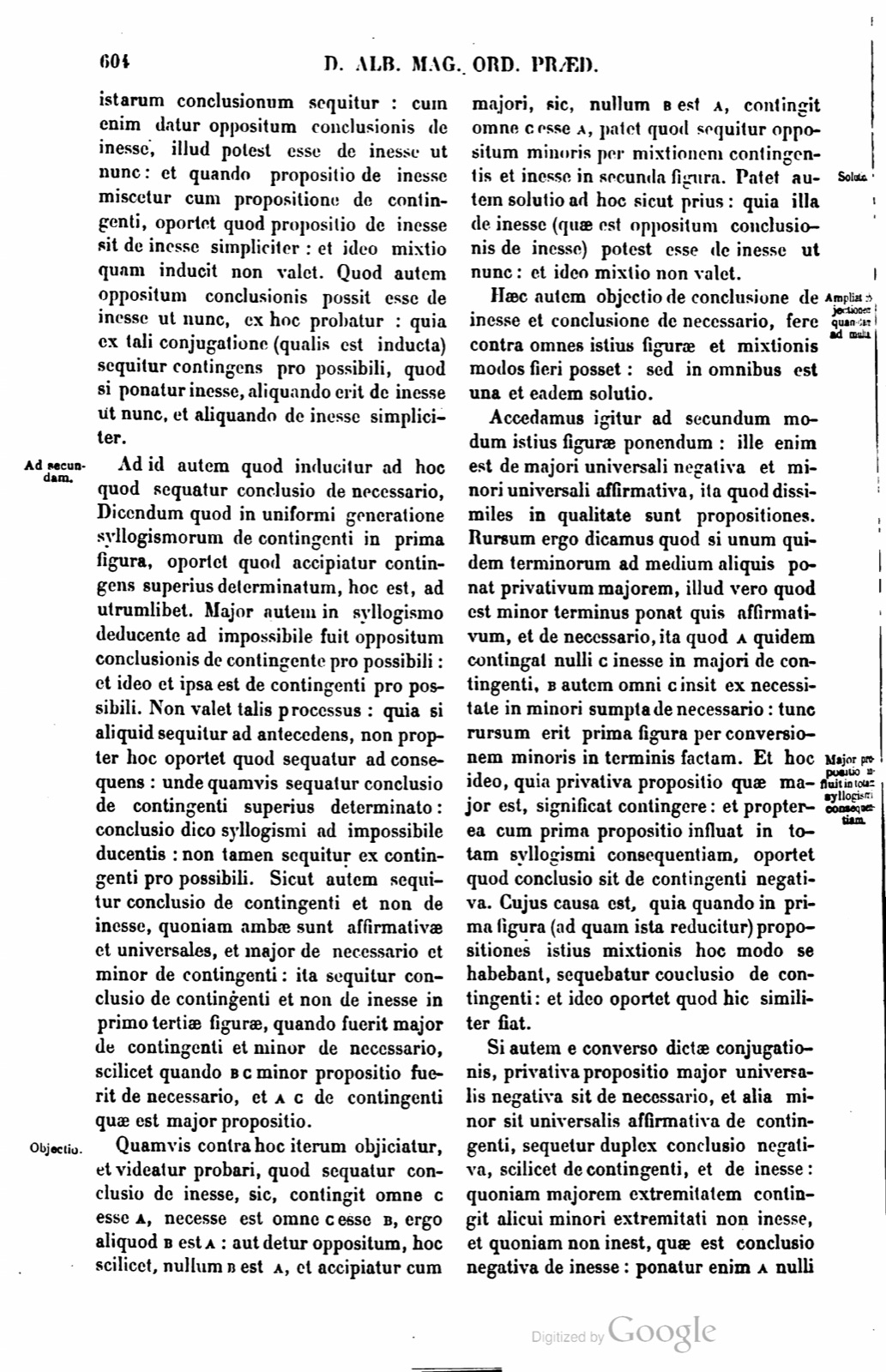
Si autem e converso dictae conjugationis, privativa propositio major universalis negativa sit de necessario, et alia minor sit universalis affirmativa de contingenti, sequetur duplex conclusio negativa, scilicet de contingenti, et de inesse: quoniam majorem extremitatem contingit alicui minori extremitati non inesse, et quoniam non inest, quae est conclusio negativa de inesse: ponatur enim A nulli inesse C ex necessitate, sic, de necessitate nullum C est A, et ponatur in minori quod B contingit omni C, sic, contingit omne C esse B, erit syllogismus, quod aliquod B et contingit non esse A, et quod aliquod B non est A, et perficitur conversa in terminis B C minori propositione: et syllogizabitur in quarto primae, in quo major propositio universalis privativa est de necessario. Quando autem sic se habebant propositiones in quarto primae, dictum est in mixtione ista in prima figura quod sequebatur duplex conclusio, scilicet quod A contingebat non inesse alicui C, et alia de inesse, quod A non inerat alicui C; propter quod et hic sequitur conclusio de contingenti et de inesse, quod scilicet A non insit alicui B.
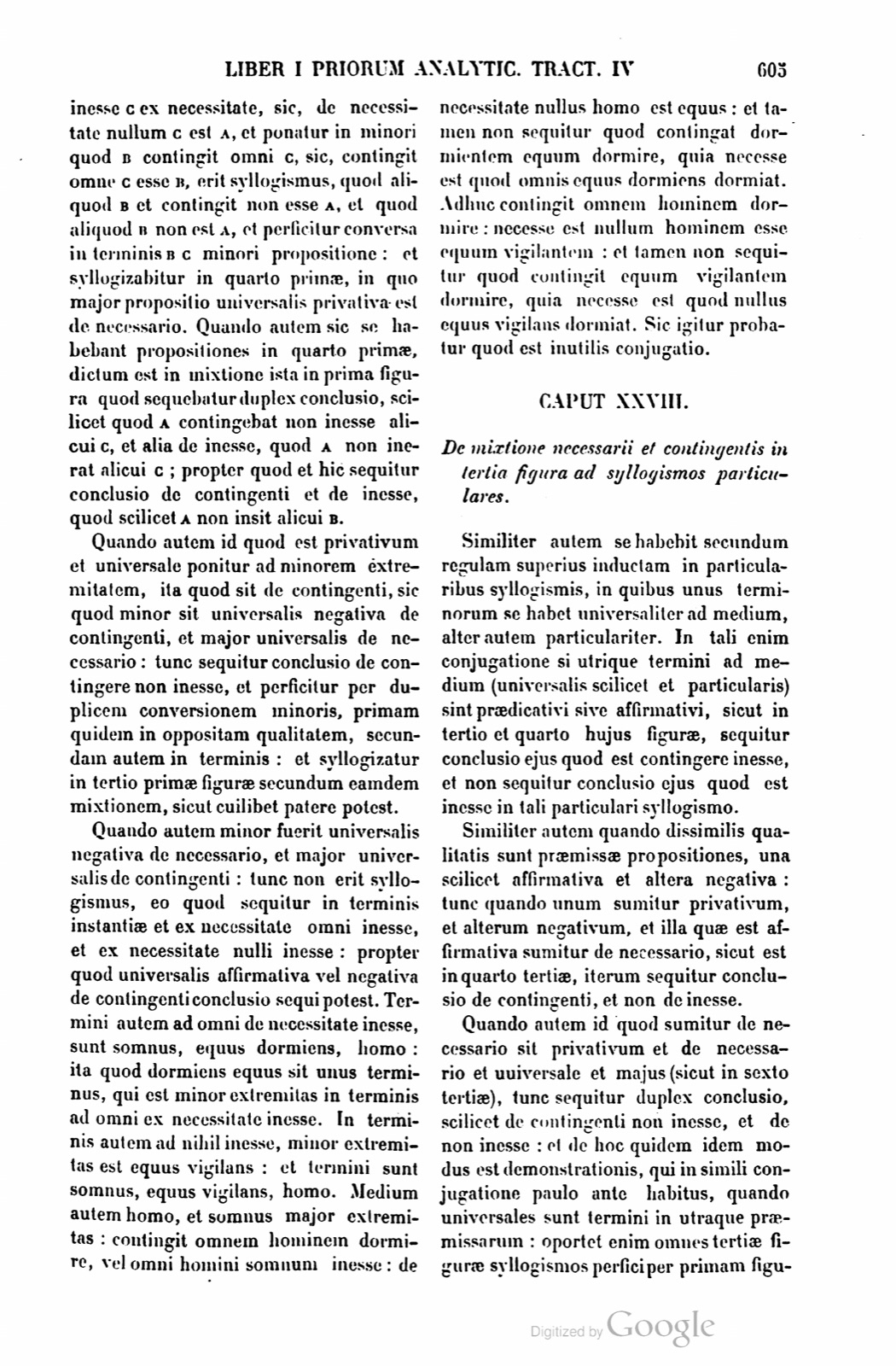
Quando autem id quod est privativum et universale ponitur ad minorem extremitatem, ita quod sit de contingenti, sic quod minor sit universalis negativa de contingenti, et major universalis de necessario: tunc sequitur conclusio de contingere non inesse, et perficitur per duplicem conversionem minoris, primam quidem in oppositam qualitatem, secundam autem in terminis: et syllogizatur in tertio primae figurae secundum eamdem mixtionem, sicut cuilibet patere potest.
Quando autem minor fuerit universalis negativa de necessario, et major universalis de contingenti: tunc non erit syllogismus, eo quod sequitur in terminis instantiae et ex necessitate omni inesse, et ex necessitate nulli inesse: propter quod universalis affirmativa vel negativa de contingenti conclusio sequi potest. Termini autem ad omni de necessitate inesse, sunt somnus, equus dormiens, homo: ita quod dormiens equus sit unus terminus, qui est minor extremitas in terminis ad omni ex necessitate inesse. In terminis autem ad nihil inesse, minor extremitas est equus vigilans: et termini sunt somnus, equus vigilans, homo. Medium autem homo, et somnus major extremitas: contingit omnem hominem dormire, vel omni homini somnum inesse: de necessitate nullus homo est equus: et tamen non sequitur quod contingat dormientem equum dormire, quia necesse est quod omnis equus dormiens dormiat. Adhuc contingit omnem hominem dormire: necesse est nullum hominem esse equum vigilantem: et tamen non sequitur quod contingit equum vigilantem dormire, quia necesse est quod nullus equus vigilans dormiat. Sic igitur probatur quod est inutilis conjugatio.
But if, conversely to the said conjugation, the privative major proposition, a universal negative, is of necessity, and the other minor is a universal affirmative about the contingent, a double negative conclusion will follow, namely about the contingent and about inherence: both that the greater extreme contingently does not inhere in some lesser extreme, and that it does not inhere, which is the negative conclusion of inherence. For let A of necessity inhere in no C, thus: of necessity no C is A, and let it be posited in the minor that B contingently belongs to every C, thus: every C contingently is B; there will be a syllogism that some B both contingently is not A and that some B is not A, and it is perfected when the B C minor proposition has been converted in terms. And it will be syllogized in the fourth mode of the first figure, in which the universal privative major proposition is of necessity. But when the propositions had themselves in this way in the fourth mode of the first figure, it was said in this mixing in the first figure that a double conclusion followed, namely that A contingently did not inhere in some C, and the other about inherence, that A did not inhere in some C; for this reason here also a conclusion about the contingent and about inherence follows, namely that A does not inhere in some B.
But when that which is privative and universal is placed at the lesser extreme, so that it is about the contingent, so that the minor is universal negative about the contingent and the major universal of necessity, then a conclusion of contingently not inhering follows, and it is perfected through the double conversion of the minor, the first into the opposite quality, and the second in terms; and it is syllogized in the third mode of the first figure according to the same mixing, as can be clear to anyone.
But when the minor is universal negative of necessity and the major universal about the contingent, then there will not be a syllogism, because in the terms of an instance both inhering of necessity in every one and inhering of necessity in none follow; for this reason a universal affirmative or negative conclusion about the contingent cannot follow. But the terms for inhering of necessity in every one are sleep, sleeping horse, man, so that sleeping horse is one term, which is the lesser extreme in the terms for inhering in every one from necessity. But in the terms for inhering in nothing, the lesser extreme is waking horse; and the terms are sleep, waking horse, man. But the middle is man, and sleep the greater extreme: every man contingently sleeps, or sleep inheres in every man; of necessity no man is a horse; and nevertheless it does not follow that a sleeping horse contingently sleeps, because it is necessary that every sleeping horse sleep. Again every man contingently sleeps; it is necessary that no man be a waking horse; and nevertheless it does not follow that a waking horse contingently sleeps, because it is necessary that no waking horse sleeps. Thus therefore it is proved that the conjugation is useless.
If a page does not appear, its photograph has not been uploaded yet.