Works › Prior Analytics, Books I–II
Volume 1 · pp. 599–602
Chapter XXVI. On the mixing of the contingent and inherence in the third figure.
A marker with ≈ is an approximate page boundary, placed by measure of the text; the page photographs remain the authority. In the paired views, clicking a page marker brings that page into view.
CAPUT XXVI. De mixtione contingentis et inesse in tertia figura.
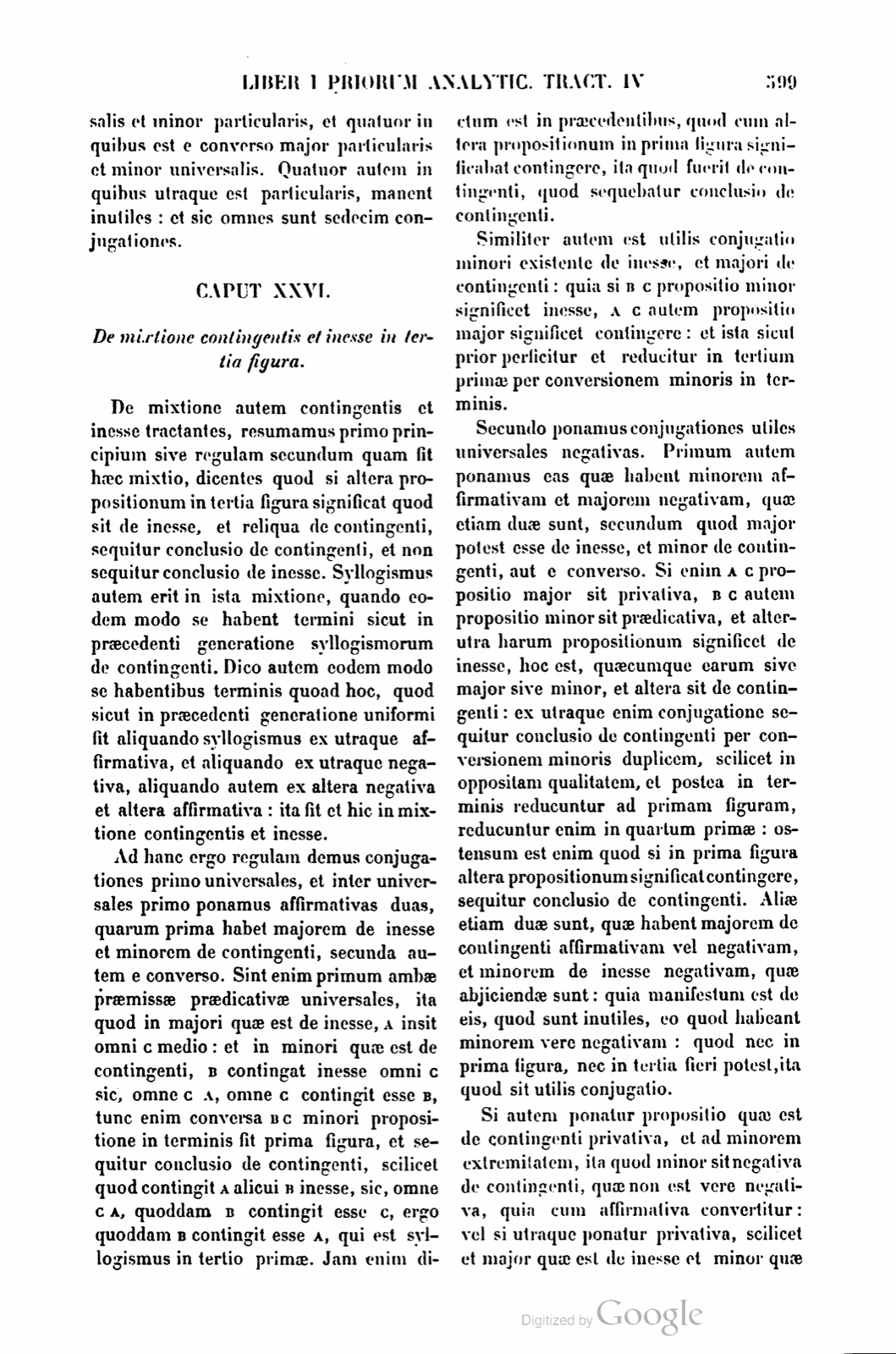
De mixtione autem contingentis et inesse tractantes, resumamus primo principium sive regulam secundum quam fit haec mixtio, dicentes quod si altera propositionum in tertia figura significat quod sit de inesse, et reliqua de contingenti, sequitur conclusio de contingenti, et non sequitur conclusio de inesse. Syllogismus autem erit in ista mixtione, quando eodem modo se habent termini sicut in praecedenti generatione syllogismorum de contingenti. Dico autem eodem modo se habentibus terminis quoad hoc, quod sicut in praecedenti generatione uniformi fit aliquando syllogismus ex utraque affirmativa, et aliquando ex utraque negativa, aliquando autem ex altera negativa et altera affirmativa: ita fit et hic in mixtione contingentis et inesse.
Ad hanc ergo regulam demus conjugationes primo universales, et inter universales primo ponamus affirmativas duas, quarum prima habet majorem de inesse et minorem de contingenti, secunda autem e converso. Sint enim primum ambae praemissae praedicativae universales, ita quod in majori quae est de inesse, A insit omni C medio: et in minori quae est de contingenti, B contingat inesse omni C, sic, omne C A, omne C contingit esse B, tunc enim conversa B C minori propositione in terminis fit prima figura, et sequitur conclusio de contingenti, scilicet quod contingit A alicui B inesse, sic, omne C A, quoddam B contingit esse C, ergo quoddam B contingit esse A, qui est syllogismus in tertio primae. Jam enim dictum est in praecedentibus, quod cum altera propositionum in prima figura significabat contingere, ita quod fuerit de contingenti, quod sequebatur conclusio de contingenti.
Similiter autem est utilis conjugatio minori existente de inesse, et majori de contingenti: quia si B C propositio minor significet inesse, A C autem propositio major significet contingere: et ista sicut prior perficitur et reducitur in tertium primae per conversionem minoris in terminis.
Secundo ponamus conjugationes utiles universales negativas. Primum autem ponamus eas quae habent minorem affirmativam et majorem negativam, quae etiam duae sunt, secundum quod major potest esse de inesse, et minor de contingenti, aut e converso. Si enim A C propositio major sit privativa, B C autem propositio minor sit praedicativa, et alterutra harum propositionum significet de inesse, hoc est, quaecumque earum sive major sive minor, et altera sit de contingenti: ex utraque enim conjugatione sequitur conclusio de contingenti per conversionem minoris duplicem, scilicet in oppositam qualitatem, et postea in terminis reducuntur ad primam figuram, reducuntur enim in quartum primae: ostensum est enim quod si in prima figura altera propositionum significat contingere, sequitur conclusio de contingenti. Aliae etiam duae sunt, quae habent majorem de contingenti affirmativam vel negativam, et minorem de inesse negativam, quae abjiciendae sunt: quia manifestum est de eis, quod sunt inutiles, eo quod habeant minorem vere negativam: quod nec in prima figura, nec in tertia fieri potest, ita quod sit utilis conjugatio.
Si autem ponatur propositio quae est de contingenti privativa, et ad minorem extremitatem, ita quod minor sit negativa de contingenti, quae non est vere negativa, quia cum affirmativa convertitur: vel si utraque ponatur privativa, scilicet et major quae est de inesse et minor quae est de contingenti, tunc quidem in illis duabus conjugationibus per sumptas propositiones, eo quod minor est negativa aliquo modo, quod primae et tertiae figuris non congruit, non erit syllogismus per sumptos terminos. Conversis autem propositionibus primo ad oppositam qualitatem, et postea ulterius in terminis conversa minori, erit syllogismus quemadmodum in primo hujus figurae, qui reducitur in tertium figurae primae, sicut in prioribus syllogismis dictum est.
CHAPTER XXVI. On the mixing of the contingent and inherence in the third figure.
But in treating the mixing of the contingent and inherence, let us first resume the principle or rule according to which this mixing is made, saying that if one of the propositions in the third figure signifies that it is of inherence, and the remaining proposition is about the contingent, a conclusion about the contingent follows, and a conclusion of inherence does not follow. But there will be a syllogism in that mixing when the terms have themselves in the same way as in the preceding generation of syllogisms about the contingent. But I say that the terms have themselves in the same way with respect to this: that just as in the preceding uniform generation a syllogism is sometimes made from both affirmatives, and sometimes from both negatives, and sometimes from one negative and the other affirmative, so also it is made here in the mixing of the contingent and inherence.
Therefore according to this rule let us give first the universal conjugations, and among the universal ones let us first posit two affirmative ones, of which the first has the major of inherence and the minor about the contingent, while the second is conversely. For let both premises first be universal predicatives, so that in the major, which is of inherence, A inheres in every C, the middle, and in the minor, which is about the contingent, B contingently inheres in every C, thus: every C is A; every C contingently is B. For then, when the B C minor proposition has been converted in terms, the first figure is made, and a conclusion about the contingent follows, namely that A contingently belongs to some B, thus: every C is A; some B contingently is C; therefore some B contingently is A, which is a syllogism in the third mode of the first figure. For it has already been said in the preceding matters that when one of the propositions in the first figure signified contingently belonging, so that it was about the contingent, the conclusion about the contingent followed.
Likewise there is a useful conjugation when the minor is of inherence and the major about the contingent, because if the B C minor proposition signifies inherence, while the A C major proposition signifies contingently belonging, this one, like the prior, is perfected and reduced into the third mode of the first figure through the conversion of the minor in terms.
Second, let us posit useful universal negative conjugations. But first let us posit those which have an affirmative minor and a negative major, which are also two according as the major can be of inherence and the minor about the contingent, or conversely. For if the A C major proposition is privative, but the B C minor proposition is predicative, and either of these propositions signifies inherence, that is, whichever of them, whether the major or the minor, and the other is about the contingent, then from each conjugation a conclusion about the contingent follows through the double conversion of the minor, namely into the opposite quality and afterward in terms; they are reduced to the first figure, for they are reduced into the fourth mode of the first. For it has been shown that if in the first figure one of the propositions signifies contingently belonging, a conclusion about the contingent follows. There are also two others which have the major about the contingent, affirmative or negative, and the minor negative of inherence; these must be rejected, because it is manifest about them that they are useless, because they have a truly negative minor, which cannot happen in the first figure or in the third so that there is a useful conjugation.
But if the proposition which is about the contingent is posited as privative and at the lesser extreme, so that the minor is negative about the contingent, which is not truly negative because it is converted with an affirmative; or if each is posited as privative, namely both the major which is of inherence and the minor which is about the contingent, then indeed in those two conjugations, through the propositions taken, because the minor is in some way negative, which does not fit the first and third figures, there will not be a syllogism through the terms taken. But when the propositions have first been converted to the opposite quality, and afterward further in terms after the minor has been converted, there will be a syllogism in the way that there is in the first mode of this figure, which is reduced into the third mode of the first figure, just as was said in the preceding syllogisms.
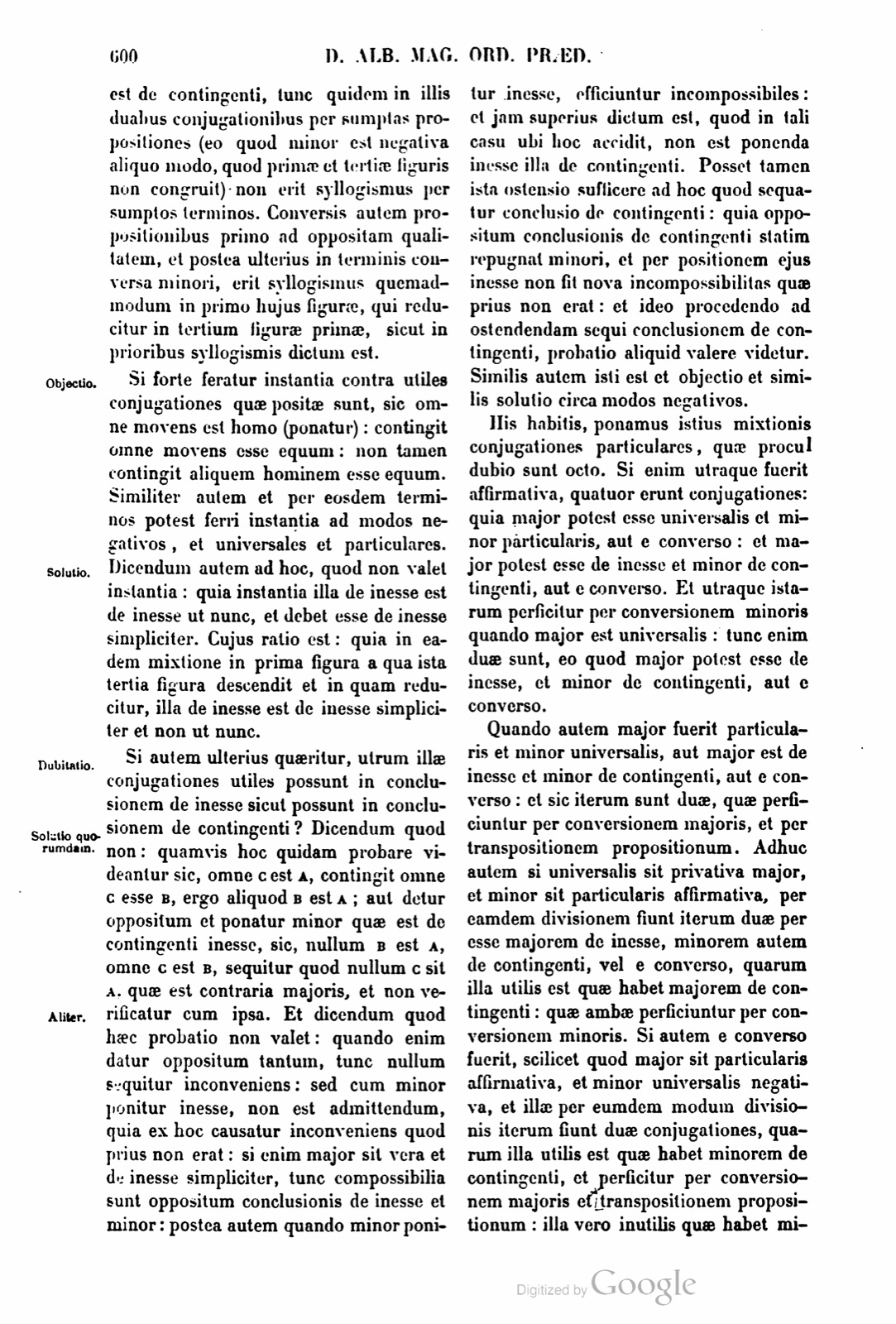
Si forte feratur instantia contra utiles conjugationes quae positae sunt, sic, omne movens est homo, ponatur: contingit omne movens esse equum: non tamen contingit aliquem hominem esse equum. Similiter autem et per eosdem terminos potest ferri instantia ad modos negativos, et universales et particulares. Dicendum autem ad hoc, quod non valet instantia: quia instantia illa de inesse est de inesse ut nunc, et debet esse de inesse simpliciter. Cujus ratio est: quia in eadem mixtione in prima figura a qua ista tertia figura descendit et in quam reducitur, illa de inesse est de inesse simpliciter et non ut nunc.
Si autem ulterius quaeritur, utrum illae conjugationes utiles possunt in conclusionem de inesse sicut possunt in conclusionem de contingenti? Dicendum quod non: quamvis hoc quidam probare videantur sic, omne C est A, contingit omne C esse B, ergo aliquod B est A; aut detur oppositum et ponatur minor quae est de contingenti inesse, sic, nullum B est A, omne C est B, sequitur quod nullum C sit A, quae est contraria majoris, et non verificatur cum ipsa. Et dicendum quod haec probatio non valet: quando enim datur oppositum tantum, tunc nullum sequitur inconveniens: sed cum minor ponitur inesse, non est admittendum, quia ex hoc causatur inconveniens quod prius non erat: si enim major sit vera et de inesse simpliciter, tunc compossibilia sunt oppositum conclusionis de inesse et minor: postea autem quando minor ponitur inesse, efficiuntur incompossibiles: et jam superius dictum est, quod in tali casu ubi hoc accidit, non est ponenda inesse illa de contingenti. Posset tamen ista ostensio sufficere ad hoc quod sequatur conclusio de contingenti: quia oppositum conclusionis de contingenti statim repugnat minori, et per positionem ejus inesse non fit nova incompossibilitas quae prius non erat: et ideo procedendo ad ostendendam sequi conclusionem de contingenti, probatio aliquid valere videtur. Similis autem isti est et objectio et similis solutio circa modos negativos.
His habitis, ponamus istius mixtionis conjugationes particulares, quae procul dubio sunt octo. Si enim utraque fuerit affirmativa, quatuor erunt conjugationes: quia major potest esse universalis et minor particularis, aut e converso: et major potest esse de inesse et minor de contingenti, aut e converso. Et utraque istarum perficitur per conversionem minoris quando major est universalis: tunc enim duae sunt, eo quod major potest esse de inesse, et minor de contingenti, aut e converso.
Quando autem major fuerit particularis et minor universalis, aut major est de inesse et minor de contingenti, aut e converso: et sic iterum sunt duae, quae perficiuntur per conversionem majoris, et per transpositionem propositionum. Adhuc autem si universalis sit privativa major, et minor sit particularis affirmativa, per eamdem divisionem fiunt iterum duae per esse majorem de inesse, minorem autem de contingenti, vel e converso, quarum illa utilis est quae habet majorem de contingenti: quae ambae perficiuntur per conversionem minoris. Si autem e converso fuerit, scilicet quod major sit particularis affirmativa, et minor universalis negativa, et illae per eumdem modum divisionis iterum fiunt duae conjugationes, quarum illa utilis est quae habet minorem de contingenti, et perficitur per conversionem majoris et transpositionem propositionum: illa vero inutilis quae habet minorem de inesse et affirmativam, quia illa habet minorem vere negativam, quod huic tertiae figurae non congruit.
Adhuc autem si universalis sit affirmativa et particularis negativa, quatuor fiunt conjugationes: aut enim major est universalis et minor particularis, aut e converso. Si major est universalis: aut major est de inesse et minor de contingenti, aut e converso. Et si major est universalis de inesse et minor de contingenti, est utilis conjugatio: aut e converso major est de contingenti et minor de inesse, et est inutilis conjugatio. Si autem major sit particularis et minor universalis: aut major est de inesse et minor de contingenti, et talis conjugatio est inutilis. Si vero sit e converso major de contingenti et minor de inesse, est conjugatio utilis. Sic ergo multiplicantur istae particulares conjugationes, quarum causam Aristoteles, cujus sententiam hic sequimur, non ponit nisi ultimam. Dicit enim Aristoteles in formatione particularium syllogismorum, quod si propositionum praemissarum una sit particularis et altera universalis, quando utraeque propositiones sunt affirmativae: aut quando universalis quidem est privativa et particularis affirmativa, sicut est in sexto hujus tertiae: idem modus per tales conjugationes erit syllogismorum: quia per conversionem unam vel duas omnes tales reducuntur et clauduntur per primam figuram: propter quod manifestum dicit esse, quod in talibus erit syllogismus ejus quod est contingere, hoc est, quod sequitur conclusio de contingenti, et non sequitur conclusio ejus quod est de inesse.
If perhaps an instance is brought against the useful conjugations which have been posited, thus, every mover is a man, let it be posited; every mover contingently is a horse; nevertheless it is not contingent that some man be a horse. Likewise also through the same terms an instance can be brought against the negative modes, both universal and particular. But to this one must say that the instance is not valid, because that instance of inherence is of inherence as now, and it ought to be of inherence simply. The reason for this is that in the same mixing in the first figure from which this third figure descends and into which it is reduced, that proposition of inherence is of inherence simply and not as now.
But if it is further asked whether those useful conjugations can proceed to a conclusion of inherence just as they can to a conclusion about the contingent, one must say that they cannot, although certain people seem to prove this thus: every C is A; every C contingently is B; therefore some B is A; or let the opposite be granted and let the minor, which is about the contingent, be posited as inherence, thus: no B is A; every C is B; it follows that no C is A, which is contrary to the major and is not verified with it. And one must say that this proof is not valid. For when only the opposite is granted, then no unacceptable consequence follows; but when the minor is posited as inherence, it must not be admitted, because from this an unacceptable consequence is caused which previously was not there. For if the major is true and of inherence simply, then the opposite of the conclusion of inherence and the minor are compossible; but afterward, when the minor is posited as inherence, they become incompossible. And it has already been said above that in such a case where this happens, that proposition about the contingent must not be posited as inherence. Yet that showing could suffice for this, that a conclusion about the contingent follows, because the opposite of the conclusion about the contingent is immediately repugnant to the minor, and by the positing of its inherence no new incompossibility is made which was not there before. And therefore, in proceeding to show that a conclusion about the contingent follows, the proof seems to have some value. Similar to this are also the objection and a similar solution concerning the negative modes.
With these things had, let us posit the particular conjugations of this mixing, which without doubt are eight. For if each premise is affirmative, there will be four conjugations, because the major can be universal and the minor particular, or conversely; and the major can be of inherence and the minor about the contingent, or conversely. And each of these is perfected through the conversion of the minor when the major is universal; for then there are two, because the major can be of inherence and the minor about the contingent, or conversely.
But when the major is particular and the minor universal, either the major is of inherence and the minor about the contingent, or conversely; and thus again there are two, which are perfected through the conversion of the major and through the transposition of the propositions. Again, if the universal is a privative major and the minor is a particular affirmative, by the same division there are again two through the major being of inherence and the minor about the contingent, or conversely; of these, that one is useful which has the major about the contingent. Both are perfected through the conversion of the minor. But if it is conversely, namely that the major is a particular affirmative and the minor a universal negative, then by the same mode of division these again become two conjugations, of which that one is useful which has the minor about the contingent, and it is perfected through the conversion of the major and the transposition of the propositions; but that one is useless which has the minor of inherence and affirmative, because it has a truly negative minor, which does not fit this third figure.
Again, if the universal is affirmative and the particular negative, four conjugations are made: for either the major is universal and the minor particular, or conversely. If the major is universal, either the major is of inherence and the minor about the contingent, or conversely. And if the major is universal of inherence and the minor about the contingent, it is a useful conjugation; but conversely, if the major is about the contingent and the minor of inherence, it is a useless conjugation. But if the major is particular and the minor universal, either the major is of inherence and the minor about the contingent, and such a conjugation is useless; or, if it is conversely, the major about the contingent and the minor of inherence, it is a useful conjugation. Thus therefore those particular conjugations are multiplied, whose cause Aristotle, whose opinion we follow here, posits only as the last. For Aristotle says in the formation of particular syllogisms that, if one of the premise-propositions is particular and the other universal, when both propositions are affirmative, or when indeed the universal is privative and the particular affirmative, as is the case in the sixth mode of this third figure, there will be the same mode of syllogisms through such conjugations, because through one or two conversions all such are reduced and closed through the first figure. For this reason he says that it is manifest that in such cases there will be a syllogism of that which is contingently to be, that is, that a conclusion about the contingent follows, and a conclusion of that which is of inherence does not follow.
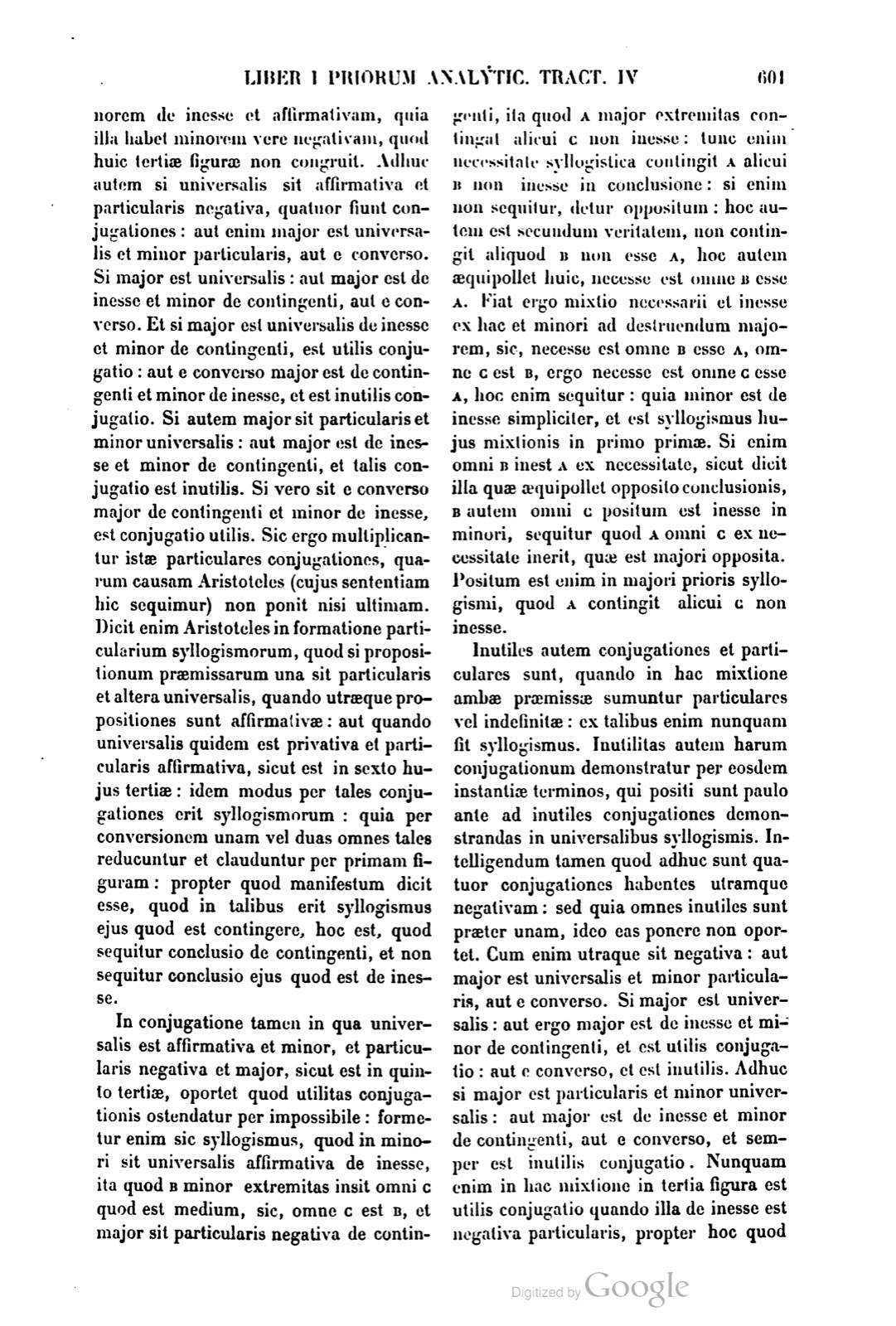
In conjugatione tamen in qua universalis est affirmativa et minor, et particularis negativa et major, sicut est in quinto tertiae, oportet quod utilitas conjugationis ostendatur per impossibile: formetur enim sic syllogismus, quod in minori sit universalis affirmativa de inesse, ita quod B minor extremitas insit omni C quod est medium, sic, omne C est B, et major sit particularis negativa de contingenti, ita quod A major extremitas contingat alicui C non inesse: tunc enim necessitate syllogistica contingit A alicui B non inesse in conclusione: si enim non sequitur, detur oppositum: hoc autem est secundum veritatem, non contingit aliquod B non esse A, hoc autem aequipollet huic, necesse est omne B esse A. Fiat ergo mixtio necessarii et inesse ex hac et minori ad destruendum majorem, sic, necesse est omne B esse A, omne C est B, ergo necesse est omne C esse A, hoc enim sequitur: quia minor est de inesse simpliciter, et est syllogismus hujus mixtionis in primo primae. Si enim omni B inest A ex necessitate, sicut dicit illa quae aequipollet opposito conclusionis, B autem omni C positum est inesse in minori, sequitur quod A omni C ex necessitate inerit, quae est majori opposita. Positum est enim in majori prioris syllogismi, quod A contingit alicui C non inesse.
Inutiles autem conjugationes et particulares sunt, quando in hac mixtione ambae praemissae sumuntur particulares vel indefinitae: ex talibus enim nunquam fit syllogismus. Inutilitas autem harum conjugationum demonstratur per eosdem instantiae terminos, qui positi sunt paulo ante ad inutiles conjugationes demonstrandas in universalibus syllogismis. Intelligendum tamen quod adhuc sunt quatuor conjugationes habentes utramque negativam: sed quia omnes inutiles sunt praeter unam, ideo eas ponere non oportet. Cum enim utraque sit negativa: aut major est universalis et minor particularis, aut e converso. Si major est universalis: aut ergo major est de inesse et minor de contingenti, et est utilis conjugatio: aut e converso, et est inutilis. Adhuc si major est particularis et minor universalis: aut major est de inesse et minor de contingenti, aut e converso, et semper est inutilis conjugatio. Nunquam enim in hac mixtione in tertia figura est utilis conjugatio quando illa de inesse est negativa particularis, propter hoc quod in reductione efficitur minor vere negativa, quod esse non potest in prima et tertia figuris.
Yet in the conjugation in which the universal is affirmative and the minor, and the particular negative is the major, as is the case in the fifth mode of the third figure, it is necessary that the usefulness of the conjugation be shown through the impossible. For let the syllogism be formed thus: that in the minor there is a universal affirmative of inherence, so that B, the lesser extreme, inheres in every C, which is the middle, thus: every C is B; and let the major be a particular negative about the contingent, so that A, the greater extreme, contingently does not inhere in some C. For then by syllogistic necessity A contingently does not inhere in some B in the conclusion. For if it does not follow, let the opposite be granted; but this according to the truth is, it is not contingent that some B not be A, and this is equipollent to this: it is necessary that every B be A. Therefore let a mixing of necessity and inherence be made from this and the minor in order to destroy the major, thus: it is necessary that every B be A; every C is B; therefore it is necessary that every C be A. For this follows, because the minor is of inherence simply, and it is a syllogism of this mixing in the first mode of the first figure. For if A inheres in every B from necessity, as that proposition which is equipollent to the opposite of the conclusion says, and B has been posited in the minor as inhering in every C, it follows that A will inhere in every C from necessity, which is opposite to the major. For it was posited in the major of the prior syllogism that A contingently does not inhere in some C.
But the useless conjugations are also particular when in this mixing both premises are taken as particular or indefinite; for from such premises a syllogism is never made. But the uselessness of these conjugations is demonstrated through the same terms of instance which were posited a little before for demonstrating the useless conjugations in universal syllogisms. Yet it must be understood that there are still four conjugations having each premise negative; but because all are useless except one, it is not necessary to posit them. For when each is negative, either the major is universal and the minor particular, or conversely. If the major is universal, then either the major is of inherence and the minor about the contingent, and it is a useful conjugation; or conversely, and it is useless. Again, if the major is particular and the minor universal, either the major is of inherence and the minor about the contingent, or conversely, and it is always a useless conjugation. For never in this mixing in the third figure is there a useful conjugation when that proposition of inherence is a particular negative, because in the reduction it is made a truly negative minor, which cannot be in the first and third figures.
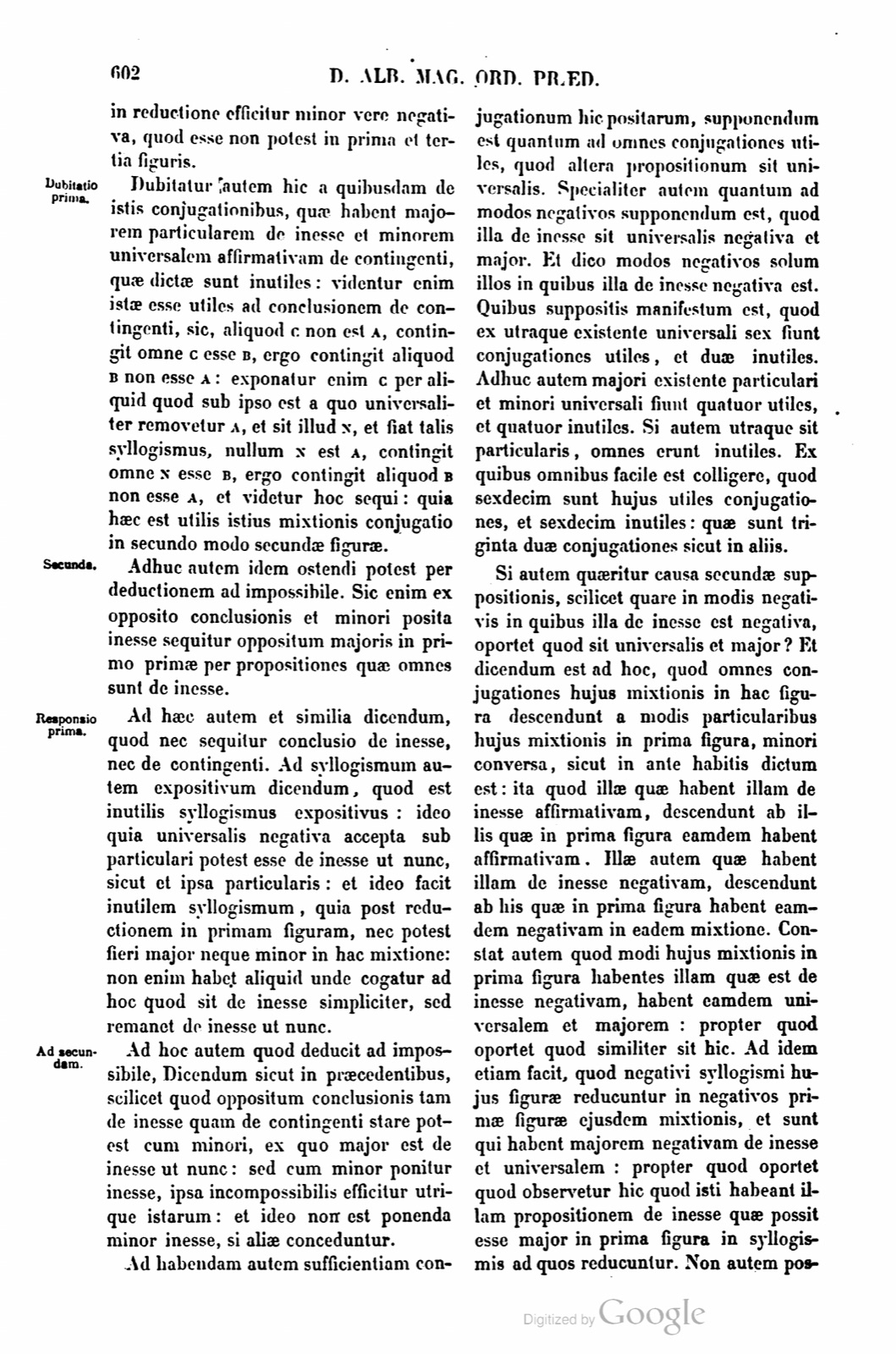
Dubitatur autem hic a quibusdam de istis conjugationibus, quae habent majorem particularem de inesse et minorem universalem affirmativam de contingenti, quae dictae sunt inutiles: videntur enim istae esse utiles ad conclusionem de contingenti, sic, aliquod C non est A, contingit omne C esse B, ergo contingit aliquod B non esse A: exponatur enim C per aliquid quod sub ipso est a quo universaliter removetur A, et sit illud X, et fiat talis syllogismus, nullum X est A, contingit omne X esse B, ergo contingit aliquod B non esse A, et videtur hoc sequi: quia haec est utilis istius mixtionis conjugatio in secundo modo secundae figurae.
Adhuc autem idem ostendi potest per deductionem ad impossibile. Sic enim ex opposito conclusionis et minori posita inesse sequitur oppositum majoris in primo primae per propositiones quae omnes sunt de inesse.
Ad haec autem et similia dicendum, quod nec sequitur conclusio de inesse, nec de contingenti. Ad syllogismum autem expositivum dicendum, quod est inutilis syllogismus expositivus: ideo quia universalis negativa accepta sub particulari potest esse de inesse ut nunc, sicut et ipsa particularis: et ideo facit inutilem syllogismum, quia post reductionem in primam figuram, nec potest fieri major neque minor in hac mixtione: non enim habet aliquid unde cogatur ad hoc quod sit de inesse simpliciter, sed remanet de inesse ut nunc.
Ad hoc autem quod deducit ad impossibile, dicendum sicut in praecedentibus, scilicet quod oppositum conclusionis tam de inesse quam de contingenti stare potest cum minori, ex quo major est de inesse ut nunc: sed cum minor ponitur inesse, ipsa incompossibilis efficitur utrique istarum: et ideo non est ponenda minor inesse, si aliae conceduntur.
Ad habendam autem sufficientiam conjugationum hic positarum, supponendum est quantum ad omnes conjugationes utiles, quod altera propositionum sit universalis. Specialiter autem quantum ad modos negativos supponendum est, quod illa de inesse sit universalis negativa et major. Et dico modos negativos solum illos in quibus illa de inesse negativa est. Quibus suppositis manifestum est, quod ex utraque existente universali sex fiunt conjugationes utiles, et duae inutiles. Adhuc autem majori existente particulari et minori universali fiunt quatuor utiles, et quatuor inutiles. Si autem utraque sit particularis, omnes erunt inutiles. Ex quibus omnibus facile est colligere, quod sexdecim sunt hujus utiles conjugationes, et sexdecim inutiles: quae sunt triginta duae conjugationes sicut in aliis.
Si autem quaeritur causa secundae suppositionis, scilicet quare in modis negativis in quibus illa de inesse est negativa, oportet quod sit universalis et major? Et dicendum est ad hoc, quod omnes conjugationes hujus mixtionis in hac figura descendunt a modis particularibus hujus mixtionis in prima figura, minori conversa, sicut in ante habitis dictum est: ita quod illae quae habent illam de inesse affirmativam, descendunt ab illis quae in prima figura eamdem habent affirmativam. Illae autem quae habent illam de inesse negativam, descendunt ab his quae in prima figura habent eamdem negativam in eadem mixtione. Constat autem quod modi hujus mixtionis in prima figura habentes illam quae est de inesse negativam, habent eamdem universalem et majorem: propter quod oportet quod similiter sit hic. Ad idem etiam facit, quod negativi syllogismi hujus figurae reducuntur in negativos primae figurae ejusdem mixtionis, et sunt qui habent majorem negativam de inesse et universalem: propter quod oportet quod observetur hic quod isti habeant illam propositionem de inesse quae possit esse major in prima figura in syllogismis ad quos reducuntur. Non autem possunt
But here it is doubted by certain people about those conjugations which have the particular major of inherence and the universal affirmative minor about the contingent, which have been called useless; for they seem to be useful for a conclusion about the contingent, thus: some C is not A; every C contingently is B; therefore some B contingently is not A. For let C be explained through something which is under it, from which A is universally removed, and let that be X, and let such a syllogism be made: no X is A; every X contingently is B; therefore some B contingently is not A. And this seems to follow, because this is a useful conjugation of this mixing in the second mode of the second figure.
Further, the same thing can be shown through a deduction to the impossible. For thus from the opposite of the conclusion and the minor posited as inherence, the opposite of the major follows in the first mode of the first figure through propositions which are all of inherence.
But to these and like things one must say that neither a conclusion of inherence nor a conclusion about the contingent follows. But to the expository syllogism one must say that it is a useless expository syllogism, for this reason: because a universal negative accepted under a particular can be of inherence as now, just as the particular itself can; and therefore it makes a useless syllogism, because after reduction into the first figure it can become neither the major nor the minor in this mixing. For it has nothing from which it is forced to this, that it be of inherence simply, but remains of inherence as now.
But to what deduces to the impossible, one must speak as in the preceding matters, namely that the opposite of the conclusion, both of inherence and about the contingent, can stand with the minor, since the major is of inherence as now; but when the minor is posited as inherence, it becomes incompossible with each of those; and therefore the minor must not be posited as inherence if the other propositions are conceded.
But in order to have the sufficiency of the conjugations posited here, it must be supposed, with respect to all useful conjugations, that one of the propositions is universal. But especially with respect to the negative modes it must be supposed that that proposition of inherence is universal negative and the major. And I call only those modes negative in which that proposition of inherence is negative. With these things supposed, it is manifest that, when each proposition is universal, six useful conjugations and two useless ones are made. Again, when the major is particular and the minor universal, four useful and four useless are made. But if each is particular, all will be useless. From all these it is easy to gather that there are sixteen useful conjugations of this mixing and sixteen useless ones, which are thirty-two conjugations, as in the others.
But if the cause of the second supposition is asked, namely why in the negative modes in which that proposition of inherence is negative it must be universal and the major, one must say to this that all the conjugations of this mixing in this figure descend from the particular modes of this mixing in the first figure, after the minor has been converted, as was said in the things had before. Thus those which have that affirmative proposition of inherence descend from those which in the first figure have the same affirmative. But those which have that negative proposition of inherence descend from those which in the first figure have the same negative in the same mixing. But it is certain that the modes of this mixing in the first figure which have that proposition which is negative of inherence have the same universal as the major; for this reason it is necessary that it be similarly here. The same point is also supported by the fact that the negative syllogisms of this figure are reduced into the negative syllogisms of the first figure of the same mixing, and they are those which have a negative major of inherence and a universal one; for this reason it is necessary that it be observed here that these syllogisms have that proposition of inherence which can be the major in the first figure in the syllogisms to which they are reduced. But they cannot
If a page does not appear, its photograph has not been uploaded yet.