Works › Prior Analytics, Books I–II
Volume 1 · pp. 596–598
Chapter XXV. On the uniform generation of syllogisms about the contingent in the third figure.
A marker with ≈ is an approximate page boundary, placed by measure of the text; the page photographs remain the authority. In the paired views, clicking a page marker brings that page into view.
CAPUT XXV. De uniformi generatione syllogismorum de contingenti in tertia figura.
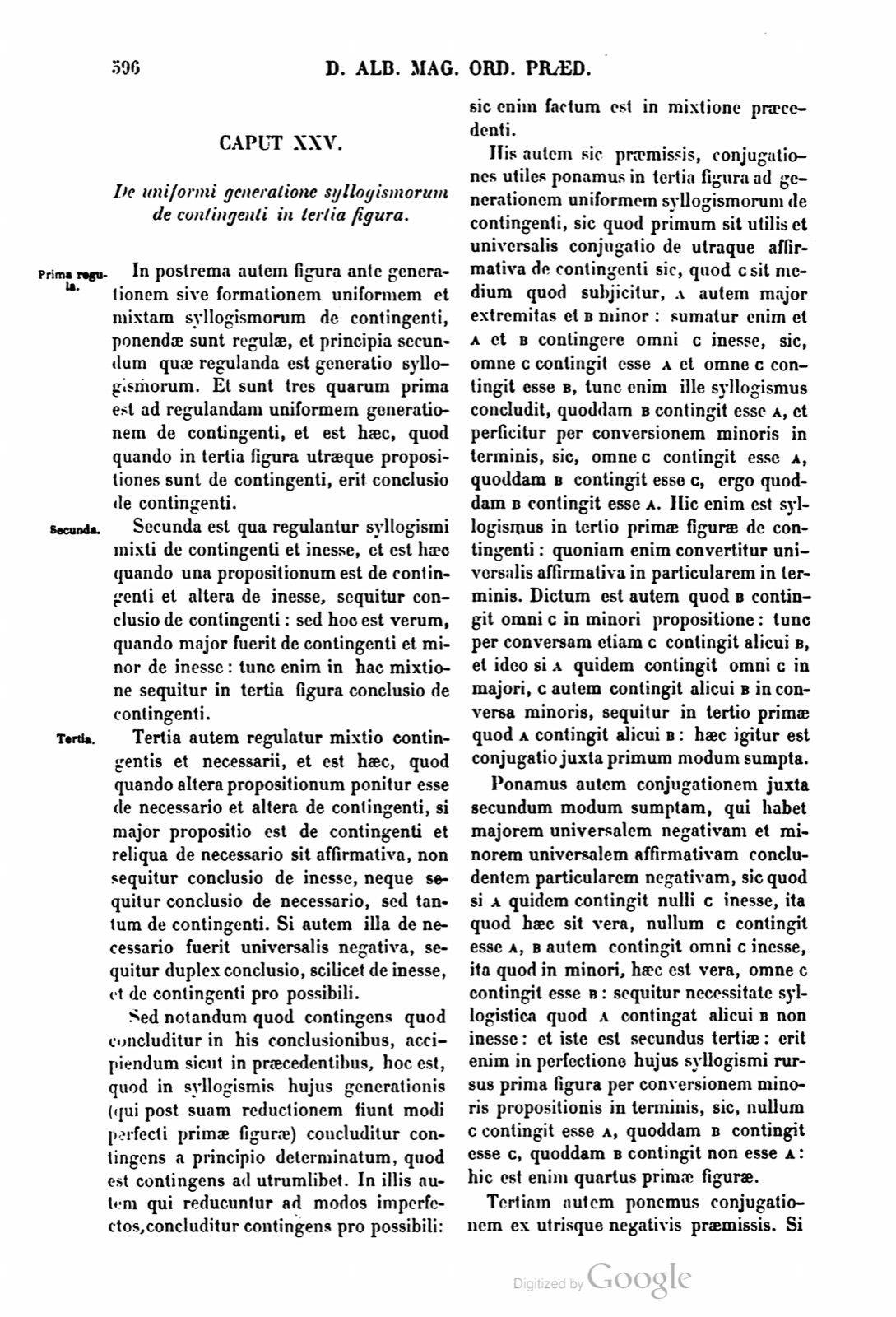
In postrema autem figura ante generationem sive formationem uniformem et mixtam syllogismorum de contingenti, ponendae sunt regulae, et principia secundum quae regulanda est generatio syllogismorum. Et sunt tres quarum prima est ad regulandam uniformem generationem de contingenti, et est haec, quod quando in tertia figura utraeque propositiones sunt de contingenti, erit conclusio de contingenti.
Secunda est qua regulantur syllogismi mixti de contingenti et inesse, et est haec: quando una propositionum est de contingenti et altera de inesse, sequitur conclusio de contingenti: sed hoc est verum, quando major fuerit de contingenti et minor de inesse: tunc enim in hac mixtione sequitur in tertia figura conclusio de contingenti.
Tertia autem regulatur mixtio contingentis et necessarii, et est haec, quod quando altera propositionum ponitur esse de necessario et altera de contingenti, si major propositio est de contingenti et reliqua de necessario sit affirmativa, non sequitur conclusio de inesse, neque sequitur conclusio de necessario, sed tantum de contingenti. Si autem illa de necessario fuerit universalis negativa, sequitur duplex conclusio, scilicet de inesse, et de contingenti pro possibili.
Sed notandum quod contingens quod concluditur in his conclusionibus, accipiendum sicut in praecedentibus, hoc est, quod in syllogismis hujus generationis, qui post suam reductionem fiunt modi perfecti primae figurae, concluditur contingens a principio determinatum, quod est contingens ad utrumlibet. In illis autem qui reducuntur ad modos imperfectos, concluditur contingens pro possibili: sic enim factum est in mixtione praecedenti.
His autem sic praemissis, conjugationes utiles ponamus in tertia figura ad generationem uniformem syllogismorum de contingenti, sic quod primum sit utilis et universalis conjugatio de utraque affirmativa de contingenti sic, quod C sit medium quod subjicitur, A autem major extremitas et B minor: sumatur enim et A et B contingere omni C inesse, sic, omne C contingit esse A et omne C contingit esse B, tunc enim ille syllogismus concludit, quoddam B contingit esse A, et perficitur per conversionem minoris in terminis, sic, omne C contingit esse A, quoddam B contingit esse C, ergo quoddam B contingit esse A. Hic enim est syllogismus in tertio primae figurae de contingenti: quoniam enim convertitur universalis affirmativa in particularem in terminis. Dictum est autem quod B contingit omni C in minori propositione: tunc per conversam etiam C contingit alicui B, et ideo si A quidem contingit omni C in majori, C autem contingit alicui B in conversa minoris, sequitur in tertio primae quod A contingit alicui B: haec igitur est conjugatio juxta primum modum sumpta.
Ponamus autem conjugationem juxta secundum modum sumptam, qui habet majorem universalem negativam et minorem universalem affirmativam concludentem particularem negativam, sic quod si A quidem contingit nulli C inesse, ita quod haec sit vera, nullum C contingit esse A, B autem contingit omni C inesse, ita quod in minori, haec est vera, omne C contingit esse B: sequitur necessitate syllogistica quod A contingat alicui B non inesse: et iste est secundus tertiae: erit enim in perfectione hujus syllogismi rursus prima figura per conversionem minoris propositionis in terminis, sic, nullum C contingit esse A, quoddam B contingit esse C, quoddam B contingit non esse A: hic est enim quartus primae figurae.
Tertiam autem ponemus conjugationem ex utrisque negativis praemissis. Si enim utraeque privativae propositiones praemissae ponantur, tunc ex his quidem quae sumpta sunt non erit necessarium aliquid sequi necessitate syllogistica: sed conversis propositionibus primo quidem in oppositam qualitatem, et deinde conversa minori in terminis, erit syllogismus, quemadmodum in prioribus de primo primae dictum est. Si enim major extremitas A et B minor contingant C nulli inesse: si transmutatur sive convertitur contingens non inesse in contingens inesse, hoc est, in oppositam qualitatem, rursum est prima figura per conversionem minoris in particularem, et in terminis, sic, nullum C contingit esse A et omne C contingit esse A, nullum C contingit esse B et omne C contingit esse B, et haec convertatur, quoddam B contingit esse C, tunc rursum erit prima figura in tertio primae figurae, quemadmodum in prioribus dictum est.
CHAPTER XXV. On the uniform generation of syllogisms about the contingent in the third figure.
But in the last figure, before the uniform and mixed generation or formation of syllogisms about the contingent, rules and principles must be posited according to which the generation of syllogisms is to be regulated. And there are three of them, of which the first is for regulating the uniform generation about the contingent, and it is this: that when in the third figure both propositions are about the contingent, the conclusion will be about the contingent.
The second is that by which mixed syllogisms about the contingent and inherence are regulated, and it is this: when one of the propositions is about the contingent and the other about inherence, a conclusion about the contingent follows; but this is true when the major is about the contingent and the minor about inherence, for then in this mixing in the third figure a conclusion about the contingent follows.
The third rule concerns the mixing of the contingent and the necessary, and it is this: when one of the propositions is posited as of necessity and the other about the contingent, if the major proposition is about the contingent and the remaining one of necessity is affirmative, no conclusion of inherence follows, nor does a conclusion of necessity follow, but only one about the contingent. But if that proposition of necessity is universal negative, a double conclusion follows, namely of inherence and of the contingent for the possible.
But it must be noted that the contingent which is concluded in these conclusions must be accepted as in the preceding matters, that is, that in syllogisms of this generation which, after their reduction, become perfect modes of the first figure, the contingent determined from the beginning is concluded, which is the contingent toward either alternative. But in those which are reduced to imperfect modes, the contingent for the possible is concluded; for thus it was done in the preceding mixing.
But with these things thus premised, let us posit the useful conjugations in the third figure for the uniform generation of syllogisms about the contingent, so that first there is a useful and universal conjugation from both affirmatives about the contingent, in such a way that C is the middle which is subjected, while A is the greater extreme and B the lesser. For let both A and B be taken to contingently inhere in every C, thus: every C contingently is A, and every C contingently is B. For then that syllogism concludes: some B contingently is A, and it is perfected through the conversion of the minor in terms, thus: every C contingently is A; some B contingently is C; therefore some B contingently is A. For this is a syllogism about the contingent in the third mode of the first figure, since the universal affirmative is converted into a particular in terms. But it has been said that B contingently belongs to every C in the minor proposition; then through the converse C also contingently belongs to some B. And therefore if A indeed contingently belongs to every C in the major, but C contingently belongs to some B in the converse of the minor, it follows in the third mode of the first that A contingently belongs to some B. This, therefore, is the conjugation taken according to the first mode.
But let us posit the conjugation taken according to the second mode, which has a universal negative major and a universal affirmative minor concluding a particular negative, so that if A indeed contingently belongs to no C, so that this is true, no C contingently is A, while B contingently belongs to every C, so that in the minor this is true, every C contingently is B, it follows by syllogistic necessity that A contingently does not belong to some B; and this is the second mode of the third figure. For in the perfection of this syllogism there will again be the first figure through the conversion of the minor proposition in terms, thus: no C contingently is A; some B contingently is C; some B contingently is not A. For this is the fourth mode of the first figure.
But we shall posit the third conjugation from both negative premises. For if both privative premise-propositions are posited, then from these things indeed which have been taken it will not be necessary that anything follow by syllogistic necessity. But when the propositions have first been converted into the opposite quality, and then the minor has been converted in terms, there will be a syllogism, just as was said in the preceding matters about the first mode of the first figure. For if the greater extreme A and the lesser B contingently belong to no C, if contingently not inhering is transmuted or converted into contingently inhering, that is, into the opposite quality, there is again the first figure through the conversion of the minor into a particular and in terms, thus: no C contingently is A and every C contingently is A; no C contingently is B and every C contingently is B; and let this be converted: some B contingently is C; then again there will be the first figure in the third mode of the first figure, just as was said in the preceding matters.
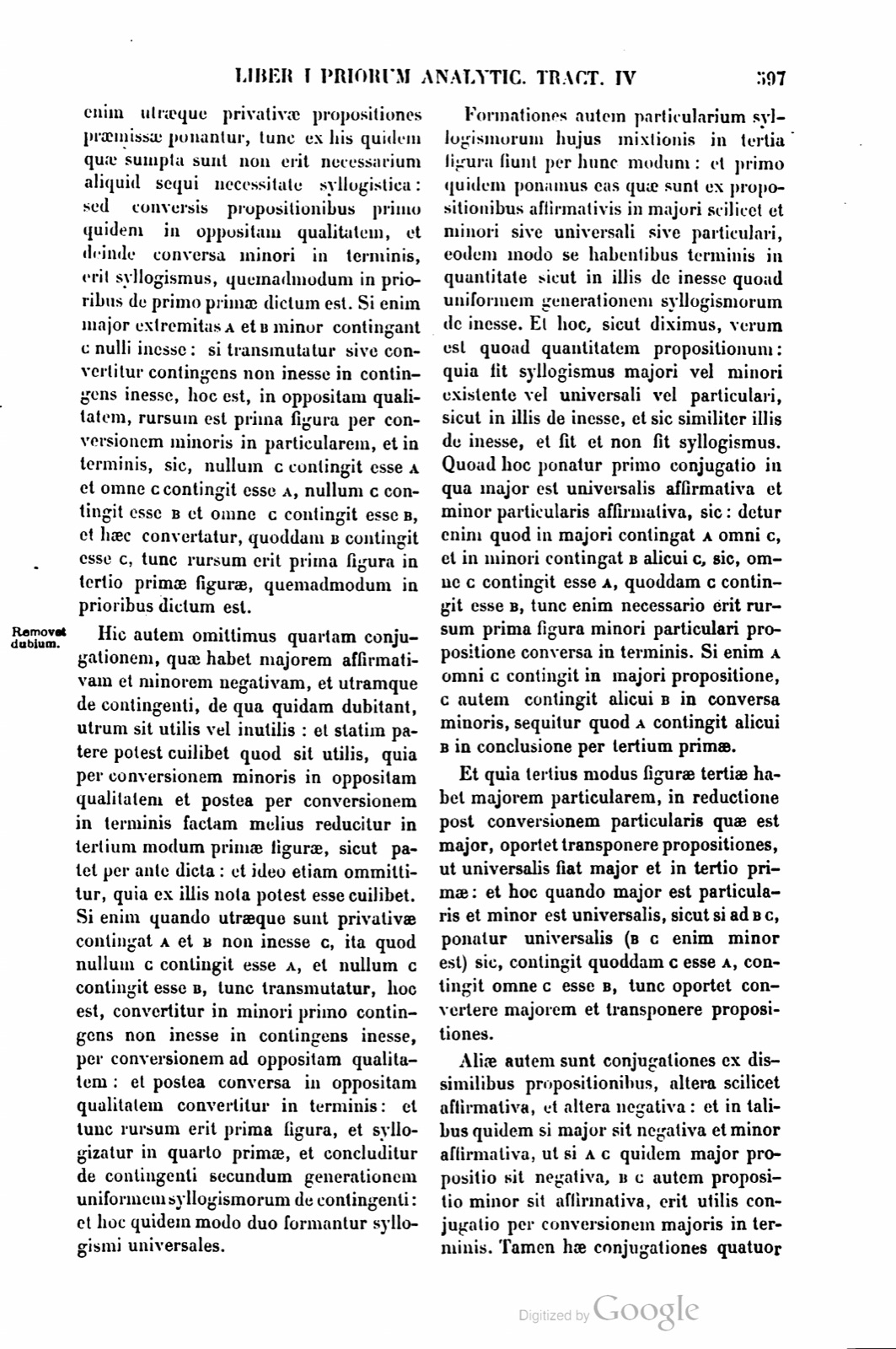
Hic autem omittimus quartam conjugationem, quae habet majorem affirmativam et minorem negativam, et utramque de contingenti, de qua quidam dubitant, utrum sit utilis vel inutilis: et statim patere potest cuilibet quod sit utilis, quia per conversionem minoris in oppositam qualitatem et postea per conversionem in terminis factam melius reducitur in tertium modum primae figurae, sicut patet per ante dicta: et ideo etiam omittitur, quia ex illis nota potest esse cuilibet. Si enim quando utraeque sunt privativae contingat A et B non inesse C, ita quod nullum C contingit esse A, et nullum C contingit esse B, tunc transmutatur, hoc est, convertitur in minori primo contingens non inesse in contingens inesse, per conversionem ad oppositam qualitatem: et postea conversa in oppositam qualitatem convertitur in terminis: et tunc rursum erit prima figura, et syllogizatur in quarto primae, et concluditur de contingenti secundum generationem uniformem syllogismorum de contingenti: et hoc quidem modo duo formantur syllogismi universales.
Formationes autem particularium syllogismorum hujus mixtionis in tertia figura fiunt per hunc modum: et primo quidem ponamus eas quae sunt ex propositionibus affirmativis in majori scilicet et minori sive universali sive particulari, eodem modo se habentibus terminis in quantitate sicut in illis de inesse quoad uniformem generationem syllogismorum de inesse. Et hoc, sicut diximus, verum est quoad quantitatem propositionum: quia fit syllogismus majori vel minori existente vel universali vel particulari, sicut in illis de inesse, et sic similiter illis in de inesse, et fit et non fit syllogismus. Quoad hoc ponatur primo conjugatio in qua major est universalis affirmativa et minor particularis affirmativa, sic: detur enim quod in majori contingat A omni C, et in minori contingat B alicui C, sic, omne C contingit esse A, quoddam C contingit esse B, tunc enim necessario erit rursum prima figura minori particulari propositione conversa in terminis. Si enim A omni C contingit in majori propositione, C autem contingit alicui B in conversa minoris, sequitur quod A contingit alicui B in conclusione per tertium primae.
Et quia tertius modus figurae tertiae habet majorem particularem, in reductione post conversionem particularis quae est major, oportet transponere propositiones, ut universalis fiat major et in tertio primae: et hoc quando major est particularis et minor est universalis, sicut si ad B C, ponatur universalis, B C enim minor est, sic, contingit quoddam C esse A, contingit omne C esse B, tunc oportet convertere majorem et transponere propositiones.
Aliae autem sunt conjugationes ex dissimilibus propositionibus, altera scilicet affirmativa, et altera negativa: et in talibus quidem si major sit negativa et minor affirmativa, ut si A C quidem major propositio sit negativa, B C autem propositio minor sit affirmativa, erit utilis conjugatio per conversionem majoris in terminis. Tamen hae conjugationes quatuor sunt, quarum duae habent majorem negativam universalem scilicet vel particularem et minorem affirmativam: quae intelliguntur per regulas inductas. Et omnium istarum facile patet perfectio: affirmativa enim quando major fuerit, convertenda est in terminis tantum. Si autem fuerit universalis negativa, primo convertenda est ad oppositam qualitatem, et postea in terminis. Si autem major sit particularis, convertendae saepe dicto modo et propositiones sunt transponendae.
But here we omit the fourth conjugation, which has an affirmative major and a negative minor, and both are about the contingent, about which certain people doubt whether it is useful or useless. And it can immediately be clear to anyone that it is useful, because through the conversion of the minor into the opposite quality and afterward through conversion made in terms it is better reduced into the third mode of the first figure, as is clear through the things said before; and therefore it is also omitted, because from those things it can be known to anyone. For if, when both are privative, A and B contingently do not inhere in C, so that no C contingently is A and no C contingently is B, then in the minor first the contingent not to inhere is transmuted, that is, converted, into the contingent to inhere, through conversion to the opposite quality; and afterward, after it has been converted into the opposite quality, it is converted in terms. And then again there will be the first figure, and it is syllogized in the fourth mode of the first, and it is concluded about the contingent according to the uniform generation of syllogisms about the contingent. And in this way, indeed, two universal syllogisms are formed.
But the formations of the particular syllogisms of this mixing in the third figure are made in this way. And first, indeed, let us posit those which are from affirmative propositions in the major and minor, whether universal or particular, the terms having themselves in quantity in the same way as in those of inherence with respect to the uniform generation of syllogisms of inherence. And this, as we said, is true with respect to the quantity of the propositions, because a syllogism is made when the major or the minor is either universal or particular, as in those of inherence, and thus similarly to those in inherence a syllogism is both made and not made. With respect to this, let the first conjugation be posited in which the major is universal affirmative and the minor particular affirmative, thus: let it be granted that in the major A contingently belongs to every C, and in the minor B contingently belongs to some C, thus: every C contingently is A; some C contingently is B. For then there will necessarily again be the first figure, after the minor particular proposition has been converted in terms. For if A contingently belongs to every C in the major proposition, but C contingently belongs to some B in the converse of the minor, it follows that A contingently belongs to some B in the conclusion through the third mode of the first.
And because the third mode of the third figure has a particular major, in reduction, after the conversion of the particular which is the major, it is necessary to transpose the propositions, so that the universal becomes the major in the third mode of the first figure. And this is when the major is particular and the minor is universal; for example, if for B C the universal is posited, for B C is the minor, thus: some C contingently is A; every C contingently is B, then it is necessary to convert the major and to transpose the propositions.
But there are other conjugations from dissimilar propositions, namely one affirmative and the other negative. And in such cases, if the major is negative and the minor affirmative, as if the A C major proposition is negative, while the B C minor proposition is affirmative, there will be a useful conjugation through the conversion of the major in terms. Yet there are four such conjugations, of which two have the major negative, namely universal or particular, and the minor affirmative; these are understood through the rules introduced. And the perfection of all these is easily clear. For when the affirmative is the major, it must be converted in terms only. But if it is universal negative, it must first be converted to the opposite quality and afterward in terms. But if the major is particular, it must be converted in the often-said way and the propositions must be transposed.
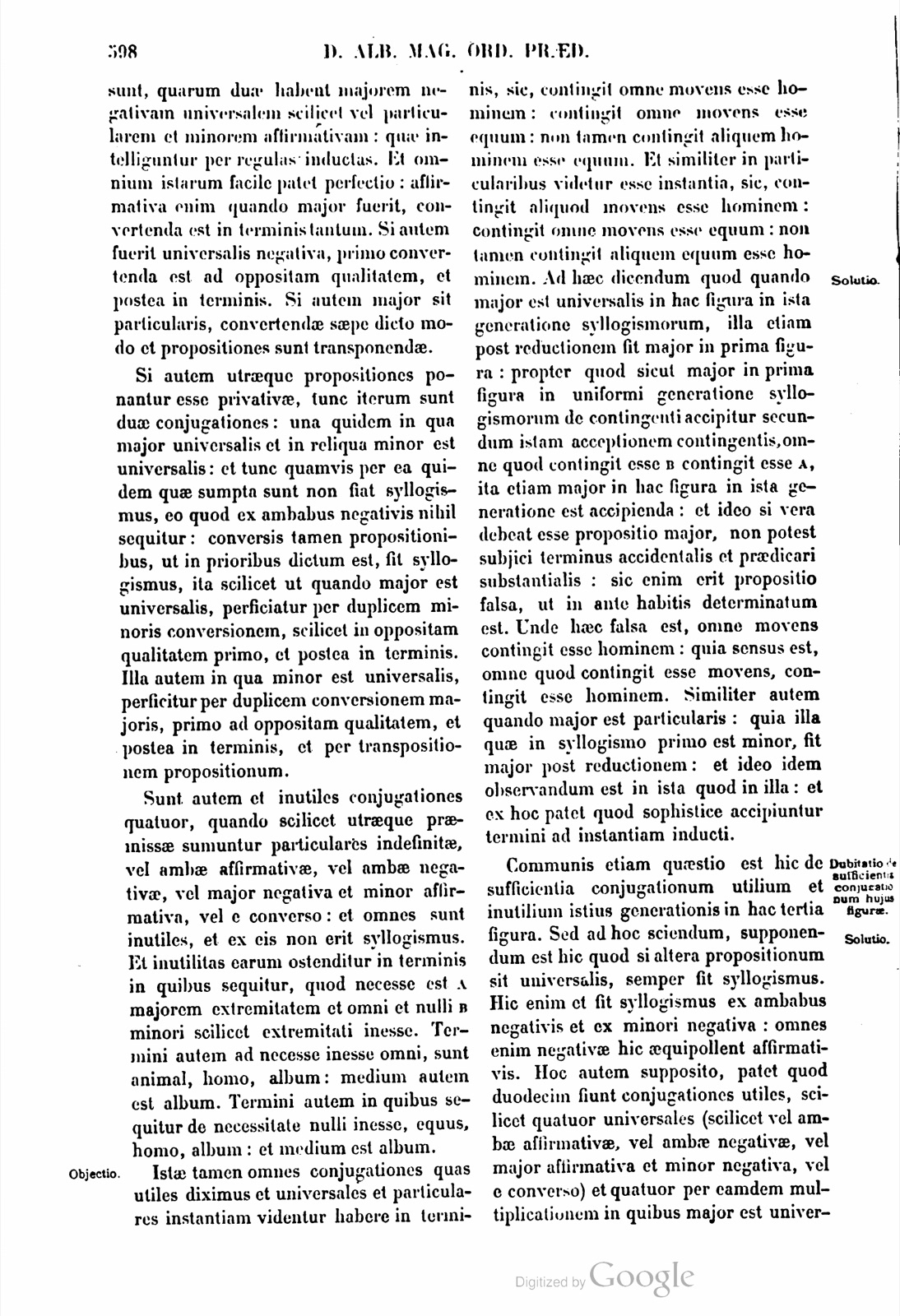
Si autem utraeque propositiones ponantur esse privativae, tunc iterum sunt duae conjugationes: una quidem in qua major universalis et in reliqua minor est universalis: et tunc quamvis per ea quidem quae sumpta sunt non fiat syllogismus, eo quod ex ambabus negativis nihil sequitur: conversis tamen propositionibus, ut in prioribus dictum est, fit syllogismus, ita scilicet ut quando major est universalis, perficiatur per duplicem minoris conversionem, scilicet in oppositam qualitatem primo, et postea in terminis. Illa autem in qua minor est universalis, perficitur per duplicem conversionem majoris, primo ad oppositam qualitatem, et postea in terminis, et per transpositionem propositionum.
Sunt autem et inutiles conjugationes quatuor, quando scilicet utraeque praemissae sumuntur particulares indefinitae, vel ambae affirmativae, vel ambae negativae, vel major negativa et minor affirmativa, vel e converso: et omnes sunt inutiles, et ex eis non erit syllogismus. Et inutilitas earum ostenditur in terminis in quibus sequitur, quod necesse est A majorem extremitatem et omni et nulli B minori scilicet extremitati inesse. Termini autem ad necesse inesse omni, sunt animal, homo, album: medium autem est album. Termini autem in quibus sequitur de necessitate nulli inesse, equus, homo, album: et medium est album.
Istae tamen omnes conjugationes quas utiles diximus et universales et particulares instantiam videntur habere in terminis, sic, contingit omne movens esse hominem: contingit omne movens esse equum: non tamen contingit aliquem hominem esse equum. Et similiter in particularibus videtur esse instantia, sic, contingit aliquod movens esse hominem: contingit omne movens esse equum: non tamen contingit aliquem equum esse hominem. Ad haec dicendum quod quando major est universalis in hac figura in ista generatione syllogismorum, illa etiam post reductionem fit major in prima figura: propter quod sicut major in prima figura in uniformi generatione syllogismorum de contingenti accipitur secundum istam acceptionem contingentis, omne quod contingit esse B contingit esse A, ita etiam major in hac figura in ista generatione est accipienda: et ideo si vera debeat esse propositio major, non potest subjici terminus accidentalis et praedicari substantialis: sic enim erit propositio falsa, ut in ante habitis determinatum est. Unde haec falsa est, omne movens contingit esse hominem: quia sensus est, omne quod contingit esse movens, contingit esse hominem. Similiter autem quando major est particularis: quia illa quae in syllogismo primo est minor, fit major post reductionem: et ideo idem observandum est in ista quod in illa: et ex hoc patet quod sophistice accipiuntur termini ad instantiam inducti.
Communis etiam quaestio est hic de sufficientia conjugationum utilium et inutilium istius generationis in hac tertia figura. Sed ad hoc sciendum, supponendum est hic quod si altera propositionum sit universalis, semper fit syllogismus. Hic enim et fit syllogismus ex ambabus negativis et ex minori negativa: omnes enim negativae hic aequipollent affirmativis. Hoc autem supposito, patet quod duodecim fiunt conjugationes utiles, scilicet quatuor universales, scilicet vel ambae affirmativae, vel ambae negativae, vel major affirmativa et minor negativa, vel e converso, et quatuor per eamdem multiplicationem in quibus major est universalis et minor particularis, et quatuor in quibus est e converso major particularis et minor universalis. Quatuor autem in quibus utraque est particularis, manent inutiles: et sic omnes sunt sedecim conjugationes.
But if both propositions are posited as privative, then again there are two conjugations: one in which the major is universal, and in the other the minor is universal. And then, although through those things indeed which have been taken no syllogism is made, because from both negatives nothing follows, nevertheless when the propositions have been converted, as was said in the preceding matters, a syllogism is made. Namely, when the major is universal, it is perfected through the double conversion of the minor, first into the opposite quality and afterward in terms. But that one in which the minor is universal is perfected through the double conversion of the major, first to the opposite quality and afterward in terms, and through the transposition of the propositions.
But there are also four useless conjugations, namely when both premises are taken as particular indefinites, whether both affirmative, or both negative, or the major negative and the minor affirmative, or conversely; and all are useless, and from them there will be no syllogism. And their uselessness is shown in terms in which it follows that it is necessary for A, the greater extreme, to inhere both in every B, namely the lesser extreme, and in no B. But the terms for necessary inherence in every one are animal, man, white; and the middle is white. But the terms in which it follows that of necessity it inheres in none are horse, man, white; and the middle is white.
Yet all these conjugations, which we have called useful, both universal and particular, seem to have an instance in terms, thus: every mover contingently is a man; every mover contingently is a horse; nevertheless it is not contingent that some man be a horse. And similarly in particulars there seems to be an instance, thus: some mover contingently is a man; every mover contingently is a horse; nevertheless it is not contingent that some horse be a man. To these things one must say that when the major is universal in this figure in this generation of syllogisms, that proposition also after reduction becomes the major in the first figure. For this reason, just as the major in the first figure in the uniform generation of syllogisms about the contingent is accepted according to this acceptance of the contingent, everything which contingently is B contingently is A, so also the major in this figure in this generation must be accepted. And therefore, if the major proposition ought to be true, an accidental term cannot be subjected and a substantial term predicated; for in this way the proposition will be false, as was determined in the preceding matters. Hence this is false: every mover contingently is a man, because the sense is, everything which contingently is moving contingently is a man. But likewise when the major is particular, because that which in the first syllogism is the minor becomes the major after reduction; and therefore the same thing must be observed in this proposition as in that one. And from this it is clear that the terms introduced for the instance are taken sophistically.
There is also here a common question about the sufficiency of the useful and useless conjugations of this generation in this third figure. But for this one must know and suppose here that, if one of the propositions is universal, a syllogism is always made. For here a syllogism is made both from both negatives and from a negative minor, since all negatives here are equipollent to affirmatives. But with this supposed, it is clear that twelve useful conjugations are made, namely four universal, that is, either both affirmative, or both negative, or the major affirmative and the minor negative, or conversely, and four by the same multiplication in which the major is universal and the minor particular, and four in which conversely the major is particular and the minor universal. But the four in which each proposition is particular remain useless; and thus there are sixteen conjugations in all.
If a page does not appear, its photograph has not been uploaded yet.