Works › Prior Analytics, Books I–II
Volume 1 · pp. 589–590
Chapter XXIII. On the useless conjugations of this mixing taken with regard to universal syllogisms of the second figure.
A marker with ≈ is an approximate page boundary, placed by measure of the text; the page photographs remain the authority. In the paired views, clicking a page marker brings that page into view.
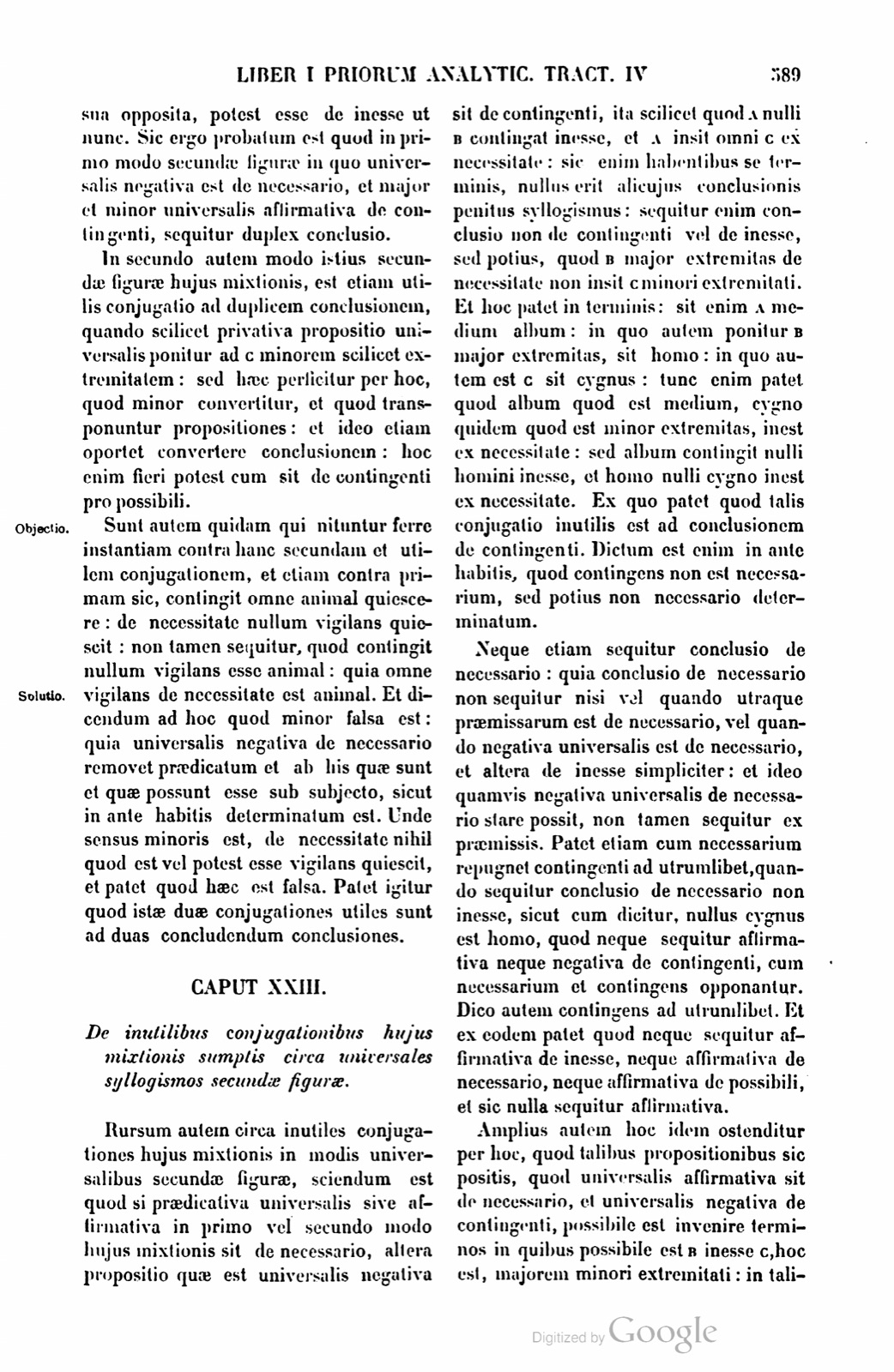
CAPUT XXIII. De inutilibus conjugationibus hujus mixtionis sumptis circa universales syllogismos secundae figurae.
Rursum autem circa inutiles conjugationes hujus mixtionis in modis universalibus secundae figurae, sciendum est quod si praedicativa universalis sive affirmativa in primo vel secundo modo hujus mixtionis sit de necessario, altera propositio quae est universalis negativa sit de contingenti, ita scilicet quod A nulli B contingat inesse, et A insit omni C ex necessitate: sic enim habentibus se terminis, nullus erit alicujus conclusionis penitus syllogismus: sequitur enim conclusio non de contingenti vel de inesse, sed potius, quod B major extremitas de necessitate non insit C minori extremitati. Et hoc patet in terminis: sit enim A medium album: in quo autem ponitur B major extremitas, sit homo: in quo autem est C sit cygnus: tunc enim patet quod album quod est medium, cygno quidem quod est minor extremitas, inest ex necessitate: sed album contingit nulli homini inesse, et homo nulli cygno inest ex necessitate. Ex quo patet quod talis conjugatio inutilis est ad conclusionem de contingenti. Dictum est enim in ante habitis, quod contingens non est necessarium, sed potius non necessario determinatum.
Neque etiam sequitur conclusio de necessario: quia conclusio de necessario non sequitur nisi vel quando utraque praemissarum est de necessario, vel quando negativa universalis est de necessario, et altera de inesse simpliciter: et ideo quamvis negativa universalis de necessario stare possit, non tamen sequitur ex praemissis. Patet etiam cum necessarium repugnet contingenti ad utrumlibet, quando sequitur conclusio de necessario non inesse, sicut cum dicitur, nullus cygnus est homo, quod neque sequitur affirmativa neque negativa de contingenti, cum necessarium et contingens opponantur. Dico autem contingens ad utrumlibet. Et ex eodem patet quod neque sequitur affirmativa de inesse, neque affirmativa de necessario, neque affirmativa de possibili, et sic nulla sequitur affirmativa.
Amplius autem hoc idem ostenditur per hoc, quod talibus propositionibus sic positis, quod universalis affirmativa sit de necessario, et universalis negativa de contingenti, possibile est invenire terminos in quibus possibile est B inesse C, hoc est, majorem minori extremitati: in talibus enim terminis stabit affirmativa de inesse conclusio. In tali enim dispositione nihil prohibet quod C sit sub B, sive quod minor extremitas sit sumpta sub majori extremitate, et quod tamen A quod est medium, contingat omni B inesse contingenter, et quod idem A medium insit C majori extremitati de necessitate, sicut patet in his terminis, si C minor extremitas ponatur esse vigilans, B autem major extremitas ponatur esse animal, in quo autem A quod est medium ponatur esse motus sive motum. Nam patet quod vigilanti ex necessitate inest motus: quia vigilia secundum actum non est aliud nisi motus caloris et sensuum ad exterius ab intimis: animali autem omni contingit inesse motum: et tamen sequitur quod omne vigilans de necessitate est animal, sic, contingit nullum animal moveri: omne vigilans de necessitate movetur: ergo omne vigilans de necessitate est animal. Quod enim contingat nullum animal moveri, ex hoc patet, quia contingit omne animal moveri, et convertitur contingens in oppositam qualitatem: ergo si contingit omne, contingit et nullum. Ex hoc autem quod sequitur conclusio de necessario, manifestum est quod non sequitur conclusio negativa de non inesse: quia sic se habentibus terminis sequitur conclusio de necesse inesse et ad necesse inesse sequitur inesse: et sic non potest stare conclusio de non inesse. Neque etiam sequitur conclusio dictionum sive affirmationum istis negationibus quae sunt contingenter inesse vel inesse simpliciter, hoc est, sine modo, sicut paulo ante dictum est: et sic nulla sequitur conclusio neque negativa neque affirmativa.
CHAPTER XXIII. On the useless conjugations of this mixing taken with regard to universal syllogisms of the second figure.
Again, concerning the useless conjugations of this mixing in the universal modes of the second figure, it must be known that if the universal predicative or affirmative proposition in the first or second mode of this mixing is about the necessary, while the other proposition, which is universal negative, is about the contingent, namely so that A contingently belongs to no B and A belongs to every C from necessity, with the terms having themselves in this way there will be absolutely no syllogism of any conclusion. For the conclusion that follows is not about the contingent or about inherence, but rather that B, the greater extreme, of necessity does not belong to C, the lesser extreme. And this is clear in terms: let A, the middle, be white; but let that in which B, the greater extreme, is posited be man; and let that in which C is be swan. Then it is clear that white, which is the middle, belongs of necessity to the swan, which is the lesser extreme, but white contingently belongs to no man, and man belongs to no swan from necessity. From this it is clear that such a conjugation is useless for a conclusion about the contingent. For it has been said in the preceding matters that the contingent is not the necessary, but rather is determined by the non-necessary.
Nor does a conclusion of necessity follow, because a conclusion of necessity follows only either when both premises are about the necessary, or when the universal negative is about the necessary and the other is of inherence simply. And therefore, although the universal negative of necessity can stand, nevertheless it does not follow from the premises. It is also clear, since the necessary is repugnant to the contingent toward either alternative, that when a conclusion of necessary non-inherence follows, as when it is said, no swan is a man, neither an affirmative nor a negative about the contingent follows, since the necessary and the contingent are opposed. But I mean the contingent toward either alternative. And from the same thing it is clear that neither an affirmative of inherence, nor an affirmative of necessity, nor an affirmative of the possible follows; and thus no affirmative follows.
Moreover this same thing is shown through this, that when such propositions are posited in such a way that the universal affirmative is about the necessary and the universal negative about the contingent, it is possible to find terms in which it is possible for B to belong to C, that is, for the greater extreme to belong to the lesser extreme; for in such terms an affirmative conclusion of inherence will stand. For in such a disposition nothing prevents C from being under B, or the lesser extreme from being taken under the greater extreme, and nevertheless A, which is the middle, from contingently belonging to every B, and the same A, the middle, from belonging of necessity to C, the greater extreme, as is clear in these terms: if C, the lesser extreme, is posited as waking, but B, the greater extreme, is posited as animal, and that in which A, which is the middle, is posited, is motion or moved. For it is clear that motion belongs to the waking thing of necessity, because waking in act is nothing other than a motion of heat and of the senses outward from the interior; but motion contingently belongs to every animal. And nevertheless it follows that every waking thing of necessity is an animal, thus: it is contingent that no animal be moved; every waking thing of necessity is moved; therefore every waking thing of necessity is an animal. For that it is contingent that no animal be moved is clear from this, that every animal contingently is moved, and the contingent is converted into the opposite quality; therefore if it is contingent that every one is, it is also contingent that none is. But from the fact that a conclusion of necessity follows, it is manifest that a negative conclusion of non-inherence does not follow, because with the terms having themselves thus a conclusion of necessary inherence follows, and upon necessary inherence inherence follows; and thus a conclusion of non-inherence cannot stand. Nor also does there follow a conclusion of sayings or affirmations opposed to these negations, which are contingently to belong or to belong simply, that is, without a mode, as was said a little before; and thus no conclusion follows, neither negative nor affirmative.
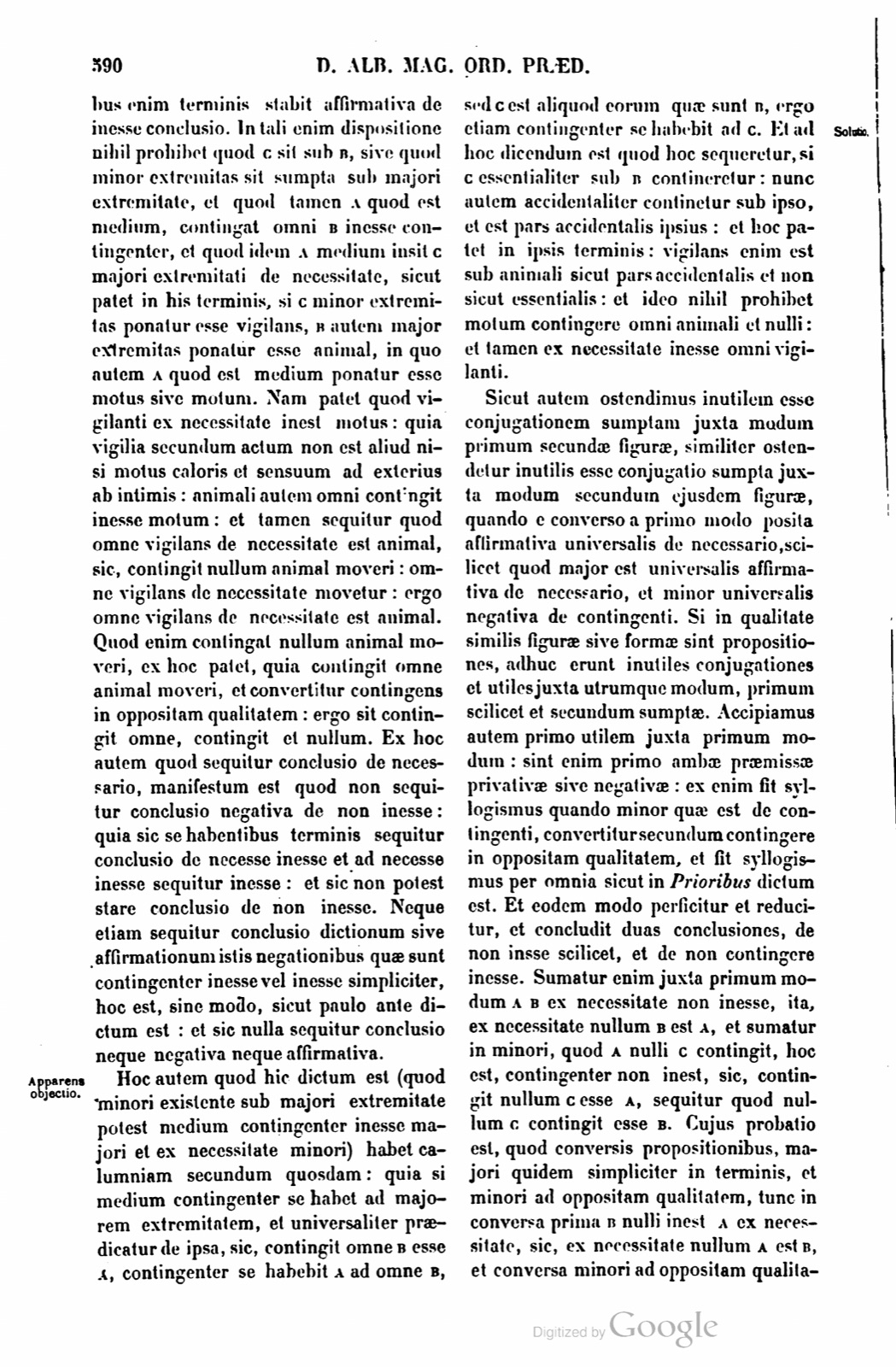
Hoc autem quod hic dictum est, quod minori existente sub majori extremitate potest medium contingenter inesse majori et ex necessitate minori, habet calumniam secundum quosdam: quia si medium contingenter se habet ad majorem extremitatem, et universaliter praedicatur de ipsa, sic, contingit omne B esse A, contingenter se habebit A ad omne B, sed C est aliquod eorum quae sunt B, ergo etiam contingenter se habebit ad C. Et ad hoc dicendum est quod hoc sequeretur, si C essentialiter sub B contineretur: nunc autem accidentaliter continetur sub ipso, et est pars accidentalis ipsius: et hoc patet in ipsis terminis: vigilans enim est sub animali sicut pars accidentalis et non sicut essentialis: et ideo nihil prohibet motum contingere omni animali et nulli: et tamen ex necessitate inesse omni vigilanti.
Sicut autem ostendimus inutilem esse conjugationem sumptam juxta modum primum secundae figurae, similiter ostendetur inutilis esse conjugatio sumpta juxta modum secundum ejusdem figurae, quando e converso a primo modo posita affirmativa universalis de necessario, scilicet quod major est universalis affirmativa de necessario, et minor universalis negativa de contingenti. Si in qualitate similis figurae sive formae sint propositiones, adhuc erunt inutiles conjugationes et utiles juxta utrumque modum, primum scilicet et secundum sumptae. Accipiamus autem primo utilem juxta primum modum: sint enim primo ambae praemissae privativae sive negativae: ex enim fit syllogismus quando minor quae est de contingenti, convertitur secundum contingere in oppositam qualitatem, et fit syllogismus per omnia sicut in Prioribus dictum est. Et eodem modo perficitur et reducitur, et concludit duas conclusiones, de non inesse scilicet, et de non contingere inesse. Sumatur enim juxta primum modum A B ex necessitate non inesse, ita, ex necessitate nullum B est A, et sumatur in minori, quod A nulli C contingit, hoc est, contingenter non inest, sic, contingit nullum C esse A, sequitur quod nullum C contingit esse B. Cujus probatio est, quod conversis propositionibus, majori quidem simpliciter in terminis, et minori ad oppositam qualitatem, tunc in conversa prima B nulli inest A ex necessitate, sic, ex necessitate nullum A est B, et conversa minori ad oppositam qualitatem
But this which has been said here, that when the minor is under the greater extreme the middle can contingently belong to the major and of necessity to the minor, has an objection according to some, because if the middle has itself contingently toward the greater extreme and is predicated universally of it, thus, every B contingently is A, A will have itself contingently to every B; but C is one of those things which are B; therefore it will also have itself contingently toward C. And to this one must say that this would follow if C were contained under B essentially; but now it is contained under it accidentally and is an accidental part of it. And this is clear in the terms themselves: for waking is under animal as an accidental part and not as an essential part. And therefore nothing prevents motion from contingently belonging to every animal and to none, and nevertheless from belonging of necessity to every waking thing.
But just as we have shown that the conjugation taken according to the first mode of the second figure is useless, similarly it will be shown that the conjugation taken according to the second mode of the same figure is useless, when conversely to the first mode the universal affirmative of necessity is posited, namely that the major is universal affirmative about the necessary and the minor universal negative about the contingent. If the propositions are similar in quality of figure or form, there will still be useless and useful conjugations taken according to each mode, namely the first and the second. But let us first accept a useful one according to the first mode: for first let both premises be privative or negative. For from them a syllogism is made when the minor which is about the contingent is converted according to contingently belonging into the opposite quality, and a syllogism is made in every way as has been said in the Prior Analytics. And in the same way it is perfected and reduced, and it concludes two conclusions, namely of not inhering and of not contingently inhering. For let A B be taken according to the first mode as not inhering from necessity, thus: of necessity no B is A; and let it be taken in the minor that A contingently belongs to no C, that is, contingently does not belong, thus: it is contingent that no C be A. It follows that no C contingently is B. Its proof is that, once the propositions have been converted, the major simply in terms and the minor to the opposite quality, then in the converted first proposition B belongs to no A from necessity, thus: of necessity no A is B, and when the minor has been converted to the opposite quality
If a page does not appear, its photograph has not been uploaded yet.