Works › Prior Analytics, Books I–II
Volume 1 · pp. 587–589
Chapter XXII. On the principle by which the mixing of the contingent and the necessary is regulated in the second figure, and on the formation of useful conjugations for universal syllogisms of this mixing.
A marker with ≈ is an approximate page boundary, placed by measure of the text; the page photographs remain the authority. In the paired views, clicking a page marker brings that page into view.
CAPUT XXII. De principio quo regulatur mixtio contingentis et necessarii in secunda figura, et formatione utilium conjugationum ad universales hujus mixtionis syllogismos.
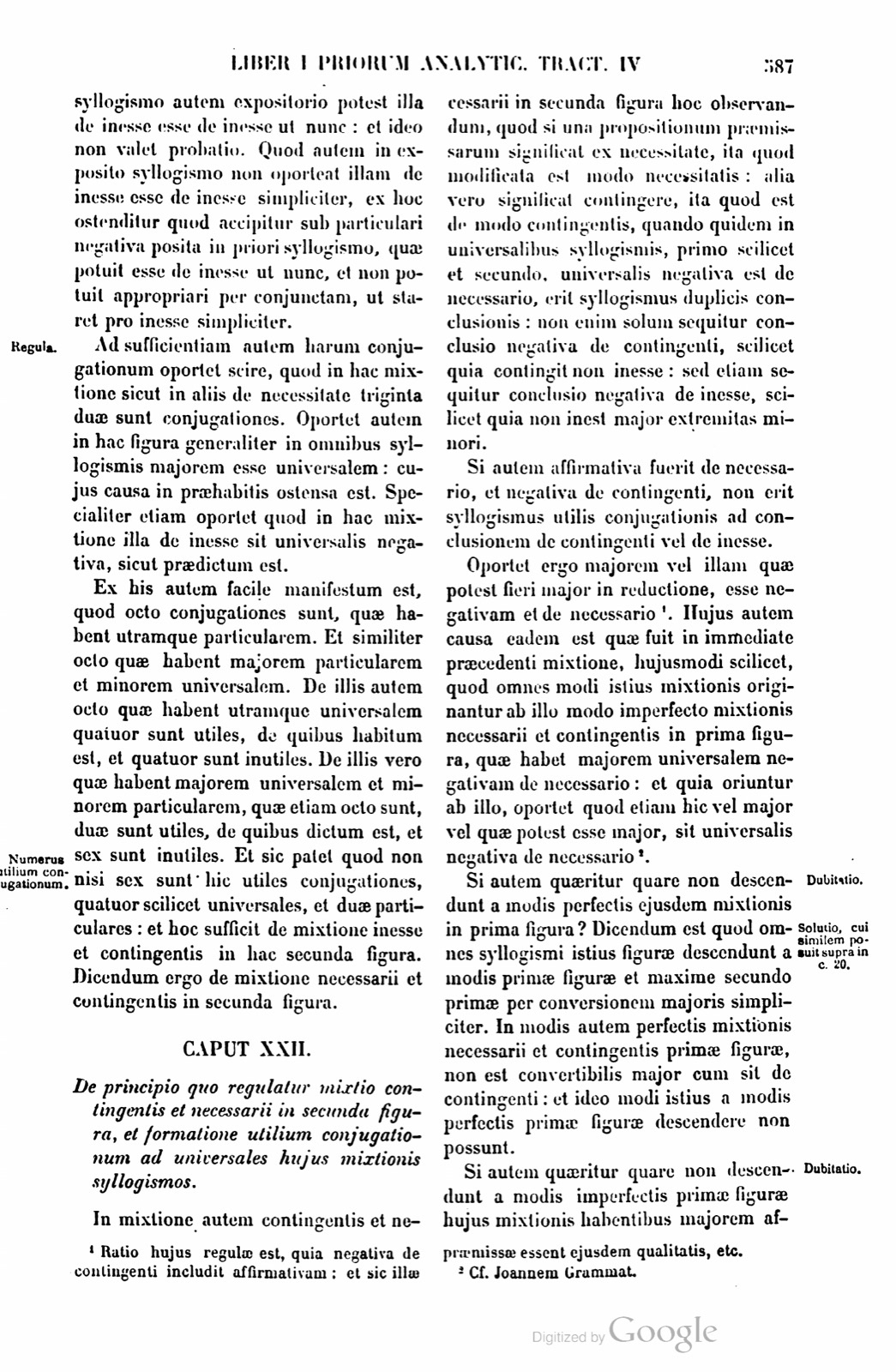
In mixtione autem contingentis et necessarii in secunda figura hoc observandum, quod si una propositionum praemissarum significat ex necessitate, ita quod modificata est modo necessitatis: alia vero significat contingere, ita quod est de modo contingentis, quando quidem in universalibus syllogismis, primo scilicet et secundo, universalis negativa est de necessario, erit syllogismus duplicis conclusionis: non enim solum sequitur conclusio negativa de contingenti, scilicet quia contingit non inesse: sed etiam sequitur conclusio negativa de inesse, scilicet quia non inest major extremitas minori.
Si autem affirmativa fuerit de necessario, et negativa de contingenti, non erit syllogismus utilis conjugationis ad conclusionem de contingenti vel de inesse. Oportet ergo majorem vel illam quae potest fieri major in reductione, esse negativam et de necessario1. Hujus autem causa eadem est quae fuit in immediate praecedenti mixtione, hujusmodi scilicet, quod omnes modi istius mixtionis originantur ab illo modo imperfecto mixtionis necessarii et contingentis in prima figura, quae habet majorem universalem negativam de necessario: et quia oriuntur ab illo, oportet quod etiam hic vel major vel quae potest esse major, sit universalis negativa de necessario2.
Si autem quaeritur quare non descendunt a modis perfectis ejusdem mixtionis in prima figura? Dicendum est quod omnes syllogismi istius figurae descendunt a modis primae figurae et maxime secundo primae per conversionem majoris simpliciter. In modis autem perfectis mixtionis necessarii et contingentis primae figurae, non est convertibilis major cum sit de contingenti: et ideo modi istius a modis perfectis primae figurae descendere non possunt.
Si autem quaeritur quare non descendunt a modis imperfectis primae figurae hujus mixtionis habentibus majorem affirmativam de necessario? Dicendum quod omnes syllogismi secundae figurae sunt negativi. Adhuc autem major universalis affirmativa de necessario simpliciter converti non potest. Et ideo cum modi istius mixtionis in secunda figura descendant a modis ejusdem mixtionis in prima figura, et affirmativa universalis simpliciter converti non possit, nec negative concludere, ideo ab illis modis imperfectis quae habent majorem affirmativam de necessario istius secundae figurae mixtionis necessarii et contingentis descendere non possunt. Haec igitur est causa, quare in secunda figura mixtionis necessarii et contingentis oportet habere majorem universalem negativam de necessario.
CHAPTER XXII. On the principle by which the mixing of the contingent and the necessary is regulated in the second figure, and on the formation of useful conjugations for universal syllogisms of this mixing.
But in the mixing of the contingent and the necessary in the second figure this must be observed: that if one of the premise propositions signifies from necessity, so that it is modified by the mode of necessity, while the other signifies contingently belonging, so that it is about the mode of the contingent, when indeed in universal syllogisms, namely the first and the second, the universal negative is about the necessary, there will be a syllogism of a twofold conclusion. For not only does a negative conclusion about the contingent follow, namely because it contingently does not belong, but a negative conclusion of inherence also follows, namely because the greater extreme does not belong to the minor.
But if the affirmative is about the necessary and the negative about the contingent, there will not be a syllogism of a useful conjugation for a conclusion about the contingent or of inherence. Therefore the major, or that proposition which can become the major in reduction, must be negative and about the necessary1. But the cause of this is the same as it was in the immediately preceding mixing, namely of this kind: that all the modes of this mixing originate from that imperfect mode of the mixing of the necessary and the contingent in the first figure, which has the universal negative major about the necessary; and because they arise from that, here also either the major or that which can be the major must be universal negative about the necessary2.
But if it is asked why they do not descend from the perfect modes of the same mixing in the first figure, one must say that all syllogisms of this figure descend from the modes of the first figure, and especially from the second of the first, through conversion of the major simply. But in the perfect modes of the mixing of the necessary and the contingent in the first figure, the major is not convertible, since it is about the contingent; and therefore the modes of this figure cannot descend from the perfect modes of the first figure.
But if it is asked why they do not descend from the imperfect modes of the first figure of this mixing which have the major affirmative about the necessary, one must say that all syllogisms of the second figure are negative. Again, the universal affirmative major about the necessary cannot be converted simply. And therefore, since the modes of this mixing in the second figure descend from modes of the same mixing in the first figure, and a universal affirmative cannot be converted simply, nor conclude negatively, therefore the modes of this second figure of the mixing of the necessary and the contingent cannot descend from those imperfect modes which have the major affirmative about the necessary. This, therefore, is the cause why in the second figure of the mixing of the necessary and the contingent it is necessary to have a universal negative major about the necessary.
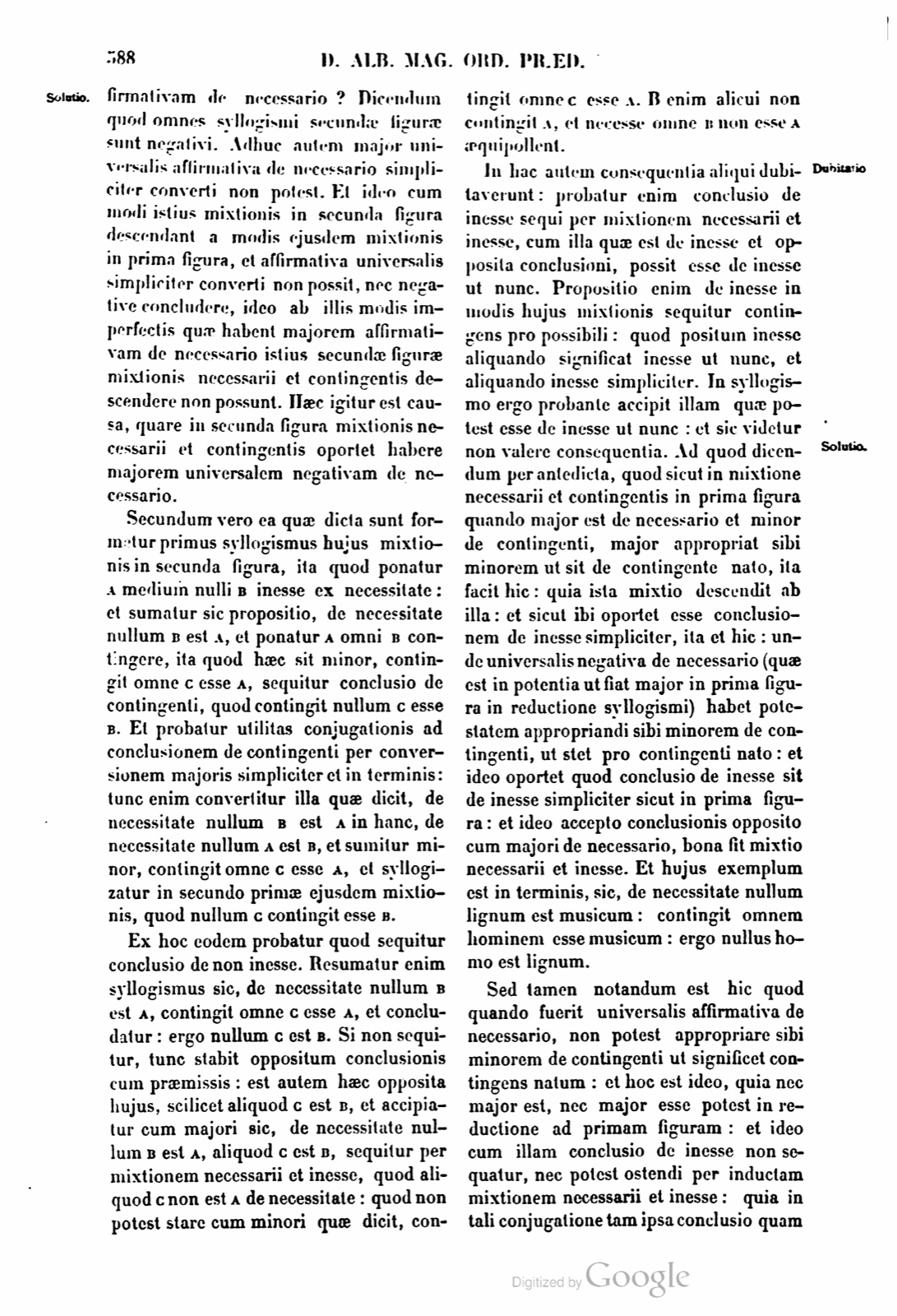
Secundum vero ea quae dicta sunt formetur primus syllogismus hujus mixtionis in secunda figura, ita quod ponatur A medium nulli B inesse ex necessitate: et sumatur sic propositio, de necessitate nullum B est A, et ponatur A omni C contingere, ita quod haec sit minor, contingit omne C esse A, sequitur conclusio de contingenti, quod contingit nullum C esse B. Et probatur utilitas conjugationis ad conclusionem de contingenti per conversionem majoris simpliciter et in terminis: tunc enim convertitur illa quae dicit, de necessitate nullum B est A in hanc, de necessitate nullum A est B, et sumitur minor, contingit omne C esse A, et syllogizatur in secundo primae ejusdem mixtionis, quod nullum C contingit esse B.
Ex hoc eodem probatur quod sequitur conclusio de non inesse. Resumatur enim syllogismus sic, de necessitate nullum B est A, contingit omne C esse A, et concludatur: ergo nullum C est B. Si non sequitur, tunc stabit oppositum conclusionis cum praemissis: est autem haec opposita hujus, scilicet aliquod C est B, et accipiatur cum majori sic, de necessitate nullum B est A, aliquod C est B, sequitur per mixtionem necessarii et inesse, quod aliquod C non est A de necessitate: quod non potest stare cum minori quae dicit, contingit omne C esse A. B enim alicui non contingit A, et necesse omne C non esse A aequipollent.
In hac autem consequentia aliqui dubitaverunt: probatur enim conclusio de inesse sequi per mixtionem necessarii et inesse, cum illa quae est de inesse et opposita conclusioni, possit esse de inesse ut nunc. Propositio enim de inesse in modis hujus mixtionis sequitur contingens pro possibili: quod positum inesse aliquando significat inesse ut nunc, et aliquando inesse simpliciter. In syllogismo ergo probante accipit illam quae potest esse de inesse ut nunc: et sic videtur non valere consequentia. Ad quod dicendum per antedicta, quod sicut in mixtione necessarii et contingentis in prima figura quando major est de necessario et minor de contingenti, major appropriat sibi minorem ut sit de contingente nato, ita facit hic: quia ista mixtio descendit ab illa: et sicut ibi oportet esse conclusionem de inesse simpliciter, ita et hic: unde universalis negativa de necessario, quae est in potentia ut fiat major in prima figura in reductione syllogismi, habet potestatem appropriandi sibi minorem de contingenti, ut stet pro contingenti nato: et ideo oportet quod conclusio de inesse sit de inesse simpliciter sicut in prima figura: et ideo accepto conclusionis opposito cum majori de necessario, bona fit mixtio necessarii et inesse. Et hujus exemplum est in terminis, sic, de necessitate nullum lignum est musicum: contingit omnem hominem esse musicum: ergo nullus homo est lignum.
According to the things which have been said, however, let the first syllogism of this mixing in the second figure be formed in such a way that A, the middle, is posited as belonging to no B from necessity; and let the proposition be taken thus, of necessity no B is A, and let A be posited to contingently belong to every C, so that this is the minor, every C contingently is A; the conclusion about the contingent follows, that no C contingently is B. And the usefulness of the conjugation for the conclusion about the contingent is proved through conversion of the major simply and in terms: for then that proposition which says, of necessity no B is A, is converted into this, of necessity no A is B, and the minor is taken, every C contingently is A, and it is syllogized in the second mode of the first figure of the same mixing that no C contingently is B.
From this same thing it is proved that a conclusion of non-inherence follows. For let the syllogism be resumed thus: of necessity no B is A; every C contingently is A; and let it be concluded: therefore no C is B. If it does not follow, then the opposite of the conclusion will stand with the premises. But this is opposed to it, namely some C is B, and let it be accepted with the major thus: of necessity no B is A; some C is B; through the mixing of the necessary and inherence it follows that some C of necessity is not A. But this cannot stand with the minor which says, every C contingently is A. For B contingently does not belong to some A, and it is necessary that every C not be A, are equipollent.
But concerning this consequence some have doubted. For a conclusion of inherence is proved to follow through the mixing of the necessary and inherence, although that proposition which is of inherence and opposite to the conclusion can be of inherence as now. For a proposition of inherence in the modes of this mixing follows the contingent for the possible, which, when posited as inhering, sometimes signifies inherence as now and sometimes inherence simply. Therefore in the proving syllogism it accepts that which can be of inherence as now; and thus the consequence seems not to be valid. To this one must say through the things said before that, just as in the mixing of the necessary and the contingent in the first figure, when the major is about the necessary and the minor about the contingent, the major appropriates the minor to itself so that it is about the natural contingent, so it does here, because this mixing descends from that one. And just as there the conclusion must be of inherence simply, so also here. Hence the universal negative of necessity, which is in potency to become the major in the first figure in the reduction of the syllogism, has the power of appropriating to itself the minor about the contingent so that it stands for the natural contingent. And therefore the conclusion of inherence must be of inherence simply, just as in the first figure. And therefore, when the opposite of the conclusion has been accepted with the major about the necessary, a good mixing of the necessary and inherence is made. And an example of this is in terms thus: of necessity no wood is musical; every man contingently is musical; therefore no man is wood.
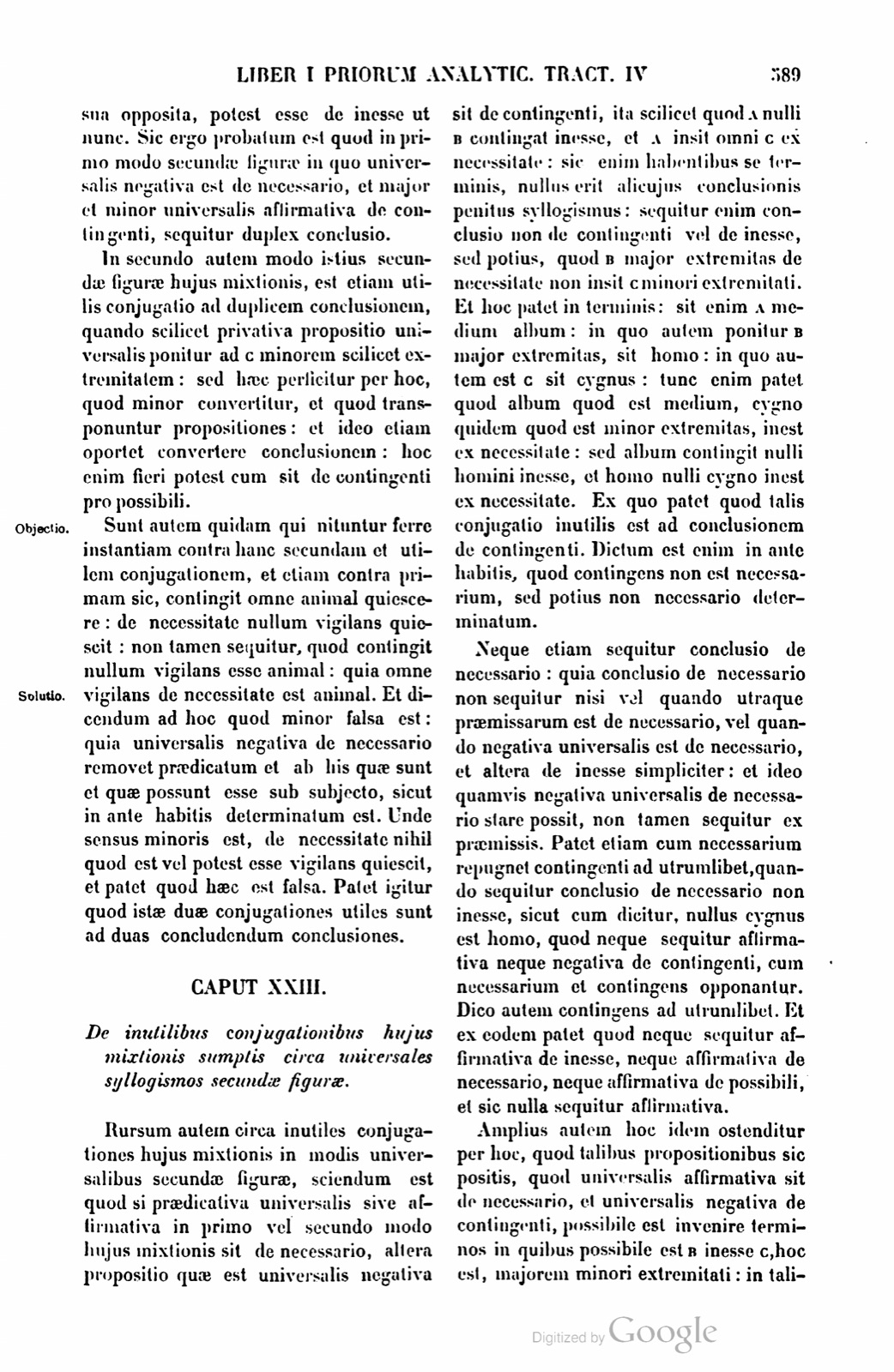
Sed tamen notandum est hic quod quando fuerit universalis affirmativa de necessario, non potest appropriare sibi minorem de contingenti ut significet contingens natum: et hoc est ideo, quia nec major est, nec major esse potest in reductione ad primam figuram: et ideo cum illam conclusio de inesse non sequatur, nec potest ostendi per inductam mixtionem necessarii et inesse: quia in tali conjugatione tam ipsa conclusio quam sua opposita, potest esse de inesse ut nunc. Sic ergo probatum est quod in primo modo secundae figurae in quo universalis negativa est de necessario, et major et minor universalis affirmativa de contingenti, sequitur duplex conclusio.
In secundo autem modo istius secundae figurae hujus mixtionis, est etiam utilis conjugatio ad duplicem conclusionem, quando scilicet privativa propositio universalis ponitur ad C minorem scilicet extremitatem: sed haec perficitur per hoc, quod minor convertitur, et quod transponuntur propositiones: et ideo etiam oportet convertere conclusionem: hoc enim fieri potest cum sit de contingenti pro possibili.
Sunt autem quidam qui nituntur ferre instantiam contra hanc secundam et utilem conjugationem, et etiam contra primam sic, contingit omne animal quiescere: de necessitate nullum vigilans quiescit: non tamen sequitur, quod contingit nullum vigilans esse animal: quia omne vigilans de necessitate est animal. Et dicendum ad hoc quod minor falsa est: quia universalis negativa de necessario removet praedicatum et ab his quae sunt et quae possunt esse sub subjecto, sicut in ante habitis determinatum est. Unde sensus minoris est, de necessitate nihil quod est vel potest esse vigilans quiescit, et patet quod haec est falsa. Patet igitur quod istae duae conjugationes utiles sunt ad duas concludendum conclusiones.
Yet it must be noted here that when there is a universal affirmative about the necessary, it cannot appropriate to itself a minor about the contingent so that it signifies the natural contingent. And this is because it neither is the major nor can be the major in reduction to the first figure; and therefore, since that conclusion of inherence does not follow, neither can it be shown through the introduced mixing of the necessary and inherence, because in such a conjugation both the conclusion itself and its opposite can be of inherence as now. Thus therefore it has been proved that in the first mode of the second figure, in which the universal negative is about the necessary and the major and minor are universal affirmative about the contingent, a twofold conclusion follows.
But in the second mode of this second figure of this mixing, there is also a useful conjugation for a twofold conclusion, when namely the universal privative proposition is posited at C, that is, the lesser extreme. But this is perfected through this, that the minor is converted and the propositions are transposed; and therefore the conclusion must also be converted. For this can be done since it is about the contingent for the possible.
But there are some who try to bring an instance against this second and useful conjugation, and also against the first, thus: every animal contingently rests; of necessity no waking thing rests; nevertheless it does not follow that no waking thing contingently is an animal, because every waking thing of necessity is an animal. And to this one must say that the minor is false, because a universal negative of necessity removes the predicate both from those things which are and from those which can be under the subject, as was determined in the preceding matters. Hence the sense of the minor is: of necessity nothing which is or can be waking rests, and it is clear that this is false. Therefore it is clear that those two conjugations are useful for concluding two conclusions.
Notes
- The reason for this rule is that a negative about the contingent includes an affirmative, and thus those premises would be of the same quality, etc. (Ratio hujus regulae est, quia negativa de contingenti includit affirmativam: et sic illae praemissae essent ejusdem qualitatis, etc.) ↩
- Compare John the Grammarian. (Cf. Joannem Grammat.) ↩
If a page does not appear, its photograph has not been uploaded yet.