Works › Prior Analytics, Books I–II
Volume 1 · pp. 591–593
Continuation and end of Chapter XXIII
A marker with ≈ is an approximate page boundary, placed by measure of the text; the page photographs remain the authority. In the paired views, clicking a page marker brings that page into view.
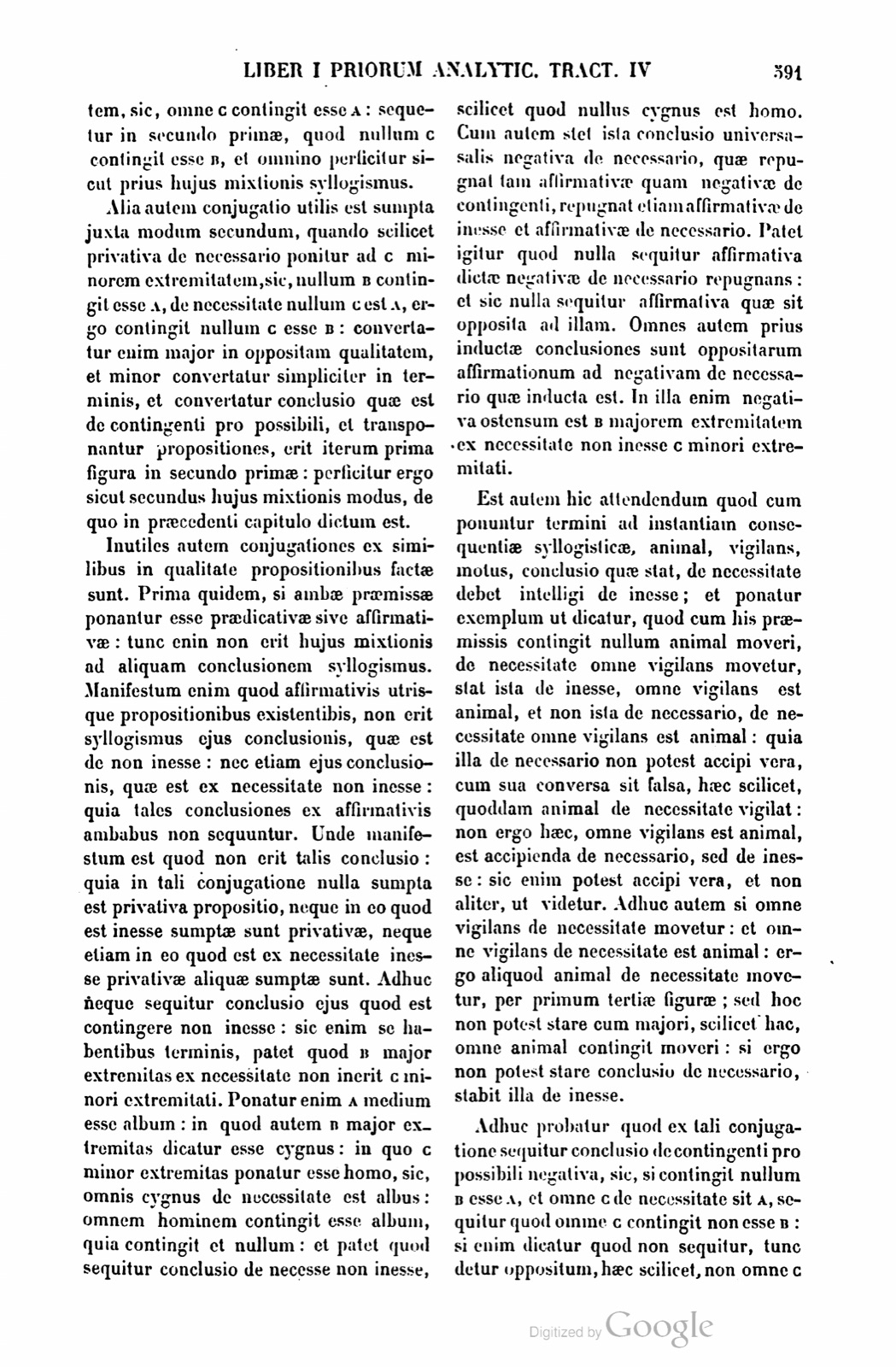
sic, omne C contingit esse A: sequitur in secundo primae, quod nullum C contingit esse B, et omnino perficitur sicut prius hujus mixtionis syllogismus.
Alia autem conjugatio utilis est sumpta juxta modum secundum, quando scilicet privativa de necessario ponitur ad C minorem extremitatem, sic, nullum B contingit esse A, de necessitate nullum C est A, ergo contingit nullum C esse B: convertatur enim major in oppositam qualitatem, et minor convertatur simpliciter in terminis, et convertatur conclusio quae est de contingenti pro possibili, et transponantur propositiones, erit iterum prima figura in secundo primae: perficitur ergo sicut secundus hujus mixtionis modus, de quo in praecedenti capitulo dictum est.
Inutiles autem conjugationes ex similibus in qualitate propositionibus factae sunt. Prima quidem, si ambae praemissae ponantur esse praedicativae sive affirmativae: tunc enim non erit hujus mixtionis ad aliquam conclusionem syllogismus. Manifestum enim quod affirmativis utrisque propositionibus existentibus, non erit syllogismus ejus conclusionis, quae est de non inesse: nec etiam ejus conclusionis, quae est ex necessitate non inesse: quia tales conclusiones ex affirmativis ambabus non sequuntur. Unde manifestum est quod non erit talis conclusio: quia in tali conjugatione nulla sumpta est privativa propositio, neque in eo quod est inesse sumptae sunt privativae, neque etiam in eo quod est ex necessitate inesse privativae aliquae sumptae sunt. Adhuc neque sequitur conclusio ejus quod est contingere non inesse: sic enim se habentibus terminis, patet quod B major extremitas ex necessitate non inerit C minori extremitati. Ponatur enim A medium esse album: in quod autem B major extremitas dicatur esse cygnus: in quo C minor extremitas ponatur esse homo, sic, omnis cygnus de necessitate est albus: omnem hominem contingit esse album, quia contingit et nullum: et patet quod sequitur conclusio de necesse non inesse, scilicet quod nullus cygnus est homo. Cum autem stet ista conclusio universalis negativa de necessario, quae repugnat tam affirmativae quam negativae de contingenti, repugnat etiam affirmativae de inesse et affirmativae de necessario. Patet igitur quod nulla sequitur affirmativa dictae negativae de necessario repugnans: et sic nulla sequitur affirmativa quae sit opposita ad illam. Omnes autem prius inductae conclusiones sunt oppositarum affirmationum ad negativam de necessario quae inducta est. In illa enim negativa ostensum est B majorem extremitatem ex necessitate non inesse C minori extremitati.
Est autem hic attendendum quod cum ponuntur termini ad instantiam consequentiae syllogisticae, animal, vigilans, motus, conclusio quae stat, de necessitate debet intelligi de inesse; et ponatur exemplum ut dicatur, quod cum his praemissis contingit nullum animal moveri, de necessitate omne vigilans movetur, stat ista de inesse, omne vigilans est animal, et non ista de necessario, de necessitate omne vigilans est animal: quia illa de necessario non potest accipi vera, cum sua conversa sit falsa, haec scilicet, quoddam animal de necessitate vigilat: non ergo haec, omne vigilans est animal, est accipienda de necessario, sed de inesse: sic enim potest accipi vera, et non aliter, ut videtur. Adhuc autem si omne vigilans de necessitate movetur: et omne vigilans de necessitate est animal: ergo aliquod animal de necessitate movetur, per primum tertiae figurae; sed hoc non potest stare cum majori, scilicet hac, omne animal contingit moveri: si ergo non potest stare conclusio de necessario, stabit illa de inesse.
Adhuc probatur quod ex tali conjugatione sequitur conclusio de contingenti pro possibili negativa, sic, si contingit nullum B esse A, et omne C de necessitate sit A, sequitur quod omne C contingit non esse B: si enim dicatur quod non sequitur, tunc detur oppositum, haec scilicet, non omne C contingit non esse B, haec autem aequipollet ei quod est, necesse est aliquod C esse B, ex qua et minori sequitur oppositum majoris, sic, de necessitate omne C est A, de necessitate aliquod C est B, ergo de necessitate aliquod B est A, et sic patet quod sequitur conclusio de contingenti pro possibili negativa. Ergo termini inducti non debent concludere talem negativam: et sic oportet quod intendatur conclusio de inesse: quia si intenderetur in praedictis terminis conclusio de necessario non inesse, excluderetur sequi conclusio negativa de contingenti pro possibili: oportet igitur quod in terminis inductis intendatur conclusio de inesse et non de necessario.
thus: every C contingently is A; it follows in the second mode of the first figure that no C contingently is B, and altogether the syllogism of this mixing is perfected as before.
But another useful conjugation is taken according to the second mode, when namely the privative proposition of necessity is placed at C, the lesser extreme, thus: no B contingently is A; of necessity no C is A; therefore no C contingently is B. For let the major be converted into the opposite quality, and let the minor be converted simply in terms, and let the conclusion, which is about the contingent for the possible, be converted, and let the propositions be transposed: there will again be the first figure in the second mode of the first; therefore it is perfected as the second mode of this mixing, concerning which it was said in the preceding chapter.
But the useless conjugations are those made from propositions alike in quality. The first indeed is if both premises are posited as predicative or affirmative; for then there will not be, from this mixing, a syllogism to any conclusion. For it is manifest that, when both propositions are affirmative, there will not be a syllogism of that conclusion which is about not-inhering, nor also of that conclusion which is about necessarily not-inhering, because such conclusions do not follow from both affirmative premises. Hence it is manifest that there will not be such a conclusion, because in such a conjugation no privative proposition has been taken, neither have privatives been taken in what is inherence, nor have any privatives been taken in what is inherence from necessity. Further, neither does there follow a conclusion of that which is contingently not to inhere; for, with the terms having themselves thus, it is clear that B, the greater extreme, will of necessity not inhere in C, the lesser extreme. For let A, the middle, be white; but let that in which B, the greater extreme, is said to be, be swan; and let that in which C, the lesser extreme, is posited, be man, thus: every swan of necessity is white; every man contingently is white, because also none contingently is; and it is clear that a conclusion follows about necessarily not inhering, namely that no swan is a man. But since that universal negative conclusion of necessity stands, which is repugnant both to the affirmative and to the negative about the contingent, it is also repugnant to the affirmative of inherence and to the affirmative of necessity. Therefore it is clear that no affirmative follows that is repugnant to the said negative of necessity, and thus no affirmative follows which is opposite to it. But all the conclusions introduced before are conclusions of affirmations opposite to the negative of necessity which has been introduced. For in that negative it was shown that B, the greater extreme, of necessity does not inhere in C, the lesser extreme.
But here one must attend that when terms are posited for an instance against a syllogistic consequence, animal, waking, motion, the conclusion which stands, of necessity, ought to be understood as being of inherence; and let the example be posited so that it is said that, with these premises, no animal contingently is moved, every waking thing of necessity is moved, this proposition of inherence stands: every waking thing is an animal, and not that proposition of necessity, every waking thing of necessity is an animal, because that proposition of necessity cannot be accepted as true, since its converse is false, namely this, some animal of necessity is awake. Therefore this, every waking thing is an animal, must not be accepted as of necessity, but as of inherence; for in this way it can be accepted as true, and not otherwise, as it seems. Again, if every waking thing of necessity is moved, and every waking thing of necessity is an animal, therefore some animal of necessity is moved, through the first mode of the third figure; but this cannot stand with the major, namely this, every animal contingently is moved. Therefore, if a conclusion of necessity cannot stand, that conclusion of inherence will stand.
Again it is proved that from such a conjugation a negative conclusion about the contingent for the possible follows thus: if no B contingently is A, and every C of necessity is A, it follows that every C contingently is not B. For if it is said that it does not follow, then let the opposite be granted, namely this: not every C contingently is not B. But this is equipollent to that which is, it is necessary that some C be B. From this and the minor the opposite of the major follows, thus: of necessity every C is A; of necessity some C is B; therefore of necessity some B is A. And thus it is clear that a negative conclusion about the contingent for the possible follows. Therefore the terms introduced should not conclude such a negative, and thus it is necessary that the conclusion of inherence be intended; because, if in the aforesaid terms a conclusion about necessarily not inhering were intended, the following of a negative conclusion about the contingent for the possible would be excluded. Therefore in the terms introduced it is necessary that the conclusion of inherence be intended and not one of necessity.
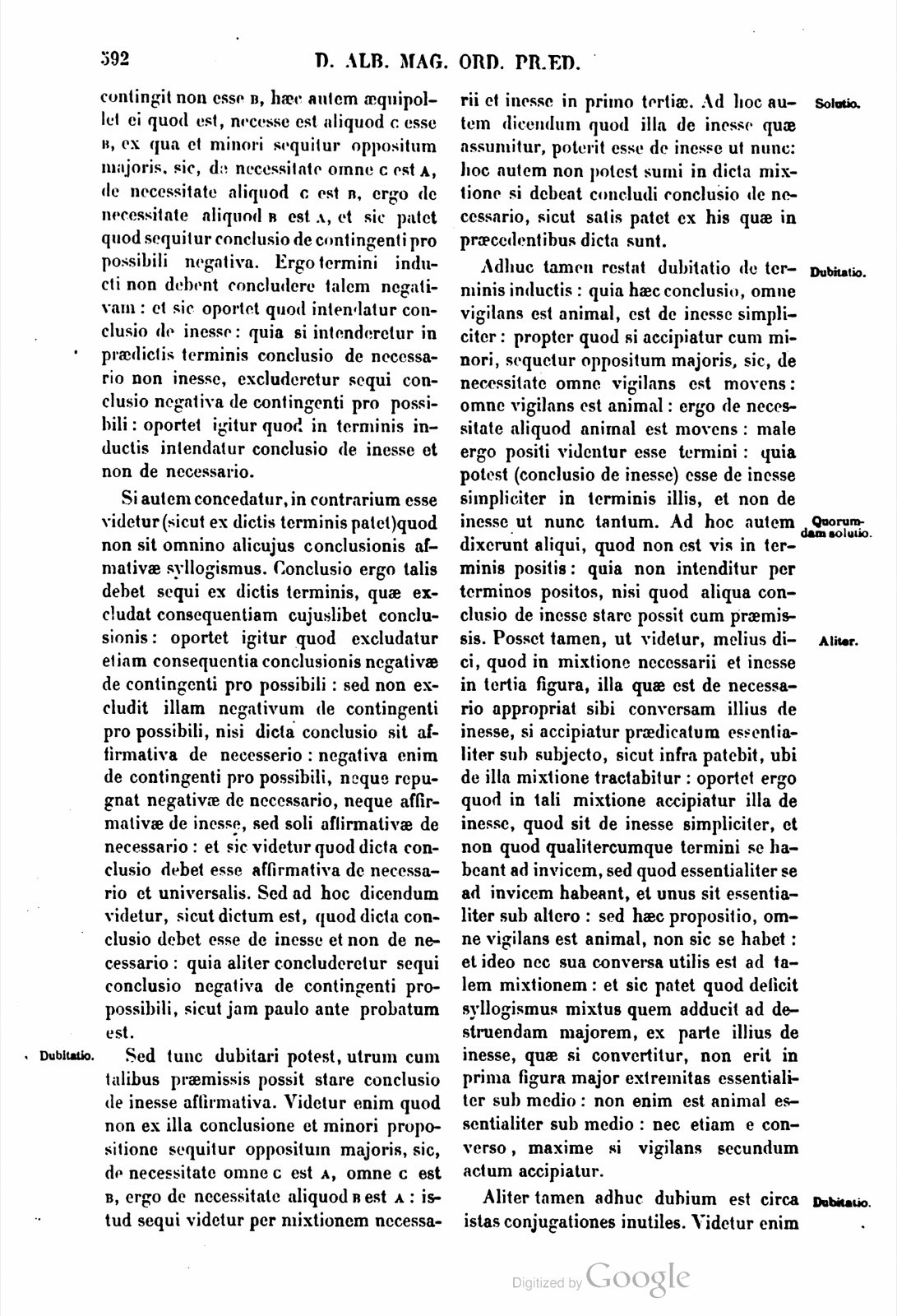
Si autem concedatur, in contrarium esse videtur (sicut ex dictis terminis patet) quod non sit omnino alicujus conclusionis affirmativae syllogismus. Conclusio ergo talis debet sequi ex dictis terminis, quae excludat consequentiam cujuslibet conclusionis: oportet igitur quod excludatur etiam consequentia conclusionis negativae de contingenti pro possibili: sed non excludit illam negativam de contingenti pro possibili, nisi dicta conclusio sit affirmativa de necessario: negativa enim de contingenti pro possibili, neque repugnat negativae de necessario, neque affirmativae de inesse, sed soli affirmativae de necessario: et sic videtur quod dicta conclusio debet esse affirmativa de necessario et universalis. Sed ad hoc dicendum videtur, sicut dictum est, quod dicta conclusio debet esse de inesse et non de necessario: quia aliter concluderetur sequi conclusio negativa de contingenti pro possibili, sicut jam paulo ante probatum est.
Sed tunc dubitari potest, utrum cum talibus praemissis possit stare conclusio de inesse affirmativa. Videtur enim quod non ex illa conclusione et minori propositione sequitur oppositum majoris, sic, de necessitate omne C est A, omne C est B, ergo de necessitate aliquod B est A: istud sequi videtur per mixtionem necessarii et inesse in primo tertiae. Ad hoc autem dicendum quod illa de inesse quae assumitur, poterit esse de inesse ut nunc: hoc autem non potest sumi in dicta mixtione si debeat concludi conclusio de necessario, sicut satis patet ex his quae in praecedentibus dicta sunt.
Adhuc tamen restat dubitatio de terminis inductis: quia haec conclusio, omne vigilans est animal, est de inesse simpliciter: propter quod si accipiatur cum minori, sequetur oppositum majoris, sic, de necessitate omne vigilans est movens: omne vigilans est animal: ergo de necessitate aliquod animal est movens: male ergo positi videntur esse termini: quia potest conclusio de inesse esse de inesse simpliciter in terminis illis, et non de inesse ut nunc tantum. Ad hoc autem dixerunt aliqui, quod non est vis in terminis positis: quia non intenditur per terminos positos, nisi quod aliqua conclusio de inesse stare possit cum praemissis. Posset tamen, ut videtur, melius dici, quod in mixtione necessarii et inesse in tertia figura, illa quae est de necessario appropriat sibi conversam illius de inesse, si accipiatur praedicatum essentialiter sub subjecto, sicut infra patebit, ubi de illa mixtione tractabitur: oportet ergo quod in tali mixtione accipiatur illa de inesse, quod sit de inesse simpliciter, et non quod qualitercumque termini se habeant ad invicem, sed quod essentialiter se ad invicem habeant, et unus sit essentialiter sub altero: sed haec propositio, omne vigilans est animal, non sic se habet: et ideo nec sua conversa utilis est ad talem mixtionem: et sic patet quod deficit syllogismus mixtus quem adducit ad destruendam majorem, ex parte illius de inesse, quae si convertitur, non erit in prima figura major extremitas essentialiter sub medio: non enim est animal essentialiter sub medio: nec etiam e converso, maxime si vigilans secundum actum accipiatur.
But if this is conceded, there seems to be on the contrary, as is clear from the said terms, that there is not altogether a syllogism of any affirmative conclusion. Therefore such a conclusion ought to follow from the said terms as would exclude the consequence of any conclusion; therefore it is necessary that the consequence of the negative conclusion about the contingent for the possible also be excluded. But that negative about the contingent for the possible is not excluded unless the said conclusion is affirmative of necessity; for a negative about the contingent for the possible is repugnant neither to the negative of necessity nor to the affirmative of inherence, but only to the affirmative of necessity. And thus it seems that the said conclusion ought to be affirmative of necessity and universal. But to this it seems one must say, as was said, that the said conclusion ought to be of inherence and not of necessity, because otherwise it would be concluded that a negative conclusion about the contingent for the possible follows, as has now been proved a little before.
But then it can be doubted whether, with such premises, an affirmative conclusion of inherence can stand. For it seems not, because from that conclusion and the minor proposition the opposite of the major follows, thus: of necessity every C is A; every C is B; therefore of necessity some B is A. This seems to follow through the mixing of necessity and inherence in the first mode of the third figure. But to this one must say that the proposition of inherence which is assumed will be able to be of inherence as now; and this cannot be taken in the said mixing if it ought to conclude a conclusion of necessity, as is sufficiently clear from the things that have been said in the preceding matters.
Yet there still remains a doubt about the terms introduced, because this conclusion, every waking thing is an animal, is of inherence simply. For this reason, if it is accepted with the minor, the opposite of the major will follow thus: of necessity every waking thing is moved; every waking thing is an animal; therefore of necessity some animal is moved. Therefore the terms seem to have been badly posited, because the conclusion of inherence can be one of inherence simply in those terms, and not only of inherence as now. But to this certain people have said that there is no force in the terms posited, because through the terms posited nothing is intended except that some conclusion of inherence can stand with the premises. Yet, as it seems, it could be better said that in the mixing of necessity and inherence in the third figure, that proposition which is about the necessary appropriates to itself the converse of that proposition of inherence, if the predicate is accepted essentially under the subject, as will be clear below, where that mixing will be treated. Therefore it is necessary that, in such a mixing, the proposition of inherence be accepted so that it is of inherence simply, and not so that the terms have themselves to one another in just any way, but so that they have themselves essentially to one another and one is essentially under the other. But this proposition, every waking thing is an animal, does not have itself in this way; and therefore neither is its converse useful for such a mixing. And thus it is clear that the mixed syllogism which it brings forward for destroying the major fails on the part of that proposition of inherence, which, if it is converted, will not in the first figure be a greater extreme essentially under the middle; for animal is not essentially under the middle, nor conversely either, especially if waking is taken according to act.
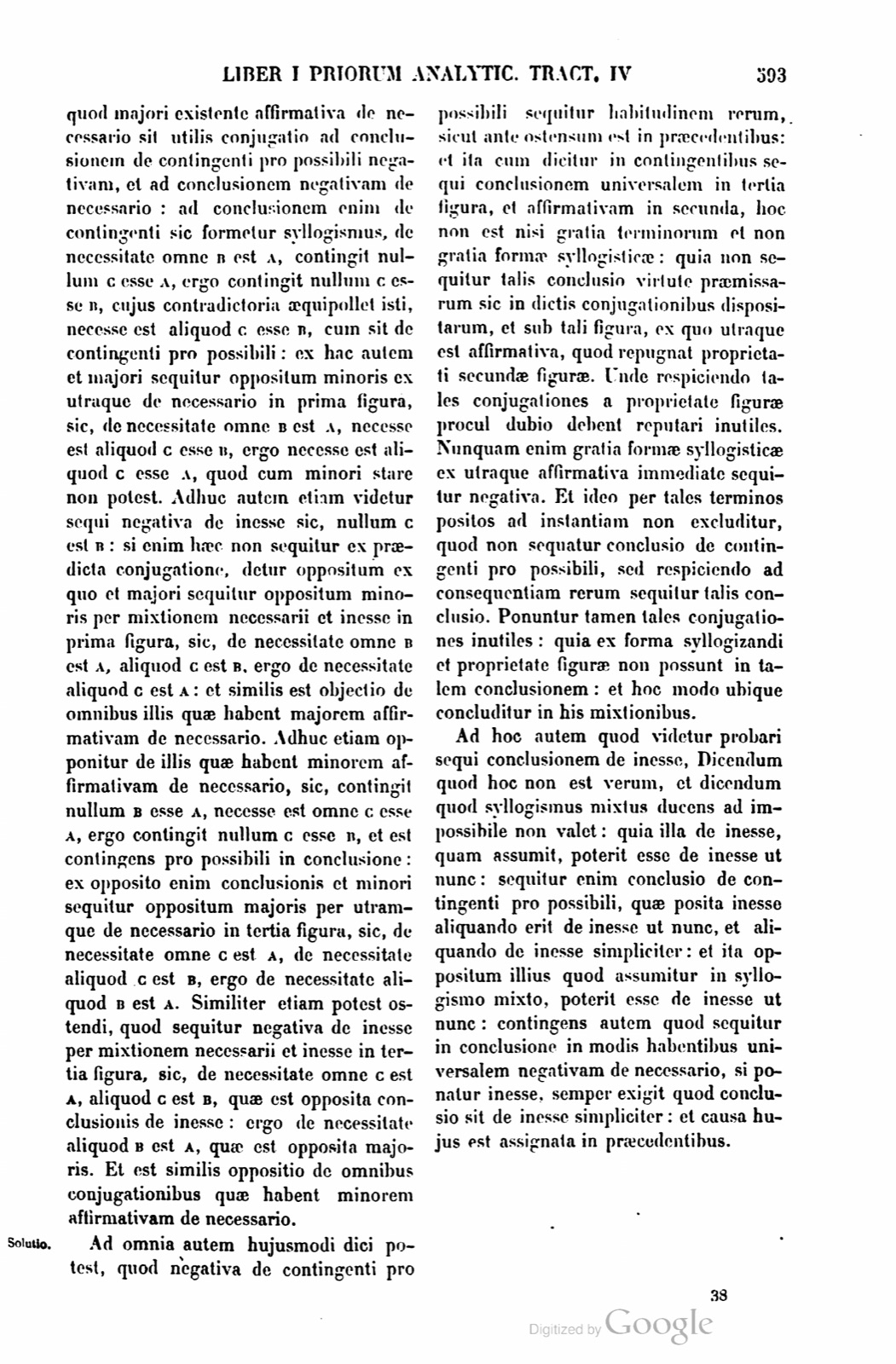
Aliter tamen adhuc dubium est circa istas conjugationes inutiles. Videtur enim quod majori existente affirmativa de necessario sit utilis conjugatio ad conclusionem de contingenti pro possibili negativam, et ad conclusionem negativam de necessario: ad conclusionem enim de contingenti sic formetur syllogismus, de necessitate omne B est A, contingit nullum C esse A, ergo contingit nullum C esse B, cujus contradictoria aequipollet isti, necesse est aliquod C esse B, cum sit de contingenti pro possibili: ex hac autem et majori sequitur oppositum minoris ex utraque de necessario in prima figura, sic, de necessitate omne B est A, necesse est aliquod C esse B, ergo necesse est aliquod C esse A, quod cum minori stare non potest. Adhuc autem etiam videtur sequi negativa de inesse sic, nullum C est B: si enim haec non sequitur ex praedicta conjugatione, detur oppositum ex quo et majori sequitur oppositum minoris per mixtionem necessarii et inesse in prima figura, sic, de necessitate omne B est A, aliquod C est B, ergo de necessitate aliquod C est A: et similis est objectio de omnibus illis quae habent majorem affirmativam de necessario. Adhuc etiam opponitur de illis quae habent minorem affirmativam de necessario, sic, contingit nullum B esse A, necesse est omne C esse A, ergo contingit nullum C esse B, et est contingens pro possibili in conclusione: ex opposito enim conclusionis et minori sequitur oppositum majoris per utramque de necessario in tertia figura, sic, de necessitate omne C est A, de necessitate aliquod C est B, ergo de necessitate aliquod B est A. Similiter etiam potest ostendi, quod sequitur negativa de inesse per mixtionem necessarii et inesse in tertia figura, sic, de necessitate omne C est A, aliquod C est B, quae est opposita conclusionis de inesse: ergo de necessitate aliquod B est A, quae est opposita majoris. Et est similis oppositio de omnibus conjugationibus quae habent minorem affirmativam de necessario.
Ad omnia autem hujusmodi dici potest, quod negativa de contingenti pro possibili sequitur habitudinem rerum, sicut ante ostensum est in praecedentibus: et ita cum dicitur in contingentibus sequi conclusionem universalem in tertia figura, et affirmativam in secunda, hoc non est nisi gratia terminorum et non gratia formae syllogisticae: quia non sequitur talis conclusio virtute praemissarum sic in dictis conjugationibus dispositarum, et sub tali figura, ex quo utraque est affirmativa, quod repugnat proprietati secundae figurae. Unde respiciendo tales conjugationes a proprietate figurae procul dubio debent reputari inutiles. Nunquam enim gratia formae syllogisticae ex utraque affirmativa immediate sequitur negativa. Et ideo per tales terminos positos ad instantiam non excluditur, quod non sequatur conclusio de contingenti pro possibili, sed respiciendo ad consequentiam rerum sequitur talis conclusio. Ponuntur tamen tales conjugationes inutiles: quia ex forma syllogizandi et proprietate figurae non possunt in talem conclusionem: et hoc modo ubique concluditur in his mixtionibus.
Ad hoc autem quod videtur probari sequi conclusionem de inesse, dicendum quod hoc non est verum, et dicendum quod syllogismus mixtus ducens ad impossibile non valet: quia illa de inesse, quam assumit, poterit esse de inesse ut nunc: sequitur enim conclusio de contingenti pro possibili, quae posita inesse aliquando erit de inesse ut nunc, et aliquando de inesse simpliciter: et ita oppositum illius quod assumitur in syllogismo mixto, poterit esse de inesse ut nunc: contingens autem quod sequitur in conclusione in modis habentibus universalem negativam de necessario, si ponatur inesse, semper exigit quod conclusio sit de inesse simpliciter: et causa hujus est assignata in praecedentibus.
Nevertheless, in another way there is still a doubt about these useless conjugations. For it seems that, when the major is affirmative of necessity, the conjugation is useful for a negative conclusion about the contingent for the possible, and for a negative conclusion of necessity. For to the conclusion about the contingent let the syllogism be formed thus: of necessity every B is A; no C contingently is A; therefore no C contingently is B. Its contradictory is equipollent to this, it is necessary that some C be B, since it is about the contingent for the possible. But from this and the major the opposite of the minor follows from both propositions of necessity in the first figure, thus: of necessity every B is A; it is necessary that some C be B; therefore it is necessary that some C be A, which cannot stand with the minor. Again, it also seems that a negative of inherence follows thus: no C is B. For if this does not follow from the aforesaid conjugation, let the opposite be granted, from which and the major the opposite of the minor follows through the mixing of necessity and inherence in the first figure, thus: of necessity every B is A; some C is B; therefore of necessity some C is A. And there is a similar objection about all those which have the major affirmative of necessity. Again, objection is also made about those which have the minor affirmative of necessity, thus: no B contingently is A; it is necessary that every C be A; therefore no C contingently is B, and the contingent for the possible is in the conclusion. For from the opposite of the conclusion and the minor the opposite of the major follows through both propositions of necessity in the third figure, thus: of necessity every C is A; of necessity some C is B; therefore of necessity some B is A. Likewise it can also be shown that a negative of inherence follows through the mixing of necessity and inherence in the third figure, thus: of necessity every C is A; some C is B, which is opposite to the conclusion of inherence; therefore of necessity some B is A, which is opposite to the major. And there is a similar opposition about all conjugations which have the minor affirmative of necessity.
But to all things of this sort it can be said that the negative about the contingent for the possible follows the relation of things, as was shown before in the preceding matters. And so, when it is said that in contingent matters a universal conclusion follows in the third figure and an affirmative in the second, this is only by reason of the terms and not by reason of the syllogistic form, because such a conclusion does not follow by the power of the premises disposed in this way in the said conjugations and under such a figure, since each premise is affirmative, which is repugnant to the property of the second figure. Hence, considering such conjugations from the property of the figure, without doubt they ought to be judged useless. For never by reason of syllogistic form does a negative immediately follow from two affirmatives. And therefore by such terms posited for an instance it is not excluded that a conclusion about the contingent for the possible does not follow; rather, considering the consequence of the things, such a conclusion follows. Nevertheless such conjugations are posited as useless, because from the form of syllogizing and the property of the figure they cannot reach such a conclusion, and in this way it is concluded everywhere in these mixings.
But as to what seems to be proved, that a conclusion of inherence follows, one must say that this is not true, and one must say that the mixed syllogism leading to the impossible is not valid, because that proposition of inherence which it assumes will be able to be of inherence as now. For a conclusion about the contingent for the possible follows, which, when posited as inherence, will sometimes be of inherence as now and sometimes of inherence simply; and thus the opposite of that which is assumed in the mixed syllogism will be able to be of inherence as now. But the contingent which follows in the conclusion in the modes having a universal negative of necessity, if it is posited as inherence, always requires that the conclusion be of inherence simply; and the cause of this has been assigned in the preceding matters.
If a page does not appear, its photograph has not been uploaded yet.