Works › Prior Analytics, Books I–II
Volume 1 · pp. 586–587
Chapter XXI. On the formation of particular syllogisms of the mixing of the contingent and inherence in the second figure.
A marker with ≈ is an approximate page boundary, placed by measure of the text; the page photographs remain the authority. In the paired views, clicking a page marker brings that page into view.
CAPUT XXI. De formatione particularium syllogismorum mixtionis contingentis et inesse in secunda figura.
Eodem autem modo, sicut dictum est, in universalibus hujus mixtionis syllogismis in secunda figura, sic etiam est in particularibus syllogismis ejusdem mixtionis. Quando enim in tertio vel quarto propositio affirmativa erit de inesse sive universalis, sive particularis sit, nullus erit syllogismus ad conclusionem de contingenti, vel de inesse. Hoc autem per eosdem terminos instantiarum demonstratur, quibus et prius in universalibus syllogismis demonstratum est, qui sunt ad inesse quidem omni, sanitas, animal, homo: non inesse autem contingenter, sanitas, equus, homo, et facile est formare syllogismos.
Quando autem fuerit illa de inesse negativa: tunc poterit esse syllogismus per conversionem in terminis factam illius de inesse quae in tertio est major et universalis, minor autem particularis affirmativa de contingenti, sicut scitur per ordines modorum in figuris.
Rursum si ambo quidem intervalla sive propositiones fuerint negativae, ita quod major sit universalis negativa de inesse, minor autem particularis de contingenti et negativa: tunc quidem ex ipsis sumptis propositionibus nullus fit syllogismus: conversa autem propositione quae est de contingenti ad oppositam qualitatem, erit et conversione illius de inesse in terminis facta.
Si autem particularis negativa fuerit de inesse, quocumque modo reliqua propositio se habeat, nullo modo erit syllogismus, sive altera sit universalis affirmativa sive sit universalis negativa. Adhuc autem nec tunc erit syllogismus, quando utraeque praemissae ponuntur esse indefinitae, vel utraeque sumuntur particulares. Et in omnibus istis conjugationibus demonstratur inutilitas per eosdem terminos, qui prius inducti sunt.
Hic tamen dubium esse videtur de quarto istius secundae figurae, qui est ex universali affirmativa majori, et negativa particulari minori, in quo secundum ea quae dicta sunt non potest esse utilis conjugatio in hac mixtione: videtur enim quod majori affirmativa universali existente de contingenti, minori autem particulari negativa existente de inesse, fit utilis conjugatio hoc modo, contingit omne B esse A, quoddam C non est A, ergo quoddam C contingit non esse B; et ostendatur per expositionem: si enim quoddam C non est A, sicut dicit minor propositio, accipiatur illud, et sit tale a quo universaliter removetur A, et fiat sic syllogismus, contingit omne B esse A, nullum C est A, ergo contingit nullum C esse B: iste syllogismus est utilis, ut videtur: et est in secundo modo hujus figurae secundum mixtionem contingentis et inesse: fit enim hic syllogismus secundum principia superius data ad hanc mixtionem.
CHAPTER XXI. On the formation of particular syllogisms of the mixing of the contingent and inherence in the second figure.
But in the same way as has been said in the universal syllogisms of this mixing in the second figure, so also it is in the particular syllogisms of the same mixing. For when in the third or fourth mode the affirmative proposition will be of inherence, whether it is universal or particular, there will be no syllogism for a conclusion about the contingent or about inherence. But this is demonstrated through the same terms of instances by which it was also previously demonstrated in universal syllogisms; for inhering in every case they are health, animal, man, but for contingently not inhering they are health, horse, man, and it is easy to form the syllogisms.
But when that proposition of inherence is negative, then there can be a syllogism through a conversion made in terms of that proposition of inherence which in the third mode is the major and universal, while the minor is particular affirmative about the contingent, as is known through the orders of the modes in the figures.
Again, if both intervals or propositions are negative, so that the major is universal negative of inherence, but the minor is particular about the contingent and negative, then indeed no syllogism is made from the propositions themselves as taken; but when the proposition which is about the contingent has been converted to the opposite quality, there will be a syllogism, once the conversion of that proposition of inherence has also been made in terms.
But if the particular negative is of inherence, in whatever way the remaining proposition has itself, in no way will there be a syllogism, whether the other proposition is a universal affirmative or a universal negative. Again there will not be a syllogism then either, when both premises are posited as indefinite, or both are taken as particular. And in all these conjugations the uselessness is demonstrated through the same terms which were introduced before.
Yet here there seems to be a doubt about the fourth mode of this second figure, which is from a universal affirmative major and a particular negative minor, in which, according to the things said, there cannot be a useful conjugation in this mixing. For it seems that, with the major being universal affirmative about the contingent and the minor particular negative of inherence, a useful conjugation is made in this way: every B contingently is A; some C is not A; therefore some C contingently is not B. And let it be shown through exposition: for if some C is not A, as the minor proposition says, let that thing be accepted, and let it be such that A is universally removed from it, and let the syllogism be made thus: every B contingently is A; no C is A; therefore no C contingently is B. This syllogism is useful, as it seems, and it is in the second mode of this figure according to the mixing of the contingent and inherence, for this syllogism is made according to the principles given above for this mixing.
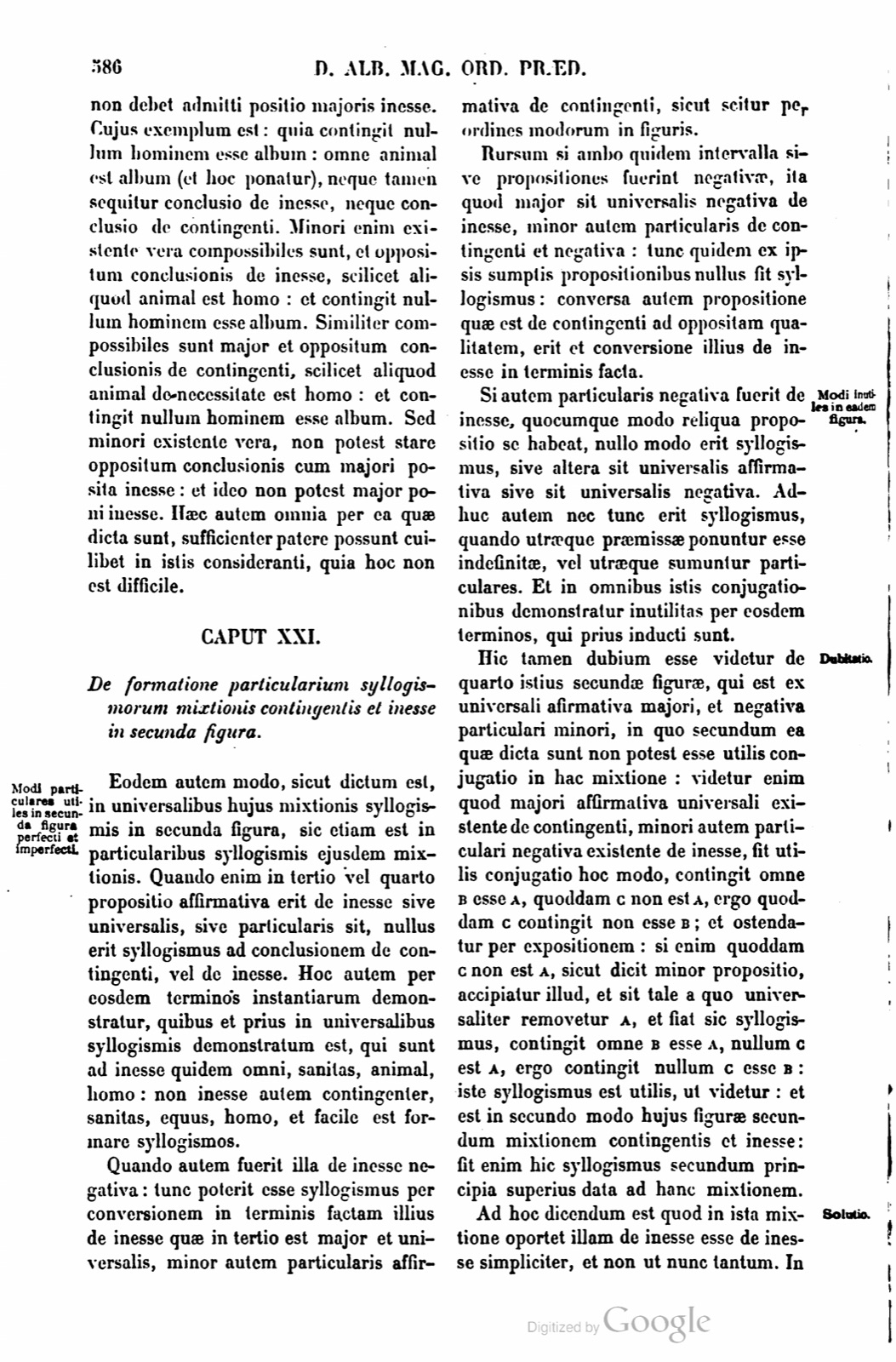
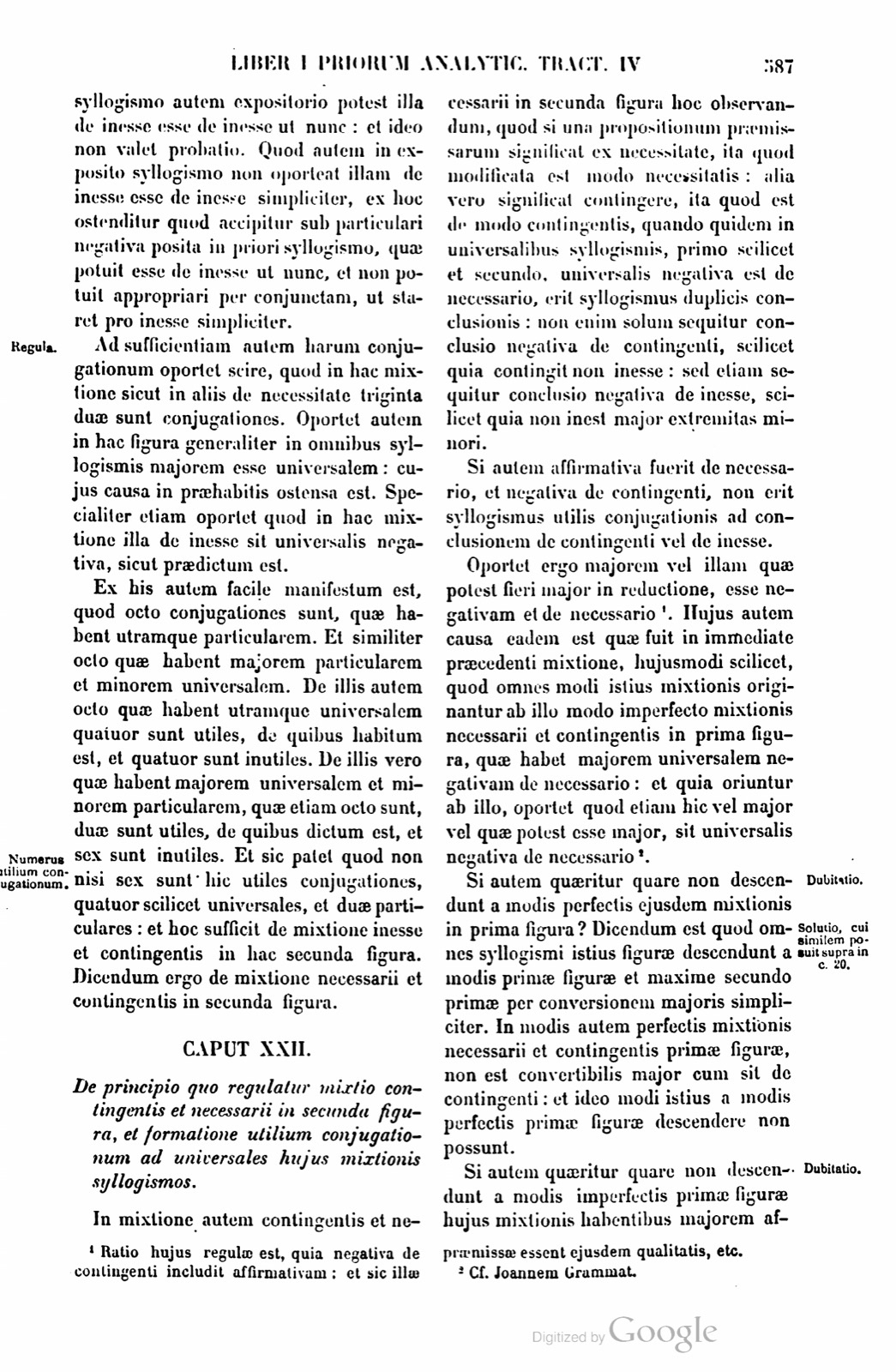
Ad hoc dicendum est quod in ista mixtione oportet illam de inesse esse de inesse simpliciter, et non ut nunc tantum. In syllogismo autem expositorio potest illa de inesse esse de inesse ut nunc: et ideo non valet probatio. Quod autem in exposito syllogismo non oporteat illam de inesse esse de inesse simpliciter, ex hoc ostenditur quod accipitur sub particulari negativa posita in priori syllogismo, quae potuit esse de inesse ut nunc, et non potuit appropriari per conjunctam, ut staret pro inesse simpliciter.
Ad sufficientiam autem harum conjugationum oportet scire, quod in hac mixtione sicut in aliis de necessitate triginta duae sunt conjugationes. Oportet autem in hac figura generaliter in omnibus syllogismis majorem esse universalem: cujus causa in praehabitis ostensa est. Specialiter etiam oportet quod in hac mixtione illa de inesse sit universalis negativa, sicut praedictum est.
Ex his autem facile manifestum est, quod octo conjugationes sunt, quae habent utramque particularem. Et similiter octo quae habent majorem particularem et minorem universalem. De illis autem octo quae habent utramque universalem quatuor sunt utiles, de quibus habitum est, et quatuor sunt inutiles. De illis vero quae habent majorem universalem et minorem particularem, quae etiam octo sunt, duae sunt utiles, de quibus dictum est, et sex sunt inutiles. Et sic patet quod non nisi sex sunt hic utiles conjugationes, quatuor scilicet universales, et duae particulares: et hoc sufficit de mixtione inesse et contingentis in hac secunda figura. Dicendum ergo de mixtione necessarii et contingentis in secunda figura.
To this one must say that in this mixing that proposition of inherence must be of inherence simply, and not only as now. But in an expository syllogism that proposition of inherence can be of inherence as now, and therefore the proof is not valid. That in the expository syllogism that proposition of inherence need not be of inherence simply is shown from this, that it is accepted under the particular negative posited in the prior syllogism, which could be of inherence as now and could not be appropriated by the joined proposition so that it would stand for inherence simply.
But for the sufficiency of these conjugations one must know that in this mixing, as in others, there are of necessity thirty-two conjugations. But in this figure generally, in all syllogisms, the major must be universal; the cause of this has been shown in the preceding matters. It is also specially necessary that in this mixing that proposition of inherence be universal negative, as was said before.
From these things it is easily manifest that there are eight conjugations which have both propositions particular; and likewise eight which have the major particular and the minor universal. But of those eight which have both propositions universal, four are useful, about which it has been held, and four are useless. But of those which have the major universal and the minor particular, which are also eight, two are useful, about which it has been said, and six are useless. And thus it is clear that there are only six useful conjugations here, namely four universal and two particular; and this is enough concerning the mixing of inherence and the contingent in this second figure. Therefore we must speak about the mixing of the necessary and the contingent in the second figure.
If a page does not appear, its photograph has not been uploaded yet.