Works › Prior Analytics, Books I–II
Volume 1 · pp. 583–586
Chapter XX. On the mixing of the contingent and inherence in the second figure.
A marker with ≈ is an approximate page boundary, placed by measure of the text; the page photographs remain the authority. In the paired views, clicking a page marker brings that page into view.
CAPUT XX. De mixtione contingentis et inesse in secunda figura.
In mixtione contingentis et inesse in secunda figura talis primo supponenda est regula, quod si altera quidem propositionum praemissarum fuerit de inesse simpliciter, et altera de contingenti, si affirmativa quidem fuerit de inesse, et privativa fuerit de contingenti, nunquam fit syllogismus hujus mixtionis in secunda figura, sive universaliter, sive particulariter sumantur termini sive propositiones. Hoc autem demonstratur per eosdem terminos, qui in praemissis adducti sunt, scilicet album, homo, equus.
Quando autem affirmativa significat contingere et sit de contingenti, et negativa de inesse simpliciter, semper erit syllogismus. Hujus autem ratio et causa est: quia quamvis syllogismi secundae figurae descendant a prima per conversionem propositionis, et quamvis talis mixtio quae est ex affirmativa de inesse posita, et negativa de contingenti accepta, sit utilis in prima figura: tamen quia isti syllogismi hujus mixtionis non descendunt a perfectis conjugationibus primae figurae, sed a quadam imperfecta conjugatione, quae in hac mixtione in prima figura posita est, quae habet majorem negativam de inesse et minorem affirmativam de contingenti: ideo oportet quod omnes istae utiles conjugationes habeant majorem de inesse negativam, et minorem affirmativam de contingenti: quia aliter non haberent propositionem quae possit esse major in prima figura dictae conjugationis imperfectae, ad quam habent immediate reduci. Haec igitur causa est, quod oportet habere majorem negativam de inesse.
Si autem aliquis quaerat quare non descendat aliquis syllogismus hujus mixtionis in secunda figura a modo imperfecto qui habet affirmativam de inesse: talis modus in prima figura jam in ante habitis positus est, sicut et ille qui habet majorem negativam de inesse. Sed hoc facile solvitur: haec enim figura secunda non habet nisi syllogismos negativos: modus imperfectus primae figurae qui habet illam quae est affirmativa de inesse, est modus affirmativus: et ideo ab illo modo non possunt descendere syllogismi hujus secundae figurae.
Si autem quaeritur, quare syllogismi isti non descendunt a conjugationibus perfectis? Dicendum est quod modus perfectus in prima figura in hac mixtione contingentis et inesse habet majorem de contingenti: syllogismi autem secundae figurae descendunt a syllogismis primae figurae per conversionem majoris: propter quod cum universalis negativa quae major est sit de contingenti in modis perfectis: et universalis negativa de contingenti non possit converti, non potest ab illo modo descendere aliquis hujus figurae syllogismus in hac mixtione. Patet igitur ex dictis quod omnes syllogismi hujus secundae figurae istius mixtionis descendunt a syllogismo primae figurae, qui est universalis negativae in secundo modo primae figurae ejusdem mixtionis: ille enim habet majorem negativam de inesse.
CHAPTER XX. On the mixing of the contingent and inherence in the second figure.
In the mixing of the contingent and inherence in the second figure, first such a rule must be supposed: that if one of the premise propositions is of inherence simply and the other about the contingent, if the affirmative is indeed of inherence and the privative is about the contingent, a syllogism of this mixing is never made in the second figure, whether the terms or propositions are taken universally or particularly. But this is demonstrated through the same terms which were adduced in the preceding matters, namely white, man, horse.
But when the affirmative signifies contingently belonging and is about the contingent, and the negative is of inherence simply, there will always be a syllogism. But the reason and cause of this is that, although syllogisms of the second figure descend from the first through the conversion of a proposition, and although such a mixing, which is from an affirmative of inherence posited and a negative of the contingent accepted, is useful in the first figure, nevertheless because these syllogisms of this mixing do not descend from perfect conjugations of the first figure, but from a certain imperfect conjugation which was posited in the first figure in this mixing, which has the major negative of inherence and the minor affirmative of the contingent, therefore all these useful conjugations must have the major negative of inherence and the minor affirmative of the contingent, because otherwise they would not have a proposition which can be the major in the first figure of the aforesaid imperfect conjugation, to which they have to be reduced immediately. This, therefore, is the cause why the major must be negative of inherence.
But if someone asks why some syllogism of this mixing in the second figure does not descend from the imperfect mode which has the affirmative of inherence, such a mode has already been posited above in the first figure, just as also the one which has the major negative of inherence. But this is easily solved: for this second figure has only negative syllogisms; the imperfect mode of the first figure which has that proposition which is affirmative of inherence is an affirmative mode; and therefore syllogisms of this second figure cannot descend from that mode.
But if it is asked why these syllogisms do not descend from perfect conjugations, one must say that the perfect mode in the first figure in this mixing of the contingent and inherence has the major about the contingent; but syllogisms of the second figure descend from syllogisms of the first figure through conversion of the major. Therefore, since the universal negative which is the major is about the contingent in perfect modes, and a universal negative about the contingent cannot be converted, some syllogism of this figure in this mixing cannot descend from that mode. Therefore it is clear from the things said that all syllogisms of this second figure of this mixing descend from a syllogism of the first figure which is of a universal negative in the second mode of the first figure of the same mixing; for that one has a major negative of inherence.
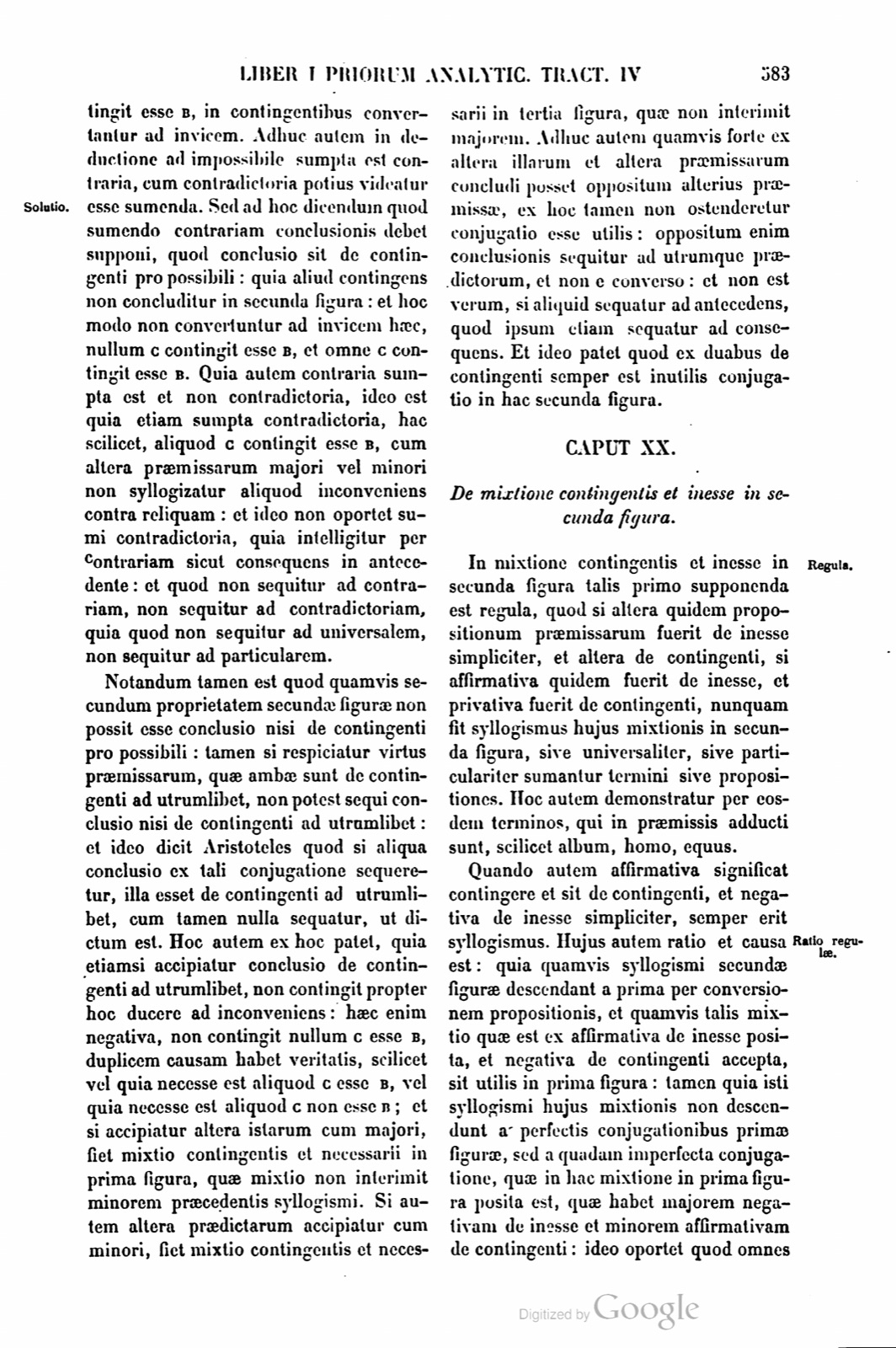
His autem sic determinatis, ponamus utiles et universales per hanc mixtionem conjugationes: et primo ponamus mixtionem juxta primum modum habentem majorem universalem negativam de inesse, et minorem universalem affirmativam de contingenti, sic, sumatur A quod est medium B quidem quod est major extremitas nulli inesse simpliciter, ut haec sit vera, nullum B est A, et sumatur in minori affirmativa, quod A contingit omni C, ita quod haec est vera, omne C contingit esse A, perficitur autem hic syllogismus concludens, quod nullum C contingit esse B per conversionem majoris propositionis, ut convertatur in hanc, nullum A est B, omne C contingit esse A, ergo nullum C contingit esse B, qui est secundus primae figurae.
Similiter autem est in formatione secundi, quando scilicet ad C minorem extremitatem ponitur privativa universalis, sic, omne B contingit esse A, nullum C est A, ergo nullum C contingit esse B. Sed hic syllogismus perficitur per conversionem minoris, et per transpositionem propositionum, et per conversionem conclusionis in terminis1. Haec enim converti poterit in terminis: quia est de contingenti pro possibili, sicut saepius dictum est: et his duobus modis fiunt utiles conjugationes concludentes ex ipsis sumptis propositionibus.
Sunt autem utiles, sed non ex sumptis propositionibus, habentes utramque praemissarum negativam. Si enim utraeque praemissae sint negativae, et una de inesse, et altera de contingenti: tunc enim per ea quae sumpta sunt, non potest fieri syllogismus, quia ex utraque negativa non fit syllogismus: quando autem convertitur illa quae est de contingere sive major sive minor secundum conversionem ejus quod est contingere, hoc est, in oppositam qualitatem, et per conversionem illius de inesse in terminis, fit syllogismus sicut prius: et fiunt hic duo modi universales sicut prius, sicut cuilibet patere potest per seipsum.
With these things thus determined, let us posit the useful and universal conjugations through this mixing. And first let us posit the mixing according to the first mode, having a universal negative major of inherence and a universal affirmative minor of the contingent, thus: let A, which is the middle, be taken as inhering simply in no B, which is the greater extreme, so that this is true, no B is A; and let it be taken affirmatively in the minor that A contingently belongs to every C, so that this is true, every C contingently is A. But this syllogism is perfected, concluding that no C contingently is B, through conversion of the major proposition, so that it is converted into this: no A is B; every C contingently is A; therefore no C contingently is B, which is the second mode of the first figure.
Likewise it is so in the formation of the second, when namely the universal privative is posited at C, the lesser extreme, thus: every B contingently is A; no C is A; therefore no C contingently is B. But this syllogism is perfected through conversion of the minor, and through transposition of the propositions, and through conversion of the conclusion in terms1. For this conclusion will be able to be converted in terms, because it is about the contingent for the possible, as has often been said; and in these two modes useful conjugations are made, concluding from the propositions themselves as taken.
But those having both premises negative are useful, although not from the propositions as taken. For if both premises are negative, and one of inherence and the other about the contingent, then a syllogism cannot be made through the things which are taken, because a syllogism is not made from both negative propositions; but when that proposition which is about contingently belonging, whether major or minor, is converted according to the conversion of that which is contingently belonging, that is, into the opposite quality, and through the conversion in terms of that proposition of inherence, a syllogism is made as before; and here two universal modes are made as before, as can be clear to anyone by itself.
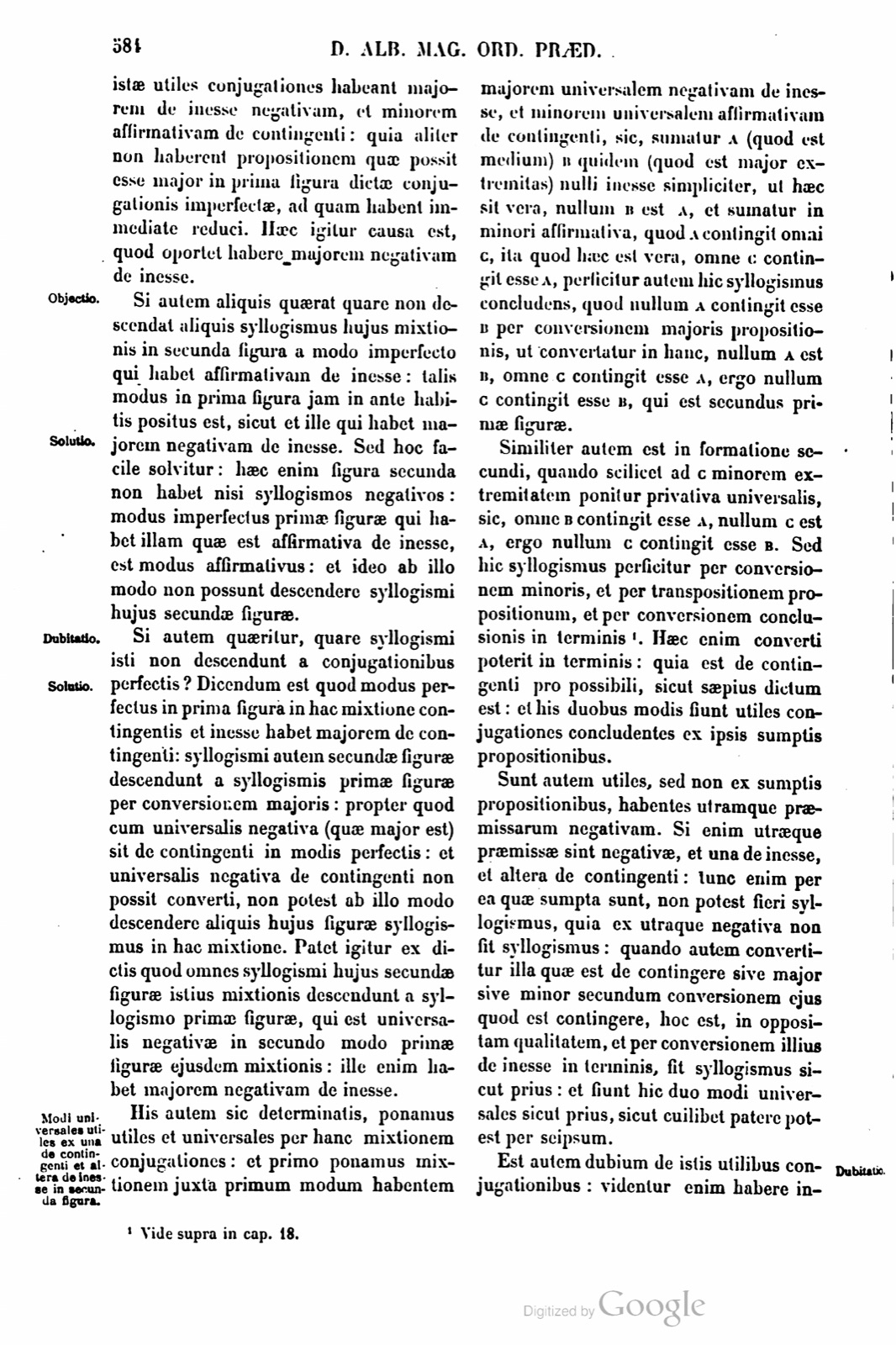
Est autem dubium de istis utilibus conjugationibus: videntur enim habere instantiam in terminis ad conclusionem de contingenti, sic, nullum animal est album et hoc ponatur, omnem equum contingit esse album: et patet quod non sequitur, contingit nullum equum esse animal. Ad haec autem et similia dicendum, quod omnes instantiae sunt sophisticae, in quibus propositio de inesse accipitur de inesse ut nunc: oportet enim negativam semper esse de inesse simpliciter.
Si autem adhuc quaeritur ratio hujus, dicendum quod illi syllogismi descendunt a conjugatione imperfecta quae habet majorem de inesse negativam: et ideo oportet quod etiam in ista sit illa de inesse negativa, quae vel sit major vel possit esse major in syllogismo primae figurae, ad quem syllogismi universales primae figurae reducuntur: et sicut ibi propositio de inesse est de inesse simpliciter, ita oportet quod sit de inesse simpliciter etiam hic.
Adhuc autem si aliquis hic opponat sicut in praecedentibus, quod sequitur conclusio de inesse, ponendo minorem inesse cum opposito conclusionis, dicendum sicut in praecedentibus, quod non potest minor poni inesse: quia per positionem ejus inesse fit incompossibilitas, eo quod major est de inesse simpliciter: oppositum enim conclusionis incompossibile efficitur minori per positionem ejus inesse.
Inutiles autem conjugationes in hac mixtione in hac secunda figura sunt istae. Prima quidem, si utraeque praemissae ponantur praedicativae, et una de contingenti, et altera de inesse, sive major fuerit de inesse et minor de contingenti, sive e converso: tunc enim non erit syllogismus: et probatur per instantiam terminorum ad conclusionem de contingenti. Et termini quidem ad inesse ex necessitate, sunt sanitas, animal, homo, sic, omne animal contingit esse sanum: omnis homo est sanus: sit ita: nec tamen sequitur, omnem hominem contingit esse animal. Idem est si minor sit de contingenti. Termini autem ad non inesse ex necessitate, sunt sanitas, equus, homo, sic, omnem equum contingit esse sanum: omnis homo est sanus et hoc ponatur, non tamen sequitur, quod omnem equum contingit esse hominem: quia equus de necessitate non est homo.
Dubium tamen est de hujusmodi conjugationibus inutilibus: videtur enim quod conjugatio in qua minor est de inesse universalis et affirmativa, sit utilis: talis enim conjugatio videtur esse utilis, contingit nullum B esse A, omne C est A, ergo contingit nullum C esse B, et accipiatur in conclusione contingens pro possibili. Accipiatur enim oppositum conclusionis cum majori posita inesse, et sequitur oppositum minoris, sic, nullum B est A, aliquod C de necessitate est B, ergo aliquod C non est A; sequitur enim ad minus conclusio de inesse: sed haec conclusio est contradictoria minoris. Similiter autem ostendi videtur talis conjugatio utilis esse respectu conclusionis de inesse, sic, contingit nullum B esse A, omne C est A, ergo nullum C est B. Si dicatur quod non sequitur, detur oppositum et ponatur major inesse sic, nullum B est A, aliquod C est B, ergo aliquod C non est A quae est contradictoria minoris. Similiter autem est omnino de omnibus inutilibus conjugationibus, et universalibus et particularibus conclusionibus habentibus universalem negativam de contingenti et illam de inesse affirmativam.
But there is a doubt about these useful conjugations, for they seem to have an instance in terms against the conclusion about the contingent, thus: no animal is white, and let this be posited; every horse contingently is white; and it is clear that it does not follow, it is contingent that no horse be an animal. To these and similar things one must say that all the instances are sophistical in which the proposition of inherence is accepted as of inherence as now; for the negative must always be of inherence simply.
But if the reason for this is still sought, one must say that those syllogisms descend from an imperfect conjugation which has the major negative of inherence; and therefore in this also there must be that negative of inherence, which either is the major or can be the major in a syllogism of the first figure, to which the universal syllogisms of the first figure are reduced. And just as there the proposition of inherence is of inherence simply, so it must be of inherence simply here also.
Again, if someone here objects, as in the preceding matters, that a conclusion of inherence follows by positing the minor as inhering together with the opposite of the conclusion, one must say, as in the preceding matters, that the minor cannot be posited as inhering, because through positing its inherence an incompossibility is made, since the major is of inherence simply; for the opposite of the conclusion is made incompossible with the minor through the positing of its inherence.
But the useless conjugations in this mixing in this second figure are these. First, if both premises are posited as predicative, and one about the contingent and the other of inherence, whether the major is of inherence and the minor of the contingent, or conversely; for then there will be no syllogism, and it is proved through an instance of terms against the conclusion about the contingent. And the terms for inherence from necessity are health, animal, man, thus: every animal contingently is healthy; every man is healthy; let it be so; nevertheless it does not follow, every man contingently is an animal. It is the same if the minor is about the contingent. But the terms for not inhering from necessity are health, horse, man, thus: every horse contingently is healthy; every man is healthy, and let this be posited; nevertheless it does not follow that every horse contingently is a man, because a horse of necessity is not a man.
Nevertheless there is a doubt about useless conjugations of this kind. For it seems that the conjugation in which the minor is universal and affirmative of inherence is useful. For such a conjugation seems to be useful: no B contingently is A; every C is A; therefore no C contingently is B, and in the conclusion let the contingent for the possible be accepted. For let the opposite of the conclusion be accepted with the major posited as inhering, and the opposite of the minor follows, thus: no B is A; some C of necessity is B; therefore some C is not A; for at least a conclusion of inherence follows. But this conclusion is contradictory to the minor. Likewise such a conjugation seems to be shown useful with respect to a conclusion of inherence thus: no B contingently is A; every C is A; therefore no C is B. If it is said that it does not follow, let the opposite be given and let the major be posited as inhering thus: no B is A; some C is B; therefore some C is not A, which is contradictory to the minor. And it is altogether similar concerning all the useless conjugations, both universal and particular, and conclusions having a universal negative about the contingent and that affirmative of inherence.
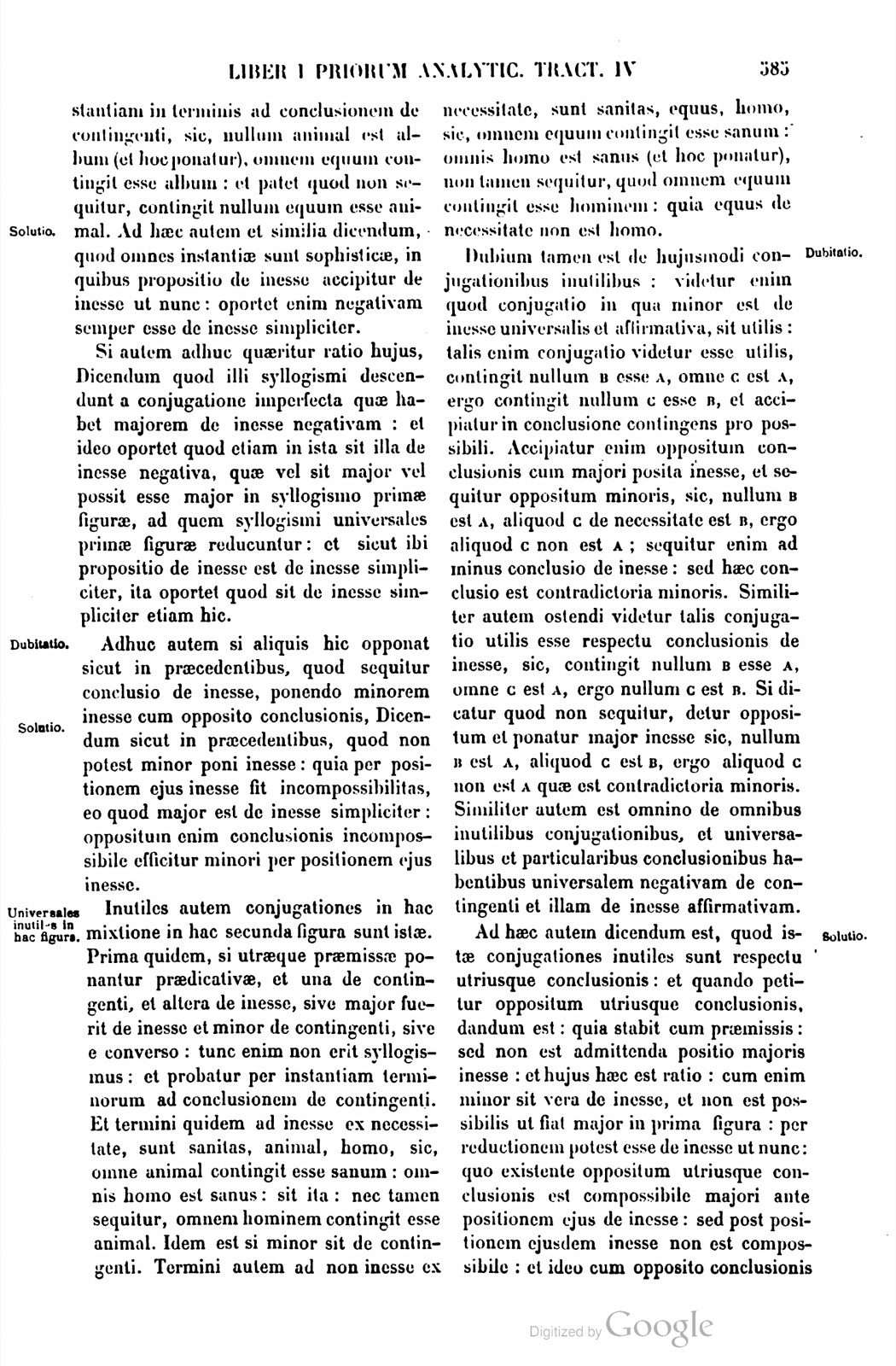
Ad haec autem dicendum est, quod istae conjugationes inutiles sunt respectu utriusque conclusionis: et quando petitur oppositum utriusque conclusionis, dandum est: quia stabit cum praemissis: sed non est admittenda positio majoris inesse: et hujus haec est ratio: cum enim minor sit vera de inesse, et non est possibilis ut fiat major in prima figura: per reductionem potest esse de inesse ut nunc: quo existente oppositum utriusque conclusionis est compossibile majori ante positionem ejus de inesse: sed post positionem ejusdem inesse non est compossibile: et ideo cum opposito conclusionis non debet admitti positio majoris inesse. Cujus exemplum est: quia contingit nullum hominem esse album: omne animal est album et hoc ponatur, neque tamen sequitur conclusio de inesse, neque conclusio de contingenti. Minori enim existente vera compossibiles sunt, et oppositum conclusionis de inesse, scilicet aliquod animal est homo: et contingit nullum hominem esse album. Similiter compossibiles sunt major et oppositum conclusionis de contingenti, scilicet aliquod animal de necessitate est homo: et contingit nullum hominem esse album. Sed minori existente vera, non potest stare oppositum conclusionis cum majori posita inesse: et ideo non potest major poni inesse. Haec autem omnia per ea quae dicta sunt, sufficienter patere possunt cuilibet in istis consideranti, quia hoc non est difficile.
But to these things one must say that those conjugations are useless with respect to each conclusion; and when the opposite of each conclusion is sought, it must be given, because it will stand with the premises. But the positing of the major as inhering must not be admitted; and the reason for this is this: since the minor is true of inherence, and it is not possible for it to become the major in the first figure, by reduction it can be of inherence as now. When this is so, the opposite of each conclusion is compossible with the major before its positing as of inherence, but after the positing of its same inherence it is not compossible; and therefore with the opposite of the conclusion the positing of the major as inhering must not be admitted. An example of this is that no man contingently is white; every animal is white, and let this be posited; nevertheless neither a conclusion of inherence nor a conclusion about the contingent follows. For when the minor is true, both the opposite of the conclusion of inherence, namely some animal is a man, and this proposition, no man contingently is white, are compossible. Likewise the major and the opposite of the conclusion about the contingent are compossible, namely some animal of necessity is a man, and no man contingently is white. But when the minor is true, the opposite of the conclusion cannot stand with the major posited as inhering; and therefore the major cannot be posited as inhering. But all these things can be sufficiently clear through what has been said to anyone considering these matters, because this is not difficult.
Notes
- See above in chapter 18. (Vide supra in cap. 18.) ↩
If a page does not appear, its photograph has not been uploaded yet.