Works › Prior Analytics, Books I–II
Volume 1 · pp. 581–583
Chapter XIX. Why from both propositions about the contingent no syllogism is made in the second figure.
A marker with ≈ is an approximate page boundary, placed by measure of the text; the page photographs remain the authority. In the paired views, clicking a page marker brings that page into view.
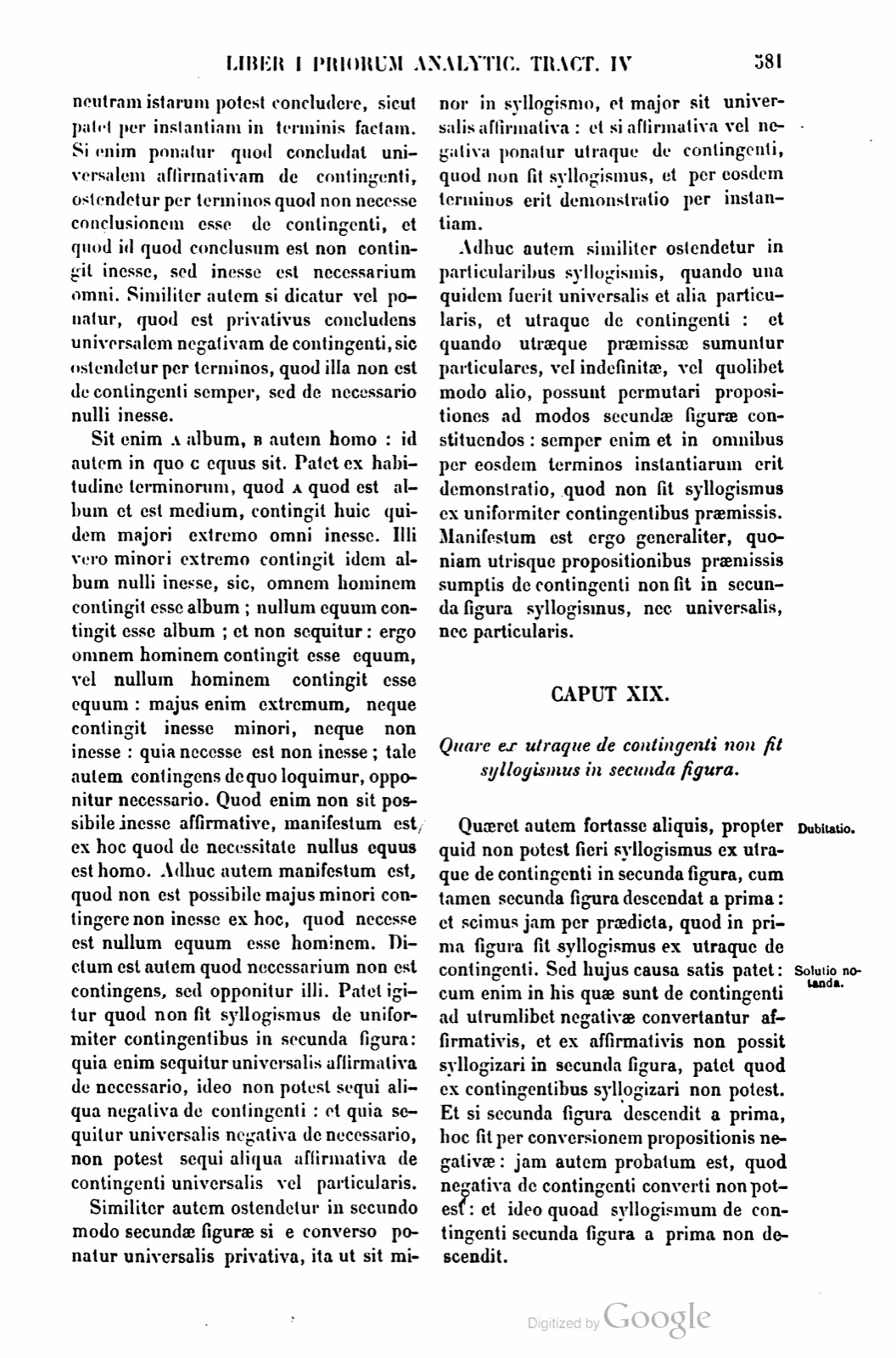
CAPUT XIX. Quare ex utraque de contingenti non fit syllogismus in secunda figura.
Quaeret autem fortasse aliquis, propter quid non potest fieri syllogismus ex utraque de contingenti in secunda figura, cum tamen secunda figura descendat a prima: et scimus jam per praedicta, quod in prima figura fit syllogismus ex utraque de contingenti. Sed hujus causa satis patet: cum enim in his quae sunt de contingenti ad utrumlibet negativae convertantur affirmativis, et ex affirmativis non possit syllogizari in secunda figura, patet quod ex contingentibus syllogizari non potest. Et si secunda figura descendit a prima, hoc fit per conversionem propositionis negativae: jam autem probatum est, quod negativa de contingenti converti non potest: et ideo quoad syllogismum de contingenti secunda figura a prima non descendit.
Attendendum autem quod in contingentibus negativae convertuntur affirmativis, et e converso: et ideo in contingentibus nulla est simpliciter negativa: quia semper remanet in ea potentia ad affirmativam. In secunda autem figura oportet alteram propositionem esse simpliciter negativam ad hoc quod fiat syllogismus: et ideo quia negativa convertitur affirmativae in secunda figura syllogismus ex contingentibus fieri non potest.
Si autem contra hoc objiciens dicat, quod secundum hoc in secunda figura non posset fieri syllogismus ex negativa de necessario, et ex negativa de contingenti pro possibili: quia illae non sunt vere negativae: quod tamen falsum est: ex talibus enim fit in secunda figura syllogismus. Sed ad hoc potest dici, quod negativa de necessario, et negativa de contingenti pro possibili, negativae sunt cujusdam compositionis, et quoad illam sunt simpliciter negativae, quamvis non negent principalem compositionem propositionis modificatae: et sic sunt quodammodo vere negativae. Potentia autem et virtute non sunt vere negativae: quod per hoc patet, quia negativa de necessario convertitur cum negativa de contingenti, ut si necesse est non esse, non contingit esse: quamvis sic non eodem modo sint negativae: quia una est negativa dicti, et altera est negativa modi, ut si contingit non esse, non necesse est esse, et est contingens pro possibili. Sic autem non est in contingenti ad utrumlibet, cujus negativa semper virtute est affirmativa: et ideo ex illis syllogizari potest in secunda figura: ex istis autem quae sunt de contingenti ad utrumlibet, non potest in secunda figura fieri syllogismus.
CHAPTER XIX. Why from both propositions about the contingent no syllogism is made in the second figure.
But perhaps someone will ask why a syllogism cannot be made from both propositions about the contingent in the second figure, although the second figure descends from the first; and we now know through the things said before that in the first figure a syllogism is made from both propositions about the contingent. But the cause of this is sufficiently clear. For since in those propositions which are about the contingent toward either alternative negatives are converted with affirmatives, and from affirmatives one cannot syllogize in the second figure, it is clear that one cannot syllogize from contingent propositions. And if the second figure descends from the first, this happens through the conversion of the negative proposition; but it has now been proved that the negative about the contingent cannot be converted, and therefore, with respect to a syllogism about the contingent, the second figure does not descend from the first.
But it must be attended that in contingent propositions negatives are converted with affirmatives, and conversely; and therefore in contingent propositions nothing is simply negative, because there always remains in it a potency toward the affirmative. But in the second figure one proposition must be simply negative in order that a syllogism be made; and therefore, because the negative is converted to the affirmative, a syllogism from contingent propositions cannot be made in the second figure.
But if someone objecting against this says that, according to this, in the second figure no syllogism could be made from a negative of necessity and from a negative of the contingent for the possible, because those are not truly negative, which nevertheless is false, for from such propositions a syllogism is made in the second figure: to this it can be said that a negative of necessity and a negative of the contingent for the possible are negatives of a certain composition, and with respect to that they are simply negative, although they do not negate the principal composition of the modified proposition; and thus in a certain way they are truly negative. But in potency and power they are not truly negative, which is clear through this: because a negative of necessity is converted with a negative of the contingent, as, if it is necessary not to be, it is not contingent to be. Yet in this way they are not negative in the same mode, because one is a negative of the dictum, and the other is a negative of the mode, as, if it contingently is not, it is not necessary to be, and it is the contingent for the possible. But it is not so in the contingent toward either alternative, whose negative is always affirmative in power; and therefore from those propositions one can syllogize in the second figure, but from these which are about the contingent toward either alternative a syllogism cannot be made in the second figure.
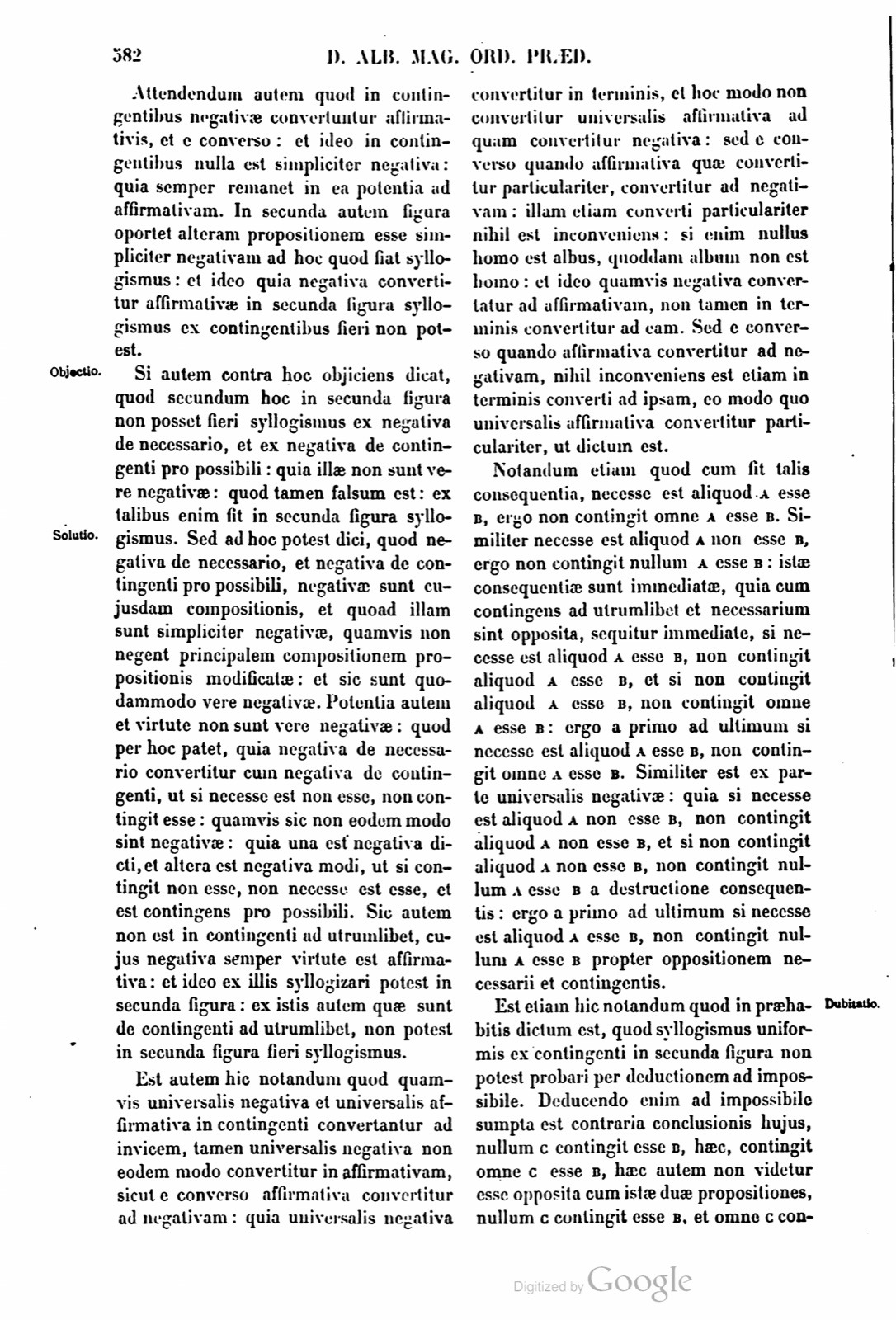
Est autem hic notandum quod quamvis universalis negativa et universalis affirmativa in contingenti convertantur ad invicem, tamen universalis negativa non eodem modo convertitur in affirmativam, sicut e converso affirmativa convertitur ad negativam: quia universalis negativa convertitur in terminis, et hoc modo non convertitur universalis affirmativa ad quam convertitur negativa: sed e converso quando affirmativa quae convertitur particulariter, convertitur ad negativam: illam etiam converti particulariter nihil est inconveniens: si enim nullus homo est albus, quoddam album non est homo: et ideo quamvis negativa convertatur ad affirmativam, non tamen in terminis convertitur ad eam. Sed e converso quando affirmativa convertitur ad negativam, nihil inconveniens est etiam in terminis converti ad ipsam, eo modo quo universalis affirmativa convertitur particulariter, ut dictum est.
Notandum etiam quod cum fit talis consequentia, necesse est aliquod A esse B, ergo non contingit omne A esse B. Similiter necesse est aliquod A non esse B, ergo non contingit nullum A esse B: istae consequentiae sunt immediatae, quia cum contingens ad utrumlibet et necessarium sint opposita, sequitur immediate, si necesse est aliquod A esse B, non contingit aliquod A esse B, et si non contingit aliquod A esse B, non contingit omne A esse B: ergo a primo ad ultimum si necesse est aliquod A esse B, non contingit omne A esse B. Similiter est ex parte universalis negativae: quia si necesse est aliquod A non esse B, non contingit aliquod A non esse B, et si non contingit aliquod A non esse B, non contingit nullum A esse B a destructione consequentis: ergo a primo ad ultimum si necesse est aliquod A esse B, non contingit nullum A esse B propter oppositionem necessarii et contingentis.
Est etiam hic notandum quod in praehabitis dictum est, quod syllogismus uniformis ex contingenti in secunda figura non potest probari per deductionem ad impossibile. Deducendo enim ad impossibile sumpta est contraria conclusionis hujus, nullum C contingit esse B, haec, contingit omne C esse B, haec autem non videtur esse opposita cum istae duae propositiones, nullum C contingit esse B, et omne C contingit esse B, in contingentibus convertantur ad invicem. Adhuc autem in deductione ad impossibile sumpta est contraria, cum contradictoria potius videatur esse sumenda. Sed ad hoc dicendum quod sumendo contrariam conclusionis debet supponi, quod conclusio sit de contingenti pro possibili: quia aliud contingens non concluditur in secunda figura: et hoc modo non convertuntur ad invicem haec, nullum C contingit esse B, et omne C contingit esse B. Quia autem contraria sumpta est et non contradictoria, ideo est quia etiam sumpta contradictoria, hac scilicet, aliquod C contingit esse B, cum altera praemissarum majori vel minori non syllogizatur aliquod inconveniens contra reliquam: et ideo non oportet sumi contradictoria, quia intelligitur per contrariam sicut consequens in antecedente: et quod non sequitur ad contrariam, non sequitur ad contradictoriam, quia quod non sequitur ad universalem, non sequitur ad particularem.
But it must be noted here that, although a universal negative and a universal affirmative in the contingent are converted to one another, nevertheless the universal negative is not converted into the affirmative in the same way as conversely the affirmative is converted to the negative. For the universal negative is converted in terms, and in this way the universal affirmative to which the negative is converted is not converted; but conversely, when the affirmative which is converted particularly is converted to the negative, there is no difficulty if that also is converted particularly in terms. For if no man is white, some white thing is not a man; and therefore, although the negative is converted to the affirmative, nevertheless it is not converted to it in terms. But conversely, when the affirmative is converted to the negative, there is no difficulty if it is also converted in terms to it, in the way in which the universal affirmative is converted particularly, as has been said.
It must also be noted that when such a consequence is made, it is necessary that some A be B; therefore it is not contingent that every A be B. Likewise: it is necessary that some A not be B; therefore it is not contingent that no A be B. These consequences are immediate, because since the contingent toward either alternative and the necessary are opposed, it follows immediately: if it is necessary that some A be B, it is not contingent that some A be B; and if it is not contingent that some A be B, it is not contingent that every A be B. Therefore from first to last, if it is necessary that some A be B, it is not contingent that every A be B. It is similar on the side of the universal negative, because if it is necessary that some A not be B, it is not contingent that some A not be B; and if it is not contingent that some A not be B, it is not contingent that no A be B, by destruction of the consequent. Therefore from first to last, if it is necessary that some A be B, it is not contingent that no A be B, on account of the opposition of the necessary and the contingent.
It must also be noted here that in the preceding matters it was said that a uniform syllogism from the contingent in the second figure cannot be proved by deduction to the impossible. For in leading to the impossible, the contrary of this conclusion, no C contingently is B, was taken, namely this, every C contingently is B. But this does not seem to be opposed, since these two propositions, no C contingently is B and every C contingently is B, are converted to each other in contingent propositions. Again, in the deduction to the impossible the contrary was taken, although the contradictory rather seems to have to be taken. But to this one must say that in taking the contrary of the conclusion it ought to be supposed that the conclusion is about the contingent for the possible, because no other contingent is concluded in the second figure; and in this way these propositions are not converted to one another: no C contingently is B, and every C contingently is B. But the reason the contrary was taken and not the contradictory is that, even if the contradictory is taken, namely this, some C contingently is B, no inconvenience against the remaining premise is syllogized with the other premise, whether major or minor. And therefore the contradictory need not be taken, because it is understood through the contrary as a consequent in an antecedent; and what does not follow from the contrary does not follow from the contradictory, because what does not follow from the universal does not follow from the particular.
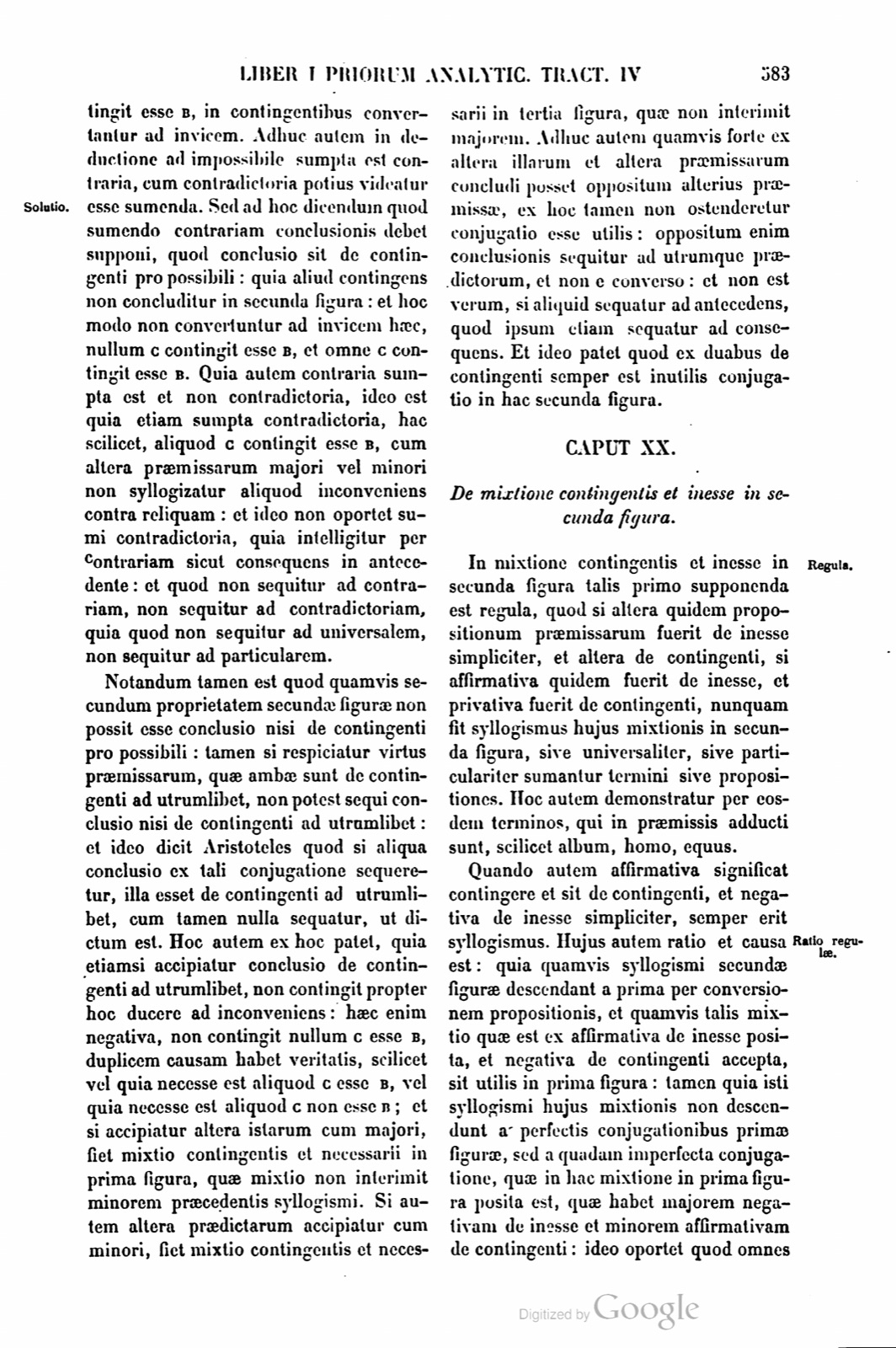
Notandum tamen est quod quamvis secundum proprietatem secundae figurae non possit esse conclusio nisi de contingenti pro possibili: tamen si respiciatur virtus praemissarum, quae ambae sunt de contingenti ad utrumlibet, non potest sequi conclusio nisi de contingenti ad utrumlibet: et ideo dicit Aristoteles quod si aliqua conclusio ex tali conjugatione sequeretur, illa esset de contingenti ad utrumlibet, cum tamen nulla sequatur, ut dictum est. Hoc autem ex hoc patet, quia etiamsi accipiatur conclusio de contingenti ad utrumlibet, non contingit propter hoc ducere ad inconveniens: haec enim negativa, non contingit nullum C esse B, duplicem causam habet veritatis, scilicet vel quia necesse est aliquod C esse B, vel quia necesse est aliquod C non esse B; et si accipiatur altera istarum cum majori, fiet mixtio contingentis et necessarii in prima figura, quae mixtio non interimit minorem praecedentis syllogismi. Si autem altera praedictarum accipiatur cum minori, fiet mixtio contingentis et necessarii in tertia figura, quae non interimit majorem. Adhuc autem quamvis forte ex altera illarum et altera praemissarum concludi posset oppositum alterius praemissae, ex hoc tamen non ostenderetur conjugatio esse utilis: oppositum enim conclusionis sequitur ad utrumque praedictorum, et non e converso: et non est verum, si aliquid sequatur ad antecedens, quod ipsum etiam sequatur ad consequens. Et ideo patet quod ex duabus de contingenti semper est inutilis conjugatio in hac secunda figura.
Nevertheless it must be noted that, although according to the property of the second figure there can be no conclusion except about the contingent for the possible, nevertheless if the power of the premises is considered, since both are about the contingent toward either alternative, no conclusion can follow except about the contingent toward either alternative. And therefore Aristotle says that, if any conclusion followed from such a conjugation, it would be about the contingent toward either alternative, although none follows, as has been said. But this is clear from this: because even if a conclusion about the contingent toward either alternative is accepted, for this reason it is not possible to lead to an inconvenience. For this negative, it is not contingent that no C be B, has a twofold cause of truth, namely either because it is necessary that some C be B, or because it is necessary that some C not be B. And if one of those is accepted with the major, there will be a mixing of the contingent and the necessary in the first figure, which mixing does not destroy the minor of the preceding syllogism. But if the other of the aforesaid propositions is accepted with the minor, there will be a mixing of the contingent and the necessary in the third figure, which does not destroy the major. Again, although perhaps from one of those and one of the premises the opposite of the other premise could be concluded, nevertheless from this it would not be shown that the conjugation is useful, for the opposite of the conclusion follows upon each of the aforesaid propositions, and not conversely; and it is not true that, if something follows upon the antecedent, that same thing also follows upon the consequent. And therefore it is clear that from two propositions about the contingent there is always a useless conjugation in this second figure.
If a page does not appear, its photograph has not been uploaded yet.