Works › Prior Analytics, Books I–II
Volume 1 · pp. 579–581
Continuation of Chapter XVIII on page 579
A marker with ≈ is an approximate page boundary, placed by measure of the text; the page photographs remain the authority. In the paired views, clicking a page marker brings that page into view.
non esse, non potest esse contingens esse vel non esse; quia necessarium et tale contingens opposita sunt.
Hoc autem idem etiam per signum ostendi potest: quia si universalis negativa convertitur in terminis, quando est de contingenti, signum esset quod talis conversio ostendi posset per deductionem ad impossibile, sicut aliae conversiones ostenduntur. Si autem ostendi posset hoc per impossibile, oporteret quod sic ostenderetur: contingit nullum B esse A, ergo contingit nullum A esse B; si non sequitur, tunc stabit oppositum cum praemissa: oppositum autem est, non contingit nullum A esse B: haec autem convertitur cum ista, necesse aliquod A esse B. Si autem necesse est aliquod A esse B, necesse est aliquod B esse A, et haec non potest stare cum prima, hac scilicet, contingit nullum B esse A: sic ergo si convertitur, deberet ostendi per impossibile: sed patet quod convertens propositionem universalem negativam de contingenti, per impossibile conversionem illam non ostendet, ita quod ostendendo assumat quod est oppositum convertentis, scilicet quod dicat falsum esse quod B contingat nulli A, et verum esse oppositum hujus, scilicet quod B non contingit nulli A, eo quod ista duo sunt affirmatio et negatio oppositae. Si autem hoc detur, quod non contingit B nulli A, tunc verum erit quod ex necessitate alicui A oportet inesse B, quia aequipollent istae duae, et una convertitur cum alia: et si detur quod aliquod A de necessitate est B, tunc per conversionem particularis sequitur, quod etiam aliquod B necesse est esse A: hoc autem est impossibile, quia non stat cum prima, quae dicit quod contingit nullum B esse A. Est ergo hoc impossibile: unde si per impossibile ostendatur ista conversio, sicut dictum est, oportet quod ostendatur: et non sequitur impossibile: quia non sequitur quod si A non contingit nulli B, ita quod non contingit nullum A esse A, quod propter hoc necesse sit alicui B inesse A.
Hujus autem causa est, quod cum dicitur nullum B contingit esse A, haec negativa de contingenti duas habet causas veritatis: nam non contingere nulli dupliciter dicitur: hoc quidem in uno sensu est verum si ex necessitate alicui inest: et hic sensus est ex oppositione contingentis et necessarii: aliud autem dicitur alicui non contingere, si ex necessitate alicui non inest, ita quod impossibile sit inesse. Patet igitur quod sic ducens ad impossibile procedit a propositione quae duas habet causas veritatis ad unam illarum causarum: et sic peccat secundum fallaciam consequentis. Hoc autem sic declaratur: quia igitur manifestum est istam propositionem, non contingit nullum A esse B, quae est opposita convertentis, verificari pro hoc sensu, necesse est aliquod A esse B, ideo iste sensus supponatur: et ostendamus quoniam adhuc et alium sensum habet suae veritatis, scilicet quod necesse est aliquod A non esse B. Hoc autem ostenditur per simile in negatione universalis affirmativae de contingenti: etiam hoc non sequitur, si B alicui eorum quae sunt A non inest ex necessitate, quod propter hoc B contingit omni A inesse: sicut non sequitur quod id quod alicui inest ex necessitate, quod propter hoc omni illi contingit inesse. Sicut ergo haec negativa, non contingit omne A esse B, verificatur pro ista, necesse est aliquod A esse B; sequitur enim, si necesse est aliquod A esse B, non contingit omne A esse B: sic etiam haec negativa, non contingit nullum A esse B, verificatur pro ista, necesse est aliquod A non esse B, et ita sequitur, si necesse est aliquod A non esse B, quod non contingit nullum A non esse B. Patet igitur quod inducta propositio duas habet causas suae veritatis.
not to be, cannot be contingently to be or not to be, because the necessary and such a contingent are opposed.
But this same thing can also be shown by a sign: because if a universal negative is converted in terms when it is about the contingent, the sign would be that such a conversion could be shown through a deduction to the impossible, as other conversions are shown. But if this could be shown through the impossible, it would have to be shown thus: it contingently belongs to no B to be A; therefore it contingently belongs to no A to be B. If it does not follow, then the opposite will stand with the premise. But the opposite is: it is not contingent that no A be B. But this is converted with this: it is necessary that some A be B. But if it is necessary that some A be B, it is necessary that some B be A, and this cannot stand with the first, namely with this: it is contingent that no B be A. Thus therefore, if it is converted, it ought to be shown through the impossible. But it is clear that one converting a universal negative proposition about the contingent will not show that conversion through the impossible in such a way that in showing it he assumes what is the opposite of what is to be converted, namely that he says it is false that B contingently belongs to no A, and true that the opposite of this is the case, namely that B does not contingently belong to no A, because those two are an affirmation and an opposed negation. But if this is granted, that B does not contingently belong to no A, then it will be true that by necessity B must belong to some A, because these two are equipollent, and one is converted with the other. And if it is granted that some A is B of necessity, then through the conversion of the particular it follows that also some B must be A. But this is impossible, because it does not stand with the first, which says that no B contingently is A. This, therefore, is impossible. Hence, if that conversion is shown through the impossible, as was said, it must be shown; and the impossible does not follow, because it does not follow that if A does not contingently belong to no B, so that it is not contingent that no A be A, for this reason A must belong to some B.
But the cause of this is that, when it is said, no B contingently is A, this negative proposition about the contingent has two causes of truth. For not to be contingent to none is said in two ways. In one sense this is true if it belongs to some by necessity, and this sense is from the opposition of the contingent and the necessary. But in another sense it is said not to be contingent to something if by necessity it does not belong to something, so that it is impossible for it to belong. Therefore it is clear that one leading in this way to the impossible proceeds from a proposition which has two causes of truth to one of those causes, and thus errs according to the fallacy of the consequent. But this is explained thus: because it is manifest that this proposition, it is not contingent that no A be B, which is the opposite of what is to be converted, is verified for this sense, it is necessary that some A be B, therefore let that sense be supposed; and let us show that it still has another sense of its truth, namely that it is necessary that some A not be B. But this is shown by a like case in the negation of a universal affirmative about the contingent: this too does not follow, that if B does not belong of necessity to some of those things which are A, for this reason B contingently belongs to every A, just as it does not follow that because something belongs of necessity to some member, for this reason it contingently belongs to every such member. Therefore just as this negative, it is not contingent that every A be B, is verified for this proposition, it is necessary that some A be B, for it follows, if it is necessary that some A be B, that it is not contingent that every A be B; so also this negative, it is not contingent that no A be B, is verified for this proposition, it is necessary that some A not be B. And thus it follows, if it is necessary that some A not be B, that it is not contingent that no A not be B. Therefore it is clear that the proposition introduced has two causes of its truth.
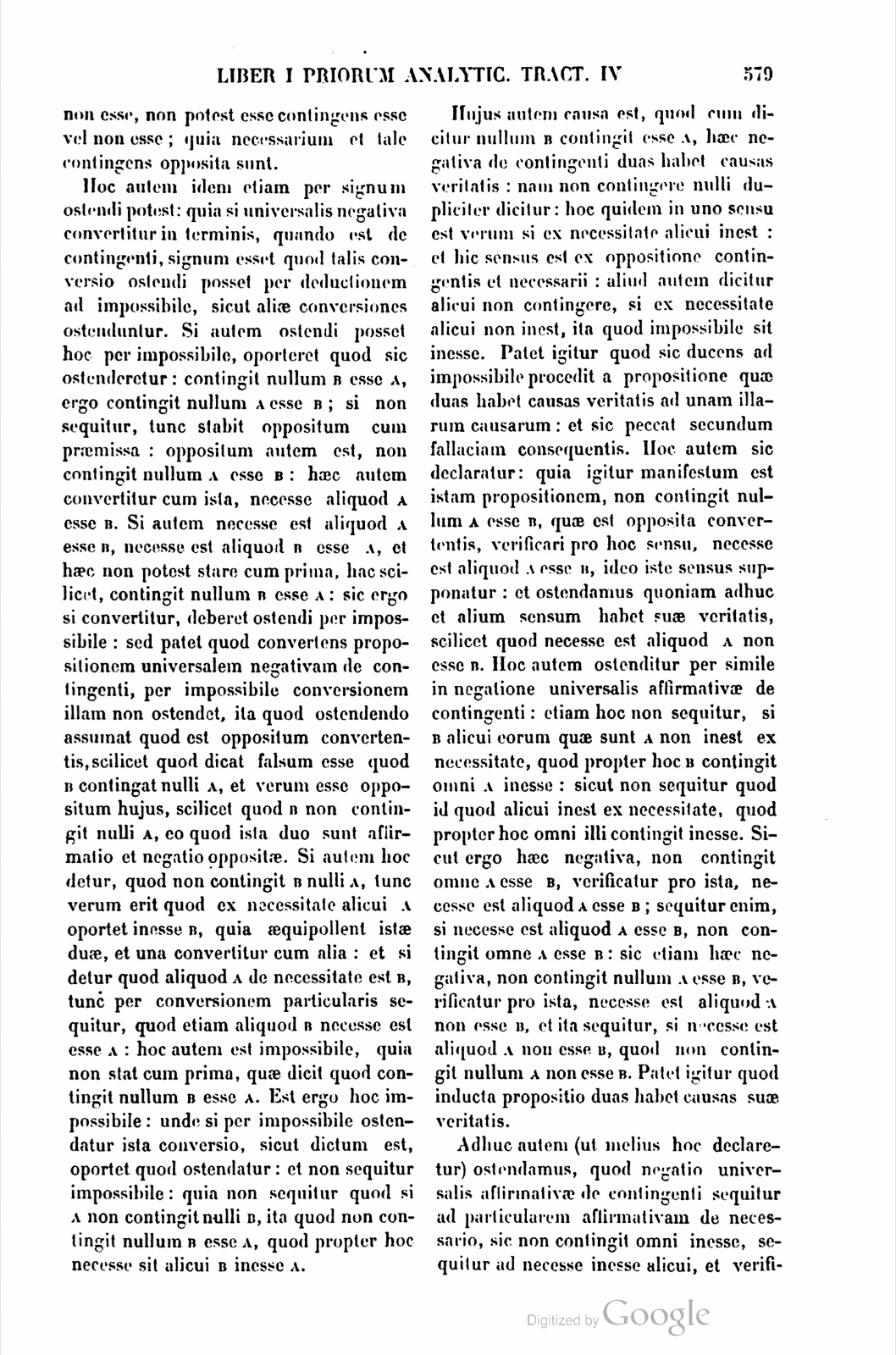
Adhuc autem, ut melius hoc declaretur, ostendamus, quod negatio universalis affirmativae de contingenti sequitur ad particularem affirmativam de necessario, sic non contingit omni inesse, sequitur ad necesse inesse alicui, et verificatur pro illa negativa de contingenti, et non convertitur. Si ergo sic arguatur, non contingit omne D esse C, ergo necesse est aliquod D non esse C, illud non sequitur: quia poterit esse vera, si necesse est aliquod D esse C: cum igitur ista negativa de contingenti, non contingit omne D esse C, habeat duas causas veritatis, scilicet vel quia necesse est aliquod D esse C, vel quia necesse est aliquod D non esse C, et quod huic affirmativae, contingit omne D esse C, opponatur utraque dictarum, scilicet et illa, necesse est aliquod D esse C, et necesse est aliquod D non esse C, patet per se: et si haec affirmativa habet istas duas sibi oppositas, sua negatio, haec scilicet, non contingit nullum D esse C, verificari potest secundum utramque istarum: et haec est solutio argumenti.
Si ergo aliquis putet, quoniam non contingit C omni B inesse: et ex hoc sumat, quoniam C ex necessitate non inest B, falsum sumit, quia omni C inest B. Sed propter hoc quod quibusdam non ex necessitate inest, ideo dicimus et concedimus quod non omni C contingit B inesse. Et ex hoc concluditur quod illi propositioni quae est contingere omni inesse, opponitur et illa, quae est ex necessitate alicui inesse, et illa quae est ex necessitate alicui non inesse, et eaedem duae opponuntur illi quae dicit quod nullum C contingit esse B.
Palam ergo est ex his quae dicta sunt, quod ad sic contingens, vel non contingens, secundum quod a principio istius tractatus diffinitum est, quod est contingens ad utrumlibet, duo sunt opposita pro quibus verificari potest, scilicet ex necessitate alicui inesse, et ex necessitate alicui non inesse; haec enim propositio, non contingit nullum A esse B, potest verificari pro hoc sensu: quia necesse est aliquod A esse B, vel pro hoc, necesse est aliquod A non esse B, et tunc non est dandum quod verificetur pro primo, sed pro secundo: et si hoc sumatur, nihil sequitur vel accidit impossibile. Sequitur ergo quod non fit syllogismus ex propositionibus de contingere: et patet quod non potest ostendi per conversionem: quia non convertitur privativa de contingenti: patet ergo quod talis syllogismus non perficitur per conversionem.
Hoc autem ostenso, probatur etiam quod non perficitur per deductionem ad impossibile. Disponantur enim propositiones in primo modo secundae figurae, sic: ponatur enim A nulli B contingere, sic, nullum B contingit esse A, et haec sit major: et ponatur A contingere omni C sic, omne C contingit esse A, et haec sit minor: in tali autem dispositione non erit syllogismus qui perficiatur per conversionem: quia jam dictum est quod propositio negativa in eodem genere contingentis non convertitur. Sed nec per impossibile potest probari vel perfici: quia si accipiatur opposita conclusionis pro contrarietate quae est, omne C contingit esse B, nihil accidit falsum: quia accepta contraria conclusionis cum majori syllogizabitur per primam figuram ex uniformibus de contingenti, quod contingit nullum C esse A, quae non repugnat minori: quia A contingit et omni et nulli C inesse: et si contingit omni, contingit nulli, et e converso. Similiter autem si contradictoria conclusionis accipiatur cum minori, non destruetur major, propter eamdem causam. Sic ergo patet quod diximus, quod nec per conversionem, nec per impossibile potest demonstrari.
Again, so that this may be declared better, let us show that the negation of the universal affirmative about the contingent follows upon the particular affirmative of necessity, thus: it is not contingent to belong to every one follows upon it being necessary to belong to some one, and it is verified for that negative proposition about the contingent, and is not converted. Therefore if one argues thus, it is not contingent that every D be C; therefore it is necessary that some D not be C, that does not follow, because it will be able to be true if it is necessary that some D be C. Therefore, since that negative about the contingent, it is not contingent that every D be C, has two causes of truth, namely either because it is necessary that some D be C or because it is necessary that some D not be C, and since each of the aforesaid propositions is opposed to this affirmative, every D contingently is C, namely both that one, it is necessary that some D be C, and that one, it is necessary that some D not be C, this is clear of itself. And if this affirmative has those two opposites to itself, its negation, namely this, it is not contingent that no D be C, can be verified according to each of them; and this is the solution of the argument.
Therefore if someone thinks that C does not contingently belong to every B, and from this takes that C of necessity does not belong to B, he takes something false, because B belongs to every C. But because it does not belong to certain things of necessity, therefore we say and concede that it is not contingent for B to belong to every C. And from this it is concluded that to that proposition which is contingently to belong to every one, both that which is of necessity to belong to some one and that which is of necessity not to belong to some one are opposed; and the same two are opposed to that which says that no C contingently is B.
Therefore it is clear from these things which have been said that, to the contingent in this way, or to the non-contingent, according as it was defined from the beginning of this treatise, which is the contingent toward either alternative, there are two opposites for which it can be verified, namely to belong to some one from necessity and not to belong to some one from necessity. For this proposition, it is not contingent that no A be B, can be verified for this sense, that it is necessary that some A be B, or for this, that it is necessary that some A not be B; and then it must not be granted that it is verified for the first, but for the second. And if this is taken, nothing impossible follows or happens. Therefore it follows that no syllogism is made from propositions about contingently belonging; and it is clear that it cannot be shown through conversion, because a privative proposition about the contingent is not converted. Therefore it is clear that such a syllogism is not perfected through conversion.
But with this shown, it is also proved that it is not perfected through deduction to the impossible. For let the propositions be arranged in the first mode of the second figure thus: let A be posited to contingently belong to no B, thus, no B contingently is A, and let this be the major; and let A be posited to contingently belong to every C thus, every C contingently is A, and let this be the minor. But in such a disposition there will not be a syllogism which is perfected through conversion, because it has already been said that a negative proposition in the same genus of contingent is not converted. Nor can it be proved or perfected through the impossible, because if the opposite of the conclusion is accepted as a contrariety, which is, every C contingently is B, nothing false happens; because when the contrary of the conclusion is accepted with the major, it will be syllogized through the first figure from uniform propositions about the contingent that it contingently belongs to no C to be A, which is not repugnant to the minor, because A contingently belongs both to every C and to no C; and if it contingently belongs to every one, it contingently belongs to none, and conversely. Likewise, if the contradictory of the conclusion is accepted with the minor, the major will not be destroyed, for the same reason. Thus therefore what we said is clear: that it can be demonstrated neither through conversion nor through the impossible.
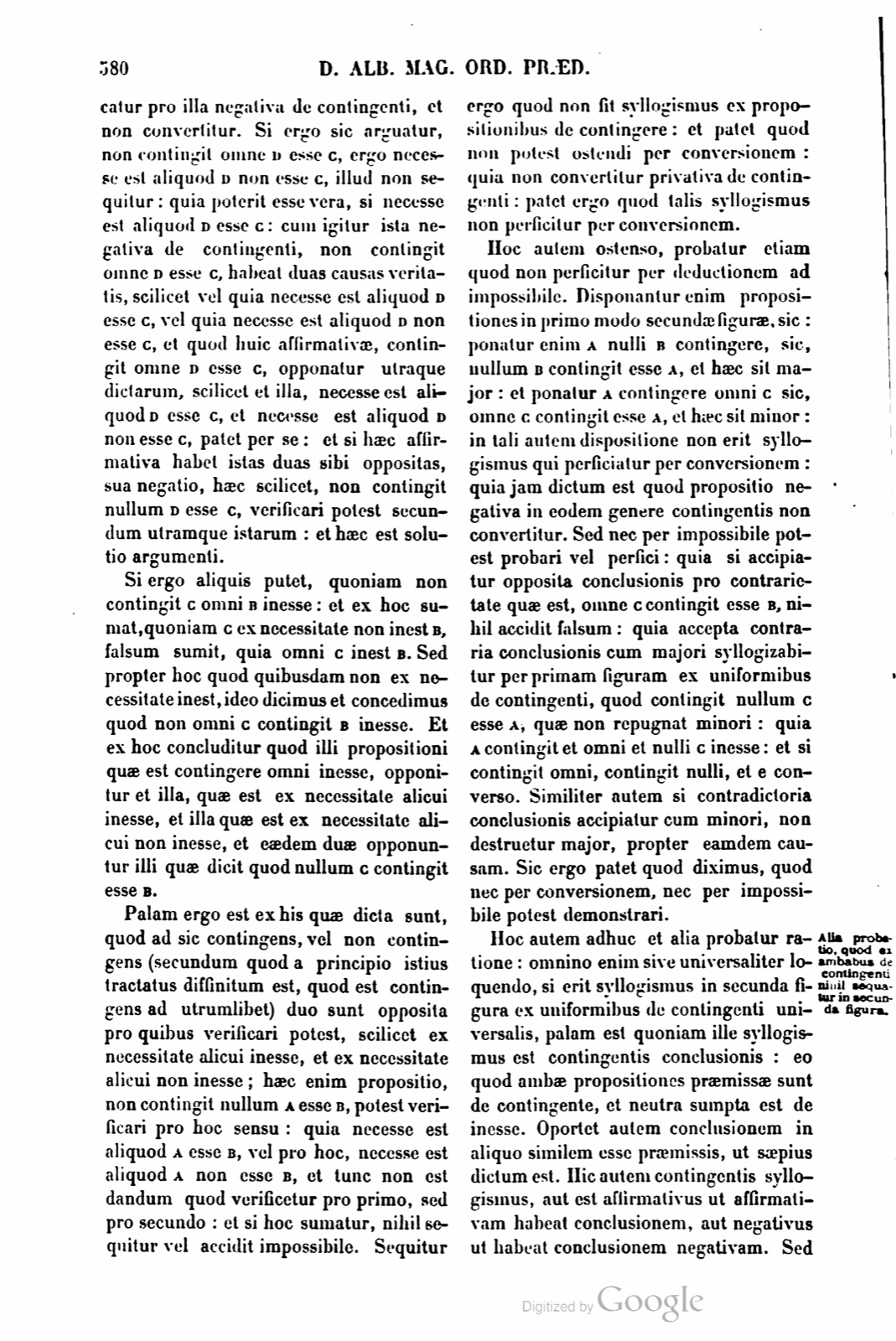
Hoc autem adhuc et alia probatur ratione: omnino enim sive universaliter loquendo, si erit syllogismus in secunda figura ex uniformibus de contingenti universalis, palam est quoniam ille syllogismus est contingentis conclusionis: eo quod ambae propositiones praemissae sunt de contingente, et neutra sumpta est de inesse. Oportet autem conclusionem in aliquo similem esse praemissis, ut saepius dictum est. Hic autem contingentis syllogismus, aut est affirmativus ut affirmativam habeat conclusionem, aut negativus ut habeat conclusionem negativam. Sed neutram istarum potest concludere, sicut patet per instantiam in terminis factam. Si enim ponatur quod concludat universalem affirmativam de contingenti, ostendetur per terminos quod non necesse conclusionem esse de contingenti, et quod id quod conclusum est non contingit inesse, sed inesse est necessarium omni. Similiter autem si dicatur vel ponatur, quod est privativus concludens universalem negativam de contingenti, sic ostendetur per terminos, quod illa non est de contingenti semper, sed de necessario nulli inesse.
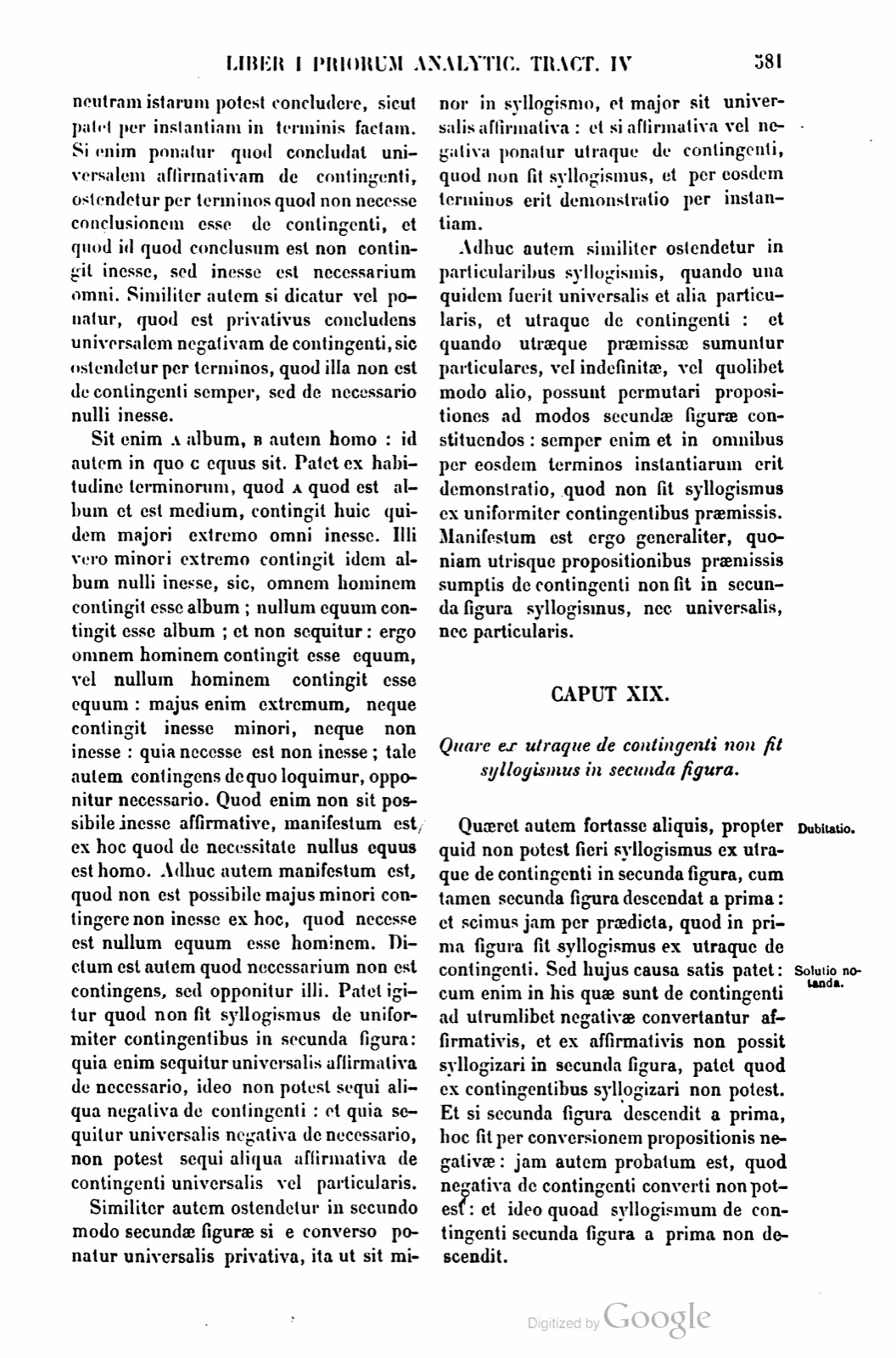
Sit enim A album, B autem homo: id autem in quo C equus sit. Patet ex habitudine terminorum, quod A quod est album et est medium, contingit huic quidem majori extremo omni inesse. Illi vero minori extremo contingit idem album nulli inesse, sic, omnem hominem contingit esse album; nullum equum contingit esse album; et non sequitur: ergo omnem hominem contingit esse equum, vel nullum hominem contingit esse equum: majus enim extremum, neque contingit inesse minori, neque non inesse: quia necesse est non inesse; tale autem contingens de quo loquimur, opponitur necessario. Quod enim non sit possibile inesse affirmative, manifestum est ex hoc quod de necessitate nullus equus est homo. Adhuc autem manifestum est, quod non est possibile majus minori contingere non inesse ex hoc, quod necesse est nullum equum esse hominem. Dictum est autem quod necessarium non est contingens, sed opponitur illi. Patet igitur quod non fit syllogismus de uniformiter contingentibus in secunda figura: quia enim sequitur universalis affirmativa de necessario, ideo non potest sequi aliqua negativa de contingenti: et quia sequitur universalis negativa de necessario, non potest sequi aliqua affirmativa de contingenti universalis vel particularis.
Similiter autem ostendetur in secundo modo secundae figurae si e converso ponatur universalis privativa, ita ut sit minor in syllogismo, et major sit universalis affirmativa: et si affirmativa vel negativa ponatur utraque de contingenti, quod non fit syllogismus, et per eosdem terminos erit demonstratio per instantiam.
Adhuc autem similiter ostendetur in particularibus syllogismis, quando una quidem fuerit universalis et alia particularis, et utraque de contingenti: et quando utraeque praemissae sumuntur particulares, vel indefinitae, vel quolibet modo alio, possunt permutari propositiones ad modos secundae figurae constituendos: semper enim et in omnibus per eosdem terminos instantiarum erit demonstratio, quod non fit syllogismus ex uniformiter contingentibus praemissis. Manifestum est ergo generaliter, quoniam utrisque propositionibus praemissis sumptis de contingenti non fit in secunda figura syllogismus, nec universalis, nec particularis.
But this is further proved by another reason. For altogether or universally speaking, if there will be a universal syllogism in the second figure from uniform propositions about the contingent, it is clear that that syllogism belongs to a contingent conclusion, because both premise propositions are about the contingent and neither is taken as of inherence. But the conclusion must be similar to the premises in some respect, as has often been said. But this syllogism about the contingent is either affirmative, so that it has an affirmative conclusion, or negative, so that it has a negative conclusion. But it can conclude neither of these, as is clear through the instance made in terms. For if it is posited that it concludes a universal affirmative about the contingent, it will be shown through terms that the conclusion need not be about the contingent, and that what is concluded does not contingently belong, but necessarily belongs to every case. Likewise, if it is said or posited that it is privative, concluding a universal negative about the contingent, it will be shown through terms that that conclusion is not always about the contingent, but about belonging to none from necessity.
For let A be white, B man, and let that in which C is be horse. It is clear from the relation of the terms that A, which is white and is the middle, contingently belongs to all of this greater extreme. But the same white contingently belongs to none of that lesser extreme, thus: every man contingently is white; no horse contingently is white. And it does not follow: therefore every man contingently is a horse, or no man contingently is a horse. For the greater extreme neither contingently belongs to the minor nor contingently does not belong, because it is necessary that it not belong; but such a contingent as we are speaking of is opposed to the necessary. For that it is not possible to belong affirmatively is manifest from this, that of necessity no horse is a man. Again it is manifest that it is not possible for the greater to contingently not belong to the minor from this, that it is necessary that no horse be a man. But it has been said that the necessary is not the contingent, but is opposed to it. Therefore it is clear that no syllogism is made from uniformly contingent propositions in the second figure, because since a universal affirmative of necessity follows, no negative proposition about the contingent can follow; and because a universal negative of necessity follows, no affirmative proposition about the contingent, universal or particular, can follow.
Likewise it will be shown in the second mode of the second figure if the universal privative is posited conversely, so that it is the minor in the syllogism and the major is the universal affirmative; and if both propositions are posited affirmative or negative about the contingent, that no syllogism is made, and by the same terms there will be demonstration through instance.
Again, it will be shown similarly in particular syllogisms, when one proposition is universal and the other particular, and each is about the contingent; and when both premises are taken as particular, or indefinite, or in any other way, the propositions can be interchanged for constituting the modes of the second figure. For always and in every case, by the same terms of instances there will be a demonstration that no syllogism is made from uniformly contingent premises. Therefore it is manifest generally that, when both premise propositions are taken about the contingent, no syllogism is made in the second figure, neither universal nor particular.
If a page does not appear, its photograph has not been uploaded yet.