Works › Prior Analytics, Books I–II
Volume 1 · pp. 571–575
Chapter XVI. On the consequence of imperfect conjugations in which the major is affirmative about the necessary.
A marker with ≈ is an approximate page boundary, placed by measure of the text; the page photographs remain the authority. In the paired views, clicking a page marker brings that page into view.
CAPUT XVI. De consequentia conjugationum imperfectarum in quibus major est affirmativa de necessario.
Circa conjugationes imperfectas in quibus major est affirmativa de necessario, adhuc restant quaedam dubitabilia: ex his enim dictum est, quod solum sequitur conclusio de contingenti: cum tamen videatur posse probari quod sequitur etiam conclusio de necessario, et etiam conclusio de inesse. Quod enim sequatur conclusio de necessario, videtur probari sic. Majori enim existente affirmativa de necessario, et minori de contingenti, ponatur minor quae est de contingenti inesse: et tunc patet per hoc quod in ante habitis de mixtione necessarii et inesse dictum est, quod sequitur conclusio de necessario: quia majori existente de necessario, et minori de inesse sequitur conclusio de necessario. Et per eamdem etiam rationem ostendi potest, quod in modis perfectis sequitur conclusio de inesse, si major in talibus modis quae est de contingenti, ponatur inesse.
Et proculdubio hoc videtur esse verum, si concedatur, quod minor quae est de contingenti, ponatur inesse: tunc enim pro certo sequitur conclusio de necessario, et etiam de inesse similis majori propositioni. Sed non sequitur conclusio de necessario vel de inesse quamdiu minor manet de contingenti. Unde per positionem minoris inesse, generatur alia conjugatio, ex qua sequitur conclusio quae quamdiu manet de contingenti, non sequebatur. Causa autem propter quam non sequitur conclusio de necessario vel de inesse, quamdiu manet minor de contingenti, haec est, quia universalis affirmativa de necessario affirmat praedicatum quod est major extremitas, non nisi de his quae actu sunt sub medio, quod est subjectum majoris propositionis, et non de his quae contingit esse sub subjecto: haec enim propositio, omnis homo de necessitate est animal, non dicit quod quidquid potest esse homo, est animal: sed dicit quod quidquid est homo, est animal: et ideo tali propositione pro majori posita et minori de contingenti, non sequitur actualis affirmativa de his quae contingenter sunt sub medio: et ideo non sequitur conclusio de necessario affirmativa neque de inesse, nisi sumatur illa de contingenti in sensu compositionis: quia in utraque actualiter affirmatur praedicatum de subjecto. Dico autem sub sensu compositionis sumptam, in qua modus refertur ad totum, sicut cum dico, contingit omnem hominem esse animal, hoc est, omnem hominem esse animal est contingens: sic enim in utraque, hoc est, tam in illa quae est de necessario quam in illa quae est de contingenti, actualiter affirmatur praedicatum de subjecto.
Notandum tamen quod affirmativa de necessario secundum sensum compositionis sumpta aliter se habet quam in syllogismis: quia sumpta in sensu compositionis termini in ea sumpti supponunt simpliciter, sed secundum hunc sensum non sumuntur propositiones de necessario quando ex eis fit syllogismus. Et ex his potest esse manifestum propter quid majori existente de necessario affirmativa, non sequitur conclusio de inesse, sicut sequitur conclusio de inesse majori existente negativa de necessario. In negativa enim de necessario removetur praedicatum actualiter de his quae actu et quae potentia sunt sub subjecto. In affirmativa autem tantum affirmatur actualiter de his quae actu sunt sub subjecto. Et hoc facit negatio quae plus tollit quam ponit affirmatio1.
CHAPTER XVI. On the consequence of imperfect conjugations in which the major is affirmative about the necessary.
Concerning the imperfect conjugations in which the major is affirmative about the necessary, certain doubtful points still remain. For from these things it has been said that only a conclusion about the contingent follows, although it seems possible to prove that a conclusion of necessity also follows, and also a conclusion of inherence. For that a conclusion of necessity follows seems to be proved thus. When the major is affirmative about the necessary and the minor about the contingent, let the minor which is about the contingent be posited as inhering. And then it is clear through what has been said before concerning the mixing of the necessary and inherence that a conclusion of necessity follows; because, when the major is about the necessary and the minor about inherence, a conclusion of necessity follows. And by the same reason it can also be shown that in perfect modes a conclusion of inherence follows, if the major in such modes, which is about the contingent, is posited as inhering.
And without doubt this seems to be true, if it is conceded that the minor which is about the contingent is posited as inhering; for then certainly a conclusion of necessity follows, and also one of inherence, similar to the major proposition. But a conclusion of necessity or of inherence does not follow so long as the minor remains about the contingent. Hence through the positing of the minor as inhering another conjugation is generated, from which there follows a conclusion which did not follow so long as it remained about the contingent. But the cause on account of which a conclusion of necessity or of inherence does not follow so long as the minor remains about the contingent is this: because a universal affirmative of necessity affirms the predicate, which is the greater extreme, only of those things which actually are under the middle, which is the subject of the major proposition, and not of those things which contingently are under the subject. For this proposition, every man of necessity is an animal, does not say that whatever can be a man is an animal, but says that whatever is a man is an animal. And therefore, when such a proposition has been posited as the major and the minor is about the contingent, an actual affirmative concerning those things which are contingently under the middle does not follow; and therefore neither an affirmative conclusion of necessity nor one of inherence follows, unless that proposition about the contingent is taken in the sense of composition, because in each the predicate is actually affirmed of the subject. But I mean taken under the sense of composition, in which the mode is referred to the whole, as when I say, every man contingently is an animal, that is, every man being an animal is contingent; for thus in each, that is, both in the proposition which is of necessity and in that which is of the contingent, the predicate is actually affirmed of the subject.
Nevertheless it must be noted that an affirmative proposition of necessity taken according to the sense of composition has itself otherwise than in syllogisms, because, taken in the sense of composition, the terms taken in it suppose simply; but propositions of necessity are not taken according to this sense when a syllogism is made from them. And from these things it can be manifest why, when the major is affirmative of necessity, a conclusion of inherence does not follow, as a conclusion of inherence follows when the major is negative of necessity. For in the negative of necessity the predicate is actually removed from those things which are actually and potentially under the subject. But in the affirmative it is only actually affirmed of those things which actually are under the subject. And the negation effects this, which takes away more than the affirmation posits1.
Potest autem adhuc esse dubium, utrum ex tali conjugatione sequatur conclusio de inesse. Videtur autem quod sic: quia sicut se habet negativum de inesse ad negativum de necessario, ita se habet affirmativum de inesse ad affirmativum de necessario: propter quod cum negativum de necessario possit in negativum de inesse, videtur quod affirmativum de necessario possit in affirmativum de inesse.
Adhuc fiat hoc modo syllogismus: de necessitate omne B est A, contingit omne C esse B, ergo omne C est A. Aut sequitur, aut non. Si sequitur, habetur propositum. Si non, detur oppositum: oppositum autem est, aliquod C non est A. Ex hac autem et minori posita inesse destruitur major per quintum modum tertiae figurae. Sic etiam potest dari instantia in terminis notis, de necessitate omne grammaticum est sciens: contingit omnem hominem esse grammaticum: non tamen sequitur quod omnis homo est sciens: possumus enim ponere, quod omnis homo sit ignorans.
Ad primum autem istorum dicendum est, quod diversa est virtus negativae de necessario et affirmativae de necessario: et ideo potest ex negativa sequi illa de inesse, quamvis non sequatur ex affirmativa. Hoc autem patet ex praedictis.
Ad aliud dicendum quod dandum est oppositum conclusionis: sed minor quae est de contingenti, non est ponenda inesse: quia oppositum conclusionis de inesse, est compossibile minori de contingenti: sed incompossibile est eidem positae inesse: et ideo si ponatur minor inesse, jam nova fit repugnantia quae prius non erat: et ideo sequitur impossibile.
Si autem objiciatur, quod secundum hoc male probat Aristoteles in Prioribus, ubi probat conclusionem de contingenti ex ista conjugatione, quando ponit illam de contingenti inesse. Dicendum quod oppositum conclusionis de contingenti pro possibili non solum est incompossibile minori positae inesse, sed etiam ipsi minori dum est de contingenti: quia cum omne C ex necessitate sit A, incompossibiles sunt hae duae, aliquod C ex necessitate non est A, et contingit omne C esse B, sicut patet ex dictis immediate in mixtione praecedenti de contingenti et inesse. Potuit itaque Aristoteles probando consequentiam conclusionis de contingenti bene ponere minorem inesse: eadem enim est incompossibilitas oppositi conclusionis et minoris ante positionem ejus inesse, et postquam inesse posita est, et non fit nova incompossibilitas.
But there can still be a doubt whether from such a conjugation a conclusion of inherence follows. It seems that it does, because as the negative of inherence is related to the negative of necessity, so the affirmative of inherence is related to the affirmative of necessity. For this reason, since the negative of necessity can proceed into the negative of inherence, it seems that the affirmative of necessity can proceed into the affirmative of inherence.
Again, let a syllogism be made in this way: of necessity every B is A; every C contingently is B; therefore every C is A. Either it follows or it does not. If it follows, the proposed point is had. If it does not, let the opposite be given; but the opposite is: some C is not A. From this and the minor posited as inhering the major is destroyed through the fifth mode of the third figure. Thus also an instance can be given in known terms: of necessity every grammatical thing is knowing; every man contingently is grammatical; nevertheless it does not follow that every man is knowing, for we can posit that every man is ignorant.
To the first of these one must say that the power of a negative proposition of necessity and of an affirmative proposition of necessity is diverse; and therefore that proposition of inherence can follow from the negative, although it does not follow from the affirmative. But this is clear from the things said before.
To the other point one must say that the opposite of the conclusion must be given; but the minor which is about the contingent must not be posited as inhering, because the opposite of the conclusion of inherence is compossible with the minor about the contingent, but is incompossible with the same minor when it has been posited as inhering. And therefore, if the minor is posited as inhering, a new repugnance is now made which was not there before; and therefore the impossible follows.
But if it is objected that, according to this, Aristotle proves badly in the Prior Analytics, where he proves the conclusion about the contingent from this conjugation when he posits that proposition about the contingent as inhering, one must say that the opposite of the conclusion about the contingent for the possible is not only incompossible with the minor posited as inhering, but also with the minor itself while it is about the contingent. For since every C is A of necessity, these two are incompossible: some C of necessity is not A, and every C contingently is B, as is clear from what was said immediately in the preceding mixing of the contingent and inherence. Therefore Aristotle, in proving the consequence of the conclusion about the contingent, was able well to posit the minor as inhering; for there is the same incompossibility of the opposite of the conclusion and of the minor before its positing as inhering and after it has been posited as inhering, and no new incompossibility is made.
Si quis autem objiciat quod posito possibili non accidit impossibile, dicendum quod hoc verum est absolute, sicut etiam in praehabitis dictum est: si enim consideretur absolute possibile secundum quod tale est, nihil ex eo sequitur impossibile: sed ex positione possibilis cum comparatione ad aliquid cui hoc impossibile est, potest accidere impossibile.
Adhuc autem in hac conjugatione videtur dubium de probatione quae facta est secundum sententiam Aristotelis qua probatur, quod conclusio de inesse sequitur: haec enim probatio nulla esse videtur: fit enim in illa probatione mixtio necessarii et inesse: cum tamen illa de inesse possit esse de inesse ut nunc. Cujus probatio est: quia si major sit negativa de necessario, et minor sit affirmativa vel negativa de contingenti, sequitur duplex conclusio, una de inesse et altera de contingenti pro possibili: sed si conclusio de contingenti pro possibili ponatur inesse, aliquando erit de inesse ut nunc, et aliquando de inesse simpliciter: cum ergo accipitur oppositum conclusionis talis cum conversa majoris, accipit propositionem quae potest esse de inesse ut nunc: et hoc modo syllogismus mixtus de necessario et inesse ut nunc, nihil valet et nihil probat, ut videtur. Sed ad hoc dicendum quod probatio est bona, et mixtio necessarii et inesse non est de inesse ut nunc: quia sicut inesse continet sub se inesse simpliciter et inesse ut nunc, sic contingens in ante habitis per non necessarium determinatum continet sub se et contingens natum et contingens infinitum. Unde sicut in mixtione necessarii et inesse major quae est de necessario, appropriat sibi minorem ad standum pro inesse simpliciter, sic in mixtione necessarii et contingentis major quae est de necessario, appropriat sibi minorem quae est de contingenti ad standum pro contingenti nato. Minori autem sic existente de contingenti nato, oportet conclusionem concludi de inesse simpliciter in modo negativo: et ideo oppositum talis conclusionis assimilatur conversae majoris: et tunc bona est mixtio de necessario et inesse simpliciter secundum hunc modum. Hoc autem probatur per exemplum hoc modo, de necessitate nullum musicum est lignum: contingit omnem hominem esse musicum: ergo nullus homo est lignum.
Ex dictis ergo patet quod in modis hujus mixtionis necessarii et contingentis minor accipi debet de contingenti nato.
Secundum autem ea quae dicta sunt oritur quaestio: quia cum major de inesse in mixtione contingentis et inesse sit de inesse simpliciter, videtur quod exigat major de inesse simpliciter minorem esse de contingenti nato, cum major de necessario in mixtione contingentis et necessarii sic exigat minorem esse de contingenti nato. Dicendum ad hoc quod hoc non oportet: major enim de inesse non appropriat aliquam sibi minorem nisi ad sumendum sub ipsa, sed non ad sic vel sic sumendum. Major autem de necessario appropriat sibi minorem ad hoc quod sit de inesse simpliciter: et ideo illa de necessario appropriat sibi minorem de contingenti, ut sit de contingenti nato: quia illa posita inesse erit de inesse simpliciter. Hanc autem appropriationem non potest facere major quae est de inesse tantum.
But if someone objects that when a possible thing has been posited, the impossible does not happen, one must say that this is true absolutely, as was also said in the preceding matters. For if the possible is considered absolutely insofar as it is such, nothing impossible follows from it; but from the positing of a possible thing, with comparison to something for which this is impossible, an impossible thing can happen.
Again, in this conjugation there seems to be a doubt about the proof which was made according to the opinion of Aristotle by which it is proved that a conclusion of inherence follows. For this proof seems to be no proof, since in that proof a mixing of the necessary and inherence is made, although that proposition of inherence can be of inherence as now. The proof of this is that, if the major is negative of necessity and the minor is affirmative or negative of the contingent, a twofold conclusion follows, one of inherence and the other of the contingent for the possible. But if the conclusion about the contingent for the possible is posited as inhering, sometimes it will be of inherence as now, and sometimes of inherence simply. Therefore, when the opposite of such a conclusion is accepted with the converted major, it accepts a proposition which can be of inherence as now; and in this way a syllogism mixed from necessity and inherence as now, as it seems, is worth nothing and proves nothing. But to this one must say that the proof is good, and the mixing of necessity and inherence is not of inherence as now. For just as inherence contains under itself inherence simply and inherence as now, so the contingent determined in the preceding matters through the non-necessary contains under itself both the natural contingent and the infinite contingent. Hence, just as in the mixing of the necessary and inherence the major which is about the necessary appropriates to itself the minor to stand for inherence simply, so in the mixing of the necessary and the contingent the major which is about the necessary appropriates to itself the minor which is about the contingent to stand for the natural contingent. But when the minor is thus about the natural contingent, the conclusion must be concluded of inherence simply in the negative mode; and therefore the opposite of such a conclusion is assimilated to the converted major, and then the mixing of necessity and inherence simply is good according to this mode. But this is proved by an example in this way: of necessity no musical thing is wood; every man contingently is musical; therefore no man is wood.
Therefore from the things said it is clear that in the modes of this mixing of the necessary and the contingent, the minor ought to be accepted about the natural contingent.
But according to the things which have been said a question arises, because since the major of inherence in the mixing of the contingent and inherence is of inherence simply, it seems that a major of inherence simply requires the minor to be about the natural contingent, since the major of necessity in the mixing of the contingent and the necessary thus requires the minor to be about the natural contingent. To this one must say that this is not necessary; for a major of inherence does not appropriate any minor to itself except for taking under itself, but not for taking in this or that way. But a major of necessity appropriates the minor to itself for this, that it be of inherence simply; and therefore that proposition of necessity appropriates to itself a minor about the contingent, so that it is about the natural contingent, because when that proposition is posited as inhering it will be of inherence simply. But the major which is only of inherence cannot make this appropriation.
Si autem aliquis objiciens dicat quod tam in modis affirmativis quam in modis negativis illa quae est de inesse, sumitur de inesse simpliciter: videtur ergo quod in utrisque modis deberet sequi conclusio quae sit de inesse simpliciter, vel conclusio de inesse ad minus. Dicendum est ad hoc quod argumentum non valet: quia acceptio minoris de contingenti nato non est causa quare sequitur conclusio de inesse, sed potius virtus propositionis negativae, sicut paulo ante dictum est. Quod autem minor in talibus syllogismis efficitur de inesse simpliciter, hoc facit minor quae est de contingenti nato. Causa ergo propter quam sequitur conclusio de inesse, deficit in modis affirmativis: et ideo non valet argumentum inductum. Causa autem hujus in modis negativis patere potest hoc modo. Si enim impossibile est aliquod A esse A, cum B insit C secundum causam ei innatam, oportet quod minor sit de contingenti nato: patet quod non poterit C esse A in conclusione: et ideo erit conclusio negativa de inesse simpliciter, sicut patet in superius positis terminis, lignum, musicum, homo. In his enim major extremitas impossibiliter se habet ad medium: medium autem ad minus secundum contingens natum. Si autem in affirmativo syllogismo omne B de necessitate sit A, quamvis B contingat inesse omni C secundum causam innatam et sit de contingenti nato, non oportet quod A, quod in prima figura est supra B, insit C actualiter, sicut patere potest in his terminis, sciens, musicum, homo, in quibus majus ad medium se habet ex necessitate, medium autem ad minus secundum contingens natum. Haec tamen omnia plenius patent per virtutem negativae diversam ab affirmativa, quando utraque fuerit de necessario.
Sed ex his quae dicta sunt oritur dubitatio: prius enim dictum est quod in ista mixtione contingentis et inesse major propositio de inesse sive affirmative sive negative tantum praedicatur de his quae actu sunt sub subjecto: cum tamen dictum sit quod subjectum majoris, quod est ad conclusionem probandam, stat in majori in qua est subjectum propositionis de inesse simpliciter sicut in minori in qua est praedicatum de contingenter inesse: aliter enim videbatur fieri fallacia figurae dictionis.
Sed ad hoc dicendum quod termini propositionis de inesse simpliciter possunt considerari secundum habitudinem naturalem eorum ad invicem circumscripto esse actuali: et sic in ipsis est ampliatio: quidquid enim potest esse sub altero illorum, potest esse reliquum, vel removeri a reliquo. Dictum autem est subjectum ampliari secundum ipsius naturam in majori de inesse ad habitudinem comparatam ad praedicatum secundum ipsius naturam circumscripto esse actuali et accidentali. Vel possunt termini de inesse simpliciter taliter se habere ut sub esse actuali, ita ut componantur et dividantur per esse actuale: et sub ista consideratione non cadit ampliatio super eos: et sic dictum est hic praedicatum actualiter affirmari vel negari de his tantum quae actu continentur sub subjecto.
But if someone objecting says that, both in affirmative modes and in negative modes, that proposition which is of inherence is taken as of inherence simply, therefore it seems that in both modes there ought to follow a conclusion which is of inherence simply, or at least a conclusion of inherence, one must say to this that the argument is not valid, because the acceptance of the minor about the natural contingent is not the cause why a conclusion of inherence follows, but rather the power of the negative proposition is, as was said a little before. But that the minor in such syllogisms becomes of inherence simply, this is effected by the minor which is about the natural contingent. Therefore the cause on account of which a conclusion of inherence follows is lacking in affirmative modes, and therefore the argument introduced is not valid. But the cause of this in negative modes can be clear in this way. For if it is impossible that some A be A, when B belongs to C according to the cause innate to it, the minor must be about the natural contingent. It is clear that C will not be able to be A in the conclusion, and therefore there will be a negative conclusion of inherence simply, as is clear in the terms posited above: wood, musical, man. For in these the greater extreme has itself impossibly toward the middle, but the middle toward the minor according to the natural contingent. But if in an affirmative syllogism every B is A of necessity, although B contingently belongs to every C according to an innate cause and is about the natural contingent, it is not necessary that A, which in the first figure is above B, belong actually to C, as can be clear in these terms: knowing, musical, man, in which the greater term is related to the middle by necessity, but the middle to the minor according to the natural contingent. Yet all these things are more fully clear through the power of the negative, diverse from the affirmative, when each has been of necessity.
But from these things which have been said a doubt arises. For previously it was said that in this mixing of the contingent and inherence the major proposition of inherence, whether affirmatively or negatively, is predicated only of those things which actually are under the subject; nevertheless it has been said that the subject of the major, which exists for proving the conclusion, stands in the major, in which it is the subject of a proposition of inherence simply, just as in the minor, in which it is the predicate of contingently inhering; otherwise there seemed to be a fallacy of figure of speech.
But to this one must say that the terms of a proposition of inherence simply can be considered according to their natural relation to one another, with actual being set aside; and thus in them there is broadening. For whatever can be under one of them can be the remaining term, or be removed from the remaining term. But it has been said that the subject is broadened according to its own nature in the major of inherence to the relation compared with the predicate according to its nature, with actual and accidental being set aside. Or the terms of inherence simply can have themselves in such a way as under actual being, so that they are composed and divided through actual being; and under that consideration broadening does not fall upon them. And thus it has been said here that the predicate is actually affirmed or denied only of those things which are actually contained under the subject.
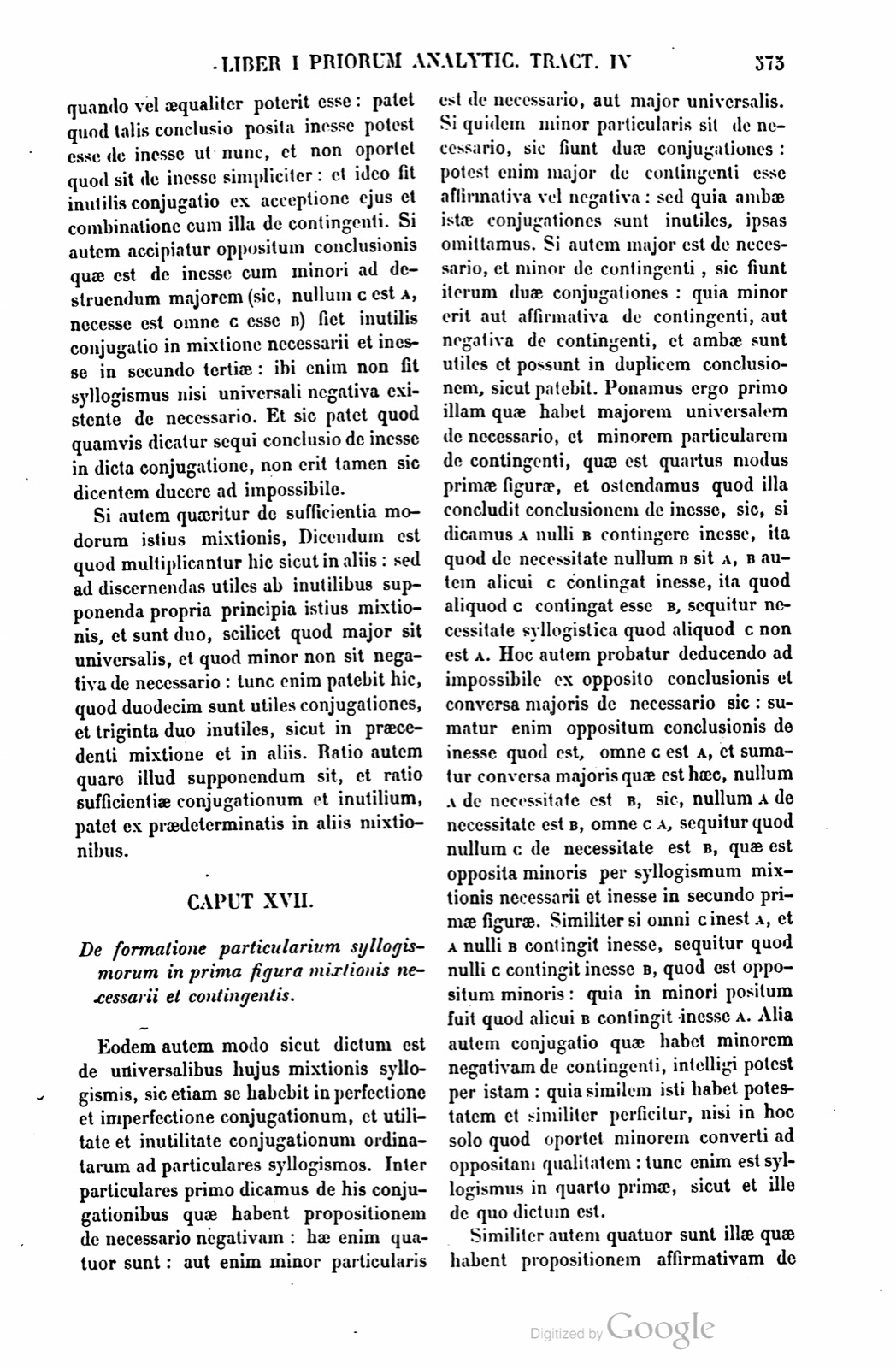
Adhuc autem dubitatur de hoc quod dictum est, quod scilicet minorem de contingenti affirmativam non sequitur conclusio de inesse: et si aliquis dicat quod sequitur, non contingit illum ducere ad impossibile, cum tamen dicat falsum. Sed ad hoc dicendum quod bene potest improbari falsum quod dictum est ex concessis: tamen non est ducere illud ad impossibile: quia si accipiatur conclusio de inesse quam dicit sequi, et combinetur cum majori propositione ad destruendam minorem, sic, contingit nullum B esse A, nullum C est B, fit inutilis conjugatio in mixtione contingentis et inesse in secundo figurae primae: in illa enim non fit syllogismus nisi universalis affirmativa sit de inesse simpliciter: hoc autem modo non est hic, quod patet: quia ex quo contingens quod sequitur in modo perfecto istius mixtionis est contingens primo in hoc tractatu determinatum, quod scilicet est contingens infinitum, quod aliquando vel aequaliter poterit esse: patet quod talis conclusio posita inesse potest esse de inesse ut nunc, et non oportet quod sit de inesse simpliciter: et ideo fit inutilis conjugatio ex acceptione ejus et combinatione cum illa de contingenti. Si autem accipiatur oppositum conclusionis quae est de inesse cum minori ad destruendum majorem, sic, nullum C est A, necesse est omne C esse B, fiet inutilis conjugatio in mixtione necessarii et inesse in secundo tertiae: ibi enim non fit syllogismus nisi universali negativa existente de necessario. Et sic patet quod quamvis dicatur sequi conclusio de inesse in dicta conjugatione, non erit tamen sic dicentem ducere ad impossibile.
Si autem quaeritur de sufficientia modorum istius mixtionis, dicendum est quod multiplicantur hic sicut in aliis: sed ad discernendas utiles ab inutilibus supponenda propria principia istius mixtionis, et sunt duo, scilicet quod major sit universalis, et quod minor non sit negativa de necessario: tunc enim patebit hic, quod duodecim sunt utiles conjugationes, et triginta duo inutiles, sicut in praecedenti mixtione et in aliis. Ratio autem quare illud supponendum sit, et ratio sufficientiae conjugationum et inutilium, patet ex praedeterminatis in aliis mixtionibus.
Again there is a doubt about what has been said, namely that the affirmative minor about the contingent is not followed by a conclusion of inherence; and if someone says that it follows, it is not possible to lead him to an impossible conclusion, although he says something false. But to this one must say that the false thing which has been said can indeed be disproved from things conceded; nevertheless there is no leading it to the impossible. For if the conclusion of inherence which he says follows is accepted and is combined with the major proposition in order to destroy the minor, thus, it contingently belongs to no B to be A; no C is B, a useless conjugation is made in the mixing of the contingent and inherence in the second mode of the first figure. For in that mode there is no syllogism unless the universal affirmative is of inherence simply; but this is not the case here, as is clear, because since the contingent which follows in the perfect mode of this mixing is the contingent first determined in this treatise, namely the infinite contingent, which sometimes or equally will be able to be, it is clear that such a conclusion posited as inhering can be of inherence as now, and need not be of inherence simply. And therefore a useless conjugation is made from its acceptance and combination with that proposition of the contingent. But if the opposite of the conclusion which is of inherence is accepted with the minor in order to destroy the major, thus, no C is A; necessarily every C is B, a useless conjugation will be made in the mixing of necessity and inherence in the second of the third figure; for there a syllogism is not made unless the universal negative is about the necessary. And thus it is clear that, although a conclusion of inherence is said to follow in the aforesaid conjugation, nevertheless one saying this will not be led to the impossible.
But if the sufficiency of the modes of this mixing is asked about, one must say that they are multiplied here as in others. But for discerning the useful from the useless, the proper principles of this mixing must be supposed, and they are two, namely that the major be universal and that the minor not be negative about the necessary. For then it will be clear here that there are twelve useful conjugations and thirty-two useless ones, as in the preceding mixing and in the others. But the reason why that must be supposed, and the reason for the sufficiency of the conjugations and of the useless ones, are clear from the things predetermined in the other mixings.
Notes
- Note, therefore, why, when the major is affirmative about the necessary and the minor about the contingent, a conclusion of inherence does not follow, but it does follow when the major is negative about the necessary. For negation extends itself even to non-beings; the sign of this is that it is commonly said that an infinite name is said indifferently of being and non-being, as is clear in book I of On Interpretation, but affirmation does not extend itself to those things. P. J. (Nota ergo quare majori existente affirmativa de necessario et minori de contingenti non sequitur conclusio de inesse, sed bene quando major est negativa de necessario. Negatio enim se extendit etiam ad non entia: cujus signum, quia communiter dicitur quod nomen infinitum dicitur de ente et non ente indifferenter, ut patet I Periherm., non autem affirmatio se extendit ad illa. P. J.) ↩
If a page does not appear, its photograph has not been uploaded yet.