Works › Prior Analytics, Books I–II
Volume 1 · pp. 568–571
Chapter XV. On the solution of doubts which concern the imperfect conjugations of this mixing.
A marker with ≈ is an approximate page boundary, placed by measure of the text; the page photographs remain the authority. In the paired views, clicking a page marker brings that page into view.
CAPUT XV. De solutione dubitationum quae sunt circa conjugationes imperfectas istius mixtionis.
Circa conjugationes etiam imperfectas universalium syllogismorum istius mixtionis multi dubitaverunt. De his enim dictum est, quod quae habent majorem negativam de necessario et minorem affirmativam de contingenti, possunt concludere conclusionem de inesse. Contra hoc autem quidam objiciunt: in mixtione contingentis et inesse majori existente negativa de inesse, et minori de contingenti, non potest, ut videtur, conclusio sequi de inesse. Hoc enim videtur hac ratione cum major sit convenientia illius de inesse ad illam de inesse quam illius de necessario ad illam de inesse. Si ergo illa de necessario potest in conclusionem de inesse quando conjungitur cum illa de contingenti, multo fortius illa de inesse cum alia de contingenti potest in talem quae est inesse conclusionem.
Adhuc in mixtione contingentis et inesse quando major est de inesse, ipsa major est de inesse simpliciter: propter quod secundum rem virtutem habet propositionis de necessario: propter quod videtur quod si negativa de necessario poterit in conclusionem de inesse, quod et negativa de inesse in mixtione contingentis et inesse possit in conclusionem de inesse.
Adhuc formetur sic syllogismus: nullum B est A, contingit omne C esse B, ergo nullum C est A. Si non sequitur, detur oppositum, hoc scilicet, aliquod C est A, quae accipiatur cum minori posita inesse, sequitur oppositum majoris, sic, aliquod C est A, omne C est B, ergo aliquod B est A per tertium modum tertiae figurae: nullum autem B esse A, et aliquod B esse A sunt opposita contradictorie1.
Ulterius autem videtur quod majori existente negativa de necessario, non sequitur conclusio de inesse: quod patet in terminis, sic, de necessitate nullum album est nigrum: contingit omnem hominem esse album: non tamen sequitur quod nullus homo sit niger, nisi hoc ita esse ponatur. Patet autem quod praemissae sunt verae, et conclusio est falsa. Similiter autem est hic, de necessitate nullus lapis est homo: contingit omne motum esse lapidem: non tamen sequitur quod nullum motum sit homo, rebus se habentibus ut nunc, ita quod per positionem non accipiatur nullum movens esse hominem.
Adhuc autem ulterius objicitur: quia si ex tali conjugatione sequitur conclusio de inesse: aut ergo sequitur conclusio de inesse simpliciter tantum, aut de inesse ut nunc tantum, quia inesse non potest pluribus modis variari. Si sequitur conclusio de inesse simpliciter, patet quod non est verum: quia in terminis nuper inductis conclusio est de inesse ut nunc: et similiter est invenire in multis aliis terminis. Si autem sequitur conclusio de inesse ut nunc, videtur iterum falsum in his terminis, de necessitate nullum album est intelligentia: contingit omnem hominem esse album: ergo nullus homo intelligentia: haec enim conclusio est de inesse simpliciter. Propter quod cum neque sequatur generaliter conclusio de inesse simpliciter, neque de inesse ut nunc, non videtur quod sequatur aliqua conclusio de inesse.
CHAPTER XV. On the solution of doubts which concern the imperfect conjugations of this mixing.
Concerning the imperfect conjugations also of the universal syllogisms of this mixing, many have doubted. For concerning these it has been said that those which have the major negative about the necessary and the minor affirmative about the contingent can conclude a conclusion of inherence. But against this some object: in the mixing of the contingent and inherence, when the major is negative of inherence and the minor about the contingent, as it seems, a conclusion of inherence cannot follow. For this seems so by this reason, since there is a greater agreement of that which is of inherence with that which is of inherence than of that which is of necessity with that which is of inherence. Therefore if that which is of necessity can proceed into a conclusion of inherence when it is joined with that which is of the contingent, much more can that which is of inherence, together with another proposition of the contingent, proceed into such a conclusion as is of inherence.
Again, in the mixing of the contingent and inherence, when the major is of inherence, that major itself is of inherence simply. On account of this, according to the thing it has the power of a proposition of necessity. On account of this, it seems that if a negative proposition of necessity can proceed into a conclusion of inherence, then also a negative proposition of inherence in the mixing of the contingent and inherence can proceed into a conclusion of inherence.
Again, let the syllogism be formed thus: no B is A; every C contingently is B; therefore no C is A. If it does not follow, let the opposite be given, namely this: some C is A. Let this be accepted with the minor posited as inhering. The opposite of the major follows thus: some C is A; every C is B; therefore some B is A, by the third mode of the third figure. But no B being A and some B being A are contradictorily opposed1.
Further, it seems that, when the major is negative about the necessary, a conclusion of inherence does not follow. This is clear in terms thus: of necessity no white thing is black; every man contingently is white; nevertheless it does not follow that no man is black, unless this is posited to be so. But it is clear that the premises are true and the conclusion is false. Similarly it is so here: of necessity no stone is a man; every moved thing contingently is a stone; nevertheless it does not follow that no moved thing is a man, the things having themselves as now, in such a way that by the positing it is not accepted that no moving thing is a man.
Again, still further it is objected: because if from such a conjugation a conclusion of inherence follows, then either only a conclusion of inherence simply follows, or only one of inherence as now, because inherence cannot be varied in more modes. If a conclusion of inherence simply follows, it is clear that this is not true, because in the terms recently introduced the conclusion is of inherence as now; and likewise this is found in many other terms. But if a conclusion of inherence as now follows, it again seems false in these terms: of necessity no white thing is an intelligence; every man contingently is white; therefore no man is an intelligence. For this conclusion is of inherence simply. Therefore, since neither a conclusion of inherence simply nor one of inherence as now follows generally, it does not seem that any conclusion of inherence follows.
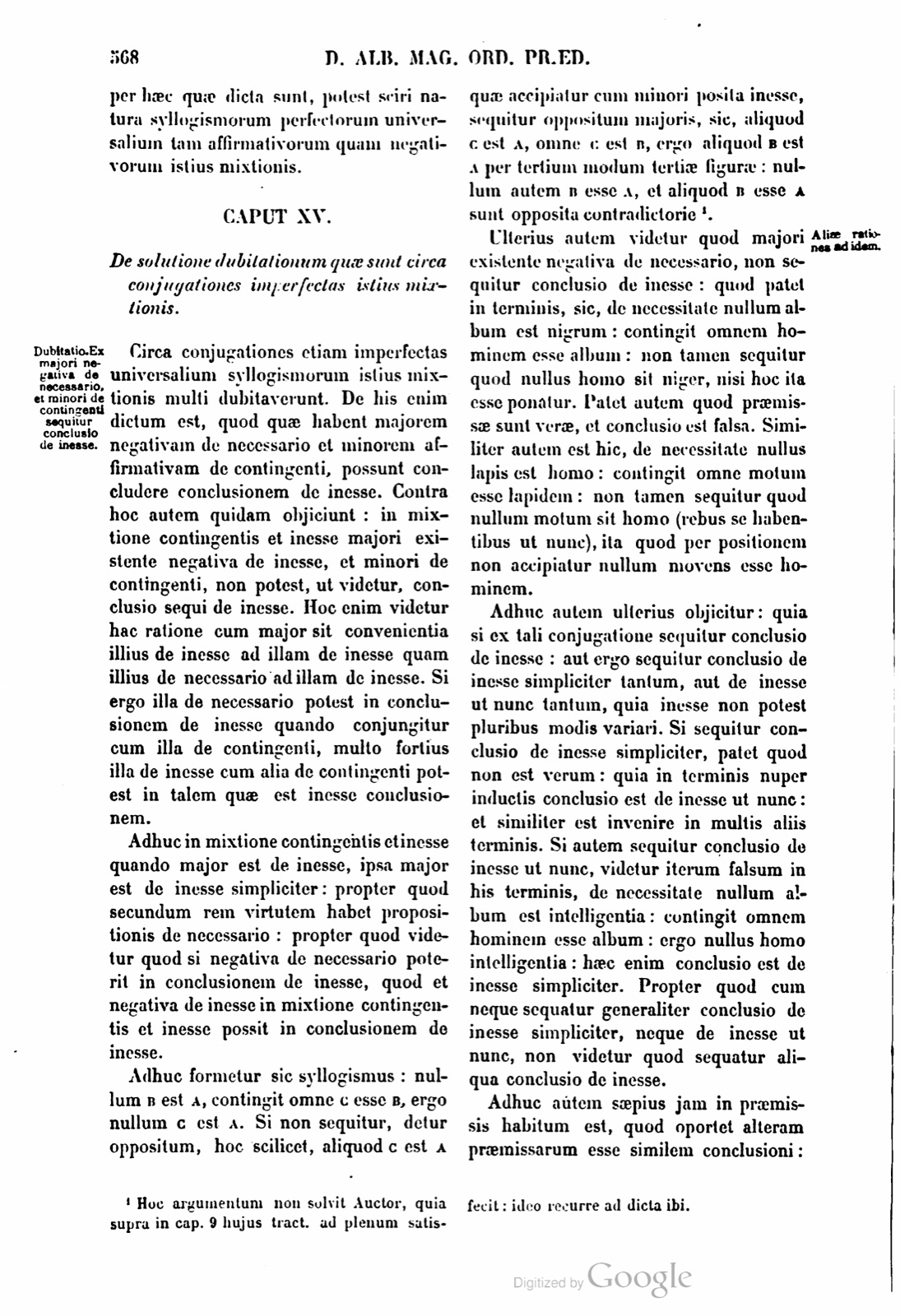
Adhuc autem saepius jam in praemissis habitum est, quod oportet alteram praemissarum esse similem conclusioni: cum autem altera praemissarum est de necessario et altera de contingenti, neutra praemissarum similis est conclusioni de inesse: ergo ex tali conjugatione conclusio de inesse non sequitur.
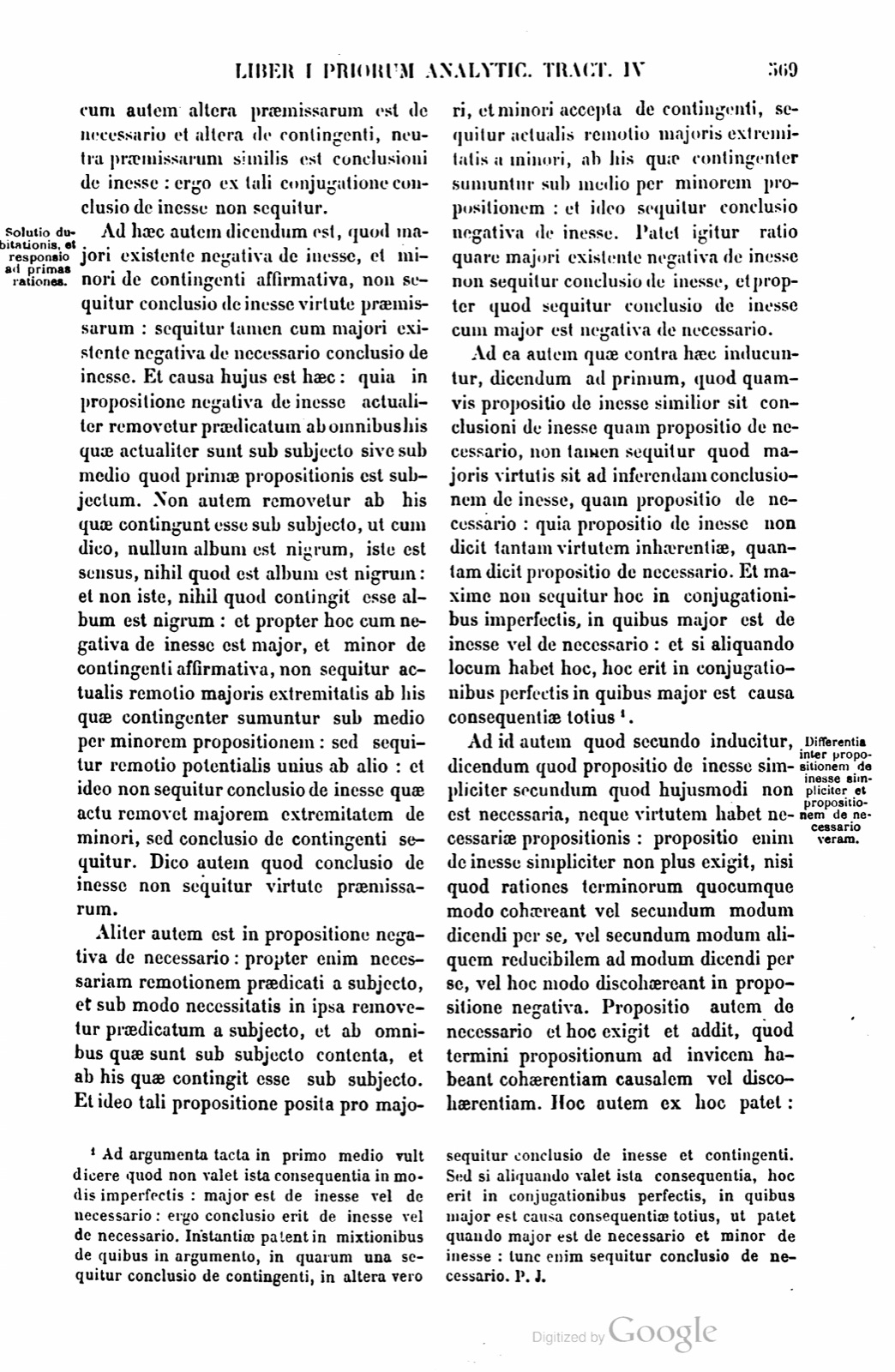
Ad haec autem dicendum est, quod majori existente negativa de inesse, et minori de contingenti affirmativa, non sequitur conclusio de inesse virtute praemissarum: sequitur tamen cum majori existente negativa de necessario conclusio de inesse. Et causa hujus est haec quia in propositione negativa de inesse actualiter removetur praedicatum ab omnibus his quae actualiter sunt sub subjecto sive sub medio quod primae propositionis est subjectum. Non autem removetur ab his quae contingunt esse sub subjecto, ut cum dico, nullum album est nigrum, iste est sensus, nihil quod est album est nigrum: et non iste, nihil quod contingit esse album est nigrum: et propter hoc cum negativa de inesse est major, et minor de contingenti affirmativa, non sequitur actualis remotio majoris extremitatis ab his quae contingenter sumuntur sub medio per minorem propositionem: sed sequitur remotio potentialis unius ab alio: et ideo non sequitur conclusio de inesse quae actu removet majorem extremitatem de minori, sed conclusio de contingenti sequitur. Dico autem quod conclusio de inesse non sequitur virtute praemissarum.
Aliter autem est in propositione negativa de necessario: propter enim necessariam remotionem praedicati a subjecto, et sub modo necessitatis in ipsa removetur praedicatum a subjecto, et ab omnibus quae sunt sub subjecto contenta, et ab his quae contingit esse sub subjecto. Et ideo tali propositione posita pro majori, et minori accepta de contingenti, sequitur actualis remotio majoris extremitatis a minori, ab his quae contingenter sumuntur sub medio per minorem propositionem: et ideo sequitur conclusio negativa de inesse. Patet igitur ratio quare majori existente negativa de inesse non sequitur conclusio de inesse, et propter quod sequitur conclusio de inesse cum major est negativa de necessario.
Ad ea autem quae contra haec inducuntur, dicendum ad primum, quod quamvis propositio de inesse similior sit conclusioni de inesse quam propositio de necessario, non tamen sequitur quod majoris virtutis sit ad inferendam conclusionem de inesse, quam propositio de necessario: quia propositio de inesse non dicit tantam virtutem inhaerentiae, quantam dicit propositio de necessario. Et maxime non sequitur hoc in conjugationibus imperfectis, in quibus major est de inesse vel de necessario: et si aliquando locum habet hoc, hoc erit in conjugationibus perfectis in quibus major est causa consequentiae totius2.
Ad id autem quod secundo inducitur, dicendum quod propositio de inesse simpliciter secundum quod hujusmodi non est necessaria, neque virtutem habet necessariae propositionis: propositio enim de inesse simpliciter non plus exigit, nisi quod rationes terminorum quocumque modo cohaereant vel secundum modum dicendi per se, vel secundum modum aliquem reducibilem ad modum dicendi per se, vel hoc modo discohaereant in propositione negativa. Propositio autem de necessario et hoc exigit et addit, quod termini propositionum ad invicem habeant cohaerentiam causalem vel discohaerentiam. Hoc autem ex hoc patet: quia quando contingens natum ponitur inesse, est propositio de inesse per se: non tamen est necessaria, nec potest modificari per modum necessitatis: et ideo non sequitur quod si propositio de necessario potest in conclusionem de inesse simpliciter, quod propositio de inesse simpliciter possit etiam in conclusionem de inesse: quia propositio de inesse simpliciter non totam habet virtutem illius quae est de necessario.
Again, it has already often been held in the preceding matters that one of the premises must be similar to the conclusion. But when one premise is about the necessary and the other about the contingent, neither premise is similar to a conclusion of inherence. Therefore from such a conjugation a conclusion of inherence does not follow.
But to these things one must say that, when the major is negative of inherence and the minor affirmative of the contingent, a conclusion of inherence does not follow by the power of the premises. Nevertheless, when the major is negative about the necessary, a conclusion of inherence follows. And the cause of this is this: because in a negative proposition of inherence the predicate is actually removed from all those things which are actually under the subject or under the middle which is the subject of the first proposition. But it is not removed from those things which contingently are under the subject, as when I say, no white thing is black, the sense is this: nothing which is white is black; and not this: nothing which contingently is white is black. And on account of this, when a negative of inherence is the major and the minor is affirmative of the contingent, an actual removal of the greater extreme from those things which are contingently taken under the middle through the minor proposition does not follow; rather, the potential removal of one thing from another follows. And therefore a conclusion of inherence does not follow, which actually removes the greater extreme from the minor, but a conclusion about the contingent follows. But I say that a conclusion of inherence does not follow by the power of the premises.
It is otherwise in a negative proposition of necessity. For on account of the necessary removal of the predicate from the subject, and under the mode of necessity, in that proposition the predicate is removed from the subject, and from all things contained under the subject, and from those things which contingently are under the subject. And therefore, when such a proposition has been posited for the major and the minor has been accepted about the contingent, there follows the actual removal of the greater extreme from the minor, from those things which are contingently taken under the middle through the minor proposition; and therefore a negative conclusion of inherence follows. Therefore the reason is clear why, when the major is negative of inherence, a conclusion of inherence does not follow, and on account of what it follows that a conclusion of inherence follows when the major is negative about the necessary.
To those things which are brought forward against these points, one must say to the first that, although a proposition of inherence is more similar to a conclusion of inherence than a proposition of necessity is, nevertheless it does not follow that it is of greater power for inferring a conclusion of inherence than a proposition of necessity is, because a proposition of inherence does not express as much power of inherence as a proposition of necessity expresses. And this especially does not follow in imperfect conjugations, in which the major is of inherence or of necessity; and if this ever has place, it will be in perfect conjugations in which the major is the cause of the consequence of the whole2.
But to that which is introduced second, one must say that a proposition of inherence simply, as such, is not necessary and does not have the power of a necessary proposition. For a proposition of inherence simply requires no more than that the accounts of the terms cohere in some way, either according to a mode of being said through itself, or according to some mode reducible to a mode of being said through itself, or that in this way they do not cohere in a negative proposition. But a proposition of necessity both requires this and adds that the terms of the propositions have causal coherence or lack of coherence with one another. But this is clear from this: when the natural contingent is posited as inhering, there is a proposition of inherence through itself; nevertheless it is not necessary, nor can it be modified by the mode of necessity. And therefore it does not follow that, if a proposition of necessity can proceed into a conclusion of inherence simply, a proposition of inherence simply can also proceed into a conclusion of inherence, because a proposition of inherence simply does not have the whole power of that which is of necessity.
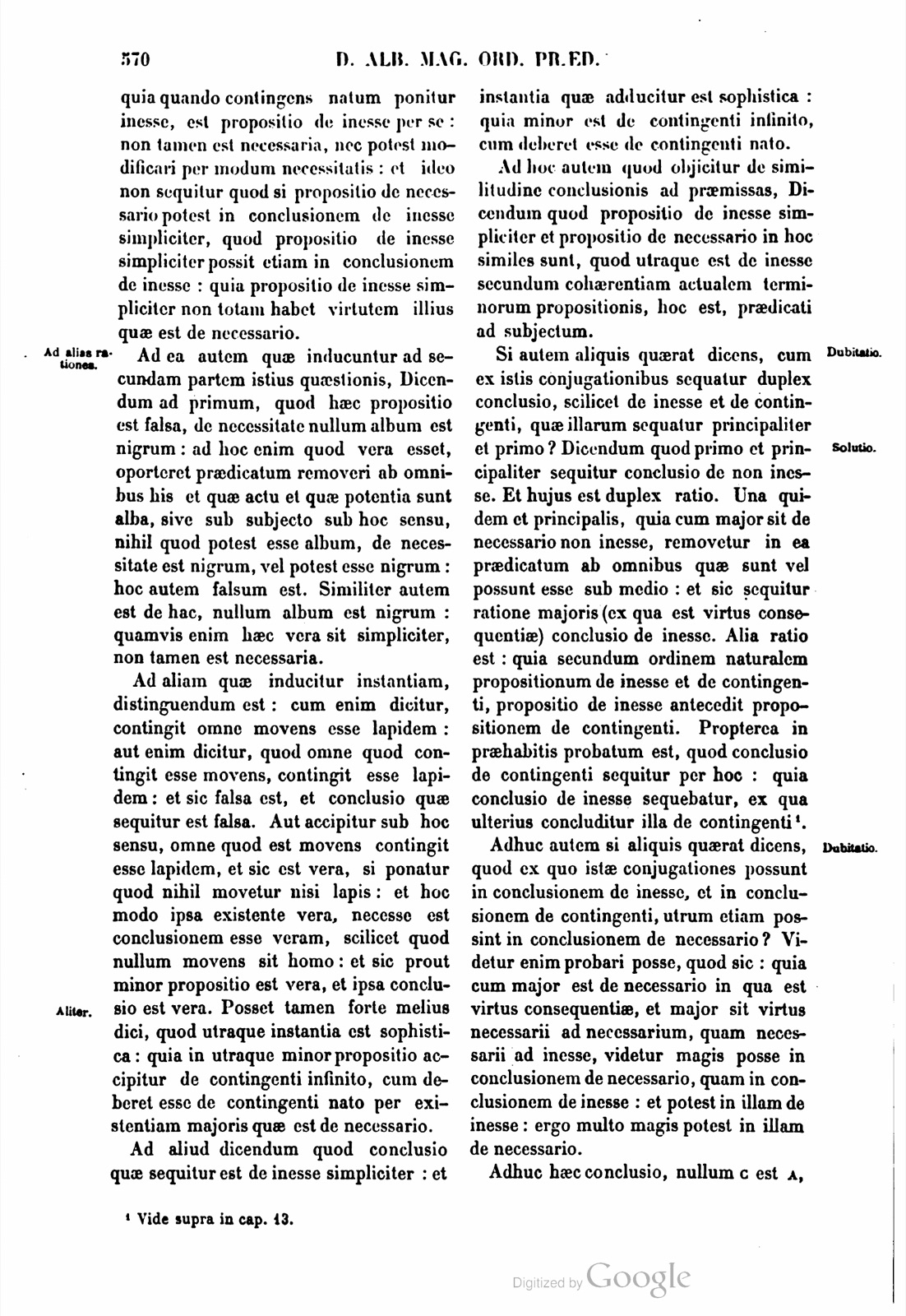
Ad ea autem quae inducuntur ad secundam partem istius quaestionis, dicendum ad primum, quod haec propositio est falsa, de necessitate nullum album est nigrum: ad hoc enim quod vera esset, oporteret praedicatum removeri ab omnibus his et quae actu et quae potentia sunt alba, sive sub subjecto sub hoc sensu, nihil quod potest esse album, de necessitate est nigrum, vel potest esse nigrum: hoc autem falsum est. Similiter autem est de hac, nullum album est nigrum: quamvis enim haec vera sit simpliciter, non tamen est necessaria.
Ad aliam quae inducitur instantiam, distinguendum est: cum enim dicitur, contingit omne movens esse lapidem: aut enim dicitur, quod omne quod contingit esse movens, contingit esse lapidem: et sic falsa est, et conclusio quae sequitur est falsa. Aut accipitur sub hoc sensu, omne quod est movens contingit esse lapidem, et sic est vera, si ponatur quod nihil movetur nisi lapis: et hoc modo ipsa existente vera, necesse est conclusionem esse veram, scilicet quod nullum movens sit homo: et sic prout minor propositio est vera, et ipsa conclusio est vera. Posset tamen forte melius dici, quod utraque instantia est sophistica: quia in utraque minor propositio accipitur de contingenti infinito, cum deberet esse de contingenti nato per existentiam majoris quae est de necessario.
Ad aliud dicendum quod conclusio quae sequitur est de inesse simpliciter: et instantia quae adducitur est sophistica: quia minor est de contingenti infinito, cum deberet esse de contingenti nato.
Ad hoc autem quod objicitur de similitudine conclusionis ad praemissas, dicendum quod propositio de inesse simpliciter et propositio de necessario in hoc similes sunt, quod utraque est de inesse secundum cohaerentiam actualem terminorum propositionis, hoc est, praedicati ad subjectum.
Si autem aliquis quaerat dicens, cum ex istis conjugationibus sequatur duplex conclusio, scilicet de inesse et de contingenti, quae illarum sequatur principaliter et primo? Dicendum quod primo et principaliter sequitur conclusio de non inesse. Et hujus est duplex ratio. Una quidem et principalis, quia cum major sit de necessario non inesse, removetur in ea praedicatum ab omnibus quae sunt vel possunt esse sub medio: et sic sequitur ratione majoris, ex qua est virtus consequentiae, conclusio de inesse. Alia ratio est: quia secundum ordinem naturalem propositionum de inesse et de contingenti, propositio de inesse antecedit propositionem de contingenti. Propterea in praehabitis probatum est, quod conclusio de contingenti sequitur per hoc: quia conclusio de inesse sequebatur, ex qua ulterius concluditur illa de contingenti3.
To those things which are introduced toward the second part of this question, one must say to the first that this proposition is false: of necessity no white thing is black. For in order that it be true, the predicate would have to be removed from all those things which are white both actually and potentially, or under the subject under this sense: nothing which can be white is, of necessity, black, or can be black. But this is false. Likewise it is so concerning this: no white thing is black; for although this is true simply, nevertheless it is not necessary.
To the other instance which is introduced, one must distinguish. For when it is said, every moving thing contingently is a stone, either it is said that everything which contingently is moving contingently is a stone, and thus it is false, and the conclusion which follows is false; or it is accepted under this sense: everything which is moving contingently is a stone, and thus it is true, if it is posited that nothing is moved except a stone. And in this way, when it is true, it is necessary that the conclusion be true, namely that no moving thing is a man; and thus, insofar as the minor proposition is true, the conclusion itself is true. Yet perhaps it could be said better that both instances are sophistical, because in each the minor proposition is accepted about the infinite contingent, when it ought to be about the natural contingent through the existence of the major which is about the necessary.
To the other point one must say that the conclusion which follows is of inherence simply; and the instance which is brought forward is sophistical, because the minor is about the infinite contingent, when it ought to be about the natural contingent.
But to that which is objected about the likeness of the conclusion to the premises, one must say that a proposition of inherence simply and a proposition of necessity are similar in this, that each is about inherence according to the actual coherence of the terms of the proposition, that is, of the predicate with the subject.
But if someone asks, saying that since from these conjugations a twofold conclusion follows, namely of inherence and about the contingent, which of them follows principally and first, one must say that first and principally a conclusion of non-inherence follows. And for this there is a twofold reason. One, indeed the principal one, is that since the major is about necessary non-inherence, in it the predicate is removed from all things which are or can be under the middle; and thus by reason of the major, from which comes the power of the consequence, a conclusion of inherence follows. The other reason is that, according to the natural order of propositions of inherence and of the contingent, a proposition of inherence precedes a proposition of the contingent. Therefore in the preceding matters it was proved that a conclusion about the contingent follows through this, that a conclusion of inherence followed, from which that proposition about the contingent is further concluded3.
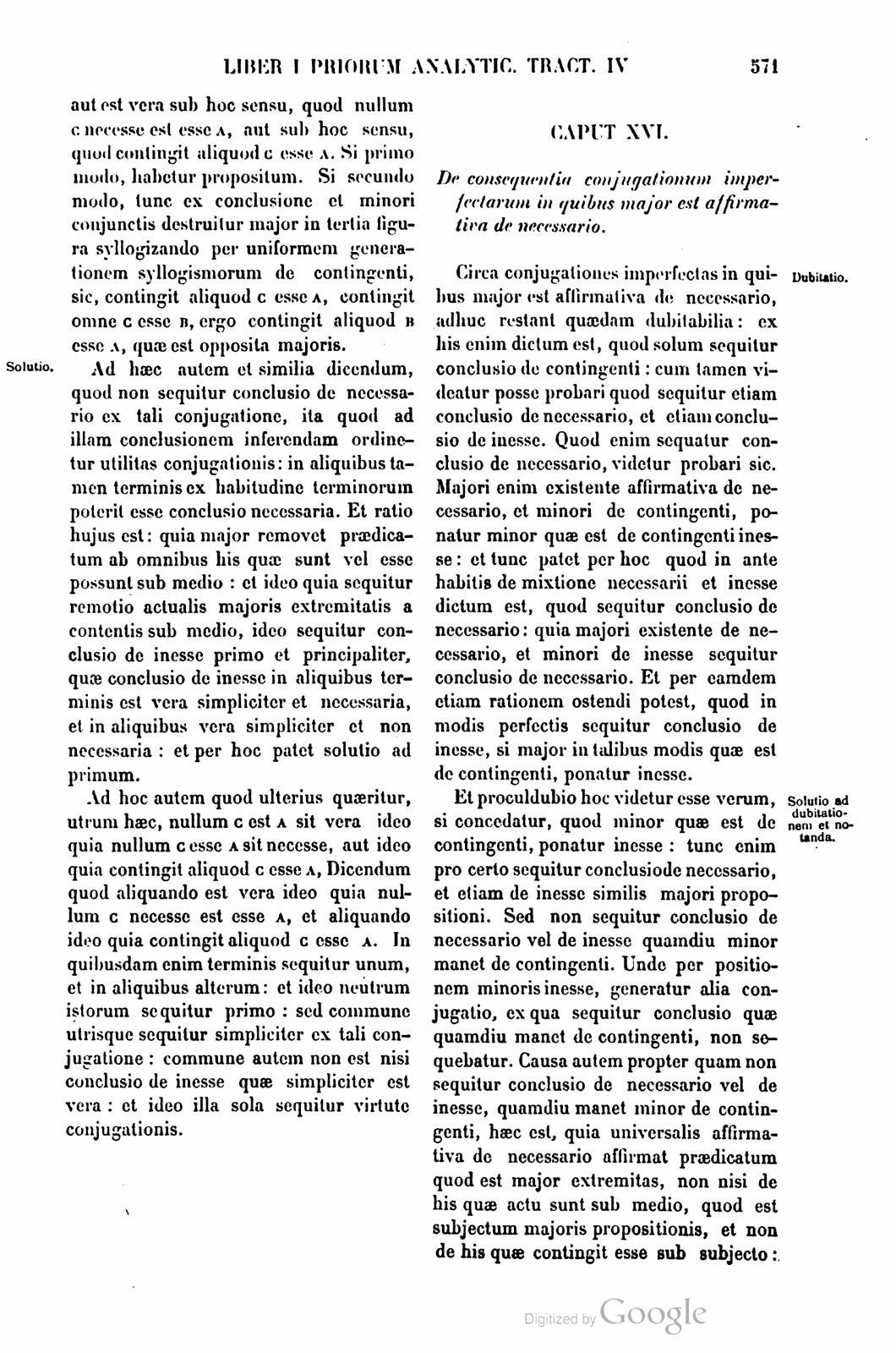
Adhuc autem si aliquis quaerat dicens, quod ex quo istae conjugationes possunt in conclusionem de inesse, et in conclusionem de contingenti, utrum etiam possint in conclusionem de necessario? Videtur enim probari posse, quod sic: quia cum major est de necessario in qua est virtus consequentiae, et major sit virtus necessarii ad necessarium, quam necessarii ad inesse, videtur magis posse in conclusionem de necessario, quam in conclusionem de inesse: et potest in illam de inesse: ergo multo magis potest in illam de necessario.
Adhuc haec conclusio, nullum C est A, aut est vera sub hoc sensu, quod nullum C necesse est esse A, aut sub hoc sensu, quod contingit aliquod C esse A. Si primo modo, habetur propositum. Si secundo modo, tunc ex conclusione et minori conjunctis destruitur major in tertia figura syllogizando per uniformem generationem syllogismorum de contingenti, sic, contingit aliquod C esse A, contingit omne C esse B, ergo contingit aliquod B esse A, quae est opposita majoris.
Ad haec autem et similia dicendum, quod non sequitur conclusio de necessario ex tali conjugatione, ita quod ad illam conclusionem inferendam ordinetur utilitas conjugationis: in aliquibus tamen terminis ex habitudine terminorum poterit esse conclusio necessaria. Et ratio hujus est: quia major removet praedicatum ab omnibus his quae sunt vel esse possunt sub medio: et ideo quia sequitur remotio actualis majoris extremitatis a contentis sub medio, ideo sequitur conclusio de inesse primo et principaliter, quae conclusio de inesse in aliquibus terminis est vera simpliciter et necessaria, et in aliquibus vera simpliciter et non necessaria: et per hoc patet solutio ad primum.
Ad hoc autem quod ulterius quaeritur, utrum haec, nullum C est A sit vera ideo quia nullum C esse A sit necesse, aut ideo quia contingit aliquod C esse A, dicendum quod aliquando est vera ideo quia nullum C necesse est esse A, et aliquando ideo quia contingit aliquod C esse A. In quibusdam enim terminis sequitur unum, et in aliquibus alterum: et ideo neutrum istorum sequitur primo: sed commune utrisque sequitur simpliciter ex tali conjugatione: commune autem non est nisi conclusio de inesse quae simpliciter est vera: et ideo illa sola sequitur virtute conjugationis.
Again, if someone asks, saying that since these conjugations can proceed into a conclusion of inherence and into a conclusion about the contingent, whether they can also proceed into a conclusion of necessity, for it seems that it can be proved that they can: because when the major is about the necessary, in which is the power of the consequence, and the power of the necessary toward the necessary is greater than that of the necessary toward inherence, it seems more able to proceed into a conclusion of necessity than into a conclusion of inherence; and it can proceed into that of inherence; therefore much more can it proceed into that of necessity.
Again this conclusion, no C is A, either is true under this sense, that no C must be A, or under this sense, that some C contingently is A. If in the first way, the proposed point is had. If in the second way, then from the conclusion and the minor joined together the major is destroyed in the third figure by syllogizing through the uniform generation of syllogisms about the contingent, thus: some C contingently is A; every C contingently is B; therefore some B contingently is A, which is the opposite of the major.
But to these and similar things one must say that a conclusion of necessity does not follow from such a conjugation in such a way that the usefulness of the conjugation is ordered to inferring that conclusion. Nevertheless, in some terms, from the relation of the terms, there will be able to be a necessary conclusion. And the reason for this is that the major removes the predicate from all those things which are or can be under the middle; and therefore, because the actual removal of the greater extreme from the things contained under the middle follows, a conclusion of inherence follows first and principally, which conclusion of inherence in some terms is true simply and necessary, and in some true simply and not necessary. And through this the solution to the first is clear.
But to that which is further asked, whether this proposition, no C is A, is true because it is necessary that no C be A, or because some C contingently is A, one must say that sometimes it is true because no C must be A, and sometimes because some C contingently is A. For in certain terms one follows, and in others the other. And therefore neither of these follows first; but what is common to both follows simply from such a conjugation. But the common element is nothing except a conclusion of inherence which is true simply; and therefore that alone follows by the power of the conjugation.
Notes
- The Author does not solve this argument, because above in chapter 9 of this treatise he satisfied it fully; therefore return to the things said there. (Hoc argumentum non solvit Auctor, quia supra in cap. 9 hujus tract. ad plenum satisfecit: ideo recurre ad dicta ibi.) ↩
- To the arguments touched on in the first middle, he means to say that this consequence is not valid in imperfect modes: the major is of inherence or of necessity; therefore the conclusion will be of inherence or of necessity. Instances are clear in the mixings about which the argument is concerned, in one of which a conclusion about the contingent follows, but in the other a conclusion of inherence and about the contingent follows. But if this consequence is ever valid, it will be in perfect conjugations, in which the major is the cause of the consequence of the whole, as is clear when the major is about the necessary and the minor about inherence; for then a conclusion of necessity follows. P. J. (Ad argumenta tacta in primo medio vult dicere quod non valet ista consequentia in modis imperfectis: major est de inesse vel de necessario: ergo conclusio erit de inesse vel de necessario. Instantiae patent in mixtionibus de quibus in argumento, in quarum una sequitur conclusio de contingenti, in altera vero sequitur conclusio de inesse et contingenti. Sed si aliquando valet ista consequentia, hoc erit in conjugationibus perfectis, in quibus major est causa consequentiae totius, ut patet quando major est de necessario et minor de inesse: tunc enim sequitur conclusio de necessario. P. J.) ↩
- See above in chapter 13. (Vide supra in cap. 13.) ↩
If a page does not appear, its photograph has not been uploaded yet.