Works › Prior Analytics, Books I–II
Volume 1 · pp. 575–577
Chapter XVII. On the formation of particular syllogisms in the first figure of the mixing of the necessary and the contingent.
A marker with ≈ is an approximate page boundary, placed by measure of the text; the page photographs remain the authority. In the paired views, clicking a page marker brings that page into view.
CAPUT XVII. De formatione particularium syllogismorum in prima figura mixtionis necessarii et contingentis.
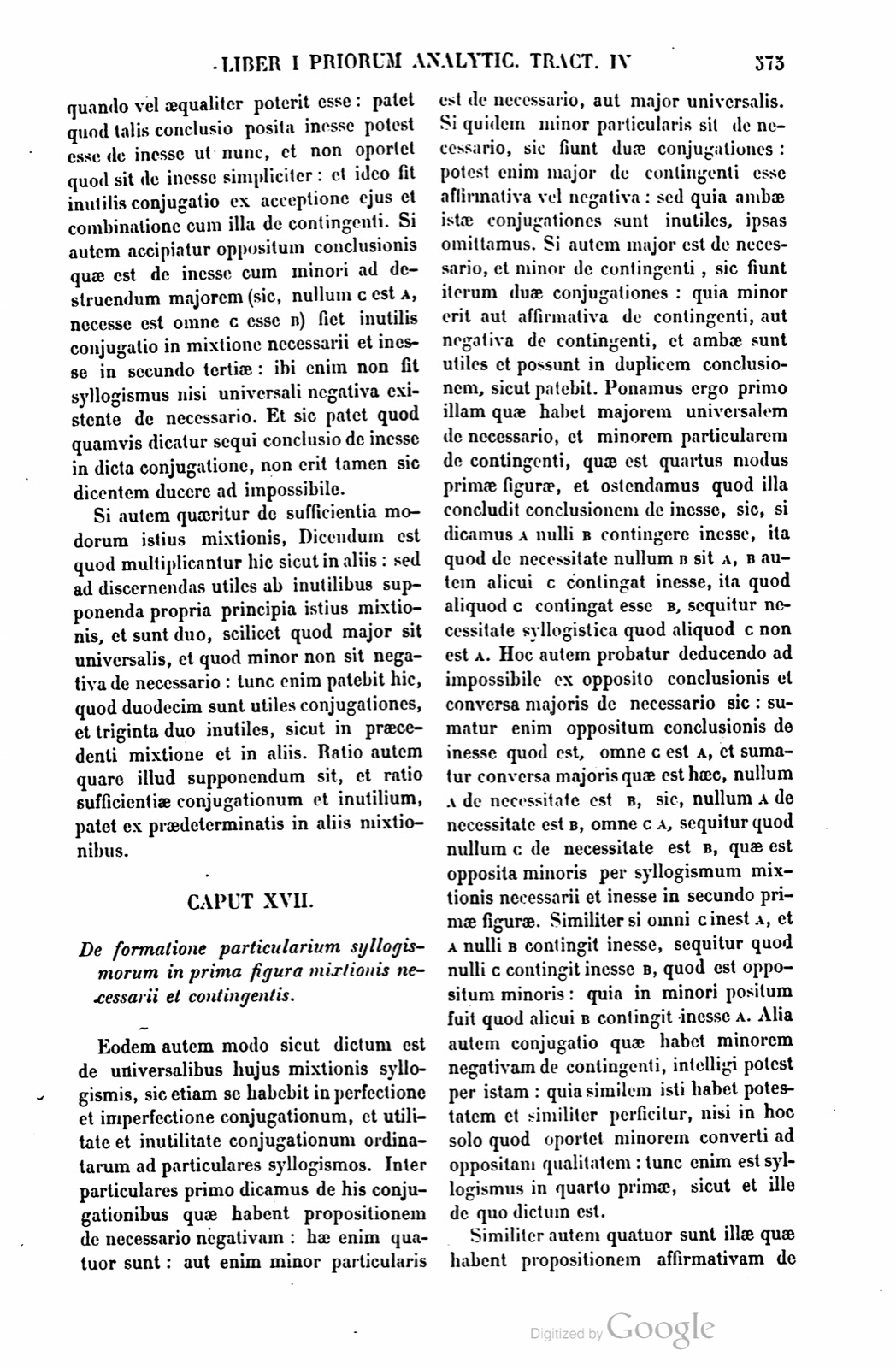
Eodem autem modo sicut dictum est de universalibus hujus mixtionis syllogismis, sic etiam se habebit in perfectione et imperfectione conjugationum, et utilitate et inutilitate conjugationum ordinatarum ad particulares syllogismos. Inter particulares primo dicamus de his conjugationibus quae habent propositionem de necessario negativam: hae enim quatuor sunt: aut enim minor particularis est de necessario, aut major universalis. Si quidem minor particularis sit de necessario, sic fiunt duae conjugationes: potest enim major de contingenti esse affirmativa vel negativa: sed quia ambae istae conjugationes sunt inutiles, ipsas omittamus. Si autem major est de necessario, et minor de contingenti, sic fiunt iterum duae conjugationes: quia minor erit aut affirmativa de contingenti, aut negativa de contingenti, et ambae sunt utiles et possunt in duplicem conclusionem, sicut patebit. Ponamus ergo primo illam quae habet majorem universalem de necessario, et minorem particularem de contingenti, quae est quartus modus primae figurae, et ostendamus quod illa concludit conclusionem de inesse, sic, si dicamus A nulli B contingere inesse, ita quod de necessitate nullum B sit A, B autem alicui C contingat inesse, ita quod aliquod C contingat esse B, sequitur necessitate syllogistica quod aliquod C non est A. Hoc autem probatur deducendo ad impossibile ex opposito conclusionis et conversa majoris de necessario sic: sumatur enim oppositum conclusionis de inesse quod est, omne C est A, et sumatur conversa majoris quae est haec, nullum A de necessitate est B, sic, nullum A de necessitate est B, omne C A, sequitur quod nullum C de necessitate est B, quae est opposita minoris per syllogismum mixtionis necessarii et inesse in secundo primae figurae. Similiter si omni C inest A, et A nulli B contingit inesse, sequitur quod nulli C contingit inesse B, quod est oppositum minoris: quia in minori positum fuit quod alicui C contingit inesse B. Alia autem conjugatio quae habet minorem negativam de contingenti, intelligi potest per istam: quia similem isti habet potestatem et similiter perficitur, nisi in hoc solo quod oportet minorem converti ad oppositam qualitatem: tunc enim est syllogismus in quarto primae, sicut et ille de quo dictum est.
Similiter autem quatuor sunt illae quae habent propositionem affirmativam de necessario. Si enim minor particularis est de necessario, fiunt duae conjugationes: si autem major et universalis, fiunt aliae duae. Variantur enim per affirmativum et negativum: et omnes istae conjugationes sunt inutiles respectu conclusionis de inesse. Et duae illarum conjugationum perfectae sunt, illae scilicet quae habent majorem de contingenti affirmativam vel negativam, et concludunt contingens secundum superius dictam determinationem, quod est contingens ad utrumlibet. Aliae autem duae sunt imperfectae, scilicet ubi minor est de contingenti affirmativa vel negativa, et concludunt contingens pro possibili. Quod autem omnes istae conjugationes inutiles sint ad conclusionem de inesse, similiter ostenditur sicut ostensum est in universalibus syllogismis. Ex quo patet quod quando particularis affirmativa de necessario est in syllogismo privativo, sicut est quartus primae, in quo minor est particularis affirmativa, quae est B C propositio, aut quando universalis affirmativa major est in syllogismo affirmativo, sicut est tertius primae, in quo A B propositio major est affirmativa, non est syllogismus concludens conclusionem de inesse et hoc eodem modo demonstratur, sicut in universalibus syllogismis in similibus conjugationibus est demonstratum.
CHAPTER XVII. On the formation of particular syllogisms in the first figure of the mixing of the necessary and the contingent.
But in the same way as it has been said about the universal syllogisms of this mixing, so also it will have itself in the perfection and imperfection of the conjugations, and in the usefulness and uselessness of conjugations ordered to particular syllogisms. Among the particular syllogisms let us first speak about those conjugations which have a negative proposition about the necessary. For these are four: either the particular minor is about the necessary, or the major is universal. If indeed the particular minor is about the necessary, in this way two conjugations are made, for the major about the contingent can be affirmative or negative; but because both of these conjugations are useless, let us omit them. But if the major is about the necessary and the minor about the contingent, in this way again two conjugations are made, because the minor will be either affirmative about the contingent or negative about the contingent, and both are useful and can proceed into a twofold conclusion, as will be clear. Therefore let us first posit the one which has the universal major about the necessary and the particular minor about the contingent, which is the fourth mode of the first figure, and let us show that it concludes a conclusion of inherence, thus: if we say that A contingently belongs to no B, in such a way that of necessity no B is A, but B contingently belongs to some C, in such a way that some C contingently is B, it follows by syllogistic necessity that some C is not A. But this is proved by leading to the impossible from the opposite of the conclusion and the converted major of necessity thus: let the opposite of the conclusion of inherence be taken, which is, every C is A, and let the converted major be taken, which is this, no A of necessity is B; thus, no A of necessity is B, every C A, it follows that no C of necessity is B, which is the opposite of the minor through a syllogism of the mixing of necessity and inherence in the second mode of the first figure. Similarly, if A inheres in every C, and A contingently belongs to no B, it follows that B contingently belongs to no C, which is the opposite of the minor, because in the minor it was posited that B contingently belongs to some C. But the other conjugation, which has the minor negative about the contingent, can be understood through this one, because it has a power similar to this one and is perfected similarly, except only in this, that the minor must be converted to the opposite quality; for then there is a syllogism in the fourth mode of the first figure, just as there is the one about which it has been spoken.
Similarly, those which have an affirmative proposition about the necessary are also four. For if the particular minor is about the necessary, two conjugations are made; but if the major, and that universal, is about the necessary, two others are made. For they are varied through affirmative and negative, and all these conjugations are useless with respect to a conclusion of inherence. And two of those conjugations are perfect, namely those which have the major about the contingent, affirmative or negative, and they conclude the contingent according to the determination said above, which is the contingent toward either alternative. But the other two are imperfect, namely where the minor is about the contingent, affirmative or negative, and they conclude the contingent for the possible. That all these conjugations are useless for a conclusion of inherence is shown similarly as it was shown in universal syllogisms. From this it is clear that when a particular affirmative of necessity is in a privative syllogism, as is the fourth of the first figure, in which the minor is the particular affirmative, which is the B C proposition, or when the universal affirmative major is in an affirmative syllogism, as is the third of the first figure, in which the A B proposition, the major, is affirmative, there is no syllogism concluding a conclusion of inherence; and this is demonstrated in the same way as it was demonstrated in universal syllogisms in similar conjugations.
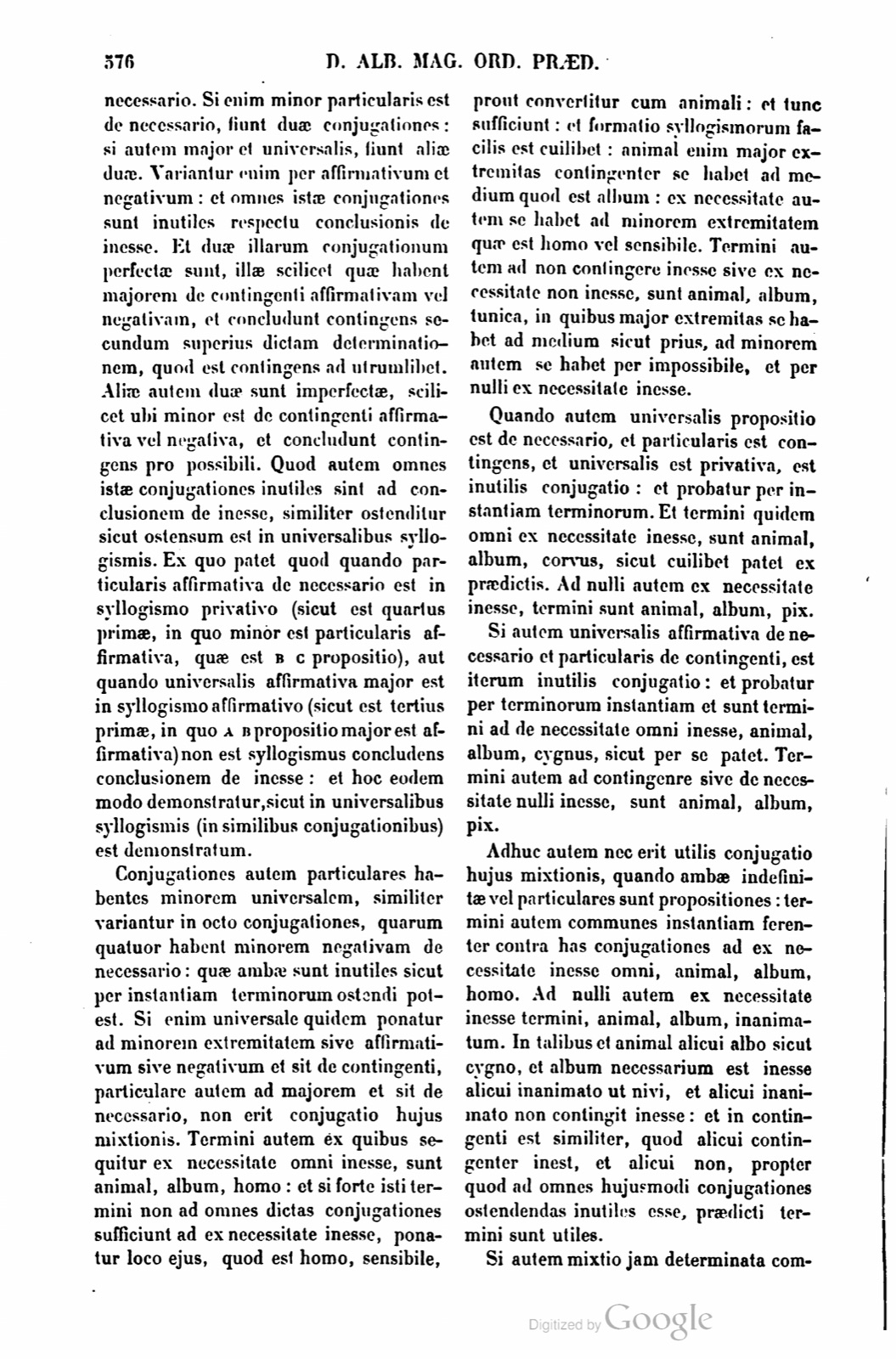
Conjugationes autem particulares habentes minorem universalem, similiter variantur in octo conjugationes, quarum quatuor habent minorem negativam de necessario: quae ambae sunt inutiles sicut per instantiam terminorum ostendi potest. Si enim universale quidem ponatur ad minorem extremitatem sive affirmativum sive negativum et sit de contingenti, particulare autem ad majorem et sit de necessario, non erit conjugatio hujus mixtionis. Termini autem ex quibus sequitur ex necessitate omni inesse, sunt animal, album, homo: et si forte isti termini non ad omnes dictas conjugationes sufficiunt ad ex necessitate inesse, ponatur loco ejus, quod est homo, sensibile, prout convertitur cum animali: et tunc sufficiunt: et formatio syllogismorum facilis est cuilibet: animal enim major extremitas contingenter se habet ad medium quod est album: ex necessitate autem se habet ad minorem extremitatem quae est homo vel sensibile. Termini autem ad non contingere inesse sive ex necessitate non inesse, sunt animal, album, tunica, in quibus major extremitas se habet ad medium sicut prius, ad minorem autem se habet per impossibile, et per nulli ex necessitate inesse.
Quando autem universalis propositio est de necessario, et particularis est contingens, et universalis est privativa, est inutilis conjugatio: et probatur per instantiam terminorum. Et termini quidem omni ex necessitate inesse, sunt animal, album, corvus, sicut cuilibet patet ex praedictis. Ad nulli autem ex necessitate inesse, termini sunt animal, album, pix.
Si autem universalis affirmativa de necessario et particularis de contingenti, est iterum inutilis conjugatio: et probatur per terminorum instantiam et sunt termini ad de necessitate omni inesse, animal, album, cygnus, sicut per se patet. Termini autem ad contingere sive de necessitate nulli inesse, sunt animal, album, pix.
But particular conjugations having the minor universal are similarly varied into eight conjugations, of which four have the minor negative about the necessary. These are both useless, as can be shown through an instance of terms. For if the universal, whether affirmative or negative, is posited at the lesser extreme and is about the contingent, but the particular at the greater and is about the necessary, there will not be a conjugation of this mixing. But the terms from which it follows that there is necessary inherence to every case are animal, white, man; and if perhaps those terms do not suffice for all the aforesaid conjugations for inhering of necessity, let sensible be posited in place of that which is man, insofar as it is converted with animal, and then they suffice. And the formation of the syllogisms is easy for anyone. For animal, the greater extreme, has itself contingently toward the middle, which is white; but it has itself of necessity toward the lesser extreme, which is man or sensible. But the terms for not contingently inhering or not inhering of necessity are animal, white, tunic; in these the greater extreme has itself toward the middle as before, but toward the lesser it has itself through the impossible and through belonging to none of necessity.
But when the universal proposition is about the necessary, and the particular is contingent, and the universal is privative, the conjugation is useless; and it is proved through an instance of terms. And the terms indeed for inhering in every case from necessity are animal, white, raven, as is clear to anyone from the preceding things. But for belonging to none from necessity, the terms are animal, white, pitch.
But if the universal affirmative is about the necessary and the particular about the contingent, the conjugation is again useless; and this is proved through an instance of terms, and the terms for inhering in every case of necessity are animal, white, swan, as is clear of itself. But the terms for contingently inhering or for belonging to none of necessity are animal, white, pitch.
Adhuc autem nec erit utilis conjugatio hujus mixtionis, quando ambae indefinitae vel particulares sunt propositiones: termini autem communes instantiam ferenter contra has conjugationes ad ex necessitate inesse omni, animal, album, homo. Ad nulli autem ex necessitate inesse termini, animal, album, inanimatum. In talibus et animal alicui albo sicut cygno, et album necessarium est inesse alicui inanimato ut nivi, et alicui inanimato non contingit inesse: et in contingenti est similiter, quod alicui contingenter inest, et alicui non, propter quod ad omnes hujusmodi conjugationes ostendendas inutiles esse, praedicti termini sunt utiles.
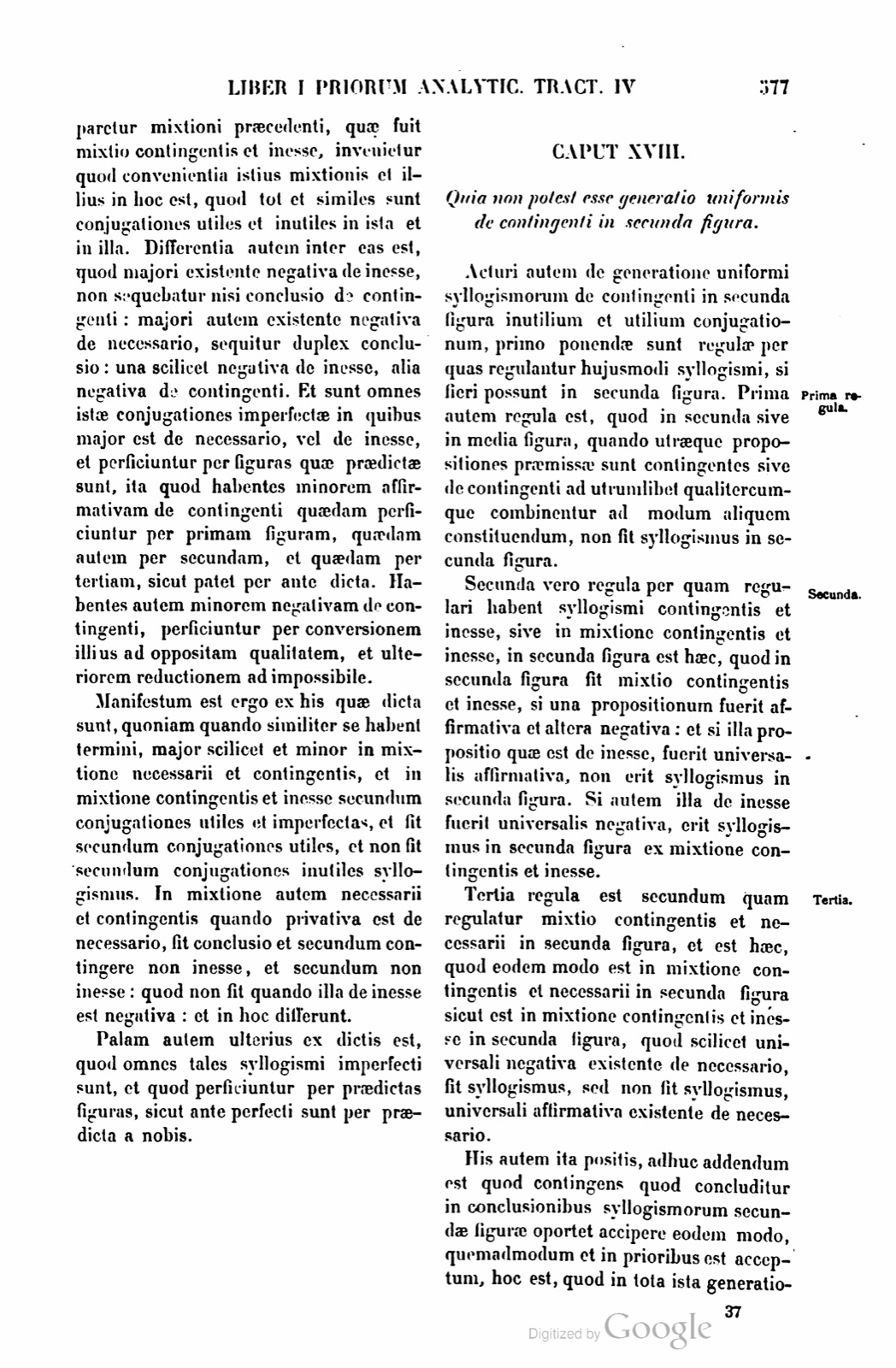
Si autem mixtio jam determinata comparetur mixtioni praecedenti, quae fuit mixtio contingentis et inesse, invenietur quod convenientia istius mixtionis et illius in hoc est, quod tot et similes sunt conjugationes utiles et inutiles in ista et in illa. Differentia autem inter eas est, quod majori existente negativa de inesse, non sequebatur nisi conclusio de contingenti: majori autem existente negativa de necessario, sequitur duplex conclusio: una scilicet negativa de inesse, alia negativa de contingenti. Et sunt omnes istae conjugationes imperfectae in quibus major est de necessario, vel de inesse, et perficiuntur per figuras quae praedictae sunt, ita quod habentes minorem affirmativam de contingenti quaedam perficiuntur per primam figuram, quaedam autem per secundam, et quaedam per tertiam, sicut patet per ante dicta. Habentes autem minorem negativam de contingenti, perficiuntur per conversionem illius ad oppositam qualitatem, et ulteriorem reductionem ad impossibile.
Manifestum est ergo ex his quae dicta sunt, quoniam quando similiter se habent termini, major scilicet et minor in mixtione necessarii et contingentis, et in mixtione contingentis et inesse secundum conjugationes utiles et imperfectas, et fit secundum conjugationes utiles, et non fit secundum conjugationes inutiles syllogismus. In mixtione autem necessarii et contingentis quando privativa est de necessario, fit conclusio et secundum contingere non inesse, et secundum non inesse: quod non fit quando illa de inesse est negativa: et in hoc differunt.
Palam autem ulterius ex dictis est, quod omnes tales syllogismi imperfecti sunt, et quod perficiuntur per praedictas figuras, sicut ante perfecti sunt per praedicta a nobis.
Again, there will be no useful conjugation of this mixing when both propositions are indefinite or particular. But the common terms bearing an instance against these conjugations for inhering in every case from necessity are animal, white, man. But for belonging to none from necessity the terms are animal, white, inanimate. In such cases animal belongs to some white thing, such as a swan, and white necessarily belongs to something inanimate, as to snow, and to some inanimate thing it does not contingently belong. And in the contingent it is similar, because it contingently belongs to some thing and not to some other. On account of this, for showing all such conjugations to be useless, the aforesaid terms are useful.
But if the mixing now determined is compared with the preceding mixing, which was the mixing of the contingent and inherence, it will be found that the agreement of this mixing and that one is in this, that there are as many and similar useful and useless conjugations in this and in that. But the difference between them is that, when the major is negative of inherence, only a conclusion about the contingent followed; but when the major is negative about the necessary, a twofold conclusion follows, namely one negative of inherence, and another negative about the contingent. And all those conjugations are imperfect in which the major is about the necessary or about inherence, and they are perfected through the figures which have been mentioned, in such a way that among those having the minor affirmative about the contingent, some are perfected through the first figure, some through the second, and some through the third, as is clear through the things said before. But those having the minor negative about the contingent are perfected through its conversion to the opposite quality and a further reduction to the impossible.
Therefore it is manifest from these things which have been said that, when the terms, namely the major and the minor, have themselves similarly in the mixing of the necessary and the contingent and in the mixing of the contingent and inherence according to useful and imperfect conjugations, a syllogism is made according to useful conjugations and is not made according to useless conjugations. But in the mixing of the necessary and the contingent, when the privative proposition is about the necessary, a conclusion is made both according to contingently not inhering and according to not inhering; this is not made when that proposition of inherence is negative; and in this they differ.
But further it is clear from the things said that all such syllogisms are imperfect, and that they are perfected through the aforesaid figures, as before they were perfected through the things aforesaid by us.
If a page does not appear, its photograph has not been uploaded yet.