Works › Prior Analytics, Books I–II
Volume 1 · pp. 567–568
Continuation of Chapter XIV on page 567
A marker with ≈ is an approximate page boundary, placed by measure of the text; the page photographs remain the authority. In the paired views, clicking a page marker brings that page into view.
Est autem adhuc dubium: cum enim in hac mixtione necessarium et contingens aequaliter se habeant ad generationem hujus syllogismi, videtur quod aequaliter debent se habere conjugationes ad generationem perfecti syllogismi, ea scilicet quae habet majorem de contingenti et minorem de necessario, et ea quae e converso habet majorem de necessario et minorem de contingenti: et hoc non est verum: quia prima est ad syllogismum perfectum, secunda autem ad syllogismum imperfectum. Rationem autem hujus non est difficile assignare: dici enim de omni in necessariis et in illis de inesse vult minorem in prima figura semper habere affirmativam et secundum actualem inhaerentiam praedicati cum subjecto. Quando ergo major est de contingenti (quod est secundum actualem inhaerentiam, sicut diximus in acceptione contingentis, sic, omne quod est B contingit esse A) et minor accipitur de necessario vel de inesse secundum actualem inhaerentiam, fit per dici de omni perfectus decursus syllogisticus a primo per medium usque ad extremum: et ideo conjugatio talis est ad syllogismum perfectum. Quando autem major est de necessario et minor de contingenti, per contingens ampliatur inhaerentia ad potentialem inhaerentiam: et tunc non potest esse decursus perfectus per dici de omni: et ideo conjugatio in qua major est de necessario et minor de contingenti, est ad syllogismum imperfectum.
Si quis autem quaerat quare in modis perfectis istius mixtionis concluditur contingens ad utrumlibet, quod est contingens secundum superius datam determinationem contingentis, modi imperfecti autem non possunt concludere nisi contingens pro possibili? Videtur enim quod tam perfecti quam imperfecti deberent concludere contingens dictum secundum unum et eumdem modum. Hujus autem causa est, quod in modo perfecto propter dici de omni minor propositio est quasi dispositio naturalis majoris propositionis: contrahit enim minor majorem secundum regulam quae est data de dici de omni: et ideo per minorem fit contractio majoris ad id quod est vera pars ejus. Et ideo cum major sit de contingenti secundum dictam contingentis determinationem, et minor sit vera pars ejus, oportet conclusionem similem esse majori, quod sit de tali de quo est major: hoc autem est contingens ad utrumlibet.
But there is still a doubt. For since in this mixing the necessary and the contingent have themselves equally for the generation of this syllogism, it seems that the conjugations ought to have themselves equally for the generation of a perfect syllogism, namely both the one which has the major about the contingent and the minor about the necessary, and the one which conversely has the major about the necessary and the minor about the contingent. And this is not true, because the first is for a perfect syllogism, but the second for an imperfect syllogism. But the reason for this is not difficult to assign. For being said of every, in necessary things and in those of inherence, requires the minor in the first figure always to be affirmative and according to an actual inherence of the predicate with the subject. Therefore, when the major is about the contingent, which is according to actual inherence, as we said in the acceptance of the contingent, thus, everything which is B contingently is A, and the minor is accepted about the necessary or about inherence according to actual inherence, a perfect syllogistic descent is made through being said of every, from the first through the middle all the way to the extreme. And therefore such a conjugation is for a perfect syllogism. But when the major is about the necessary and the minor about the contingent, through the contingent inherence is broadened to potential inherence; and then there cannot be a perfect descent through being said of every. And therefore the conjugation in which the major is about the necessary and the minor about the contingent is for an imperfect syllogism.
But if someone asks why in the perfect modes of this mixing the contingent toward either alternative is concluded, which is the contingent according to the determination of the contingent given above, whereas the imperfect modes can conclude only the contingent for the possible, for it seems that both perfect and imperfect modes ought to conclude the contingent so called according to one and the same mode, the cause of this is that in a perfect mode, on account of being said of every, the minor proposition is as it were a natural disposition of the major proposition. For the minor contracts the major according to the rule which has been given about being said of every; and therefore through the minor a contraction of the major is made to that which is a true part of it. And therefore, since the major is about the contingent according to the aforesaid determination of the contingent, and the minor is a true part of it, the conclusion must be similar to the major, so that it is about such a thing as the major is about. But this is the contingent toward either alternative.
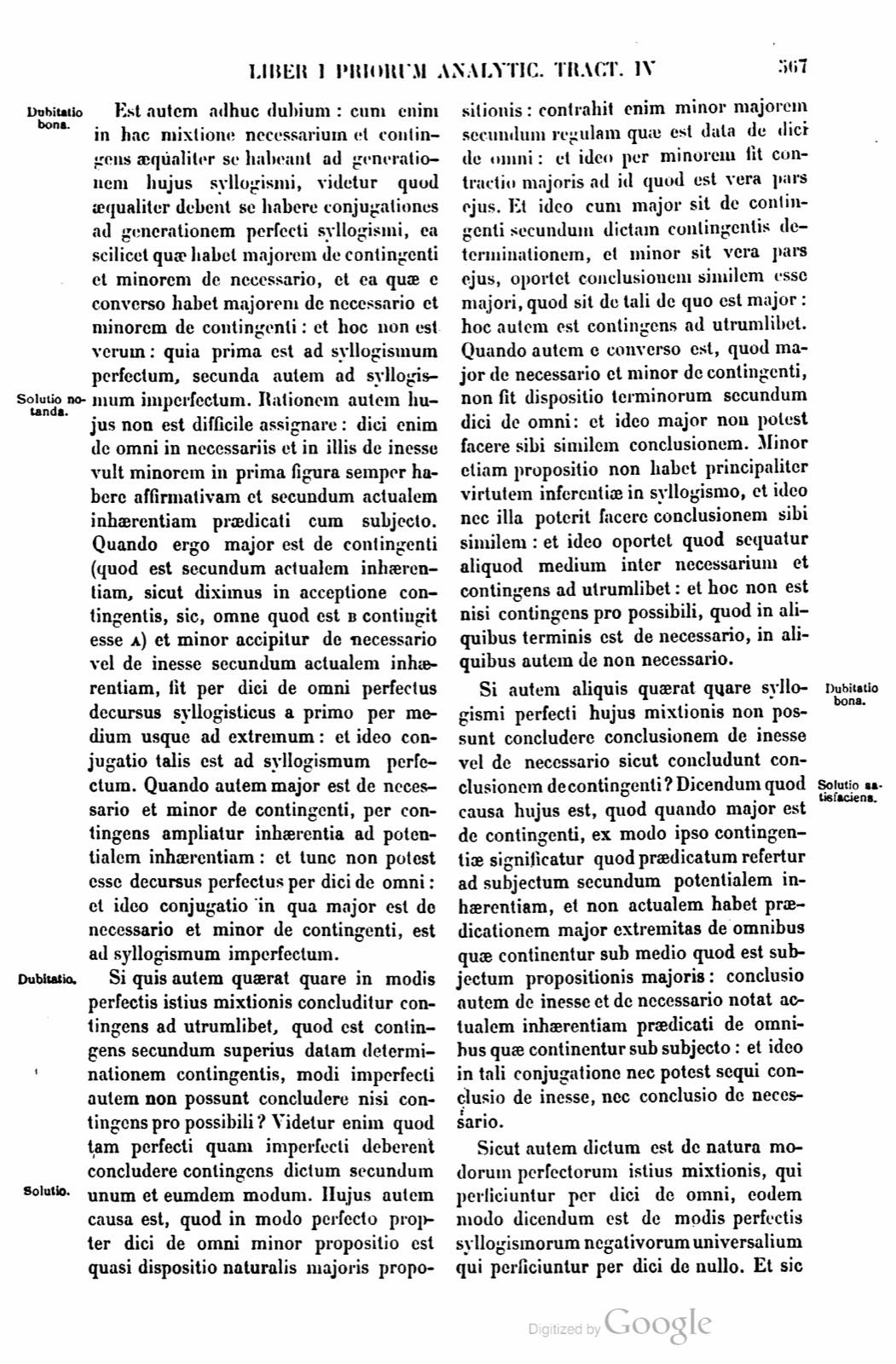
Quando autem e converso est, quod major de necessario et minor de contingenti, non fit dispositio terminorum secundum dici de omni: et ideo major non potest facere sibi similem conclusionem. Minor etiam propositio non habet principaliter virtutem inferentiae in syllogismo, et ideo nec illa poterit facere conclusionem sibi similem: et ideo oportet quod sequatur aliquod medium inter necessarium et contingens ad utrumlibet: et hoc non est nisi contingens pro possibili, quod in aliquibus terminis est de necessario, in aliquibus autem de non necessario.
Si autem aliquis quaerat quare syllogismi perfecti hujus mixtionis non possunt concludere conclusionem de inesse vel de necessario sicut concludunt conclusionem de contingenti? Dicendum quod causa hujus est, quod quando major est de contingenti, ex modo ipso contingentiae significatur quod praedicatum refertur ad subjectum secundum potentialem inhaerentiam, et non actualem habet praedicationem major extremitas de omnibus quae continentur sub medio quod est subjectum propositionis majoris: conclusio autem de inesse et de necessario notat actualem inhaerentiam praedicati de omnibus quae continentur sub subjecto: et ideo in tali conjugatione nec potest sequi conclusio de inesse, nec conclusio de necessario.
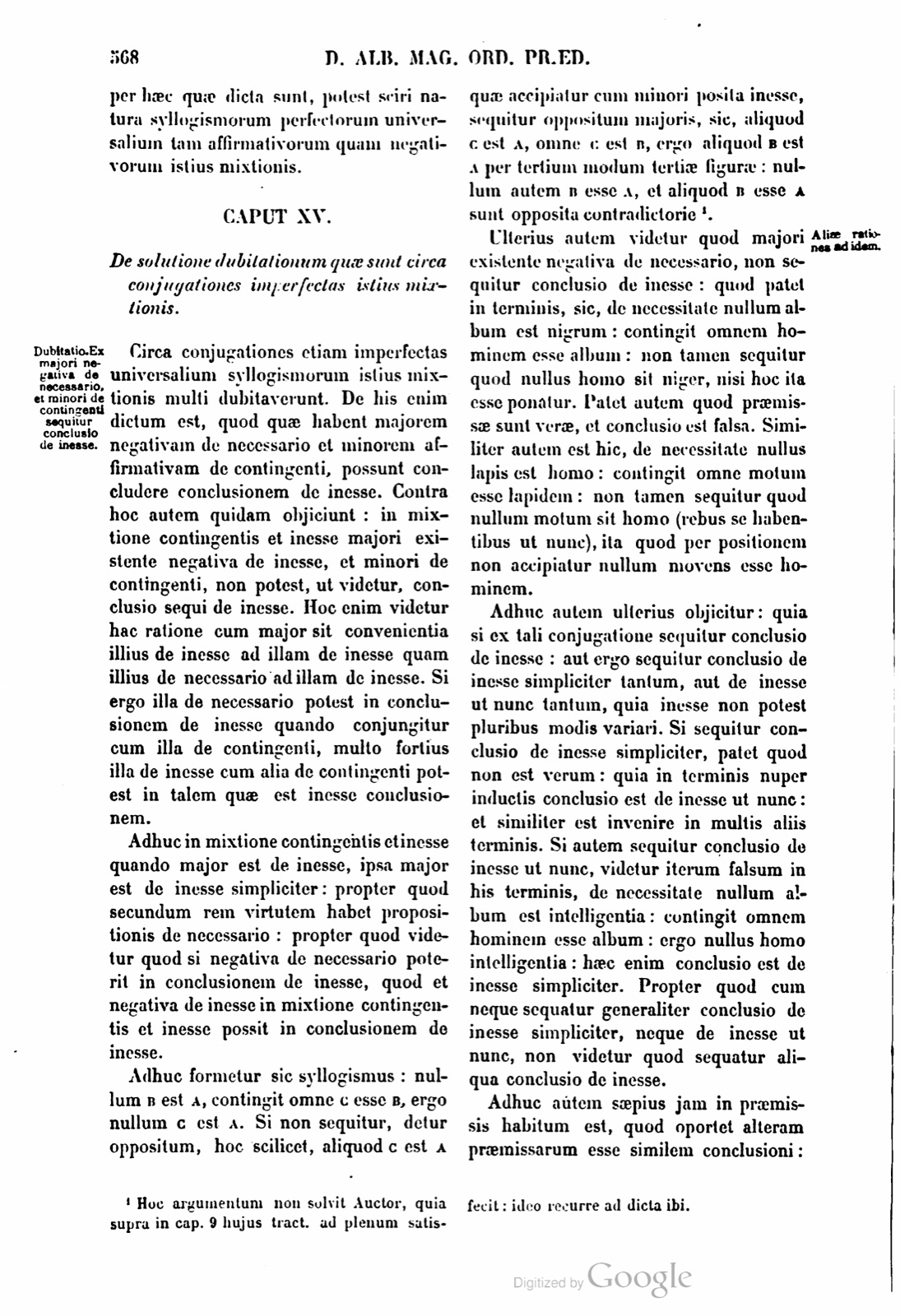
Sicut autem dictum est de natura modorum perfectorum istius mixtionis, qui perficiuntur per dici de omni, eodem modo dicendum est de modis perfectis syllogismorum negativorum universalium qui perficiuntur per dici de nullo. Et sic per haec quae dicta sunt, potest sciri natura syllogismorum perfectorum universalium tam affirmativorum quam negativorum istius mixtionis.
But when it is conversely the case that the major is about the necessary and the minor about the contingent, no disposition of the terms is made according to being said of every; and therefore the major cannot make a conclusion similar to itself. The minor proposition also does not principally have the power of inference in a syllogism, and therefore neither will it be able to make a conclusion similar to itself. And therefore something middle must follow between the necessary and the contingent toward either alternative; and this is nothing except the contingent for the possible, which in some terms is about the necessary, but in others about the non-necessary.
But if someone asks why the perfect syllogisms of this mixing cannot conclude a conclusion of inherence or of necessity, as they conclude a conclusion about the contingent, one must say that the cause of this is that, when the major is about the contingent, from the very mode of contingency it is signified that the predicate is referred to the subject according to potential inherence, and the greater extreme does not have actual predication of all the things which are contained under the middle, which is the subject of the major proposition. But a conclusion of inherence and of necessity marks actual inherence of the predicate concerning all things which are contained under the subject; and therefore in such a conjugation neither can a conclusion of inherence follow, nor a conclusion of necessity.
But just as it has been said about the nature of the perfect modes of this mixing, which are perfected through being said of every, in the same way one must speak about the perfect modes of universal negative syllogisms which are perfected through being said of none. And thus through these things which have been said, the nature of the perfect universal syllogisms of this mixing, both affirmative and negative, can be known.
If a page does not appear, its photograph has not been uploaded yet.