Works › Prior Analytics, Books I–II
Volume 1 · p. 566
Chapter XIV. On the solution of two things which concern the conjugations of perfect syllogisms of this mixing.
CAPUT XIV. De solutione duorum quae sunt circa conjugationes perfectorum syllogismorum istius mixtionis.
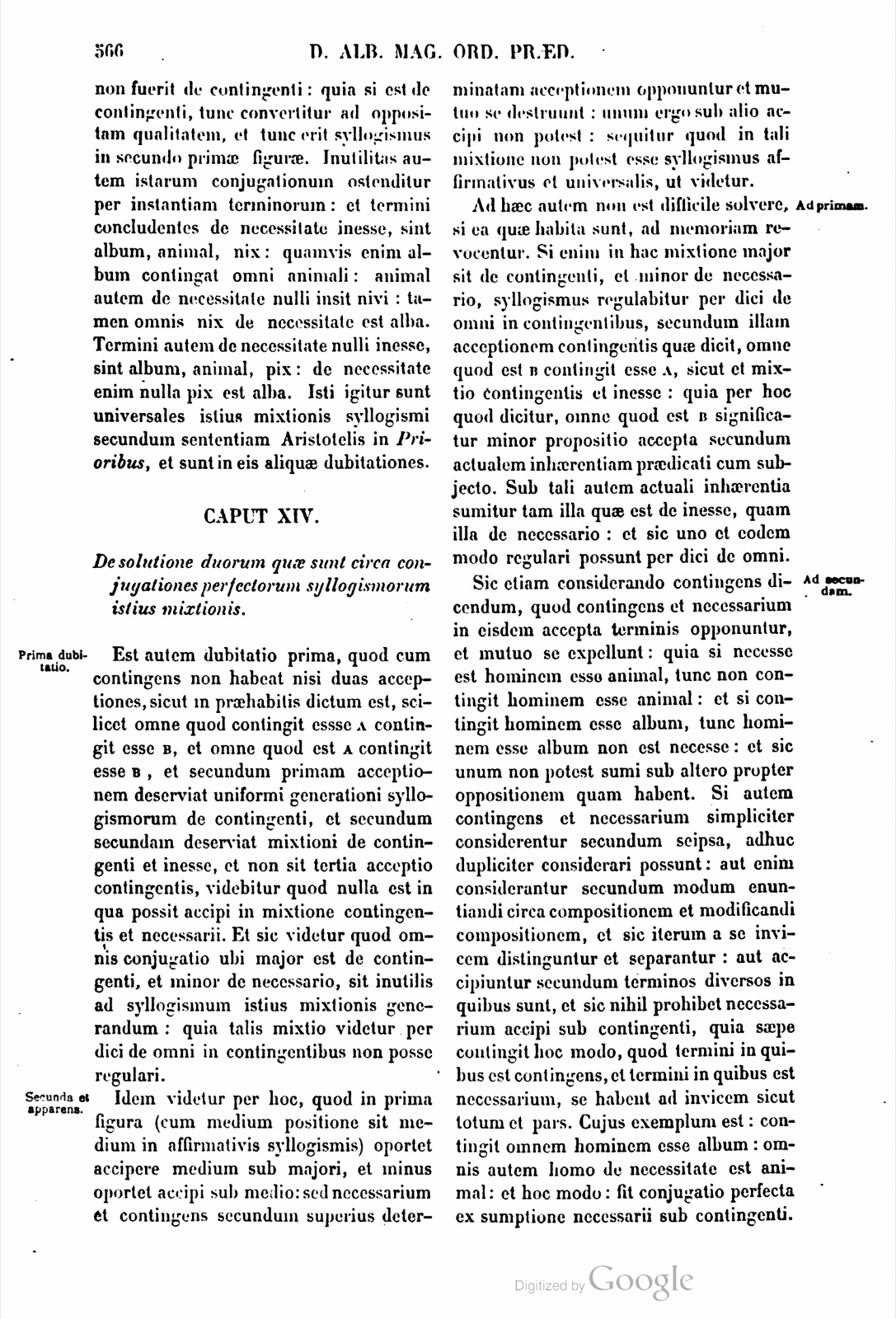
Est autem dubitatio prima, quod cum contingens non habeat nisi duas acceptiones, sicut in praehabitis dictum est, scilicet omne quod contingit esse A contingit esse B, et omne quod est A contingit esse B, et secundum primam acceptionem deserviat uniformi generationi syllogismorum de contingenti, et secundum secundam deserviat mixtioni de contingenti et inesse, et non sit tertia acceptio contingentis, videbitur quod nulla est in qua possit accipi in mixtione contingentis et necessarii. Et sic videtur quod omnis conjugatio ubi major est de contingenti, et minor de necessario, sit inutilis ad syllogismum istius mixtionis generandum: quia talis mixtio videtur per dici de omni in contingentibus non posse regulari.
Idem videtur per hoc, quod in prima figura, cum medium positione sit medium in affirmativis syllogismis, oportet accipere medium sub majori, et minus oportet accipi sub medio: sed necessarium et contingens secundum superius determinatam acceptionem opponuntur et mutuo se destruunt: unum ergo sub alio accipi non potest: sequitur quod in tali mixtione non potest esse syllogismus affirmativus et universalis, ut videtur.
Ad haec autem non est difficile solvere, si ea quae habita sunt, ad memoriam revocentur. Si enim in hac mixtione major sit de contingenti, et minor de necessario, syllogismus regulabitur per dici de omni in contingentibus, secundum illam acceptionem contingentis quae dicit, omne quod est B contingit esse A, sicut et mixtio contingentis et inesse: quia per hoc quod dicitur, omne quod est B significatur minor propositio accepta secundum actualem inhaerentiam praedicati cum subjecto. Sub tali autem actuali inhaerentia sumitur tam illa quae est de inesse, quam illa de necessario: et sic uno et eodem modo regulari possunt per dici de omni.
Sic etiam considerando contingens dicendum, quod contingens et necessarium in eisdem accepta terminis opponuntur, et mutuo se expellunt: quia si necesse est hominem esse animal, tunc non contingit hominem esse animal: et si contingit hominem esse album, tunc hominem esse album non est necesse: et sic unum non potest sumi sub altero propter oppositionem quam habent. Si autem contingens et necessarium simpliciter considerentur secundum seipsa, adhuc dupliciter considerari possunt: aut enim considerantur secundum modum enuntiandi circa compositionem et modificandi compositionem, et sic iterum a se invicem distinguntur et separantur: aut accipiuntur secundum terminos diversos in quibus sunt, et sic nihil prohibet necessarium accipi sub contingenti, quia saepe contingit hoc modo, quod termini in quibus est contingens, et termini in quibus est necessarium, se habent ad invicem sicut totum et pars. Cujus exemplum est: contingit omnem hominem esse album: omnis autem homo de necessitate est animal: et hoc modo: fit conjugatio perfecta ex sumptione necessarii sub contingenti.
CHAPTER XIV. On the solution of two things which concern the conjugations of perfect syllogisms of this mixing.
But the first doubt is that, since the contingent has only two acceptations, as was said in what was had before, namely everything that contingently is A contingently is B, and everything that is A contingently is B, and according to the first acceptation it serves the uniform generation of syllogisms concerning the contingent, and according to the second it serves the mixing of the contingent and inherence, and there is no third acceptation of the contingent, it will seem that there is no acceptation in which it can be taken in the mixing of the contingent and the necessary. And thus it seems that every conjugation where the major is of the contingent and the minor of necessity is useless for generating a syllogism of this mixing, because such a mixing seems unable to be ruled through being said of every in contingents.
The same thing seems so through this, that in the first figure, since the middle by position is the middle in affirmative syllogisms, it is necessary to take the middle under the major and the lesser under the middle. But the necessary and the contingent, according to the acceptation determined above, are opposed and mutually destroy one another. Therefore one cannot be taken under the other; it follows that in such a mixing there cannot be an affirmative and universal syllogism, as it seems.
But these things are not difficult to solve if the things that have been held are recalled to memory. For if in this mixing the major is of the contingent and the minor of necessity, the syllogism will be ruled through being said of every in contingents, according to that acceptation of the contingent which says: everything that is B contingently is A, just as also the mixing of the contingent and inherence. For through the fact that it is said, everything that is B, the minor proposition is signified as accepted according to the actual inherence of the predicate with the subject. But under such actual inherence both that proposition which is of inherence and that which is of necessity are taken; and thus in one and the same way they can be ruled through being said of every.
Thus also, when considering the contingent, one must say that the contingent and the necessary, taken in the same terms, are opposed and mutually expel one another, because if it is necessary for a man to be an animal, then it is not contingent for a man to be an animal; and if it is contingent for a man to be white, then it is not necessary for a man to be white. And thus one cannot be taken under the other because of the opposition that they have. But if the contingent and the necessary are considered simply according to themselves, they can still be considered in two ways: for either they are considered according to the mode of enunciating about composition and of modifying composition, and thus again they are distinguished and separated from one another; or they are taken according to the diverse terms in which they are, and thus nothing prevents the necessary from being taken under the contingent, because it often happens in this way, that the terms in which the contingent is and the terms in which the necessary is have themselves to one another as whole and part. An example of this is: it is contingent that every man be white; but every man of necessity is an animal; and in this way a perfect conjugation is made from the taking of the necessary under the contingent.
If a page does not appear, its photograph has not been uploaded yet.