Works › Prior Analytics, Books I–II
Volume 1 · pp. 563–566
Chapter XIII. On the rules of the mixing of the necessary and the contingent in the first figure, and on the useful and useless conjugations of universal syllogisms of this mixing.
A marker with ≈ is an approximate page boundary, placed by measure of the text; the page photographs remain the authority. In the paired views, clicking a page marker brings that page into view.
CAPUT XIII. De regulis mixtionis necessarii et contingentis in prima figura, et de conjugationibus utilibus et inutilibus universalium syllogismorum istius mixtionis.
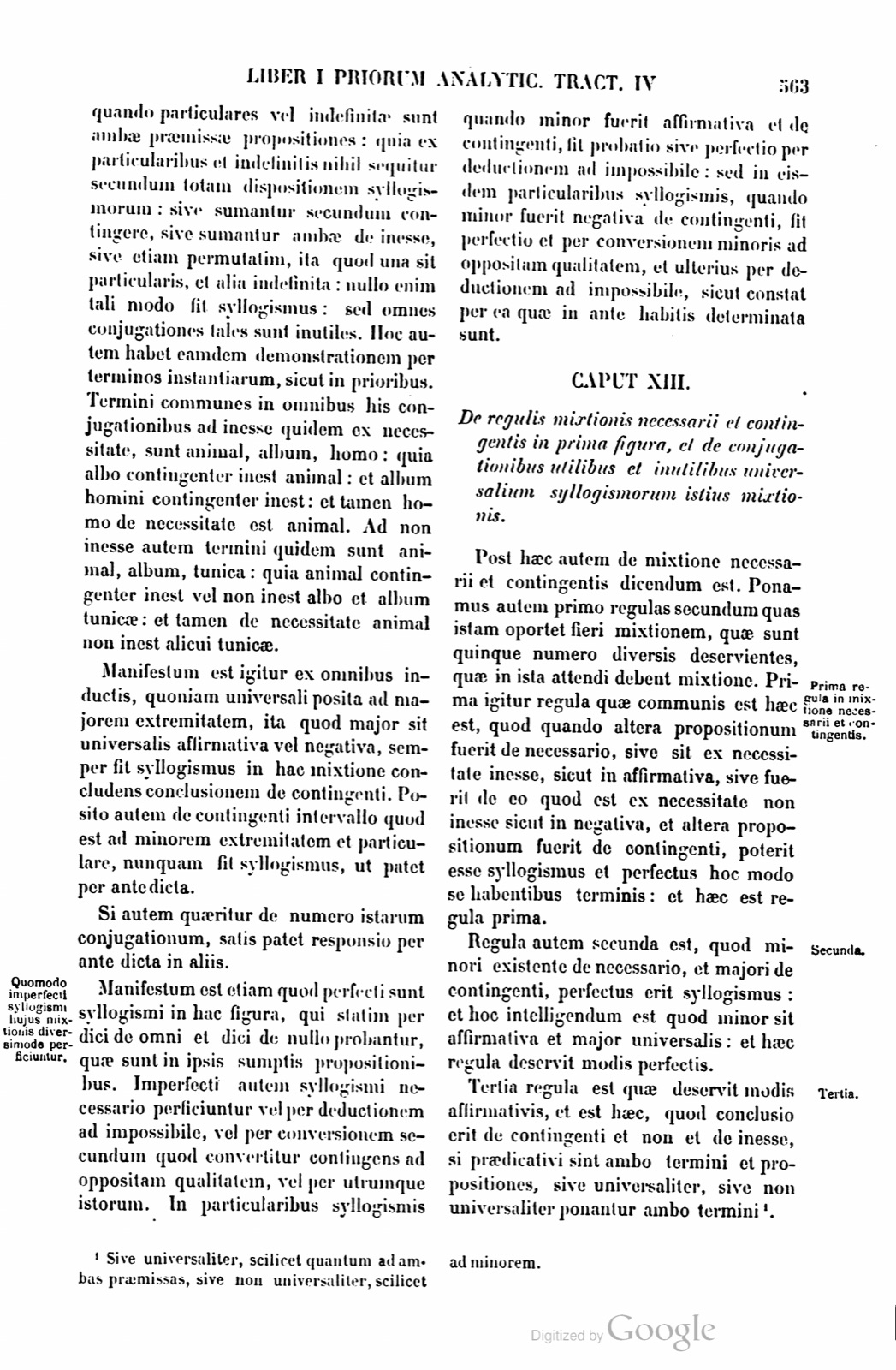
Post haec autem de mixtione necessarii et contingentis dicendum est. Ponamus autem primo regulas secundum quas istam oportet fieri mixtionem, quae sunt quinque numero diversis deservientes, quae in ista attendi debent mixtione. Prima igitur regula quae communis est haec est, quod quando altera propositionum fuerit de necessario, sive sit ex necessitate inesse, sicut in affirmativa, sive fuerit de eo quod est ex necessitate non inesse sicut in negativa, et altera propositionum fuerit de contingenti, poterit esse syllogismus et perfectus hoc modo se habentibus terminis: et haec est regula prima.
Regula autem secunda est, quod minori existente de necessario, et majori de contingenti, perfectus erit syllogismus: et hoc intelligendum est quod minor sit affirmativa et major universalis: et haec regula deservit modis perfectis.
Tertia regula est quae deservit modis affirmativis, et est haec, quod conclusio erit de contingenti et non et de inesse, si praedicativi sint ambo termini et propositiones, sive universaliter, sive non universaliter ponantur ambo termini1.
Quarta autem deservit modis negativis, et haec est, quod quando alter quidem terminus fuerit affirmativus, alter vero privativus, dummodo affirmativus fuerit de necessario, sequitur conclusio de contingenti, et non sequitur conclusio de inesse. Quando autem privativus fuerit de necessario, sequitur conclusio de contingenti et de eo quod est non inesse, sive universales sint termini, sive non universales.
Quinta autem regula est, quod in omnibus his conjugationibus mixtionum contingere quod sequitur in conclusione, eodem modo accipiendum est sicut in praecedenti mixtione, ita scilicet, quod in modis perfectis sequitur contingens secundum superius inductam determinationem. In modis autem imperfectis sequitur contingens pro possibili. Modi enim imperfecti negativi non concludunt contingens non esse, quod est idem cum necesse non esse, sed quod est idem cum non necesse esse: et tale est idem quod contingens pro possibili. Illius enim quod est ex necessitate non inesse conclusionis, non erit syllogismus in modis imperfectis. Aliud est enim ex necessitate non inesse, aliud non ex necessitate inesse: quia in uno negatur modus et affirmatur dictum, in altero autem affirmatur modus et dictum negatur.
CHAPTER XIII. On the rules of the mixing of the necessary and the contingent in the first figure, and on the useful and useless conjugations of universal syllogisms of this mixing.
After these things one must speak about the mixing of the necessary and the contingent. But let us first posit the rules according to which this mixing must be made; they are five in number, serving diverse matters which must be attended to in this mixing. Therefore the first rule, which is common, is this: that when one of the propositions has been of necessity, whether it is to belong from necessity, as in the affirmative, or is about that which is not to belong from necessity, as in the negative, and the other of the propositions has been about the contingent, there can be a syllogism, and a perfect one, when the terms have themselves in this way; and this is the first rule.
The second rule is that, when the minor is of necessity and the major of the contingent, the syllogism will be perfect; and this must be understood as meaning that the minor is affirmative and the major universal; and this rule serves the perfect modes.
The third rule is the one that serves affirmative modes, and it is this: that the conclusion will be about the contingent and not also about inherence, if both the terms and the propositions are predicative, whether both terms are posited universally or not universally1.
But the fourth serves negative modes, and it is this: that when one term has been affirmative and the other privative, provided that the affirmative has been of necessity, a conclusion about the contingent follows, and a conclusion of inherence does not follow. But when the privative has been of necessity, a conclusion about the contingent and about that which is not to inhere follows, whether the terms are universal or not universal.
But the fifth rule is that in all these conjugations of mixings, the contingency that follows in the conclusion must be taken in the same way as in the preceding mixing, namely so that in perfect modes the contingent follows according to the determination introduced above. But in imperfect modes the contingent for the possible follows. For imperfect negative modes do not conclude contingent not-being, which is the same as necessary not-being, but that which is the same as not necessarily being; and such is the same as the contingent for the possible. For there will not be a syllogism in imperfect modes of a conclusion of that which is not to belong from necessity. For it is one thing not to belong from necessity, and another not from necessity to belong, because in the one the mode is denied and the dictum is affirmed, but in the other the mode is affirmed and the dictum denied.
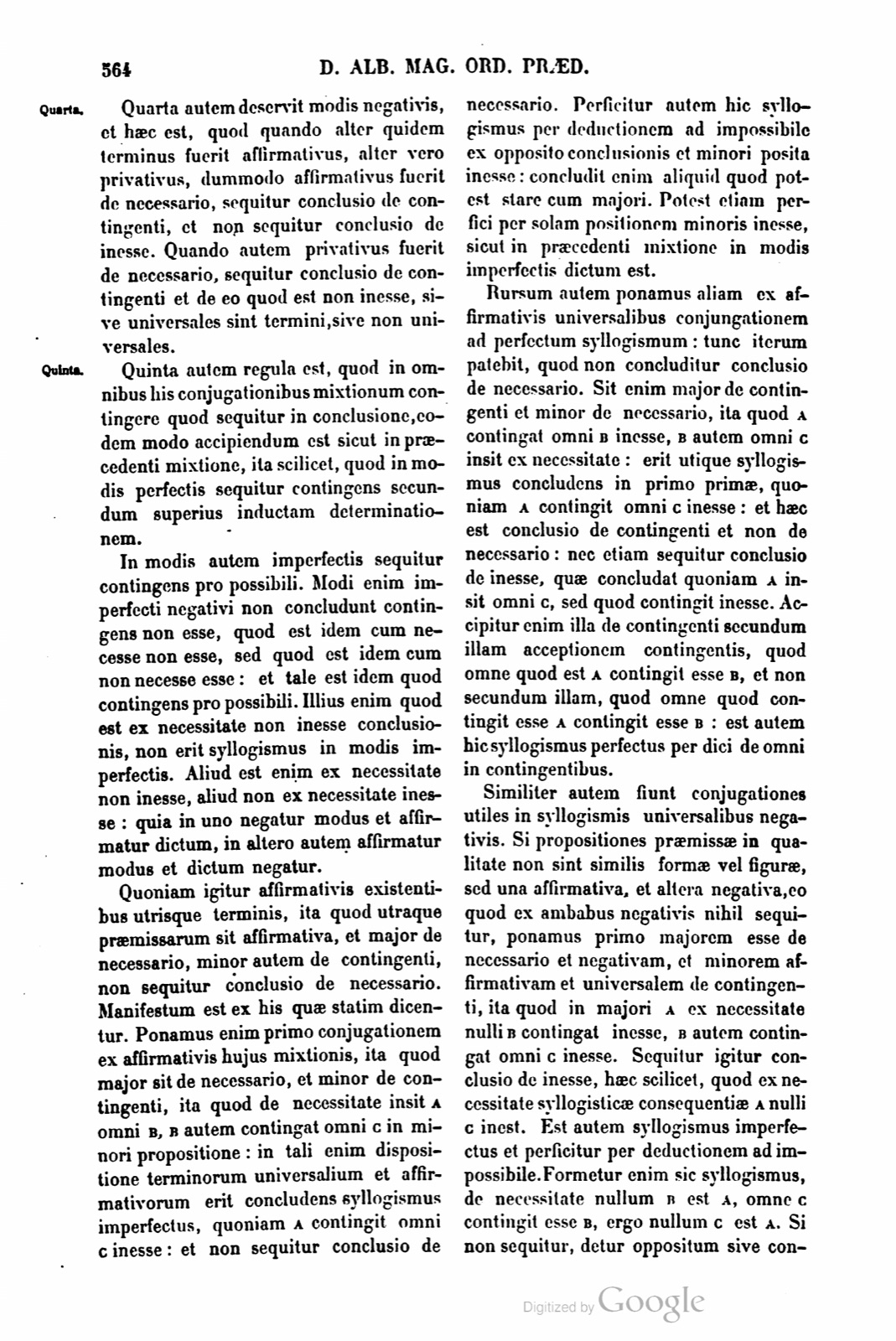
Quoniam igitur affirmativis existentibus utrisque terminis, ita quod utraque praemissarum sit affirmativa, et major de necessario, minor autem de contingenti, non sequitur conclusio de necessario. Manifestum est ex his quae statim dicentur. Ponamus enim primo conjugationem ex affirmativis hujus mixtionis, ita quod major sit de necessario, et minor de contingenti, ita quod de necessitate insit A omni B, B autem contingat omni C in minori propositione: in tali enim dispositione terminorum universalium et affirmativorum erit concludens syllogismus imperfectus, quoniam A contingit omni C inesse: et non sequitur conclusio de necessario. Perficitur autem hic syllogismus per deductionem ad impossibile ex opposito conclusionis et minori posita inesse: concludit enim aliquid quod potest stare cum majori. Potest etiam perfici per solam positionem minoris inesse, sicut in praecedenti mixtione in modis imperfectis dictum est.
Rursum autem ponamus aliam ex affirmativis universalibus conjugationem ad perfectum syllogismum: tunc iterum patebit, quod non concluditur conclusio de necessario. Sit enim major de contingenti et minor de necessario, ita quod A contingat omni B inesse, B autem omni C insit ex necessitate: erit utique syllogismus concludens in primo primae, quoniam A contingit omni C inesse: et haec est conclusio de contingenti et non de necessario: nec etiam sequitur conclusio de inesse, quae concludat quoniam A insit omni C, sed quod contingit inesse. Accipitur enim illa de contingenti secundum illam acceptionem contingentis, quod omne quod est A contingit esse B, et non secundum illam, quod omne quod contingit esse A contingit esse B: est autem hic syllogismus perfectus per dici de omni in contingentibus.
Similiter autem fiunt conjugationes utiles in syllogismis universalibus negativis. Si propositiones praemissae in qualitate non sint similis formae vel figurae, sed una affirmativa, et altera negativa, eo quod ex ambabus negativis nihil sequitur, ponamus primo majorem esse de necessario et negativam, et minorem affirmativam et universalem de contingenti, ita quod in majori A ex necessitate nulli B contingat inesse, B autem contingat omni C inesse. Sequitur igitur conclusio de inesse, haec scilicet, quod ex necessitate syllogisticae consequentiae A nulli C inest. Est autem syllogismus imperfectus et perficitur per deductionem ad impossibile. Formetur enim sic syllogismus, de necessitate nullum B est A, omne C contingit esse B, ergo nullum C est A. Si non sequitur, detur oppositum sive contradictorium sive contrarium. Et si detur contradictorium: tunc ex illa et conversa majoris concluditur oppositum minoris, sic, de necessitate nullum A est B, aliquod C est A, ergo de necessitate aliquod C non est B: quod est oppositum minoris per syllogismum mixtum ex necessario et inesse in quarto primae. Si autem detur conclusionis contraria, destruetur minor per syllogismum factum in secundo secundae figurae, sicut cuilibet per seipsum patere potest: cum enim concluditur quod necesse est A nulli C inesse, accipiendo oppositum contradictorie vel contrarie, accipitur quod vel omni vel alicui C inest A: positum autem in majori propositione erat quod A nulli B contingit inesse: quoniam igitur major negativa convertitur in terminis, si nulli B contingit inesse A, sequitur quod etiam nulli A contingit inesse B: positum est autem in opposito conclusionis quod A aut omni C inest, aut alicui: sequitur ergo, quod aut nulli aut non omni C contingit inesse B, quod destruit minorem in qua positum fuit quod omne C est B, quando minor de contingenti posita fuit inesse.
Therefore, since both terms are affirmative, so that each premise is affirmative, and the major is of necessity but the minor of the contingent, a conclusion of necessity does not follow. This is manifest from the things that will be said immediately. For let us first posit a conjugation from affirmatives of this mixing, so that the major is of necessity and the minor of the contingent, in such a way that A belongs of necessity to every B, but B contingently belongs to every C in the minor proposition. For in such a disposition of universal and affirmative terms there will be an imperfect syllogism concluding that A contingently belongs to every C; and a conclusion of necessity does not follow. But this syllogism is perfected through deduction to the impossible from the opposite of the conclusion and the minor posited as inhering; for it concludes something that can stand with the major. It can also be perfected by the sole positing of the minor as inhering, as was said in the preceding mixing in the imperfect modes.
Again, let us posit another conjugation from affirmative universals for a perfect syllogism; then again it will be clear that a conclusion of necessity is not concluded. For let the major be of the contingent and the minor of necessity, so that A contingently belongs to every B, but B belongs to every C from necessity. There will in any case be a syllogism concluding in the first of the first that A contingently belongs to every C. And this is a conclusion about the contingent and not about the necessary; nor does there follow a conclusion of inherence which concludes that A belongs to every C, but rather that it contingently belongs. For that proposition of the contingent is taken according to that acceptation of the contingent, that everything which is A contingently is B, and not according to that one, that everything which contingently is A contingently is B. But here the syllogism is perfect through being said of every in contingents.
Similarly useful conjugations are also made in universal negative syllogisms. If the premise propositions are not of a similar form or figure in quality, but one affirmative and the other negative, since from both negatives nothing follows, let us first posit the major to be of necessity and negative, and the minor affirmative and universal of the contingent, so that in the major A from necessity contingently belongs to no B, but B contingently belongs to every C. Therefore there follows a conclusion of inherence, namely this: that from the necessity of syllogistic consequence A belongs to no C. But it is an imperfect syllogism and is perfected through deduction to the impossible. For let the syllogism be formed thus: of necessity no B is A; every C contingently is B; therefore no C is A. If it does not follow, let the opposite be granted, whether contradictory or contrary. And if the contradictory is granted, then from that and the converse of the major the opposite of the minor is concluded thus: of necessity no A is B; some C is A; therefore of necessity some C is not B, which is the opposite of the minor through a syllogism mixed from necessity and inherence in the fourth of the first. But if the contrary of the conclusion is granted, the minor will be destroyed through a syllogism made in the second of the second figure, as can be clear to anyone through himself. For when it is concluded that it is necessary for A to belong to no C, by taking the opposite contradictorily or contrariwise, it is taken that A belongs either to every C or to some C; but in the major proposition it had been posited that A contingently belongs to no B. Therefore, because the negative major is converted in the terms, if A contingently belongs to no B, it follows that B also contingently belongs to no A. But it was posited in the opposite of the conclusion that A belongs either to every C or to some C; therefore it follows that B contingently belongs either to no C or not to every C, which destroys the minor in which it had been posited that every C is B, when the minor of the contingent had been posited as inhering.
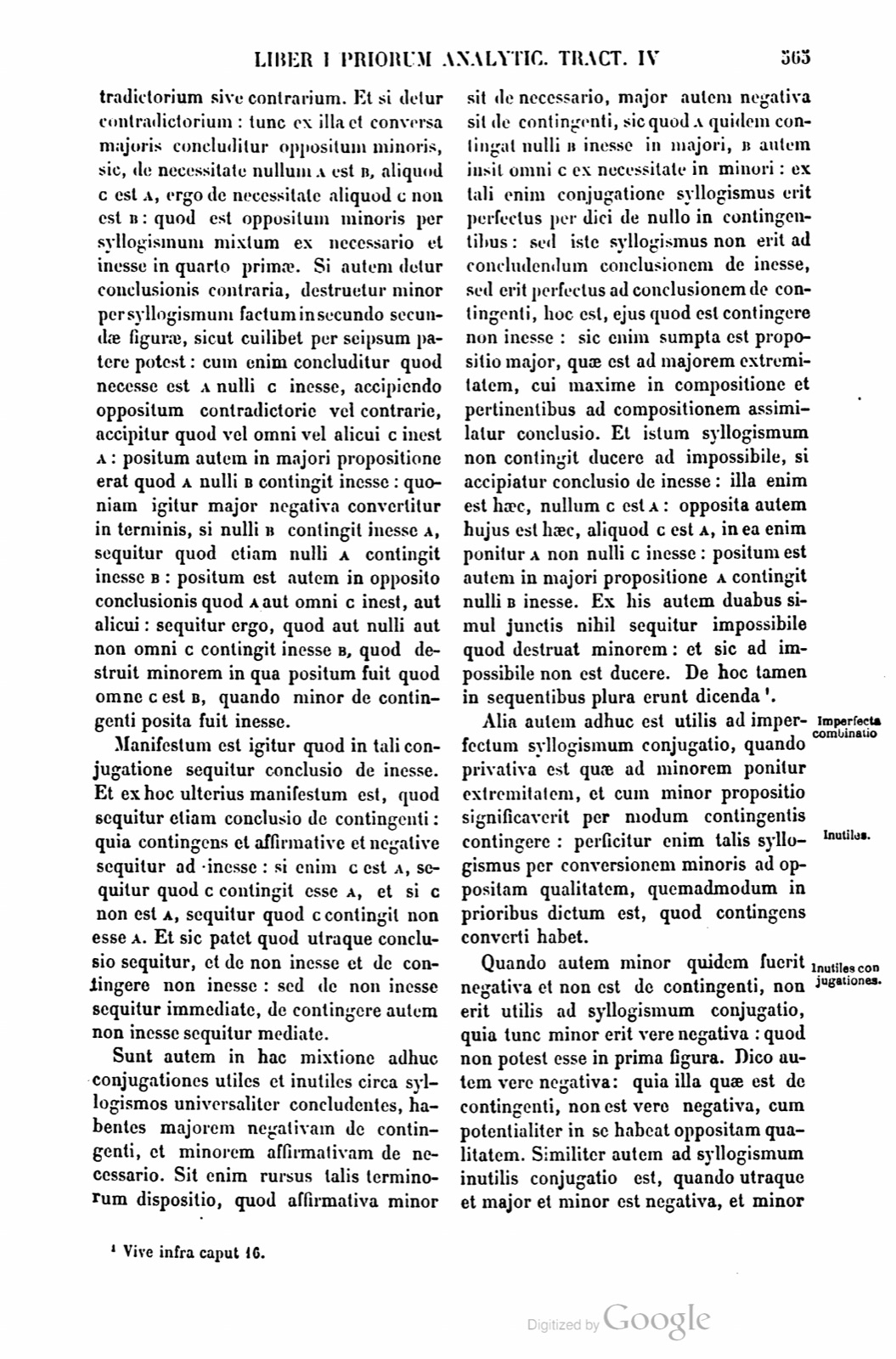
Manifestum est igitur quod in tali conjugatione sequitur conclusio de inesse. Et ex hoc ulterius manifestum est, quod sequitur etiam conclusio de contingenti: quia contingens et affirmative et negative sequitur ad inesse: si enim C est A, sequitur quod C contingit esse A, et sic non est A, sequitur quod C contingit non esse A. Et sic patet quod utraque conclusio sequitur, et de non inesse et de contingere non inesse: sed de non inesse sequitur immediate, de contingere autem non inesse sequitur mediate.
Sunt autem in hac mixtione adhuc conjugationes utiles et inutiles circa syllogismos universaliter concludentes, habentes majorem negativam de contingenti, et minorem affirmativam de necessario. Sit enim rursus talis terminorum dispositio, quod affirmativa minor sit de necessario, major autem negativa sit de contingenti, sic quod A quidem contingat nulli C inesse in majori, B autem insit omni C ex necessitate in minori: ex tali enim conjugatione syllogismus erit perfectus per dici de nullo in contingentibus: sed iste syllogismus non erit ad concludendum conclusionem de inesse, sed erit perfectus ad conclusionem de contingenti, hoc est, ejus quod est contingere non inesse: sic enim sumpta est propositio major, quae est ad majorem extremitatem, cui maxime in compositione et pertinentibus ad compositionem assimilatur conclusio. Et istum syllogismum non contingit ducere ad impossibile, si accipiatur conclusio de inesse: illa enim est haec, nullum C est A: opposita autem hujus est haec, aliquod C est A, in ea enim ponitur A non nulli C inesse: positum est autem in majori propositione A contingit nulli B inesse. Ex his autem duabus simul junctis nihil sequitur impossibile quod destruat minorem: et sic ad impossibile non est ducere. De hoc tamen in sequentibus plura erunt dicenda2.
Therefore it is manifest that in such a conjugation a conclusion of inherence follows. And from this it is further manifest that a conclusion of the contingent also follows, because the contingent follows affirmatively and negatively upon inherence. For if C is A, it follows that C contingently is A; and if it is not A, it follows that C contingently is not A. And thus it is clear that each conclusion follows, both concerning non-inherence and concerning contingently not inhering; but concerning non-inherence it follows immediately, while concerning contingently not inhering it follows mediately.
But in this mixing there are still useful and useless conjugations concerning syllogisms concluding universally, having the major negative of the contingent and the minor affirmative of necessity. For again let there be such a disposition of terms, that the affirmative minor is of necessity, but the major negative is of the contingent, so that A indeed contingently belongs to no C in the major, but B belongs to every C from necessity in the minor. From such a conjugation the syllogism will be perfect through being said of none in contingents; but that syllogism will not be for concluding a conclusion of inherence, but will be perfect for a conclusion of the contingent, that is, of that which is contingently not to inhere. For the major proposition, which is at the greater extreme, is taken in this way, to which the conclusion is especially assimilated in composition and in things pertaining to composition. And this syllogism cannot be led to the impossible if a conclusion of inherence is taken. For that conclusion is this: no C is A; but its opposite is this: some C is A, for in it A is posited to belong to not no C. But in the major proposition it was posited that A contingently belongs to no B. From these two joined together nothing impossible follows that would destroy the minor; and thus it is not to be led to the impossible. Yet about this more will have to be said in what follows2.
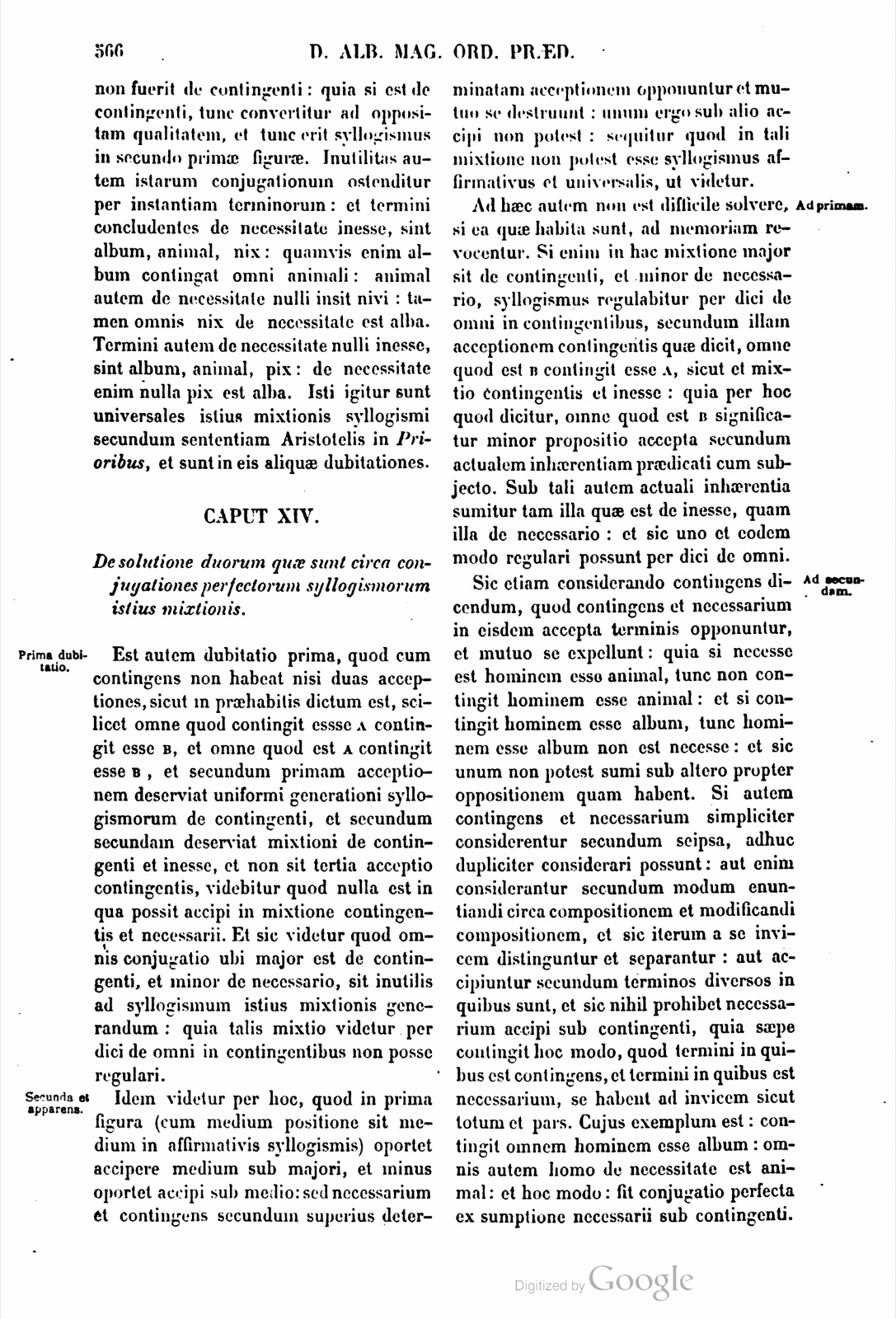
Alia autem adhuc est utilis ad imperfectum syllogismum conjugatio, quando privativa est quae ad minorem ponitur extremitatem, et cum minor propositio significaverit per modum contingentis contingere: perficitur enim talis syllogismus per conversionem minoris ad oppositam qualitatem, quemadmodum in prioribus dictum est, quod contingens converti habet.
Quando autem minor quidem fuerit negativa et non est de contingenti, non erit utilis ad syllogismum conjugatio, quia tunc minor erit vere negativa: quod non potest esse in prima figura. Dico autem vere negativa: quia illa quae est de contingenti, non est vere negativa, cum potentialiter in se habeat oppositam qualitatem. Similiter autem ad syllogismum inutilis conjugatio est, quando utraque et major et minor est negativa, et minor non fuerit de contingenti: quia si est de contingenti, tunc convertitur ad oppositam qualitatem, et tunc erit syllogismus in secundo primae figurae. Inutilitas autem istarum conjugationum ostenditur per instantiam terminorum: et termini concludentes de necessitate inesse, sint album, animal, nix: quamvis enim album contingat omni animali: animal autem de necessitate nulli insit nivi: tamen omnis nix de necessitate est alba. Termini autem de necessitate nulli inesse, sint album, animal, pix: de necessitate enim nulla pix est alba. Isti igitur sunt universales istius mixtionis syllogismi secundum sententiam Aristotelis in Prioribus, et sunt in eis aliquae dubitationes.
But there is still another conjugation useful for an imperfect syllogism, when the privative is the one posited at the lesser extreme, and when the minor proposition has signified contingency through the mode of the contingent. For such a syllogism is perfected through conversion of the minor to the opposite quality, just as it was said in the preceding matters that the contingent has to be converted.
But when the minor has indeed been negative and is not of the contingent, the conjugation will not be useful for a syllogism, because then the minor will be truly negative, which cannot be in the first figure. But I call it truly negative because that proposition which is of the contingent is not truly negative, since it has the opposite quality in itself potentially. Similarly the conjugation is useless for a syllogism when both the major and the minor are negative and the minor has not been of the contingent, because if it is of the contingent, then it is converted to the opposite quality, and then there will be a syllogism in the second of the first figure. But the uselessness of these conjugations is shown through an instance of terms; and let the terms concluding necessary inherence be white, animal, snow. For although white contingently belongs to every animal, but animal of necessity belongs to no snow, nevertheless every snow is white of necessity. But let the terms for belonging of necessity to none be white, animal, pitch; for of necessity no pitch is white. These, therefore, are the universal syllogisms of this mixing according to the opinion of Aristotle in the Prior Analytics, and there are some doubts in them.
If a page does not appear, its photograph has not been uploaded yet.