Works › Prior Analytics, Books I–II
Volume 1 · pp. 561–563
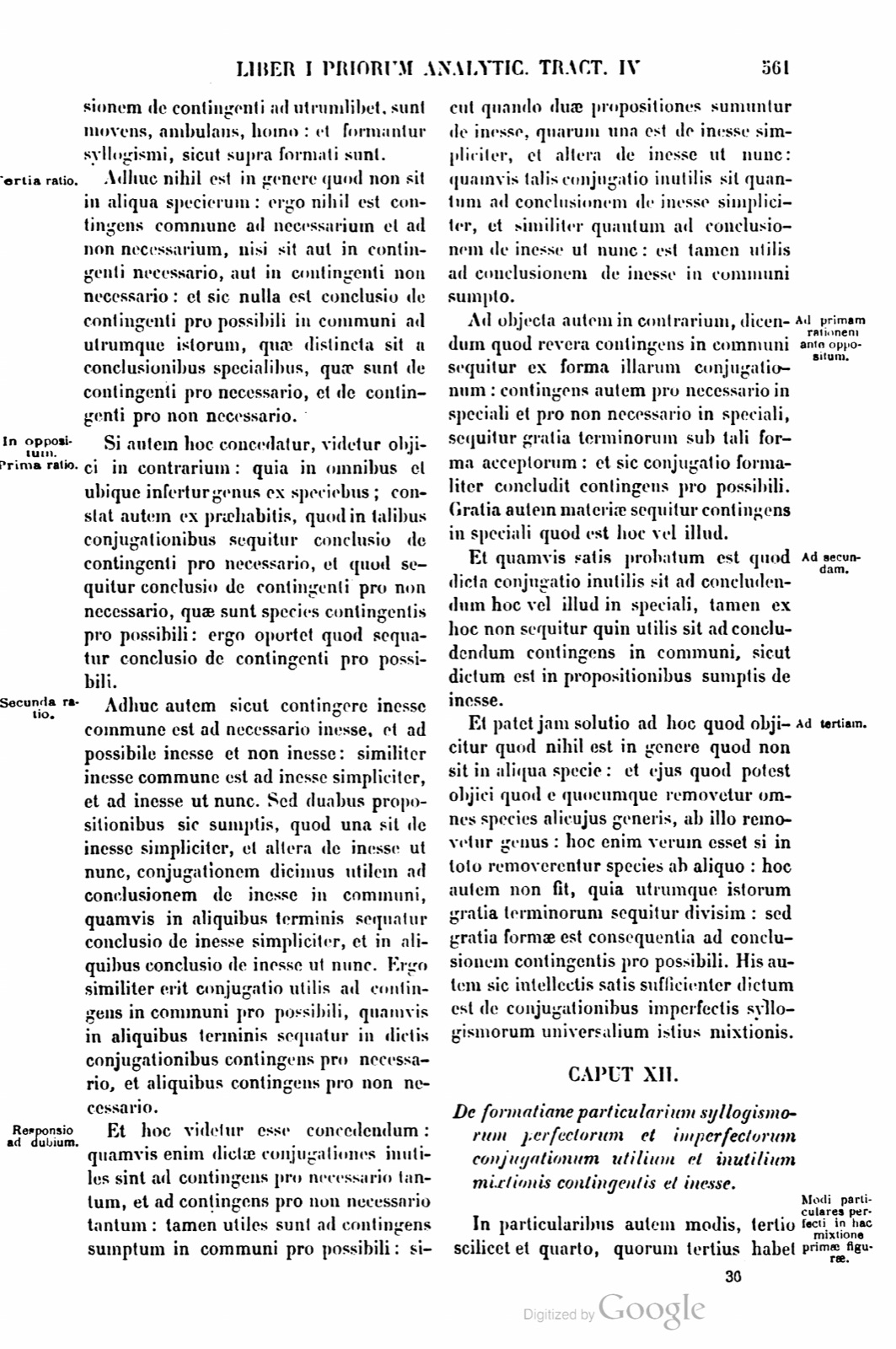
Chapter XII. On the formation of particular syllogisms of perfect and imperfect useful and useless conjugations of the mixing of the contingent and inherence.
A marker with ≈ is an approximate page boundary, placed by measure of the text; the page photographs remain the authority. In the paired views, clicking a page marker brings that page into view.
CAPUT XII. De formatione particularium syllogismorum perfectorum et imperfectorum conjugationum utilium et inutilium mixtionis contingentis et inesse.
In particularibus autem modis, tertio scilicet et quarto, quorum tertius habet majorem universalem affirmativam et minorem particularem affirmativam, et quartus majorem universalem habet negativam et minorem particularem affirmativam: in talibus syllogismis particularibus in ista mixtione, quando unum intervallorum sumitur universale, et aliud particulare: et quando id quod est ad majorem universalem ponitur et de contingenti sive sit affirmativum sicut in tertio, sive negativum sicut in quarto: et id quod ad minorem extremitatem sit particulare affirmativum de inesse simpliciter, erit syllogismus perfectus per dici de omni vel dici de nullo: sicut etiam perfectus est, quando ambo termini et ambae propositiones sunt universales, sicut jam ante dictum est. Quod autem perfectus sit talis syllogismus particulariter concludens, demonstratur eodem modo per dici de omni et dici de nullo in contingentibus, sicut et prius in universalibus syllogismis demonstratum est.
Quando autem universalis quidem ad majorem extremitatem et sit de inesse et non de contingenti: alterum autem intervallorum sit particulare quod est ad minorem, et sit de contingenti sive affirmativae sive negativae ponantur utraeque propositiones, sive una affirmativa ponatur, et altera negativa: in omnibus talibus conjugationibus erit syllogismus imperfectus, qui indiget reductione qua perficiatur: ita quod aliqui per impossibile perficiuntur, quidam autem per conversionem contingentis secundum oppositas qualitates, et quidam utroque modo: et illa est melior perfectio, sicut etiam factum est in praedictis universalibus syllogismis.
Erit autem in talibus syllogismus per conversionem tunc quando universalis quidem ad majorem posita extremitatem significaverit inesse, sicut in affirmativa, vel non inesse, sicut in negativa. Particularis autem cum fuerit privativa, sumet contingens, hoc est, fit de modo contingentis, cujus exemplum est, ut si A quidem omni B inest sicut in tertio, vel non inest sicut in quarto primae figurae, B autem alicui C contingit non inesse; conversa enim B C minori propositione secundum conversionem ejus quod est contingere ad oppositam, scilicet qualitatem, fit syllogismus vel in tertio primae, vel in quarto primae.
CHAPTER XII. On the formation of particular syllogisms of perfect and imperfect useful and useless conjugations of the mixing of the contingent and inherence.
But in the particular modes, namely the third and the fourth, of which the third has a universal affirmative major and a particular affirmative minor, and the fourth has a universal negative major and a particular affirmative minor: in such particular syllogisms in this mixing, when one of the intervals is taken as universal and the other as particular, and when that which is at the greater extreme is posited as universal and of the contingent, whether it is affirmative as in the third or negative as in the fourth, and that which is at the lesser extreme is a particular affirmative of inherence simply, there will be a perfect syllogism through being said of every or being said of none, just as it is also perfect when both terms and both propositions are universal, as has already been said. But that such a syllogism concluding particularly is perfect is demonstrated in the same way through being said of every and being said of none in contingents, as was also demonstrated before in universal syllogisms.
But when the universal is at the greater extreme and is of inherence and not of the contingent, while the other of the intervals is particular, which is at the lesser extreme, and is of the contingent, whether both propositions are posited as affirmative or as negative, or whether one is posited affirmative and the other negative: in all such conjugations there will be an imperfect syllogism which needs the reduction by which it is perfected. Thus some are perfected through the impossible, some through conversion of the contingent according to opposite qualities, and some in both ways; and that is the better perfection, as was also done in the aforesaid universal syllogisms.
But in such cases there will be a syllogism through conversion when the universal, posited at the greater extreme, has signified inherence, as in the affirmative, or non-inherence, as in the negative. But when the particular is privative, it will take the contingent, that is, it becomes about the mode of the contingent. An example of this is that if A indeed belongs to every B as in the third, or does not belong as in the fourth of the first figure, but B contingently does not belong to some C, then when the minor proposition B C has been converted according to the conversion of that which is contingent to the opposite, namely quality, a syllogism is made either in the third of the first or in the fourth of the first.
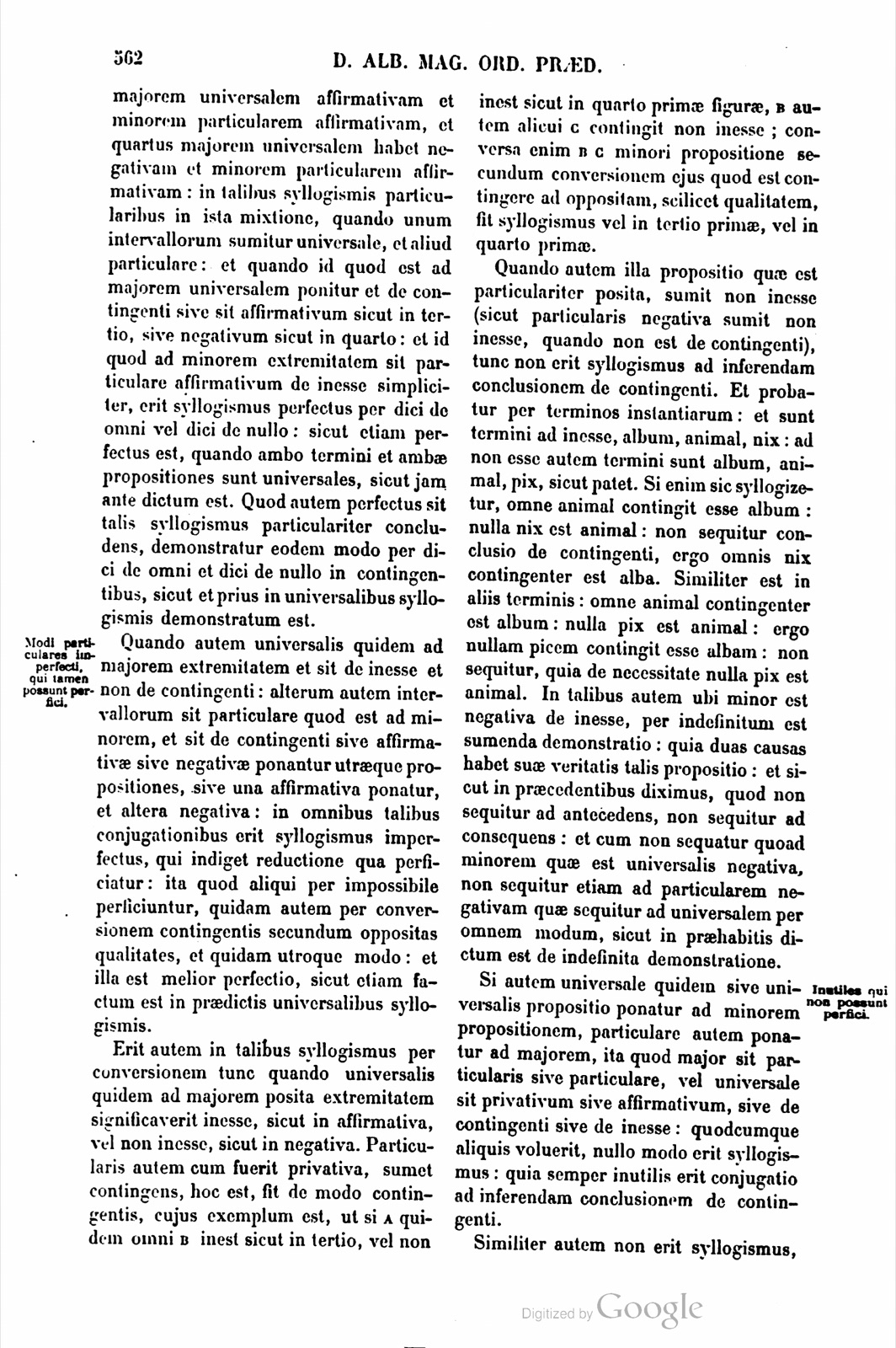
Quando autem illa propositio quae est particulariter posita, sumit non inesse, sicut particularis negativa sumit non inesse, quando non est de contingenti, tunc non erit syllogismus ad inferendam conclusionem de contingenti. Et probatur per terminos instantiarum: et sunt termini ad inesse, album, animal, nix: ad non esse autem termini sunt album, animal, pix, sicut patet. Si enim sic syllogizetur, omne animal contingit esse album: nulla nix est animal: non sequitur conclusio de contingenti, ergo omnis nix contingenter est alba. Similiter est in aliis terminis: omne animal contingenter est album: nulla pix est animal: ergo nullam picem contingit esse albam: non sequitur, quia de necessitate nulla pix est animal. In talibus autem ubi minor est negativa de inesse, per indefinitum est sumenda demonstratio: quia duas causas habet suae veritatis talis propositio: et sicut in praecedentibus diximus, quod non sequitur ad antecedens, non sequitur ad consequens: et cum non sequatur quoad minorem quae est universalis negativa, non sequitur etiam ad particularem negativam quae sequitur ad universalem per omnem modum, sicut in praehabitis dictum est de indefinita demonstratione.
Si autem universale quidem sive universalis propositio ponatur ad minorem propositionem, particulare autem ponatur ad majorem, ita quod major sit particularis sive particulare, vel universale sit privativum sive affirmativum, sive de contingenti sive de inesse: quodcumque aliquis voluerit, nullo modo erit syllogismus: quia semper inutilis erit conjugatio ad inferendam conclusionem de contingenti.
Similiter autem non erit syllogismus, quando particulares vel indefinitae sunt ambae praemissae propositiones: quia ex particularibus et indefinitis nihil sequitur secundum totam dispositionem syllogismorum: sive sumantur secundum contingere, sive sumantur ambae de inesse, sive etiam permutatim, ita quod una sit particularis, et alia indefinita: nullo enim tali modo fit syllogismus: sed omnes conjugationes tales sunt inutiles. Hoc autem habet eamdem demonstrationem per terminos instantiarum, sicut in prioribus. Termini communes in omnibus his conjugationibus ad inesse quidem ex necessitate, sunt animal, album, homo: quia albo contingenter inest animal: et album homini contingenter inest: et tamen homo de necessitate est animal. Ad non inesse autem termini quidem sunt animal, album, tunica: quia animal contingenter inest vel non inest albo et album tunicae: et tamen de necessitate animal non inest alicui tunicae.
But when that proposition which is posited particularly takes non-inherence, as a particular negative takes non-inherence when it is not about the contingent, then there will not be a syllogism for inferring a conclusion about the contingent. And this is proved through terms of instances: the terms for inherence are white, animal, snow; but for non-being the terms are white, animal, pitch, as is clear. For if one syllogizes thus: every animal contingently is white; no snow is an animal; a conclusion about the contingent does not follow, therefore every snow is contingently white. Similarly it is in the other terms: every animal contingently is white; no pitch is an animal; therefore it is contingent that no pitch be white. It does not follow, because of necessity no pitch is an animal. But in such cases, where the minor is negative of inherence, the demonstration must be taken through the indefinite, because such a proposition has two causes of its truth; and just as in the preceding matters we said that what does not follow to the antecedent does not follow to the consequent, so, since it does not follow with respect to the minor which is universal negative, it also does not follow to the particular negative which follows upon the universal in every way, as was said in what was had before about indefinite demonstration.
But if the universal or universal proposition is posited at the minor proposition, while the particular is posited at the major, so that the major is particular or particular, or the universal is privative or affirmative, whether of the contingent or of inherence, whatever someone wishes, there will in no way be a syllogism, because the conjugation will always be useless for inferring a conclusion about the contingent.
Similarly there will not be a syllogism when both premise propositions are particular or indefinite, because from particulars and indefinites nothing follows according to the whole disposition of syllogisms, whether they are taken according to contingency, or both are taken of inherence, or even alternately, so that one is particular and the other indefinite. For in no such way is a syllogism made; rather all such conjugations are useless. But this has the same demonstration through terms of instances as in the preceding cases. The common terms in all these conjugations for inherence of necessity are animal, white, man, because animal contingently belongs to the white, and white contingently belongs to man, and yet man is animal of necessity. But the terms for non-inherence are animal, white, tunic, because animal contingently belongs or does not belong to white, and white to tunic; and nevertheless animal of necessity does not belong to any tunic.
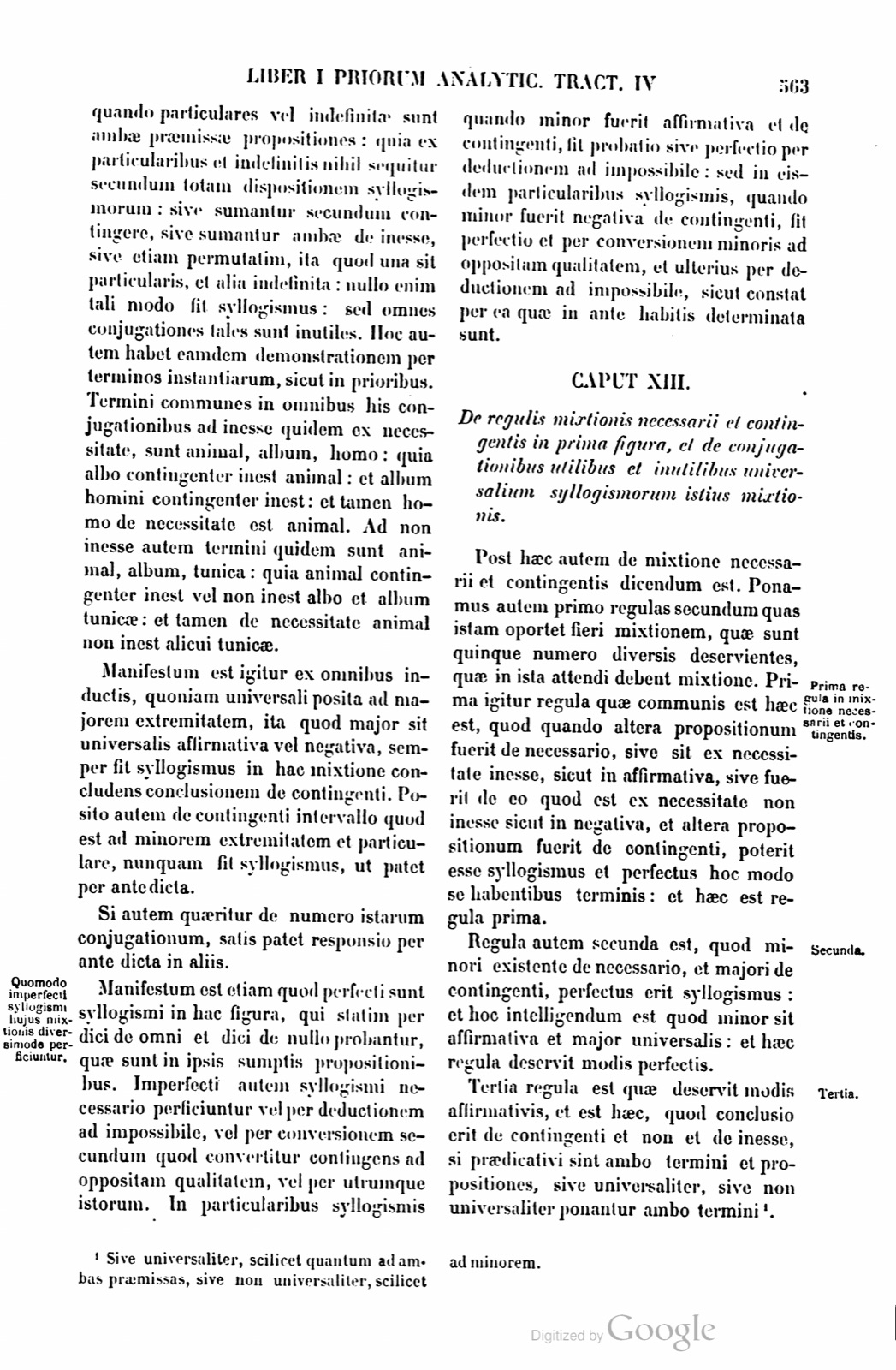
Manifestum est igitur ex omnibus inductis, quoniam universali posita ad majorem extremitatem, ita quod major sit universalis affirmativa vel negativa, semper fit syllogismus in hac mixtione concludens conclusionem de contingenti. Posito autem de contingenti intervallo quod est ad minorem extremitatem et particulare, nunquam fit syllogismus, ut patet per antedicta.
Si autem quaeritur de numero istarum conjugationum, satis patet responsio per ante dicta in aliis.
Manifestum est etiam quod perfecti sunt syllogismi in hac figura, qui statim per dici de omni et dici de nullo probantur, quae sunt in ipsis sumptis propositionibus. Imperfecti autem syllogismi necessario perficiuntur vel per deductionem ad impossibile, vel per conversionem secundum quod convertitur contingens ad oppositam qualitatem, vel per utrumque istorum. In particularibus syllogismis quando minor fuerit affirmativa et de contingenti, fit probatio sive perfectio per deductionem ad impossibile: sed in eisdem particularibus syllogismis, quando minor fuerit negativa de contingenti, fit perfectio et per conversionem minoris ad oppositam qualitatem, et ulterius per deductionem ad impossibile, sicut constat per ea quae in ante habitis determinata sunt.
Therefore it is manifest from all the introduced points that, when the universal is posited at the greater extreme, so that the major is universal affirmative or negative, a syllogism is always made in this mixing concluding a conclusion about the contingent. But when the interval which is at the lesser extreme and particular is posited as of the contingent, a syllogism is never made, as is clear through the things said before.
But if one asks about the number of these conjugations, the response is sufficiently clear through the things said before in the others.
It is also manifest that syllogisms in this figure are perfect which are immediately proved through being said of every and being said of none, which are in the propositions themselves taken. But imperfect syllogisms are necessarily perfected either through deduction to the impossible, or through conversion according as the contingent is converted to the opposite quality, or through both of these. In particular syllogisms, when the minor has been affirmative and of the contingent, proof or perfection is made through deduction to the impossible; but in the same particular syllogisms, when the minor has been negative of the contingent, perfection is made both through conversion of the minor to the opposite quality and further through deduction to the impossible, as is established through those things which have been determined in what was had before.
If a page does not appear, its photograph has not been uploaded yet.