Works › Prior Analytics, Books I–II
Volume 1 · pp. 559–561
Chapter XI. How these imperfect modes infer a conclusion about the contingent for the possible.
A marker with ≈ is an approximate page boundary, placed by measure of the text; the page photographs remain the authority. In the paired views, clicking a page marker brings that page into view.
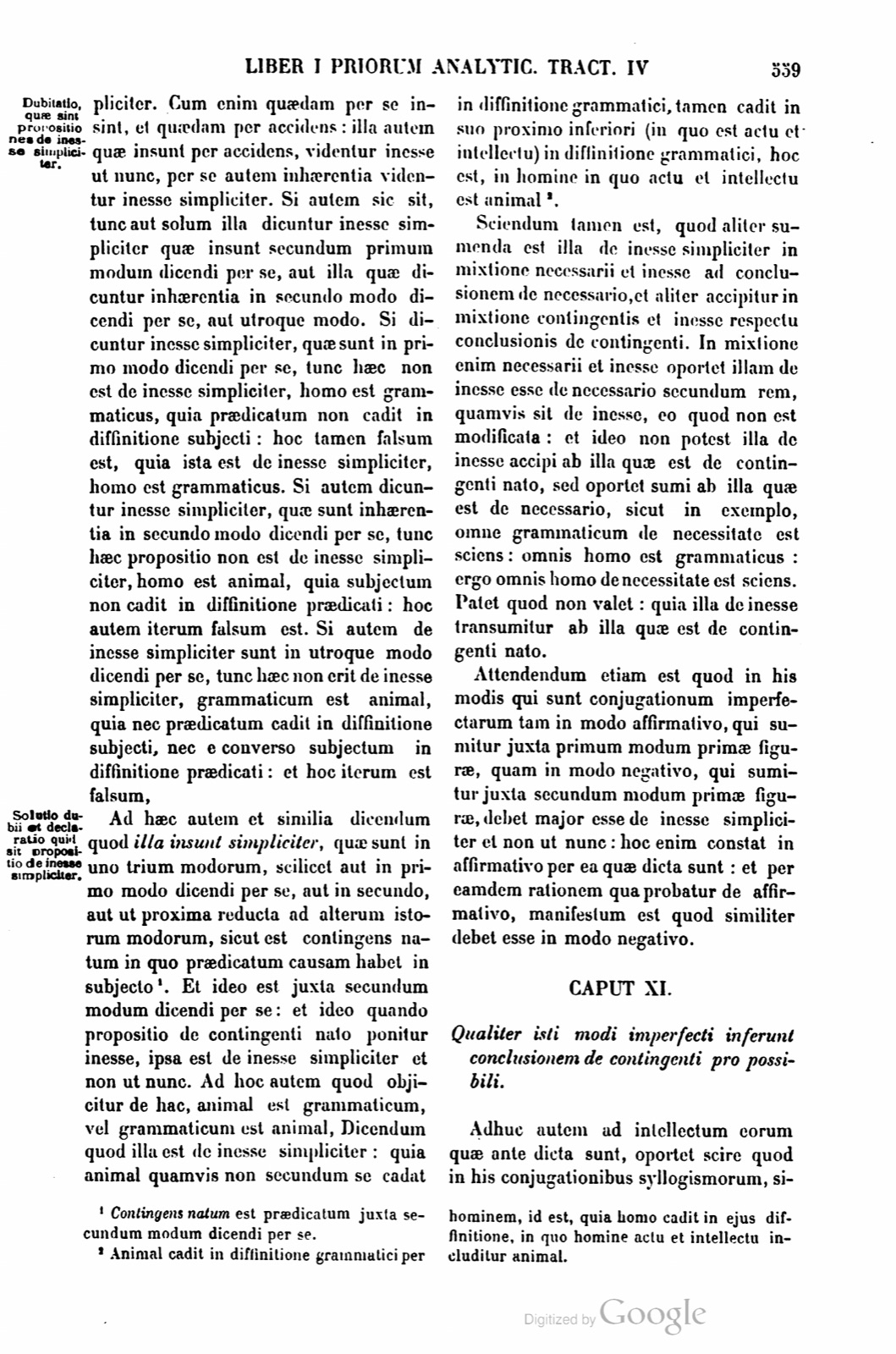
CAPUT XI. Qualiter isti modi imperfecti inferunt conclusionem de contingenti pro possibili.
Adhuc autem ad intellectum eorum quae ante dicta sunt, oportet scire quod in his conjugationibus syllogismorum, sicut in modo negativo est conclusio de contingenti pro possibili: ita per eumdem modum conclusio quae est de contingenti in modo affirmativo, est de contingenti pro possibili. Et hoc probatur ex dispositione terminorum sicut in modo negativo: ex aliqua enim dispositione terminorum sequitur conclusio de necessario, et ex aliqua sequitur conclusio de contingenti ad utrumlibet: et cum nihil sit commune illis duobus, oportet quod contingens quod semper sequitur in tali modo, sit contingens pro possibili, quod solum commune est ad illa duo: hoc enim in modo affirmativo invenitur sicut in negativo. Accipiantur enim termini, in quibus postremum de necessitate insit omni medio, sic, omne album coloratum: contingit omnem hominem esse album: patet quod de necessitate est omnis homo coloratus: unde si inferatur, ergo contingit omnem hominem esse coloratum, erit contingens pro necessario, et quod sequitur ad necessarium. Si autem termini accipiantur, in quibus primum de necessitate inest omni medio, sic, omne ambulans movetur: contingit omnem hominem ambulare: ergo contingit omnem hominem moveri: patet quod conclusio est ad utrumlibet: et hoc est concedendum.
Tamen sciendum quod hoc plus apparet in modis affirmativis quam in modis negativis. In modis enim affirmativis medium et major extremitas ad invicem se habent ut inferius et superius. Patet autem per se: quia regulariter verum est quod inferius et superius uni alicui possunt inesse necessario, et alicui ambo contingenter: si enim album insit, necessario inest coloratum: aliquando autem ambo possunt inesse contingenter, sicut ambulans et movens insunt homini. Et sic per se patet quod in modis affirmativis aliquando sequitur contingens necessarium, et aliquando contingens non necessarium: et sic semper sequitur contingens pro possibili. In modis autem negativis medium et major extremitas se habent ad invicem sicut opposita vel disparata: et in illis regulariter verum est quod si unum oppositorum contingenter inest, reliquum contingenter removetur ab eodem: et ideo ubi major est de tali contingenti, videtur semper sequi conclusio de contingenti ad utrumlibet. Et quia non est ita manifestum quod sequatur conclusio de contingenti pro possibili in modis negativis sicut in modis affirmativis, ideo de modo negativo oportuit hoc probari, et in modo affirmativo tanquam per se manifestum relinqui sine probatione: et ideo in praemissis non est hoc probatum de modo affirmativo.
CHAPTER XI. How these imperfect modes infer a conclusion about the contingent for the possible.
Moreover, for understanding the things that have been said before, one must know that in these conjugations of syllogisms, just as in the negative mode the conclusion is about the contingent for the possible, so through the same mode the conclusion which is about the contingent in the affirmative mode is about the contingent for the possible. And this is proved from the disposition of the terms as in the negative mode. For from one disposition of terms there follows a conclusion of necessity, and from another there follows a conclusion of the contingent toward either alternative; and since nothing is common to those two, the contingent which always follows in such a mode must be the contingent for the possible, which alone is common to those two. For this is found in the affirmative mode as in the negative. For let terms be taken in which the last belongs of necessity to every middle, thus: every white thing is colored; every man contingently is white. It is clear that every man is colored of necessity; hence, if it is inferred, therefore every man contingently is colored, it will be a contingent for the necessary, and something that follows upon the necessary. But if terms are taken in which the first belongs of necessity to every middle, thus: every walking thing is moved; every man contingently walks; therefore every man contingently is moved. It is clear that the conclusion is toward either alternative, and this must be conceded.
Yet it must be known that this appears more in affirmative modes than in negative modes. For in affirmative modes the middle and the greater extreme have themselves to each other as inferior and superior. But it is clear through itself, because it is regularly true that an inferior and a superior can belong necessarily to one thing, and both contingently to another. For if white belongs, colored necessarily belongs; but sometimes both can belong contingently, as walking and moving belong to man. And thus it is clear through itself that in affirmative modes sometimes a necessary contingent follows and sometimes a non-necessary contingent; and thus the contingent for the possible always follows. But in negative modes the middle and the greater extreme have themselves to one another as opposites or disparates; and in these it is regularly true that, if one of the opposites contingently belongs, the other is contingently removed from the same thing. And therefore where the major is about such a contingent, it seems that a conclusion of the contingent toward either alternative always follows. And because it is not as manifest that a conclusion of the contingent for the possible follows in negative modes as in affirmative modes, it was necessary to prove this concerning the negative mode, and in the affirmative mode to leave it without proof as manifest through itself. And therefore in the premises this was not proved concerning the affirmative mode.
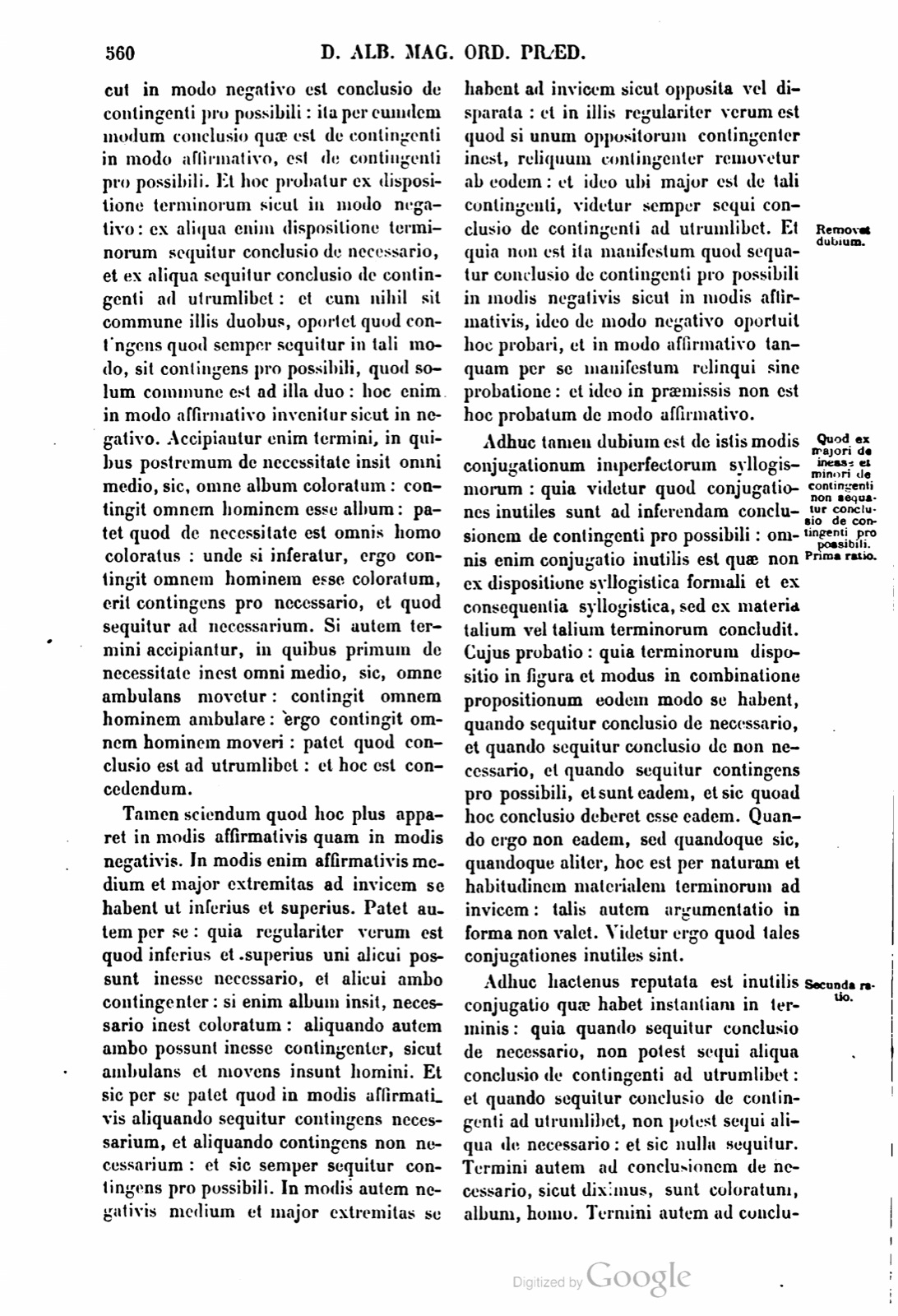
Adhuc tamen dubium est de istis modis conjugationum imperfectorum syllogismorum: quia videtur quod conjugationes inutiles sunt ad inferendam conclusionem de contingenti pro possibili: omnis enim conjugatio inutilis est quae non ex dispositione syllogistica formali et ex consequentia syllogistica, sed ex materia talium vel talium terminorum concludit. Cujus probatio: quia terminorum dispositio in figura et modus in combinatione propositionum eodem modo se habent, quando sequitur conclusio de necessario, et quando sequitur conclusio de non necessario, et quando sequitur contingens pro possibili, et sunt eadem, et sic quoad hoc conclusio deberet esse eadem. Quando ergo non eadem, sed quandoque sic, quandoque aliter, hoc est per naturam et habitudinem materialem terminorum ad invicem: talis autem argumentatio in forma non valet. Videtur ergo quod tales conjugationes inutiles sint.
Adhuc hactenus reputata est inutilis conjugatio quae habet instantiam in terminis: quia quando sequitur conclusio de necessario, non potest sequi aliqua conclusio de contingenti ad utrumlibet: et quando sequitur conclusio de contingenti ad utrumlibet, non potest sequi aliqua de necessario: et sic nulla sequitur. Termini autem ad conclusionem de necessario, sicut diximus, sunt coloratum, album, homo. Termini autem ad conclusionem de contingenti ad utrumlibet, sunt movens, ambulans, homo: et formantur syllogismi, sicut supra formati sunt.
Adhuc nihil est in genere quod non sit in aliqua specierum: ergo nihil est contingens commune ad necessarium et ad non necessarium, nisi sit aut in contingenti necessario, aut in contingenti non necessario: et sic nulla est conclusio de contingenti pro possibili in communi ad utrumque istorum, quae distincta sit a conclusionibus specialibus, quae sunt de contingenti pro necessario, et de contingenti pro non necessario.
Si autem hoc concedatur, videtur objici in contrarium: quia in omnibus et ubique infertur genus ex speciebus; constat autem ex praehabitis, quod in talibus conjugationibus sequitur conclusio de contingenti pro necessario, et quod sequitur conclusio de contingenti pro non necessario, quae sunt species contingentis pro possibili: ergo oportet quod sequatur conclusio de contingenti pro possibili.
Still there is a doubt about these modes of conjugations of imperfect syllogisms, because it seems that the conjugations are useless for inferring a conclusion about the contingent for the possible. For every conjugation is useless which concludes not from formal syllogistic disposition and from syllogistic consequence, but from the matter of such or such terms. Its proof is this: because the disposition of the terms in the figure and the mode in the combination of propositions have themselves in the same way when a conclusion of necessity follows, and when a conclusion of non-necessity follows, and when the contingent for the possible follows; and they are the same. And thus with respect to this the conclusion ought to be the same. Therefore when it is not the same, but sometimes in this way and sometimes otherwise, this is through the nature and material relation of the terms to one another; but such argumentation is not valid in form. Therefore it seems that such conjugations are useless.
Moreover, up to now a conjugation has been regarded as useless which has an instance in terms, because when a conclusion of necessity follows, no conclusion of the contingent toward either alternative can follow; and when a conclusion of the contingent toward either alternative follows, none of necessity can follow; and thus none follows. But the terms for a conclusion of necessity, as we said, are colored, white, man. But the terms for a conclusion of the contingent toward either alternative are moving, walking, man; and the syllogisms are formed as they were formed above.
Again, nothing exists in a genus which is not in some one of the species; therefore there is no contingent common to the necessary and to the non-necessary unless it is either in the necessary contingent or in the non-necessary contingent. And thus there is no conclusion about the contingent for the possible in common to each of these which is distinct from the special conclusions, which are about the contingent for the necessary and about the contingent for the non-necessary.
But if this is conceded, there seems to be an objection to the contrary, because in all things and everywhere the genus is inferred from the species; but it is established from what was had before that in such conjugations there follows a conclusion about the contingent for the necessary, and that there follows a conclusion about the contingent for the non-necessary, which are species of the contingent for the possible. Therefore a conclusion about the contingent for the possible must follow.
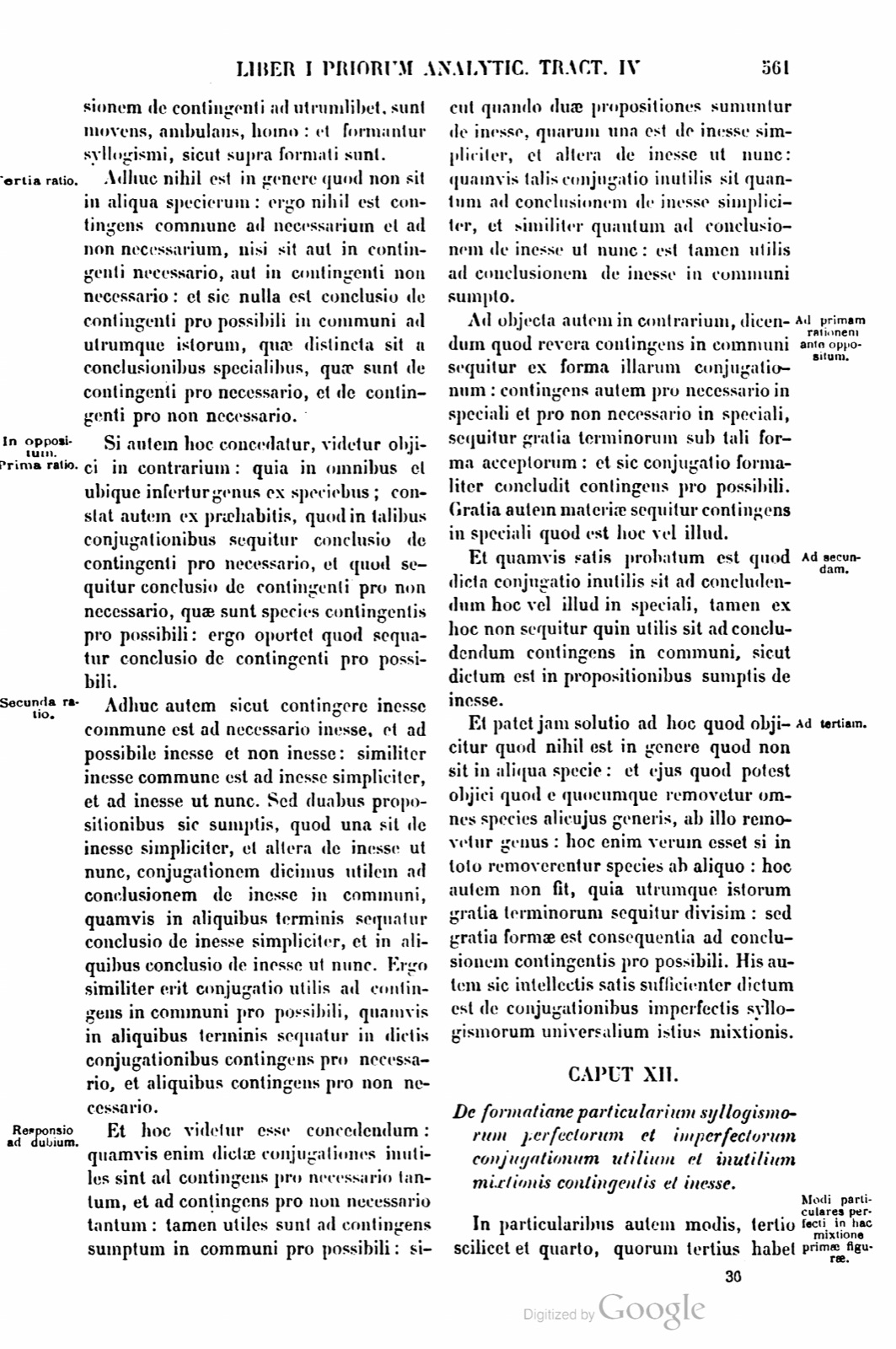
Adhuc autem sicut contingere inesse commune est ad necessario inesse, et ad possibile inesse et non inesse: similiter inesse commune est ad inesse simpliciter, et ad inesse ut nunc. Sed duabus propositionibus sic sumptis, quod una sit de inesse simpliciter, et altera de inesse ut nunc, conjugationem dicimus utilem ad conclusionem de inesse in communi, quamvis in aliquibus terminis sequatur conclusio de inesse simpliciter, et in aliquibus conclusio de inesse ut nunc. Ergo similiter erit conjugatio utilis ad contingens in communi pro possibili, quamvis in aliquibus terminis sequatur in dictis conjugationibus contingens pro necessario, et aliquibus contingens pro non necessario.
Et hoc videtur esse concedendum: quamvis enim dictae conjugationes inutiles sint ad contingens pro necessario tantum, et ad contingens pro non necessario tantum: tamen utiles sunt ad contingens sumptum in communi pro possibili: sicut quando duae propositiones sumuntur de inesse, quarum una est de inesse simpliciter, et altera de inesse ut nunc: quamvis talis conjugatio inutilis sit quantum ad conclusionem de inesse simpliciter, et similiter quantum ad conclusionem de inesse ut nunc: est tamen utilis ad conclusionem de inesse in communi sumpto.
Ad objecta autem in contrarium, dicendum quod revera contingens in communi sequitur ex forma illarum conjugationum: contingens autem pro necessario in speciali et pro non necessario in speciali, sequitur gratia terminorum sub tali forma acceptorum: et sic conjugatio formaliter concludit contingens pro possibili. Gratia autem materiae sequitur contingens in speciali quod est hoc vel illud.
Et quamvis satis probatum est quod dicta conjugatio inutilis sit ad concludendum hoc vel illud in speciali, tamen ex hoc non sequitur quin utilis sit ad concludendum contingens in communi, sicut dictum est in propositionibus sumptis de inesse.
Et patet jam solutio ad hoc quod objicitur quod nihil est in genere quod non sit in aliqua specie: et ejus quod potest objici quod e quocumque removetur omnes species alicujus generis, ab illo removetur genus: hoc enim verum esset si in toto removerentur species ab aliquo: hoc autem non fit, quia utrumque istorum gratia terminorum sequitur divisim: sed gratia formae est consequentia ad conclusionem contingentis pro possibili. His autem sic intellectis satis sufficienter dictum est de conjugationibus imperfectis syllogismorum universalium istius mixtionis.
Moreover, just as contingently inhering is common to necessarily inhering and to possibly inhering and not inhering, similarly inherence is common to inherence simply and to inherence as now. But when two propositions are taken thus, so that one is of inherence simply and the other of inherence as now, we call the conjugation useful for a conclusion of inherence taken in common, although in some terms a conclusion of inherence simply follows and in some a conclusion of inherence as now. Therefore similarly the conjugation will be useful for the contingent in common for the possible, although in some terms in the stated conjugations the contingent for the necessary follows and in some the contingent for the non-necessary.
And this seems to have to be conceded: for although the stated conjugations are useless for the contingent for the necessary only, and for the contingent for the non-necessary only, nevertheless they are useful for the contingent taken in common for the possible. This is as when two propositions are taken of inherence, one of which is of inherence simply and the other of inherence as now. Although such a conjugation is useless with respect to a conclusion of inherence simply, and similarly with respect to a conclusion of inherence as now, nevertheless it is useful for a conclusion of inherence taken in common.
But to the objections to the contrary one must say that in truth the contingent in common follows from the form of those conjugations. But the contingent for the necessary in particular and for the non-necessary in particular follows by reason of the terms taken under such a form; and thus the conjugation formally concludes the contingent for the possible. But by reason of the matter there follows the contingent in particular which is this or that.
And although it has been sufficiently proved that the stated conjugation is useless for concluding this or that in particular, nevertheless from this it does not follow that it is not useful for concluding the contingent in common, as was said in propositions taken of inherence.
And now the solution is clear to what is objected, that nothing exists in a genus which is not in some species, and to what can be objected, that from whatever all species of some genus are removed, from that the genus is removed. For this would be true if the species were removed from something wholly; but this is not done, because each of these follows separately by reason of the terms. But by reason of the form there is consequence to the conclusion of the contingent for the possible. With these things thus understood, enough has been sufficiently said about the imperfect conjugations of universal syllogisms of this mixing.
If a page does not appear, its photograph has not been uploaded yet.