Works › Prior Analytics, Books I–II
Volume 1 · pp. 558–559
Chapter X. What inherence simply is.
A marker with ≈ is an approximate page boundary, placed by measure of the text; the page photographs remain the authority. In the paired views, clicking a page marker brings that page into view.
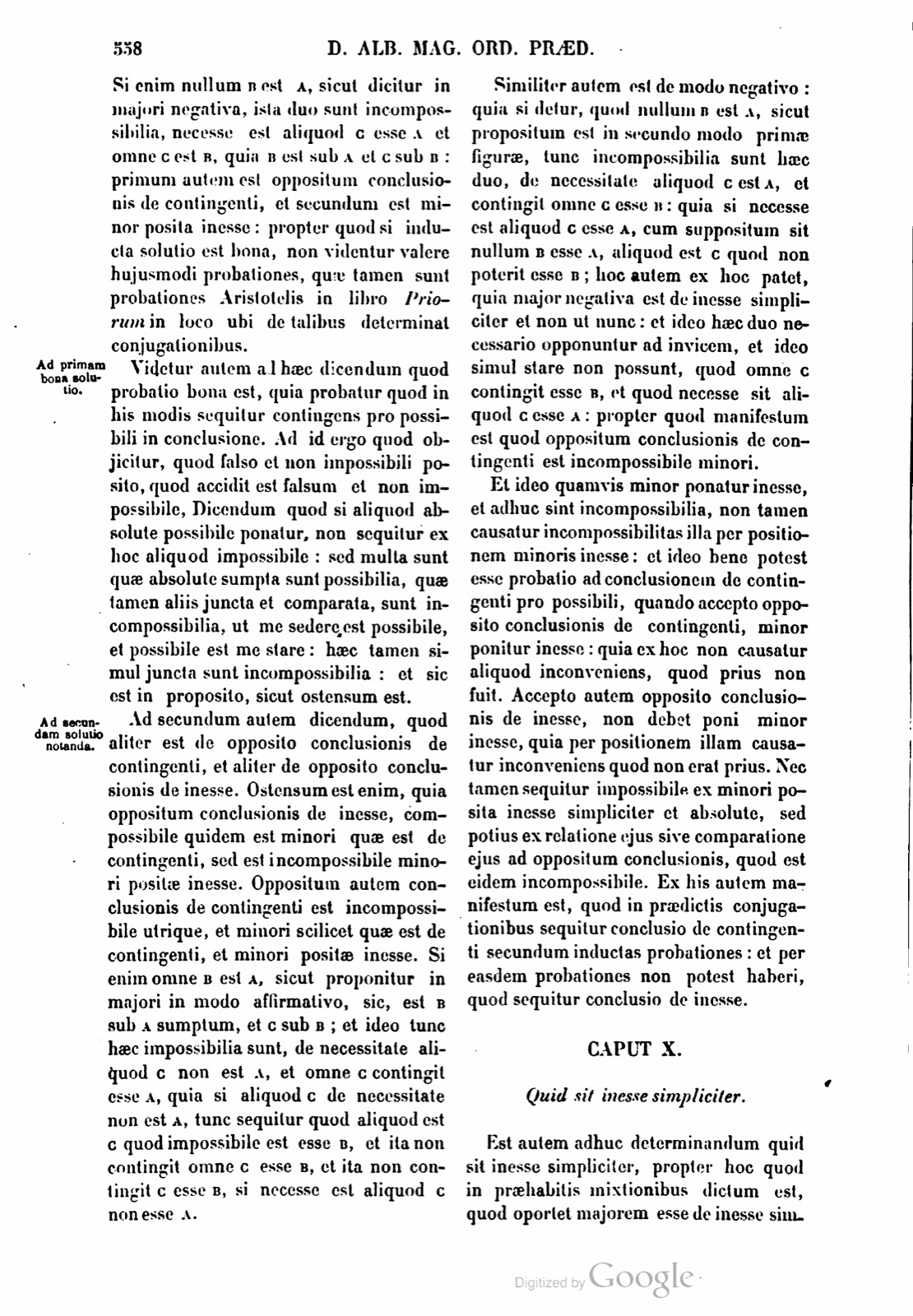
CAPUT X. Quid sit inesse simpliciter.
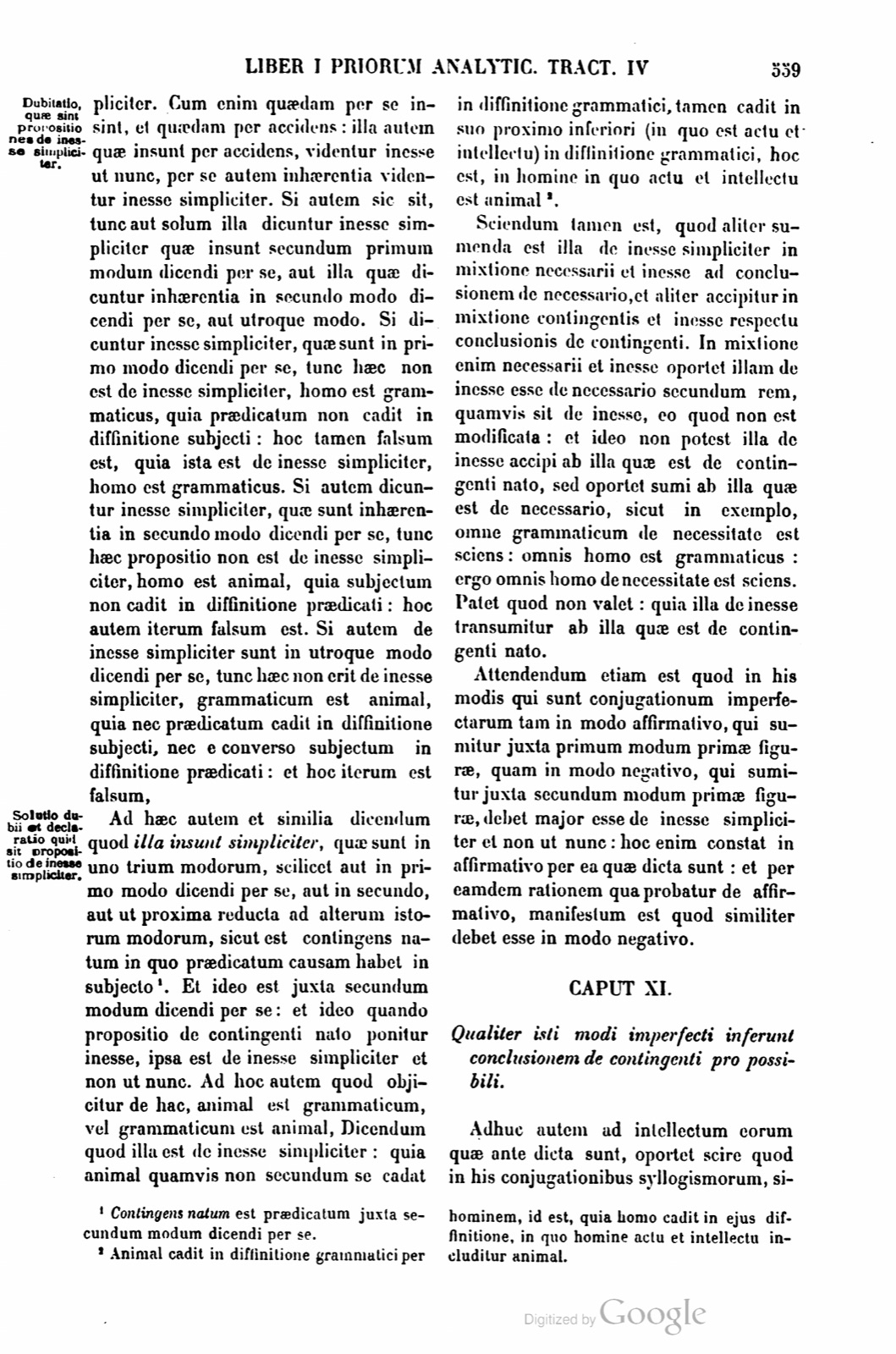
Est autem adhuc determinandum quid sit inesse simpliciter, propter hoc quod in praehabitis mixtionibus dictum est, quod oportet majorem esse de inesse simpliciter. Cum enim quaedam per se insint, et quaedam per accidens: illa autem quae insunt per accidens, videntur inesse ut nunc, per se autem inhaerentia videntur inesse simpliciter. Si autem sic sit, tunc aut solum illa dicuntur inesse simpliciter quae insunt secundum primum modum dicendi per se, aut illa quae dicuntur inhaerentia in secundo modo dicendi per se, aut utroque modo. Si dicuntur inesse simpliciter, quae sunt in primo modo dicendi per se, tunc haec non est de inesse simpliciter, homo est grammaticus, quia praedicatum non cadit in diffinitione subjecti: hoc tamen falsum est, quia ista est de inesse simpliciter, homo est grammaticus. Si autem dicuntur inesse simpliciter, quae sunt inhaerentia in secundo modo dicendi per se, tunc haec propositio non est de inesse simpliciter, homo est animal, quia subjectum non cadit in diffinitione praedicati: hoc autem iterum falsum est. Si autem de inesse simpliciter sunt in utroque modo dicendi per se, tunc haec non erit de inesse simpliciter, grammaticum est animal, quia nec praedicatum cadit in diffinitione subjecti, nec e converso subjectum in diffinitione praedicati: et hoc iterum est falsum.
Ad haec autem et similia dicendum quod illa insunt simpliciter, quae sunt in uno trium modorum, scilicet aut in primo modo dicendi per se, aut in secundo, aut ut proxima reducta ad alterum istorum modorum, sicut est contingens natum in quo praedicatum causam habet in subjecto1. Et ideo est juxta secundum modum dicendi per se: et ideo quando propositio de contingenti nato ponitur inesse, ipsa est de inesse simpliciter et non ut nunc. Ad hoc autem quod objicitur de hac, animal est grammaticum, vel grammaticum est animal, dicendum quod illa est de inesse simpliciter: quia animal quamvis non secundum se cadat in diffinitione grammatici, tamen cadit in suo proximo inferiori, in quo est actu et intellectu, in diffinitione grammatici, hoc est, in homine in quo actu et intellectu est animal2.
CHAPTER X. What inherence simply is.
It must still be determined what inherence simply is, because in the preceding mixings it was said that the major must be of inherence simply. For since some things belong through themselves and some accidentally, those things which belong accidentally seem to belong as now, but things inhering through themselves seem to belong simply. But if this is so, then either only those things are said to belong simply which belong according to the first mode of being said through itself, or those things which are called inhering in the second mode of being said through itself, or in both modes. If those things which are in the first mode of being said through itself are said to belong simply, then this is not of inherence simply: man is grammatical, because the predicate does not fall in the definition of the subject. Yet this is false, because this proposition is of inherence simply: man is grammatical. But if those things are said to belong simply which are inhering in the second mode of being said through itself, then this proposition is not of inherence simply: man is an animal, because the subject does not fall in the definition of the predicate. But this again is false. But if propositions of inherence simply are in both modes of being said through itself, then this will not be of inherence simply: the grammatical is animal, because neither does the predicate fall in the definition of the subject, nor conversely the subject in the definition of the predicate; and this again is false.
But to these and similar things one must say that those things belong simply which are in one of three modes, namely either in the first mode of being said through itself, or in the second, or as things proximately reduced to one of those modes, as is the natural contingent in which the predicate has a cause in the subject1. And therefore it is beside the second mode of being said through itself; and therefore when a proposition about the natural contingent is posited as inhering, it is itself of inherence simply and not as now. But to that which is objected about this, animal is grammatical, or the grammatical is animal, one must say that that proposition is of inherence simply, because although animal does not according to itself fall in the definition of grammatical, nevertheless it falls in its proximate inferior, in which it exists actually and intellectually, in the definition of grammatical, that is, in man in whom animal exists actually and intellectually2.
Sciendum tamen est, quod aliter sumenda est illa de inesse simpliciter in mixtione necessarii et inesse ad conclusionem de necessario, et aliter accipitur in mixtione contingentis et inesse respectu conclusionis de contingenti. In mixtione enim necessarii et inesse oportet illam de inesse esse de necessario secundum rem, quamvis sit de inesse, eo quod non est modificata: et ideo non potest illa de inesse accipi ab illa quae est de contingenti nato, sed oportet sumi ab illa quae est de necessario, sicut in exemplo, omne grammaticum de necessitate est sciens: omnis homo est grammaticus: ergo omnis homo de necessitate est sciens. Patet quod non valet: quia illa de inesse transumitur ab illa quae est de contingenti nato.
Attendendum etiam est quod in his modis qui sunt conjugationum imperfectarum tam in modo affirmativo, qui sumitur juxta primum modum primae figurae, quam in modo negativo, qui sumitur juxta secundum modum primae figurae, debet major esse de inesse simpliciter et non ut nunc: hoc enim constat in affirmativo per ea quae dicta sunt: et per eamdem rationem qua probatur de affirmativo, manifestum est quod similiter debet esse in modo negativo.
Nevertheless it must be known that that proposition of inherence simply must be taken in one way in the mixing of the necessary and inherence for a conclusion of necessity, and in another way it is taken in the mixing of the contingent and inherence with respect to a conclusion about the contingent. For in the mixing of the necessary and inherence, that proposition of inherence must be of necessity according to the thing, although it is of inherence because it is not modified; and therefore that proposition of inherence cannot be taken from that which is about the natural contingent, but must be taken from that which is of necessity, as in the example: every grammatical thing of necessity is knowing; every man is grammatical; therefore every man of necessity is knowing. It is clear that it is not valid, because that proposition of inherence is transferred from that which is about the natural contingent.
It must also be attended to that in these modes which belong to imperfect conjugations, both in the affirmative mode, which is taken according to the first mode of the first figure, and in the negative mode, which is taken according to the second mode of the first figure, the major must be of inherence simply and not as now. For this is established in the affirmative by the things that have been said; and by the same reason by which it is proved concerning the affirmative, it is manifest that it must similarly be so in the negative mode.
Notes
- The natural contingent is a predicate beside the second mode of being said through itself. (Contingens natum est praedicatum juxta secundum modum dicendi per se.) ↩
- Animal falls in the definition of grammatical through man, that is, because man falls in its definition, in which man animal is included actually and intellectually. (Animal cadit in diffinitione grammatici per hominem, id est, quia homo cadit in ejus diffinitione, in quo homine actu et intellectu includitur animal.) ↩
If a page does not appear, its photograph has not been uploaded yet.