Works › Prior Analytics, Books I–II
Volume 1 · pp. 556–558
Chapter IX. Whether a conclusion of inherence can follow from the conjugations of imperfect syllogisms.
A marker with ≈ is an approximate page boundary, placed by measure of the text; the page photographs remain the authority. In the paired views, clicking a page marker brings that page into view.
CAPUT IX. An conclusio de inesse sequi possit ex conjugationibus syllogismorum imperfectorum.
Quaerendum autem utrum conclusio de inesse sequi possit ex conjugationibus syllogismorum imperfectorum. Hoc enim videtur per eumdem modum probandi qui dictus est, sic, omne B est A, contingit omne C esse B, concludatur, ergo omne C est A. Si non sequitur, detur oppositum, aliquod C non est A, et accipiatur minor posita inesse sic, omne C est B, sequitur ex opposito conclusionis dato et minori posita inesse in quinto modo tertiae figurae, quod aliquod B non est A, quae est opposita majoris, istius scilicet, omne B est A.
Similiter autem videtur esse in modo negativo sic, nullum B est A, contingit omne C esse B, concludatur, ergo nullum C est A. Si non sequitur, detur oppositum, aliquod C est A, et ponatur minor inesse sic, aliquod C est A, omne C est B, sequitur in tertio tertiae, quod aliquod B est A, et datum fuit quod nullum B est A, et sic videtur quod istae conjugationes possunt in conclusione de inesse1.
Quod si concedatur, videtur contrarium in terminis: ponatur enim quod nullus homo moveatur, et syllogizetur sic in modo affirmativo: omne ambulans est movens: contingit omnem hominem ambulare: sequitur per conclusionem de inesse, ergo omnis homo movetur. Patet quod ambae praemissae sunt verae, et tamen conclusio est falsa.
Similiter autem est de modo negativo, sic, nullum album est nigrum: contingit omnem hominem esse album: sequitur per conclusionem de inesse, quod nullus homo est niger: quod non est verum, si ponatur, omnis homo est niger: et sic iterum conclusio erit falsa, et ambae praemissae sunt verae. Videtur igitur quod ex istis conjugationibus non potest sequi conclusio de inesse, et hoc est concedendum.
Dicendum autem ad instantias quae inducuntur, quod cum datur oppositum conclusionis quae est de inesse, erit illius conclusionis oppositum de inesse, et illud stat cum utraque praemissarum: quia cum B sit sub A, sicut medium est sub majori extremitate in prima figura, quamvis omne B sit A, possibile tamen est quod B medium contingenter insit omni C minori scilicet extremitati: et sic haec erit vera, omne C contingit esse B, et sic oppositum conclusionis verificatur cum illa de contingenti quae est minor: possibile est enim quod aliquod C non sit A, et tamen omne C contingat esse B. Sed non est possibile quod verificetur oppositum conclusionis cum minori posita inesse: accipiatur enim oppositum conclusionis, quod est, aliquod C non est A, cum minori posita inesse, scilicet, omne C est B: sic non verificatur cum ipsa oppositum conclusionis, quia cum omne B sit A, et omne C B, sequitur quod omne C A, cujus opposita minori positae inesse repugnat: quia per primam relinquitur cum C sit sub B quod aliquod C sit A, vel quod omne C sit A, cum quo non potest stare oppositum conclusionis: et tamen stat cum ipsa minori quae est de contingenti: quia istae simul possunt esse verae, aliquod C non est A, et omne C contingit esse B, quamvis B sit sub A et C sit sub B, et ideo minor non debet poni inesse: quia statim ut ponitur inesse, erit incompossibilis opposito conclusionis: et ex ista incompossibilitate sequitur praedictum inconveniens.
CHAPTER IX. Whether a conclusion of inherence can follow from the conjugations of imperfect syllogisms.
But it must be asked whether a conclusion of inherence can follow from the conjugations of imperfect syllogisms. For this seems so through the same mode of proving that was stated, thus: every B is A; every C contingently is B; let it be concluded, therefore every C is A. If it does not follow, let the opposite be granted, some C is not A, and let the minor be taken as posited in inherence thus: every C is B. From the opposite of the conclusion granted and the minor posited as inhering, there follows, in the fifth mode of the third figure, that some B is not A, which is the opposite of the major, namely of this: every B is A.
Similarly it seems to be so in the negative mode thus: no B is A; every C contingently is B; let it be concluded, therefore no C is A. If it does not follow, let the opposite be granted, some C is A, and let the minor be posited as inhering thus: some C is A; every C is B; there follows in the third of the third that some B is A, and it had been granted that no B is A. And thus it seems that these conjugations can conclude in a conclusion of inherence1.
But if this is conceded, the contrary seems evident in terms. For let it be posited that no man is moved, and let a syllogism be made thus in the affirmative mode: every walking thing is moving; every man contingently walks; by a conclusion of inherence it follows, therefore every man is moved. It is clear that both premises are true and nevertheless the conclusion is false.
Similarly it is in the negative mode thus: no white thing is black; every man contingently is white; by a conclusion of inherence it follows that no man is black. But this is not true if it is posited that every man is black. And thus again the conclusion will be false, and both premises are true. Therefore it seems that from these conjugations a conclusion of inherence cannot follow, and this must be conceded.
But to the instances that are introduced one must say that, when the opposite of a conclusion which is of inherence is granted, the opposite of that conclusion will be of inherence, and that stands with each premise. For since B is under A, as the middle is under the greater extreme in the first figure, although every B is A, nevertheless it is possible that B the middle contingently belongs to every C, namely the lesser extreme; and thus this will be true: every C contingently is B. And thus the opposite of the conclusion is verified with that proposition of the contingent which is the minor; for it is possible that some C is not A, and nevertheless every C contingently is B. But it is not possible that the opposite of the conclusion be verified with the minor posited as inhering. For let the opposite of the conclusion be taken, which is: some C is not A, with the minor posited as inhering, namely: every C is B. Thus the opposite of the conclusion is not verified with it, because since every B is A and every C is B, it follows that every C is A, whose opposite is repugnant to the minor posited as inhering. For through the first proposition it is left, since C is under B, that some C is A, or that every C is A, with which the opposite of the conclusion cannot stand; and nevertheless it stands with the minor itself which is of the contingent. For these can be true at once: some C is not A, and every C contingently is B, although B is under A and C is under B. And therefore the minor must not be posited as inhering, because immediately when it is posited as inhering it will be incompossible with the opposite of the conclusion; and from this incompossibility the aforesaid inconvenience follows.
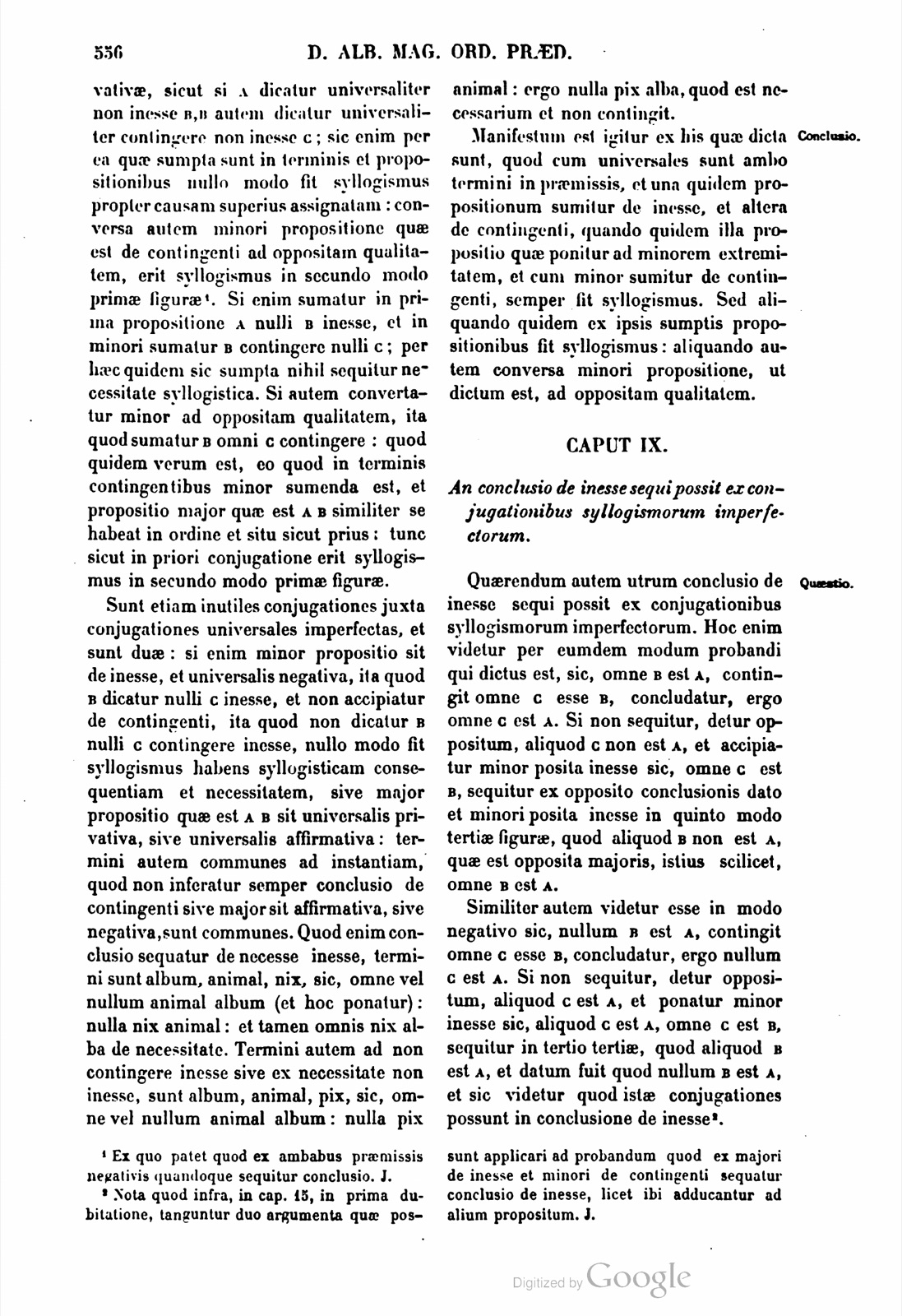
Eodem modo dicendum est in modo negativo: quia non debet admitti, quod minor de contingenti ponatur inesse: quia oppositum conclusionis compossibile est illi quae est de contingente, et non est compossibile illi quae est de inesse, quae sumitur ab illa quae est de contingente. Ex majori enim habetur quod nullum C sit A, propter hoc quod C est sub B, et in majori ponitur nullum B esse A, cum hoc autem non stat quod aliquod C sit A, quia ista sunt contradictoria: tamen simul stare possunt istae, aliquod C est A, et quod omne C contingit esse B, et ita si minor ponatur inesse, erit incompossibilis opposito conclusionis, et ex illa incompossibilitate causatur inconveniens quod inductum est.
Si forte aliquis contra hoc objiciens dicat, quod falso et non impossibili posito quod accidit est falsum et non impossibile: cum autem minor quae est de contingenti ponitur inesse, non erit impossibile: et ideo ex illo non potest sequi impossibile: sequitur autem falsum: patet igitur quod inducta solutio non videtur esse sufficiens.
Adhuc autem si inducta solutio est sufficiens, tunc videtur quod non valet probatio, qua probatur quod in his modis sequitur contingens pro possibili: oppositum enim conclusionis incompossibile est minori positae inesse. Verbi gratia si in modo affirmativo ponatur omne B esse A, erunt incompossibilia haec duo, aliquod C de necessitate non est A, et omne C est B, quia B est sub A et C sub B, quorum primum est oppositum conclusionis de contingenti, et secundum est minor posita inesse.
Similiter etiam est in modo negativo. Si enim nullum B est A, sicut dicitur in majori negativa, ista duo sunt incompossibilia, necesse est aliquod C esse A et omne C est B, quia B est sub A et C sub B: primum autem est oppositum conclusionis de contingenti, et secundum est minor posita inesse: propter quod si inducta solutio est bona, non videntur valere hujusmodi probationes, quae tamen sunt probationes Aristotelis in libro Priorum in loco ubi de talibus determinat conjugationibus.
Videtur autem ad haec dicendum quod probatio bona est, quia probatur quod in his modis sequitur contingens pro possibili in conclusione. Ad id ergo quod objicitur, quod falso et non impossibili posito, quod accidit est falsum et non impossibile, dicendum quod si aliquod absolute possibile ponatur, non sequitur ex hoc aliquod impossibile: sed multa sunt quae absolute sumpta sunt possibilia, quae tamen aliis juncta et comparata, sunt incompossibilia, ut me sedere est possibile, et possibile est me stare: haec tamen simul juncta sunt incompossibilia: et sic est in proposito, sicut ostensum est.
In the same way one must speak in the negative mode, because it must not be admitted that the minor of the contingent be posited as inhering, because the opposite of the conclusion is compossible with that proposition which is of the contingent, and is not compossible with that proposition which is of inherence, which is taken from that which is of the contingent. For from the major it is had that no C is A, because C is under B, and in the major it is posited that no B is A. But that some C is A does not stand with this, because those are contradictories. Nevertheless these can stand at once: some C is A, and every C contingently is B. And so, if the minor is posited as inhering, it will be incompossible with the opposite of the conclusion, and from that incompossibility the inconvenience that was introduced is caused.
If perhaps someone, objecting against this, says that when something false and not impossible is posited, what happens is false and not impossible; but when the minor which is of the contingent is posited as inhering, it will not be impossible, and therefore from it the impossible cannot follow, but the false follows; therefore it is clear that the introduced solution does not seem sufficient.
Moreover, if the introduced solution is sufficient, then it seems that the proof is not valid by which it is proved that in these modes the contingent for the possible follows. For the opposite of the conclusion is incompossible with the minor posited as inhering. For example, if in the affirmative mode every B is posited to be A, these two will be incompossible: some C of necessity is not A, and every C is B, because B is under A and C under B. The first of these is the opposite of the conclusion about the contingent, and the second is the minor posited as inhering.
Similarly it is also in the negative mode. For if no B is A is granted, as is said in the negative major, these two are incompossible: it is necessary that some C be A, and every C is B, because B is under A and C under B. But the first is the opposite of the conclusion about the contingent, and the second is the minor posited as inhering. Therefore, if the introduced solution is good, proofs of this kind do not seem to be valid, although they are the proofs of Aristotle in the book of the Prior Analytics in the place where he determines such conjugations.
But it seems that to these things one must say that the proof is good, because it is proved that in these modes the contingent for the possible follows in the conclusion. Therefore to that which is objected, that, when the false and non-impossible has been posited, what happens is false and non-impossible, one must say that if something absolutely possible is posited, from this nothing impossible follows. But there are many things which, taken absolutely, are possible, yet, when joined and compared with others, are incompossible, as it is possible for me to sit, and it is possible for me to stand; yet these, joined at the same time, are incompossible. And so it is in the case proposed, as has been shown.
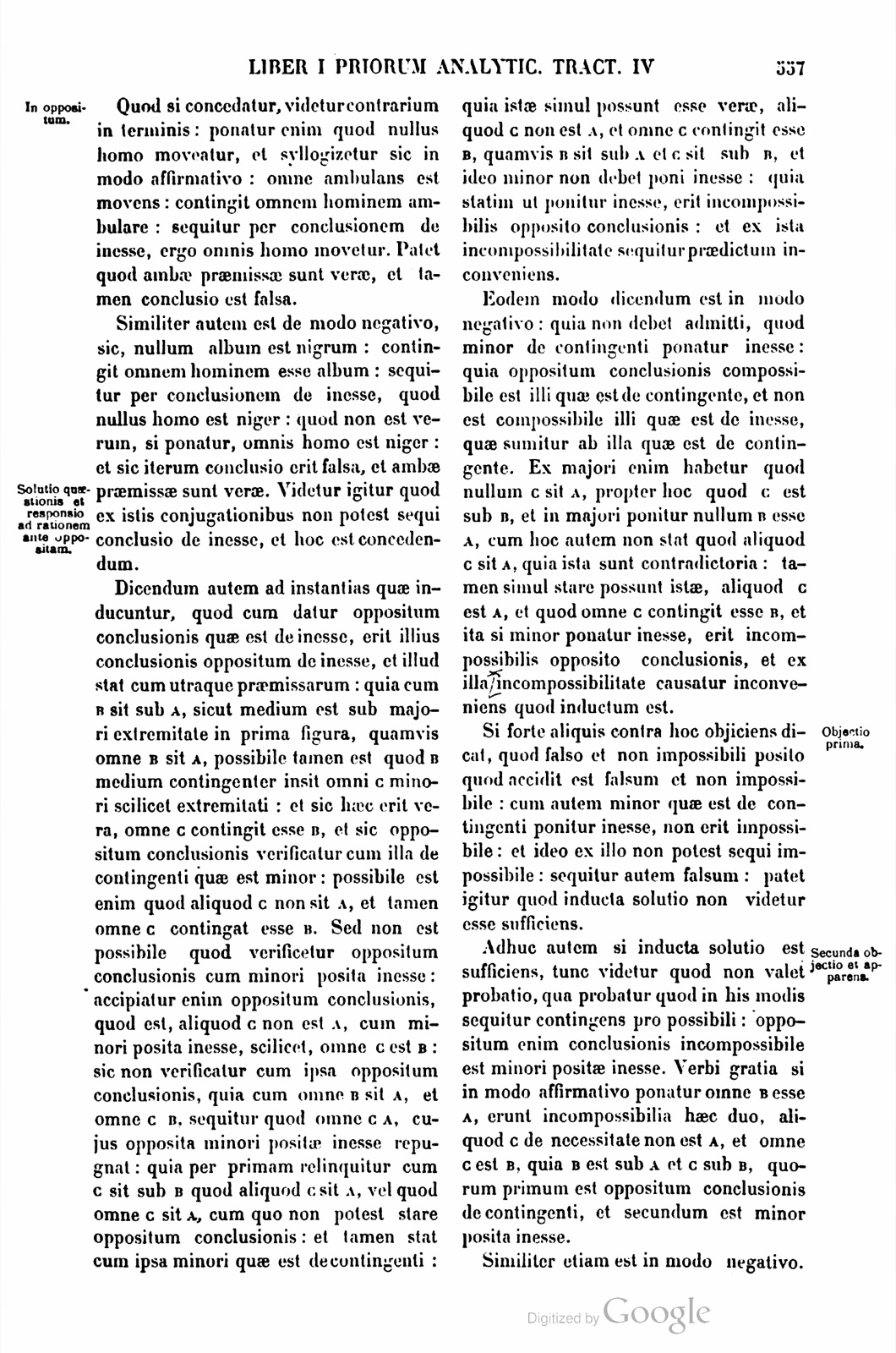
Ad secundum autem dicendum, quod aliter est de opposito conclusionis de contingenti, et aliter de opposito conclusionis de inesse. Ostensum est enim, quia oppositum conclusionis de inesse, compossibile quidem est minori quae est de contingenti, sed est incompossibile minori positae inesse. Oppositum autem conclusionis de contingenti est incompossibile utrique, et minori scilicet quae est de contingenti, et minori positae inesse. Si enim omne B est A, sicut proponitur in majori in modo affirmativo, sic, est B sub A sumptum, et C sub B; et ideo tunc haec impossibilia sunt, de necessitate aliquod C non est A, et omne C contingit esse B, quia si aliquod C de necessitate non est A, tunc sequitur quod aliquod est C quod impossibile est esse B, et ita non contingit omne C esse B, et ita non contingit C esse B, si necesse est aliquod C non esse A.
Similiter autem est de modo negativo: quia si detur, quod nullum B est A, sicut propositum est in secundo modo primae figurae, tunc incompossibilia sunt haec duo, de necessitate aliquod C est A, et contingit omne C esse B: quia si necesse est aliquod C esse A, cum suppositum sit nullum B esse A, aliquod est A quod non poterit esse B; hoc autem ex hoc patet, quia major negativa est de inesse simpliciter et non ut nunc: et ideo haec duo necessario opponuntur ad invicem, et ideo simul stare non possunt, quod omne C contingit esse B, et quod necesse sit aliquod C esse A: propter quod manifestum est quod oppositum conclusionis de contingenti est incompossibile minori.
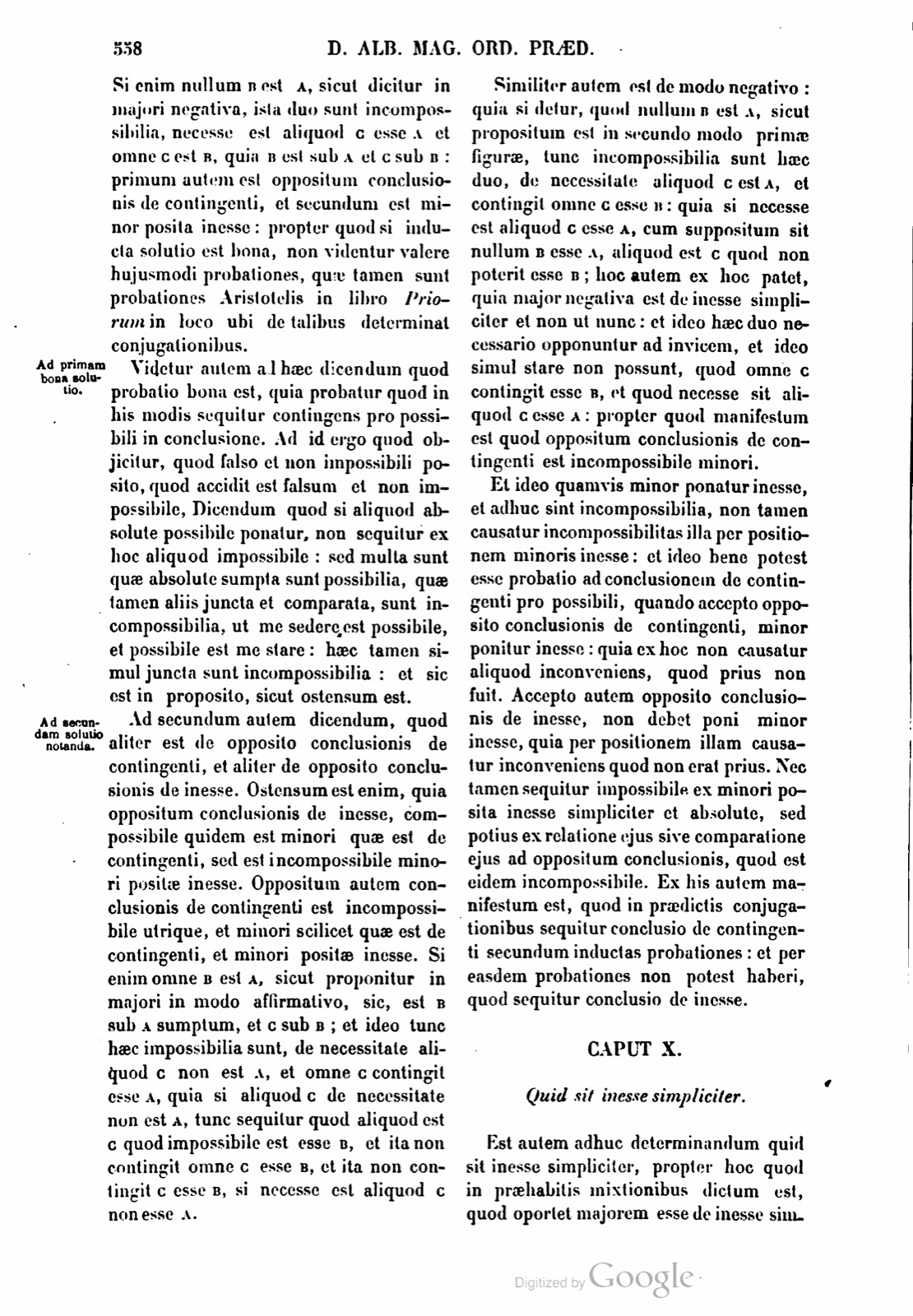
Et ideo quamvis minor ponatur inesse, et adhuc sint incompossibilia, non tamen causatur incompossibilitas illa per positionem minoris inesse: et ideo bene potest esse probatio ad conclusionem de contingenti pro possibili, quando accepto opposito conclusionis de contingenti, minor ponitur inesse: quia ex hoc non causatur aliquod inconveniens, quod prius non fuit. Accepto autem opposito conclusionis de inesse, non debet poni minor inesse, quia per positionem illam causatur inconveniens quod non erat prius. Nec tamen sequitur impossibile ex minori posita inesse simpliciter et absolute, sed potius ex relatione ejus sive comparatione ejus ad oppositum conclusionis, quod est eidem incompossibile. Ex his autem manifestum est, quod in praedictis conjugationibus sequitur conclusio de contingenti secundum inductas probationes: et per easdem probationes non potest haberi, quod sequitur conclusio de inesse.
To the second, however, one must say that it is one way concerning the opposite of a conclusion about the contingent, and another way concerning the opposite of a conclusion of inherence. For it has been shown that the opposite of a conclusion of inherence is indeed compossible with the minor which is of the contingent, but is incompossible with the minor posited as inhering. But the opposite of a conclusion about the contingent is incompossible with each, namely with the minor which is of the contingent and with the minor posited as inhering. For if every B is A, as is proposed in the major in the affirmative mode, thus B is taken under A and C under B; and therefore then these are impossible: of necessity some C is not A, and every C contingently is B, because if some C of necessity is not A, then it follows that there is some C which is impossible to be B, and thus it is not contingent that every C be B, and so C is not contingently B, if it is necessary that some C not be A.
Similarly it is in the negative mode, because if it is granted that no B is A, as was proposed in the second mode of the first figure, then these two are incompossible: of necessity some C is A, and every C contingently is B. For if it is necessary that some C be A, when it has been supposed that no B is A, there is some A which will not be able to be B; but this is clear from this, that the negative major is of inherence simply and not as now. And therefore these two are necessarily opposed to each other, and therefore they cannot stand at once, that every C contingently is B and that it is necessary that some C be A. For this reason it is manifest that the opposite of the conclusion about the contingent is incompossible with the minor.
And therefore, although the minor is posited as inhering and they are still incompossible, nevertheless that incompossibility is not caused by positing the minor as inhering. And therefore there can well be a proof for a conclusion about the contingent for the possible, when, after the opposite of the conclusion about the contingent has been accepted, the minor is posited as inhering, because from this no inconvenience is caused which did not exist before. But when the opposite of a conclusion of inherence has been accepted, the minor must not be posited as inhering, because through that positing an inconvenience is caused which was not there before. Nor nevertheless does the impossible follow from the minor posited as inhering simply and absolutely, but rather from its relation or its comparison to the opposite of the conclusion, which is incompossible with it. But from these things it is manifest that in the aforesaid conjugations a conclusion about the contingent follows according to the introduced proofs, and through the same proofs it cannot be had that a conclusion of inherence follows.
Notes
- Note that below, in chapter 15, in the first doubt, two arguments are touched upon which can be applied to prove that from a major of inherence and a minor of the contingent a conclusion of inherence follows, although there they are brought forward for another proposed point. J. (Nota quod infra, in cap. 15, in prima dubitatione, tanguntur duo argumenta quae possunt applicari ad probandum quod ex majori de inesse et minori de contingenti sequatur conclusio de inesse, licet ibi adducantur ad alium propositum. J.) ↩
If a page does not appear, its photograph has not been uploaded yet.