Works › Prior Analytics, Books I–II
Volume 1 · pp. 555–556
Continuation of Chapter VIII on page 555
A marker with ≈ is an approximate page boundary, placed by measure of the text; the page photographs remain the authority. In the paired views, clicking a page marker brings that page into view.
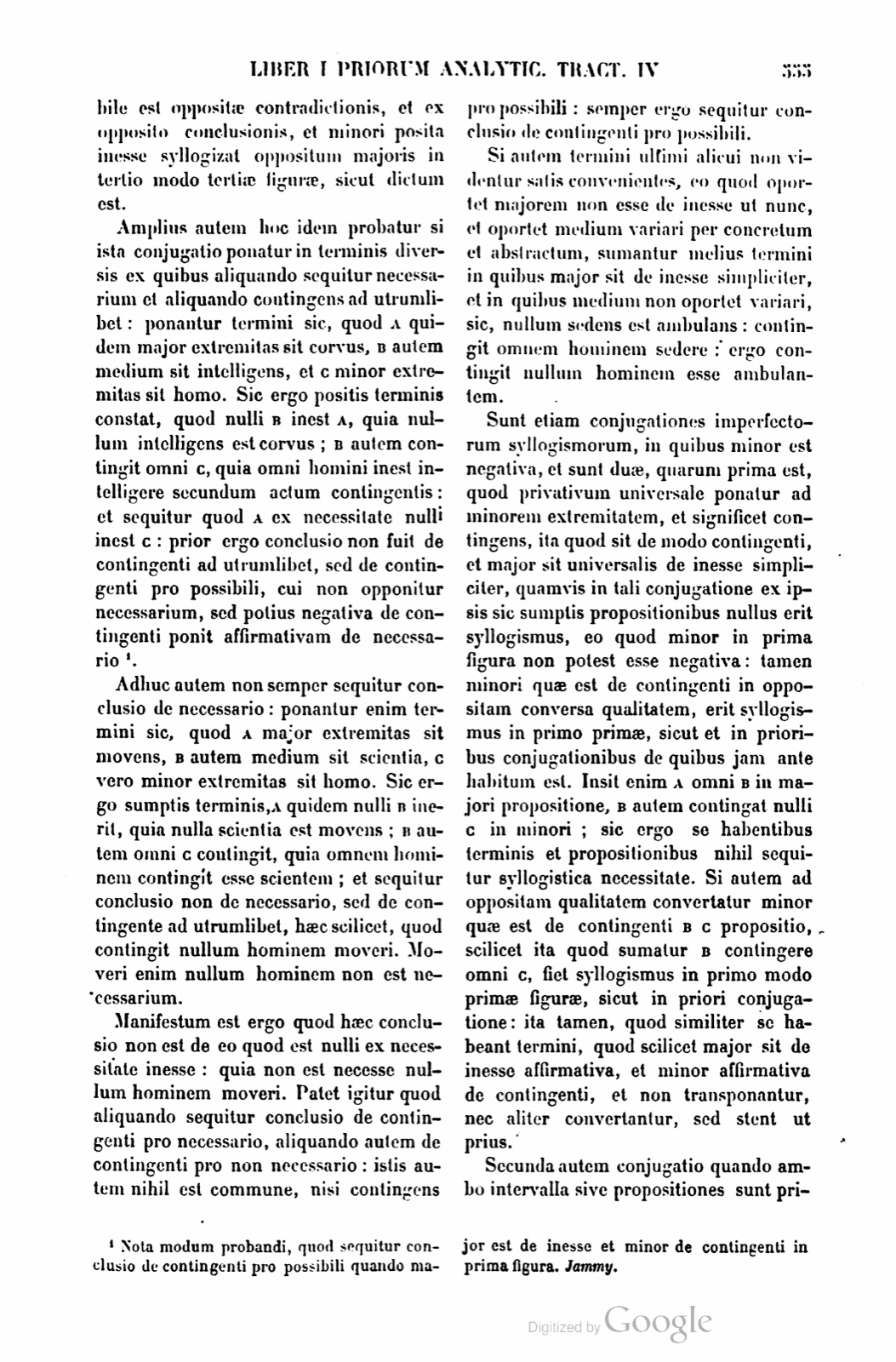
est oppositae contradictionis, et ex opposito conclusionis, et minori posita inesse syllogizat oppositum majoris in tertio modo tertiae figurae, sicut dictum est.
Amplius autem hoc idem probatur si ista conjugatio ponatur in terminis diversis ex quibus aliquando sequitur necessarium et aliquando contingens ad utrumlibet: ponantur termini sic, quod A quidem major extremitas sit corvus, B autem medium sit intelligens, et C minor extremitas sit homo. Sic ergo positis terminis constat, quod nulli B inest A, quia nullum intelligens est corvus; B autem contingit omni C, quia omni homini inest intelligere secundum actum contingentis: et sequitur quod A ex necessitate nulli inest C: prior ergo conclusio non fuit de contingenti ad utrumlibet, sed de contingenti pro possibili, cui non opponitur necessarium, sed potius negativa de contingenti ponit affirmativam de necessario1.
Adhuc autem non semper sequitur conclusio de necessario: ponantur enim termini sic, quod A major extremitas sit movens, B autem medium sit scientia, C vero minor extremitas sit homo. Sic ergo sumptis terminis, A quidem nulli B inerit, quia nulla scientia est movens; B autem omni C contingit, quia omnem hominem contingit esse scientem; et sequitur conclusio non de necessario, sed de contingente ad utrumlibet, haec scilicet, quod contingit nullum hominem moveri. Moveri enim nullum hominem non est necessarium.
Manifestum est ergo quod haec conclusio non est de eo quod est nulli ex necessitate inesse: quia non est necesse nullum hominem moveri. Patet igitur quod aliquando sequitur conclusio de contingenti pro necessario, aliquando autem de contingenti pro non necessario: istis autem nihil est commune, nisi contingens pro possibili: semper ergo sequitur conclusio de contingenti pro possibili.
Si autem termini ultimi alicui non videntur satis convenientes, eo quod oportet majorem non esse de inesse ut nunc, et oportet medium variari per concretum et abstractum, sumantur melius termini in quibus major sit de inesse simpliciter, et in quibus medium non oportet variari, sic, nullum sedens est ambulans: contingit omnem hominem sedere: ergo contingit nullum hominem esse ambulantem.
Sunt etiam conjugationes imperfectorum syllogismorum, in quibus minor est negativa, et sunt duae, quarum prima est, quod privativum universale ponatur ad minorem extremitatem, et significet contingens, ita quod sit de modo contingenti, et major sit universalis de inesse simpliciter, quamvis in tali conjugatione ex ipsis sic sumptis propositionibus nullus erit syllogismus, eo quod minor in prima figura non potest esse negativa: tamen minori quae est de contingenti in oppositam conversa qualitatem, erit syllogismus in primo primae, sicut et in prioribus conjugationibus de quibus jam ante habitum est. Insit enim A omni B in majori propositione, B autem contingat nulli C in minori; sic ergo se habentibus terminis et propositionibus nihil sequitur syllogistica necessitate. Si autem ad oppositam qualitatem convertatur minor quae est de contingenti B C propositio, scilicet ita quod sumatur B contingere omni C, fiet syllogismus in primo modo primae figurae, sicut in priori conjugatione: ita tamen, quod similiter se habeant termini, quod scilicet major sit de inesse affirmativa, et minor affirmativa de contingenti, et non transponantur, nec aliter convertantur, sed stent ut prius.
is of the opposite contradiction, and from the opposite of the conclusion and the minor posited as inhering it syllogizes the opposite of the major in the third mode of the third figure, as was said.
Moreover, this same thing is proved if this conjugation is posited in diverse terms from which sometimes the necessary follows and sometimes the contingent toward either alternative. Let the terms be posited thus: A, the greater extreme, is raven; B, the middle, is intelligent; and C, the lesser extreme, is man. Therefore, with the terms thus posited, it is established that A belongs to no B, because no intelligent thing is a raven; but B contingently belongs to every C, because to every man there belongs understanding according to the act of the contingent. And it follows that A belongs to no C from necessity. Therefore the prior conclusion was not of the contingent toward either alternative, but of the contingent for the possible, to which the necessary is not opposed; rather the negative about the contingent posits the affirmative of necessity1.
Again, a conclusion of necessity does not always follow. For let the terms be posited thus: A, the greater extreme, is moving; B, the middle, is knowledge; but C, the lesser extreme, is man. Therefore, with the terms thus taken, A indeed will belong to no B, because no knowledge is moving; but B contingently belongs to every C, because every man can contingently be knowing. And there follows a conclusion not of necessity but of the contingent toward either alternative, namely this: that it is contingent that no man be moved. For for no man to be moved is not necessary.
Therefore it is manifest that this conclusion is not about that which is to belong to none from necessity, because it is not necessary that no man be moved. Therefore it is clear that sometimes a conclusion follows about the contingent for the necessary, but sometimes about the contingent for the non-necessary. But to these there is nothing common except the contingent for the possible; therefore a conclusion about the contingent for the possible always follows.
But if the last terms do not seem sufficiently suitable to someone, because the major ought not to be of inherence as now and the middle must be varied through concrete and abstract, let better terms be taken in which the major is of inherence simply and in which the middle need not be varied, thus: no sitting thing is walking; every man contingently sits; therefore it is contingent that no man be walking.
There are also conjugations of imperfect syllogisms in which the minor is negative, and there are two of them. The first is that a universal privative is posited at the lesser extreme and signifies the contingent, so that it is about the mode of the contingent, and the major is universal of inherence simply. Although in such a conjugation, from the propositions themselves taken thus, there will be no syllogism, because the minor in the first figure cannot be negative, nevertheless, when the minor which is about the contingent has been converted into the opposite quality, there will be a syllogism in the first of the first, just as also in the prior conjugations about which it has already been held. For let A belong to every B in the major proposition, but let B contingently belong to no C in the minor. Therefore, when the terms and propositions have themselves thus, nothing follows by syllogistic necessity. But if the minor, which is the proposition B C about the contingent, is converted to the opposite quality, namely so that B is taken to contingently belong to every C, a syllogism will be made in the first mode of the first figure, just as in the prior conjugation, yet in such a way that the terms have themselves similarly, namely that the major is affirmative of inherence and the minor affirmative of the contingent, and they are not transposed nor otherwise converted, but stand as before.
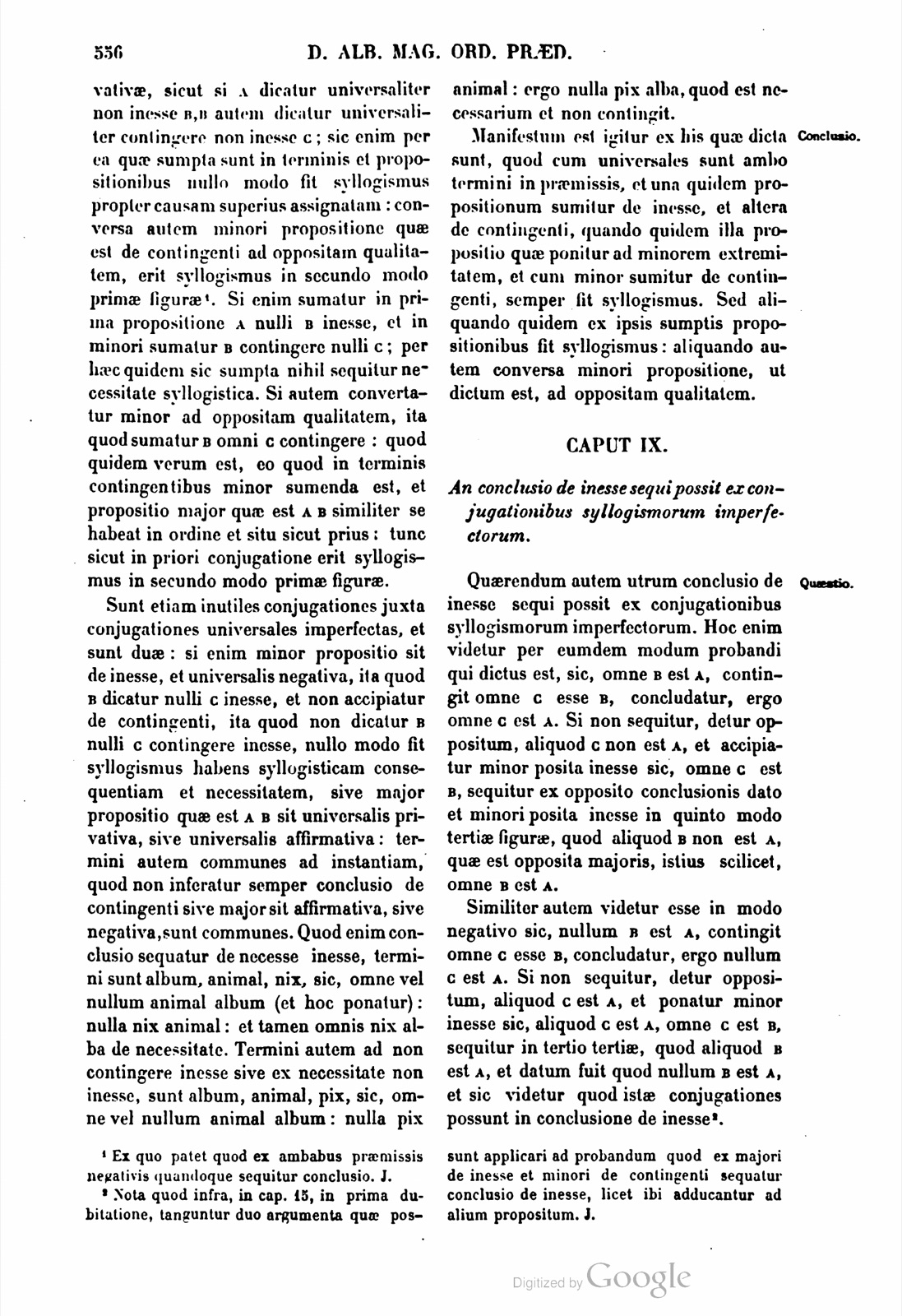
Secunda autem conjugatio quando ambo intervalla sive propositiones sunt privativae, sicut si A dicatur universaliter non inesse B, B autem dicatur universaliter contingere non inesse C; sic enim per ea quae sumpta sunt in terminis et propositionibus nullo modo fit syllogismus propter causam superius assignatam: conversa autem minori propositione quae est de contingenti ad oppositam qualitatem, erit syllogismus in secundo modo primae figurae2. Si enim sumatur in prima propositione A nulli B inesse, et in minori sumatur B contingere nulli C; per haec quidem sic sumpta nihil sequitur necessitate syllogistica. Si autem convertatur minor ad oppositam qualitatem, ita quod sumatur B omni C contingere: quod quidem verum est, eo quod in terminis contingentibus minor sumenda est, et propositio major quae est A B similiter se habeat in ordine et situ sicut prius: tunc sicut in priori conjugatione erit syllogismus in secundo modo primae figurae.
Sunt etiam inutiles conjugationes juxta conjugationes universales imperfectas, et sunt duae: si enim minor propositio sit de inesse, et universalis negativa, ita quod B dicatur nulli C inesse, et non accipiatur de contingenti, ita quod non dicatur B nulli C contingere inesse, nullo modo fit syllogismus habens syllogisticam consequentiam et necessitatem, sive major propositio quae est A B sit universalis privativa, sive universalis affirmativa: termini autem communes ad instantiam, quod non inferatur semper conclusio de contingenti sive major sit affirmativa, sive negativa, sunt communes. Quod enim conclusio sequatur de necesse inesse, termini sunt album, animal, nix, sic, omne vel nullum animal album, et hoc ponatur: nulla nix animal: et tamen omnis nix alba de necessitate. Termini autem ad non contingere inesse sive ex necessitate non inesse, sunt album, animal, pix, sic, omne vel nullum animal album: nulla pix animal: ergo nulla pix alba, quod est necessarium et non contingit.
Manifestum est igitur ex his quae dicta sunt, quod cum universales sunt ambo termini in praemissis, et una quidem propositionum sumitur de inesse, et altera de contingenti, quando quidem illa propositio quae ponitur ad minorem extremitatem, et cum minor sumitur de contingenti, semper fit syllogismus. Sed aliquando quidem ex ipsis sumptis propositionibus fit syllogismus: aliquando autem conversa minori propositione, ut dictum est, ad oppositam qualitatem.
But the second conjugation is when both intervals or propositions are privative, as if A is said universally not to belong to B, but B is said universally contingently not to belong to C. For in this way, through those things which are taken in the terms and propositions, no syllogism is made in any way, because of the cause assigned above; but when the minor proposition, which is of the contingent, has been converted to the opposite quality, there will be a syllogism in the second mode of the first figure2. For if in the first proposition A is taken to belong to no B, and in the minor B is taken to contingently belong to no C, through these things thus taken nothing follows by syllogistic necessity. But if the minor is converted to the opposite quality, so that B is taken to contingently belong to every C, which indeed is true because in contingent terms the minor must be taken, and the major proposition which is A B has itself similarly in order and position as before, then as in the prior conjugation there will be a syllogism in the second mode of the first figure.
There are also useless conjugations beside the imperfect universal conjugations, and they are two. For if the minor proposition is of inherence and universal negative, so that B is said to belong to no C, and is not taken about the contingent, so that B is not said contingently to belong to no C, in no way is a syllogism made having syllogistic consequence and necessity, whether the major proposition which is A B is universal privative or universal affirmative. But the common terms for the instance, that a conclusion about the contingent is not always inferred whether the major is affirmative or negative, are common. For where a conclusion follows about necessary inherence, the terms are white, animal, snow, thus: every or no animal is white, and let this be posited; no snow is an animal; and yet every snow is white of necessity. But the terms for not contingently inhering or for not inhering from necessity are white, animal, pitch, thus: every or no animal is white; no pitch is an animal; therefore no pitch is white, which is necessary and not contingent.
Therefore it is manifest from these things that have been said that when both terms in the premises are universal, and one of the propositions is taken as of inherence and the other of the contingent, when indeed that proposition which is posited at the lesser extreme is taken as the minor and about the contingent, a syllogism is always made. But sometimes a syllogism is made from the propositions themselves as taken, and sometimes after the minor proposition has been converted, as was said, to the opposite quality.
Notes
- Note the mode of proving that a conclusion about the contingent for the possible follows when the major is of inherence and the minor of the contingent in the first figure. Jammy. (Nota modum probandi, quod sequitur conclusio de contingenti pro possibili quando major est de inesse et minor de contingenti in prima figura. Jammy.) ↩
- From this it is clear that from both negative premises a conclusion sometimes follows. J. (Ex quo patet quod ex ambabus praemissis negativis quandoque sequitur conclusio. J.) ↩
If a page does not appear, its photograph has not been uploaded yet.