Works › Prior Analytics, Books I–II
Volume 1 · p. 554
Chapter VIII. On the imperfect conjugations of universal negative syllogisms.
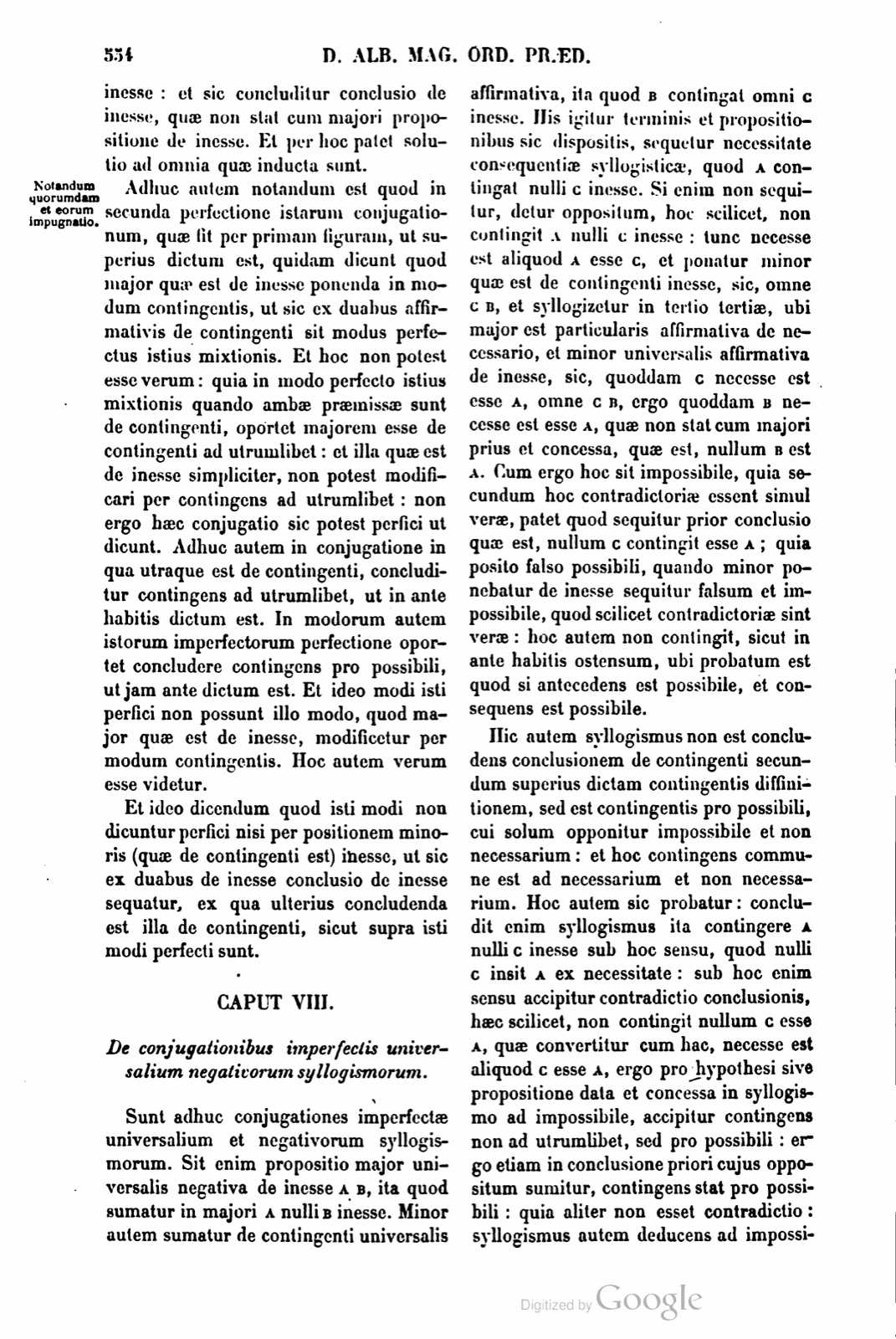
CAPUT VIII. De conjugationibus imperfectis universalium negativorum syllogismorum.
Sunt adhuc conjugationes imperfectae universalium et negativorum syllogismorum. Sit enim propositio major universalis negativa de inesse A B, ita quod sumatur in majori A nulli B inesse. Minor autem sumatur de contingenti universalis affirmativa, ita quod B contingat omni C inesse. His igitur terminis et propositionibus sic dispositis, sequetur necessitate consequentiae syllogisticae, quod A contingat nulli C inesse. Si enim non sequitur, detur oppositum, hoc scilicet, non contingit A nulli C inesse: tunc necesse est aliquod A esse C, et ponatur minor quae est de contingenti inesse, sic, omne C B, et syllogizetur in tertio tertiae, ubi major est particularis affirmativa de necessario, et minor universalis affirmativa de inesse, sic, quoddam C necesse est esse A, omne C B, ergo quoddam B necesse est esse A, quae non stat cum majori prius et concessa, quae est, nullum B est A. Cum ergo hoc sit impossibile, quia secundum hoc contradictoriae essent simul verae, patet quod sequitur prior conclusio quae est, nullum C contingit esse A; quia posito falso possibili, quando minor ponebatur de inesse sequitur falsum et impossibile, quod scilicet contradictoriae sint verae: hoc autem non contingit, sicut in ante habitis ostensum, ubi probatum est quod si antecedens est possibile, et consequens est possibile.
Hic autem syllogismus non est concludens conclusionem de contingenti secundum superius dictam contingentis diffinitionem, sed est contingentis pro possibili, cui solum opponitur impossibile et non necessarium: et hoc contingens commune est ad necessarium et non necessarium. Hoc autem sic probatur: concludit enim syllogismus ita contingere A nulli C inesse sub hoc sensu, quod nulli C insit A ex necessitate: sub hoc enim sensu accipitur contradictio conclusionis, haec scilicet, non contingit nullum C esse A, quae convertitur cum hac, necesse est aliquod C esse A, ergo pro hypothesi sive propositione data et concessa in syllogismo ad impossibile, accipitur contingens non ad utrumlibet, sed pro possibili: ergo etiam in conclusione priori cujus oppositum sumitur, contingens stat pro possibili: quia aliter non esset contradictio: syllogismus autem deducens ad impossibile
CHAPTER VIII. On the imperfect conjugations of universal negative syllogisms.
There are still imperfect conjugations of universal and negative syllogisms. For let the major proposition be a universal negative of inherence A B, so that in the major A is taken to belong to no B. But let the minor be taken as a universal affirmative about the contingent, so that B contingently belongs to every C. Therefore with these terms and propositions disposed thus, it will follow by the necessity of syllogistic consequence that A contingently belongs to no C. For if it does not follow, let the opposite be granted, namely this: A does not contingently belong to no C. Then it is necessary that some A be C; and let the minor, which is of the contingent, be posited as inhering thus: every C is B; and let a syllogism be made in the third of the third, where the major is a particular affirmative of necessity and the minor a universal affirmative of inherence, thus: some C of necessity is A; every C is B; therefore some B of necessity is A, which does not stand with the major previously granted, which is: no B is A. Therefore, since this is impossible, because according to this contradictories would be true at the same time, it is clear that the prior conclusion follows, which is: no C contingently is A; because, when a false possible thing is posited, when the minor was posited as of inherence, something false and impossible follows, namely that contradictories are true. But this is not contingent, as was shown in what was had before, where it was proved that if the antecedent is possible, then the consequent is possible.
But this syllogism is not concluding a conclusion about the contingent according to the definition of the contingent stated above, but is about the contingent for the possible, to which only the impossible and not the necessary is opposed; and this common contingent is common to the necessary and the non-necessary. But this is proved thus: for the syllogism concludes that A contingently belongs to no C under this sense, that A belongs to no C from necessity. For under this sense the contradiction of the conclusion is taken, namely this: it is not contingent that no C be A, which is converted with this: it is necessary that some C be A. Therefore for the hypothesis or proposition given and conceded in the syllogism to the impossible, the contingent is taken not toward either alternative, but for the possible; therefore also in the prior conclusion whose opposite is taken, the contingent stands for the possible, because otherwise there would not be a contradiction; but the syllogism leading to the impossible
If a page does not appear, its photograph has not been uploaded yet.