Works › Prior Analytics, Books I–II
Volume 1 · pp. 551–554
Chapter VII. On the imperfect conjugations of universal syllogisms and on their perfection.
A marker with ≈ is an approximate page boundary, placed by measure of the text; the page photographs remain the authority. In the paired views, clicking a page marker brings that page into view.
CAPUT VII. De conjugationibus universalium syllogismorum imperfectis, et de perfectione earum.
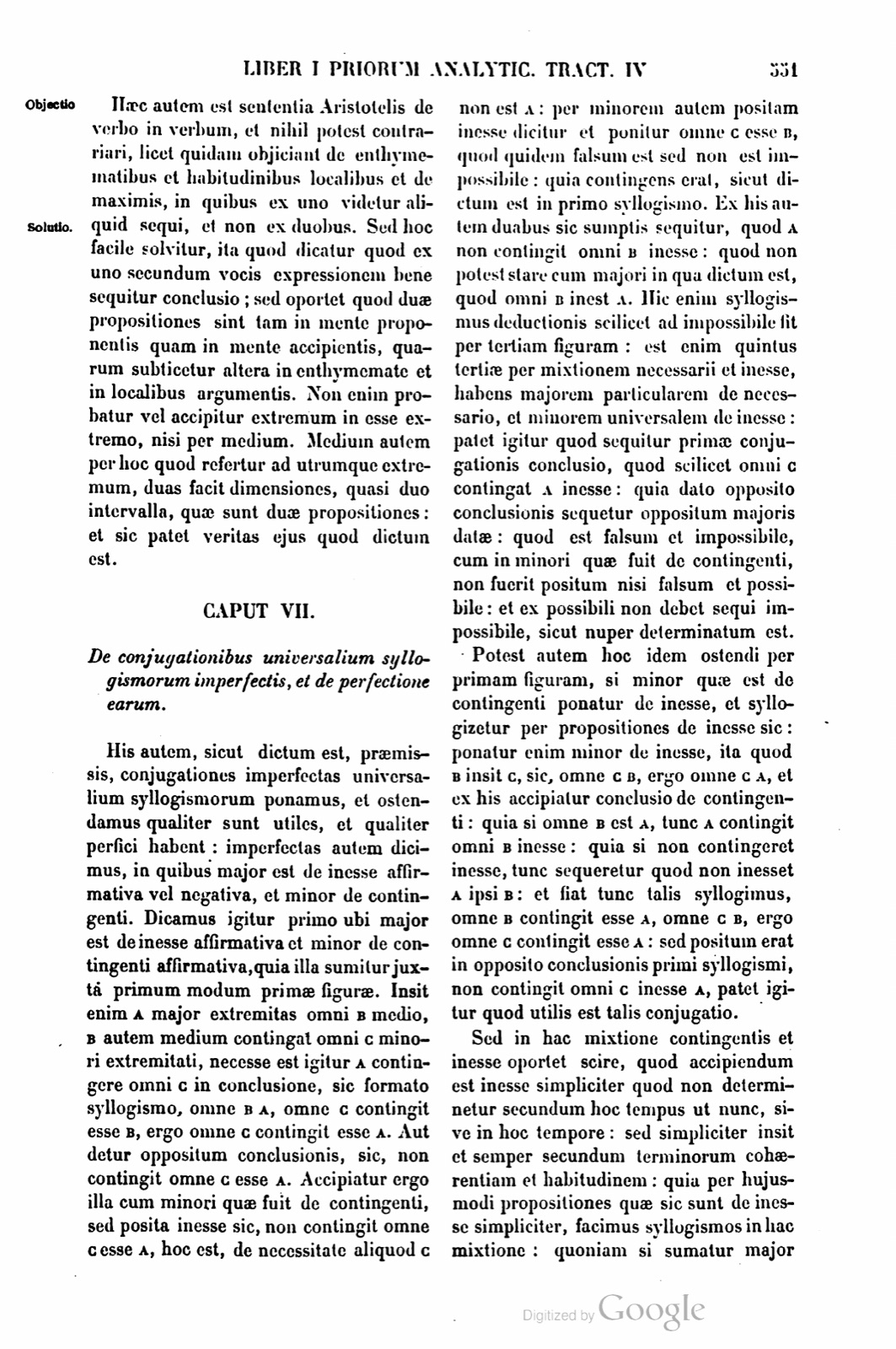
His autem, sicut dictum est, praemissis, conjugationes imperfectas universalium syllogismorum ponamus, et ostendamus qualiter sunt utiles, et qualiter perfici habent: imperfectas autem dicimus, in quibus major est de inesse affirmativa vel negativa, et minor de contingenti. Dicamus igitur primo ubi major est de inesse affirmativa et minor de contingenti affirmativa, quia illa sumitur juxta primum modum primae figurae. Insit enim A major extremitas omni B medio, B autem medium contingat omni C minori extremitati, necesse est igitur A contingere omni C in conclusione, sic formato syllogismo, omne B A, omne C contingit esse B, ergo omne C contingit esse A. Aut detur oppositum conclusionis, sic, non contingit omne C esse A. Accipiatur ergo illa cum minori quae fuit de contingenti, sed posita inesse sic, non contingit omne C esse A, hoc est, de necessitate aliquod C non est A: per minorem autem positam inesse dicitur et ponitur omne C esse B, quod quidem falsum est sed non est impossibile: quia contingens erat, sicut dictum est in primo syllogismo. Ex his autem duabus sic sumptis sequitur, quod A non contingit omni B inesse: quod non potest stare cum majori in qua dictum est, quod omni B inest A. Hic enim syllogismus deductionis scilicet ad impossibile fit per tertiam figuram: est enim quintus tertiae per mixtionem necessarii et inesse, habens majorem particularem de necessario, et minorem universalem de inesse: patet igitur quod sequitur primae conjugationis conclusio, quod scilicet omni C contingat A inesse: quia dato opposito conclusionis sequetur oppositum majoris datae: quod est falsum et impossibile, cum in minori quae fuit de contingenti, non fuerit positum nisi falsum et possibile: et ex possibili non debet sequi impossibile, sicut nuper determinatum est.
Potest autem hoc idem ostendi per primam figuram, si minor quae est de contingenti ponatur de inesse, et syllogizetur per propositiones de inesse sic: ponatur enim minor de inesse, ita quod B insit C, sic, omne C B, ergo omne C A, et ex his accipiatur conclusio de contingenti: quia si omne B est A, tunc A contingit omni B inesse: quia si non contingeret inesse, tunc sequeretur quod non inesset A ipsi B: et fiat tunc talis syllogimus, omne B contingit esse A, omne C B, ergo omne C contingit esse A: sed positum erat in opposito conclusionis primi syllogismi, non contingit omni C inesse A, patet igitur quod utilis est talis conjugatio.
Sed in hac mixtione contingentis et inesse oportet scire, quod accipiendum est inesse simpliciter quod non determinetur secundum hoc tempus ut nunc, sive in hoc tempore: sed simpliciter insit et semper secundum terminorum cohaerentiam et habitudinem: quia per hujusmodi propositiones quae sic sunt de inesse simpliciter, facimus syllogismos in hac mixtione: quoniam si sumatur major in hac mixtione de inesse ut nunc, non erit syllogismus, sed deficiet propter terminorum inutilitatem: hoc autem in terminis manifestum, qui sunt homo, movens, equus: nihil enim fortasse prohibet, si ita ponatur omni moventi hominem inesse: sicut si ponatur quod omne quod movetur sit homo, et nihil moveatur nisi homo. Movens autem contingit omni equo, ita quod omnem equum contingit moveri. Et tamen non sequitur quod omnem equum contingat esse hominem: quinimo de necessitate nullus equus est homo.
CHAPTER VII. On the imperfect conjugations of universal syllogisms and on their perfection.
But with these things set forth beforehand, as has been said, let us posit the imperfect conjugations of universal syllogisms, and let us show how they are useful and how they have to be perfected. But we call those imperfect in which the major is of inherence, affirmative or negative, and the minor is of the contingent. Therefore let us speak first where the major is affirmative of inherence and the minor affirmative of the contingent, because that is taken according to the first mode of the first figure. For let A, the greater extreme, belong to every B, the middle, and let B, the middle, contingently belong to every C, the lesser extreme; therefore A must contingently belong to every C in the conclusion, with the syllogism formed thus: every B is A; every C contingently is B; therefore every C contingently is A. Or let the opposite of the conclusion be granted thus: it is not contingent that every C be A. Therefore let that be taken with the minor which was of the contingent, but posited as inhering thus: it is not contingent that every C be A, that is, of necessity some C is not A. But through the minor posited as inhering it is said and posited that every C is B; this indeed is false, but is not impossible, because it was contingent, as was said in the first syllogism. But from these two things thus taken it follows that A does not contingently belong to every B, which cannot stand with the major in which it was said that A belongs to every B. For this syllogism of deduction, namely to the impossible, is made through the third figure; for it is the fifth of the third through the mixing of the necessary and inherence, having the major particular of necessity and the minor universal of inherence. Therefore it is clear that the conclusion of the first conjugation follows, namely that A contingently belongs to every C, because, when the opposite of the conclusion has been granted, the opposite of the given major will follow; this is false and impossible, since in the minor which was of the contingent nothing had been posited except what was false and possible, and from the possible the impossible ought not to follow, as was just now determined.
But this same thing can be shown through the first figure if the minor which is of the contingent is posited as of inherence, and one syllogizes through propositions of inherence thus: for let the minor be posited as of inherence, so that B belongs to C, thus, every C is B; therefore every C is A; and from these let a conclusion about the contingent be taken. For if every B is A, then A contingently belongs to every B, because if it were not contingent to belong, then it would follow that A did not belong to B itself. And then let such a syllogism be made: every B contingently is A; every C is B; therefore every C contingently is A. But in the opposite of the conclusion of the first syllogism it had been posited that A does not contingently belong to every C; therefore it is clear that such a conjugation is useful.
But in this mixing of the contingent and inherence one must know that inherence simply must be taken, which is not determined according to this time as now, or in this time; rather it should belong simply and always according to the coherence and relation of the terms. For through propositions of this kind, which are thus of inherence simply, we make syllogisms in this mixing, since if the major in this mixing is taken as of inherence as now, there will not be a syllogism, but it will fail because of the uselessness of the terms. But this is manifest in terms, which are man, moving, horse: for perhaps nothing prevents it from being posited thus that man belongs to every moving thing, as if it is posited that everything which is moved is a man and that nothing is moved except a man. But moving contingently belongs to every horse, so that every horse contingently is moved. And nevertheless it does not follow that every horse contingently is a man; indeed, of necessity no horse is a man.
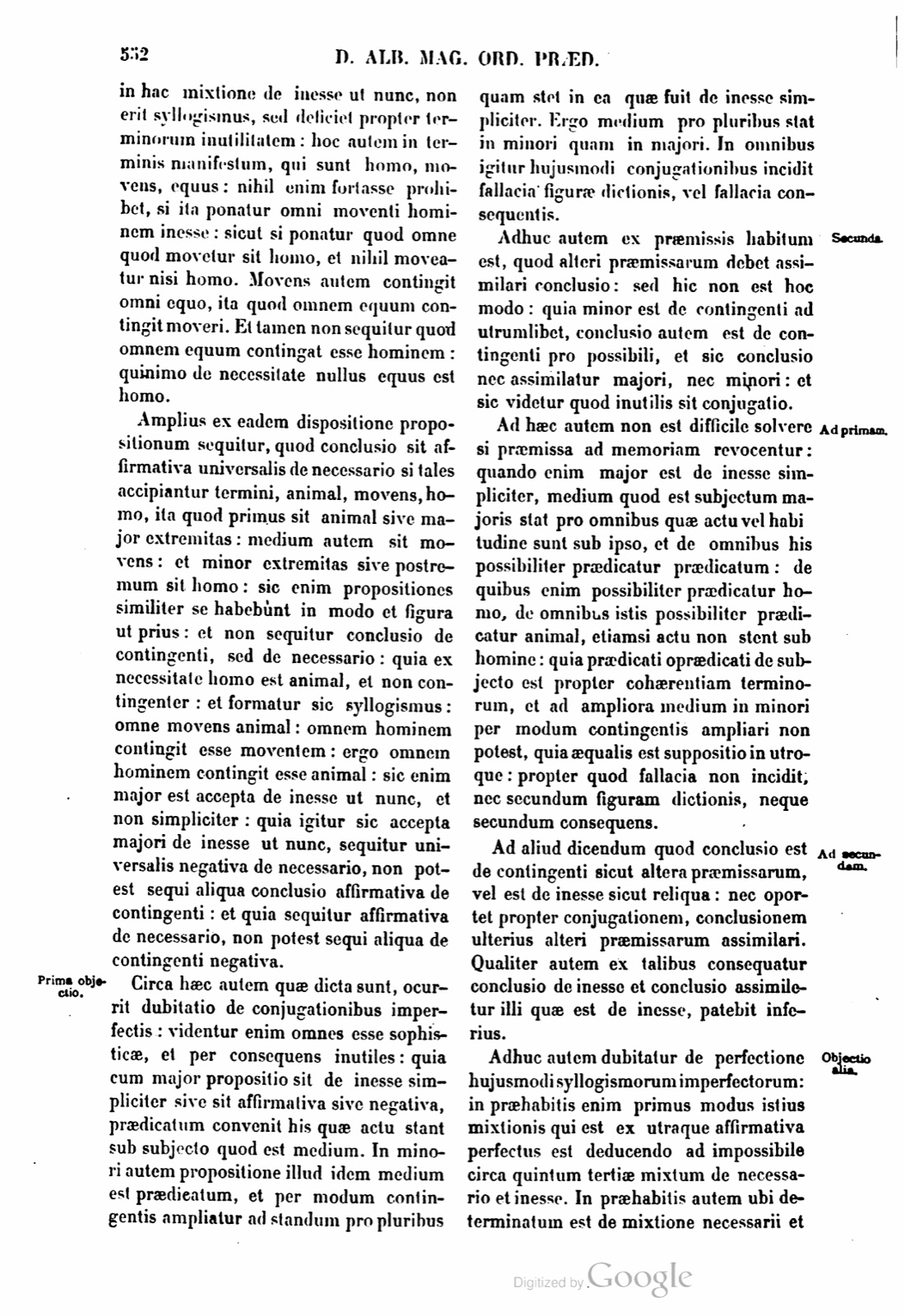
Amplius ex eadem dispositione propositionum sequitur, quod conclusio sit affirmativa universalis de necessario si tales accipiantur termini, animal, movens, homo, ita quod primus sit animal sive major extremitas: medium autem sit movens: et minor extremitas sive postremum sit homo: sic enim propositiones similiter se habebunt in modo et figura ut prius: et non sequitur conclusio de contingenti, sed de necessario: quia ex necessitate homo est animal, et non contingenter: et formatur sic syllogismus: omne movens animal: omnem hominem contingit esse moventem: ergo omnem hominem contingit esse animal: sic enim major est accepta de inesse ut nunc, et non simpliciter: quia igitur sic accepta majori de inesse ut nunc, sequitur universalis negativa de necessario, non potest sequi aliqua conclusio affirmativa de contingenti: et quia sequitur affirmativa de necessario, non potest sequi aliqua de contingenti negativa.
Circa haec autem quae dicta sunt, occurrit dubitatio de conjugationibus imperfectis: videntur enim omnes esse sophisticae, et per consequens inutiles: quia cum major propositio sit de inesse simpliciter sive sit affirmativa sive negativa, praedicatum convenit his quae actu stant sub subjecto quod est medium. In minori autem propositione illud idem medium est praedicatum, et per modum contingentis ampliatur ad standum pro pluribus quam stet in ea quae fuit de inesse simpliciter. Ergo medium pro pluribus stat in minori quam in majori. In omnibus igitur hujusmodi conjugationibus incidit fallacia figurae dictionis, vel fallacia consequentis.
Adhuc autem ex praemissis habitum est, quod alteri praemissarum debet assimilari conclusio: sed hic non est hoc modo: quia minor est de contingenti ad utrumlibet, conclusio autem est de contingenti pro possibili, et sic conclusio nec assimilatur majori, nec minori: et sic videtur quod inutilis sit conjugatio.
Ad haec autem non est difficile solvere si praemissa ad memoriam revocentur: quando enim major est de inesse simpliciter, medium quod est subjectum majoris stat pro omnibus quae actu vel habitudine sunt sub ipso, et de omnibus his possibiliter praedicatur praedicatum: de quibus enim possibiliter praedicatur homo, de omnibus istis possibiliter praedicatur animal, etiamsi actu non stent sub homine: quia praedicatio praedicati de subjecto est propter cohaerentiam terminorum, et ad ampliora medium in minori per modum contingentis ampliari non potest, quia aequalis est suppositio in utroque: propter quod fallacia non incidit, nec secundum figuram dictionis, neque secundum consequens.
Moreover, from the same disposition of propositions it follows that the conclusion is a universal affirmative of necessity if such terms are taken: animal, moving, man, so that the first is animal or the greater extreme; but the middle is moving; and the lesser extreme or last is man. For thus the propositions will have themselves similarly in mode and figure as before, and a conclusion of the contingent does not follow, but one of necessity, because of necessity a man is an animal, and not contingently. And the syllogism is formed thus: every moving thing is an animal; every man contingently is moving; therefore every man contingently is an animal. For thus the major is taken as of inherence as now and not simply. Therefore, because with the major thus taken as of inherence as now a universal negative of necessity follows, no affirmative conclusion about the contingent can follow; and because an affirmative of necessity follows, no negative about the contingent can follow.
Concerning these things that have been said, a doubt occurs about the imperfect conjugations: for all seem to be sophistical and consequently useless, because when the major proposition is of inherence simply, whether it is affirmative or negative, the predicate befits those things which actually stand under the subject which is the middle. But in the minor proposition that same middle is the predicate, and through the mode of the contingent it is broadened to stand for more things than it stood for in that proposition which was of inherence simply. Therefore the middle stands for more things in the minor than in the major. Therefore in all conjugations of this kind there occurs the fallacy of figure of speech or the fallacy of the consequent.
Moreover, from the premises it has been held that the conclusion ought to be assimilated to one of the premises. But here this is not so, because the minor is of the contingent toward either alternative, while the conclusion is of the contingent for the possible; and thus the conclusion is assimilated neither to the major nor to the minor. And thus it seems that the conjugation is useless.
But these things are not difficult to solve if the premises are recalled to memory. For when the major is of inherence simply, the middle which is the subject of the major stands for all things which are under it in act or by aptitude, and of all these the predicate is possibly predicated. For of all the things of which man is possibly predicated, of all those animal is possibly predicated, even if they do not actually stand under man, because the predication of the predicate concerning the subject is on account of the coherence of the terms; and the middle in the minor cannot be broadened through the mode of the contingent to wider things, because the supposition is equal in both. For this reason no fallacy occurs, neither according to figure of speech nor according to the consequent.
Ad aliud dicendum quod conclusio est de contingenti sicut altera praemissarum, vel est de inesse sicut reliqua: nec oportet propter conjugationem, conclusionem ulterius alteri praemissarum assimilari. Qualiter autem ex talibus consequatur conclusio de inesse et conclusio assimiletur illi quae est de inesse, patebit inferius.
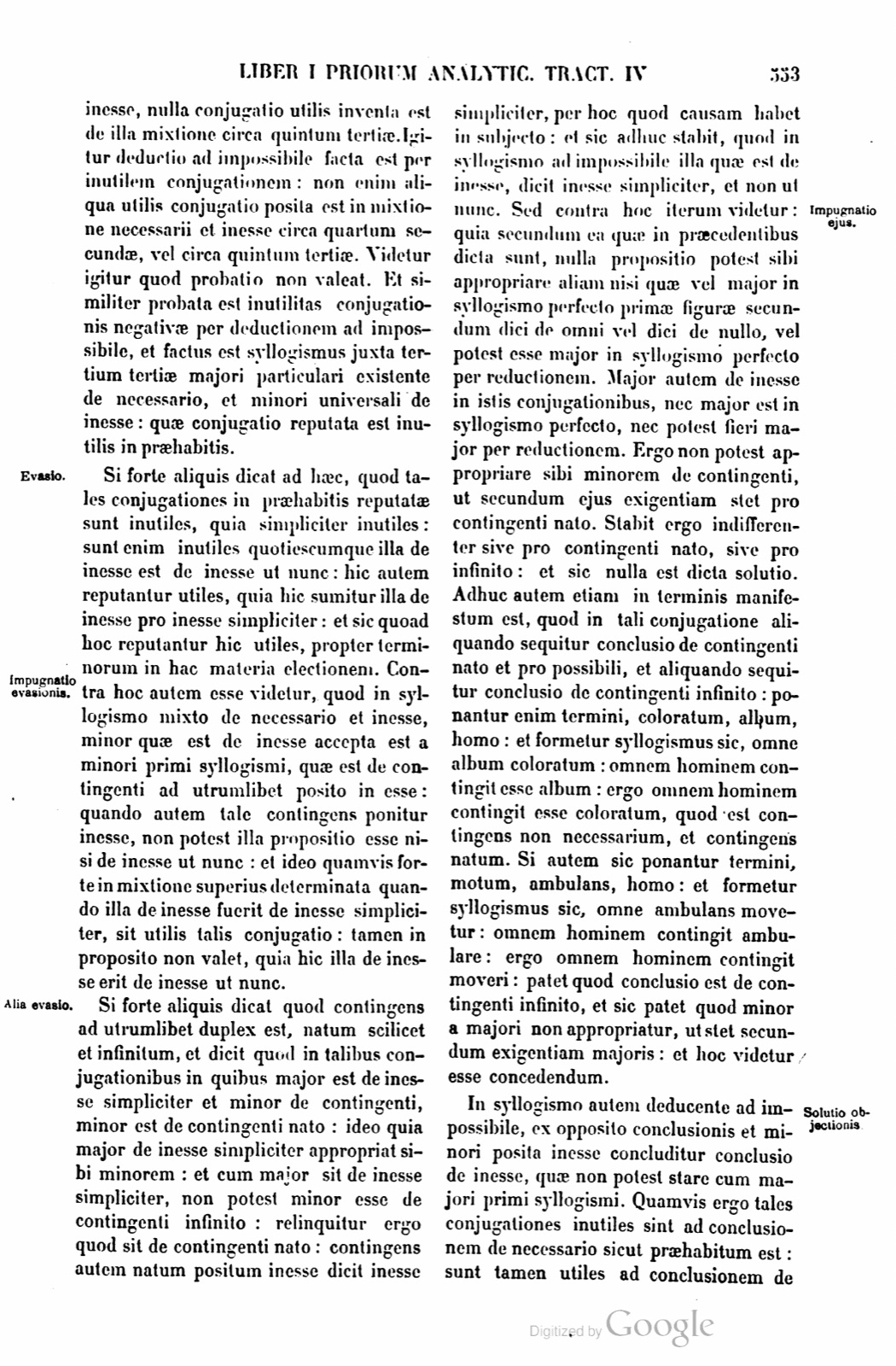
Adhuc autem dubitatur de perfectione hujusmodi syllogismorum imperfectorum: in praehabitis enim primus modus istius mixtionis qui est ex utraque affirmativa perfectus est deducendo ad impossibile circa quintum tertiae mixtum de necessario et inesse. In praehabitis autem ubi determinatum est de mixtione necessarii et inesse, nulla conjugatio utilis inventa est de illa mixtione circa quintum tertiae. Igitur deductio ad impossibile facta est per inutilem conjugationem: non enim aliqua utilis conjugatio posita est in mixtione necessarii et inesse circa quartum secundae, vel circa quintum tertiae. Videtur igitur quod probatio non valeat. Et similiter probata est inutilitas conjugationis negativae per deductionem ad impossibile, et factus est syllogismus juxta tertium tertiae majori particulari existente de necessario, et minori universali de inesse: quae conjugatio reputata est inutilis in praehabitis.
Si forte aliquis dicat ad haec, quod tales conjugationes in praehabitis reputatae sunt inutiles, quia simpliciter inutiles: sunt enim inutiles quotiescumque illa de inesse est de inesse ut nunc: hic autem reputantur utiles, quia hic sumitur illa de inesse pro inesse simpliciter: et sic quoad hoc reputantur hic utiles, propter terminorum in hac materia electionem. Contra hoc autem esse videtur, quod in syllogismo mixto de necessario et inesse, minor quae est de inesse accepta est a minori primi syllogismi, quae est de contingenti ad utrumlibet posito in esse: quando autem tale contingens ponitur inesse, non potest illa propositio esse nisi de inesse ut nunc: et ideo quamvis forte in mixtione superius determinata quando illa de inesse fuerit de inesse simpliciter, sit utilis talis conjugatio: tamen in proposito non valet, quia hic illa de inesse erit de inesse ut nunc.
Si forte aliquis dicat quod contingens ad utrumlibet duplex est, natum scilicet et infinitum, et dicit quod in talibus conjugationibus in quibus major est de inesse simpliciter et minor de contingenti, minor est de contingenti nato: ideo quia major de inesse simpliciter appropriat sibi minorem: et cum major sit de inesse simpliciter, non potest minor esse de contingenti infinito: relinquitur ergo quod sit de contingenti nato: contingens autem natum positum inesse dicit inesse simpliciter, per hoc quod causam habet in subjecto: et sic adhuc stabit, quod in syllogismo ad impossibile illa quae est de inesse, dicit inesse simpliciter, et non ut nunc. Sed contra hoc iterum videtur: quia secundum ea quae in praecedentibus dicta sunt, nulla propositio potest sibi appropriare aliam nisi quae vel major in syllogismo perfecto primae figurae secundum dici de omni vel dici de nullo, vel potest esse major in syllogismo perfecto per reductionem. Major autem de inesse in istis conjugationibus, nec major est in syllogismo perfecto, nec potest fieri major per reductionem. Ergo non potest appropriare sibi minorem de contingenti, ut secundum ejus exigentiam stet pro contingenti nato. Stabit ergo indifferenter sive pro contingenti nato, sive pro infinito: et sic nulla est dicta solutio. Adhuc autem etiam in terminis manifestum est, quod in tali conjugatione aliquando sequitur conclusio de contingenti nato et pro possibili, et aliquando sequitur conclusio de contingenti infinito: ponantur enim termini, coloratum, album, homo: et formetur syllogismus sic, omne album coloratum: omnem hominem contingit esse album: ergo omnem hominem contingit esse coloratum, quod est contingens non necessarium, et contingens natum. Si autem sic ponantur termini, motum, ambulans, homo: et formetur syllogismus sic, omne ambulans movetur: omnem hominem contingit ambulare: ergo omnem hominem contingit moveri: patet quod conclusio est de contingenti infinito, et sic patet quod minor a majori non appropriatur, ut stet secundum exigentiam majoris: et hoc videtur esse concedendum.
To the other point one must say that the conclusion is of the contingent like one of the premises, or it is of inherence like the remaining one; nor is it necessary, because of the conjugation, for the conclusion to be further assimilated to one of the premises. But how from such things a conclusion of inherence follows and the conclusion is assimilated to that which is of inherence will be clear below.
Moreover, doubt is raised about the perfection of imperfect syllogisms of this kind. For in what was had before the first mode of this mixing, which is from both affirmative propositions, is perfected by leading to the impossible around the fifth of the third, mixed from necessity and inherence. But in what was had before, where it was determined about the mixing of the necessary and inherence, no useful conjugation was found from that mixing around the fifth of the third. Therefore the deduction to the impossible was made through a useless conjugation; for no useful conjugation was posited in the mixing of the necessary and inherence around the fourth of the second, or around the fifth of the third. Therefore it seems that the proof is not valid. And similarly the uselessness of the negative conjugation was proved through deduction to the impossible, and a syllogism was made according to the third of the third, with the major being particular of necessity and the minor universal of inherence; this conjugation was regarded as useless in what was had before.
If perhaps someone says to these things that such conjugations were regarded as useless in what was had before because they are simply useless, for they are useless whenever that proposition of inherence is of inherence as now, but here they are regarded as useful because here that proposition of inherence is taken for inherence simply, and thus, with respect to this, they are regarded here as useful because of the choice of terms in this matter: against this it seems to be the case that in a syllogism mixed from necessity and inherence, the minor which is of inherence was taken from the minor of the first syllogism, which is of the contingent toward either alternative posited in being. But when such a contingent is posited to inhere, that proposition cannot be anything except of inherence as now; and therefore, although perhaps in the mixing determined above, when that proposition of inherence was of inherence simply, such a conjugation would be useful, nevertheless in the present case it is not valid, because here that proposition of inherence will be of inherence as now.
If perhaps someone says that the contingent toward either alternative is twofold, namely natural and indefinite, and says that in such conjugations in which the major is of inherence simply and the minor of the contingent, the minor is of the natural contingent, for this reason, that the major of inherence simply appropriates the minor to itself; and since the major is of inherence simply, the minor cannot be of the indefinite contingent; therefore it is left that it is of the natural contingent. But the natural contingent posited as inhering states inherence simply, through the fact that it has a cause in the subject; and thus still it will stand that in the syllogism to the impossible that which is of inherence states inherence simply and not as now. But again against this it seems that, according to the things that were said in the preceding matters, no proposition can appropriate another to itself except one which either is the major in a perfect syllogism of the first figure according to being said of every or being said of none, or can be the major in a perfect syllogism through reduction. But the major of inherence in these conjugations neither is the major in a perfect syllogism nor can become the major through reduction. Therefore it cannot appropriate to itself the minor of the contingent so that, according to its demand, it stands for the natural contingent. Therefore it will stand indifferently either for the natural contingent or for the indefinite, and thus the stated solution is nothing. Moreover, it is also manifest in terms that in such a conjugation sometimes a conclusion of the natural contingent and for the possible follows, and sometimes a conclusion of the indefinite contingent follows. For let the terms be posited: colored, white, man; and let the syllogism be formed thus: every white thing is colored; every man contingently is white; therefore every man contingently is colored, which is a non-necessary contingent and a natural contingent. But if the terms are posited thus: moved, walking, man; and let the syllogism be formed thus: every walking thing is moved; every man contingently walks; therefore every man contingently is moved. It is clear that the conclusion is of the indefinite contingent, and thus it is clear that the minor is not appropriated by the major so that it stands according to the demand of the major; and this seems that it must be conceded.
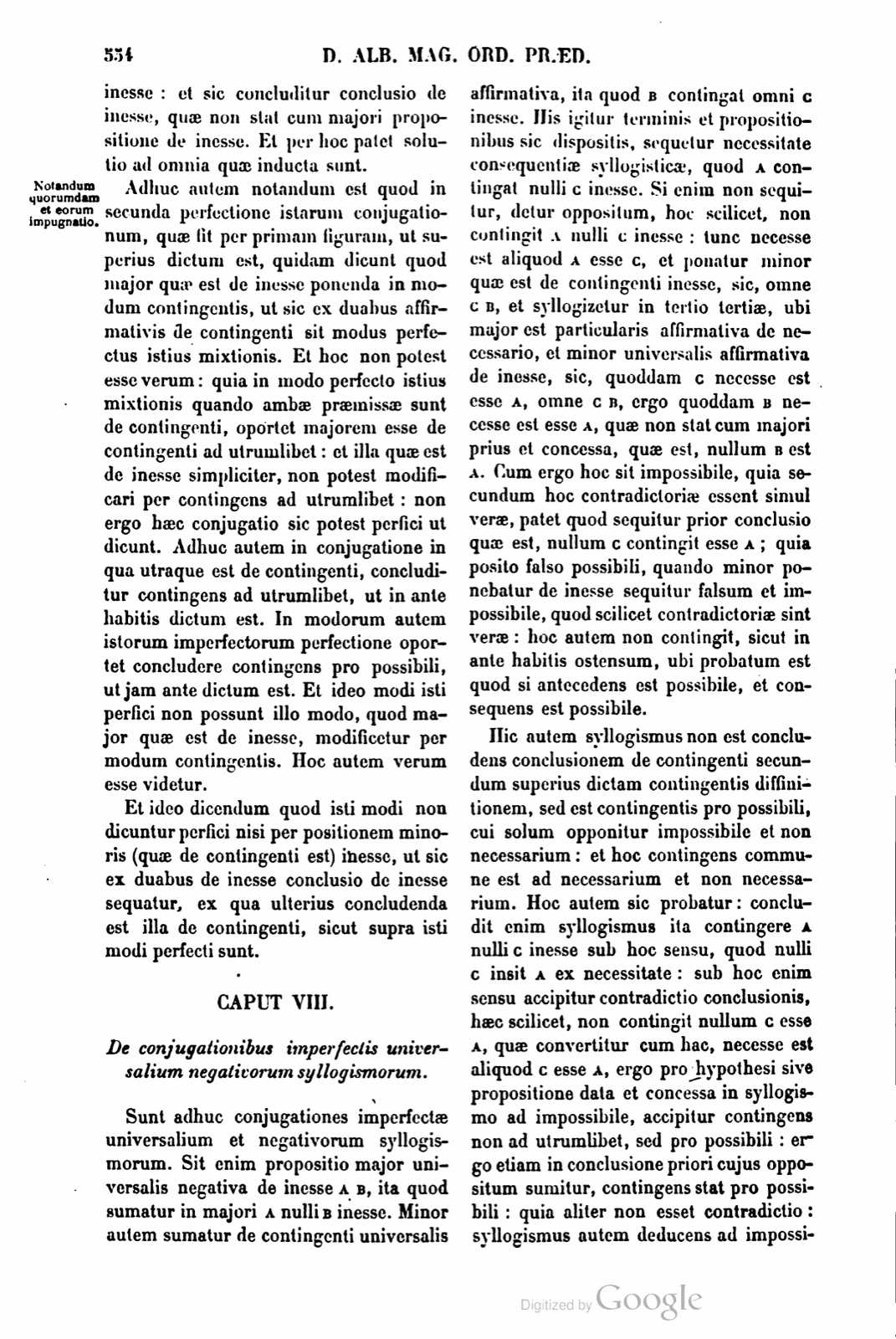
In syllogismo autem deducente ad impossibile, ex opposito conclusionis et minori posita inesse concluditur conclusio de inesse, quae non potest stare cum majori primi syllogismi. Quamvis ergo tales conjugationes inutiles sint ad conclusionem de necessario sicut praehabitum est: sunt tamen utiles ad conclusionem de inesse: et sic concluditur conclusio de inesse, quae non stat cum majori propositione de inesse. Et per hoc patet solutio ad omnia quae inducta sunt.
Adhuc autem notandum est quod in secunda perfectione istarum conjugationum, quae fit per primam figuram, ut superius dictum est, quidam dicunt quod major quae est de inesse ponenda in modum contingentis, ut sic ex duabus affirmativis de contingenti sit modus perfectus istius mixtionis. Et hoc non potest esse verum: quia in modo perfecto istius mixtionis quando ambae praemissae sunt de contingenti, oportet majorem esse de contingenti ad utrumlibet: et illa quae est de inesse simpliciter, non potest modificari per contingens ad utrumlibet: non ergo haec conjugatio sic potest perfici ut dicunt. Adhuc autem in conjugatione in qua utraque est de contingenti, concluditur contingens ad utrumlibet, ut in ante habitis dictum est. In modorum autem istorum imperfectorum perfectione oportet concludere contingens pro possibili, ut jam ante dictum est. Et ideo modi isti perfici non possunt illo modo, quod major quae est de inesse, modificetur per modum contingentis. Hoc autem verum esse videtur.
Et ideo dicendum quod isti modi non dicuntur perfici nisi per positionem minoris quae de contingenti est inesse, ut sic ex duabus de inesse conclusio de inesse sequatur, ex qua ulterius concludenda est illa de contingenti, sicut supra isti modi perfecti sunt.
But in a syllogism leading to the impossible, from the opposite of the conclusion and the minor posited as inhering, a conclusion of inherence is concluded, which cannot stand with the major of the first syllogism. Therefore although such conjugations are useless for a conclusion of necessity, as was held before, nevertheless they are useful for a conclusion of inherence; and thus a conclusion of inherence is concluded which does not stand with the major proposition of inherence. And through this the solution to all the things that have been introduced is clear.
Moreover, it must be noted that in the second perfection of these conjugations, which is made through the first figure, as was said above, certain persons say that the major which is of inherence must be posited in the mode of the contingent, so that in this way from two affirmatives about the contingent there is the perfect mode of this mixing. And this cannot be true, because in the perfect mode of this mixing, when both premises are about the contingent, the major must be of the contingent toward either alternative; and that which is of inherence simply cannot be modified by the contingent toward either alternative. Therefore this conjugation cannot be perfected in this way as they say. Moreover, in the conjugation in which each proposition is about the contingent, the contingent toward either alternative is concluded, as was said in what was had before. But in the perfection of these imperfect modes one must conclude the contingent for the possible, as has already been said before. And therefore these modes cannot be perfected in that way, namely that the major which is of inherence should be modified through the mode of the contingent. But this seems to be true.
And therefore one must say that these modes are not said to be perfected except through the positing of the minor, which is of the contingent, as inhering, so that in this way from two propositions of inherence a conclusion of inherence follows, from which that proposition about the contingent must further be concluded, just as above these modes were perfected.
If a page does not appear, its photograph has not been uploaded yet.