Works › Prior Analytics, Books I–II
Volume 1 · pp. 549–551
Chapter VI. On the things which must precede the conjugations of imperfect modes.
A marker with ≈ is an approximate page boundary, placed by measure of the text; the page photographs remain the authority. In the paired views, clicking a page marker brings that page into view.
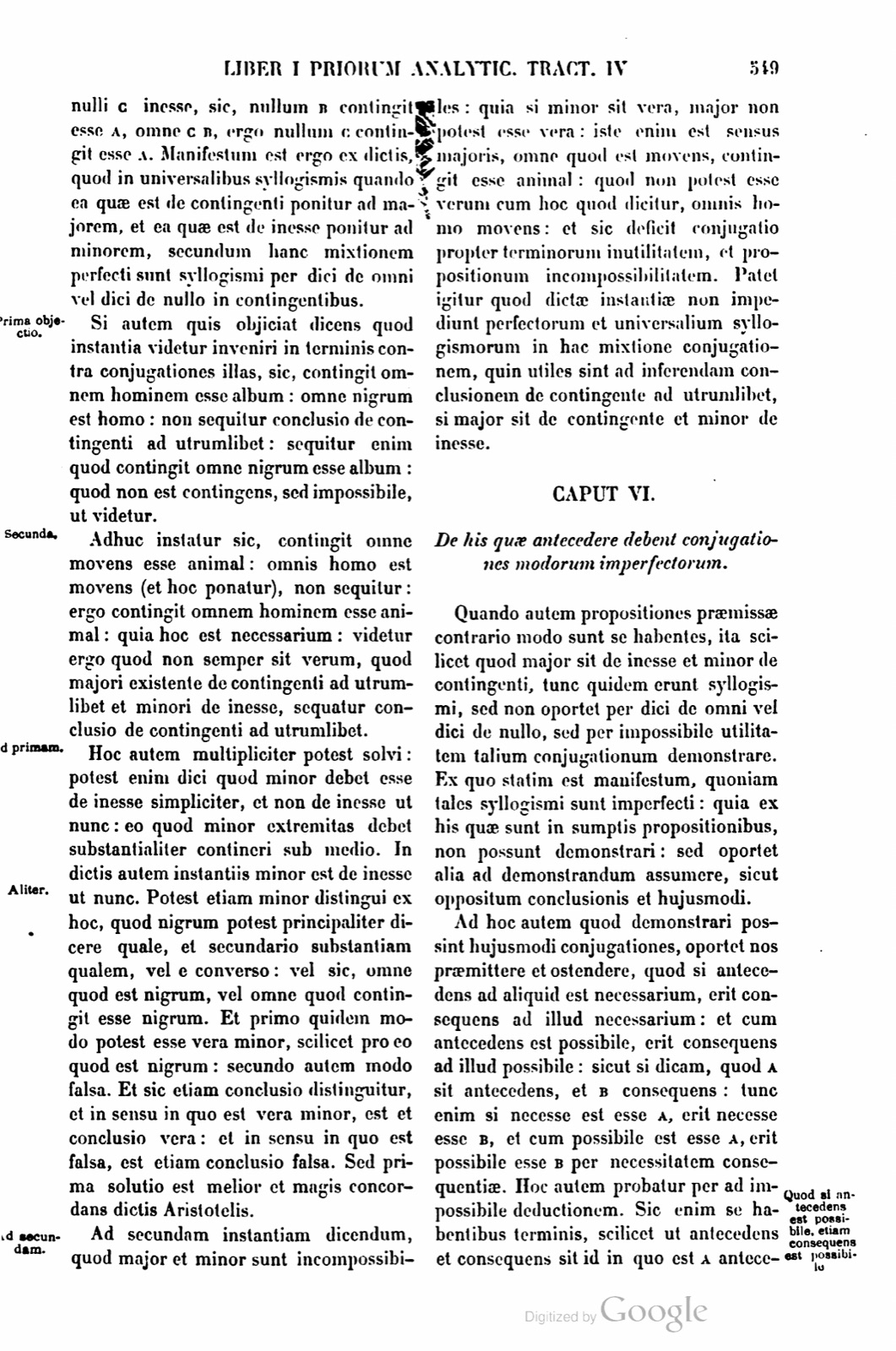
CAPUT VI. De his quae antecedere debent conjugationes modorum imperfectorum.
Quando autem propositiones praemissae contrario modo sunt se habentes, ita scilicet quod major sit de inesse et minor de contingenti, tunc quidem erunt syllogismi, sed non oportet per dici de omni vel dici de nullo, sed per impossibile utilitatem talium conjugationum demonstrare. Ex quo statim est manifestum, quoniam tales syllogismi sunt imperfecti: quia ex his quae sunt in sumptis propositionibus, non possunt demonstrari: sed oportet alia ad demonstrandum assumere, sicut oppositum conclusionis et hujusmodi.
Ad hoc autem quod demonstrari possint hujusmodi conjugationes, oportet nos praemittere et ostendere, quod si antecedens ad aliquid est necessarium, erit consequens ad illud necessarium: et cum antecedens est possibile, erit consequens ad illud possibile: sicut si dicam, quod A sit antecedens, et B consequens: tunc enim si necesse est esse A, erit necesse esse B, et cum possibile est esse A, erit possibile esse B per necessitatem consequentiae. Hoc autem probatur per ad impossibile deductionem. Sic enim se habentibus terminis, scilicet ut antecedens et consequens sit id in quo est A antecedens possibile: dico ergo quod B consequens erit possibile: vel detur oppositum, quod scilicet B non sit possibile, quando A est possibile. Si ergo B non est possibile, sequitur ab aequipollenti quod B erit impossibile, cum tamen sit consequens ad A. Sed id quod est possibile, est hoc quod cum possibile sit fieri, aliquando fiet: impossibile vero, quod cum sit impossibile, non fiet unquam: sequitur quod cum A sit possibile, et B impossibile, quod A aliquando sit praeter B, si enim fieri contingit: tunc etiam esse contingit A praeter B, quod enim fit quando jam factum est, tunc est in actu: oportet enim hic accipere possibile non ante actum tantum, secundum quod possibile dicimus, quod potest fieri quod possibile est in generatione sive in fieri dictum. Sed oportet etiam accipere in actu quando jam est, et quando jam verum est quod est, et quando jam habet esse in actu, et quocumque alio modo etiam in complexis sicut in propositionibus aliter dicitur possibile. In omnibus enim similiter se habebit: et similiter etiam est impossibile et ante fieri sive generationem, et in actu postquam est in actu. In omnibus enim sequitur id quod dictum est. Aut si consequens erit impossibile quando antecedens est possibile, sequitur quod antecedens sit sine consequente: et cum antecedens sit aliquid consequentis et sub ipso, sequitur quod aliquid semper erit et non erit, et erit idem possibile et impossibile, quod stare non potest. Stabit igitur quod dictum est, quod si antecedens est possibile, consequens est possibile.
CHAPTER VI. On the things which must precede the conjugations of imperfect modes.
But when the premise propositions have themselves in a contrary way, namely so that the major is of inherence and the minor of the contingent, then there will indeed be syllogisms; but it is not necessary to demonstrate the usefulness of such conjugations through being said of every or being said of none, but through the impossible. From this it is immediately manifest that such syllogisms are imperfect, because they cannot be demonstrated from those things which are in the propositions taken, but other things must be assumed for demonstrating, such as the opposite of the conclusion and things of this sort.
But in order that such conjugations can be demonstrated, we must set forth beforehand and show that if an antecedent to something is necessary, the consequent to that thing will be necessary; and when the antecedent is possible, the consequent to that thing will be possible. Thus if I say that A is the antecedent and B the consequent, then if it is necessary that A be, it will be necessary that B be; and when it is possible that A be, it will be possible that B be, through the necessity of the consequence. But this is proved through reduction to the impossible. For when the terms have themselves thus, namely so that antecedent and consequent are that in which A is a possible antecedent, I say therefore that B, the consequent, will be possible. Or let the opposite be granted, namely that B is not possible when A is possible. Therefore if B is not possible, it follows from the equipollent that B will be impossible, although it is consequent to A. But that which is possible is this: that when it is possible for it to come to be, at some time it will come to be. But the impossible, since it is impossible, will never come to be. It follows that, since A is possible and B impossible, A at some time is apart from B. For if it is contingent to come to be, then it is also contingent for A to be apart from B; for what comes to be, when it has now been made, then is in act. For here one must take the possible not only before act, according as we call possible that which can come to be, which possible is said in generation or in becoming. But one must also take it in act when it now is, and when it is now true that it is, and when it now has being in act, and in whatever other way the possible is said otherwise also in complexes, as in propositions. For in all things it will have itself similarly; and the impossible also is similarly both before becoming or generation and in act after it is in act. For in all cases what has been said follows. Or if the consequent will be impossible when the antecedent is possible, it follows that the antecedent is without the consequent; and since the antecedent is something of the consequent and under it, it follows that something will always be and not be, and the same thing will be possible and impossible, which cannot stand. Therefore what has been said will stand: that if the antecedent is possible, the consequent is possible.
Amplius autem inter ea quae mixtioni syllogismorum imperfectorum praemittenda sunt, secundum est hoc quod cum dicimus cum est A antecedens, quod sit ante B consequens, non oportet opinari, quod ibi dicamus A tanquam unum aliquid sit ex quo syllogistice sequatur B consequens: nihil enim sequitur syllogistice ex uno et unico aliquo existente, sed ex duabus ad minus propositionibus et tribus terminis: unde A ponitur non pro uno, sed pro duabus propositionibus antecedentibus, et B ponitur pro conclusione: et tunc antecedens sunt duae propositiones inferentes conclusionem, quando sic se habent in mixtione contingentis et inesse sicut dictum est secundum syllogismum contingentem conclusionem concludentem. In tali enim consequentia si C ut consequens dicitur de D sicut de antecedente, D autem per eumdem modum ut consequens dicitur de E ut antecedente, sequitur per necessitatem syllogisticam quod etiam C dicatur de E in conclusione per id quod in Praedicamentis dictum est, quando alterum de altero ut de subjecto dicitur, omnia quae de praedicato dicuntur, dici de subjecto necesse est. Et si utrumque in antecedente possibile est praemissorum, erit etiam possibilis conclusio. Quemadmodum accidit in necessariis, si quis ponat propositiones esse A, et B ponat esse conclusionem. In talibus enim accidit sive sequitur, cum A sit propositiones necessariae, et B conclusionem esse necessariam: sic etiam sequitur quod possibile in propositionibus sequitur possibile in conclusione.
Moreover, among those things which must be set forth before the mixing of imperfect syllogisms, the second is this: that when we say, when A the antecedent is, that it is before B the consequent, one ought not to think that there we say A as if it were one something from which B, the consequent, follows syllogistically. For nothing follows syllogistically from one single existing thing, but from at least two propositions and three terms. Hence A is posited not for one thing, but for two antecedent propositions, and B is posited for the conclusion; and then the antecedent is two propositions inferring the conclusion, when they have themselves in the mixing of the contingent and inherence as was said according to a syllogism concluding a contingent conclusion. For in such a consequence, if C as consequent is said of D as of antecedent, and D in the same way as consequent is said of E as antecedent, it follows by syllogistic necessity that C also is said of E in the conclusion through that which was said in the Predicaments: when one thing is said of another as of a subject, all things which are said of the predicate must be said of the subject. And if each of the premises in the antecedent is possible, the conclusion also will be possible. Just as happens in necessary things if someone posits the propositions to be A, and posits B to be the conclusion. For in such things it happens or follows, when A is necessary propositions, and B the conclusion, that the conclusion is necessary; so also it follows that the possible in the propositions follows as possible in the conclusion.
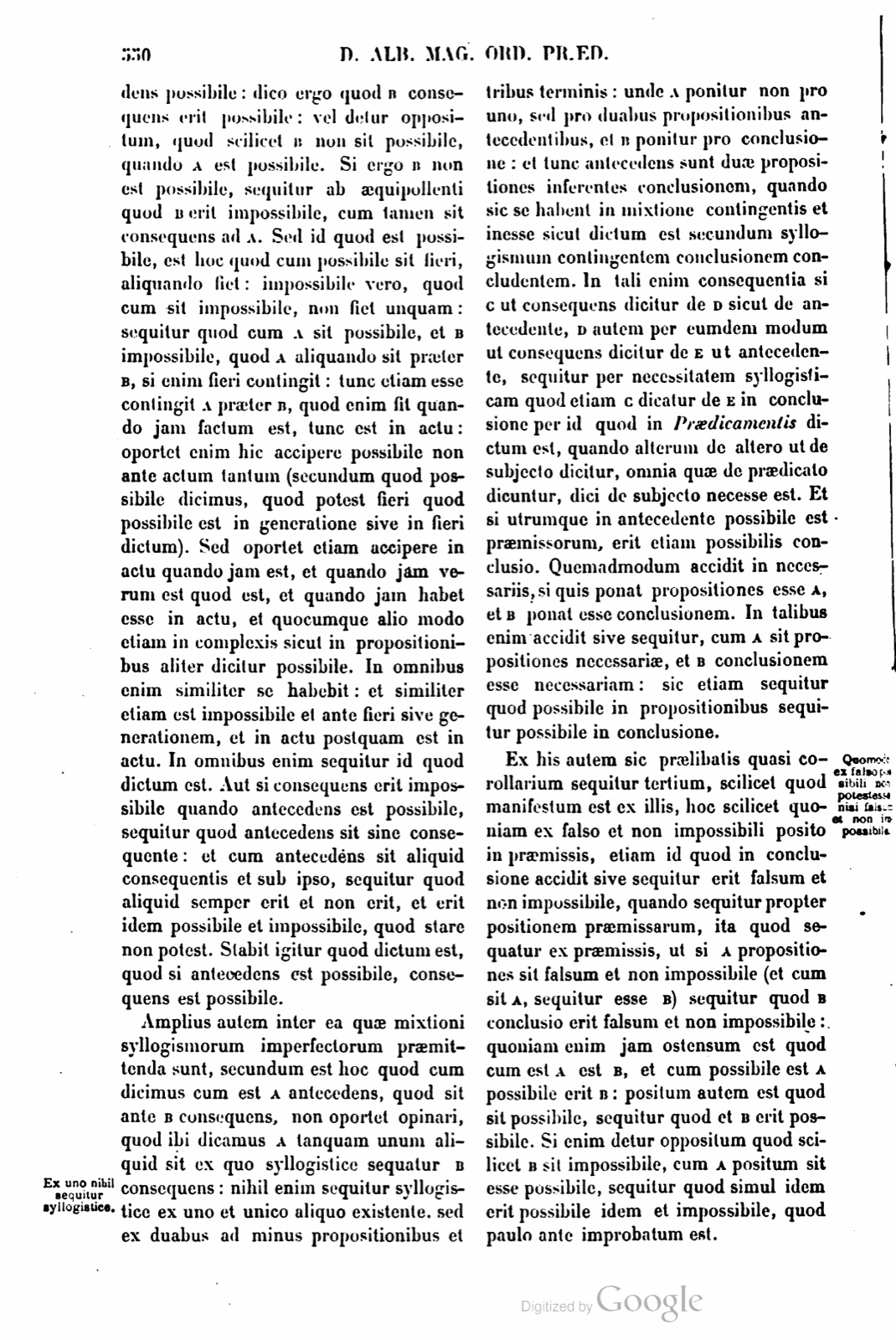
Ex his autem sic praelibatis quasi corollarium sequitur tertium, scilicet quod manifestum est ex illis, hoc scilicet quoniam ex falso et non impossibili posito in praemissis, etiam id quod in conclusione accidit sive sequitur erit falsum et non impossibile, quando sequitur propter positionem praemissarum, ita quod sequatur ex praemissis, ut si A propositiones sit falsum et non impossibile, et cum sit A, sequitur esse B, sequitur quod B conclusio erit falsum et non impossibile: quoniam enim jam ostensum est quod cum est A est B, et cum possibile est A possibile erit B: positum autem est quod sit possibile, sequitur quod et B erit possibile. Si enim detur oppositum quod scilicet B sit impossibile, cum A positum sit esse possibile, sequitur quod simul idem erit possibile idem et impossibile, quod paulo ante improbatum est.
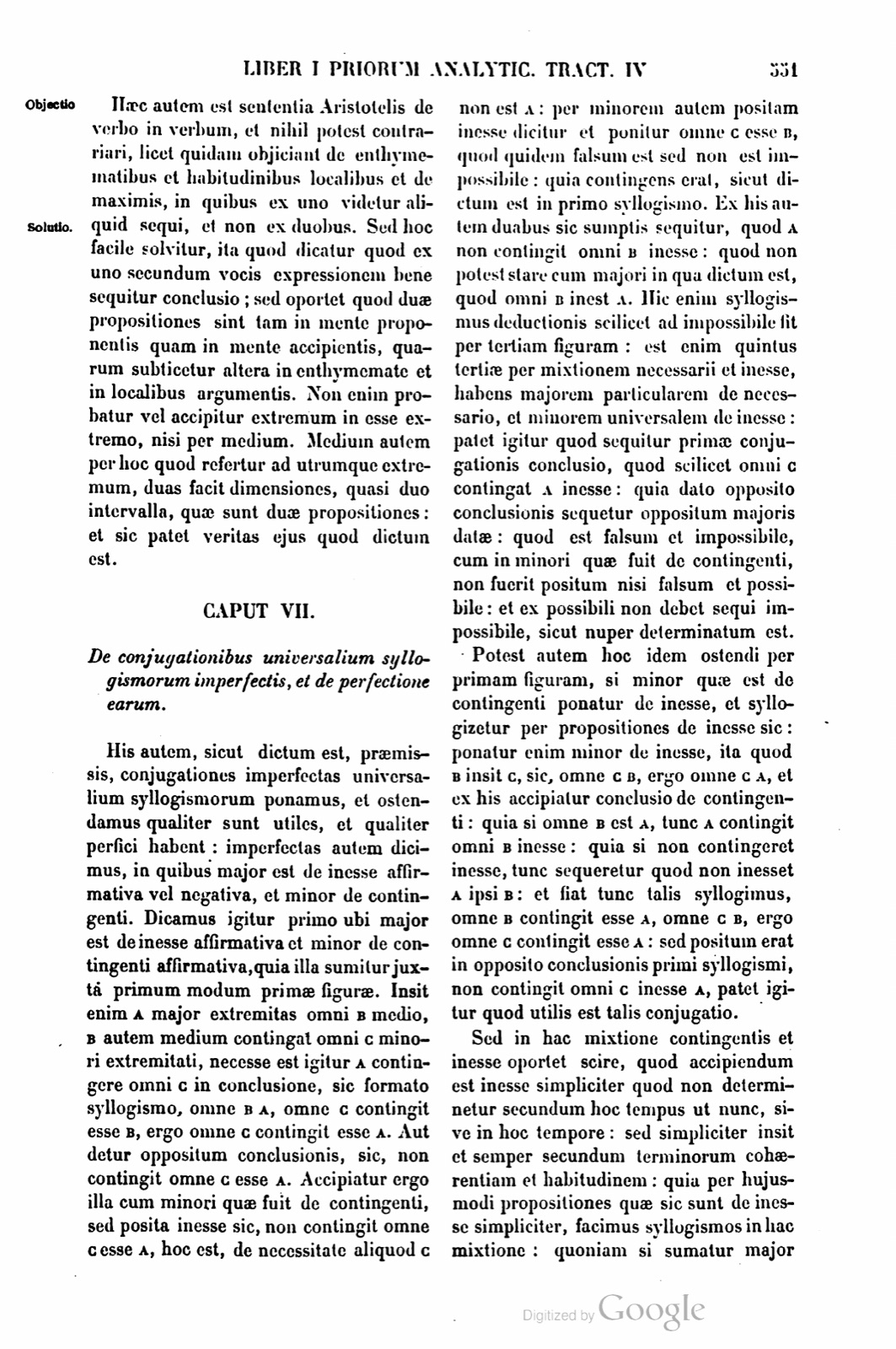
Haec autem est sententia Aristotelis de verbo in verbum, et nihil potest contrariari, licet quidam objiciant de enthymematibus et habitudinibus localibus et de maximis, in quibus ex uno videtur aliquid sequi, et non ex duobus. Sed hoc facile solvitur, ita quod dicatur quod ex uno secundum vocis expressionem bene sequitur conclusio; sed oportet quod duae propositiones sint tam in mente proponentis quam in mente accipientis, quarum subticetur altera in enthymemate et in localibus argumentis. Non enim probatur vel accipitur extremum in esse extremo, nisi per medium. Medium autem per hoc quod refertur ad utrumque extremum, duas facit dimensiones, quasi duo intervalla, quae sunt duae propositiones: et sic patet veritas ejus quod dictum est.
But from these things thus set forth beforehand, as a corollary there follows a third point, namely that this is manifest from them: that from a false and non-impossible thing posited in the premises, that too which happens or follows in the conclusion will be false and non-impossible, when it follows because of the positing of the premises, so that it follows from the premises. For example, if A as propositions is false and non-impossible, and when A is, B follows to be, it follows that B as conclusion will be false and non-impossible. For since it has already been shown that when A is, B is, and when A is possible B will be possible, and it has been posited that A is possible, it follows that B also will be possible. For if the opposite is granted, namely that B is impossible, when A has been posited to be possible, it follows that at the same time the same thing will be possible and the same impossible, which was disproved a little before.
But this is the opinion of Aristotle word for word, and nothing can be opposed to it, although some object concerning enthymemes and local habits and maxims, in which something seems to follow from one thing and not from two. But this is easily solved, so that it is said that from one thing according to the expression of speech a conclusion indeed follows well; but two propositions must be both in the mind of the one proposing and in the mind of the one receiving, of which one is suppressed in the enthymeme and in local arguments. For an extreme is not proved or received to be in an extreme except through a middle. But the middle, through the fact that it is referred to each extreme, makes two dimensions, as it were two intervals, which are two propositions; and thus the truth of what has been said is clear.
If a page does not appear, its photograph has not been uploaded yet.