Works › Prior Analytics, Books I–II
Volume 1 · pp. 547–549
Chapter V. On the mixing of the contingent and inherence in the universal modes of the first figure.
A marker with ≈ is an approximate page boundary, placed by measure of the text; the page photographs remain the authority. In the paired views, clicking a page marker brings that page into view.
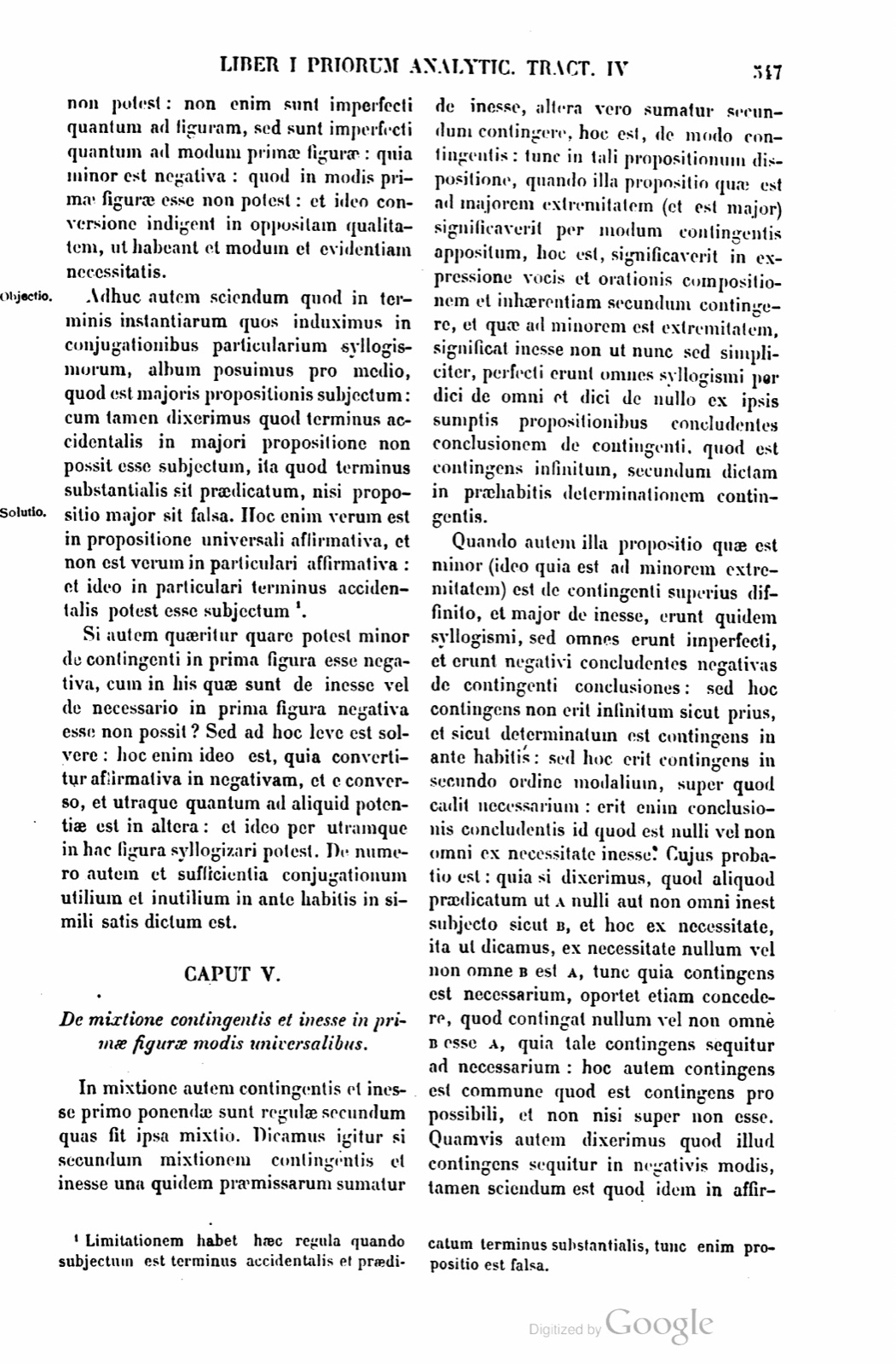
CAPUT V. De mixtione contingentis et inesse in primae figurae modis universalibus.
In mixtione autem contingentis et inesse primo ponendae sunt regulae secundum quas fit ipsa mixtio. Dicamus igitur si secundum mixtionem contingentis et inesse una quidem praemissarum sumatur de inesse, altera vero sumatur secundum contingere, hoc est, de modo contingentis: tunc in tali propositionum dispositione, quando illa propositio quae est ad majorem extremitatem et est major significaverit per modum contingentis appositum, hoc est, significaverit in expressione vocis et orationis compositionem et inhaerentiam secundum contingere, et quae ad minorem est extremitatem significat inesse non ut nunc sed simpliciter, perfecti erunt omnes syllogismi per dici de omni et dici de nullo ex ipsis sumptis propositionibus concludentes conclusionem de contingenti, quod est contingens infinitum, secundum dictam in praehabitis determinationem contingentis.
Quando autem illa propositio quae est minor, ideo quia est ad minorem extremitatem, est de contingenti superius diffinito, et major de inesse, erunt quidem syllogismi, sed omnes erunt imperfecti, et erunt negativi concludentes negativas de contingenti conclusiones: sed hoc contingens non erit infinitum sicut prius, et sicut determinatum est contingens in ante habitis: sed hoc erit contingens in secundo ordine modalium, super quod cadit necessarium: erit enim conclusionis concludentis id quod est nulli vel non omni ex necessitate inesse. Cujus probatio est: quia si dixerimus, quod aliquod praedicatum ut A nulli aut non omni inest subjecto sicut B, et hoc ex necessitate, ita ut dicamus, ex necessitate nullum vel non omne B est A, tunc quia contingens est necessarium, oportet etiam concedere, quod contingat nullum vel non omne B esse A, quia tale contingens sequitur ad necessarium: hoc autem contingens est commune quod est contingens pro possibili, et non nisi super non esse. Quamvis autem dixerimus quod illud contingens sequitur in negativis modis, tamen sciendum est quod idem in affirmativis in quibus minor est de contingenti. Hoc autem patebit in consequentibus. Istae igitur sunt duae regulae, quibus fit mixtio contingentis et inesse ad inferendam conclusionem de contingenti.
Est autem quaestio circa regulas inductas: quia in mixtione necessarii et inesse non fuit utilis conjugatio ad inferendam conclusionem de necessario, nisi majori existente de necessario. Quaeritur ergo, quare in ista mixtione utilis est ad inferendam conclusionem de contingenti, et majori existente de contingenti, et minori de inesse: et e converso minori existente de contingenti, et majori de inesse. Sed hoc ideo est, quia necessarium dicitur uno modo, et contingens dicitur multipliciter. Et ideo ad conclusionem de necessario, quod semper uno modo est, conjugatio utilis est quando major est de necessario: et hoc non potest inferri quando minor, quae minoris virtutis est in inferendo, fuerit de necessario, et major de inesse. Et similiter esset de contingenti si uno modo diceretur, et esset semper uno modo: propter quod minori existente de contingenti infertur aliquod contingens, quamvis non uno modo sit acceptum in conclusione et in praemissa.
CHAPTER V. On the mixing of the contingent and inherence in the universal modes of the first figure.
But in the mixing of the contingent and inherence, first the rules must be posited according to which the mixing itself is made. Therefore let us say that if, according to the mixing of the contingent and inherence, one of the premises is taken as of inherence, but the other is taken according to contingency, that is, concerning the mode of the contingent, then in such a disposition of propositions, when that proposition which is at the greater extreme and is the major has signified through the mode of the contingent added, that is, has signified in the expression of the spoken word and of speech composition and inherence according to contingency, and that which is at the lesser extreme signifies inherence not as now but simply, all the syllogisms will be perfect through being said of every and being said of none, concluding from the propositions themselves taken a conclusion about the contingent, which is the indefinite contingent, according to the determination of the contingent stated in what was had before.
But when that proposition which is the minor, because it is at the lesser extreme, is about the contingent defined above, and the major is of inherence, there will indeed be syllogisms, but all will be imperfect, and they will be negative syllogisms concluding negative conclusions about the contingent. But this contingent will not be indefinite as before, and as the contingent has been determined in what was had before; rather this will be a contingent in the second order of modals, upon which the necessary falls. For it will be of a conclusion concluding that which is to belong to none or not to every from necessity. The proof of this is that if we have said that some predicate, as A, belongs to no or not every subject such as B, and this from necessity, so that we say: of necessity no or not every B is A, then, because the necessary is contingent, one must also concede that it is contingent that no or not every B be A, because such a contingent follows upon the necessary. But this contingent is the common contingent which is the contingent for the possible, and only upon not-being. Although, however, we have said that that contingent follows in negative modes, nevertheless it must be known that the same is true in affirmatives in which the minor is about the contingent. But this will be clear in what follows. Therefore these are the two rules by which the mixing of the contingent and inherence is made for inferring a conclusion about the contingent.
But there is a question concerning the rules introduced, because in the mixing of the necessary and inherence there was not a useful conjugation for inferring a conclusion of necessity unless the major was of necessity. Therefore it is asked why in this mixing a conjugation is useful for inferring a conclusion about the contingent both when the major is of the contingent and the minor of inherence, and conversely when the minor is of the contingent and the major of inherence. But this is so because the necessary is said in one way, and the contingent is said in many ways. And therefore, for a conclusion of necessity, which is always in one way, the conjugation is useful when the major is of necessity; and this cannot be inferred when the minor, which has less power in inferring, has been of necessity and the major of inherence. And it would be similar concerning the contingent if it were said in one way and were always in one way; for this reason, when the minor is of the contingent, some contingent is inferred, although it is not taken in one way in the conclusion and in the premise.
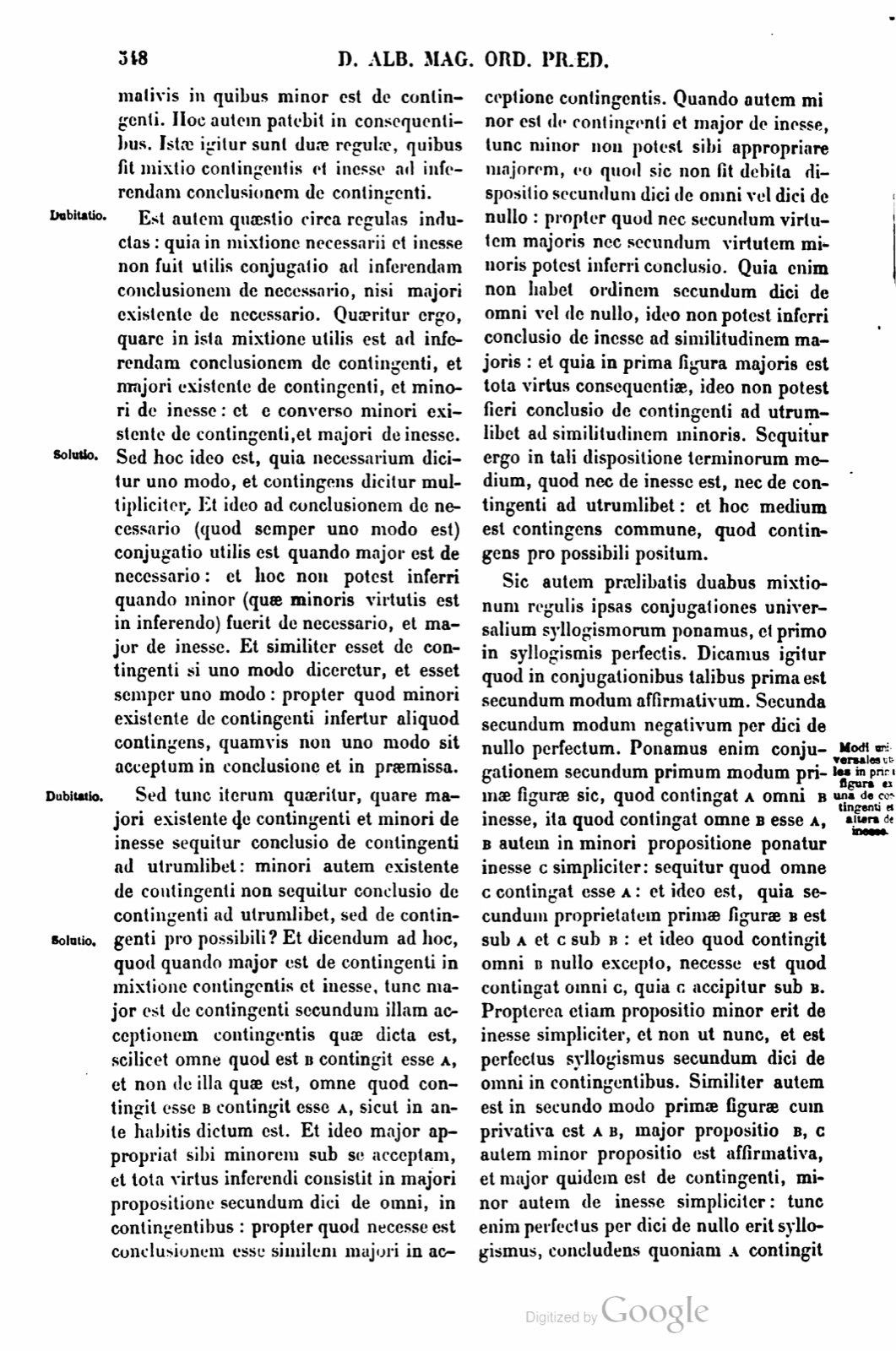
Sed tunc iterum quaeritur, quare majori existente de contingenti et minori de inesse sequitur conclusio de contingenti ad utrumlibet: minori autem existente de contingenti non sequitur conclusio de contingenti ad utrumlibet, sed de contingenti pro possibili? Et dicendum ad hoc, quod quando major est de contingenti in mixtione contingentis et inesse, tunc major est de contingenti secundum illam acceptionem contingentis quae dicta est, scilicet omne quod est B contingit esse A, et non de illa quae est, omne quod contingit esse B contingit esse A, sicut in ante habitis dictum est. Et ideo major appropriat sibi minorem sub se acceptam, et tota virtus inferendi consistit in majori propositione secundum dici de omni, in contingentibus: propter quod necesse est conclusionem esse similem majori in acceptione contingentis. Quando autem minor est de contingenti et major de inesse, tunc minor non potest sibi appropriare majorem, eo quod sic non fit debita dispositio secundum dici de omni vel dici de nullo: propter quod nec secundum virtutem majoris nec secundum virtutem minoris potest inferri conclusio. Quia enim non habet ordinem secundum dici de omni vel de nullo, ideo non potest inferri conclusio de inesse ad similitudinem majoris: et quia in prima figura majoris est tota virtus consequentiae, ideo non potest fieri conclusio de contingenti ad utrumlibet ad similitudinem minoris. Sequitur ergo in tali dispositione terminorum medium, quod nec de inesse est, nec de contingenti ad utrumlibet: et hoc medium est contingens commune, quod contingens pro possibili positum.
Sic autem praelibatis duabus mixtionum regulis ipsas conjugationes universalium syllogismorum ponamus, et primo in syllogismis perfectis. Dicamus igitur quod in conjugationibus talibus prima est secundum modum affirmativum. Secunda secundum modum negativum per dici de nullo perfectum. Ponamus enim conjugationem secundum primum modum primae figurae sic, quod contingat A omni B inesse, ita quod contingat omne B esse A, B autem in minori propositione ponatur inesse C simpliciter: sequitur quod omne C contingat esse A: et ideo est, quia secundum proprietatem primae figurae B est sub A et C sub B: et ideo quod contingit omni B nullo excepto, necesse est quod contingat omni C, quia C accipitur sub B. Propterea etiam propositio minor erit de inesse simpliciter, et non ut nunc, et est perfectus syllogismus secundum dici de omni in contingentibus. Similiter autem est in secundo modo primae figurae cum privativa est A B, major propositio B, C autem minor propositio est affirmativa, et major quidem est de contingenti, minor autem de inesse simpliciter: tunc enim perfectus per dici de nullo erit syllogismus, concludens quoniam A contingit nulli C inesse, sic, nullum B contingit esse A, omne C B, ergo nullum C contingit esse A. Manifestum est ergo ex dictis, quod in universalibus syllogismis quando ea quae est de contingenti ponitur ad majorem, et ea quae est de inesse ponitur ad minorem, secundum hanc mixtionem perfecti sunt syllogismi per dici de omni vel dici de nullo in contingentibus.
But then again it is asked why, when the major is of the contingent and the minor of inherence, a conclusion of the contingent toward either alternative follows; but when the minor is of the contingent, a conclusion of the contingent toward either alternative does not follow, but one concerning the contingent for the possible. And to this it must be said that when the major is of the contingent in the mixing of the contingent and inherence, then the major is of the contingent according to that acceptation of the contingent which was stated, namely: everything that is B contingently is A, and not of that one which is: everything that contingently is B contingently is A, as was said in what was had before. And therefore the major appropriates to itself the minor taken under it, and the whole power of inferring consists in the major proposition according to being said of every in contingents; for this reason the conclusion must be similar to the major in the acceptation of the contingent. But when the minor is of the contingent and the major of inherence, then the minor cannot appropriate the major to itself, because in this way the due disposition according to being said of every or being said of none is not made. For this reason a conclusion can be inferred neither according to the power of the major nor according to the power of the minor. For because it does not have order according to being said of every or of none, a conclusion of inherence cannot be inferred according to the likeness of the major; and because in the first figure the whole power of consequence belongs to the major, a conclusion of the contingent toward either alternative cannot be made according to the likeness of the minor. Therefore, in such a disposition of terms, there follows a middle which is neither of inherence nor of the contingent toward either alternative; and this middle is the common contingent, which is the contingent posited for the possible.
But with the two rules of mixings thus set forth, let us posit the conjugations themselves of universal syllogisms, and first in perfect syllogisms. Therefore let us say that in such conjugations the first is according to the affirmative mode. The second is according to the negative mode, perfected through being said of none. For let us posit a conjugation according to the first mode of the first figure thus: that A contingently belongs to every B, so that every B contingently is A, but B in the minor proposition is posited to belong to C simply. It follows that every C contingently is A; and this is because, according to the property of the first figure, B is under A and C under B; and therefore what contingently belongs to every B, with none excepted, must contingently belong to every C, because C is taken under B. For this reason also the minor proposition will be of inherence simply, and not as now, and it is a perfect syllogism according to being said of every in contingents. Similarly it is in the second mode of the first figure when A B is privative, the major proposition, but B C the minor proposition is affirmative, and the major indeed is of the contingent while the minor is of inherence simply. For then the syllogism will be perfect through being said of none, concluding that A contingently belongs to no C, thus: no B contingently is A; every C is B; therefore no C contingently is A. Therefore it is manifest from what has been said that in universal syllogisms, when that which is of the contingent is posited at the major and that which is of inherence is posited at the minor, according to this mixing the syllogisms are perfect through being said of every or being said of none in contingents.
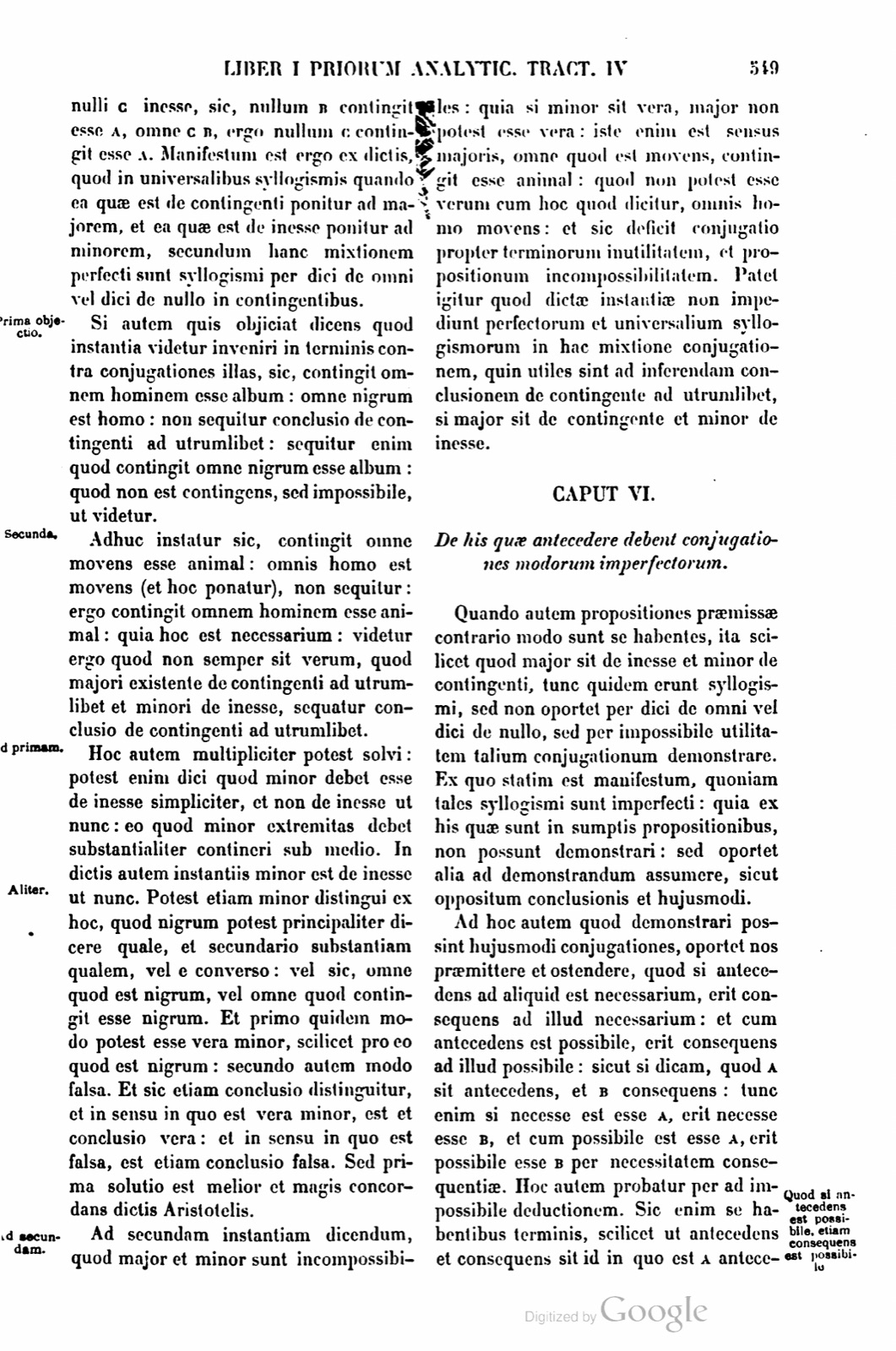
Si autem quis objiciat dicens quod instantia videtur inveniri in terminis contra conjugationes illas, sic, contingit omnem hominem esse album: omne nigrum est homo: non sequitur conclusio de contingenti ad utrumlibet: sequitur enim quod contingit omne nigrum esse album: quod non est contingens, sed impossibile, ut videtur.
Adhuc instatur sic, contingit omne movens esse animal: omnis homo est movens, et hoc ponatur, non sequitur: ergo contingit omnem hominem esse animal: quia hoc est necessarium: videtur ergo quod non semper sit verum, quod majori existente de contingenti ad utrumlibet et minori de inesse, sequatur conclusio de contingenti ad utrumlibet.
Hoc autem multipliciter potest solvi: potest enim dici quod minor debet esse de inesse simpliciter, et non de inesse ut nunc: eo quod minor extremitas debet substantialiter contineri sub medio. In dictis autem instantiis minor est de inesse ut nunc. Potest etiam minor distingui ex hoc, quod nigrum potest principaliter dicere quale, et secundario substantiam qualem, vel e converso: vel sic, omne quod est nigrum, vel omne quod contingit esse nigrum. Et primo quidem modo potest esse vera minor, scilicet pro eo quod est nigrum: secundo autem modo falsa. Et sic etiam conclusio distinguitur, et in sensu in quo est vera minor, est et conclusio vera: et in sensu in quo est falsa, est etiam conclusio falsa. Sed prima solutio est melior et magis concordans dictis Aristotelis.
Ad secundam instantiam dicendum, quod major et minor sunt incompossibiles: quia si minor sit vera, major non potest esse vera: iste enim est sensus majoris, omne quod est movens, contingit esse animal: quod non potest esse verum cum hoc quod dicitur, omnis homo movens: et sic deficit conjugatio propter terminorum inutilitatem, et propositionum incompossibilitatem. Patet igitur quod dictae instantiae non impediunt perfectorum et universalium syllogismorum in hac mixtione conjugationem, quin utiles sint ad inferendam conclusionem de contingente ad utrumlibet, si major sit de contingente et minor de inesse.
But if someone objects, saying that an instance seems to be found in terms against those conjugations, thus: it is contingent that every man be white; every black thing is a man; a conclusion of the contingent toward either alternative does not follow. For it follows that it is contingent that every black thing be white, which is not contingent but impossible, as it seems.
Again an objection is pressed thus: it is contingent that every moving thing be an animal; every man is moving, and let this be posited; it does not follow: therefore it is contingent that every man be an animal, because this is necessary. Therefore it seems that it is not always true that, with the major being of the contingent toward either alternative and the minor of inherence, a conclusion of the contingent toward either alternative follows.
But this can be solved in many ways. For it can be said that the minor must be of inherence simply and not of inherence as now, because the lesser extreme must be contained substantially under the middle. But in the stated instances the minor is of inherence as now. The minor can also be distinguished from this, that black can principally state a quality and secondarily a qualified substance, or conversely; or thus: everything that is black, or everything that contingently is black. And in the first way the minor can be true, namely for that which is black; but in the second way false. And thus the conclusion also is distinguished, and in the sense in which the minor is true, the conclusion too is true; and in the sense in which it is false, the conclusion also is false. But the first solution is better and more concordant with the sayings of Aristotle.
To the second instance one must say that the major and minor are incompossible, because if the minor is true, the major cannot be true. For this is the sense of the major: everything that is moving contingently is an animal; and this cannot be true together with what is said, every man is moving. And thus the conjugation fails because of the uselessness of the terms and the incompossibility of the propositions. Therefore it is clear that the stated instances do not impede the conjugation of perfect and universal syllogisms in this mixing, so that they are useful for inferring a conclusion about the contingent toward either alternative, if the major is of the contingent and the minor of inherence.
If a page does not appear, its photograph has not been uploaded yet.