Works › Prior Analytics, Books I–II
Volume 1 · pp. 545–547
Chapter IV. On the solution of doubts which concern this uniform generation in the contingent.
A marker with ≈ is an approximate page boundary, placed by measure of the text; the page photographs remain the authority. In the paired views, clicking a page marker brings that page into view.
CAPUT IV. De solutione dubiorum quae sunt circa istam generationem uniformem in contingenti.
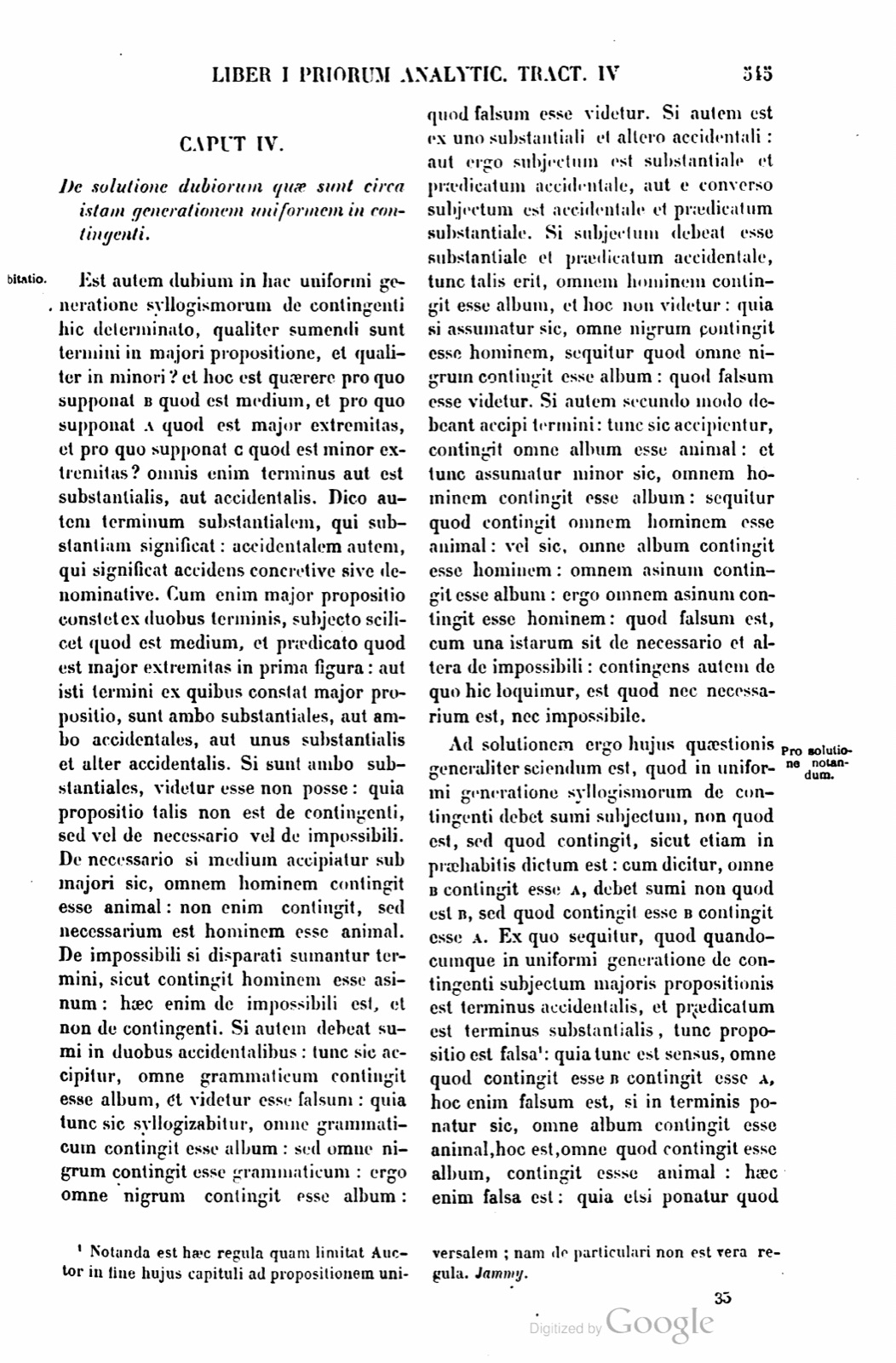
Est autem dubium in hac uniformi generatione syllogismorum de contingenti hic determinato, qualiter sumendi sunt termini in majori propositione, et qualiter in minori? et hoc est quaerere pro quo supponat B quod est medium, et pro quo supponat A quod est major extremitas, et pro quo supponat C quod est minor extremitas? omnis enim terminus aut est substantialis, aut accidentalis. Dico autem terminum substantialem, qui substantiam significat: accidentalem autem, qui significat accidens concretive sive denominative. Cum enim major propositio constet ex duobus terminis, subjecto scilicet quod est medium, et praedicato quod est major extremitas in prima figura: aut isti termini ex quibus constat major propositio, sunt ambo substantiales, aut ambo accidentales, aut unus substantialis et alter accidentalis. Si sunt ambo substantiales, videtur esse non posse: quia propositio talis non est de contingenti, sed vel de necessario vel de impossibili. De necessario si medium accipiatur sub majori sic, omnem hominem contingit esse animal: non enim contingit, sed necessarium est hominem esse animal. De impossibili si disparati sumantur termini, sicut contingit hominem esse asinum: haec enim de impossibili est, et non de contingenti. Si autem debeat sumi in duobus accidentalibus: tunc sic accipitur, omne grammaticum contingit esse album, et videtur esse falsum: quia tunc sic syllogizabitur, omne grammaticum contingit esse album: sed omne nigrum contingit esse grammaticum: ergo omne nigrum contingit esse album: quod falsum esse videtur. Si autem est ex uno substantiali et altero accidentali: aut ergo subjectum est substantiale et praedicatum accidentale, aut e converso subjectum est accidentale et praedicatum substantiale. Si subjectum debeat esse substantiale et praedicatum accidentale, tunc talis erit, omnem hominem contingit esse album, et hoc non videtur: quia si assumatur sic, omne nigrum contingit esse hominem, sequitur quod omne nigrum contingit esse album: quod falsum esse videtur. Si autem secundo modo debeant accipi termini: tunc sic accipientur, contingit omne album esse animal: et tunc assumatur minor sic, omnem hominem contingit esse album: sequitur quod contingit omnem hominem esse animal: vel sic, omne album contingit esse hominem: omnem asinum contingit esse album: ergo omnem asinum contingit esse hominem: quod falsum est, cum una istarum sit de necessario et altera de impossibili: contingens autem de quo hic loquimur, est quod nec necessarium est, nec impossibile.
Ad solutionem ergo hujus quaestionis generaliter sciendum est, quod in uniformi generatione syllogismorum de contingenti debet sumi subjectum, non quod est, sed quod contingit, sicut etiam in praehabitis dictum est: cum dicitur, omne B contingit esse A, debet sumi non quod est B, sed quod contingit esse B contingit esse A. Ex quo sequitur, quod quandocumque in uniformi generatione de contingenti subjectum majoris propositionis est terminus accidentalis, et praedicatum est terminus substantialis, tunc propositio est falsa1: quia tunc est sensus, omne quod contingit esse B contingit esse A, hoc enim falsum est, si in terminis ponatur sic, omne album contingit esse animal, hoc est, omne quod contingit esse album, contingit esse animal: haec enim falsa est: quia etsi ponatur quod omne quod est album sit animal, tamen multa contingit esse alba, sicut lignum, et lapidem, et vestem, quorum nullum contingit esse animal. In ista ergo generatione non debet medium esse terminus accidentalis, cum major extremitas sit terminus substantialis.
CHAPTER IV. On the solution of doubts which concern this uniform generation in the contingent.
Now there is a doubt in this uniform generation of syllogisms concerning the contingent as here determined: how the terms must be taken in the major proposition, and how in the minor? And this is to ask for what B, which is the middle, supposits, and for what A, which is the greater extreme, supposits, and for what C, which is the lesser extreme, supposits. For every term is either substantial or accidental. But I call a substantial term one which signifies substance, and an accidental term one which signifies an accident concretively or denominatively. For since the major proposition consists of two terms, namely the subject, which is the middle, and the predicate, which is the greater extreme in the first figure, either the terms from which the major proposition consists are both substantial, or both accidental, or one is substantial and the other accidental. If both are substantial, this seems unable to be, because such a proposition is not about the contingent, but either about the necessary or about the impossible. It is about the necessary if the middle is taken under the major thus: every man contingently is an animal; for it is not contingent, but necessary, for a man to be an animal. It is about the impossible if disparate terms are taken, as: it is contingent for a man to be an ass; for this is about the impossible and not about the contingent. But if it ought to be taken in two accidentals, then it is taken thus: every grammatical thing contingently is white; and it seems to be false, because then one will syllogize thus: every grammatical thing contingently is white; but every black thing contingently is grammatical; therefore every black thing contingently is white, which seems to be false. But if it is from one substantial and the other accidental, then either the subject is substantial and the predicate accidental, or conversely the subject is accidental and the predicate substantial. If the subject must be substantial and the predicate accidental, then it will be such as this: every man contingently is white; and this does not seem right, because if it is assumed thus: every black thing contingently is a man, it follows that every black thing contingently is white, which seems to be false. But if the terms must be taken in the second way, then they will be taken thus: it is contingent that every white thing be an animal; and then let the minor be assumed thus: every man contingently is white; it follows that it is contingent that every man be an animal. Or thus: every white thing contingently is a man; every ass contingently is white; therefore every ass contingently is a man; which is false, since one of these propositions is of the necessary and the other of the impossible. But the contingent about which we speak here is that which is neither necessary nor impossible.
Therefore, for the solution of this question, it must generally be known that in the uniform generation of syllogisms concerning the contingent the subject must be taken not as what is, but as what is contingent, just as was also said in what was had before. When it is said, every B contingently is A, there must be taken not what is B, but what contingently is B contingently is A. From this it follows that whenever, in the uniform generation concerning the contingent, the subject of the major proposition is an accidental term and the predicate is a substantial term, then the proposition is false1. For then the sense is: everything that contingently is B contingently is A. For this is false if it is posited in terms thus: every white thing contingently is an animal, that is, everything that contingently is white contingently is an animal. For this is false, because even if it is posited that everything that is white is an animal, nevertheless many things can contingently be white, such as wood and stone and garment, none of which can contingently be an animal. Therefore in this generation the middle must not be an accidental term, when the greater extreme is a substantial term.
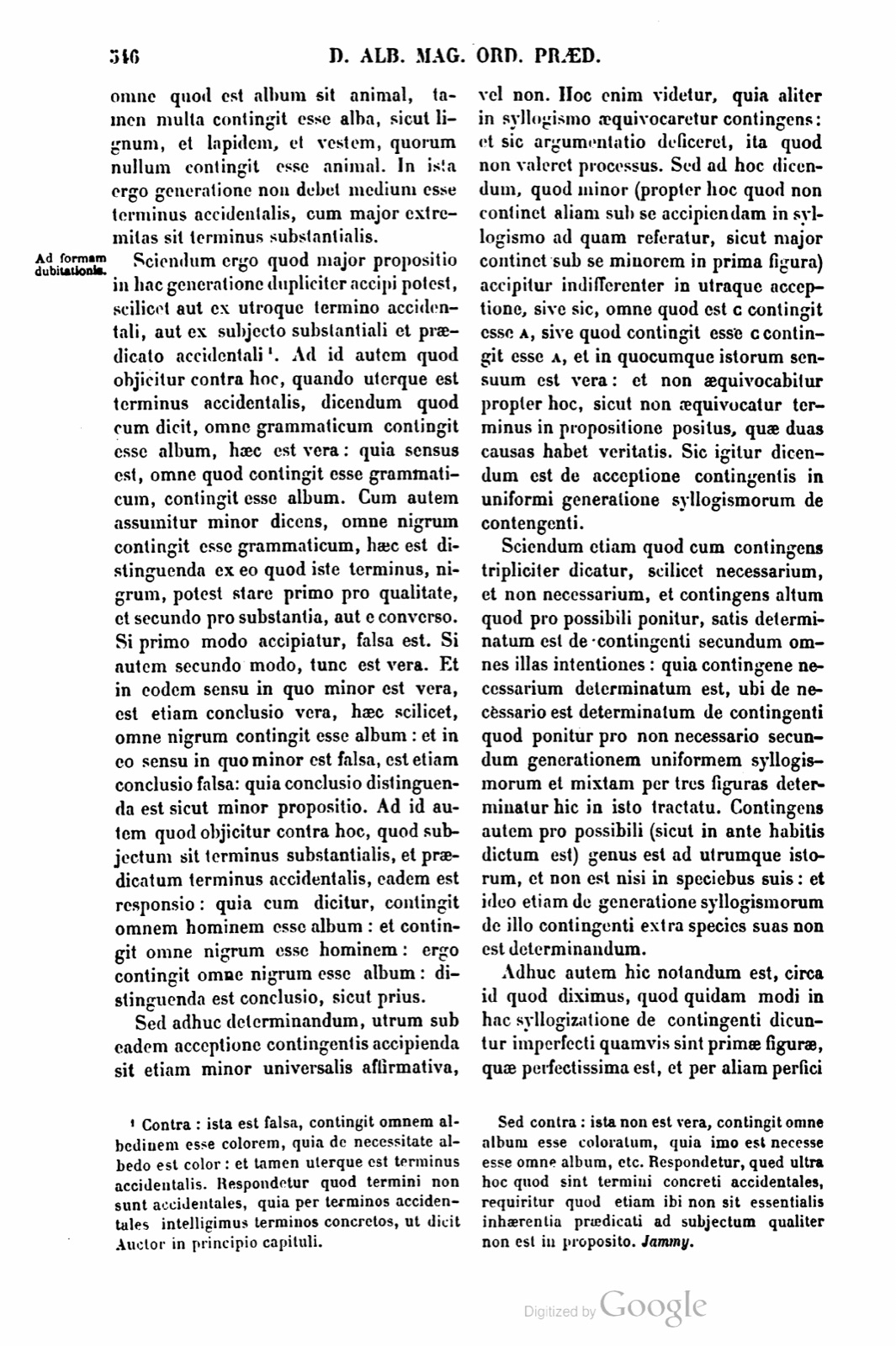
Sciendum ergo quod major propositio in hac generatione dupliciter accipi potest, scilicet aut ex utroque termino accidentali, aut ex subjecto substantiali et praedicato accidentali2. Ad id autem quod objicitur contra hoc, quando uterque est terminus accidentalis, dicendum quod cum dicit, omne grammaticum contingit esse album, haec est vera: quia sensus est, omne quod contingit esse grammaticum, contingit esse album. Cum autem assumitur minor dicens, omne nigrum contingit esse grammaticum, haec est distinguenda ex eo quod iste terminus, nigrum, potest stare primo pro qualitate, et secundo pro substantia, aut e converso. Si primo modo accipiatur, falsa est. Si autem secundo modo, tunc est vera. Et in eodem sensu in quo minor est vera, est etiam conclusio vera, haec scilicet, omne nigrum contingit esse album: et in eo sensu in quo minor est falsa, est etiam conclusio falsa: quia conclusio distinguenda est sicut minor propositio. Ad id autem quod objicitur contra hoc, quod subjectum sit terminus substantialis, et praedicatum terminus accidentalis, eadem est responsio: quia cum dicitur, contingit omnem hominem esse album: et contingit omne nigrum esse hominem: ergo contingit omne nigrum esse album: distinguenda est conclusio, sicut prius.
Sed adhuc determinandum, utrum sub eadem acceptione contingentis accipienda sit etiam minor universalis affirmativa, vel non. Hoc enim videtur, quia aliter in syllogismo aequivocaretur contingens: et sic argumentatio deficeret, ita quod non valeret processus. Sed ad hoc dicendum, quod minor, propter hoc quod non continet aliam sub se accipiendam in syllogismo ad quam referatur, sicut major continet sub se minorem in prima figura, accipitur indifferenter in utraque acceptione, sive sic, omne quod est C contingit esse A, sive quod contingit esse C contingit esse A, et in quocumque istorum sensuum est vera: et non aequivocabitur propter hoc, sicut non aequivocatur terminus in propositione positus, quae duas causas habet veritatis. Sic igitur dicendum est de acceptione contingentis in uniformi generatione syllogismorum de contingenti.
Therefore it must be known that the major proposition in this generation can be taken in two ways, namely either from each term accidental, or from a substantial subject and an accidental predicate2. But to that which is objected against this, when each is an accidental term, one must say that when he says, every grammatical thing contingently is white, this is true, because the sense is: everything that contingently is grammatical contingently is white. But when the minor is assumed saying, every black thing contingently is grammatical, this must be distinguished from the fact that this term, black, can stand first for the quality and secondly for the substance, or conversely. If it is taken in the first way, it is false. But if in the second way, then it is true. And in the same sense in which the minor is true, the conclusion also is true, namely this: every black thing contingently is white. And in the sense in which the minor is false, the conclusion also is false, because the conclusion must be distinguished just as the minor proposition. But to that which is objected against this, that the subject is a substantial term and the predicate an accidental term, the response is the same, because when it is said: it is contingent that every man be white, and it is contingent that every black thing be a man, therefore it is contingent that every black thing be white, the conclusion must be distinguished as before.
But it must still be determined whether the universal affirmative minor too must be taken under the same acceptation of the contingent, or not. For this seems so, because otherwise the contingent would be equivocated in the syllogism; and thus the argumentation would fail, so that the process would not be valid. But to this it must be said that the minor, because it does not contain another proposition under itself to be taken in the syllogism to which it is referred, as the major contains the minor under itself in the first figure, is taken indifferently in either acceptation, whether thus, everything that is C contingently is A, or what contingently is C contingently is A; and in whichever of these senses it is true, it will not be equivocated because of this, just as a term posited in a proposition is not equivocated when that proposition has two causes of truth. Thus, therefore, one must speak about the acceptation of the contingent in the uniform generation of syllogisms concerning the contingent.
Sciendum etiam quod cum contingens tripliciter dicatur, scilicet necessarium, et non necessarium, et contingens aliud quod pro possibili ponitur, satis determinatum est de contingenti secundum omnes illas intentiones: quia contingens necessarium determinatum est, ubi de necessario est determinatum; de contingenti quod ponitur pro non necessario secundum generationem uniformem syllogismorum et mixtam per tres figuras determinatur hic in isto tractatu. Contingens autem pro possibili, sicut in ante habitis dictum est, genus est ad utrumque istorum, et non est nisi in speciebus suis: et ideo etiam de generatione syllogismorum de illo contingenti extra species suas non est determinandum.
Adhuc autem hic notandum est, circa id quod diximus, quod quidam modi in hac syllogizatione de contingenti dicuntur imperfecti quamvis sint primae figurae, quae perfectissima est, et per aliam perfici non potest: non enim sunt imperfecti quantum ad figuram, sed sunt imperfecti quantum ad modum primae figurae: quia minor est negativa: quod in modis primae figurae esse non potest: et ideo conversione indigent in oppositam qualitatem, ut habeant et modum et evidentiam necessitatis.
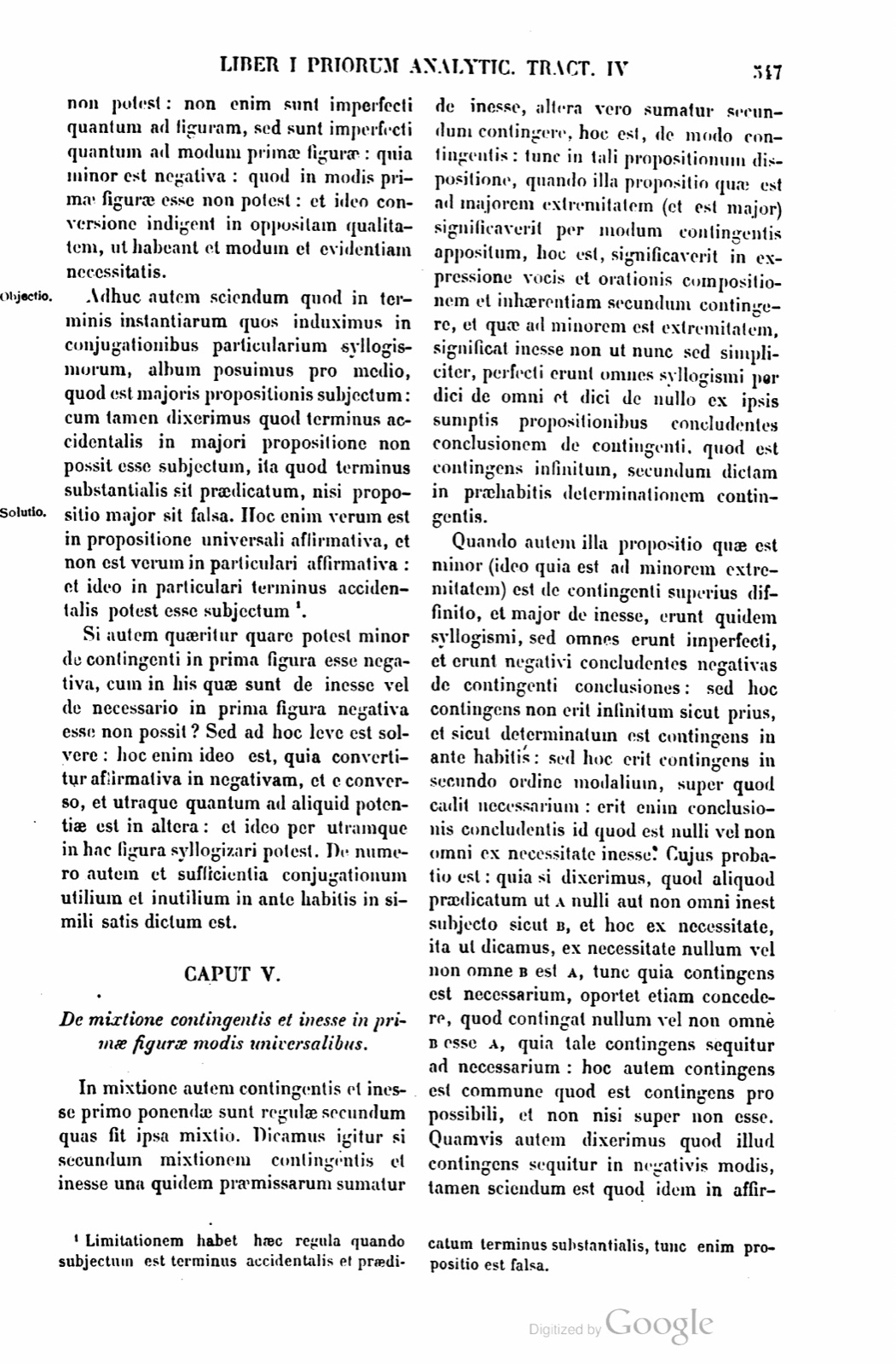
Adhuc autem sciendum quod in terminis instantiarum quos induximus in conjugationibus particularium syllogismorum, album posuimus pro medio, quod est majoris propositionis subjectum: cum tamen dixerimus quod terminus accidentalis in majori propositione non possit esse subjectum, ita quod terminus substantialis sit praedicatum, nisi propositio major sit falsa. Hoc enim verum est in propositione universali affirmativa, et non est verum in particulari affirmativa: et ideo in particulari terminus accidentalis potest esse subjectum3.
Si autem quaeritur quare potest minor de contingenti in prima figura esse negativa, cum in his quae sunt de inesse vel de necessario in prima figura negativa esse non possit? Sed ad hoc leve est solvere: hoc enim ideo est, quia convertitur affirmativa in negativam, et e converso, et utraque quantum ad aliquid potentiae est in altera: et ideo per utramque in hac figura syllogizari potest. De numero autem et sufficientia conjugationum utilium et inutilium in ante habitis in simili satis dictum est.
It must also be known that, since contingent is said in three ways, namely the necessary, the non-necessary, and another contingent which is posited for the possible, enough has been determined concerning the contingent according to all those intentions. For the necessary contingent has been determined where the necessary has been determined; but the contingent which is posited for the non-necessary, according to the uniform generation of syllogisms and the mixed one through the three figures, is determined here in this tractate. But the contingent for the possible, as was said in what was had before, is a genus to both of those, and it exists only in its species; and therefore the generation of syllogisms from that contingent outside its species must not be determined either.
Moreover, here it must be noted, concerning that which we said, that certain modes in this syllogizing concerning the contingent are called imperfect although they are of the first figure, which is most perfect and cannot be perfected through another. For they are not imperfect with respect to the figure, but they are imperfect with respect to the mode of the first figure, because the minor is negative, which cannot be in the modes of the first figure; and therefore they need conversion into the opposite quality, so that they may have both the mode and the evidence of necessity.
Again, it must be known that in the terms of the instances which we introduced in the conjugations of particular syllogisms, we posited white for the middle, which is the subject of the major proposition; yet we said that an accidental term in the major proposition cannot be the subject, so that a substantial term is the predicate, unless the major proposition is false. For this is true in a universal affirmative proposition, and it is not true in a particular affirmative; and therefore in a particular an accidental term can be the subject3.
But if it is asked why the minor about the contingent in the first figure can be negative, although in those propositions which are of inherence or of necessity a negative cannot be in the first figure, to this it is easy to solve. For this is so because the affirmative is converted into the negative, and conversely, and each is in the other with respect to something of potency; and therefore through each one a syllogism can be made in this figure. But about the number and sufficiency of useful and useless conjugations enough has been said in a similar case in what was had before.
Notes
- This rule must be noted, which the Author limits at the end of this chapter to a universal proposition; for concerning a particular proposition the rule is not true. Jammy. (Notanda est haec regula quam limitat Auctor in fine hujus capituli ad propositionem universalem; nam de particulari non est vera regula. Jammy.) ↩
- On the contrary: this is false, it is contingent that every whiteness be a color, because of necessity whiteness is a color; and yet each is an accidental term. It is answered that the terms are not accidental, because by accidental terms we understand concrete terms, as the Author says at the beginning of the chapter. But on the contrary: this is not true, it is contingent that every white thing be colored, because rather it is necessary that every white thing be, etc. It is answered that, beyond the fact that they are concrete accidental terms, it is also required that there not be there an essential inherence of the predicate to the subject, in the way in which there is not in the case proposed. Jammy. (Contra: ista est falsa, contingit omnem albedinem esse colorem, quia de necessitate albedo est color: et tamen uterque est terminus accidentalis. Respondetur quod termini non sunt accidentales, quia per terminos accidentales intelligimus terminos concretos, ut dicit Auctor in principio capituli. Sed contra: ista non est vera, contingit omne album esse coloratum, quia imo est necesse esse omne album, etc. Respondetur, quod ultra hoc quod sint termini concreti accidentales, requiritur quod etiam ibi non sit essentialis inhaerentia praedicati ad subjectum qualiter non est in proposito. Jammy.) ↩
- This rule has a limitation when the subject is an accidental term and the predicate a substantial term; for then the proposition is false. (Limitationem habet haec regula quando subjectum est terminus accidentalis et praedicatum terminus substantialis, tunc enim propositio est falsa.) ↩
If a page does not appear, its photograph has not been uploaded yet.