Works › Prior Analytics, Books I–II
Volume 1 · pp. 543–544
Chapter III. On the formation of particular syllogisms concerning the contingent.
A marker with ≈ is an approximate page boundary, placed by measure of the text; the page photographs remain the authority. In the paired views, clicking a page marker brings that page into view.
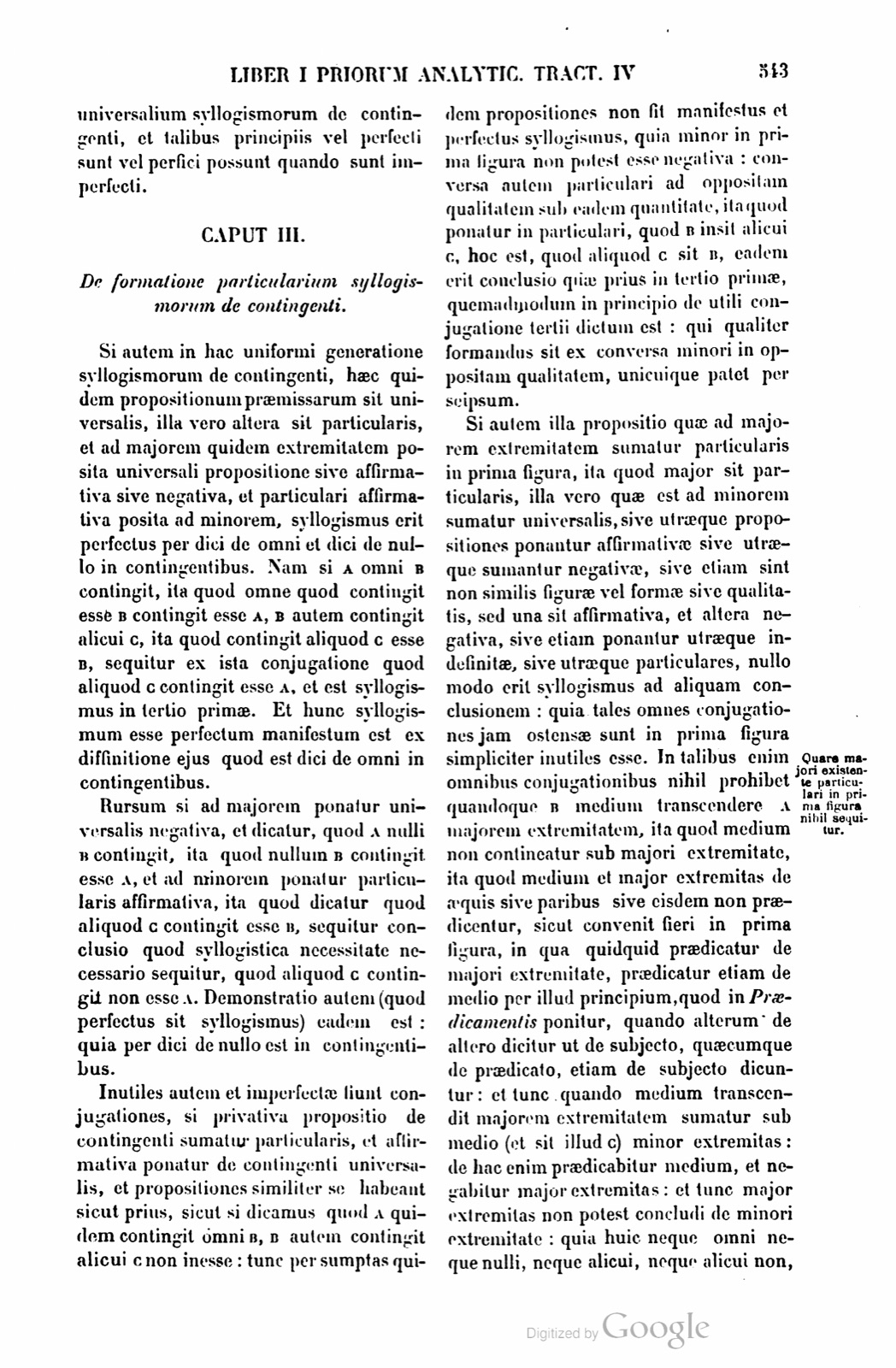
CAPUT III. De formatione particularium syllogismorum de contingenti.
Si autem in hac uniformi generatione syllogismorum de contingenti, haec quidem propositionum praemissarum sit universalis, illa vero altera sit particularis, et ad majorem quidem extremitatem posita universali propositione sive affirmativa sive negativa, et particulari affirmativa posita ad minorem, syllogismus erit perfectus per dici de omni et dici de nullo in contingentibus. Nam si A omni B contingit, ita quod omne quod contingit esse B contingit esse A, B autem contingit alicui C, ita quod contingit aliquod C esse B, sequitur ex ista conjugatione quod aliquod C contingit esse A, et est syllogismus in tertio primae. Et hunc syllogismum esse perfectum manifestum est ex diffinitione ejus quod est dici de omni in contingentibus.
Rursum si ad majorem ponatur universalis negativa, et dicatur, quod A nulli B contingit, ita quod nullum B contingit esse A, et ad minorem ponatur particularis affirmativa, ita quod dicatur quod aliquod C contingit esse B, sequitur conclusio quod syllogistica necessitate necessario sequitur, quod aliquod C contingit non esse A. Demonstratio autem quod perfectus sit syllogismus eadem est: quia per dici de nullo est in contingentibus.
Inutiles autem et imperfectae fiunt conjugationes, si privativa propositio de contingenti sumatur particularis, et affirmativa ponatur de contingenti universalis, et propositiones similiter se habeant sicut prius, sicut si dicamus quod A quidem contingit omni B, B autem contingit alicui C non inesse: tunc per sumptas quidem propositiones non fit manifestus et perfectus syllogismus, quia minor in prima figura non potest esse negativa: conversa autem particulari ad oppositam qualitatem sub eadem quantitate, ita quod ponatur in particulari, quod B insit alicui C, hoc est, quod aliquod C sit B, eadem erit conclusio quae prius in tertio primae, quemadmodum in principio de utili conjugatione tertii dictum est: qui qualiter formandus sit ex conversa minori in oppositam qualitatem, unicuique patet per seipsum.
Si autem illa propositio quae ad majorem extremitatem sumatur particularis in prima figura, ita quod major sit particularis, illa vero quae est ad minorem sumatur universalis, sive utraeque propositiones ponantur affirmativae sive utraeque sumantur negativae, sive etiam sint non similis figurae vel formae sive qualitatis, sed una sit affirmativa, et altera negativa, sive etiam ponantur utraeque indefinitae, sive utraeque particulares, nullo modo erit syllogismus ad aliquam conclusionem: quia tales omnes conjugationes jam ostensae sunt in prima figura simpliciter inutiles esse. In talibus enim omnibus conjugationibus nihil prohibet quandoque B medium transcendere A majorem extremitatem, ita quod medium non contineatur sub majori extremitate, ita quod medium et major extremitas de aequis sive paribus sive eisdem non praedicentur, sicut convenit fieri in prima figura, in qua quidquid praedicatur de majori extremitate, praedicatur etiam de medio per illud principium, quod in Praedicamentis ponitur, quando alterum de altero dicitur ut de subjecto, quaecumque de praedicato, etiam de subjecto dicuntur: et tunc quando medium transcendit majorem extremitatem sumatur sub medio, et sit illud C, minor extremitas: de hac enim praedicabitur medium, et negabitur major extremitas: et tunc major extremitas non potest concludi de minori extremitate: quia huic neque omni neque nulli, neque alicui, neque alicui non, sive non alicui contingit inesse A majorem extremitatem: et sic nulla penitus sequitur conclusio.
Et hujus causa est: quia, sicut dictum est, propositiones quae sunt secundum contingere sive de modo contingentis, convertuntur secundum oppositas qualitates: in talibus autem conjugationibus B medium contingit pluribus inesse quam A, quod est major extremitas. Hoc autem patet in terminis, si sumatur medium aliquis terminus accidentalis, extremitates accipiantur duo inter se disparata, contenta tamen sub medio accidentaliter, sicut animal, album, tunica.
CHAPTER III. On the formation of particular syllogisms concerning the contingent.
But if, in this uniform generation of syllogisms concerning the contingent, one of the premise propositions is universal and the other is particular, and when the universal proposition, whether affirmative or negative, has been posited at the greater extreme, and a particular affirmative has been posited at the lesser, the syllogism will be perfect through being said of every and being said of none in contingents. For if A contingently belongs to every B, so that everything that contingently is B contingently is A, but B contingently belongs to some C, so that some C contingently is B, from that conjugation it follows that some C contingently is A, and it is a syllogism in the third of the first. And that this syllogism is perfect is manifest from the definition of what it is to be said of every in contingents.
Again, if a universal negative is posited at the greater extreme, and it is said that A is contingent to no B, so that no B contingently is A, and a particular affirmative is posited at the lesser, so that it is said that some C contingently is B, there follows the conclusion that by syllogistic necessity it follows necessarily that some C contingently is not A. But the demonstration that the syllogism is perfect is the same, because it is through being said of none in contingents.
But conjugations become useless and imperfect if a privative proposition about the contingent is taken as particular, and an affirmative proposition is posited as universal about the contingent, and the propositions have themselves similarly as before, as if we say that A indeed contingently belongs to every B, but B contingently does not belong to some C. Then, from the propositions taken, indeed, a manifest and perfect syllogism is not made, because the minor in the first figure cannot be negative. But when the particular has been converted to the opposite quality under the same quantity, so that it is posited particularly that B belongs to some C, that is, that some C is B, the conclusion will be the same as before in the third of the first, just as was said in the beginning concerning the useful conjugation of the third; and how it must be formed from the minor converted to the opposite quality is clear to each person through himself.
But if that proposition which is taken at the greater extreme is particular in the first figure, so that the major is particular, but that which is at the lesser is taken as universal, whether both propositions are posited as affirmative or both are taken as negative, or even whether they are not of a like figure or form or quality, but one is affirmative and the other negative, or even whether both are posited as indefinite or both particular, in no way will there be a syllogism to any conclusion. For all such conjugations have already been shown in the first figure to be simply useless. For in all such conjugations nothing prevents B, the middle, sometimes from transcending A, the greater extreme, so that the middle is not contained under the greater extreme, in such a way that the middle and the greater extreme are not predicated of equal or paired or the same things, as ought to happen in the first figure, in which whatever is predicated of the greater extreme is also predicated of the middle through that principle which is posited in the Predicaments: when one thing is said of another as of a subject, whatever things are said of the predicate are also said of the subject. And then, when the middle transcends the greater extreme, let there be taken under the middle, and let that be C, the lesser extreme. For of this the middle will be predicated, and the greater extreme will be denied. And then the greater extreme cannot be concluded of the lesser extreme, because A, the greater extreme, contingently belongs to this neither every, nor none, nor some, nor some not, or not some; and thus utterly no conclusion follows.
And the cause of this is that, as has been said, propositions which are according to contingency or concerning the mode of the contingent are converted according to opposite qualities. But in such conjugations B, the middle, can belong to more things than A, which is the greater extreme. This is clear in terms if some accidental term is taken as the middle, and two extremes disparate from each other are taken, yet contained accidentally under the middle, as animal, white, tunic.
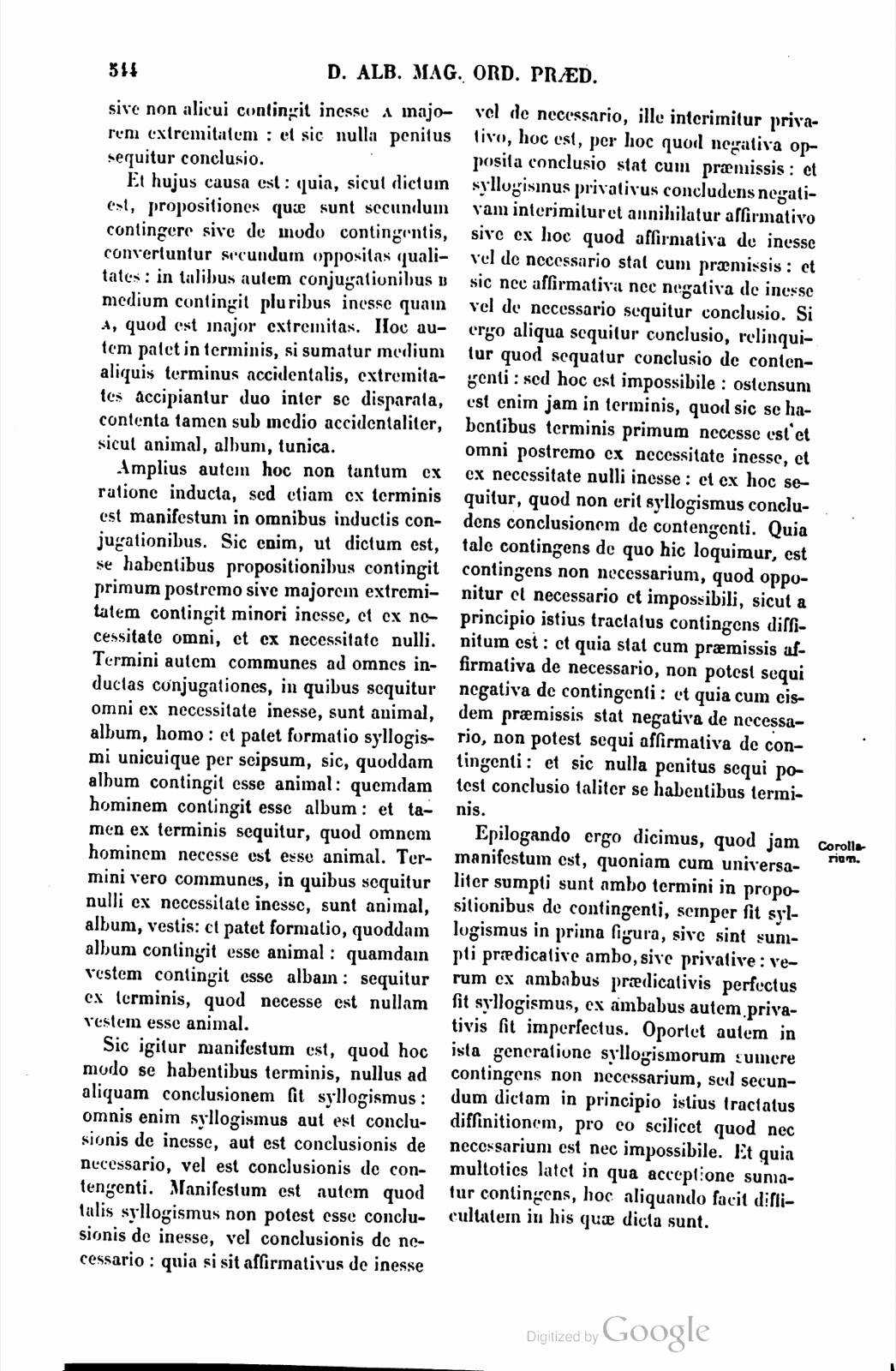
Amplius autem hoc non tantum ex ratione inducta, sed etiam ex terminis est manifestum in omnibus inductis conjugationibus. Sic enim, ut dictum est, se habentibus propositionibus contingit primum postremo sive majorem extremitatem contingit minori inesse, et ex necessitate omni, et ex necessitate nulli. Termini autem communes ad omnes inductas conjugationes, in quibus sequitur omni ex necessitate inesse, sunt animal, album, homo: et patet formatio syllogismi unicuique per seipsum, sic, quoddam album contingit esse animal: quemdam hominem contingit esse album: et tamen ex terminis sequitur, quod omnem hominem necesse est esse animal. Termini vero communes, in quibus sequitur nulli ex necessitate inesse, sunt animal, album, vestis: et patet formatio, quoddam album contingit esse animal: quamdam vestem contingit esse albam: sequitur ex terminis, quod necesse est nullam vestem esse animal.
Sic igitur manifestum est, quod hoc modo se habentibus terminis, nullus ad aliquam conclusionem fit syllogismus: omnis enim syllogismus aut est conclusionis de inesse, aut est conclusionis de necessario, vel est conclusionis de contingenti. Manifestum est autem quod talis syllogismus non potest esse conclusionis de inesse, vel conclusionis de necessario: quia si sit affirmativus de inesse vel de necessario, ille interimitur privativo, hoc est, per hoc quod negativa opposita conclusio stat cum praemissis: et syllogismus privativus concludens negativam interimitur et annihilatur affirmativo sive ex hoc quod affirmativa de inesse vel de necessario stat cum praemissis: et sic nec affirmativa nec negativa de inesse vel de necessario sequitur conclusio. Si ergo aliqua sequitur conclusio, relinquitur quod sequatur conclusio de contingenti: sed hoc est impossibile: ostensum est enim jam in terminis, quod sic se habentibus terminis primum necesse est et omni postremo ex necessitate inesse, et ex necessitate nulli inesse: et ex hoc sequitur, quod non erit syllogismus concludens conclusionem de contingenti. Quia tale contingens de quo hic loquimur, est contingens non necessarium, quod opponitur et necessario et impossibili, sicut a principio istius tractatus contingens diffinitum est: et quia stat cum praemissis affirmativa de necessario, non potest sequi negativa de contingenti: et quia cum eisdem praemissis stat negativa de necessario, non potest sequi affirmativa de contingenti: et sic nulla penitus sequi potest conclusio taliter se habentibus terminis.
Epilogando ergo dicimus, quod jam manifestum est, quoniam cum universaliter sumpti sunt ambo termini in propositionibus de contingenti, semper fit syllogismus in prima figura, sive sint sumpti praedicative ambo, sive privative: verum ex ambabus praedicativis perfectus fit syllogismus, ex ambabus autem privativis fit imperfectus. Oportet autem in ista generatione syllogismorum sumere contingens non necessarium, sed secundum dictam in principio istius tractatus diffinitionem, pro eo scilicet quod nec necessarium est nec impossibile. Et quia multoties latet in qua acceptione sumatur contingens, hoc aliquando facit difficultatem in his quae dicta sunt.
Moreover, this is manifest in all the introduced conjugations not only from the reason introduced but also from terms. For when the propositions have themselves thus, as was said, it is contingent that the first belong to the last, or that the greater extreme belong to the lesser, both of necessity to every and of necessity to none. But the terms common to all the introduced conjugations in which belonging to every of necessity follows are animal, white, man; and the formation of the syllogism is clear to anyone through himself, thus: some white thing contingently is an animal; a certain man contingently is white; and yet from the terms it follows that every man must be an animal. But the common terms in which belonging to none of necessity follows are animal, white, garment; and the formation is clear: some white thing contingently is an animal; a certain garment contingently is white; it follows from the terms that of necessity no garment is an animal.
Thus, therefore, it is manifest that, when the terms have themselves in this way, no syllogism is made to any conclusion. For every syllogism is either of a conclusion of inherence, or of a conclusion of necessity, or of a conclusion of the contingent. But it is manifest that such a syllogism cannot be of a conclusion of inherence or of a conclusion of necessity, because if it is affirmative of inherence or of necessity, it is destroyed by the privative, that is, by the fact that the opposite negative conclusion stands with the premises; and a privative syllogism concluding a negative is destroyed and annulled by the affirmative, or by the fact that an affirmative of inherence or of necessity stands with the premises. And thus neither an affirmative nor a negative conclusion of inherence or of necessity follows. Therefore if some conclusion follows, it remains that a conclusion about the contingent follows. But this is impossible; for it has already been shown in terms that, with terms having themselves thus, the first must both belong of necessity to every last and belong of necessity to none. And from this it follows that there will not be a syllogism concluding a conclusion about the contingent. For such a contingent, about which we are speaking here, is the non-necessary contingent, which is opposed both to the necessary and to the impossible, just as from the beginning of this tractate the contingent has been defined. And because an affirmative of necessity stands with the premises, a negative about the contingent cannot follow; and because a negative of necessity stands with the same premises, an affirmative about the contingent cannot follow. And thus utterly no conclusion can follow when the terms have themselves in such a way.
Therefore, recapitulating, we say that now it is manifest that, when both terms are taken universally in propositions about the contingent, a syllogism is always made in the first figure, whether both are taken predicatively or privatively. But from both predicative propositions a perfect syllogism is made, while from both privative propositions an imperfect one is made. But in this generation of syllogisms one must take the contingent as non-necessary, but according to the definition stated at the beginning of this tractate, namely as that which is neither necessary nor impossible. And because it is often hidden in which acceptation the contingent is taken, this sometimes causes difficulty in the things that have been said.
If a page does not appear, its photograph has not been uploaded yet.