Works › Prior Analytics, Books I–II
Volume 1 · pp. 537–539
Tractate IV. On the generation of syllogisms of the contingent, uniform and mixed. Chapter I. On the principles of the generation of syllogisms about the contingent.
A marker with ≈ is an approximate page boundary, placed by measure of the text; the page photographs remain the authority. In the paired views, clicking a page marker brings that page into view.
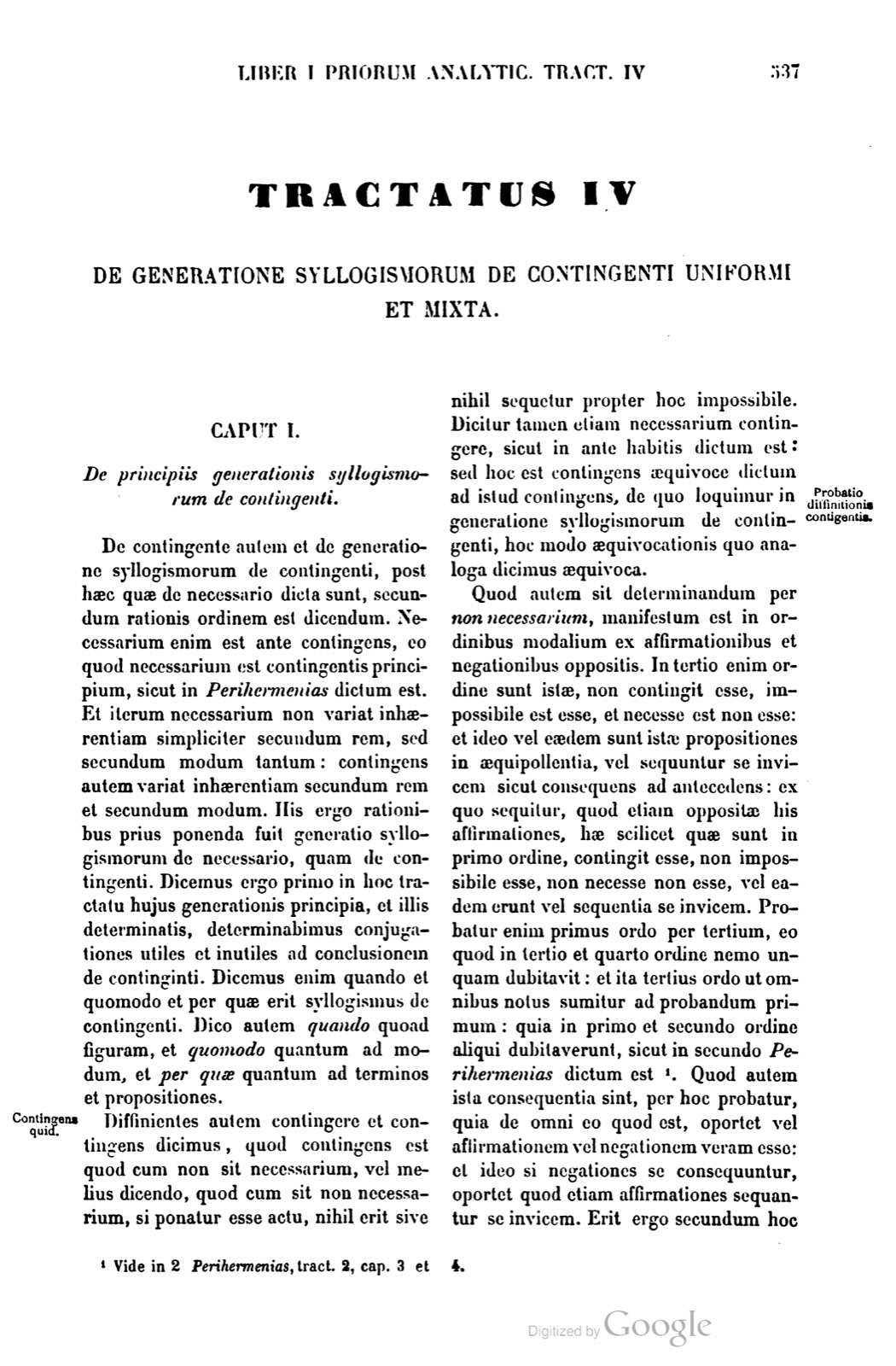
TRACTATUS IV. DE GENERATIONE SYLLOGISMORUM DE CONTINGENTI UNIFORMI ET MIXTA.
CAPUT I. De principiis generationis syllogismorum de contingenti.
De contingente autem et de generatione syllogismorum de contingenti, post haec quae de necessario dicta sunt, secundum rationis ordinem est dicendum. Necessarium enim est ante contingens, eo quod necessarium est contingentis principium, sicut in Perihermenias dictum est. Et iterum necessarium non variat inhaerentiam simpliciter secundum rem, sed secundum modum tantum: contingens autem variat inhaerentiam secundum rem et secundum modum. His ergo rationibus prius ponenda fuit generatio syllogismorum de necessario, quam de contingenti. Dicemus ergo primo in hoc tractatu hujus generationis principia, et illis determinatis, determinabimus conjugationes utiles et inutiles ad conclusionem de contingenti. Dicemus enim quando et quomodo et per quae erit syllogismus de contingenti. Dico autem quando quoad figuram, et quomodo quantum ad modum, et per quae quantum ad terminos et propositiones.
Diffinientes autem contingere et contingens dicimus, quod contingens est quod cum non sit necessarium, vel melius dicendo, quod cum sit non necessarium, si ponatur esse actu, nihil erit sive nihil sequetur propter hoc impossibile. Dicitur tamen etiam necessarium contingere, sicut in ante habitis dictum est: sed hoc est contingens aequivoce dictum ad istud contingens, de quo loquimur in generatione syllogismorum de contingenti, hoc modo aequivocationis quo analoga dicimus aequivoca.
Quod autem sit determinandum per non necessarium, manifestum est in ordinibus modalium ex affirmationibus et negationibus oppositis. In tertio enim ordine sunt istae, non contingit esse, impossibile est esse, et necesse est non esse: et ideo vel eaedem sunt istae propositiones in aequipollentia, vel sequuntur se invicem sicut consequens ad antecedens: ex quo sequitur, quod etiam oppositae his affirmationes, hae scilicet quae sunt in primo ordine, contingit esse, non impossibile esse, non necesse non esse, vel eaedem erunt vel sequentia se invicem. Probatur enim primus ordo per tertium, eo quod in tertio et quarto ordine nemo unquam dubitavit: et ita tertius ordo ut omnibus notus sumitur ad probandum primum: quia in primo et secundo ordine aliqui dubitaverunt, sicut in secundo Perihermenias dictum est1. Quod autem ista consequentia sint, per hoc probatur, quia de omni eo quod est, oportet vel affirmationem vel negationem veram esse: et ideo si negationes se consequuntur, oportet quod etiam affirmationes sequantur se invicem. Erit ergo secundum hoc dupliciter dictum contingens, ita quod contingens est necessarium, et contingens est non necessarium.
His visis, sciendum quod omnes propositiones quae sunt secundum contingere quod est non necessarium, convertuntur sibi invicem secundum consequentiam secundum oppositas qualitates affirmationis et negationis: et hoc est unum principiorum quo perficientur syllogismi imperfecti. Dico autem converti sibi invicem secundum oppositas qualitates, non quod affirmativae convertantur cum negativis: quia sicut in Perihermenias dictum est, propositiones modales affirmativae vel negativae dicuntur, eo quod sunt de modo affirmato vel negato: et tales affirmativae non convertuntur cum negativis, sed potius quaecumque affirmativam habent figuram in modo, et in dicto differunt secundum affirmationem et negationem: et hoc modo ea quae est, contingit esse, convertitur in illam quae est, contingit non esse: et ea quae est, contingit omni inesse, convertitur in eam quae est, contingit nulli inesse, ut contraria in contrariam convertatur, vel convertatur ad contradictoriam in dicto, ut ea quae est, contingit omni, convertitur in eam quae est, contingit non omni: vel ea quae est, contingit alicui, convertitur in hanc quae est, contingit non alicui. Eodem autem modo est in omnibus aliis.
TRACTATE IV. ON THE GENERATION OF SYLLOGISMS OF THE CONTINGENT, UNIFORM AND MIXED.
CHAPTER I. On the principles of the generation of syllogisms about the contingent.
But concerning the contingent and concerning the generation of syllogisms about the contingent, after those things which have been said about the necessary, one must speak according to the order of reason. For the necessary is prior to the contingent, because the necessary is a principle of the contingent, as was said in the Perihermenias. And again, the necessary does not vary inherence simply according to the thing, but only according to mode; but the contingent varies inherence according to the thing and according to mode. Therefore for these reasons the generation of syllogisms of necessity had to be posited before the generation of syllogisms about the contingent. Therefore first in this tractate we shall state the principles of this generation, and when these have been determined, we shall determine the useful and useless conjugations for a conclusion about the contingent. For we shall say when and how and through what there will be a syllogism about the contingent. I call it when with respect to figure, and how with respect to mode, and through what with respect to terms and propositions.
But in defining to-contingently-be and the contingent, we say that the contingent is that which, when it is not necessary, or better said, when it is non-necessary, if it is posited to be actually, nothing impossible will be or follow on account of this. Nevertheless the necessary also is said to be contingent, as was said in what was had before; but this is called contingent equivocally with respect to that contingent about which we are speaking in the generation of syllogisms about the contingent, by that mode of equivocation by which we call analogues equivocal.
But that it must be determined through the non-necessary is manifest in the orders of modals from opposite affirmations and negations. For in the third order there are these: it does not contingently be, it is impossible to be, and it is necessary not to be. And therefore either these propositions are the same in equipollence, or they follow one another as consequent follows antecedent. From this it follows that the affirmations opposite to these also, namely these which are in the first order, it contingently is, it is not impossible to be, it is not necessary not to be, will either be the same or will follow one another. For the first order is proved through the third, because no one ever doubted about the third and fourth order; and thus the third order, as known to all, is taken to prove the first, because some doubted about the first and second order, as was said in the second Perihermenias1. But that these are consequences is proved through this, that concerning everything that is, either an affirmation or a negation must be true. And therefore if negations follow one another, affirmations also must follow one another. Therefore according to this the contingent will be said in two ways, so that the contingent is necessary, and the contingent is non-necessary.
With these things seen, it must be known that all propositions which are according to the contingent which is non-necessary are converted into one another according to consequence according to the opposite qualities of affirmation and negation; and this is one of the principles by which imperfect syllogisms will be perfected. But I say that they are converted into one another according to opposite qualities, not that affirmatives are converted with negatives; because, as was said in the Perihermenias, modal propositions are called affirmative or negative because they are about a mode affirmed or denied. And such affirmatives are not converted with negatives, but rather whatever propositions have an affirmative figure in the mode, and differ in the dictum according to affirmation and negation. And in this way that proposition which is, it contingently is, is converted into that which is, it contingently is not; and that which is, it contingently belongs to every, is converted into that which is, it contingently belongs to none, so that a contrary is converted into a contrary, or is converted to a contradictory in the dictum, so that that which is, it contingently belongs to every, is converted into that which is, it contingently does not belong to every; or that which is, it contingently belongs to some, is converted into this which is, it contingently does not belong to some. The same mode, moreover, holds in all the others.
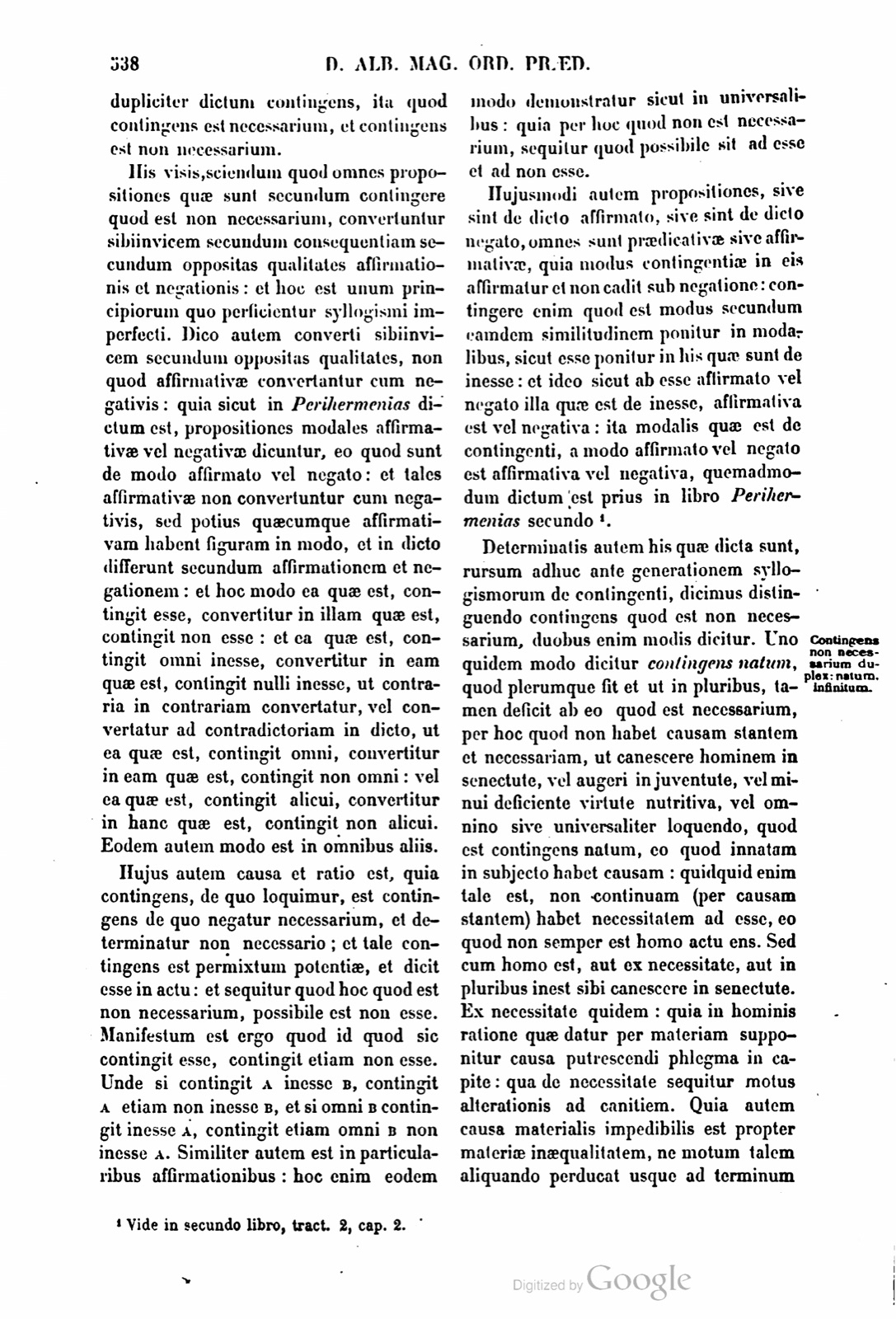
Hujus autem causa et ratio est, quia contingens, de quo loquimur, est contingens de quo negatur necessarium, et determinatur non necessario; et tale contingens est permixtum potentiae, et dicit esse in actu: et sequitur quod hoc quod est non necessarium, possibile est non esse. Manifestum est ergo quod id quod sic contingit esse, contingit etiam non esse. Unde si contingit A inesse B, contingit A etiam non inesse B, et si omni B contingit inesse A, contingit etiam omni B non inesse A. Similiter autem est in particularibus affirmationibus: hoc enim eodem modo demonstratur sicut in universalibus: quia per hoc quod non est necessarium, sequitur quod possibile sit ad esse et ad non esse.
Hujusmodi autem propositiones, sive sint de dicto affirmato, sive sint de dicto negato, omnes sunt praedicativae sive affirmativae, quia modus contingentiae in eis affirmatur et non cadit sub negatione: contingere enim quod est modus secundum eamdem similitudinem ponitur in modalibus, sicut esse ponitur in his quae sunt de inesse: et ideo sicut ab esse affirmato vel negato illa quae est de inesse, affirmativa est vel negativa: ita modalis quae est de contingenti, a modo affirmato vel negato est affirmativa vel negativa, quemadmodum dictum est prius in libro Perihermenias secundo2.
Determinatis autem his quae dicta sunt, rursum adhuc ante generationem syllogismorum de contingenti, dicimus distinguendo contingens quod est non necessarium, duobus enim modis dicitur. Uno quidem modo dicitur contingens natum, quod plerumque fit et ut in pluribus, tamen deficit ab eo quod est necessarium, per hoc quod non habet causam stantem et necessariam, ut canescere hominem in senectute, vel augeri in juventute, vel minui deficiente virtute nutritiva, vel omnino sive universaliter loquendo, quod est contingens natum, eo quod innatam in subjecto habet causam: quidquid enim tale est, non continuam (per causam stantem) habet necessitatem ad esse, eo quod non semper est homo actu ens. Sed cum homo est, aut ex necessitate, aut in pluribus inest sibi canescere in senectute. Ex necessitate quidem: quia in hominis ratione quae datur per materiam supponitur causa putrescendi phlegma in capite: qua de necessitate sequitur motus alterationis ad canitiem. Quia autem causa materialis impedibilis est propter materiae inaequalitatem, ne motum talem aliquando perducat usque ad terminum perfectae canitiei, tunc convenit ut in pluribus hominem canescere, hoc est, canum esse in senectute: cum omni homini existenti conveniat ex necessitate in senectute moveri ad canitiem: quia necesse est calore remisso et non terminante humidum multum phlegmaticum quod abundat in capite, phlegma moveri et alterari ad putredinem. Et sic actualis canities est in pluribus secundum naturae habilitatem, sed motus ad canitiem necessario est in omnibus existentibus hominibus: et sic ex necessitate et ut in pluribus inest homini canescere in senectute: et ideo est, quod cum homo est, aut ex necessitate, aut ut pluribus est canescere. Canescere enim non est praedicatum quod conveniat homini secundum rationem sumpto, sive homo actu sit apud naturam, sive non sit actu, sed tantum ratio ejus sit apud animam3.
But the cause and reason of this is that the contingent about which we are speaking is the contingent of which the necessary is denied, and it is determined non-necessarily; and such a contingent is mixed with potency and states being in act. And it follows that what is non-necessary is possible not to be. Therefore it is manifest that what thus contingently is, also contingently is not. Hence if it is contingent that A belong to B, it is also contingent that A not belong to B; and if A contingently belongs to every B, A also contingently does not belong to every B. But it is similar in particular affirmations; for this is demonstrated in the same way as in universals, because through the fact that it is not necessary it follows that it is possible toward being and toward not being.
But propositions of this kind, whether they are about an affirmed dictum or about a denied dictum, are all predicative or affirmative, because the mode of contingency is affirmed in them and does not fall under negation. For to-contingently-be, which is the mode, is posited in modals according to the same likeness as being is posited in those propositions which are about inherence; and therefore, just as from being affirmed or denied a proposition of inherence is affirmative or negative, so a modal proposition which is about the contingent is affirmative or negative from the mode affirmed or denied, as was said before in the second book of the Perihermenias2.
But after these things that have been said have been determined, again, still before the generation of syllogisms about the contingent, we say, by distinguishing, that the contingent which is non-necessary is said in two ways. In one way it is called the natural contingent, which happens for the most part and as in most cases, yet falls short of what is necessary, through the fact that it does not have a standing and necessary cause, as for a man to become gray in old age, or to be increased in youth, or to be diminished when nutritive power fails, or, speaking altogether or universally, whatever is the natural contingent, because it has an innate cause in the subject. For whatever is such does not have a continuous necessity for being through a standing cause, because a man is not always actually existing. But when a man exists, becoming gray in old age belongs to him either from necessity or in most cases. From necessity, indeed, because in the account of man which is given through matter there is presupposed a cause of phlegm growing putrid in the head; from this there follows of necessity a motion of alteration toward grayness. But because the material cause is impedible because of the inequality of matter, so that sometimes it does not lead such a motion all the way to the term of perfect grayness, then it befits a man to become gray for the most part, that is, to be gray in old age, since it belongs of necessity to every existing man to be moved in old age toward grayness, because, with heat weakened and not terminating the much phlegmatic moisture that abounds in the head, it is necessary that phlegm be moved and altered toward putrefaction. And thus actual grayness exists in most cases according to the aptitude of nature, but the motion toward grayness is necessarily in all existing men; and thus from necessity and as in most cases it belongs to man to become gray in old age. And therefore it is the case that, when a man exists, becoming gray is either from necessity or in most cases. For becoming gray is not a predicate that belongs to man taken according to his account, whether man actually exists in nature or does not actually exist, but only his account exists in the soul3.
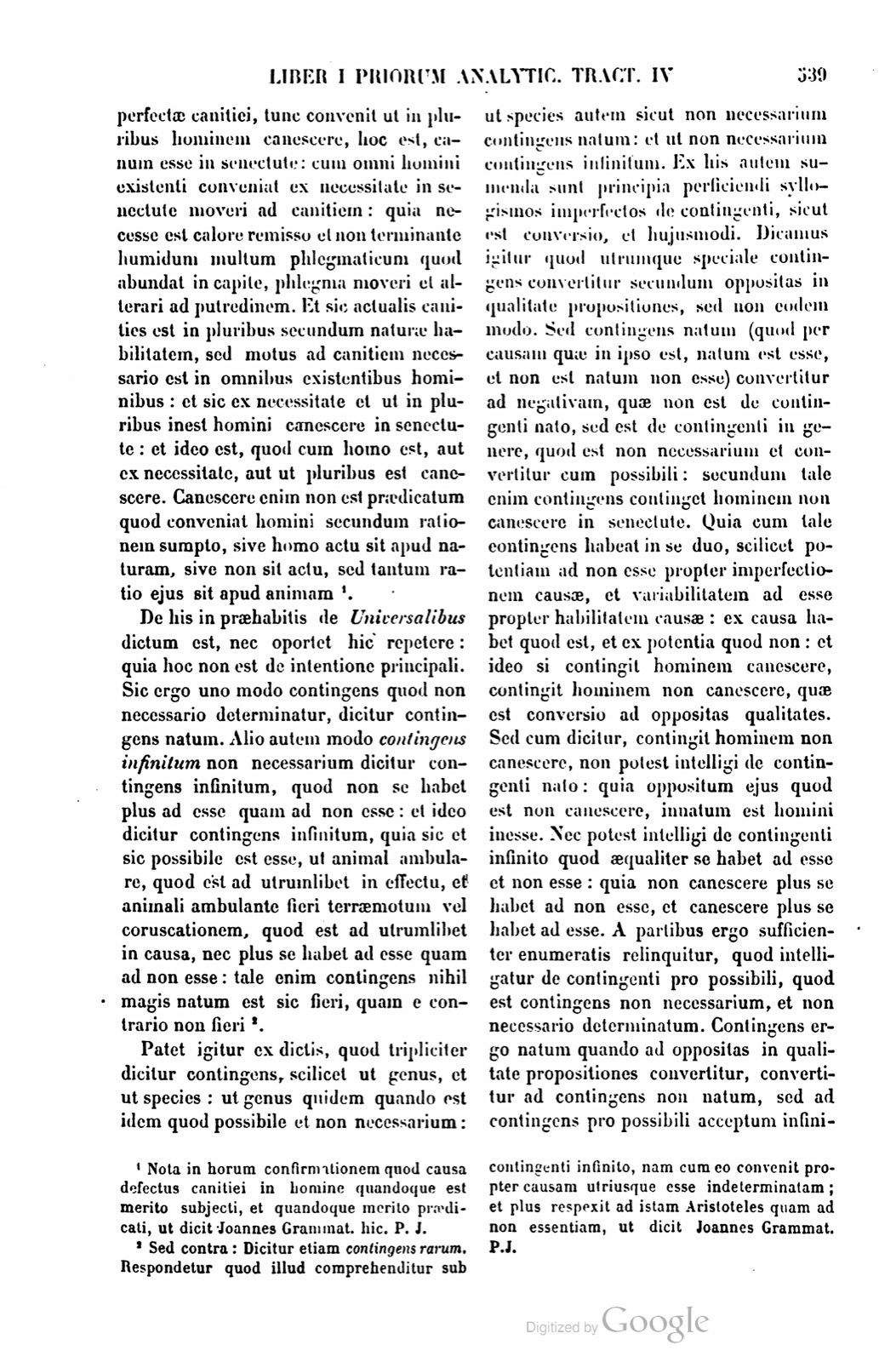
De his in praehabitis de Universalibus dictum est, nec oportet hic repetere: quia hoc non est de intentione principali. Sic ergo uno modo contingens quod non necessario determinatur, dicitur contingens natum. Alio autem modo contingens infinitum non necessarium dicitur contingens infinitum, quod non se habet plus ad esse quam ad non esse: et ideo dicitur contingens infinitum, quia sic et sic possibile est esse, ut animal ambulare, quod est ad utrumlibet in effectu, et animali ambulante fieri terraemotum vel coruscationem, quod est ad utrumlibet in causa, nec plus se habet ad esse quam ad non esse: tale enim contingens nihil magis natum est sic fieri, quam e contrario non fieri4.
Patet igitur ex dictis, quod tripliciter dicitur contingens, scilicet ut genus, et ut species: ut genus quidem quando est idem quod possibile et non necessarium: ut species autem sicut non necessarium contingens natum: et ut non necessarium contingens infinitum. Ex his autem sumenda sunt principia perficiendi syllogismos imperfectos de contingenti, sicut est conversio, et hujusmodi. Dicamus igitur quod utrumque speciale contingens convertitur secundum oppositas in qualitate propositiones, sed non eodem modo. Sed contingens natum (quod per causam quae in ipso est, natum est esse, et non est natum non esse) convertitur ad negativam, quae non est de contingenti nato, sed est de contingenti in genere, quod est non necessarium et convertitur cum possibili: secundum tale enim contingens continget hominem non canescere in senectute. Quia cum tale contingens habeat in se duo, scilicet potentiam ad non esse propter imperfectionem causae, et variabilitatem ad esse propter habilitatem causae: ex causa habet quod est, et ex potentia quod non: et ideo si contingit hominem canescere, contingit hominem non canescere, quae est conversio ad oppositas qualitates. Sed cum dicitur, contingit hominem non canescere, non potest intelligi de contingenti nato: quia oppositum ejus quod est non canescere, innatum est homini inesse. Nec potest intelligi de contingenti infinito quod aequaliter se habet ad esse et non esse: quia non canescere plus se habet ad non esse, et canescere plus se habet ad esse. A partibus ergo sufficienter enumeratis relinquitur, quod intelligatur de contingenti pro possibili, quod est contingens non necessarium, et non necessario determinatum. Contingens ergo natum quando ad oppositas in qualitate propositiones convertitur, convertitur ad contingens non natum, sed ad contingens pro possibili acceptum infinitum.
About these things it was said in the preceding matters on Universals, and it is not necessary to repeat them here, because this does not belong to the principal intention. Thus, therefore, in one way the contingent which is not determined necessarily is called the natural contingent. But in another way the indefinite non-necessary contingent is called the indefinite contingent, which does not have itself more toward being than toward not being. And therefore it is called the indefinite contingent, because it is possible to be thus and thus, as for an animal to walk, which is toward either alternative in effect, and, when an animal is walking, for an earthquake or lightning-flash to happen, which is toward either alternative in cause and does not have itself more toward being than toward not being. For such a contingent is no more naturally apt to happen in this way than, on the contrary, not to happen4.
Therefore it is clear from what has been said that contingent is said in three ways, namely as genus and as species: as genus, indeed, when it is the same as possible and non-necessary; but as species, as the non-necessary natural contingent, and as the non-necessary indefinite contingent. But from these must be taken the principles of perfecting imperfect syllogisms about the contingent, such as conversion and things of this kind. Therefore let us say that each special contingent is converted according to propositions opposite in quality, but not in the same way. But the natural contingent, which through the cause that is in it is naturally apt to be and is not naturally apt not to be, is converted to a negative which is not about the natural contingent, but is about the contingent in general, which is non-necessary and is converted with the possible; for according to such a contingent it will be contingent for a man not to become gray in old age. Because, since such a contingent has two things in itself, namely potency toward not-being because of the imperfection of the cause, and variability toward being because of the aptitude of the cause, from the cause it has that it is, and from potency that it is not; and therefore if it is contingent for a man to become gray, it is contingent for a man not to become gray, which is conversion to opposite qualities. But when it is said, it is contingent for a man not to become gray, this cannot be understood about the natural contingent, because the opposite of that which is not to become gray is innate to man to belong. Nor can it be understood about the indefinite contingent, which has itself equally toward being and not being, because not becoming gray has itself more toward not-being, and becoming gray has itself more toward being. Therefore, from the sufficiently enumerated parts, it is left that it be understood of the contingent taken for the possible, which is the non-necessary contingent and determined non-necessarily. Therefore when the natural contingent is converted to propositions opposite in quality, it is converted to the contingent that is not natural, but to the indefinite contingent taken for the possible.
Notes
- See in the second Perihermenias, tractate 2, chapters 3 and 4. (Vide in 2 Perihermenias, tract. 2, cap. 3 et 4.) ↩
- See in the second book, tractate 2, chapter 2. (Vide in secundo libro, tract. 2, cap. 2.) ↩
- Note, in confirmation of these things, that the cause of the defect of grayness in man is sometimes by reason of the subject and sometimes by reason of the predicate, as John the Grammarian says here. P. J. (Nota in horum confirmationem quod causa defectus canitiei in homine quandoque est merito subjecti, et quandoque merito praedicati, ut dicit Joannes Grammat. hic. P. J.) ↩
- But on the contrary: the rare contingent is also spoken of. It is answered that it is comprehended under the indefinite contingent, for it agrees with it because the cause of each is indeterminate with respect to being; and Aristotle looked more to this than to non-essence, as John the Grammarian says. P. J. (Sed contra: Dicitur etiam contingens rarum. Respondetur quod illud comprehenditur sub contingenti infinito, nam cum eo convenit propter causam utriusque esse indeterminatam; et plus respexit ad istam Aristoteles quam ad non essentiam, ut dicit Joannes Grammat. P. J.) ↩
If a page does not appear, its photograph has not been uploaded yet.