Works › Prior Analytics, Books I–II
Volume 1 · pp. 534–536
Chapter IX. On the mixing of the necessary and inherence in particular syllogisms of the third figure.
A marker with ≈ is an approximate page boundary, placed by measure of the text; the page photographs remain the authority. In the paired views, clicking a page marker brings that page into view.
CAPUT IX. De mixtione necessarii et inesse in particularibus syllogismis tertiae figurae.
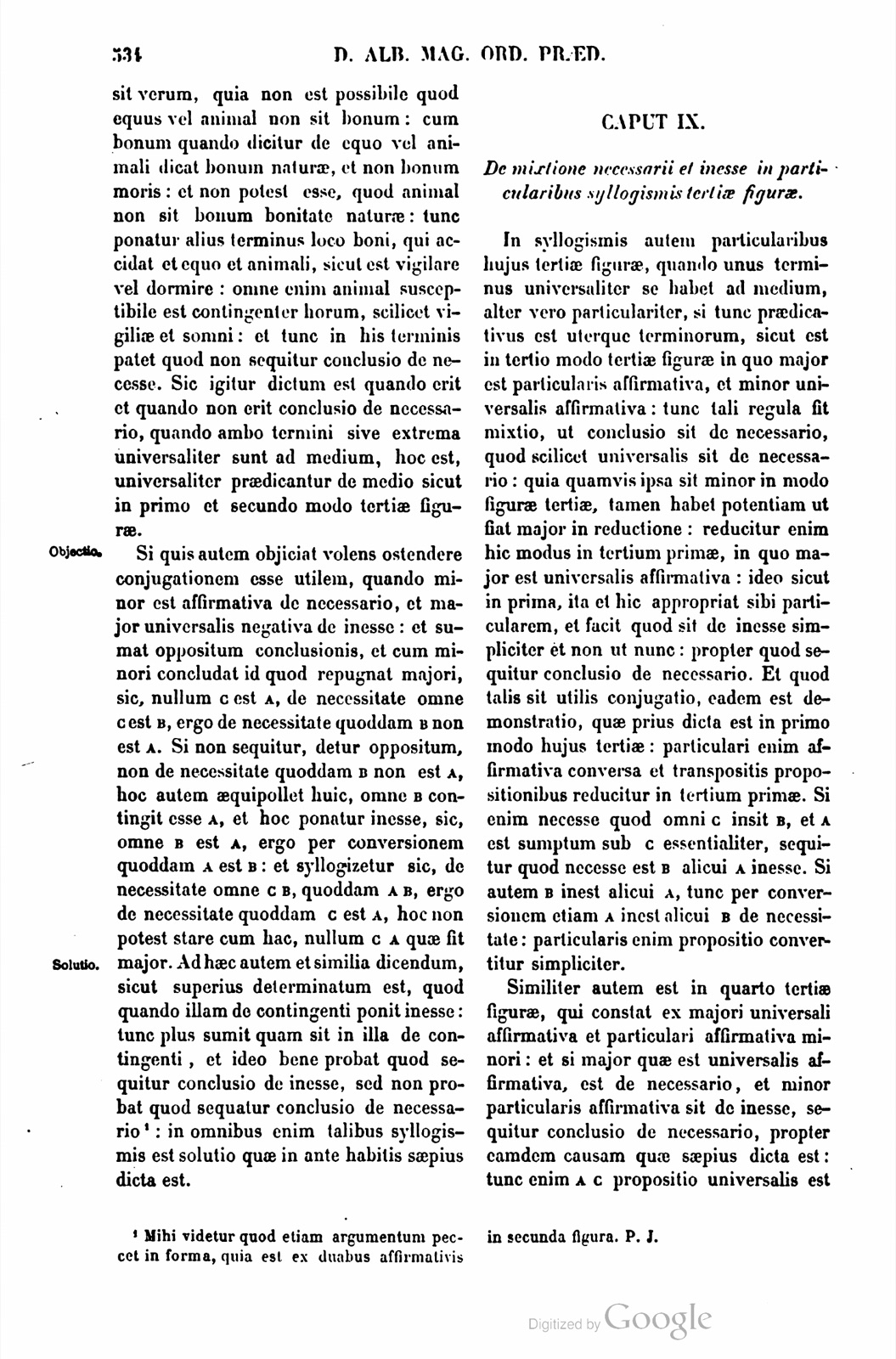
In syllogismis autem particularibus hujus tertiae figurae, quando unus terminus universaliter se habet ad medium, alter vero particulariter, si tunc praedicativus est uterque terminorum, sicut est in tertio modo tertiae figurae in quo major est particularis affirmativa, et minor universalis affirmativa: tunc tali regula fit mixtio, ut conclusio sit de necessario, quod scilicet universalis sit de necessario: quia quamvis ipsa sit minor in modo figurae tertiae, tamen habet potentiam ut fiat major in reductione: reducitur enim hic modus in tertium primae, in quo major est universalis affirmativa: ideo sicut in prima, ita et hic appropriat sibi particularem, et facit quod sit de inesse simpliciter et non ut nunc: propter quod sequitur conclusio de necessario. Et quod talis sit utilis conjugatio, eadem est demonstratio, quae prius dicta est in primo modo hujus tertiae: particulari enim affirmativa conversa et transpositis propositionibus reducitur in tertium primae. Si enim necesse quod omni C insit B, et A est sumptum sub C essentialiter, sequitur quod necesse est B alicui A inesse. Si autem B inest alicui A, tunc per conversionem etiam A inest alicui B de necessitate: particularis enim propositio convertitur simpliciter.
Similiter autem est in quarto tertiae figurae, qui constat ex majori universali affirmativa et particulari affirmativa minori: et si major quae est universalis affirmativa, est de necessario, et minor particularis affirmativa sit de inesse, sequitur conclusio de necessario, propter eamdem causam quae saepius dicta est: tunc enim A C propositio universalis est de necessario, et B C minor particularis: sequitur autem ideo conclusio de necessario, quia B est sub C, et ideo propositio est de inesse simpliciter.
Si autem in affirmativo syllogismo tertio hujus figurae universalis est de inesse, et particularis de necessario, non sequitur conclusio de necessario: quia in reductione particularis non potest esse major in prima figura: et ideo non potest sibi appropriare universalem ad inesse simpliciter. Sit enim B C propositio minor particularis et necessaria sive de necessario, A autem insit omni C tantum, et sit de inesse propositio A C quae est major. Si ergo convertatur B C propositio ut prima fiat figura in tertio primae, tunc universalis quidem propositio non est de necessario, particularis autem est de necessario. Quando autem in prima figura sic se habebant propositiones, non erat conclusio de necessario sicut in tertio primae dictum est: propter quod etiam in his syllogismis qui sunt tertiae figurae talis erit inutilis conjugatio: quia iste tertius secundae descendit a tertio primae.
Amplius autem hoc idem etiam est manifestum in terminis, in quibus est instantia talis consequentiae. Sit enim A major terminus vigilatio, B autem minor terminus sit bipes: id autem in quo ponitur C medium sit animal. Talibus igitur terminis positis, B quod est bipes, necesse est inesse alicui C, hoc est, animali; A autem quod est vigilatio contingit inesse C, hoc est, animali, et A quod est vigilatio non necessario inerit B, hoc est, bipedi. Non enim necesse est aliquem bipedem vel dormire vel vigilare. Similiter autem et per eosdem terminos, si A C propositio major sit particularis et de necessario, et altera sit universalis et de inesse, quod videlicet est inutilis conjugatio quantum ad conclusionem de necessario.
CHAPTER IX. On the mixing of the necessary and inherence in particular syllogisms of the third figure.
But in particular syllogisms of this third figure, when one term has itself universally with respect to the middle, but the other particularly, if then each of the terms is predicative, as it is in the third mode of the third figure, in which the major is particular affirmative and the minor universal affirmative, then the mixing is made by such a rule, so that the conclusion is of necessity, namely that the universal is of necessity. For although it is the minor in the mode of the third figure, nevertheless it has the power to become the major in the reduction; for this mode is reduced into the third of the first, in which the major is universal affirmative. Therefore, just as in the first figure, so also here it appropriates the particular to itself and makes it be of inherence simply and not as now; for this reason a conclusion of necessity follows. And that such a conjugation is useful, the demonstration is the same as was said earlier in the first mode of this third figure; for when the particular affirmative has been converted and the propositions transposed, it is reduced into the third of the first. For if it is necessary that B belong to every C, and A is taken essentially under C, it follows that it is necessary that B belong to some A. But if B belongs to some A, then by conversion A also belongs to some B of necessity; for a particular proposition is converted simply.
Similarly it is in the fourth of the third figure, which consists from a universal affirmative major and a particular affirmative minor; and if the major, which is universal affirmative, is of necessity, and the particular affirmative minor is of inherence, a conclusion of necessity follows, because of the same cause that has often been stated. For then A C, the universal proposition, is of necessity, and B C is the particular minor; and the conclusion of necessity follows for this reason, that B is under C, and therefore the proposition is of inherence simply.
But if in the third affirmative syllogism of this figure the universal is of inherence and the particular of necessity, a conclusion of necessity does not follow, because in the reduction the particular cannot be the major in the first figure, and therefore it cannot appropriate the universal to itself for inherence simply. For let B C, the minor proposition, be particular and necessary or of necessity, but let A belong to every C only, and let A C, which is the major, be a proposition of inherence. Therefore if the B C proposition is converted so that the first figure is made in the third of the first, then the universal proposition indeed is not of necessity, but the particular is of necessity. But when propositions had themselves thus in the first figure, there was not a conclusion of necessity, as was said in the third of the first. For this reason also in these syllogisms which are of the third figure such a conjugation will be useless, because this third of the second descends from the third of the first.
Moreover, this same thing is also manifest in terms, in which there is an instance against such a consequence. For let A, the major term, be wakefulness, and let B, the minor term, be biped; but let that in which C is posited as the middle be animal. Therefore, with such terms posited, B, which is biped, must belong to some C, that is, to animal; but A, which is wakefulness, contingently belongs to C, that is, to animal, and A, which is wakefulness, will not belong necessarily to B, that is, to biped. For it is not necessary that some biped either sleep or be awake. Similarly also through the same terms, if the major proposition A C is particular and of necessity, and the other is universal and of inherence, this is evidently a useless conjugation with respect to a conclusion of necessity.
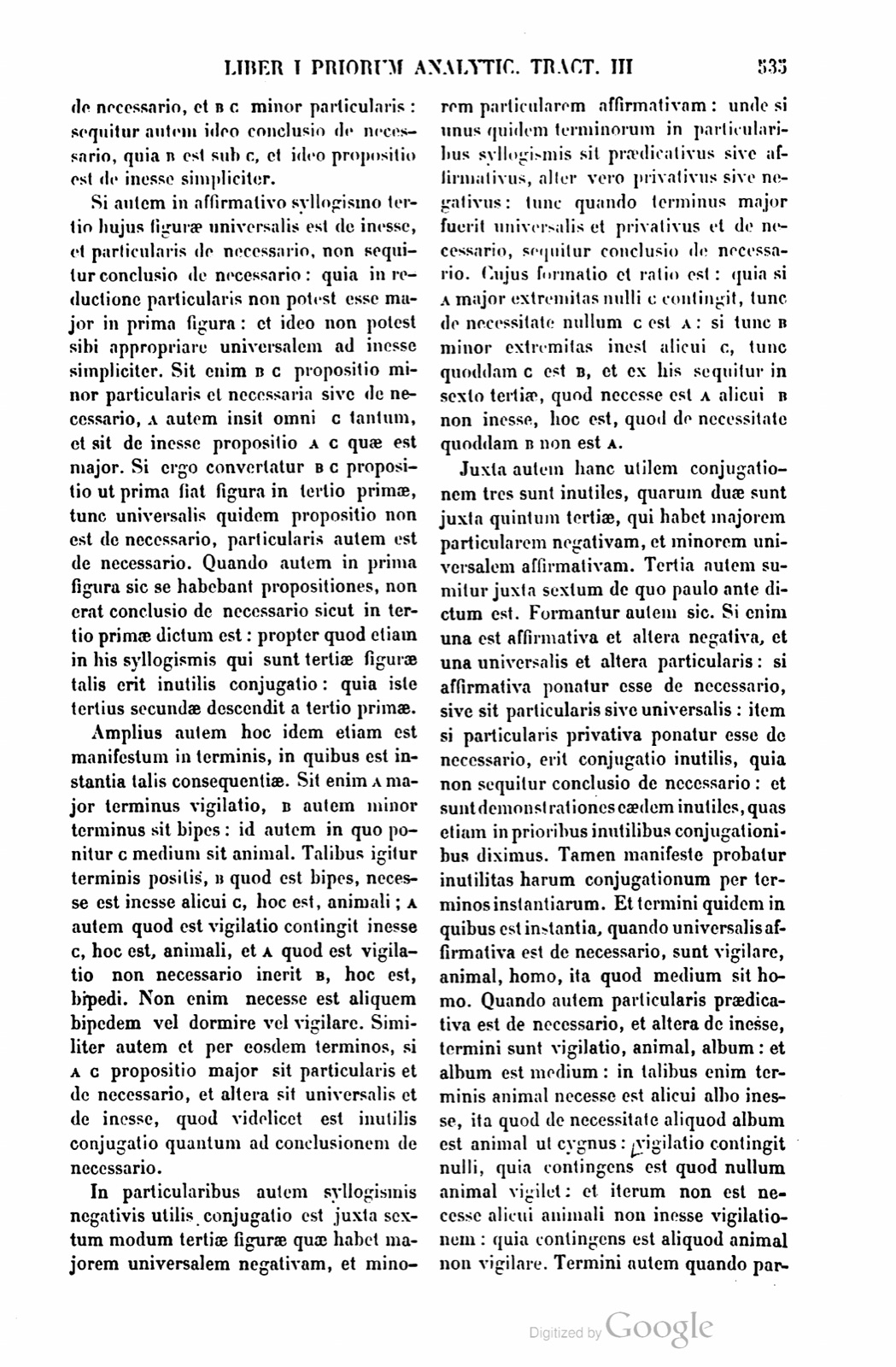
In particularibus autem syllogismis negativis utilis conjugatio est juxta sextum modum tertiae figurae quae habet majorem universalem negativam, et minorem particularem affirmativam: unde si unus quidem terminorum in particularibus syllogismis sit praedicativus sive affirmativus, alter vero privativus sive negativus: tunc quando terminus major fuerit universalis et privativus et de necessario, sequitur conclusio de necessario. Cujus formatio et ratio est: quia si A major extremitas nulli C contingit, tunc de necessitate nullum C est A: si tunc B minor extremitas inest alicui C, tunc quoddam C est B, et ex his sequitur in sexto tertiae, quod necesse est A alicui B non inesse, hoc est, quod de necessitate quoddam B non est A.
Juxta autem hanc utilem conjugationem tres sunt inutiles, quarum duae sunt juxta quintum tertiae, qui habet majorem particularem negativam, et minorem universalem affirmativam. Tertia autem sumitur juxta sextum de quo paulo ante dictum est. Formantur autem sic. Si enim una est affirmativa et altera negativa, et una universalis et altera particularis: si affirmativa ponatur esse de necessario, sive sit particularis sive universalis: item si particularis privativa ponatur esse de necessario, erit conjugatio inutilis, quia non sequitur conclusio de necessario: et sunt demonstrationes eaedem inutiles, quas etiam in prioribus inutilibus conjugationibus diximus. Tamen manifeste probatur inutilitas harum conjugationum per terminos instantiarum. Et termini quidem in quibus est instantia, quando universalis affirmativa est de necessario, sunt vigilare, animal, homo, ita quod medium sit homo. Quando autem particularis praedicativa est de necessario, et altera de inesse, termini sunt vigilatio, animal, album: et album est medium: in talibus enim terminis animal necesse est alicui albo inesse, ita quod de necessitate aliquod album est animal ut cygnus: vigilatio contingit nulli, quia contingens est quod nullum animal vigilet: et iterum non est necesse alicui animali non inesse vigilationem: quia contingens est aliquod animal non vigilare. Termini autem quando particularis privativa ponitur esse de necessario, et altera de inesse, sunt bipes, moveri, animal: medium autem est animal.
Quod autem diximus in terminis istis, quod animal necesse est alicui albo inesse, non intelleximus de albo secundum quod significat qualitatem albedinis in subjecto, quia sic album contingit animali: sed intelleximus de aliqua substantia cui necessario inest albedo, sicut est cygnus. Tamen verum est, quod haec, aliquod album de necessitate est animal, est vera de necessitate per accidens: et sic boni sunt et declarant propositum termini inducti. Posset tamen melius instari per hos terminos, homo, album, animal, sic, nullum animal est album (et hoc ponatur) de necessitate aliquod animal est homo: et tamen non sequitur quod de necessitate aliquis homo non sit albus.
But in negative particular syllogisms the useful conjugation is according to the sixth mode of the third figure, which has a universal negative major and a particular affirmative minor. Hence if one of the terms in particular syllogisms is predicative or affirmative, but the other privative or negative, then when the major term has been universal and privative and of necessity, a conclusion of necessity follows. Its formation and reason is this: because if A the greater extreme contingently belongs to no C, then of necessity no C is A; if then B the lesser extreme belongs to some C, then some C is B, and from these it follows in the sixth of the third that it is necessary that A not belong to some B, that is, that of necessity some B is not A.
But beside this useful conjugation there are three useless ones, of which two are according to the fifth of the third, which has a particular negative major and a universal affirmative minor. But the third is taken according to the sixth, about which it was said a little before. They are formed thus. For if one is affirmative and the other negative, and one universal and the other particular, if the affirmative is posited as of necessity, whether it is particular or universal; likewise if the particular privative is posited as of necessity, the conjugation will be useless, because a conclusion of necessity does not follow. And the useless demonstrations are the same as those which we also stated in the preceding useless conjugations. Nevertheless the uselessness of these conjugations is manifestly proved through terms of instances. And the terms in which there is an instance, when the universal affirmative is of necessity, are to be awake, animal, man, so that the middle is man. But when the particular predicative is of necessity and the other of inherence, the terms are wakefulness, animal, white, and white is the middle. For in such terms animal necessarily belongs to some white thing, so that of necessity some white thing is animal, as a swan; wakefulness contingently belongs to none, because it is contingent that no animal be awake; and again it is not necessary that wakefulness not belong to some animal, because it is contingent that some animal not be awake. But the terms when the particular privative is posited as of necessity and the other of inherence are biped, to be moved, animal; and the middle is animal.
But when we said in these terms that animal necessarily belongs to some white thing, we did not understand this of white according as it signifies the quality of whiteness in a subject, because in that way white contingently belongs to animal; but we understood it of some substance to which whiteness belongs necessarily, as a swan. Nevertheless it is true that this proposition, some white thing of necessity is animal, is true by necessity accidentally; and thus the terms introduced are good and declare the proposed point. Yet a better instance could be made through these terms: man, white, animal, thus: no animal is white, and let this be posited; of necessity some animal is man; and nevertheless it does not follow that of necessity some man is not white.
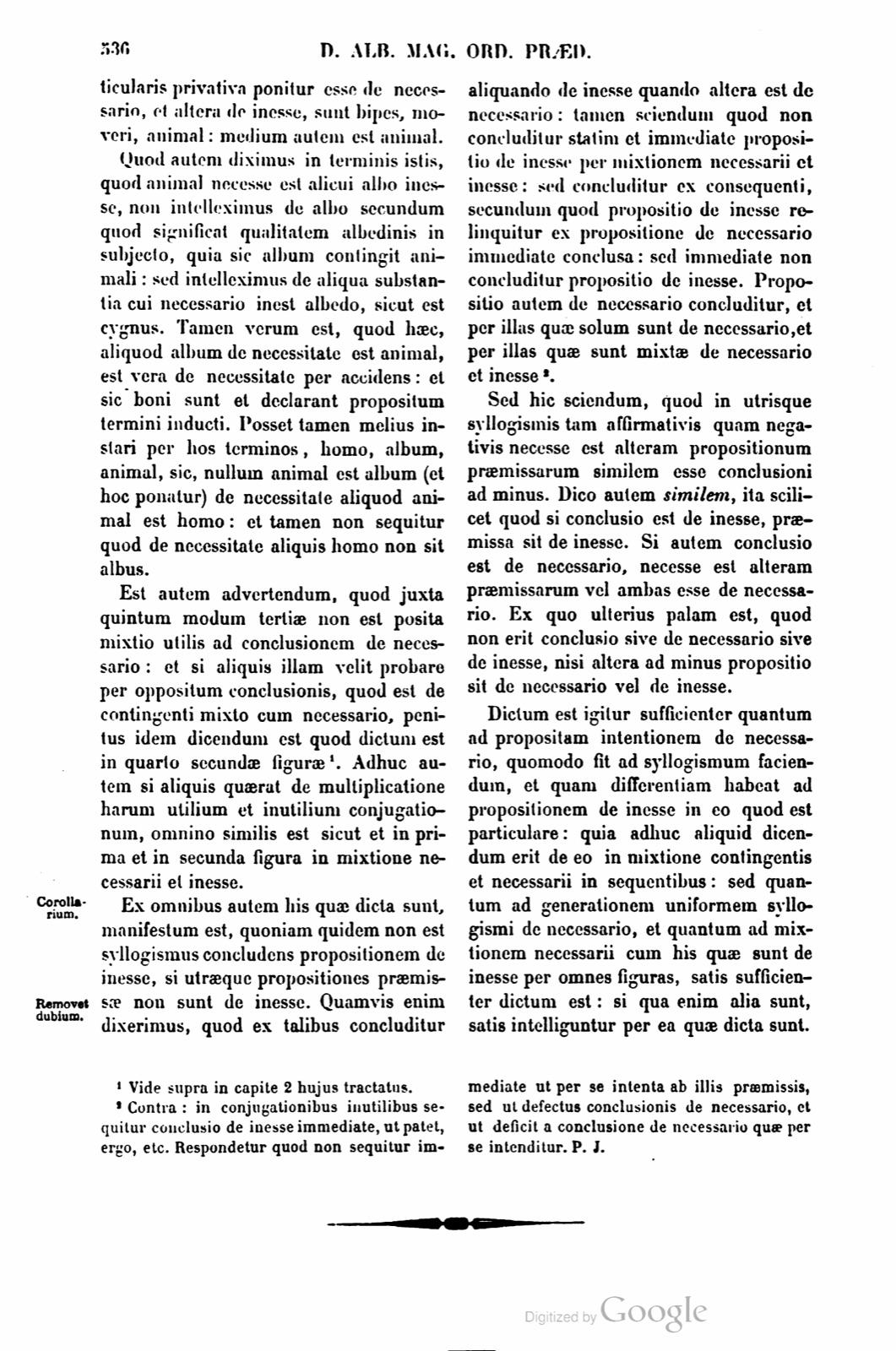
Est autem advertendum, quod juxta quintum modum tertiae non est posita mixtio utilis ad conclusionem de necessario: et si aliquis illam velit probare per oppositum conclusionis, quod est de contingenti mixto cum necessario, penitus idem dicendum est quod dictum est in quarto secundae figurae1. Adhuc autem si aliquis quaerat de multiplicatione harum utilium et inutilium conjugationum, omnino similis est sicut et in prima et in secunda figura in mixtione necessarii et inesse.
Ex omnibus autem his quae dicta sunt, manifestum est, quoniam quidem non est syllogismus concludens propositionem de inesse, si utraeque propositiones praemissae non sunt de inesse. Quamvis enim dixerimus, quod ex talibus concluditur aliquando de inesse quando altera est de necessario: tamen sciendum quod non concluditur statim et immediate propositio de inesse per mixtionem necessarii et inesse: sed concluditur ex consequenti, secundum quod propositio de inesse relinquitur ex propositione de necessario immediate conclusa: sed immediate non concluditur propositio de inesse. Propositio autem de necessario concluditur, et per illas quae solum sunt de necessario, et per illas quae sunt mixtae de necessario et inesse2.
Sed hic sciendum, quod in utrisque syllogismis tam affirmativis quam negativis necesse est alteram propositionum praemissarum similem esse conclusioni ad minus. Dico autem similem, ita scilicet quod si conclusio est de inesse, praemissa sit de inesse. Si autem conclusio est de necessario, necesse est alteram praemissarum vel ambas esse de necessario. Ex quo ulterius palam est, quod non erit conclusio sive de necessario sive de inesse, nisi altera ad minus propositio sit de necessario vel de inesse.
Dictum est igitur sufficienter quantum ad propositam intentionem de necessario, quomodo fit ad syllogismum faciendum, et quam differentiam habeat ad propositionem de inesse in eo quod est particulare: quia adhuc aliquid dicendum erit de eo in mixtione contingentis et necessarii in sequentibus: sed quantum ad generationem uniformem syllogismi de necessario, et quantum ad mixtionem necessarii cum his quae sunt de inesse per omnes figuras, satis sufficienter dictum est: si qua enim alia sunt, satis intelliguntur per ea quae dicta sunt.
But it must be noted that according to the fifth mode of the third, no useful mixing has been posited for a conclusion of necessity; and if someone wishes to prove it through the opposite of the conclusion, which is of the contingent mixed with the necessary, altogether the same thing must be said that was said in the fourth of the second figure1. Moreover, if someone asks about the multiplication of these useful and useless conjugations, it is wholly similar to what it is both in the first and in the second figure in the mixing of the necessary and inherence.
From all these things which have been said it is manifest, indeed, that there is not a syllogism concluding a proposition of inherence if both premise propositions are not of inherence. For although we have said that from such propositions sometimes a conclusion of inherence is concluded when one proposition is of necessity, nevertheless it must be known that a proposition of inherence is not concluded at once and immediately through the mixing of the necessary and inherence; rather, it is concluded consequently, according as the proposition of inherence is left from the proposition of necessity immediately concluded. But a proposition of inherence is not immediately concluded. But a proposition of necessity is concluded both by those propositions which are only of necessity and by those which are mixed from necessity and inherence2.
But here it must be known that in both kinds of syllogisms, both affirmative and negative, it is necessary that at least one of the premise propositions be similar to the conclusion. I call it similar in this way, namely that if the conclusion is of inherence, the premise should be of inherence. But if the conclusion is of necessity, it is necessary that one of the premises or both be of necessity. From this it is further evident that there will not be a conclusion, whether of necessity or of inherence, unless at least one proposition is of necessity or of inherence.
Therefore enough has been said, with respect to the proposed intention, about the necessary, how it operates for making a syllogism, and what difference it has from a proposition of inherence in that which is particular; because still something will have to be said about it in the mixing of the contingent and the necessary in what follows. But with respect to the uniform generation of a syllogism of necessity, and with respect to the mixing of the necessary with those propositions which are of inherence through all the figures, enough has been sufficiently said; for if there are any other things, they are sufficiently understood through the things that have been said.
Notes
- See above in chapter 2 of this tractate. (Vide supra in capite 2 hujus tractatus.) ↩
- On the contrary: in useless conjugations a conclusion of inherence follows immediately, as is clear; therefore, etc. It is answered that it does not follow immediately as intended through itself from those premises, but as the defect of a conclusion of necessity, and as it falls short of the conclusion of necessity which is intended through itself. P. J. (Contra: in conjugationibus inutilibus sequitur conclusio de inesse immediate, ut patet, ergo, etc. Respondetur quod non sequitur immediate ut per se intenta ab illis praemissis, sed ut defectus conclusionis de necessario, et ut deficit a conclusione de necessario quae per se intenditur. P. J.) ↩
If a page does not appear, its photograph has not been uploaded yet.