Works › Prior Analytics, Books I–II
Volume 1 · pp. 540–542
Chapter II. On being said of every and being said of none in propositions about the contingent, and on universal syllogisms about the contingent according to useful conjugations.
A marker with ≈ is an approximate page boundary, placed by measure of the text; the page photographs remain the authority. In the paired views, clicking a page marker brings that page into view.
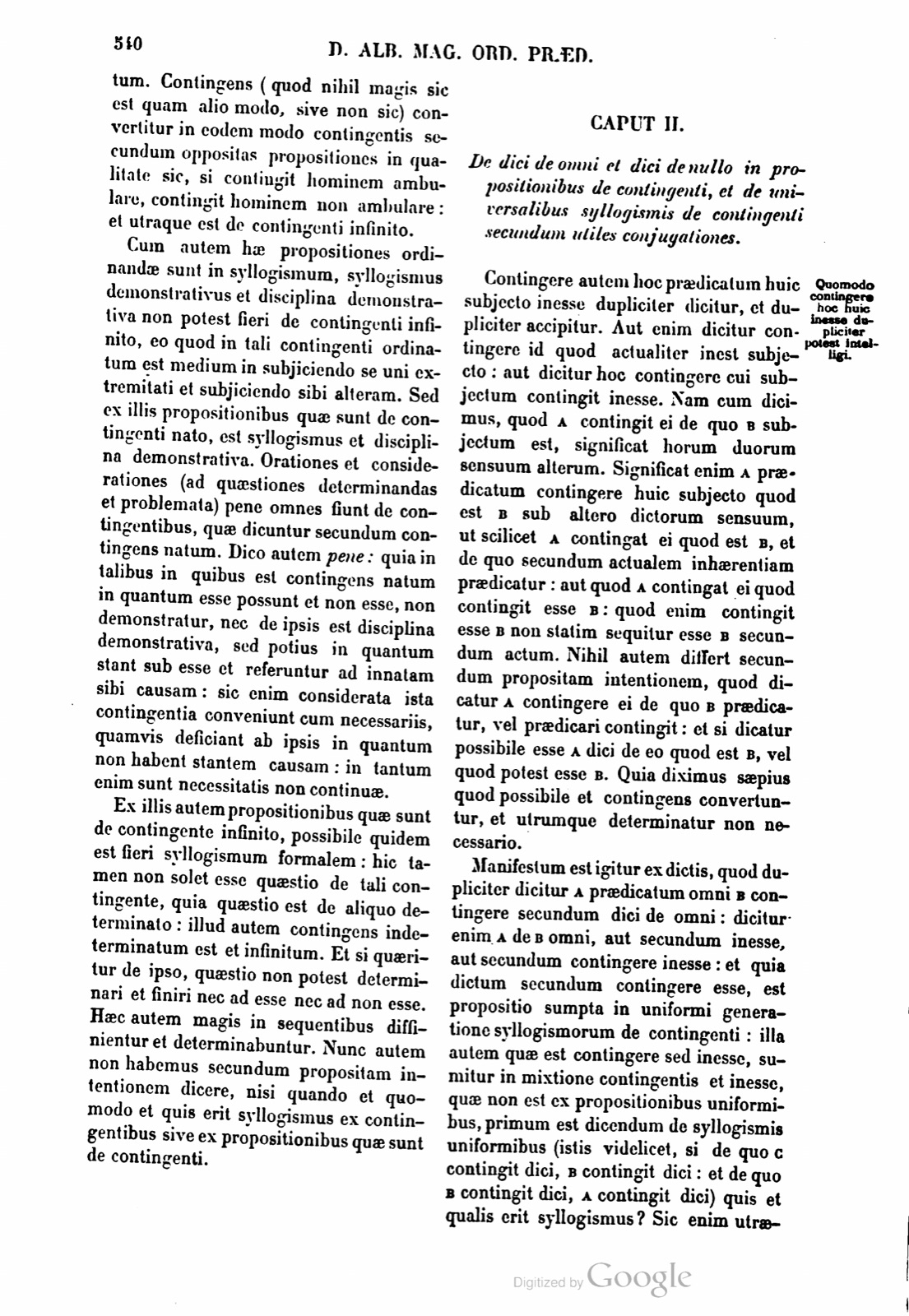
CAPUT II. De dici de omni et dici de nullo in propositionibus de contingenti, et de universalibus syllogismis de contingenti secundum utiles conjugationes.
Contingens (quod nihil magis sic est quam alio modo, sive non sic) convertitur in eodem modo contingentis secundum oppositas propositiones in qualitate sic, si contingit hominem ambulare, contingit hominem non ambulare: et utraque est de contingenti infinito.
Cum autem hae propositiones ordinandae sunt in syllogismum, syllogismus demonstrativus et disciplina demonstrativa non potest fieri de contingenti infinito, eo quod in tali contingenti ordinatum est medium in subjiciendo se uni extremitati et subjiciendo sibi alteram. Sed ex illis propositionibus quae sunt de contingenti nato, est syllogismus et disciplina demonstrativa. Orationes et considerationes (ad quaestiones determinandas et problemata) pene omnes fiunt de contingentibus, quae dicuntur secundum contingens natum. Dico autem pene: quia in talibus in quibus est contingens natum in quantum esse possunt et non esse, non demonstratur, nec de ipsis est disciplina demonstrativa, sed potius in quantum stant sub esse et referuntur ad innatam sibi causam: sic enim considerata ista contingentia conveniunt cum necessariis, quamvis deficiant ab ipsis in quantum non habent stantem causam: in tantum enim sunt necessitatis non continuae.
Ex illis autem propositionibus quae sunt de contingente infinito, possibile quidem est fieri syllogismum formalem: hic tamen non solet esse quaestio de tali contingente, quia quaestio est de aliquo determinato: illud autem contingens indeterminatum est et infinitum. Et si quaeritur de ipso, quaestio non potest determinari et finiri nec ad esse nec ad non esse. Haec autem magis in sequentibus diffinientur et determinabuntur. Nunc autem non habemus secundum propositam intentionem dicere, nisi quando et quomodo et quis erit syllogismus ex contingentibus sive ex propositionibus quae sunt de contingenti.
Contingere autem hoc praedicatum huic subjecto inesse dupliciter dicitur, et dupliciter accipitur. Aut enim dicitur contingere id quod actualiter inest subjecto: aut dicitur hoc contingere cui subjectum contingit inesse. Nam cum dicimus, quod A contingit ei de quo A subjectum est, significat horum duorum sensuum alterum. Significat enim A praedicatum contingere huic subjecto quod est B sub altero dictorum sensuum, ut scilicet A contingat ei quod est B, et de quo secundum actualem inhaerentiam praedicatur: aut quod A contingat ei quod contingit esse B: quod enim contingit esse B non statim sequitur esse B secundum actum. Nihil autem differt secundum propositam intentionem, quod dicatur A contingere ei de quo B praedicatur, vel praedicari contingit: et si dicatur possibile esse A dici de eo quod est B, vel quod potest esse B. Quia diximus saepius quod possibile et contingens convertuntur, et utrumque determinatur non necessario.
Manifestum est igitur ex dictis, quod dupliciter dicitur A praedicatum omni B contingere secundum dici de omni: dicitur enim A de B omni, aut secundum inesse, aut secundum contingere inesse: et quia dictum secundum contingere esse, est propositio sumpta in uniformi generatione syllogismorum de contingenti: illa autem quae est contingere sed inesse, sumitur in mixtione contingentis et inesse, quae non est ex propositionibus uniformibus, primum est dicendum de syllogismis uniformibus (istis videlicet, si de quo C contingit dici, B contingit dici: et de quo B contingit dici, A contingit dici) quis et qualis erit syllogismus? Sic enim utraeque propositiones sumuntur secundum contingere, et ambae sunt de contingenti et major et minor. Quando autem sumuntur secundum alterum modum, scilicet quod de quo B est praedicatum, quod illud contingat esse A, tunc una propositionum est de inesse, et altera de contingenti, quod mixtam facit syllogismorum generationem. Propter quod incipiendum est ab his quae sunt similis figurae quantum ad modum propositionis, quemadmodum et in aliis quae diximus: praemisimus enim generationem uniformem de necessario generationi mixtae de necessario et inesse: simile est enim ante dissimile, sicut unum ante multa. Per hoc autem quod dici de omni in contingentibus determinavimus, satis etiam est determinatum dici de nullo, quia unum convertitur ad alterum: et quod contingit omni, contingit nulli: et quod contingit esse, contingit non esse.
CHAPTER II. On being said of every and being said of none in propositions about the contingent, and on universal syllogisms about the contingent according to useful conjugations.
The contingent, which is no more this way than in another way, or not this way, is converted in the same mode of the contingent according to propositions opposite in quality thus: if it is contingent for a man to walk, it is contingent for a man not to walk; and each is about the indefinite contingent.
But when these propositions must be ordered into a syllogism, a demonstrative syllogism and demonstrative discipline cannot be made from the indefinite contingent, because in such a contingent the middle is ordered in subjecting itself to one extreme and in subjecting the other to itself. But from those propositions which are about the natural contingent there is syllogism and demonstrative discipline. Discourses and considerations, for determining questions and problems, are almost all made about contingents which are spoken of according to the natural contingent. But I say almost, because in such things in which there is the natural contingent, insofar as they can be and not be, there is no demonstration, nor is there demonstrative discipline about them, but rather insofar as they stand under being and are referred to the cause innate to them. For considered thus, these contingencies agree with necessary things, although they fall short of them insofar as they do not have a standing cause; for to that extent they are of non-continuous necessity.
But from those propositions which are about the indefinite contingent, it is indeed possible for a formal syllogism to be made; yet here there is not usually a question about such a contingent, because a question is about something determinate, but that contingent is indeterminate and indefinite. And if inquiry is made about it, the question cannot be determined and bounded either to being or to not-being. But these things will be defined and determined more in what follows. Now, however, according to the proposed intention, we have nothing to say except when and how and what kind of syllogism there will be from contingents or from propositions which are about the contingent.
But for this predicate contingently to belong to this subject is said in two ways and is taken in two ways. For either that is said to be contingent which actually belongs to the subject, or this is said to be contingent to which the subject contingently belongs. For when we say that A is contingent to that of which A is the subject, it signifies one of these two senses. For it signifies that A as predicate contingently belongs to this subject, which is B, under one of the stated senses, namely either that A contingently belongs to that which is B and of which it is predicated according to actual inherence, or that A contingently belongs to that which contingently is B; for what contingently is B does not immediately follow to be B according to act. But it makes no difference according to the proposed intention whether it is said that A contingently belongs to that of which B is predicated, or can contingently be predicated, and if it is said that it is possible for A to be said of that which is B, or which can be B. For we have often said that the possible and the contingent are converted, and each is determined non-necessarily.
Therefore it is manifest from what has been said that A as predicate is said to be contingent to every B according to being said of every in two ways. For A is said of every B either according to inherence or according to contingent inherence. And because the dictum according to contingent being is a proposition taken in the uniform generation of syllogisms about the contingent, but that proposition which is contingency but inherence is taken in the mixing of the contingent and inherence, which is not from uniform propositions, one must first speak about uniform syllogisms, namely these: if of that of which C is contingently said, B is contingently said, and of that of which B is contingently said, A is contingently said, what and what sort of syllogism will there be? For in this way both propositions are taken according to contingency, and both the major and the minor are about the contingent. But when they are taken according to the other mode, namely that of which B is the predicate, that it contingently be A, then one of the propositions is of inherence and the other of the contingent, which makes the generation of syllogisms mixed. For this reason one must begin from those things which are of similar figure with respect to the mode of the proposition, just as also in the other matters which we have discussed; for we set the uniform generation about the necessary before the mixed generation about the necessary and inherence. For the similar is before the dissimilar, as the one is before the many. But through the fact that we have determined being said of every in contingents, being said of none is also sufficiently determined, because the one is converted to the other: and what contingently belongs to every, contingently belongs to none; and what contingently is, contingently is not.
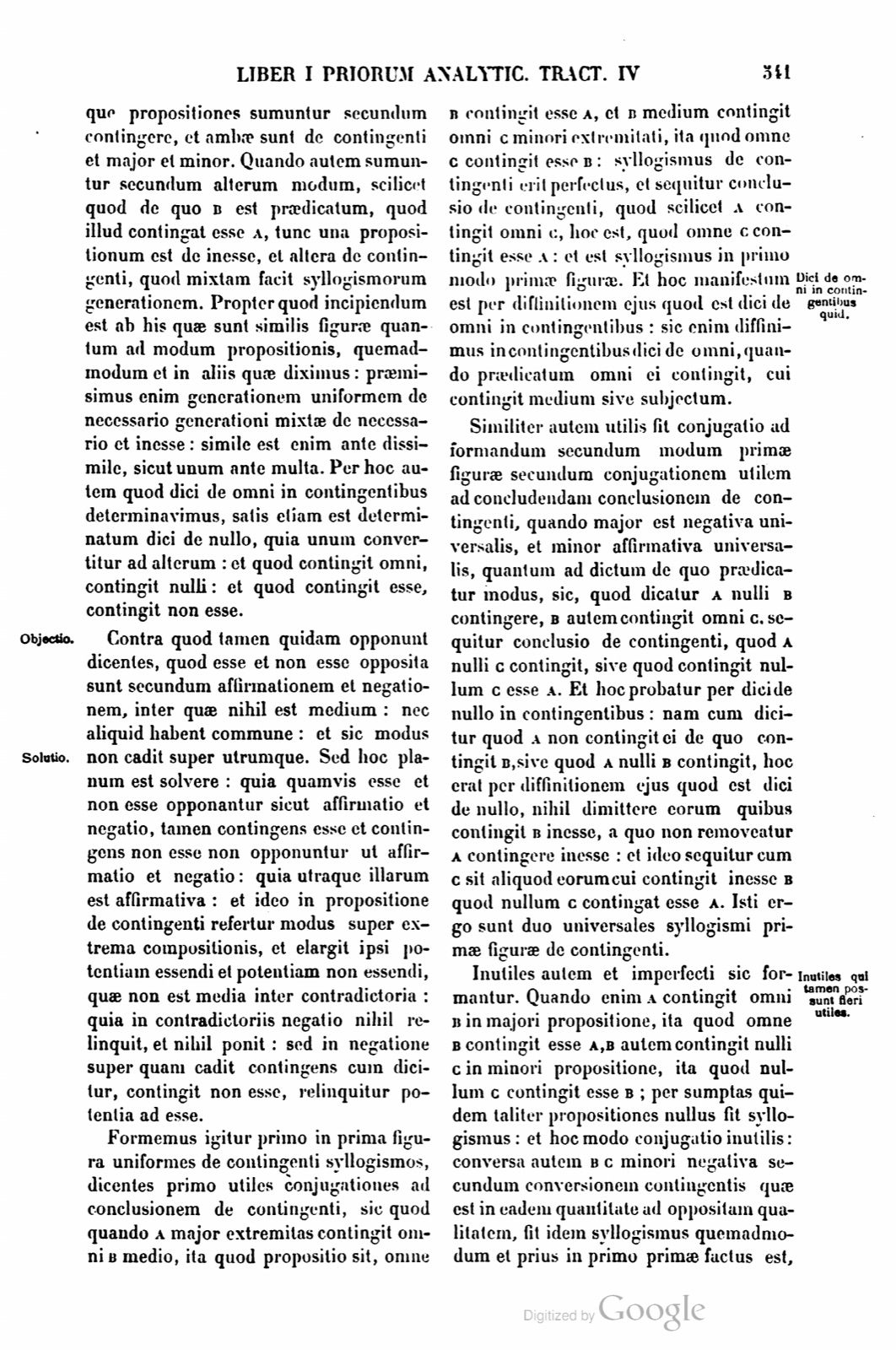
Contra quod tamen quidam opponunt dicentes, quod esse et non esse opposita sunt secundum affirmationem et negationem, inter quae nihil est medium: nec aliquid habent commune: et sic modus non cadit super utrumque. Sed hoc planum est solvere: quia quamvis esse et non esse opponantur sicut affirmatio et negatio, tamen contingens esse et contingens non esse non opponuntur ut affirmatio et negatio: quia utraque illarum est affirmativa: et ideo in propositione de contingenti refertur modus super extrema compositionis, et elargit ipsi potentiam essendi et potentiam non essendi, quae non est media inter contradictoria: quia in contradictoriis negatio nihil relinquit, et nihil ponit: sed in negatione super quam cadit contingens cum dicitur, contingit non esse, relinquitur potentia ad esse.
Formemus igitur primo in prima figura uniformes de contingenti syllogismos, dicentes primo utiles conjugationes ad conclusionem de contingenti, sic quod quando A major extremitas contingit omni B medio, ita quod propositio sit, omne B contingit esse A, et B medium contingit omni C minori extremitati, ita quod omne C contingit esse B: syllogismus de contingenti erit perfectus, et sequitur conclusio de contingenti, quod scilicet A contingit omni C, hoc est, quod omne C contingit esse A: et est syllogismus in primo modo primae figurae. Et hoc manifestum est per diffinitionem ejus quod est dici de omni in contingentibus: sic enim diffinimus in contingentibus dici de omni, quando praedicatum omni ei contingit, cui contingit medium sive subjectum.
Similiter autem utilis fit conjugatio ad formandum secundum modum primae figurae secundum conjugationem utilem ad concludendam conclusionem de contingenti, quando major est negativa universalis, et minor affirmativa universalis, quantum ad dictum de quo praedicatur modus, sic, quod dicatur A nulli B contingere, B autem contingit omni C, sequitur conclusio de contingenti, quod A nulli C contingit, sive quod contingit nullum C esse A. Et hoc probatur per dici de nullo in contingentibus: nam cum dicitur quod A non contingit ei de quo contingit B, sive quod A nulli B contingit, hoc erat per diffinitionem ejus quod est dici de nullo, nihil dimittere eorum quibus contingit B inesse, a quo non removeatur A contingere inesse: et ideo sequitur cum C sit aliquod eorum cui contingit inesse B quod nullum C contingat esse A. Isti ergo sunt duo universales syllogismi primae figurae de contingenti.
Inutiles autem et imperfecti sic formantur. Quando enim A contingit omni B in majori propositione, ita quod omne B contingit esse A, B autem contingit nulli C in minori propositione, ita quod nullum C contingit esse B; per sumptas quidem taliter propositiones nullus fit syllogismus: et hoc modo conjugatio inutilis: conversa autem B C minori negativa secundum conversionem contingentis quae est in eadem quantitate ad oppositam qualitatem, fit idem syllogismus quemadmodum et prius in primo primae factus est, et sic est conjugatio ad syllogismum imperfectum. Haec autem conversio talis est: quia cum B contingat nulli C inesse, sequitur per conversionem ad oppositam qualitatem, quod contingit B omni C inesse: hoc autem in superius dictis est determinatum: propter quod ex tali conversione sequitur, quod B contingit omni C inesse, et A contingit omni B inesse: transponantur propositiones sic, omne B contingit esse A, omne C contingit esse B, ergo omne C contingit esse A, qui est primus modus primae figurae.
Against this, however, some object, saying that being and not-being are opposites according to affirmation and negation, between which there is no middle, nor do they have anything common; and thus the mode does not fall upon both. But this is plain to solve, because although being and not-being are opposed as affirmation and negation, nevertheless contingent being and contingent not-being are not opposed as affirmation and negation, because each of them is affirmative; and therefore in a proposition about the contingent the mode is referred over the extremes of the composition and broadens for it the potency of being and the potency of not-being, which is not a middle between contradictories. For in contradictories negation leaves nothing and posits nothing; but in the negation upon which the contingent falls, when it is said, it is contingent not to be, potency toward being is left.
Therefore let us form first, in the first figure, uniform syllogisms about the contingent, first stating the useful conjugations for a conclusion about the contingent, so that when A, the greater extreme, contingently belongs to every B, the middle, so that the proposition is, every B contingently is A, and B, the middle, contingently belongs to every C, the lesser extreme, so that every C contingently is B, the syllogism about the contingent will be perfect, and a conclusion about the contingent follows, namely that A contingently belongs to every C, that is, that every C contingently is A; and it is a syllogism in the first mode of the first figure. And this is manifest through the definition of what it is to be said of every in contingents; for in this way we define being said of every in contingents, when the predicate contingently belongs to every one to which the middle or subject contingently belongs.
Similarly a useful conjugation is made for forming the second mode of the first figure according to a useful conjugation for concluding a conclusion about the contingent, when the major is universal negative and the minor universal affirmative, with respect to the dictum of which the mode is predicated, thus: that A is said to be contingent to no B, but B is contingent to every C. There follows a conclusion about the contingent, that A is contingent to no C, or that it is contingent that no C be A. And this is proved through being said of none in contingents; for when it is said that A is not contingent to that of which B is contingent, or that A is contingent to no B, this was, through the definition of what it is to be said of none, to leave out nothing of those to which B contingently belongs from which A's contingently belonging is not removed. And therefore it follows, since C is one of those to which B contingently belongs, that no C contingently is A. Therefore these are the two universal syllogisms of the first figure about the contingent.
But the useless and imperfect ones are formed thus. For when A contingently belongs to every B in the major proposition, so that every B contingently is A, but B contingently belongs to no C in the minor proposition, so that no C contingently is B, then from propositions taken in this way no syllogism is made; and in this mode the conjugation is useless. But when the negative minor B C has been converted according to the conversion of the contingent, which is in the same quantity to the opposite quality, the same syllogism is made in the way it was also made before in the first of the first; and thus there is a conjugation for an imperfect syllogism. But this conversion is such: because when B contingently belongs to no C, it follows through conversion to the opposite quality that B contingently belongs to every C. But this has been determined in the things said above. For this reason, from such a conversion it follows that B contingently belongs to every C, and A contingently belongs to every B. Let the propositions be transposed thus: every B contingently is A; every C contingently is B; therefore every C contingently is A, which is the first mode of the first figure.
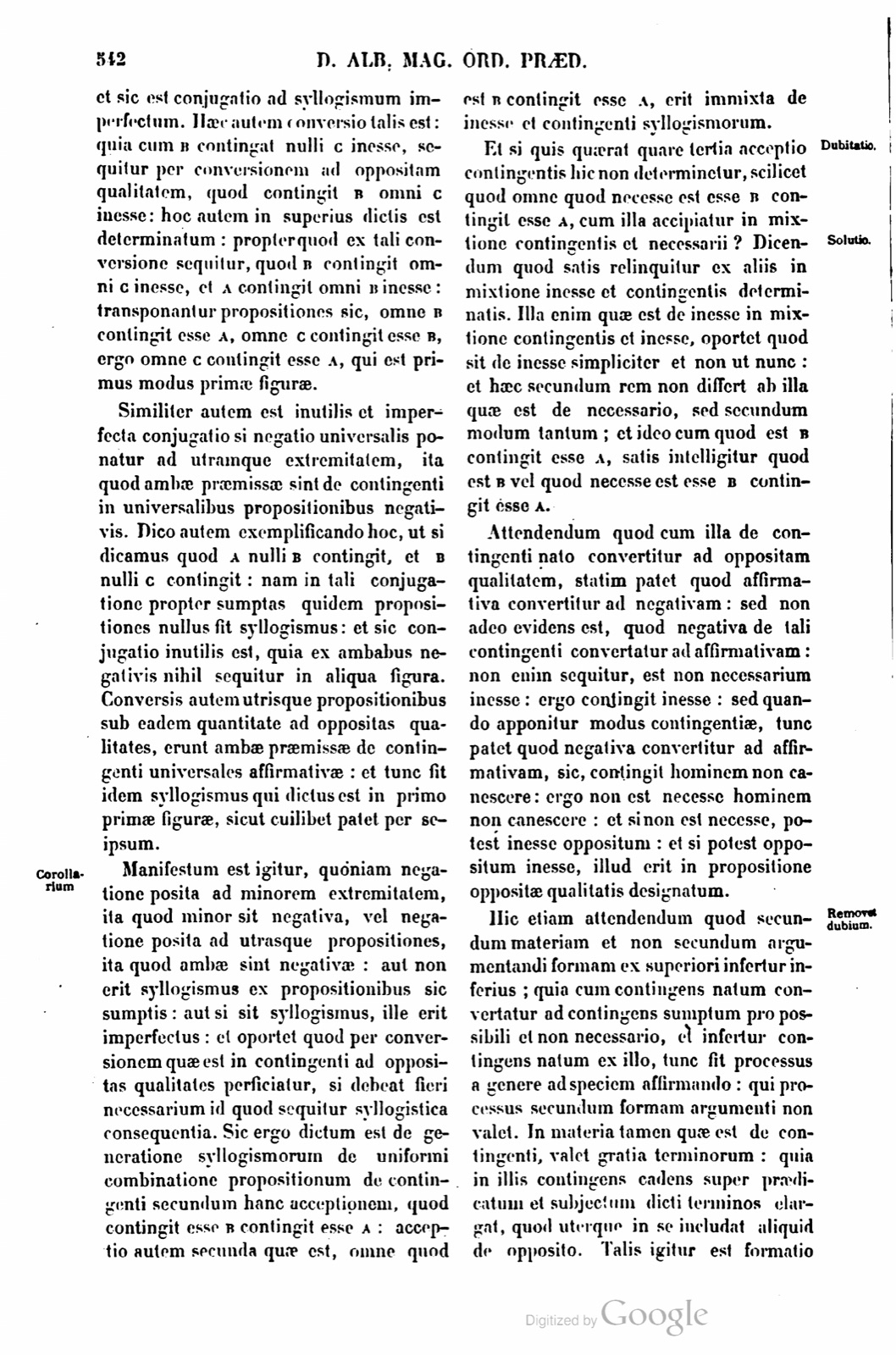
Similiter autem est inutilis et imperfecta conjugatio si negatio universalis ponatur ad utramque extremitatem, ita quod ambae praemissae sint de contingenti in universalibus propositionibus negativis. Dico autem exemplificando hoc, ut si dicamus quod A nulli B contingit, et B nulli C contingit: nam in tali conjugatione propter sumptas quidem propositiones nullus fit syllogismus: et sic conjugatio inutilis est, quia ex ambabus negativis nihil sequitur in aliqua figura. Conversis autem utrisque propositionibus sub eadem quantitate ad oppositas qualitates, erunt ambae praemissae de contingenti universales affirmativae: et tunc fit idem syllogismus qui dictus est in primo primae figurae, sicut cuilibet patet per seipsum.
Manifestum est igitur, quoniam negatione posita ad minorem extremitatem, ita quod minor sit negativa, vel negatione posita ad utrasque propositiones, ita quod ambae sint negativae: aut non erit syllogismus ex propositionibus sic sumptis: aut si sit syllogismus, ille erit imperfectus: et oportet quod per conversionem quae est in contingenti ad oppositas qualitates perficiatur, si debeat fieri necessarium id quod sequitur syllogistica consequentia. Sic ergo dictum est de generatione syllogismorum de uniformi combinatione propositionum de contingenti secundum hanc acceptionem, quod contingit esse B contingit esse A: acceptio autem secunda quae est, omne quod est B contingit esse A, erit immixta de inesse et contingenti syllogismorum.
Et si quis quaerat quare tertia acceptio contingentis hic non determinetur, scilicet quod omne quod necesse est esse B contingit esse A, cum illa accipiatur in mixtione contingentis et necessarii? Dicendum quod satis relinquitur ex aliis in mixtione inesse et contingentis determinatis. Illa enim quae est de inesse in mixtione contingentis et inesse, oportet quod sit de inesse simpliciter et non ut nunc: et haec secundum rem non differt ab illa quae est de necessario, sed secundum modum tantum; et ideo cum quod est B contingit esse A, satis intelligitur quod est B vel quod necesse est esse B contingit esse A.
Attendendum quod cum illa de contingenti nato convertitur ad oppositam qualitatem, statim patet quod affirmativa convertitur ad negativam: sed non adeo evidens est, quod negativa de tali contingenti convertatur ad affirmativam: non enim sequitur, est non necessarium inesse: ergo contingit inesse: sed quando apponitur modus contingentiae, tunc patet quod negativa convertitur ad affirmativam, sic, contingit hominem non canescere: ergo non est necesse hominem non canescere: et si non est necesse, potest inesse oppositum: et si potest oppositum inesse, illud erit in propositione oppositae qualitatis designatum.
Hic etiam attendendum quod secundum materiam et non secundum argumentandi formam ex superiori infertur inferius; quia cum contingens natum convertatur ad contingens sumptum pro possibili et non necessario, et infertur contingens natum ex illo, tunc fit processus a genere ad speciem affirmando: qui processus secundum formam argumenti non valet. In materia tamen quae est de contingenti, valet gratia terminorum: quia in illis contingens cadens super praedicatum et subjectum dicti terminos elargat, quod uterque in se includat aliquid de opposito. Talis igitur est formatio
Similarly the conjugation is useless and imperfect if the universal negation is posited at each extreme, so that both premises are about the contingent in universal negative propositions. But I say this by example, as if we say that A is contingent to no B, and B is contingent to no C. For in such a conjugation, from the propositions taken, indeed no syllogism is made; and thus the conjugation is useless, because nothing follows from both negatives in any figure. But when both propositions have been converted under the same quantity to opposite qualities, both premises will be about the contingent as universal affirmatives, and then the same syllogism is made which was stated in the first of the first figure, as is clear to anyone through himself.
Therefore it is manifest that, when negation is posited at the lesser extreme, so that the minor is negative, or when negation is posited at both propositions, so that both are negative, either there will not be a syllogism from propositions taken thus, or, if there is a syllogism, it will be imperfect; and it must be perfected through the conversion which is in the contingent to opposite qualities, if what follows by syllogistic consequence ought to be made necessary. Thus, therefore, it has been said about the generation of syllogisms from the uniform combination of propositions about the contingent according to this acceptation, that what contingently is B contingently is A. But the second acceptation, which is, every thing that is B contingently is A, will be mixed from inherence and the contingent in syllogisms.
And if someone asks why the third acceptation of the contingent is not determined here, namely that every thing which necessarily is B contingently is A, since that is taken in the mixing of the contingent and the necessary, one must say that it is sufficiently left from the other things determined in the mixing of inherence and the contingent. For that proposition which is of inherence in the mixing of the contingent and inherence must be of inherence simply and not as now; and this according to the thing does not differ from that which is of necessity, but only according to mode. And therefore with this, what is B contingently is A, it is sufficiently understood that what is B, or what necessarily is B, contingently is A.
It must be attended to that when that proposition about the natural contingent is converted to the opposite quality, it is immediately clear that the affirmative is converted to the negative; but it is not so evident that the negative concerning such a contingent is converted to the affirmative. For it does not follow: it is non-necessary to belong, therefore it contingently belongs. But when the mode of contingency is added, then it is clear that the negative is converted to the affirmative, thus: it is contingent for a man not to become gray; therefore it is not necessary for a man not to become gray; and if it is not necessary, the opposite can belong; and if the opposite can belong, that will be designated in a proposition of the opposite quality.
Here also it must be attended to that according to the matter, and not according to the form of arguing, the inferior is inferred from the superior; because when the natural contingent is converted to the contingent taken for the possible and non-necessary, and the natural contingent is inferred from that, then a process is made from genus to species affirming, which process is not valid according to the form of argument. Nevertheless in the matter which concerns the contingent it is valid by favor of the terms, because in those terms the contingent falling upon the predicate and the subject broadens the terms of the dictum, so that each includes in itself something of the opposite. Such, therefore, is the formation
If a page does not appear, its photograph has not been uploaded yet.