Works › Prior Analytics, Books I–II
Volume 1 · pp. 532–534
Chapter VIII. On the mixing of the necessary and inherence in the third figure in universal syllogisms.
A marker with ≈ is an approximate page boundary, placed by measure of the text; the page photographs remain the authority. In the paired views, clicking a page marker brings that page into view.
CAPUT VIII. De mixtione necessarii et inesse in tertia figura in universalibus syllogismis.
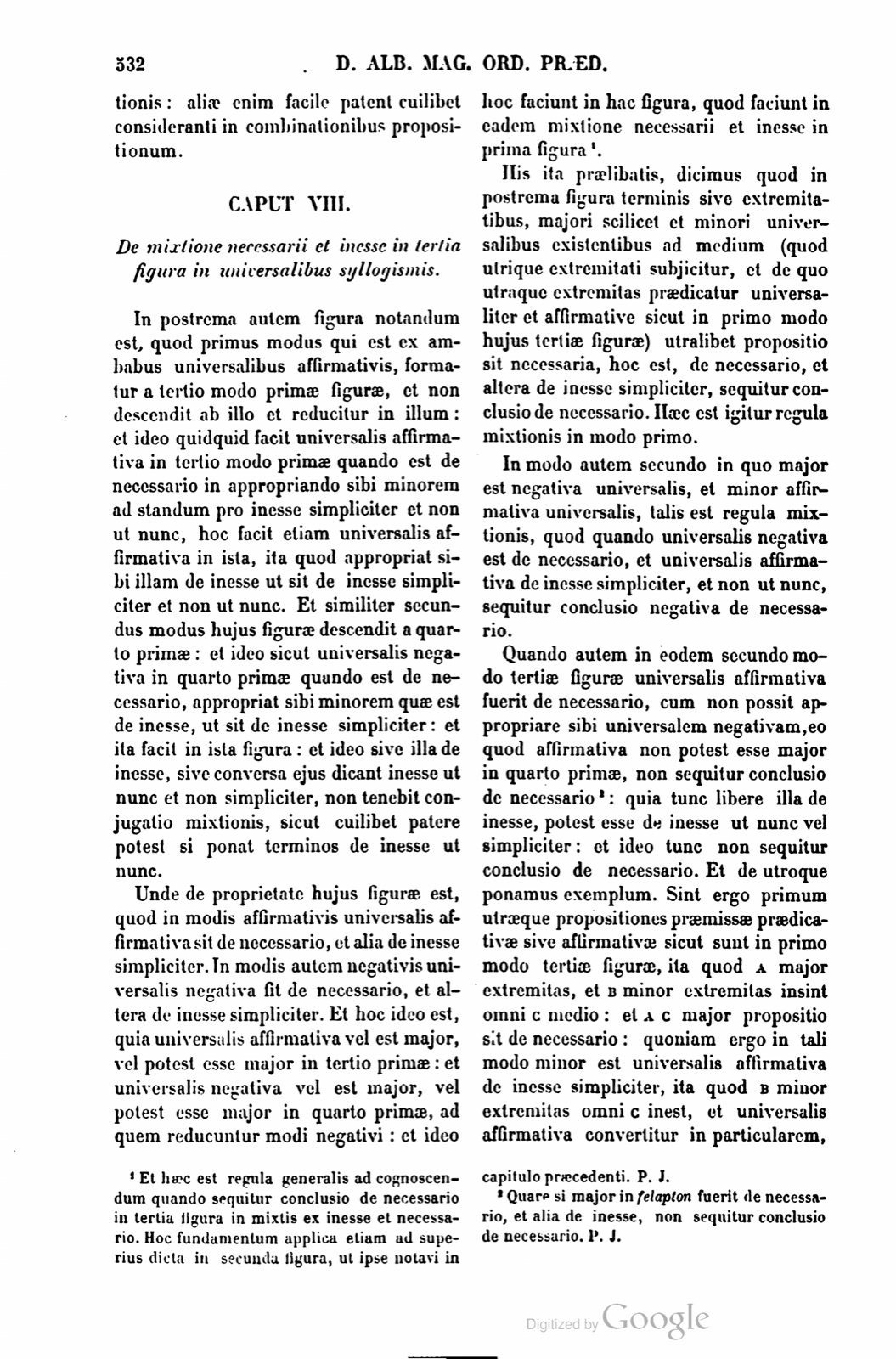
In postrema autem figura notandum est, quod primus modus qui est ex ambabus universalibus affirmativis, formatur a tertio modo primae figurae, et non descendit ab illo et reducitur in illum: et ideo quidquid facit universalis affirmativa in tertio modo primae quando est de necessario in appropriando sibi minorem ad standum pro inesse simpliciter et non ut nunc, hoc facit etiam universalis affirmativa in ista, ita quod appropriat sibi illam de inesse ut sit de inesse simpliciter et non ut nunc. Et similiter secundus modus hujus figurae descendit a quarto primae: et ideo sicut universalis negativa in quarto primae quando est de necessario, appropriat sibi minorem quae est de inesse, ut sit de inesse simpliciter: et ita facit in ista figura: et ideo sive illa de inesse, sive conversa ejus dicant inesse ut nunc et non simpliciter, non tenebit conjugatio mixtionis, sicut cuilibet patere potest si ponat terminos de inesse ut nunc.
Unde de proprietate hujus figurae est, quod in modis affirmativis universalis affirmativa sit de necessario, et alia de inesse simpliciter. In modis autem negativis universalis negativa fit de necessario, et altera de inesse simpliciter. Et hoc ideo est, quia universalis affirmativa vel est major, vel potest esse major in tertio primae: et universalis negativa vel est major, vel potest esse major in quarto primae, ad quem reducuntur modi negativi: et ideo hoc faciunt in hac figura, quod faciunt in eadem mixtione necessarii et inesse in prima figura1.
His ita praelibatis, dicimus quod in postrema figura terminis sive extremitatibus, majori scilicet et minori universalibus existentibus ad medium (quod utrique extremitati subjicitur, et de quo utraque extremitas praedicatur universaliter et affirmative sicut in primo modo hujus tertiae figurae) utralibet propositio sit necessaria, hoc est, de necessario, et altera de inesse simpliciter, sequitur conclusio de necessario. Haec est igitur regula mixtionis in modo primo.
In modo autem secundo in quo major est negativa universalis, et minor affirmativa universalis, talis est regula mixtionis, quod quando universalis negativa est de necessario, et universalis affirmativa de inesse simpliciter, et non ut nunc, sequitur conclusio negativa de necessario.
Quando autem in eodem secundo modo tertiae figurae universalis affirmativa fuerit de necessario, cum non possit appropriare sibi universalem negativam, eo quod affirmativa non potest esse major in quarto primae, non sequitur conclusio de necessario2: quia tunc libere illa de inesse potest esse de inesse ut nunc vel simpliciter: et ideo tunc non sequitur conclusio de necessario. Et de utroque ponamus exemplum. Sint ergo primum utraeque propositiones praemissae praedicativae sive affirmativae sicut sunt in primo modo tertiae figurae, ita quod A major extremitas, et B minor extremitas insint omni C medio: et A C major propositio sit de necessario: quoniam ergo in tali modo minor est universalis affirmativa de inesse simpliciter, ita quod B minor extremitas omni C inest, et universalis affirmativa convertitur in particularem, oportet si omni C inest B, quod C insit alicui B; propter quod si A inest omni C ex necessitate in majori, et C inest alicui B in conversa minoris, sequitur conclusio de necessario in tertio primae, quod scilicet ex necessitate A inest alicui B; et hoc ideo sequitur, quia B minor extremitas sub C medio est sumpta essentialiter: et ideo dicit inesse simpliciter et non ut nunc. In tali igitur reductione fit prima figura conversa minori, quae est de inesse, et fit reductio in tertium modum primae figurae.
CHAPTER VIII. On the mixing of the necessary and inherence in the third figure in universal syllogisms.
But in the last figure it must be noted that the first mode, which is from both universal affirmatives, is formed from the third mode of the first figure, and does not descend from it and is reduced into it; and therefore whatever the universal affirmative does in the third mode of the first figure, when it is of necessity, in appropriating the minor to itself so that it stands for inherence simply and not as now, this the universal affirmative also does in this figure, so that it appropriates to itself that proposition of inherence in order that it be of inherence simply and not as now. And similarly the second mode of this figure descends from the fourth of the first; and therefore, just as the universal negative in the fourth of the first, when it is of necessity, appropriates to itself the minor which is of inherence, so that it be of inherence simply, so also it does in this figure. And therefore, whether that proposition of inherence or its converse states inherence as now and not simply, the conjugation of the mixing will not hold, as can be clear to anyone if he posits terms of inherence as now.
Hence it belongs to the property of this figure that in affirmative modes the universal affirmative should be of necessity, and the other proposition of inherence simply. But in negative modes the universal negative is made of necessity, and the other of inherence simply. And this is so because the universal affirmative either is the major or can be the major in the third of the first; and the universal negative either is the major or can be the major in the fourth of the first, to which the negative modes are reduced. And therefore they do this in this figure which they do in the same mixing of the necessary and inherence in the first figure1.
With these things thus set forth beforehand, we say that in the last figure, when the terms or extremes, namely the major and the minor, are universal with respect to the middle, which is subjected to each extreme and of which each extreme is predicated universally and affirmatively, as in the first mode of this third figure, if either proposition is necessary, that is, of necessity, and the other of inherence simply, a conclusion of necessity follows. This, therefore, is the rule of mixing in the first mode.
But in the second mode, in which the major is universal negative and the minor universal affirmative, the rule of the mixing is such that when the universal negative is of necessity, and the universal affirmative of inherence simply and not as now, a negative conclusion of necessity follows.
But when in the same second mode of the third figure the universal affirmative has been of necessity, since it cannot appropriate to itself the universal negative, because the affirmative cannot be the major in the fourth of the first, a conclusion of necessity does not follow2. For then that proposition of inherence can freely be of inherence as now or simply; and therefore then a conclusion of necessity does not follow. And let us posit an example of each. Therefore first let both premise propositions be predicative or affirmative, as they are in the first mode of the third figure, so that A the greater extreme and B the lesser extreme belong to every C, the middle; and let A C, the major proposition, be of necessity. Therefore, since in such a mode the minor is a universal affirmative of inherence simply, so that B the lesser extreme belongs to every C, and a universal affirmative is converted into a particular, if B belongs to every C, C must belong to some B. For this reason, if A belongs to every C of necessity in the major, and C belongs to some B in the converse of the minor, a conclusion of necessity follows in the third of the first, namely that of necessity A belongs to some B. And this follows for this reason, that B, the lesser extreme, is taken essentially under C the middle; and therefore it states inherence simply and not as now. Therefore in such a reduction the first figure is made, with the minor converted, which is of inherence, and the reduction is made into the third mode of the first figure.
Similiter autem ostendetur, quod conclusio sequitur de necessario in eodem primo modo tertiae figurae si minor propositio quae est B C est de necessario, et major de inesse simpliciter et non ut nunc: tunc enim convertitur major propositio quae est A C in particularem: ita quod si A omni C inest, quod C inest alicui A. Transponantur ergo propositiones, et fit iterum tertius modus primae figurae: propter quod si detur quod omni C inest B ex necessitate in minori propositione, sequitur conclusio de necessario, quod scilicet C alicui A inerit ex necessitate, sic, omne C A ex necessitate, omne C B, ergo ex necessitate quoddam B A. Convertatur enim major et fiat transpositio sic, ex necessitate omne C B, quoddam autem A C, ergo ex necessitate quoddam A B, qui est syllogismus in tertio primae. Sic igitur mixtio fit necessarii et inesse in primo modo tertiae figurae.
Rursus sit A C major propositio privativa, B C autem minor propositio sit affirmativa sicut in secundo modo tertiae figurae, et universalis privativa quae est major sit de necessario, sequitur conclusio particularis negativa de necessario, et reducitur in quartum primae per conversionem minoris propositionis in particularem affirmativam de inesse simpliciter sic, ex necessitate A nulli C inest, C autem inest alicui B, haec enim est conversa illius quae dixit omne C est B, sequitur in quarto primae quod ex necessitate A alicui B non inerit: et hoc ideo est, quia B minor extremitas essentialiter est sub C medio: et ideo minorem oportet esse de inesse simpliciter, et non ut nunc.
Si autem in hoc secundo modo tertiae universalis praedicativa sit de necessario, et universalis negativa de inesse, non sequitur conclusio de necessario: quia cum universalis affirmativa non possit esse major in quarto primae, in quem iste modus reducitur, non potest appropriare sibi universalem negativam ad dicendum inesse simpliciter: sed potest dicere inesse ut nunc: et ideo non sequitur conclusio de necessario. Sit enim minor propositio quae est B C de necessario, A C autem propositio major sit de inesse, et negativa, et non de necessario. Quia igitur convertitur universalis affirmativa de necessario in particularem, ex hac, omne B C ex necessitate, sequitur aliquod C B ex necessitate: propter quod si detur ista, quod A nulli eorum quae sunt C inest, hoc est, quod nullum C A, et C inest alicui eorum quae sunt B ex necessitate, hoc est, quod necessario aliquod B C, sequitur quidem conclusio de inesse, quod scilicet A non inest alicui B, sed non sequitur conclusio de necessario, quod scilicet ex necessitate A non insit alicui eorum quae sunt B. Jam enim in prima figura in quarto modo primae figurae ostensum est, quod quando privativa universalis non est de necessario, conclusio non erit de necessario.
Similarly it will be shown that a conclusion of necessity follows in the same first mode of the third figure if the minor proposition, which is B C, is of necessity and the major of inherence simply and not as now. For then the major proposition, which is A C, is converted into a particular, so that if A belongs to every C, C belongs to some A. Therefore let the propositions be transposed, and again the third mode of the first figure is made. For this reason, if it is granted that B belongs to every C of necessity in the minor proposition, a conclusion of necessity follows, namely that C will belong to some A of necessity, thus: every C is A of necessity; every C is B; therefore of necessity some B is A. For let the major be converted and let a transposition be made thus: of necessity every C is B; but some A is C; therefore of necessity some A is B, which is a syllogism in the third of the first. Thus, therefore, the mixing of the necessary and inherence is made in the first mode of the third figure.
Again, let A C, the major proposition, be privative, but let B C, the minor proposition, be affirmative, as in the second mode of the third figure; and if the universal privative, which is the major, is of necessity, a particular negative conclusion of necessity follows, and it is reduced into the fourth of the first through conversion of the minor proposition into a particular affirmative of inherence simply, thus: of necessity A belongs to no C, but C belongs to some B, for this is the converse of that which said every C is B; it follows in the fourth of the first that of necessity A will not belong to some B. And this is so because B, the lesser extreme, is essentially under C the middle; and therefore the minor must be of inherence simply and not as now.
But if in this second mode of the third figure the universal predicative is of necessity, and the universal negative of inherence, a conclusion of necessity does not follow; because, since the universal affirmative cannot be the major in the fourth of the first, into which this mode is reduced, it cannot appropriate the universal negative to itself so that it state inherence simply; but it can state inherence as now, and therefore a conclusion of necessity does not follow. For let the minor proposition, which is B C, be of necessity, and let A C, the major proposition, be of inherence, and negative, and not of necessity. Therefore because the universal affirmative of necessity is converted into a particular, from this, every B is C of necessity, there follows some C is B of necessity. For this reason, if this is granted, that A belongs to none of those which are C, that is, that no C is A, and C belongs to some of those which are B of necessity, that is, that necessarily some B is C, a conclusion of inherence indeed follows, namely that A does not belong to some B, but a conclusion of necessity does not follow, namely that of necessity A does not belong to some of those which are B. For already in the first figure, in the fourth mode of the first figure, it has been shown that when the universal privative is not of necessity, the conclusion will not be of necessity.
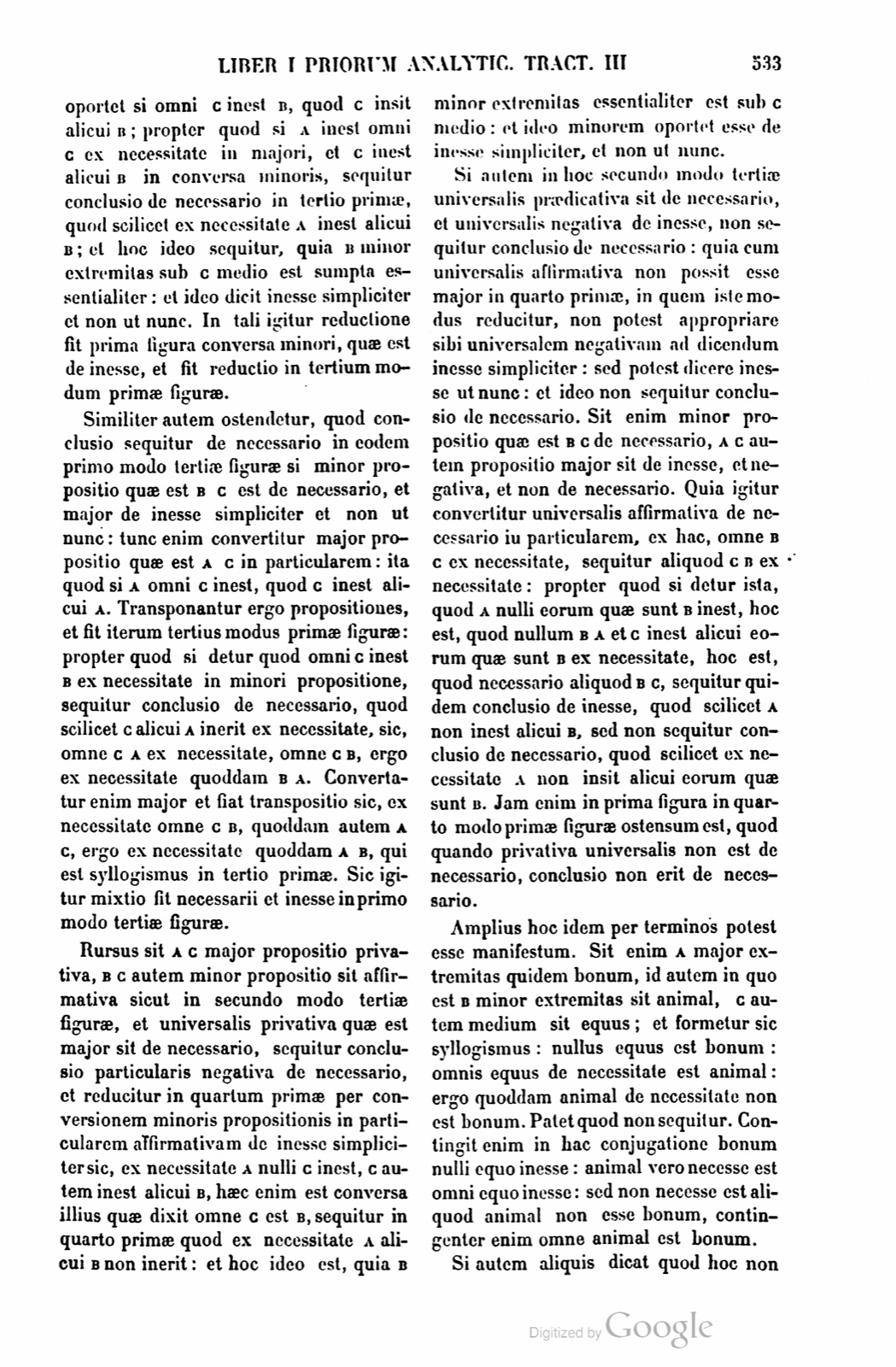
Amplius hoc idem per terminos potest esse manifestum. Sit enim A major extremitas quidem bonum, id autem in quo est B minor extremitas sit animal, C autem medium sit equus; et formetur sic syllogismus: nullus equus est bonum: omnis equus de necessitate est animal: ergo quoddam animal de necessitate non est bonum. Patet quod non sequitur. Contingit enim in hac conjugatione bonum nulli equo inesse: animal vero necesse est omni equo inesse: sed non necesse est aliquod animal non esse bonum, contingenter enim omne animal est bonum.
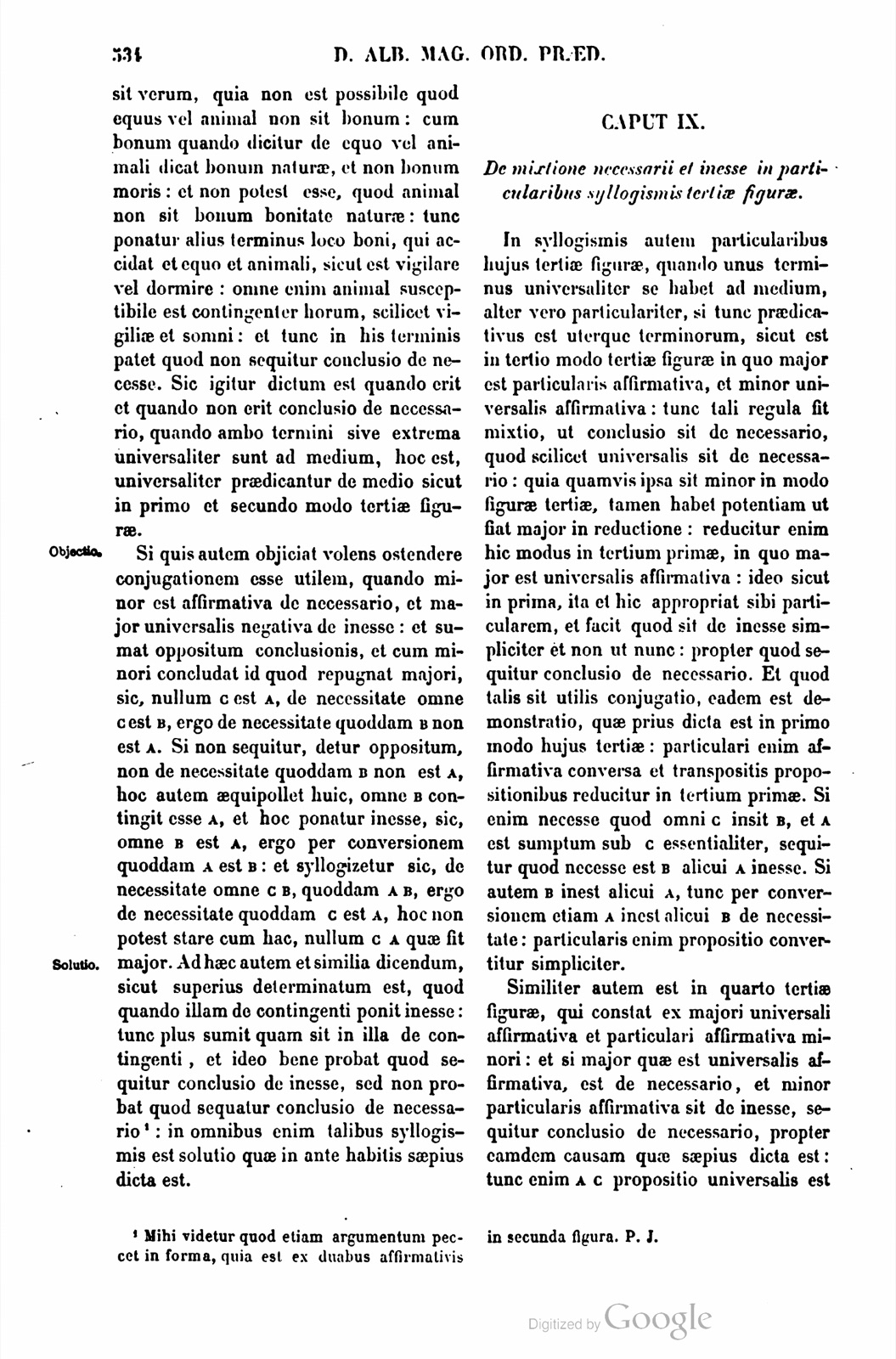
Si autem aliquis dicat quod hoc non sit verum, quia non est possibile quod equus vel animal non sit bonum: cum bonum quando dicitur de equo vel animali dicat bonum naturae, et non bonum moris: et non potest esse, quod animal non sit bonum bonitate naturae: tunc ponatur alius terminus loco boni, qui accidat et equo et animali, sicut est vigilare vel dormire: omne enim animal susceptibile est contingenter horum, scilicet vigiliae et somni: et tunc in his terminis patet quod non sequitur conclusio de necesse. Sic igitur dictum est quando erit et quando non erit conclusio de necessario, quando ambo termini sive extrema universaliter sunt ad medium, hoc est, universaliter praedicantur de medio sicut in primo et secundo modo tertiae figurae.
Si quis autem objiciat volens ostendere conjugationem esse utilem, quando minor est affirmativa de necessario, et major universalis negativa de inesse: et sumat oppositum conclusionis, et cum minori concludat id quod repugnat majori, sic, nullum C est A, de necessitate omne C est B, ergo de necessitate quoddam B non est A. Si non sequitur, detur oppositum, non de necessitate quoddam B non est A, hoc autem aequipollet huic, omne B contingit esse A, et hoc ponatur inesse, sic, omne B est A, ergo per conversionem quoddam A est B: et syllogizetur sic, de necessitate omne C B, quoddam A B, ergo de necessitate quoddam C est A, hoc non potest stare cum hac, nullum C A quae fit major. Ad haec autem et similia dicendum, sicut superius determinatum est, quod quando illam de contingenti ponit inesse: tunc plus sumit quam sit in illa de contingenti, et ideo bene probat quod sequitur conclusio de inesse, sed non probat quod sequatur conclusio de necessario3: in omnibus enim talibus syllogismis est solutio quae in ante habitis saepius dicta est.
Moreover this same thing can be manifest through terms. Let A the greater extreme be good, but that in which B the lesser extreme is, let it be animal, and let C the middle be horse; and let the syllogism be formed thus: no horse is good; every horse of necessity is animal; therefore some animal of necessity is not good. It is clear that this does not follow. For in this conjugation it is contingent that good belong to no horse; but animal necessarily belongs to every horse; but it is not necessary that some animal not be good, for contingently every animal is good.
But if someone says that this is not true, because it is not possible that a horse or an animal not be good, since good, when it is said of a horse or animal, says the good of nature and not the good of morals, and it cannot be that an animal is not good with the goodness of nature, then let another term be posited in place of good, one which happens both to horse and to animal, such as to be awake or to sleep. For every animal is contingently receptive of these, namely wakefulness and sleep; and then in these terms it is clear that a conclusion of necessity does not follow. Thus, therefore, it has been said when there will be and when there will not be a conclusion of necessity, when both terms or extremes are universal with respect to the middle, that is, are universally predicated of the middle, as in the first and second mode of the third figure.
But if someone objects, wishing to show that the conjugation is useful when the minor is affirmative of necessity and the major universal negative of inherence, and takes the opposite of the conclusion and with the minor concludes that which is repugnant to the major, thus: no C is A; of necessity every C is B; therefore of necessity some B is not A. If it does not follow, let the opposite be granted: not of necessity some B is not A. But this is equivalent to this: every B is contingently A; and let this be posited as inhering, thus, every B is A. Therefore by conversion some A is B. And let a syllogism be made thus: of necessity every C is B; some A is B; therefore of necessity some C is A. This cannot stand with this, no C is A, which is made the major. To these and similar things one must say, as was determined above, that when he posits that proposition of the contingent as inhering, then he takes more than is in that proposition of the contingent; and therefore he does prove well that a conclusion of inherence follows, but he does not prove that a conclusion of necessity follows3. For in all such syllogisms the solution is the one that has often been stated in what was had before.
Notes
- And this is the general rule for knowing when a conclusion of necessity follows in the third figure in mixtures from inherence and the necessary. Apply this foundation also to the things said above in the second figure, as I myself noted in the preceding chapter. P. J. (Et haec est regula generalis ad cognoscendum quando sequitur conclusio de necessario in tertia figura in mixtis ex inesse et necessario. Hoc fundamentum applica etiam ad superius dicta in secunda figura, ut ipse notavi in capitulo praecedenti. P. J.) ↩
- Wherefore if the major in Felapton has been of necessity, and the other proposition of inherence, a conclusion of necessity does not follow. P. J. (Quare si major in felapton fuerit de necessario, et alia de inesse, non sequitur conclusio de necessario. P. J.) ↩
- It seems to me that the argument also sins in form, because it is from two affirmatives in the second figure. P. J. (Mihi videtur quod etiam argumentum peccet in forma, quia est ex duabus affirmativis in secunda figura. P. J.) ↩
If a page does not appear, its photograph has not been uploaded yet.