Works › Prior Analytics, Books I–II
Volume 1 · pp. 531–532
Continuation of Chapter VII on page 531
A marker with ≈ is an approximate page boundary, placed by measure of the text; the page photographs remain the authority. In the paired views, clicking a page marker brings that page into view.
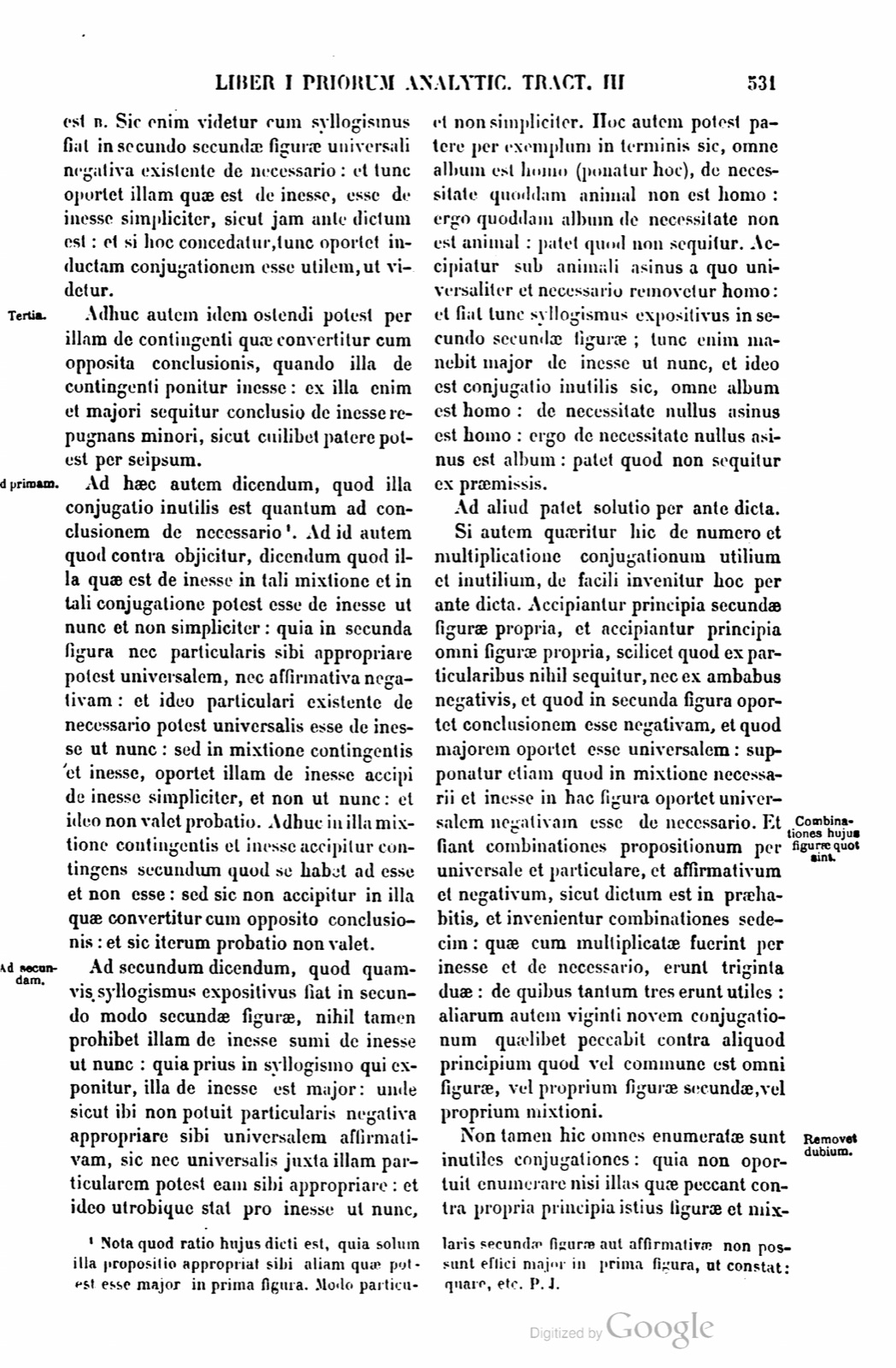
est A. Sic enim videtur cum syllogismus fiat in secundo secundae figurae universali negativa existente de necessario: et tunc oportet illam quae est de inesse, esse de inesse simpliciter, sicut jam ante dictum est: et si hoc concedatur, tunc oportet inductam conjugationem esse utilem, ut videtur.
Adhuc autem idem ostendi potest per illam de contingenti quae convertitur cum opposita conclusionis, quando illa de contingenti ponitur inesse: ex illa enim et majori sequitur conclusio de inesse repugnans minori, sicut cuilibet patere potest per seipsum.
Ad haec autem dicendum, quod illa conjugatio inutilis est quantum ad conclusionem de necessario1. Ad id autem quod contra objicitur, dicendum quod illa quae est de inesse in tali mixtione et in tali conjugatione potest esse de inesse ut nunc et non simpliciter: quia in secunda figura nec particularis sibi appropriare potest universalem, nec affirmativa negativam: et ideo particulari existente de necessario potest universalis esse de inesse ut nunc: sed in mixtione contingentis et inesse, oportet illam de inesse accipi de inesse simpliciter, et non ut nunc: et ideo non valet probatio. Adhuc in illa mixtione contingentis et inesse accipitur contingens secundum quod se habet ad esse et non esse: sed sic non accipitur in illa quae convertitur cum opposito conclusionis: et sic iterum probatio non valet.
Ad secundum dicendum, quod quamvis syllogismus expositivus fiat in secundo modo secundae figurae, nihil tamen prohibet illam de inesse sumi de inesse ut nunc: quia prius in syllogismo qui exponitur, illa de inesse est major: unde sicut ibi non potuit particularis negativa appropriare sibi universalem affirmativam, sic nec universalis juxta illam particularem potest eam sibi appropriare: et ideo utrobique stat pro inesse ut nunc, et non simpliciter. Hoc autem potest patere per exemplum in terminis sic, omne album est homo (ponatur hoc), de necessitate quoddam animal non est homo: ergo quoddam album de necessitate non est animal: patet quod non sequitur. Accipiatur sub animali asinus a quo universaliter et necessario removetur homo: et fiat tunc syllogismus expositivus in secundo secundae figurae; tunc enim manebit major de inesse ut nunc, et ideo est conjugatio inutilis sic, omne album est homo: de necessitate nullus asinus est homo: ergo de necessitate nullus asinus est album: patet quod non sequitur ex praemissis.
is A. For thus it seems when the syllogism is made in the second mode of the second figure, with the universal negative existing as of necessity; and then that which is of inherence must be of inherence simply, as has already been said before. And if this is granted, then it must be that the introduced conjugation is useful, as it seems.
Again, the same thing can be shown through that proposition about the contingent which is converted with the opposite of the conclusion, when that proposition about the contingent is posited as inhering; for from it and the major there follows a conclusion of inherence repugnant to the minor, as can be clear to anyone through himself.
But to these things one must say that that conjugation is useless with respect to a conclusion of necessity1. To that, however, which is objected against this, one must say that that proposition which is of inherence in such a mixing and in such a conjugation can be of inherence as now and not simply: because in the second figure neither can the particular appropriate the universal to itself, nor can the affirmative appropriate the negative; and therefore, with the particular existing as of necessity, the universal can be of inherence as now. But in the mixing of the contingent and inherence, that proposition of inherence must be taken as of inherence simply and not as now; and therefore the proof is not valid. Again, in that mixing of the contingent and inherence, the contingent is taken according as it has itself toward being and not being; but it is not taken thus in that proposition which is converted with the opposite of the conclusion; and thus again the proof is not valid.
To the second one must say that although an expository syllogism is made in the second mode of the second figure, nevertheless nothing prevents that proposition of inherence from being taken as of inherence as now; because earlier, in the syllogism which is expounded, that proposition of inherence is the major. Hence, just as there the particular negative could not appropriate to itself the universal affirmative, so neither can the universal beside that particular appropriate it to itself; and therefore in both places it stands for inherence as now and not simply. This can be clear through an example in terms thus: every white thing is a man, let this be posited; of necessity some animal is not a man; therefore some white thing of necessity is not an animal. It is clear that this does not follow. Let an ass be taken under animal, from which man is removed universally and necessarily; and let an expository syllogism then be made in the second mode of the second figure. For then the major will remain of inherence as now, and therefore the conjugation is useless thus: every white thing is a man; of necessity no ass is a man; therefore of necessity no ass is white. It is clear that it does not follow from the premises.
Ad aliud patet solutio per ante dicta.
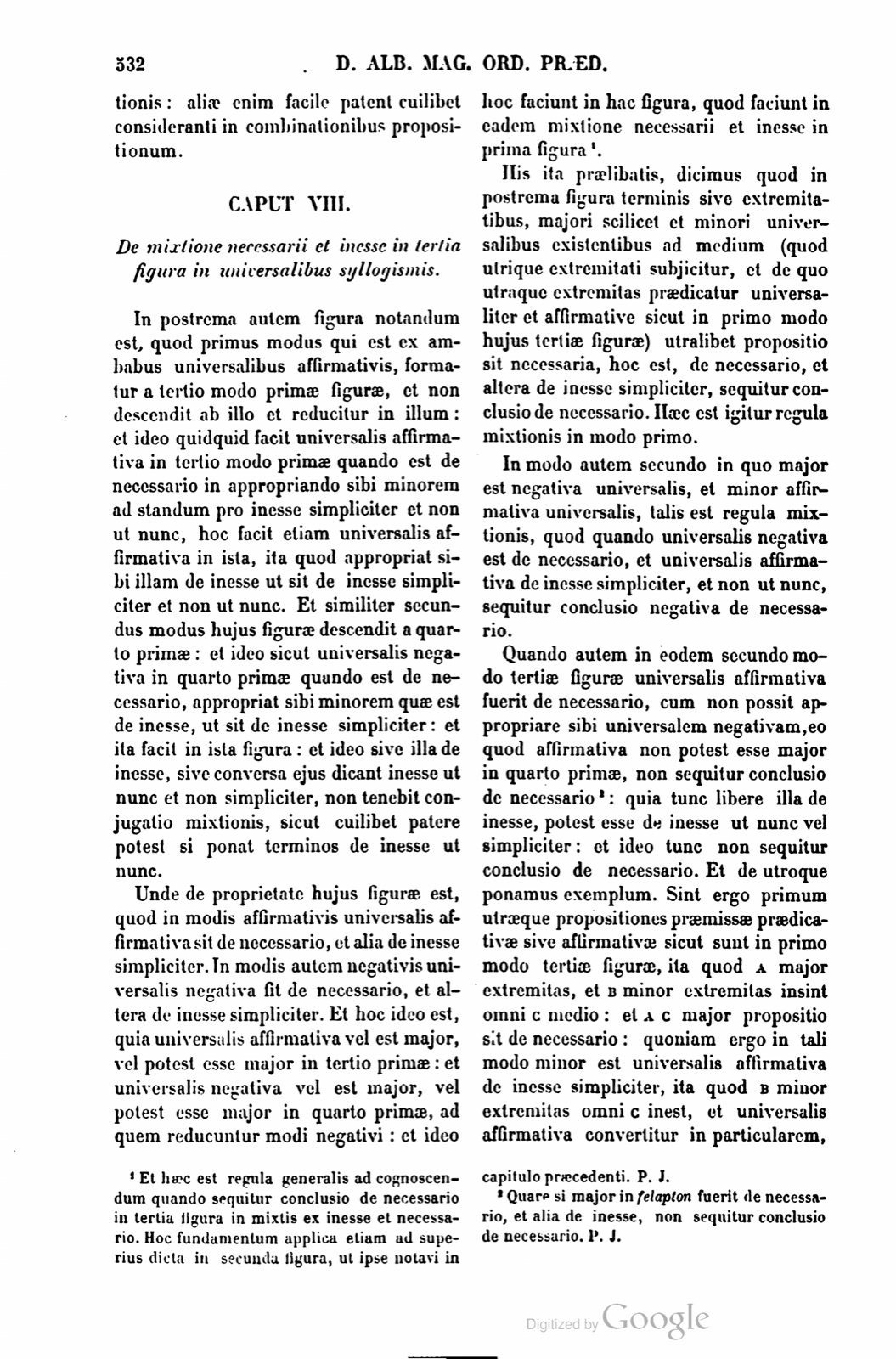
Si autem quaeritur hic de numero et multiplicatione conjugationum utilium et inutilium, de facili invenitur hoc per ante dicta. Accipiantur principia secundae figurae propria, et accipiantur principia omni figurae propria, scilicet quod ex particularibus nihil sequitur, nec ex ambabus negativis, et quod in secunda figura oportet conclusionem esse negativam, et quod majorem oportet esse universalem: supponatur etiam quod in mixtione necessarii et inesse in hac figura oportet universalem negativam esse de necessario. Et fiant combinationes propositionum per universale et particulare, et affirmativum et negativum, sicut dictum est in praehabitis, et invenientur combinationes sedecim: quae cum multiplicatae fuerint per inesse et de necessario, erunt triginta duae: de quibus tantum tres erunt utiles: aliarum autem viginti novem conjugationum quaelibet peccabit contra aliquod principium quod vel commune est omni figurae, vel proprium figurae secundae, vel proprium mixtioni.
Non tamen hic omnes enumeratae sunt inutiles conjugationes: quia non oportuit enumerare nisi illas quae peccant contra propria principia istius figurae et mixtionis: aliae enim facile patent cuilibet consideranti in combinationibus propositionum.
To the other point, the solution is clear through the things said before.
But if one asks here about the number and multiplication of useful and useless conjugations, this is easily found through what has been said before. Let the proper principles of the second figure be taken, and let the principles proper to every figure be taken, namely that nothing follows from particulars, nor from both negatives, and that in the second figure the conclusion must be negative, and that the major must be universal. Let it also be supposed that in the mixing of the necessary and inherence in this figure the universal negative must be of necessity. And let combinations of propositions be made through universal and particular, and affirmative and negative, as has been said in what was had before, and sixteen combinations will be found. When these have been multiplied by inherence and by necessity, they will be thirty-two; of these only three will be useful. But each of the other twenty-nine conjugations will sin against some principle which is either common to every figure, or proper to the second figure, or proper to the mixing.
Nevertheless not all the useless conjugations have been enumerated here, because it was not necessary to enumerate except those which sin against the proper principles of this figure and of the mixing; for the others are easily evident to anyone considering the combinations of propositions.
Notes
- Note that the reason for this statement is that only that proposition appropriates another to itself which can be the major in the first figure. But a particular proposition of the second figure, or an affirmative proposition, cannot be made the major in the first figure, as is established; wherefore, etc. P. J. (Nota quod ratio hujus dicti est, quia solum illa propositio appropriat sibi aliam quae potest esse major in prima figura. Modo particularis secundae figurae aut affirmativae non possunt effici major in prima figura, ut constat: quare, etc. P. J.) ↩
If a page does not appear, its photograph has not been uploaded yet.