Works › Prior Analytics, Books I–II
Volume 1 · pp. 529–530
Chapter VII. On the formation of particular syllogisms of the mixing of the necessary and inherence in the second figure.
A marker with ≈ is an approximate page boundary, placed by measure of the text; the page photographs remain the authority. In the paired views, clicking a page marker brings that page into view.
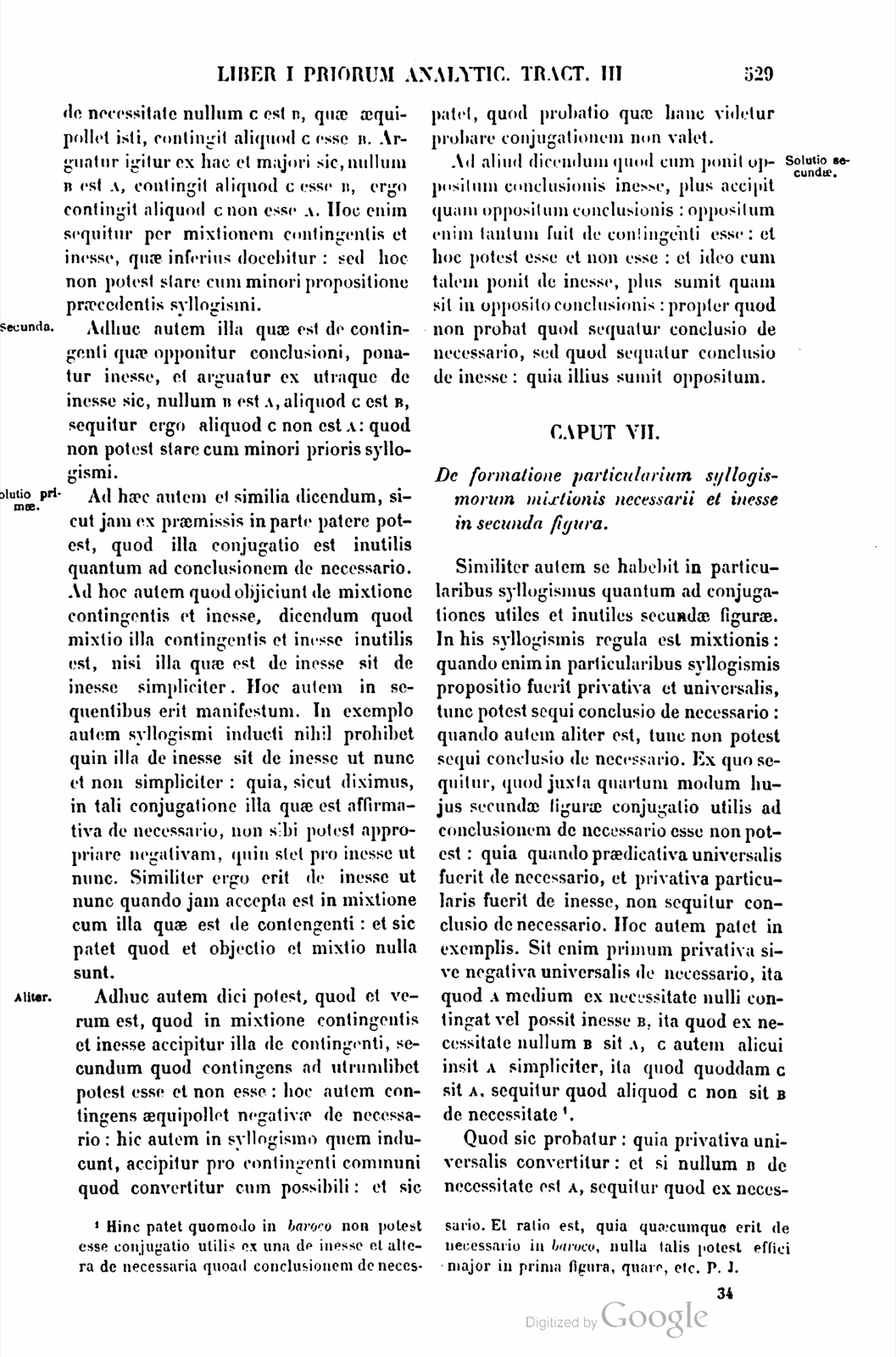
CAPUT VII. De formatione particularium syllogismorum mixtionis necessarii et inesse in secunda figura.
Similiter autem se habebit in particularibus syllogismus quantum ad conjugationes utiles et inutiles secundae figurae. In his syllogismis regula est mixtionis: quando enim in particularibus syllogismis propositio fuerit privativa et universalis, tunc potest sequi conclusio de necessario: quando autem aliter est, tunc non potest sequi conclusio de necessario. Ex quo sequitur, quod juxta quartum modum hujus secundae figurae conjugatio utilis ad conclusionem de necessario esse non potest: quia quando praedicativa universalis fuerit de necessario, et privativa particularis fuerit de inesse, non sequitur conclusio de necessario. Hoc autem patet in exemplis. Sit enim primum privativa sive negativa universalis de necessario, ita quod A medium ex necessitate nulli contingat vel possit inesse B, ita quod ex necessitate nullum B sit A, C autem alicui insit A simpliciter, ita quod quoddam C sit A, sequitur quod aliquod C non sit B de necessitate1.
Quod sic probatur: quia privativa universalis convertitur: et si nullum B de necessitate est A, sequitur quod ex necessario nullum A est B. Syllogizetur ergo sic, ex necessitate nullum A est B, quoddam C est A, ergo ex necessitate aliquod C non est B: quare B ut praedicatum inerit alicui eorum quae sunt C. Hic enim est quartus primae figurae.
Omnes autem aliae conjugationes erunt inutiles. Sit enim universalis affirmativa sive praedicativa de necessario, et praedicativum ponatur ad B, majorem scilicet extremitatem, ita quod major sit universalis et affirmativa, sicut est in quarto modo secundae figurae: si ergo in tali conjugatione A inest omni B ex necessitate, A autem alicui C non inest tantum, ita scilicet quod minor sit particularis negativa de inesse tantum: tunc manifestum est quod sequitur conclusio de inesse tantum, quod scilicet B non inerit alicui C, hoc est, quod aliquod C non est B. Sed non sequitur conclusio de necessario, scilicet quod ex necessitate aliquod C non sit B, hoc autem demonstratur per instantiam in terminis: et erunt iidem termini qui positi sunt in universalibus syllogismis.
Adhuc etiam utilis conjugatio non est si particularis privativa sit de necessario, quae ad minorem ponitur extremitatem: tunc enim iterum non sequitur conclusio de necessario: et demonstratur hoc per eosdem terminos instantiae, qui jam dicti sunt, sicut cuilibet patet per seipsum. Sed sunt aliter ordinandi: hic enim homo est medium, album major, et animal minor extremitas sic: omne album est homo: de necessitate quoddam animal non est homo: ergo quoddam animal non est album ex necessitate. Patet quod non sequitur.
CHAPTER VII. On the formation of particular syllogisms of the mixing of the necessary and inherence in the second figure.
Similarly, in particular syllogisms, the syllogism will have itself with respect to useful and useless conjugations of the second figure. In these syllogisms this is the rule of mixing: for when in particular syllogisms the proposition is privative and universal, then a conclusion of necessity can follow; but when it is otherwise, then a conclusion of necessity cannot follow. From this it follows that, beside the fourth mode of this second figure, there cannot be a useful conjugation for a conclusion of necessity, because when the universal predicative is of necessity and the particular privative is of inherence, a conclusion of necessity does not follow. This is clear in examples. For first let the privative or universal negative be of necessity, so that A, the middle, of necessity contingently or possibly belongs to no B, so that of necessity no B is A; but let C belong to some A simply, so that some C is A; it follows that some C is not B of necessity1.
This is proved in this way: because the universal privative is converted; and if no B is A of necessity, it follows that by necessity no A is B. Therefore let it be syllogized thus: of necessity no A is B; some C is A; therefore of necessity some C is not B. Therefore B as predicate will belong to some of those things which are C. For this is the fourth of the first figure.
But all other conjugations will be useless. For let the universal affirmative or predicative be of necessity, and let the predicative be placed at B, namely the greater extreme, so that the major is universal and affirmative, as it is in the fourth mode of the second figure. Therefore if in such a conjugation A belongs to every B of necessity, but A does not belong to some C only, so that the minor is particular negative of inherence only, then it is manifest that a conclusion of inherence only follows, namely that B will not belong to some C, that is, that some C is not B. But a conclusion of necessity does not follow, namely that of necessity some C is not B; and this is demonstrated through an instance in terms, and the same terms will be used that were posited in universal syllogisms.
Again, there is also no useful conjugation if the particular privative, which is placed at the lesser extreme, is of necessity; for then again a conclusion of necessity does not follow. And this is demonstrated through the same terms of the instance that have already been mentioned, as is clear to anyone through itself. But they must be ordered differently: for here man is the middle, white the major, and animal the lesser extreme, thus: every white thing is man; of necessity some animal is not man; therefore some animal is not white of necessity. It is clear that it does not follow.
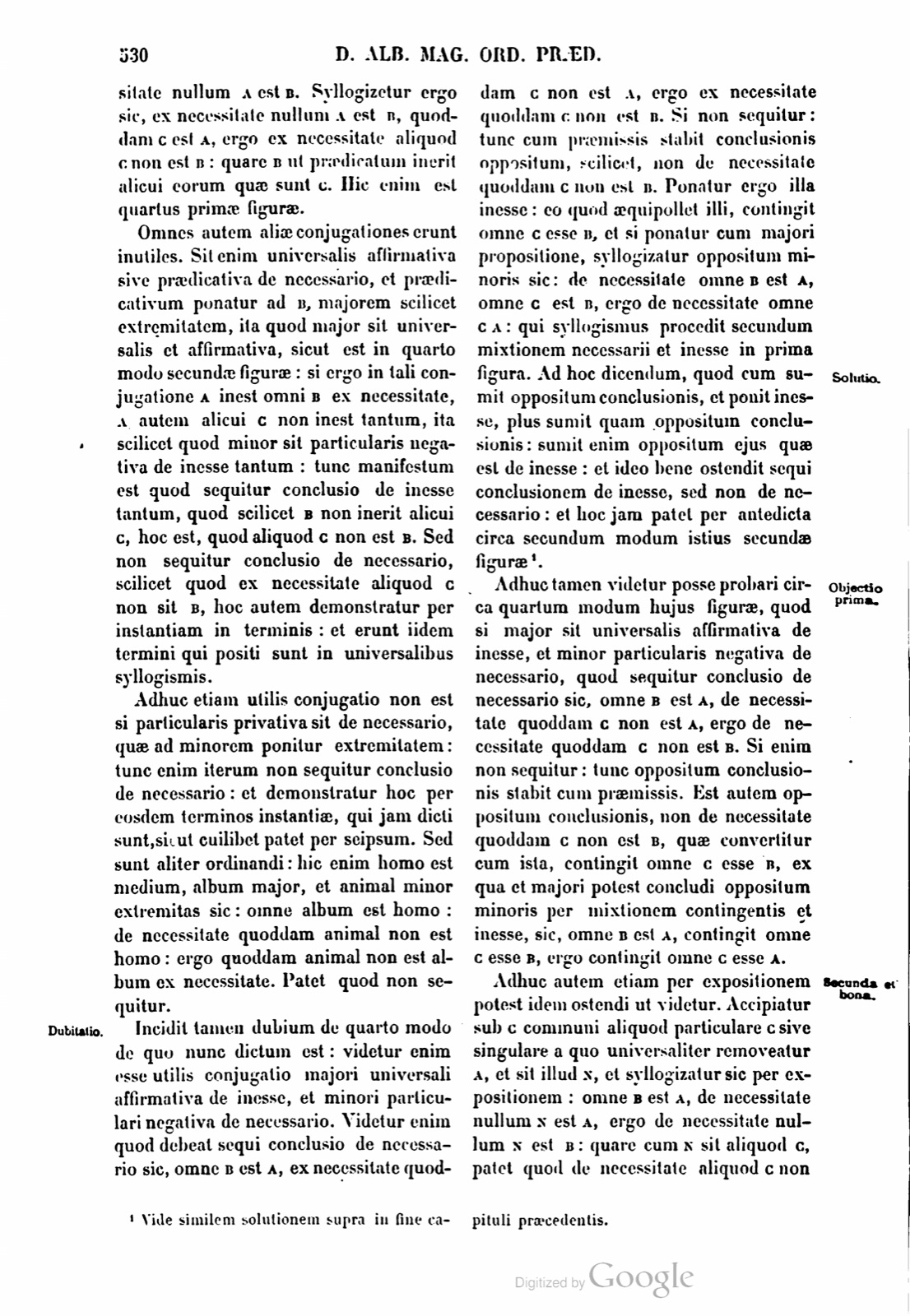
Incidit tamen dubium de quarto modo de quo nunc dictum est: videtur enim esse utilis conjugatio majori universali affirmativa de inesse, et minori particulari negativa de necessario. Videtur enim quod debeat sequi conclusio de necessario sic, omne B est A, ex necessitate quoddam C non est A, ergo ex necessitate quoddam C non est B. Si non sequitur: tunc cum praemissis stabit conclusionis oppositum, scilicet, non de necessitate quoddam C non est B. Ponatur ergo illa inesse: eo quod aequipollet illi, contingit omne C esse B, et si ponatur cum majori propositione, syllogizatur oppositum minoris sic: de necessitate omne B est A, omne C est B, ergo de necessitate omne C A: qui syllogismus procedit secundum mixtionem necessarii et inesse in prima figura. Ad hoc dicendum, quod cum sumit oppositum conclusionis, et ponit inesse, plus sumit quam oppositum conclusionis: sumit enim oppositum ejus quae est de inesse: et ideo bene ostendit sequi conclusionem de inesse, sed non de necessario: et hoc jam patet per antedicta circa secundum modum istius secundae figurae2.
Adhuc tamen videtur posse probari circa quartum modum hujus figurae, quod si major sit universalis affirmativa de inesse, et minor particularis negativa de necessario, quod sequitur conclusio de necessario sic, omne B est A, de necessitate quoddam C non est A, ergo de necessitate quoddam C non est B. Si enim non sequitur: tunc oppositum conclusionis stabit cum praemissis. Est autem oppositum conclusionis, non de necessitate quoddam C non est B, quae convertitur cum ista, contingit omne C esse B, ex qua et majori potest concludi oppositum minoris per mixtionem contingentis et inesse, sic, omne B est A, contingit omne C esse B, ergo contingit omne C esse A.
Adhuc autem etiam per expositionem potest idem ostendi ut videtur. Accipiatur sub C communi aliquod particulare C sive singulare a quo universaliter removeatur A, et sit illud X, et syllogizatur sic per expositionem: omne B est A, de necessitate nullum X est A, ergo de necessitate nullum X est B: quare cum X sit aliquod C, patet quod de necessitate aliquod C non
Yet a doubt occurs concerning the fourth mode about which we have now spoken: for the conjugation seems to be useful when the major is universal affirmative of inherence and the minor particular negative of necessity. For it seems that a conclusion of necessity ought to follow thus: every B is A; of necessity some C is not A; therefore of necessity some C is not B. For if it does not follow, then the opposite of the conclusion will stand with the premises, namely, not of necessity some C is not B. Therefore let that be posited as inhering, because it is equivalent to this, it is contingent that every C be B; and if it is posited with the major proposition, the opposite of the minor is syllogized thus: of necessity every B is A; every C is B; therefore of necessity every C is A. This syllogism proceeds according to the mixing of the necessary and inherence in the first figure. To this one must say that when it takes the opposite of the conclusion and posits inherence, it takes more than the opposite of the conclusion; for it takes the opposite of that which is of inherence. And therefore it shows well that a conclusion of inherence follows, but not of necessity; and this is already clear through what was said before concerning the second mode of this second figure2.
Nevertheless, concerning the fourth mode of this figure it still seems possible to prove that, if the major is universal affirmative of inherence and the minor particular negative of necessity, a conclusion of necessity follows thus: every B is A; of necessity some C is not A; therefore of necessity some C is not B. For if it does not follow, then the opposite of the conclusion will stand with the premises. But the opposite of the conclusion is: not of necessity some C is not B, which is converted with this: it is contingent that every C be B; and from this and the major the opposite of the minor can be concluded through the mixing of the contingent and inherence, thus: every B is A; it is contingent that every C be B; therefore it is contingent that every C be A.
Again, the same thing can also be shown through exposition, as it seems. Let some particular C or singular be taken under the common C, from which A is universally removed, and let that be X; and let it be syllogized thus through exposition: every B is A; of necessity no X is A; therefore of necessity no X is B. Therefore, since X is some C, it is clear that of necessity some C is not
Notes
- From this it is clear how in Baroco there cannot be a useful conjugation from one proposition of inherence and another of necessity with respect to a conclusion of necessity. And the reason is that, whichever proposition will be of necessity in Baroco, no such proposition can be made the major in the first figure; wherefore, etc. P. J. (Hinc patet quomodo in baroco non potest esse conjugatio utilis ex una de inesse et altera de necessaria quoad conclusionem de necessario. Et ratio est, quia quaecumque erit de necessario in baroco, nulla talis potest effici major in prima figura, quare, etc. P. J.) ↩
- See a similar solution above at the end of the preceding chapter. (Vide similem solutionem supra in fine capituli praecedentis.) ↩
If a page does not appear, its photograph has not been uploaded yet.