Works › Prior Analytics, Books I–II
Volume 1 · pp. 528–529
Chapter VI. On the solution of those things that seem to be against what has been said.
A marker with ≈ is an approximate page boundary, placed by measure of the text; the page photographs remain the authority. In the paired views, clicking a page marker brings that page into view.
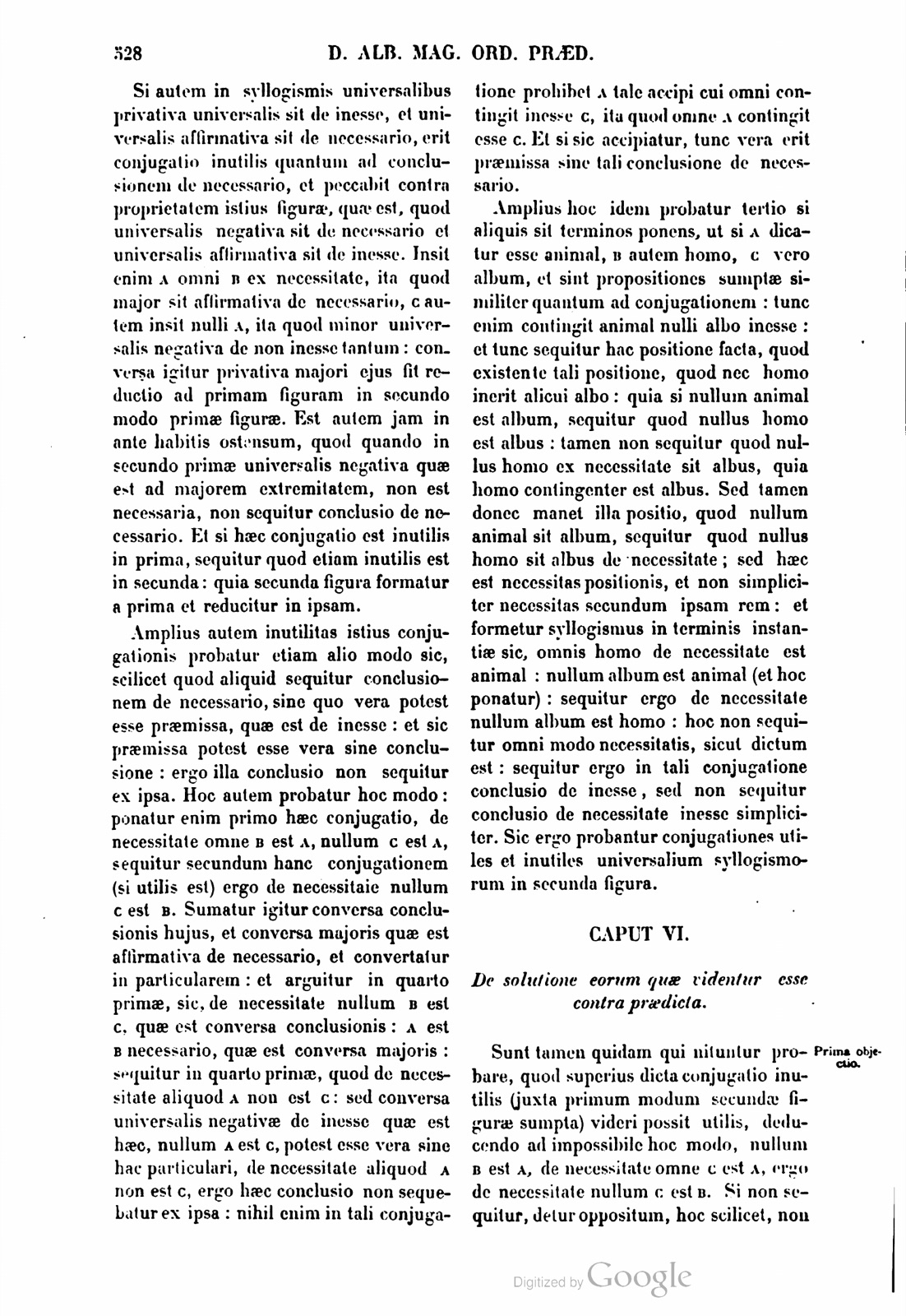
CAPUT VI. De solutione eorum quae videntur esse contra praedicta.
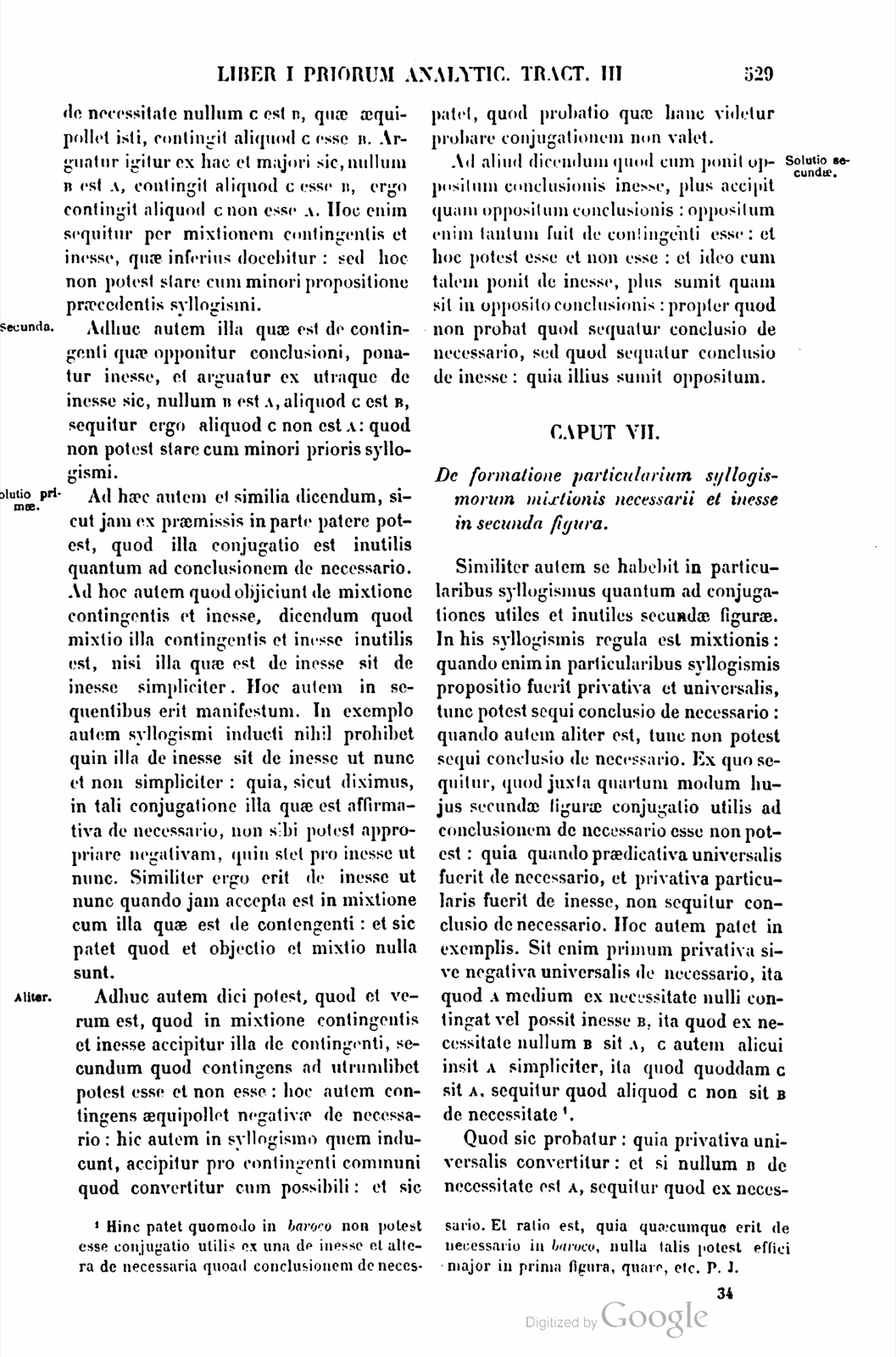
Sunt tamen quidam qui nituntur probare, quod superius dicta conjugatio inutilis juxta primum modum secundae figurae sumpta, videri possit utilis, deducendo ad impossibile hoc modo, nullum B est A, de necessitate omne C est A, ergo de necessitate nullum C est B. Si non sequitur, detur oppositum, hoc scilicet, non de necessitate nullum C est B, quae aequipollet isti, contingit aliquod C esse B. Arguatur igitur ex hac et majori sic, nullum B est A, contingit aliquod C esse B, ergo contingit aliquod C non esse A. Hoc enim sequitur per mixtionem contingentis et inesse, quae inferius docebitur: sed hoc non potest stare cum minori propositione praecedentis syllogismi.
Adhuc autem illa quae est de contingenti quae opponitur conclusioni, ponatur inesse, et arguatur ex utraque de inesse sic, nullum B est A, aliquod C est B, sequitur ergo aliquod C non est A: quod non potest stare cum minori prioris syllogismi.
Ad haec autem et similia dicendum, sicut jam ex praemissis in parte patere potest, quod illa conjugatio est inutilis quantum ad conclusionem de necessario. Ad hoc autem quod objiciunt de mixtione contingentis et inesse, dicendum quod mixtio illa contingentis et inesse inutilis est, nisi illa quae est de inesse sit de inesse simpliciter. Hoc autem in sequentibus erit manifestum. In exemplo autem syllogismi inducti nihil prohibet quin illa de inesse sit de inesse ut nunc et non simpliciter: quia, sicut diximus, in tali conjugatione illa quae est affirmativa de necessario, non sibi potest appropriare negativam, quin stet pro inesse ut nunc. Similiter ergo erit de inesse ut nunc quando jam accepta est in mixtione cum illa quae est de contingenti: et sic patet quod et objectio et mixtio nulla sunt.
CHAPTER VI. On the solution of those things that seem to be against what has been said.
There are nevertheless some who try to prove that the useless conjugation stated above, taken beside the first mode of the second figure, can seem to be useful, by reducing to impossibility in this way: no B is A; of necessity every C is A; therefore of necessity no C is B. If it does not follow, let the opposite be given, namely this: not of necessity no C is B, which is equivalent to this, it is contingent that some C is B. Therefore let an argument be made from this and from the major thus: no B is A; it is contingent that some C is B; therefore it is contingent that some C is not A. For this follows through the mixing of the contingent and inherence, which will be taught below; but this cannot stand with the minor proposition of the preceding syllogism.
Again, let that proposition of the contingent which is opposed to the conclusion be posited as inhering, and let an argument be made from both as of inherence thus: no B is A; some C is B; therefore it follows that some C is not A, which cannot stand with the minor of the prior syllogism.
To these and similar things one must say, as can now in part be clear from the premises, that that conjugation is useless with respect to a conclusion of necessity. But to what they object concerning the mixing of the contingent and inherence, one must say that that mixing of the contingent and inherence is useless unless that which is of inherence is of inherence simply. This will be manifest in what follows. But in the example of the syllogism introduced nothing prevents that proposition of inherence from being of inherence as now and not simply, because, as we have said, in such a conjugation that which is affirmative of necessity cannot appropriate the negative to itself so that it stands for inherence as now. Therefore similarly it will be of inherence as now when it has already been accepted in a mixing with that which is of the contingent; and thus it is clear that both the objection and the mixing are null.
Adhuc autem dici potest, quod et verum est, quod in mixtione contingentis et inesse accipitur illa de contingenti, secundum quod contingens ad utrumlibet potest esse et non esse: hoc autem contingens aequipollet negativae de necessario: hic autem in syllogismo quem inducunt, accipitur pro contingenti communi quod convertitur cum possibili: et sic patet, quod probatio quae hanc videtur probare conjugationem non valet.
Ad aliud dicendum quod cum ponit oppositum conclusionis inesse, plus accipit quam oppositum conclusionis: oppositum enim tantum fuit de contingenti esse: et hoc potest esse et non esse: et ideo cum talem ponit de inesse, plus sumit quam sit in opposito conclusionis: propter quod non probat quod sequatur conclusio de necessario, sed quod sequatur conclusio de inesse: quia illius sumit oppositum.
Again, it can be said that it is also true that in the mixing of the contingent and inherence that proposition of the contingent is taken according as the contingent can be and not be toward either alternative. But this contingent is equivalent to the negative of the necessary; here, however, in the syllogism which they introduce, it is taken for the common contingent which is converted with the possible. And thus it is clear that the proof which seems to prove this conjugation is not valid.
To the other point one must say that when it posits the opposite of the conclusion as inhering, it accepts more than the opposite of the conclusion. For the opposite was only about contingent being, and this can be and not be; and therefore when it posits such a proposition as of inherence, it takes more than is in the opposite of the conclusion. On account of this it does not prove that a conclusion of necessity follows, but that a conclusion of inherence follows, because it takes the opposite of that.
If a page does not appear, its photograph has not been uploaded yet.