Works › Prior Analytics, Books I–II
Volume 1 · pp. 522–524
Chapter III. On the mixing of the necessary and inherence in universal syllogisms of the first figure.
A marker with ≈ is an approximate page boundary, placed by measure of the text; the page photographs remain the authority. In the paired views, clicking a page marker brings that page into view.
CAPUT III. De mixtione necessarii et inesse in primae figurae universalibus syllogismis.
Nunc autem videamus de mixtione necessarii et inesse. Sed hoc primum attendendum est quod mixtio in syllogismis metaphorice mixtio dicitur. Proprie autem dicitur mixtio in physicis: quia in physicis mixtio dicitur miscibilium alteratorum unio ad actum alicujus medii, quod ex omnibus ex se invicem alterantibus mixtis generatur. Propter quod mixta in eo quod ex mixtione generatur, non remanent secundum actus suos simplices nisi potentia1. In syllogismis autem metaphorice dicitur mixtio ordo diversarum propositionum de inesse et de modo ad unum eliciendum quod neutra illarum est, conveniens tamen cum utraque, quod est conclusio quidem quae in praedicato convenit cum majori, et in omnibus praedicati dispositionibus, sicut est affirmativum, negativum, et hujusmodi: in subjecto autem et subjecti proprietatibus quae sunt universale, particulare, et hujusmodi, convenit cum minori. Propter quod in mixtione syllogismorum, mixta manent sub actibus suis stantia non alterata ad aliud, quamvis unum sit aliquo modo in alio, sicut medium est in toto primo, et postremum in toto medio, sicut in prae habitis determinatum est.
Sic ergo loquentes de mixtione, dicimus quod conclusio de necessario quae est cum modo necessitatis, non tantum sequitur ex uniformiter sumptis ambabus propositionibus de necessario, sed accidit quandoque, quando altera propositionum est de necessario et altera de inesse, quod syllogismus fit concludens propositionem de modo necessitatis. Verum hoc non fit indifferenter quacumque praemissarum existente de necessario, sed quando illa quae est ad majorem existentem, quae est propositio major, est de necessario, et minor de inesse simpliciter, et non de inesse ut nunc, sequitur conclusio de necessario: cujus exemplum est, ut si A quod est major extremitas sumptum sive positum vel concessum sit omni B medio ex necessitate inesse, sic, necesse est omne B esse A, vel etiam negative sumatur, sicut in secundo primae figurae sic, necesse est nullum B esse A. B autem sumatur inesse C tantum, ut minor propositio sit de inesse simpliciter et non sit cum modo necessitatis: sic enim sumptis propositionibus sequitur conclusio de modo necessitatis, quod scilicet minori extremitati quae est C inerit major extremitas quae est A ex necessitate, vel non inerit. Et sic formantur duo universales syllogismi primae figurae, sic, de necessitate omne B est A, sed omne C B, ergo de necessitate omne C est A, et hic est primus primae figurae. Item sic, de necessitate nullum B A, omne C B, ergo de necessitate nullum C A, et hic est secundus primae.
CHAPTER III. On the mixing of the necessary and inherence in universal syllogisms of the first figure.
Now let us consider the mixing of the necessary and inherence. But first this must be attended to, that in syllogisms mixing is called mixing metaphorically. Properly, however, mixing is spoken of in physics, because in physics mixing is called the union of alterable things capable of being mixed toward the act of some middle, which is generated out of all the mixed things altering one another from themselves. Because of this, the things mixed in that which is generated from mixing do not remain according to their simple acts except in potency1. But in syllogisms mixing is called metaphorically the ordering of diverse propositions, about inherence and about mode, for eliciting one thing which is neither of them, yet agrees with each: namely the conclusion, which agrees with the major in the predicate and in all dispositions of the predicate, such as being affirmative, negative, and the like; but in the subject and in the properties of the subject, which are universal, particular, and the like, it agrees with the minor. On account of this, in the mixing of syllogisms the mixed things remain standing under their own acts, not altered into something else, although one is in another in some way, as the middle is in the whole first term and the last is in the whole middle, as was determined in what was had before.
Therefore, speaking thus of mixing, we say that a conclusion of the necessary, which is with the mode of necessity, follows not only from both propositions taken uniformly as of necessity, but sometimes it happens, when one of the propositions is of necessity and the other of inherence, that a syllogism is made concluding a proposition with the mode of necessity. Yet this does not happen indifferently with whichever premise being of necessity, but when that which is toward the existing major, which is the major proposition, is of necessity, and the minor is of inherence simply and not of inherence as now, a conclusion of necessity follows. An example of this is: if A, which is the greater extreme, is taken or posited or conceded to belong of necessity to every B, the middle, thus, it is necessary that every B be A; or also if it is taken negatively, as in the second of the first figure thus, it is necessary that no B be A. But let B be taken to belong to C only, so that the minor proposition is of inherence simply and is not with the mode of necessity. For when the propositions are taken thus, there follows a conclusion with the mode of necessity, namely that the greater extreme, which is A, will belong of necessity to the lesser extreme, which is C, or will not belong. And thus two universal syllogisms of the first figure are formed: thus, of necessity every B is A; but every C is B; therefore of necessity every C is A, and this is the first of the first figure. Again thus: of necessity no B is A; every C is B; therefore of necessity no C is A, and this is the second of the first.
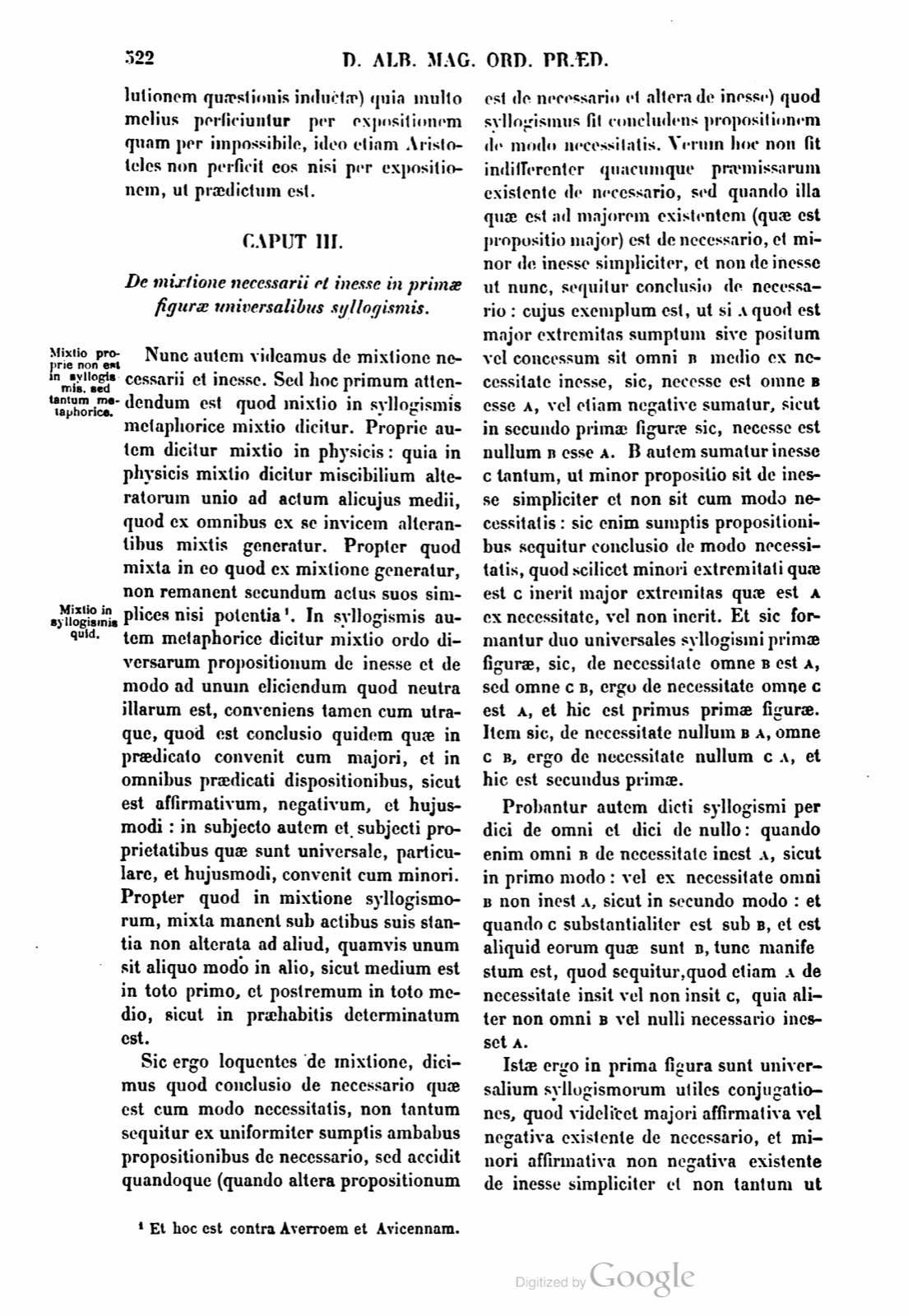
Probantur autem dicti syllogismi per dici de omni et dici de nullo: quando enim omni B de necessitate inest A, sicut in primo modo: vel ex necessitate omni B non inest A, sicut in secundo modo: et quando C substantialiter est sub B, et est aliquid eorum quae sunt B, tunc manifestum est, quod sequitur, quod etiam A de necessitate insit vel non insit C, quia aliter non omni B vel nulli necessario inesset A.
Istae ergo in prima figura sunt universalium syllogismorum utiles conjugationes, quod videlicet majori affirmativa vel negativa existente de necessario, et minori affirmativa non negativa existente de inesse simpliciter et non tantum ut nunc, sequitur conclusio affirmativa vel negativa de necessario, hoc modo necessitatis determinata.
Si autem major propositio quae est A B, non sit necessaria, hoc est non sit cum modo necessitatis, sed minor propositio quae est A C sit cum modo necessitatis, ex tali mixtione non sequitur conclusio quae sit cum modo necessitatis: et si aliquando sequi videatur, hoc non erit virtute syllogistica, sed sequetur gratia materiae et propter habitudinem terminorum secundum determinatam materiam acceptorum: unde tunc non sequitur conclusio de modo necessitatis. Dico autem quod minor debet esse de inesse simpliciter et non de inesse ut nunc. Et voco inesse simpliciter idem quod substantialiter inesse, quod secundum rem quidem est necessarium, quamvis non sit modo necessitatis determinatum. Et tunc quidem majori existente de necessario, et minori de tali inesse, sequitur conclusio de necessario: et si sit de inesse ut nunc, non sequitur conclusio de necessario, sicut patet si ponatur in terminis: omnis homo de necessitate est animal: omne rationale homo: ergo omne rationale de necessitate animal.
Si autem e converso fiat, quod scilicet major non est de necessario, sed de inesse, et minor sit de necessario, erit inutilis conjugatio ad inferendam conclusionem de necessario. Hoc autem sic est, quod A B propositio quae est major, non sit de necessario, B C autem minor propositio sit de necessario: tunc enim non erit consequens conclusio de necessario, sic, omne B A, omne C de necessitate est B; non sequitur quod omne C de necessitate sit A. Et hoc probatur dupliciter, scilicet per rationem, et in terminis. Per rationem sic: detur enim quod conclusio sit de necessario, et fiat talis syllogismus, omne B est A, omne C de necessitate est B, ergo omne C de necessitate est A. Deinde sumatur conclusio illa, et ex illa cum minori arguatur in primo tertiae, sic, omne C de necessitate est A, omne C de necessitate est B, sequitur quod aliquod B de necessitate est A. Similiter potest argui in tertio primae si accipiatur conversa minoris, sic, omne C de necessitate est A, aliquod B de necessitate est C, ergo aliquod B de necessitate est A. Sequitur ergo aliquid ex tali conclusione sine quo vera esse potuit major propositio, quae est omne B A. Haec enim vera esse potest absque eo quod necesse sit omne B esse A. Contingit enim aliquando tale esse B, cui possibile est A nulli inesse: et sic non erit verum quod B de necessitate sit A.
The stated syllogisms are proved through being-said-of-every-one and being-said-of-none. For when A belongs of necessity to every B, as in the first mode, or A does not belong of necessity to every B, as in the second mode, and when C is substantially under B and is something of those things which are B, then it is manifest that it follows that A also of necessity belongs or does not belong to C, because otherwise A would not necessarily belong to every B or to no B.
Therefore these in the first figure are the useful conjugations of universal syllogisms: namely, with the major affirmative or negative being of necessity and the minor affirmative, not negative, being of inherence simply and not only as now, an affirmative or negative conclusion of necessity follows, determined by this mode of necessity.
But if the major proposition, which is A B, is not necessary, that is, is not with the mode of necessity, but the minor proposition, which is A C, is with the mode of necessity, from such a mixing there does not follow a conclusion which is with the mode of necessity. And if sometimes it seems to follow, this will not be by syllogistic power, but will follow by favor of the matter and because of the relation of the terms taken according to determinate matter. Hence then a conclusion with the mode of necessity does not follow. I say, however, that the minor ought to be of inherence simply and not of inherence as now. And I call inherence simply the same as inhering substantially, which according to the thing is indeed necessary, although it is not determined by the mode of necessity. And then, with the major being of necessity and the minor of such inherence, a conclusion of necessity follows; but if it is of inherence as now, a conclusion of necessity does not follow, as is clear if it is posited in terms: every man is of necessity animal; every rational thing is man; therefore every rational thing is animal of necessity.
But if it is done conversely, namely that the major is not of necessity but of inherence, and the minor is of necessity, it will be a useless conjugation for inferring a conclusion of necessity. This is so when the A B proposition, which is the major, is not of necessity, but B C, the minor proposition, is of necessity; for then the conclusion of necessity will not be consequent, thus: every B is A; every C is B of necessity; it does not follow that every C is A of necessity. And this is proved in two ways, namely by reason and in terms. By reason thus: let it be granted that the conclusion is of necessity, and let such a syllogism be made: every B is A; every C is B of necessity; therefore every C is A of necessity. Then let that conclusion be taken, and from it with the minor let an argument be made in the first of the third figure thus: every C is A of necessity; every C is B of necessity; it follows that some B is A of necessity. Similarly one can argue in the third of the first if the converted minor is taken, thus: every C is A of necessity; some B is C of necessity; therefore some B is A of necessity. Therefore something follows from such a conclusion without which the major proposition, which is every B A, could have been true. For this can be true without it being necessary that every B be A. For sometimes there happens to be such a B to which it is possible that A belong to none, and thus it will not be true that B is A of necessity.
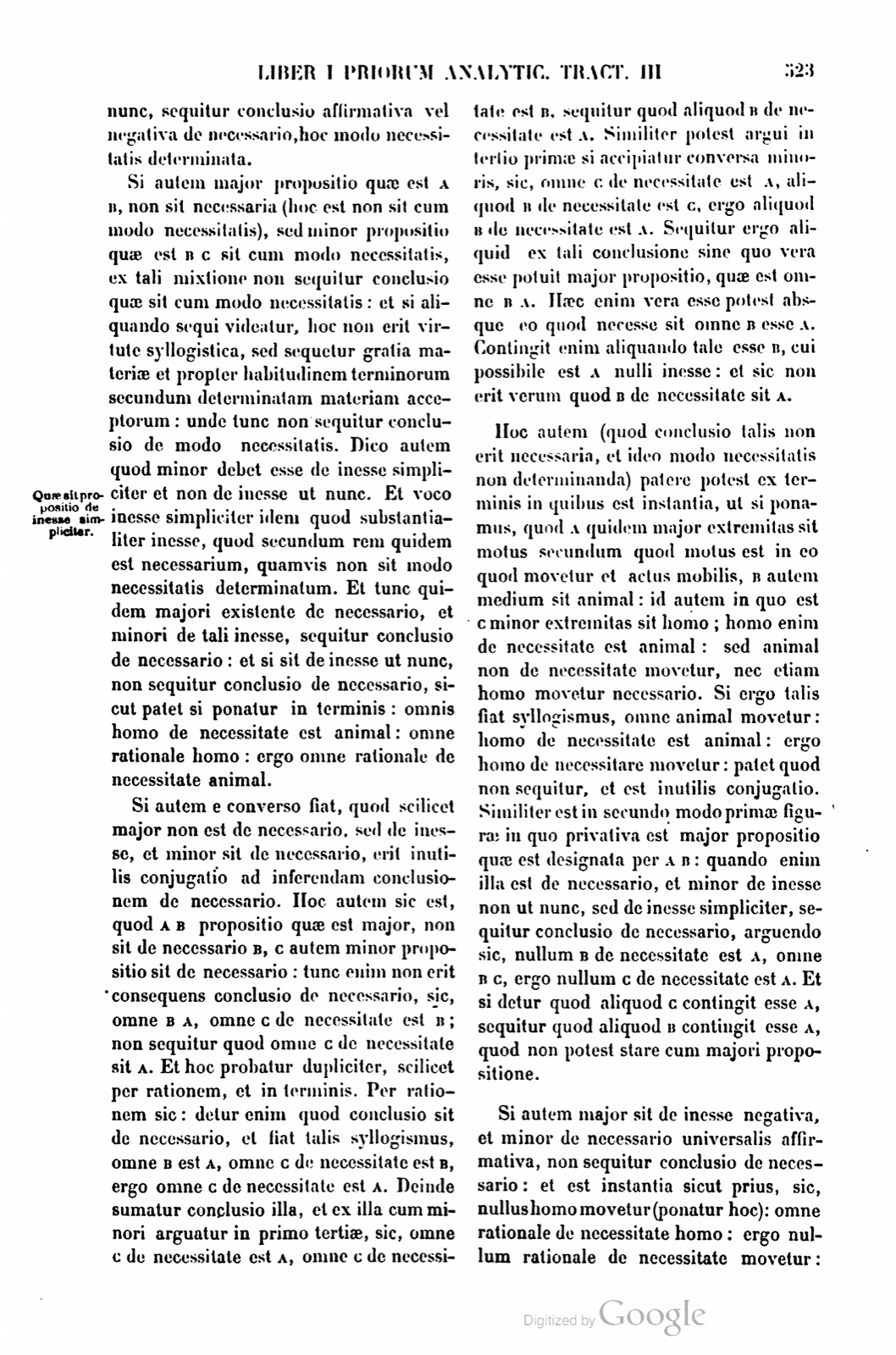
Hoc autem quod conclusio talis non erit necessaria, et ideo modo necessitatis non determinanda, patere potest ex terminis in quibus est instantia, ut si ponamus, quod A quidem major extremitas sit motus secundum quod motus est in eo quod movetur et actus mobilis, B autem medium sit animal: id autem in quo est C minor extremitas sit homo; homo enim de necessitate est animal: sed animal non de necessitate movetur, nec etiam homo movetur necessario. Si ergo talis fiat syllogismus, omne animal movetur: homo de necessitate est animal: ergo homo de necessitate movetur: patet quod non sequitur, et est inutilis conjugatio. Similiter est in secundo modo primae figurae in quo privativa est major propositio quae est designata per A B: quando enim illa est de necessario, et minor de inesse non ut nunc, sed de inesse simpliciter, sequitur conclusio de necessario, arguendo sic, nullum B de necessitate est A, omne B C, ergo nullum C de necessitate est A. Et si detur quod aliquod C contingit esse A, sequitur quod aliquod B contingit esse A, quod non potest stare cum majori propositione.
Si autem major sit de inesse negativa, et minor de necessario universalis affirmativa, non sequitur conclusio de necessario: et est instantia sicut prius, sic, nullus homo movetur, ponatur hoc: omne rationale de necessitate homo: ergo nullum rationale de necessitate movetur: quod non sequitur, quia rationale moveri potest et non moveri.
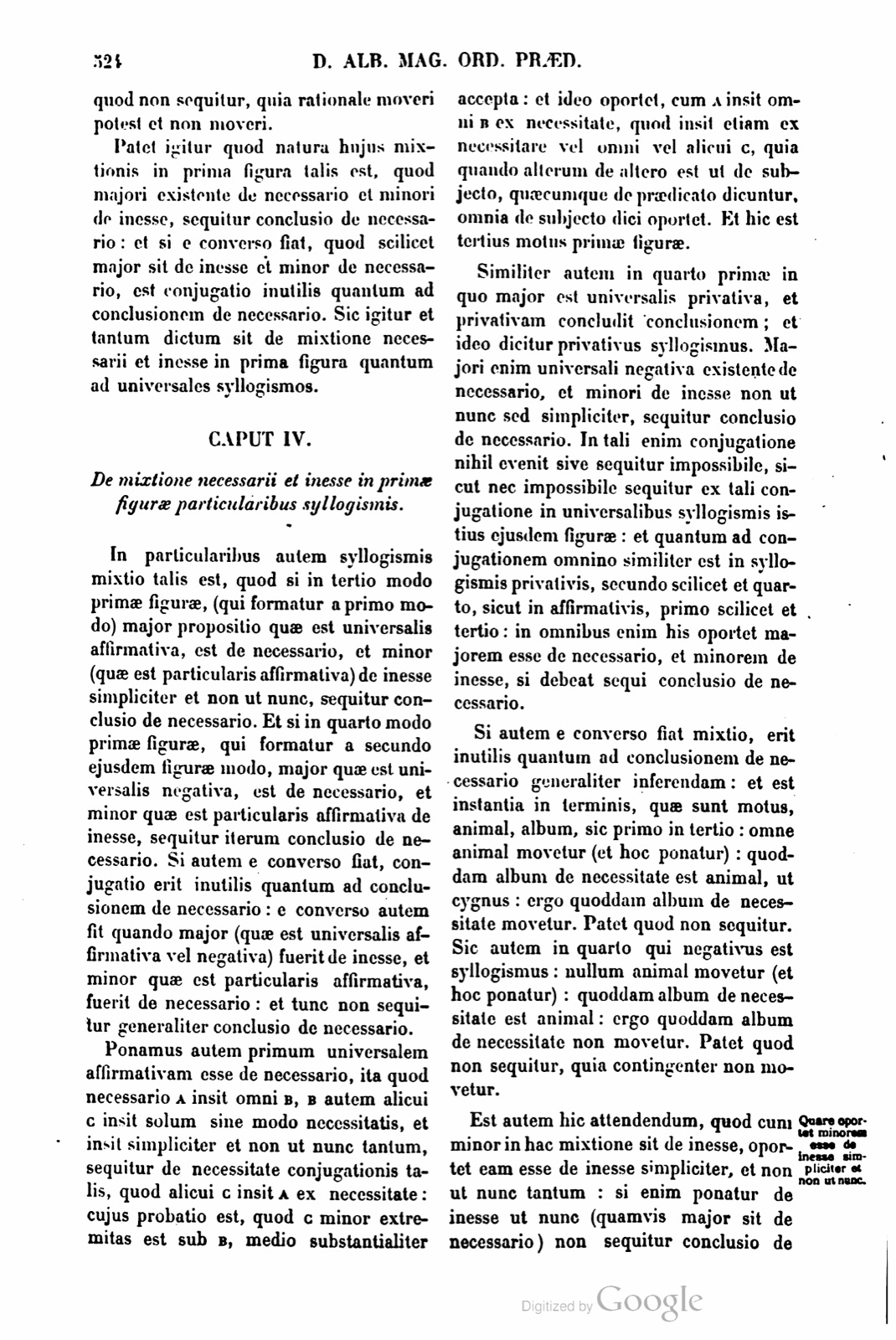
Patet igitur quod natura hujus mixtionis in prima figura talis est, quod majori existente de necessario et minori de inesse, sequitur conclusio de necessario: et si e converso fiat, quod scilicet major sit de inesse et minor de necessario, est conjugatio inutilis quantum ad conclusionem de necessario. Sic igitur et tantum dictum sit de mixtione necessarii et inesse in prima figura quantum ad universales syllogismos.
But this, that such a conclusion will not be necessary and therefore must not be determined by the mode of necessity, can be clear from terms in which there is an instance: as if we posit that A, the greater extreme, is motion according as motion is in that which is moved and is the act of the movable, but B, the middle, is animal; but that in which C, the lesser extreme, is, is man. For man is of necessity animal; but animal is not moved of necessity, nor is man moved necessarily. Therefore if such a syllogism is made: every animal is moved; man is of necessity animal; therefore man is moved of necessity; it is clear that it does not follow, and it is a useless conjugation. Similarly it is in the second mode of the first figure, in which the major proposition designated by A B is privative: for when that proposition is of necessity and the minor is of inherence not as now but of inherence simply, a conclusion of necessity follows, arguing thus: no B is A of necessity; every C is B; therefore no C is A of necessity. And if it is granted that some C contingently is A, it follows that some B contingently is A, which cannot stand with the major proposition.
But if the major is a negative of inherence, and the minor a universal affirmative of necessity, a conclusion of necessity does not follow; and there is an instance as before, thus: no man is moved, let this be posited; every rational thing is man of necessity; therefore no rational thing is moved of necessity; this does not follow, because a rational thing can be moved and not moved.
Therefore it is clear that the nature of this mixing in the first figure is such that, when the major is of necessity and the minor of inherence, a conclusion of necessity follows; and if it is done conversely, namely that the major is of inherence and the minor of necessity, it is a useless conjugation with respect to a conclusion of necessity. Thus, therefore, and so much has been said about the mixing of the necessary and inherence in the first figure with respect to universal syllogisms.
Notes
- And this is against Averroes and Avicenna. (Et hoc est contra Averroem et Avicennam.) ↩
If a page does not appear, its photograph has not been uploaded yet.