Works › Prior Analytics, Books I–II
Volume 1 · pp. 519–522
Chapter II. On the question whether the fourth of the second and the fifth of the third can be perfected through impossibility.
A marker with ≈ is an approximate page boundary, placed by measure of the text; the page photographs remain the authority. In the paired views, clicking a page marker brings that page into view.
CAPUT II. De quaestione utrum quartus secundae et quintus tertiae possint perfici per impossibile.
Quidam de hoc dubitantes dicunt hos syllogismos qui dicti sunt, scilicet quartum secundae, et quintum tertiae per impossibile reduci: et alii contradicentes istis dicunt hoc fieri non posse. Illi autem qui dicunt hoc fieri posse, sic hoc probare nituntur. Fiat enim quartus secundae sic: de necessitate omne B est A, de necessitate aliquod C non est A, ergo de necessitate aliquod C non est B. Aut sequitur, aut non. Si non sequitur, oppositum conclusionis stabit cum altera praemissarum, scilicet non de necessitate aliquod C non est B, quae aequipollet huic, contingit omne C esse B. Fiat ergo syllogismus ex ista et majori prioris syllogismi in primo modo primae figurae sic, de necessitate omne B est A, contingit omne C esse B, ergo contingit omne C esse A, quae non stat cum minori praecedentis syllogismi quae fuit ista, de necessitate aliquod C non est A.
Similiter autem videtur probari quintus tertiae, et fiat primo sic, de necessitate aliquod B non est A, de necessitate omne B est C, ergo de necessitate aliquod C non est A: aut detur oppositum, hoc scilicet, non de necessitate aliquod C non est A, quae aequipollet huic, contingit omne C esse A: et fiat syllogismus in primo primae figurae ex ista et minori prioris syllogismi sic, contingit omne C esse A, necesse est omne B esse C, ergo contingit omne B esse A: quae non potest stare cum prima, scilicet hac, de necessitate aliquod B non est A.
Forte autem dicet aliquis, quod isti syllogismi non procedunt: quia non bene fit mixtio necessarii et contingentis. Contra hoc esse videtur quod inferius dicetur, ubi docetur mixtio necessarii et contingentis, quod si major sit de necessitate, et minor de contingenti, vel e contrario, dummodo major sit de necessario et affirmativa, fit syllogismus in primo primae concludens de contingente: tales autem fuerunt ambo dicti syllogismi.
Adhuc autem ad idem objicitur. Cum enim dicitur, de necessitate omne B est A, contingit omne C esse B, ergo contingit omne C esse A. Ponatur minor de inesse: hoc enim fieri potest ex quo est contingens, et nihil ex hoc debet sequi impossibile: et fiat talis syllogismus, de necessitate omne B est A, omne C B, ergo de necessitate omne C A: talis enim syllogismi conjugatio utilis est in mixtione necessarii et inesse, sicut statim in sequenti ostendetur capitulo, scilicet quod majori existente de necessario, et minori de inesse, sequitur conclusio de necessario. Si autem necesse est omne C esse A, patet etiam quod contingit omne C esse A, quia contingere esse sequitur ad necesse esse. Patet igitur quod syllogismus bonus est de mixtione necessarii et contingentis. Omni eodem modo potest probari de quinto tertiae, si illa quae est de contingenter inesse, ponatur inesse, sicut factum est in ante habito syllogismo.
CHAPTER II. On the question whether the fourth of the second and the fifth of the third can be perfected through impossibility.
Some, doubting about this, say that these syllogisms which have been mentioned, namely the fourth of the second figure and the fifth of the third, are reduced through impossibility; and others, contradicting them, say that this cannot be done. But those who say that this can be done try to prove it in this way. Let the fourth of the second be made thus: of necessity every B is A; of necessity some C is not A; therefore of necessity some C is not B. Either it follows, or it does not. If it does not follow, the opposite of the conclusion will stand with the other premise, namely, not of necessity some C is not B, which is equivalent to this, it is contingent that every C be B. Therefore let a syllogism be made from this and from the major of the prior syllogism in the first mode of the first figure thus: of necessity every B is A; it is contingent that every C be B; therefore it is contingent that every C be A, which does not stand with the minor of the preceding syllogism, which was this: of necessity some C is not A.
Similarly the fifth of the third also seems to be proved; and let it first be made thus: of necessity some B is not A; of necessity every B is C; therefore of necessity some C is not A. Or let the opposite be given, namely this: not of necessity some C is not A, which is equivalent to this, it is contingent that every C be A. And let a syllogism be made in the first of the first figure from this and from the minor of the prior syllogism thus: it is contingent that every C be A; it is necessary that every B be C; therefore it is contingent that every B be A, which cannot stand with the first premise, namely this, of necessity some B is not A.
Perhaps someone will say that these syllogisms do not proceed, because the mixing of the necessary and the contingent is not made well. Against this there seems to be what will be said below, where the mixing of the necessary and the contingent is taught: that if the major is of necessity and the minor of the contingent, or conversely, provided that the major is of the necessary and affirmative, a syllogism is made in the first of the first figure concluding about the contingent. But both of the stated syllogisms were such.
Again, an objection is made to the same point. For when it is said: of necessity every B is A; it is contingent that every C be B; therefore it is contingent that every C be A. Let the minor be posited as of inherence; for this can be done from the fact that it is contingent, and nothing impossible ought to follow from this. And let such a syllogism be made: of necessity every B is A; every C is B; therefore of necessity every C is A. For the conjugation of such a syllogism is useful in the mixing of the necessary and inherence, as will immediately be shown in the following chapter, namely that, when the major is of necessity and the minor of inherence, a conclusion of necessity follows. But if it is necessary that every C be A, it is also clear that it is contingent that every C be A, because contingent being follows upon necessary being. Therefore it is clear that the syllogism is good from the mixing of the necessary and the contingent. In the very same way it can be proved about the fifth of the third, if that which is of contingent inherence is posited as inhering, just as was done in the syllogism had before.
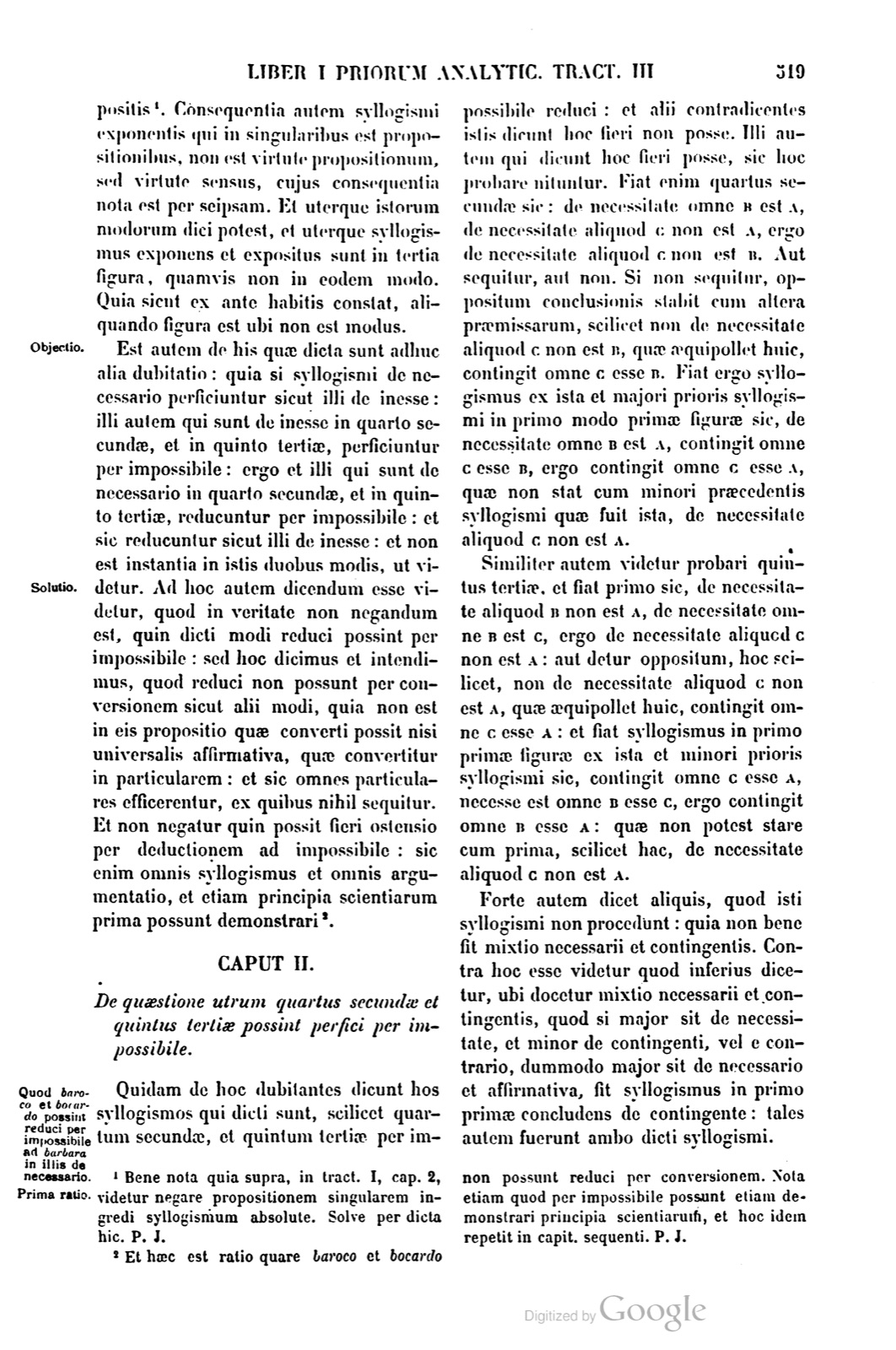
Qui autem dicunt, quod non possunt isti syllogismi reduci per impossibile, dicunt ad haec, quod in sequentibus quidem docetur mixtio necessarii et contingentis. Sed ibi accipitur contingens pro non necessario, quod potest esse et non esse. In syllogismis autem qui adducti sunt, accipitur contingens pro possibili quod sequitur ad necessarium: et sic patet quod non accipitur secundum doctrinam mixtionis necessarii et contingentis: et sic talis forma argumentandi non valet, ut videtur.
Adhuc propositio quae est de contingenti, quae convertitur cum negativa de necessario, est de contingenti pro possibili. Tale autem contingens abstrahit et a terminis qui simpliciter dicunt inesse, et ab his qui simpliciter dicunt non inesse: quia potest inesse et non inesse: et sic contingens accipiebatur in dictis syllogismis. Si ergo tale contingens ponatur inesse, non oportet quod fiat de necessario syllogismus: quia potest esse de inesse ut nunc et non simpliciter: sed majori existente de necessario, et minori de inesse ut nunc, non sequitur conclusio de necessario, sicut consequenter docebitur. Patet igitur quod per talem modum mixtionis non potest probari propositum.
Ad haec autem dici potest, quod Aristoteles dicit1, reduci quartum secundae et quintum tertiae per expositionem: ideo quia talis verificatio proprie probat particularem quae probatur uno demonstrato singulari cui insit vel non insit singulare: et tamen non negatur, quin etiam possit ostendi per impossibile. Haec enim probatio quae est per impossibile, valde est generalis, ita quod etiam principia probantur per eam: tamen quia talis probatio fit per mixtionem necessarii et contingentis, de qua adhuc determinatum non est, ideo hic locum non habet: sed exponendo faciliter probatur, et ideo talis probatio hic ponitur et sufficit ad praesens.
Ut tamen etiam quaestioni inductae satisfaciamus, qua scilicet quaeritur utrum isti duo modi possint reduci per impossibile, vel non? Potest dici quod per impossibile reduci possunt per mixtionem necessarii et contingentis, sicut paulo ante ostensum est. Sed minor quae est de contingenti in tali mixtione, cum major sit de necessario, potest esse de contingenti tripliciter, secundum quod tribus modis dicitur contingens, ut in ante habitis distinctum est: aut enim erit de contingenti accepto pro possibili, quod est contingens secundum genus, quod indifferenter se habet ad utrumque contingens speciale, ad contingens scilicet necessarium et ad contingens non necessarium: aut erit de contingenti non necessario quod potest esse et non esse: aut erit de contingenti necessario.
But those who say that these syllogisms cannot be reduced through impossibility say to these points that in what follows the mixing of the necessary and the contingent is indeed taught. But there the contingent is taken for the non-necessary, which can be and not be. Yet in the syllogisms that were brought forward, the contingent is taken for the possible that follows upon the necessary; and thus it is clear that it is not taken according to the doctrine of the mixing of the necessary and the contingent; and so such a form of arguing is not valid, as it seems.
Again, the proposition which is of the contingent and is converted with the negative of the necessary is of the contingent in the sense of the possible. But such a contingent abstracts both from terms that simply state inherence and from those that simply state non-inherence, because it can belong and not belong; and thus the contingent was taken in the stated syllogisms. Therefore if such a contingent is posited as inhering, it is not necessary that a syllogism of necessity be made, because it can be of inherence as now and not simply. But when the major is of necessity and the minor of inherence as now, a conclusion of necessity does not follow, as will be taught subsequently. Therefore it is clear that through such a mode of mixing the proposed point cannot be proved.
To these things, however, it can be said that Aristotle says1 that the fourth of the second and the fifth of the third are reduced through exposition; and this because such verification properly proves the particular, which is proved by one demonstrated singular to which a singular belongs or does not belong. And nevertheless it is not denied that it can also be shown through impossibility. For this proof which is through impossibility is very general, so that even principles are proved through it; nevertheless, because such a proof is made through the mixing of the necessary and the contingent, about which determination has not yet been made, for that reason it has no place here; but by expounding it is proved easily, and therefore such a proof is put here and suffices for the present.
Yet, so that we may also satisfy the question introduced, by which it is asked whether these two modes can be reduced through impossibility or not, it can be said that they can be reduced through impossibility through the mixing of the necessary and the contingent, as was shown a little before. But the minor, which is of the contingent in such a mixing, while the major is of necessity, can be of the contingent in three ways, according as the contingent is said in three ways, as was distinguished in what was had before: for either it will be of the contingent taken as the possible, which is the contingent according to genus, which has itself indifferently to each special contingent, namely to the necessary contingent and to the non-necessary contingent; or it will be of the non-necessary contingent, which can be and not be; or it will be of the necessary contingent.
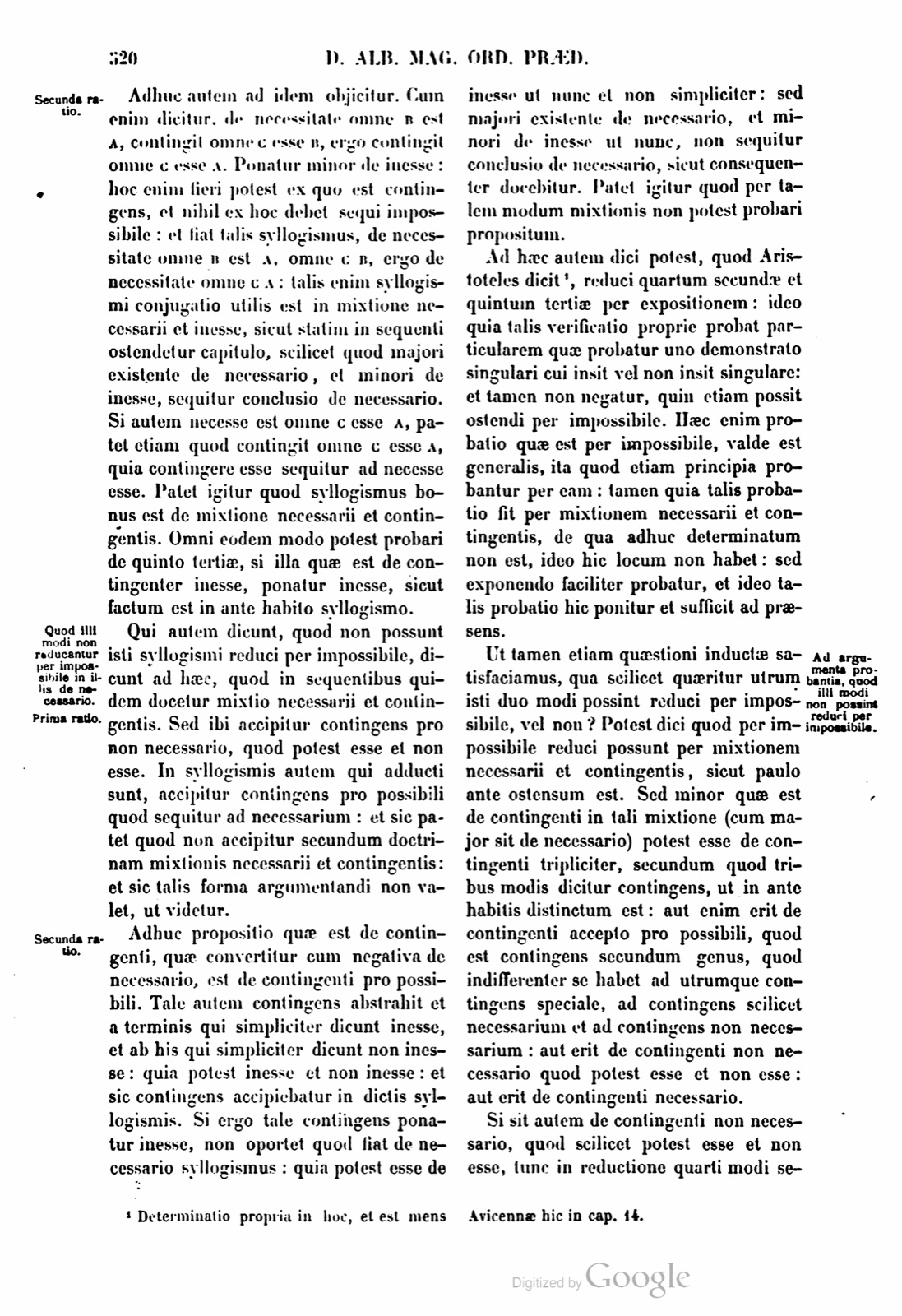
Si sit autem de contingenti non necessario, quod scilicet potest esse et non esse, tunc in reductione quarti modi secundae figurae, majori existente de necessario, et minori de tali contingenti, sequetur conclusio de contingenti pro possibili, secundum quod inferius docebitur in mixtione contingentis et necessarii. Sed non potest probari per hoc quartus secundae figurae: quia illa propositio de contingenti quae convertitur cum opposito conclusionis, est de contingenti accepto pro possibili, quod est ut genus: alia autem est de contingenti non necessario: et ideo talis probatio non valet, quia contingens in una acceptione debet accipi et in syllogismo probante et in syllogismo probato.
Si vero est de contingente communi, quod ad utrumque se habet, necessarium scilicet et non necessarium. Contra hoc est: quia secundum tale contingens inutilis est conjugatio majori existente de necessario, et minori de tali contingente, sicut infra patebit. Inutilis autem est, quia non potest inferre conclusionem de contingente non necessario, nec potest inferre conclusionem de contingenti pro possibili. Quia non oportet quod id sequatur ad consequens quod sequitur ad antecedens: talis enim conclusio de tali contingenti sequitur majori existente de necessario, et minori existente de contingenti pro non necessario: et ad tale contingens sequitur contingens commune. Nec iterum ex tali mixtione sequitur conclusio de necessario, nisi illa de contingenti esset talis, quod ipsa posita inesse esset de inesse simpliciter et non ut nunc. Sed hoc non est contingens commune: quia non oportet quod si contingens commune ponatur inesse, quod sit de inesse simpliciter, sed potest esse de inesse ut nunc.
Si autem in praedicta mixtione contingens in minori propositione accipiatur pro contingenti necessario, ita quod ipsa posita in esse sit de inesse simpliciter: tunc sequitur conclusio de contingenti pro possibili: et etiam minori posita in esse simpliciter, sequitur conclusio de necessario: et utraque conclusio, hoc est, tam illa quae est de necessario, quam illa quae est de tali contingenti, destruunt minorem propositionem quarti modi secundae figurae: et secundum hunc modum accipiendo illam de contingenti potest quartus modus secundae figurae reduci per impossibile, et non aliter. Et cum illa propositio quae est de contingenti quod convertitur cum negativa de necessario, accipiatur de contingenti pro possibili, non verificatur talis de contingenti, nisi ponatur in terminis de inesse simpliciter in quibus accipitur contingens pro necessario.
But if it is of the non-necessary contingent, namely that which can be and not be, then in the reduction of the fourth mode of the second figure, with the major being of necessity and the minor of such a contingent, a conclusion of the contingent in the sense of the possible will follow, according as will be taught below in the mixing of the contingent and the necessary. But the fourth of the second figure cannot be proved through this, because that proposition of the contingent which is converted with the opposite of the conclusion is of the contingent taken as possible, which is as a genus; but the other is of the non-necessary contingent. And therefore such a proof is not valid, because the contingent must be taken in one acceptance both in the syllogism proving and in the syllogism proved.
But if it is of the common contingent, which has itself to each, namely the necessary and the non-necessary, there is this against it: because according to such a contingent the conjugation is useless when the major is of necessity and the minor of such a contingent, as will be clear below. It is useless because it cannot infer a conclusion of the non-necessary contingent, nor can it infer a conclusion of the contingent in the sense of the possible. For it is not necessary that what follows upon the consequent should follow upon the antecedent; for such a conclusion of such a contingent follows when the major is of necessity and the minor is of the contingent in the sense of the non-necessary, and upon such a contingent the common contingent follows. Nor again from such a mixing does a conclusion of necessity follow unless that proposition of the contingent were such that, once it was posited as inhering, it would be of inherence simply and not as now. But this is not the common contingent, because it is not necessary that, if the common contingent is posited as inhering, it be of inherence simply, but it can be of inherence as now.
But if in the aforesaid mixing the contingent in the minor proposition is taken for the necessary contingent, so that, when it is posited in being, it is of inherence simply, then a conclusion of the contingent in the sense of the possible follows; and also, when the minor is posited as being simply, a conclusion of necessity follows. And each conclusion, that is, both that which is of necessity and that which is of such a contingent, destroys the minor proposition of the fourth mode of the second figure. And by taking that proposition of the contingent in this way, the fourth mode of the second figure can be reduced through impossibility, and not otherwise. And since that proposition which is of the contingent, which is converted with the negative of the necessary, is taken of the contingent in the sense of the possible, such a proposition of the contingent is not verified unless it is posited in terms of inherence simply, in which the contingent is taken as necessary.
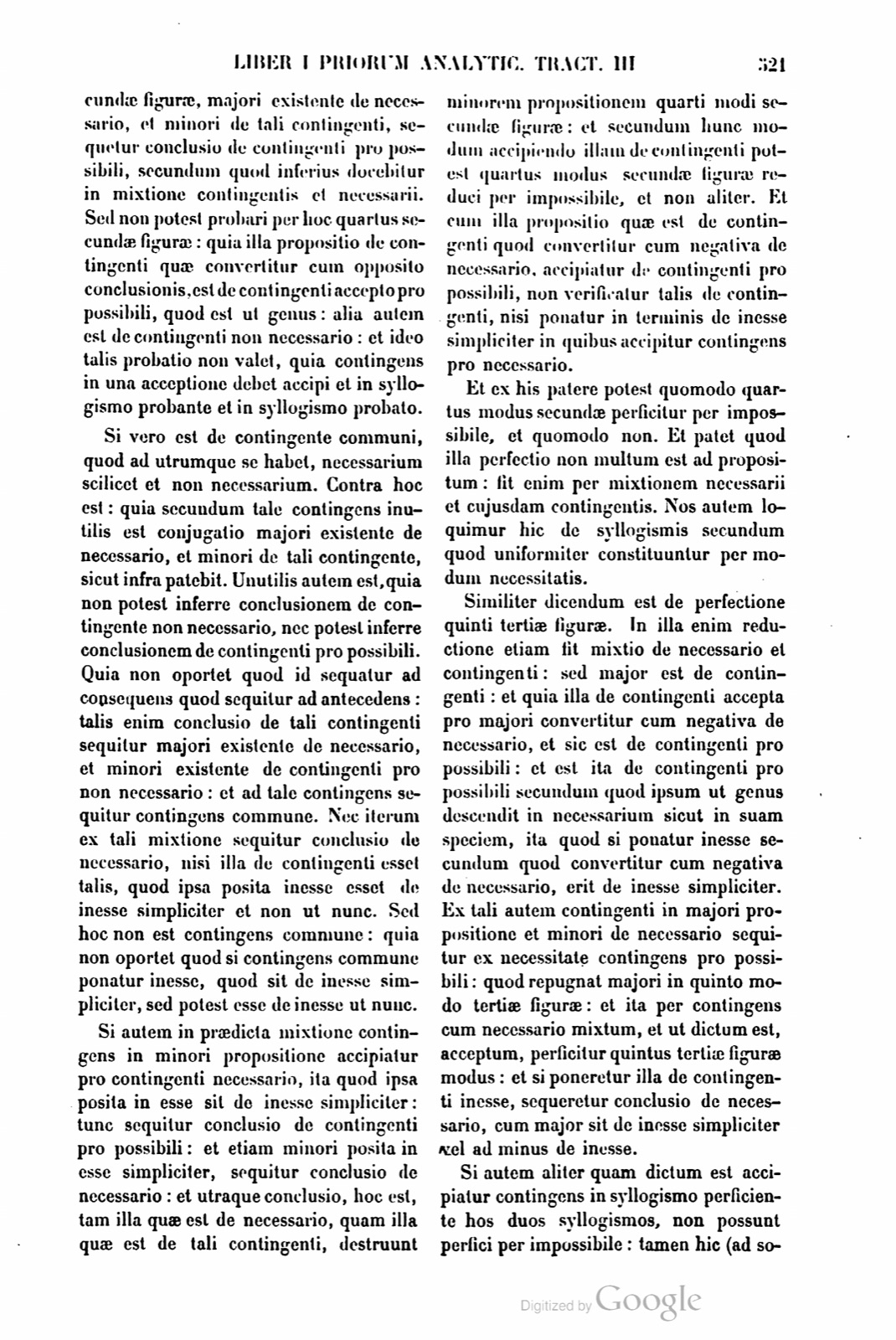
Et ex his patere potest quomodo quartus modus secundae perficitur per impossibile, et quomodo non. Et patet quod illa perfectio non multum est ad propositum: fit enim per mixtionem necessarii et cujusdam contingentis. Nos autem loquimur hic de syllogismis secundum quod uniformiter constituuntur per modum necessitatis.
Similiter dicendum est de perfectione quinti tertiae figurae. In illa enim reductione etiam fit mixtio de necessario et contingenti: sed major est de contingenti: et quia illa de contingenti accepta pro majori convertitur cum negativa de necessario, et sic est de contingenti pro possibili: et est ita de contingenti pro possibili secundum quod ipsum ut genus descendit in necessarium sicut in suam speciem, ita quod si ponatur inesse secundum quod convertitur cum negativa de necessario, erit de inesse simpliciter. Ex tali autem contingenti in majori propositione et minori de necessario sequitur ex necessitate contingens pro possibili: quod repugnat majori in quinto modo tertiae figurae: et ita per contingens cum necessario mixtum, et ut dictum est, acceptum, perficitur quintus tertiae figurae modus: et si poneretur illa de contingenti inesse, sequeretur conclusio de necessario, cum major sit de inesse simpliciter vel ad minus de inesse.
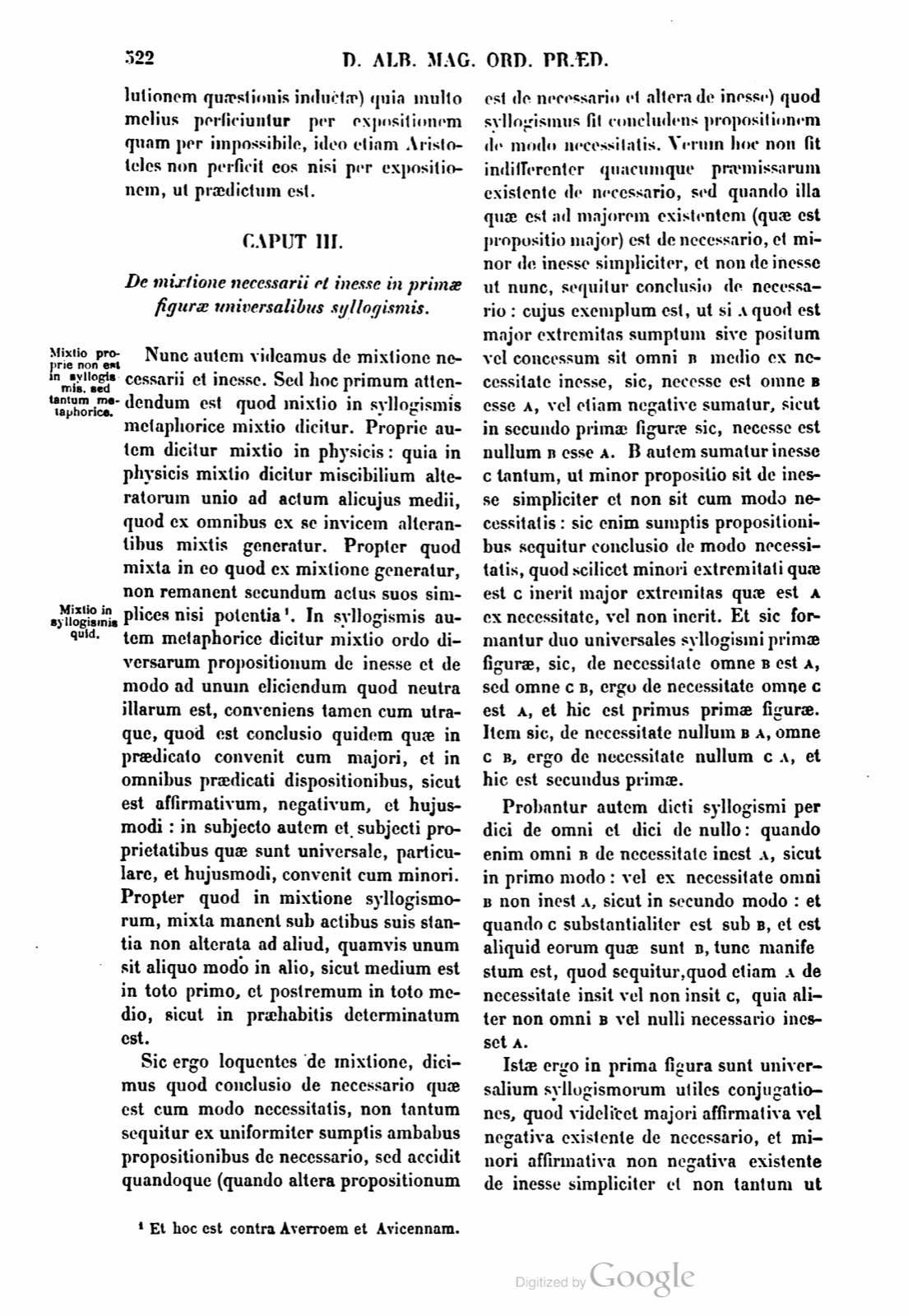
Si autem aliter quam dictum est accipiatur contingens in syllogismo perficiente hos duos syllogismos, non possunt perfici per impossibile: tamen hic, ad solutionem quaestionis inductae, quia multo melius perficiuntur per expositionem quam per impossibile, ideo etiam Aristoteles non perficit eos nisi per expositionem, ut praedictum est.
And from these things it can be clear how the fourth mode of the second is perfected through impossibility, and how it is not. And it is clear that that perfection is not very much to the proposed point, for it is made through the mixing of the necessary and of a certain contingent. But we are speaking here of syllogisms according as they are constituted uniformly through the mode of necessity.
Similarly one must speak about the perfection of the fifth of the third figure. For in that reduction there is also a mixing of the necessary and the contingent; but the major is of the contingent. And because that proposition of the contingent, taken as the major, is converted with the negative of the necessary, and thus is of the contingent in the sense of the possible, and is of the contingent in the sense of the possible in such a way that it, as a genus, descends into the necessary as into its species, so that if it is posited as inhering according as it is converted with the negative of the necessary, it will be of inherence simply. But from such a contingent in the major proposition and a minor of necessity there follows by necessity the contingent in the sense of the possible; and this conflicts with the major in the fifth mode of the third figure. And so the mode of the fifth of the third figure is perfected through the contingent mixed with the necessary and taken as has been said; and if that proposition of the contingent were posited as of inherence, a conclusion of necessity would follow, since the major is of inherence simply or at least of inherence.
But if the contingent is taken otherwise than has been said in the syllogism perfecting these two syllogisms, they cannot be perfected through impossibility. Nevertheless here, for the solution of the question introduced, because they are much better perfected through exposition than through impossibility, Aristotle for that reason also does not perfect them except through exposition, as was said before.
Notes
- The proper determination is in this, and it is the meaning of Avicenna here in chapter 14. (Determinatio propria in hoc, et est mens Avicennae hic in cap. 14.) ↩
If a page does not appear, its photograph has not been uploaded yet.