Works › Prior Analytics, Books I–II
Volume 1 · pp. 524–527
Chapter IV. On the mixing of the necessary and inherence in particular syllogisms of the first figure.
A marker with ≈ is an approximate page boundary, placed by measure of the text; the page photographs remain the authority. In the paired views, clicking a page marker brings that page into view.
CAPUT IV. De mixtione necessarii et inesse in primae figurae particularibus syllogismis.
In particularibus autem syllogismis mixtio talis est, quod si in tertio modo primae figurae, qui formatur a primo modo, major propositio quae est universalis affirmativa, est de necessario, et minor quae est particularis affirmativa de inesse simpliciter et non ut nunc, sequitur conclusio de necessario. Et si in quarto modo primae figurae, qui formatur a secundo ejusdem figurae modo, major quae est universalis negativa, est de necessario, et minor quae est particularis affirmativa de inesse, sequitur iterum conclusio de necessario. Si autem e converso fiat, conjugatio erit inutilis quantum ad conclusionem de necessario: e converso autem fit quando major, quae est universalis affirmativa vel negativa, fuerit de inesse, et minor quae est particularis affirmativa, fuerit de necessario: et tunc non sequitur generaliter conclusio de necessario.
Ponamus autem primum universalem affirmativam esse de necessario, ita quod necessario A insit omni B, B autem alicui C insit solum sine modo necessitatis, et insit simpliciter et non ut nunc tantum, sequitur de necessitate conjugationis talis, quod alicui C insit A ex necessitate: cujus probatio est, quod C minor extremitas est sub B, medio substantialiter accepta: et ideo oportet, cum A insit omni B ex necessitate, quod insit etiam ex necessitate vel omni vel alicui C, quia quando alterum de altero est ut de subjecto, quaecumque de praedicato dicuntur, omnia de subjecto dici oportet. Et hic est tertius modus primae figurae.
Similiter autem in quarto primae in quo major est universalis privativa, et privativam concludit conclusionem: et ideo dicitur privativus syllogismus. Majori enim universali negativa existente de necessario, et minori de inesse non ut nunc sed simpliciter, sequitur conclusio de necessario. In tali enim conjugatione nihil evenit sive sequitur impossibile, sicut nec impossibile sequitur ex tali conjugatione in universalibus syllogismis istius ejusdem figurae: et quantum ad conjugationem omnino similiter est in syllogismis privativis, secundo scilicet et quarto, sicut in affirmativis, primo scilicet et tertio: in omnibus enim his oportet majorem esse de necessario, et minorem de inesse, si debeat sequi conclusio de necessario.
Si autem e converso fiat mixtio, erit inutilis quantum ad conclusionem de necessario generaliter inferendam: et est instantia in terminis, quae sunt motus, animal, album, sic primo in tertio: omne animal movetur, et hoc ponatur: quoddam album de necessitate est animal, ut cygnus: ergo quoddam album de necessitate movetur. Patet quod non sequitur. Sic autem in quarto qui negativus est syllogismus: nullum animal movetur, et hoc ponatur: quoddam album de necessitate est animal: ergo quoddam album de necessitate non movetur. Patet quod non sequitur, quia contingenter non movetur.
CHAPTER IV. On the mixing of the necessary and inherence in particular syllogisms of the first figure.
But in particular syllogisms the mixing is such that, if in the third mode of the first figure, which is formed from the first mode, the major proposition, which is universal affirmative, is of necessity, and the minor, which is particular affirmative, is of inherence simply and not as now, a conclusion of necessity follows. And if in the fourth mode of the first figure, which is formed from the second mode of the same figure, the major, which is universal negative, is of necessity, and the minor, which is particular affirmative, is of inherence, again a conclusion of necessity follows. But if it is done conversely, the conjugation will be useless with respect to a conclusion of necessity. It is done conversely when the major, which is universal affirmative or negative, is of inherence, and the minor, which is particular affirmative, is of necessity; and then a conclusion of necessity does not follow generally.
Let us posit, then, first that the universal affirmative is of necessity, so that A necessarily belongs to every B, but B belongs to some C only without the mode of necessity, and belongs simply and not only as now. It follows by the necessity of such a conjugation that A belongs to some C of necessity. The proof of this is that C, the lesser extreme, is under B, the middle, taken substantially; and therefore, since A belongs to every B of necessity, it must also belong of necessity either to every C or to some C, because when one thing is of another as of a subject, whatever is said of the predicate must all be said of the subject. And this is the third mode of the first figure.
Similarly in the fourth of the first, in which the major is universal privative and concludes a privative conclusion, and for this reason is called a privative syllogism. For when the universal negative major is of necessity and the minor is of inherence not as now but simply, a conclusion of necessity follows. For in such a conjugation nothing impossible happens or follows, just as neither does the impossible follow from such a conjugation in universal syllogisms of this same figure. And with respect to the conjugation it is altogether similar in privative syllogisms, namely the second and the fourth, as in affirmative syllogisms, namely the first and the third; for in all these it is necessary for the major to be of necessity and the minor of inherence, if a conclusion of necessity ought to follow.
But if the mixing is done conversely, it will be useless for generally inferring a conclusion of necessity; and there is an instance in the terms motion, animal, white, thus first in the third: every animal is moved, and let this be posited; some white thing is of necessity animal, as a swan; therefore some white thing is moved of necessity. It is clear that this does not follow. And thus in the fourth, which is the negative syllogism: no animal is moved, and let this be posited; some white thing is of necessity animal; therefore some white thing is not moved of necessity. It is clear that this does not follow, because it is contingently not moved.
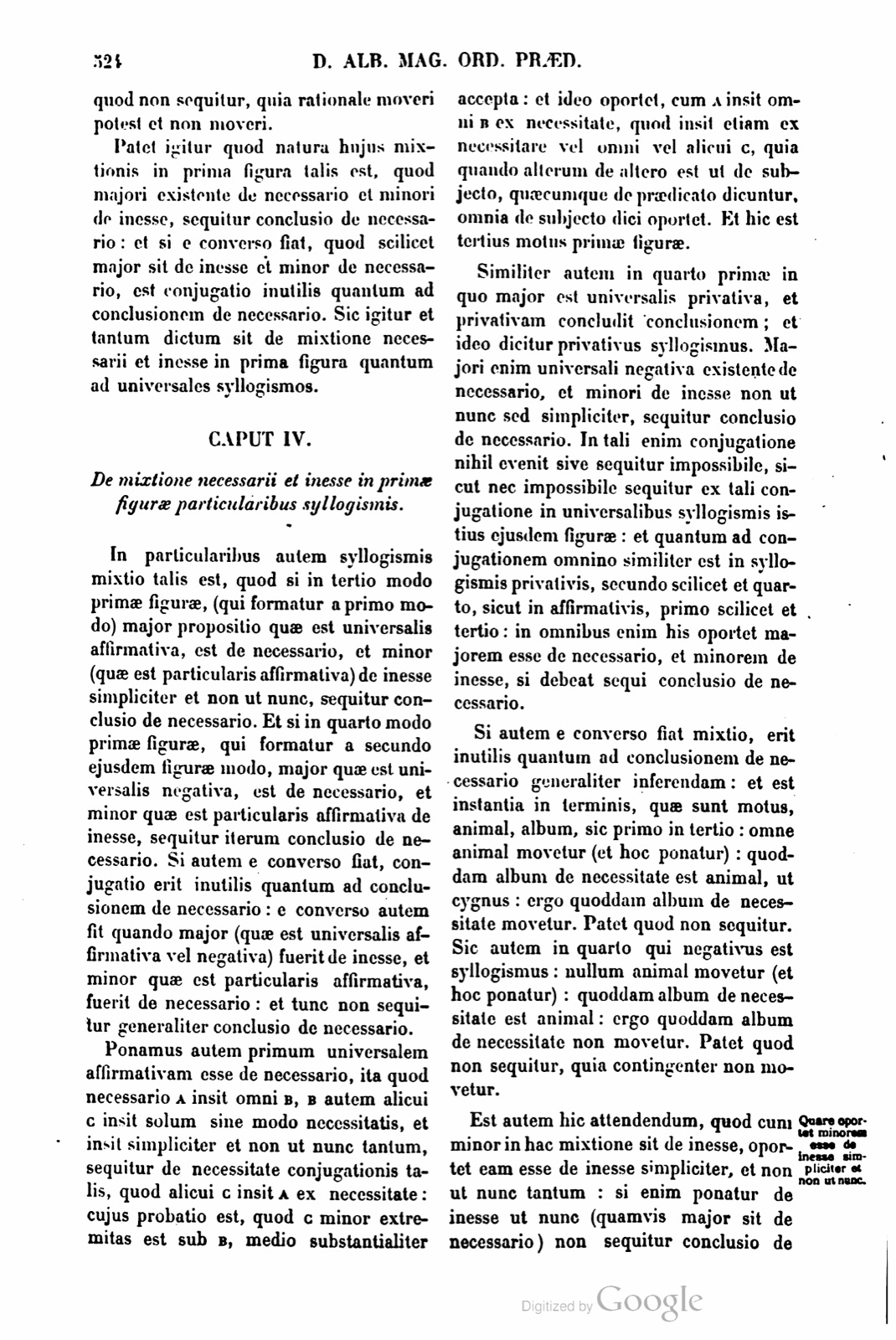
Est autem hic attendendum, quod cum minor in hac mixtione sit de inesse, oportet eam esse de inesse simpliciter, et non ut nunc tantum: si enim ponatur de inesse ut nunc, quamvis major sit de necessario, non sequitur conclusio de necessario, sicut patet in terminis, sic, omnis homo de necessitate est animal: omne album est homo, sit ita: ergo omne album de necessitate est animal. Patet quod non sequitur. Hujus autem causa est, quod minor extremitas essentialiter debet sumi sub medio, sicut medium in majori propositione quae est de necessario, essentialiter stat sub majori extremo: et ideo si vel accidentaliter vel ut nunc accipitur minus sub medio, non sequitur conclusio de necessario. Accidentaliter accipitur sub homine album vel motum, ut nunc autem Socrates, vel iste demonstratus homo: substantialiter autem accipitur aliquis propter identitatem et indifferentiam cum homine: et ideo non sequitur, omnis homo de necessitate est animal: hoc album vel Socrates vel iste homo est homo: ergo hoc album vel Socrates vel iste homo de necessitate est animal. Ex quo relinquitur, quod nihil denominative dictum essentialiter accipitur sub medio, nisi sit vel convertibile cum medio, ut risibile cum homine: vel habeat se sicut superius ad ipsum, sicut cum dicitur album coloratum.
Sed tunc ex praedictis oritur quaestio: cum enim ostensa est inutilis esse conjugatio in hac mixtione, quando minor est de necessario et major de inesse, data est instantia de inesse ut nunc, et non de inesse simpliciter. Posset ergo alicui videri quod, etiam in conjugationibus utilibus, sufficeret quod minor deberet esse de inesse ut nunc, et non de inesse simpliciter.
Adhuc autem si minor sit de inesse simpliciter, tunc minor secundum rem est necessaria, quamvis non sit modo necessitatis determinata: et tunc videtur quod totus iste tractatus de mixtione superfluus sit, quia satis scitur per uniformem generationem syllogismorum de necessario prius habitam.
Adhuc autem prius habitum est, quod ambabus existentibus de necessario sequitur conclusio de necessario: hoc autem dictum est, quod minori existente de inesse et majori de necessario, sequitur conclusio de necessario: cum ergo illa de necessario aliquid addat super illam quae est de inesse, et conclusio de necessario sufficienter concludatur quando altera est de inesse, videtur quod quando ambae sunt de necessario, aliquid sit in altera propositione quod sit non causa ut causa ad conclusionem.
But here it must be attended to that, since the minor in this mixing is of inherence, it must be of inherence simply and not only as now. For if it is posited as of inherence as now, although the major is of necessity, a conclusion of necessity does not follow, as is clear in terms, thus: every man is animal of necessity; every white thing is man, let it be so; therefore every white thing is animal of necessity. It is clear that this does not follow. The cause of this is that the lesser extreme must be taken essentially under the middle, just as the middle, in the major proposition which is of necessity, stands essentially under the greater extreme. And therefore if the lesser is taken under the middle either accidentally or as now, a conclusion of necessity does not follow. White or moved is taken accidentally under man; Socrates, or this demonstrated man, is taken as now; but some one is taken substantially because of identity and indifference with man. And therefore it does not follow: every man is animal of necessity; this white thing, or Socrates, or this man, is man; therefore this white thing, or Socrates, or this man, is animal of necessity. From this it is left that nothing said denominatively is taken essentially under the middle, unless it is either convertible with the middle, as risible with man, or has itself as superior to it, as when white is called colored.
But then from the things said before a question arises: since the conjugation in this mixing has been shown to be useless when the minor is of necessity and the major of inherence, an instance has been given about inherence as now, and not about inherence simply. Therefore it could seem to someone that, even in useful conjugations, it would suffice that the minor should be of inherence as now and not of inherence simply.
Again, if the minor is of inherence simply, then the minor according to the thing is necessary, although it is not determined by the mode of necessity; and then it seems that this whole treatise on mixing is superfluous, because it is sufficiently known through the uniform generation of syllogisms about the necessary had before.
Again, it was had before that, with both propositions being of necessity, a conclusion of necessity follows. But this has been said, that with the minor being of inherence and the major of necessity, a conclusion of necessity follows. Therefore since that proposition of necessity adds something over that which is of inherence, and a conclusion of necessity is sufficiently concluded when one proposition is of inherence, it seems that when both are of necessity there is something in one proposition which is a non-cause as a cause with respect to the conclusion.
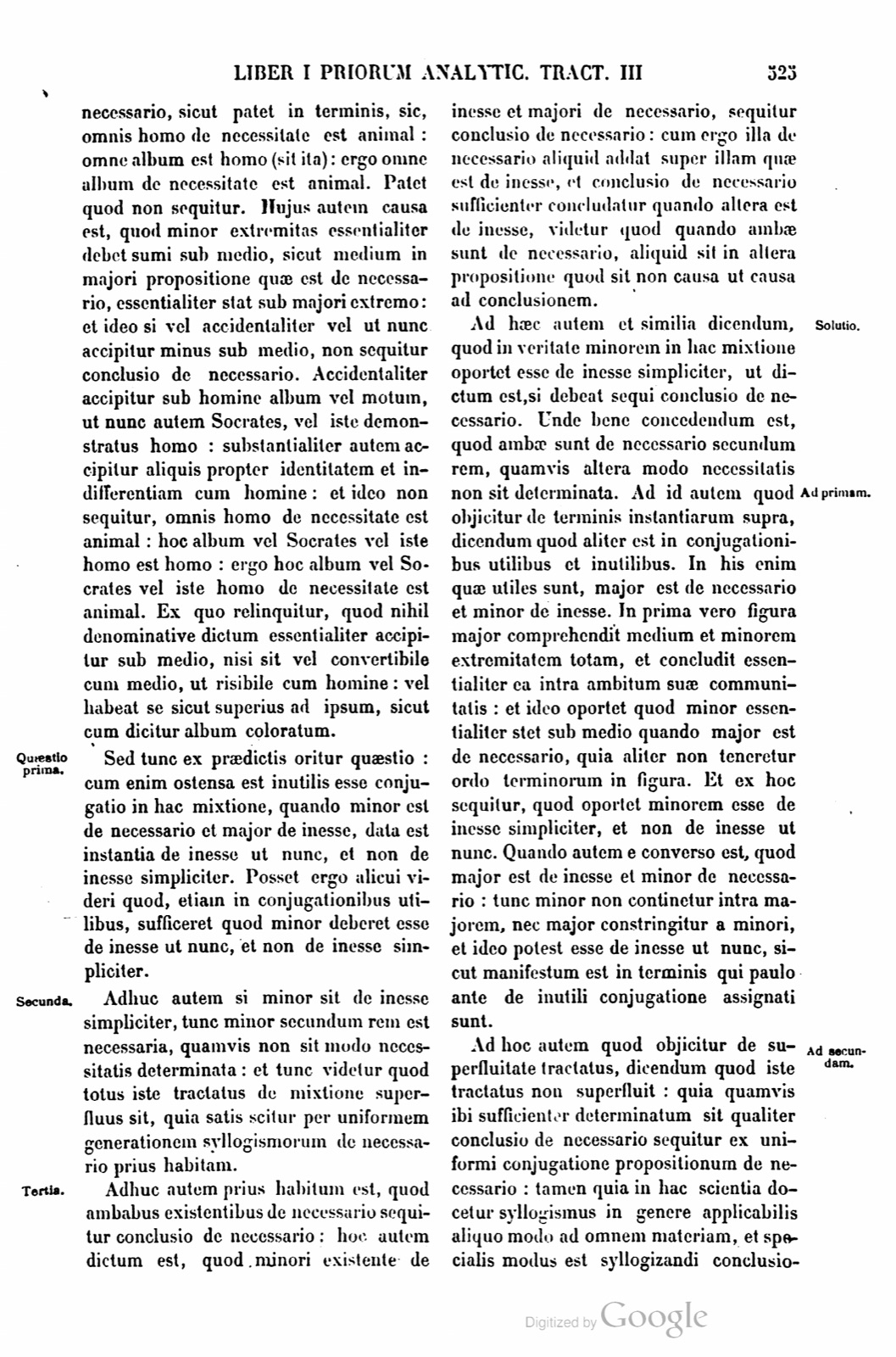
Ad haec autem et similia dicendum, quod in veritate minorem in hac mixtione oportet esse de inesse simpliciter, ut dictum est, si debeat sequi conclusio de necessario. Unde bene concedendum est, quod ambae sunt de necessario secundum rem, quamvis altera modo necessitatis non sit determinata. Ad id autem quod objicitur de terminis instantiarum supra, dicendum quod aliter est in conjugationibus utilibus et inutilibus. In his enim quae utiles sunt, major est de necessario et minor de inesse. In prima vero figura major comprehendit medium et minorem extremitatem totam, et concludit essentialiter ea intra ambitum suae communitatis: et ideo oportet quod minor essentialiter stet sub medio quando major est de necessario, quia aliter non teneretur ordo terminorum in figura. Et ex hoc sequitur, quod oportet minorem esse de inesse simpliciter, et non de inesse ut nunc. Quando autem e converso est, quod major est de inesse et minor de necessario: tunc minor non continetur intra majorem, nec major constringitur a minori, et ideo potest esse de inesse ut nunc, sicut manifestum est in terminis qui paulo ante de inutili conjugatione assignati sunt.
Ad hoc autem quod objicitur de superfluitate tractatus, dicendum quod iste tractatus non superfluit: quia quamvis ibi sufficienter determinatum sit qualiter conclusio de necessario sequitur ex uniformi conjugatione propositionum de necessario: tamen quia in hac scientia docetur syllogismus in genere applicabilis aliquo modo ad omnem materiam, et specialis modus est syllogizandi conclusionem de necessario per mixtionem necessarii et inesse, alius a dicto modo qui est ex uniformibus propositionibus de necessario, oportuit de necessitate doctrinae, quod etiam iste modus doceretur, quia aliter scientia esset incompleta.
Per hoc etiam patet solutio ad sequens: quia necessarium est, quod utraque sit de necessario in uniformi generatione syllogismi de necessario: et nihil est ibi quod sit non causa ut causa, sed totum causa est quantum ad illum modum syllogizandi conclusionem de necessario: sed per hoc non concluditur quin etiam alius modus sit syllogizandi conclusionem de necessario, ad quem non requiritur, quod utraque sit de necessario, sed major tantum.
Attendendum autem, quod cum dicimus, quod sequeretur conclusio de necessario, non negamus quin etiam sequatur conclusio de inesse: quia necesse esse antecedit inesse: et quod necesse est esse, illud relinquitur esse: sed conclusio de necesse esse, sequitur primo et principaliter quando vel ambae vel major sunt de necessario: conclusio autem de inesse sequitur ex consequenti. Similiter autem si minor sit de necessario, et major de inesse, bene sequitur conclusio de inesse. Et similiter si ambae sint de necessario, vel ambae de inesse, sequitur conclusio de inesse. Qualiter igitur sequatur conclusio de inesse, non oportet studere per artem, quia leve est: et quocumque modo varientur propositiones, est adhuc conjugatio utilis, quod concludat propositionem de inesse. Sed difficile est qualiter concludatur conclusio de necessario: et ad hoc ponendum studium, et doctrina artis tradenda.
To these and similar points one must say that in truth the minor in this mixing must be of inherence simply, as has been said, if a conclusion of necessity ought to follow. Hence it must well be conceded that both are of necessity according to the thing, although one is not determined by the mode of necessity. To that which is objected from the terms of instances above, one must say that it is otherwise in useful and useless conjugations. For in those that are useful, the major is of necessity and the minor of inherence. But in the first figure the major comprehends the whole middle and lesser extreme, and concludes them essentially within the scope of its commonness; and therefore it is necessary that the minor stand essentially under the middle when the major is of necessity, because otherwise the order of the terms in the figure would not be held. And from this it follows that the minor must be of inherence simply and not of inherence as now. But when it is conversely the case that the major is of inherence and the minor of necessity, then the minor is not contained within the major, nor is the major constrained by the minor, and therefore it can be of inherence as now, as is manifest in the terms that were assigned a little before concerning the useless conjugation.
To the point objected about the superfluity of the treatise, one must say that this treatise is not superfluous. For although there it has been sufficiently determined how a conclusion of necessity follows from a uniform conjugation of propositions of necessity, nevertheless, because in this science the syllogism is taught in general as applicable in some way to every matter, and because there is a special mode of syllogizing a conclusion of necessity through the mixing of the necessary and inherence, different from the stated mode which is from uniform propositions of necessity, it was necessary by the necessity of doctrine that this mode also be taught, because otherwise the science would be incomplete.
Through this the solution to the next point is also clear: because it is necessary that each proposition be of necessity in the uniform generation of a syllogism of necessity; and there nothing is a non-cause as a cause, but the whole is cause with respect to that mode of syllogizing a conclusion of necessity. But through this it is not concluded that there is not also another mode of syllogizing a conclusion of necessity, for which it is not required that each proposition be of necessity, but only the major.
But it must be attended to that when we say that a conclusion of necessity would follow, we do not deny that a conclusion of inherence also follows, because necessary being precedes inherence, and what is necessary to be is left to be. But the conclusion of necessary being follows first and principally when either both propositions or the major are of necessity; but the conclusion of inherence follows consequently. Similarly, if the minor is of necessity and the major of inherence, a conclusion of inherence follows well. And similarly, if both are of necessity or both of inherence, a conclusion of inherence follows. Therefore how a conclusion of inherence follows need not be studied by art, because it is easy; and in whatever way the propositions are varied, there is still a useful conjugation for concluding a proposition of inherence. But it is difficult how a conclusion of necessity is concluded; and study must be placed upon this, and the doctrine of the art must be handed down.
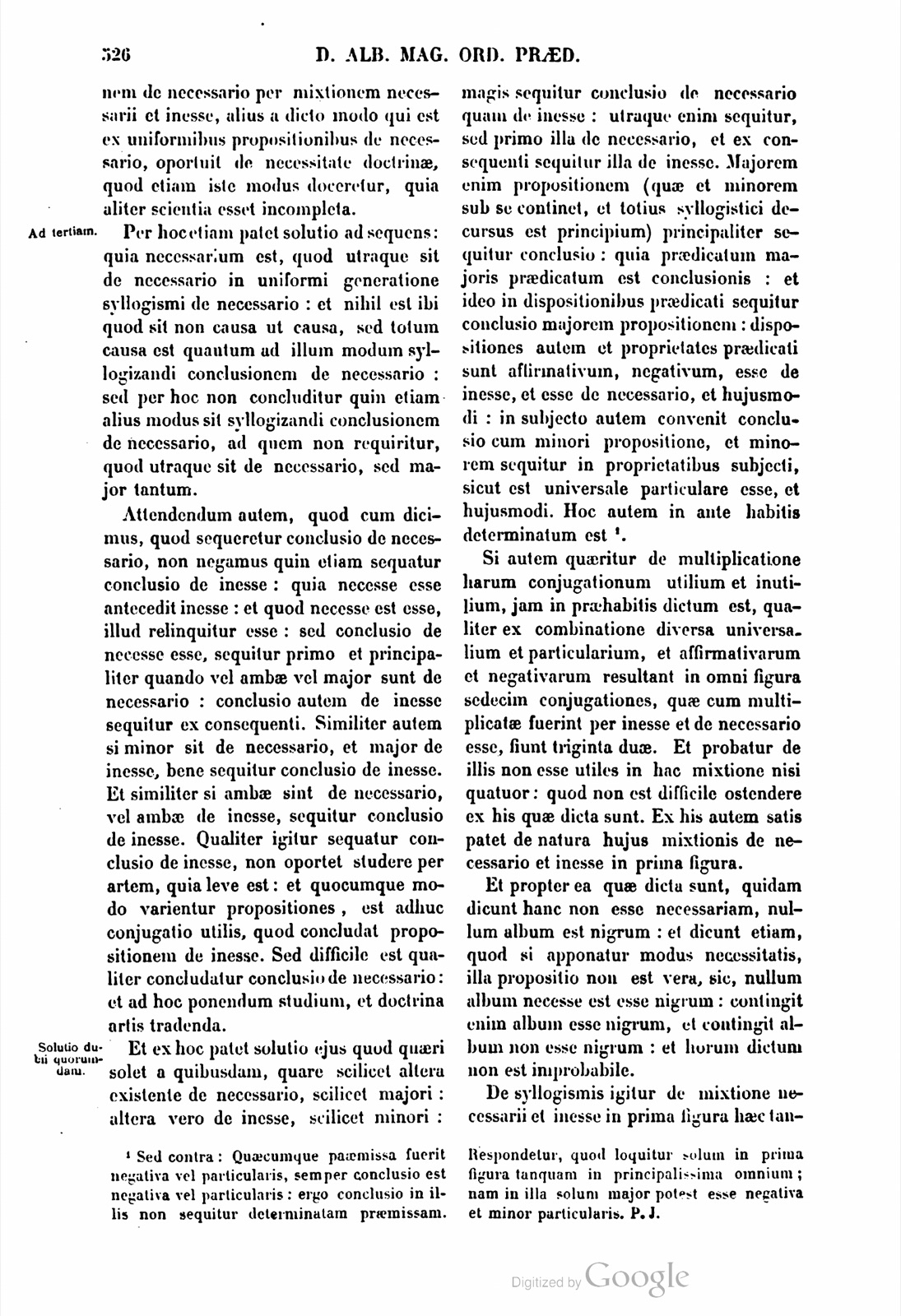
Et ex hoc patet solutio ejus quod quaeri solet a quibusdam, quare scilicet altera existente de necessario, scilicet majori: altera vero de inesse, scilicet minori: magis sequitur conclusio de necessario quam de inesse: utraque enim sequitur, sed primo illa de necessario, et ex consequenti sequitur illa de inesse. Majorem enim propositionem, quae et minorem sub se continet, et totius syllogistici decursus est principium, principaliter sequitur conclusio: quia praedicatum majoris praedicatum est conclusionis: et ideo in dispositionibus praedicati sequitur conclusio majorem propositionem: dispositiones autem et proprietates praedicati sunt affirmativum, negativum, esse de inesse, et esse de necessario, et hujusmodi: in subjecto autem convenit conclusio cum minori propositione, et minorem sequitur in proprietatibus subjecti, sicut est universale, particulare esse, et hujusmodi. Hoc autem in ante habitis determinatum est1.
Si autem quaeritur de multiplicatione harum conjugationum utilium et inutilium, jam in prae habitis dictum est, qualiter ex combinatione diversa universalium et particularium, et affirmativarum et negativarum resultant in omni figura sedecim conjugationes, quae cum multiplicatae fuerint per inesse et de necessario esse, fiunt triginta duae. Et probatur de illis non esse utiles in hac mixtione nisi quatuor: quod non est difficile ostendere ex his quae dicta sunt. Ex his autem satis patet de natura hujus mixtionis de necessario et inesse in prima figura.
Et propter ea quae dicta sunt, quidam dicunt hanc non esse necessariam, nullum album est nigrum: et dicunt etiam, quod si apponatur modus necessitatis, illa propositio non est vera, sic, nullum album necesse est esse nigrum: contingit enim album esse nigrum, et contingit album non esse nigrum: et horum dictum non est improbabile.
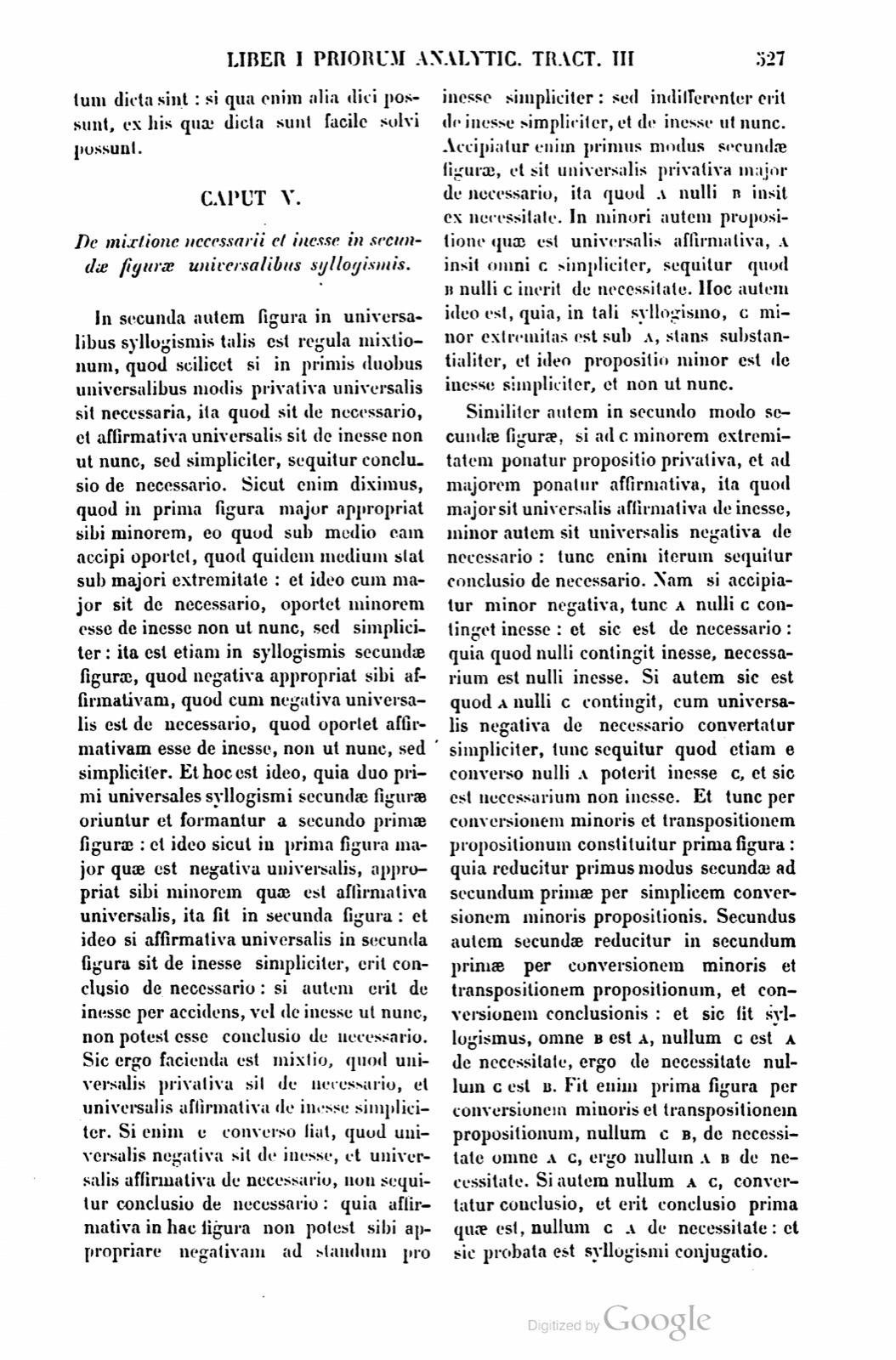
De syllogismis igitur de mixtione necessarii et inesse in prima figura haec tantum dicta sint: si qua enim alia dici possunt, ex his quae dicta sunt facile solvi possunt.
And from this the solution is clear to what some are accustomed to ask: namely why, when one proposition is of necessity, namely the major, and the other of inherence, namely the minor, a conclusion of necessity follows more than a conclusion of inherence. For both follow, but first that of necessity, and consequently that of inherence follows. For the conclusion principally follows the major proposition, which both contains the minor under itself and is the principle of the whole syllogistic course, because the predicate of the major is the predicate of the conclusion; and therefore in the dispositions of the predicate the conclusion follows the major proposition. But the dispositions and properties of the predicate are being affirmative, negative, being of inherence, and being of necessity, and the like; but in the subject the conclusion agrees with the minor proposition, and follows the minor in the properties of the subject, such as being universal, particular, and the like. This, however, was determined in what was had before1.
But if one asks about the multiplication of these useful and useless conjugations, it has already been said in what was had before how, from the diverse combination of universals and particulars and of affirmatives and negatives, sixteen conjugations result in every figure; and when these have been multiplied by being of inherence and being of necessity, they become thirty-two. And it is proved concerning them that only four are useful in this mixing, which is not difficult to show from the things that have been said. From these things, however, enough is clear about the nature of this mixing of the necessary and inherence in the first figure.
And because of the things that have been said, some say that this is not necessary: no white thing is black; and they also say that if the mode of necessity is added, that proposition is not true, thus: no white thing is necessarily black; for it is contingent that white be black, and it is contingent that white not be black. And their saying is not improbable.
Therefore concerning syllogisms from the mixing of the necessary and inherence in the first figure, let these things alone have been said. For if any other things can be said, they can easily be solved from the things that have been said.
Notes
- But on the contrary: whichever premise is negative or particular, the conclusion is always negative or particular; therefore the conclusion in those cases does not follow a determinate premise. It is answered that he is speaking only in the first figure as in the most principal of all; for in that figure alone can the major be negative and the minor particular. P. J. (Sed contra: Quaecumque praemissa fuerit negativa vel particularis, semper conclusio est negativa vel particularis: ergo conclusio in illis non sequitur determinatam praemissam. Respondetur, quod loquitur solum in prima figura tanquam in principalissima omnium; nam in illa solum major potest esse negativa et minor particularis. P. J.) ↩
If a page does not appear, its photograph has not been uploaded yet.