Works › Prior Analytics, Books I–II
Volume 1 · p. 519
Continuation of Chapter I on page 519
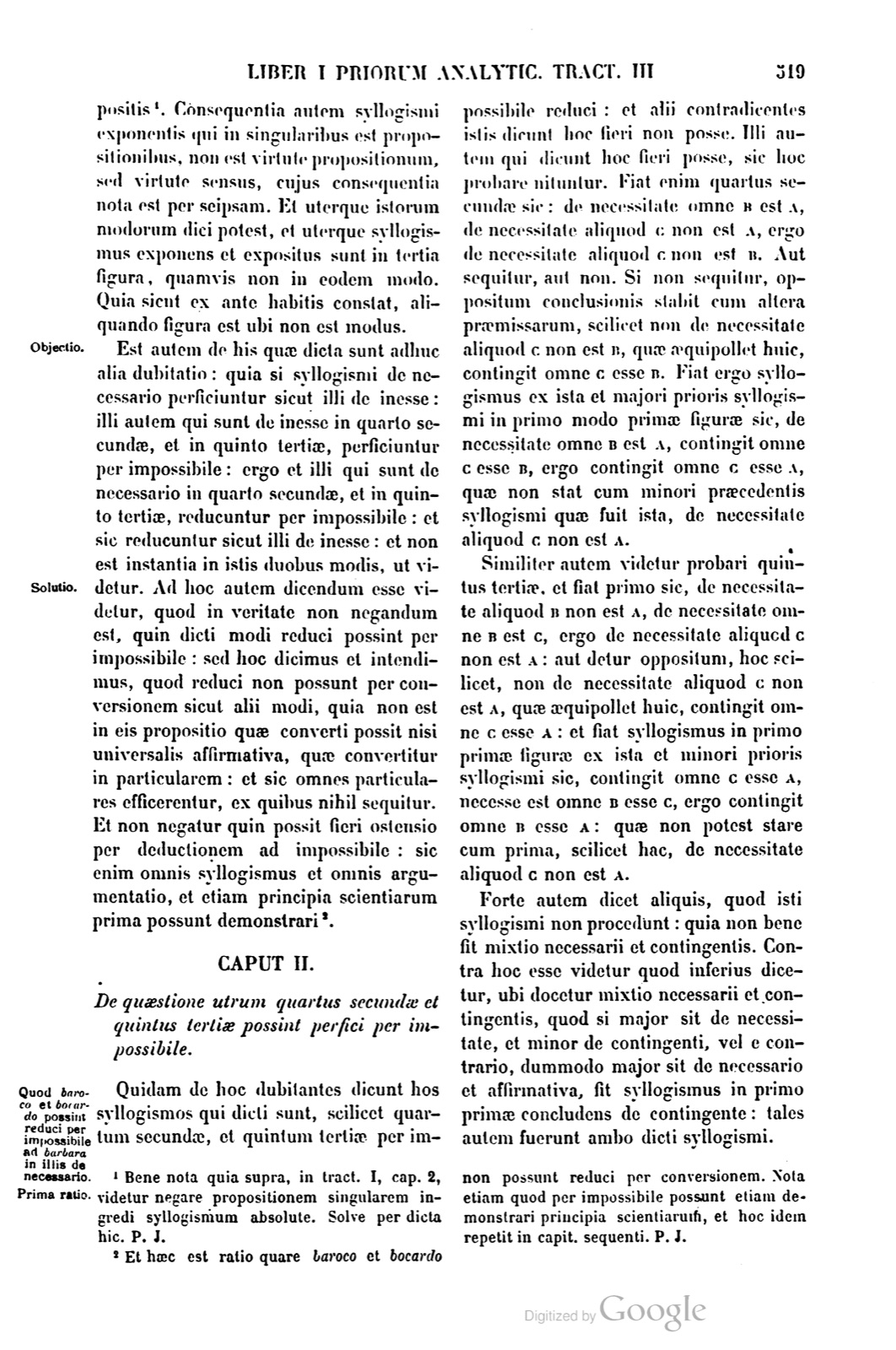
positis1. Consequentia autem syllogismi exponentis qui in singularibus est propositionibus, non est virtute propositionum, sed virtute sensus, cujus consequentia nota est per seipsam. Et uterque istorum modorum dici potest, et uterque syllogismus exponens et expositus sunt in tertia figura, quamvis non in eodem modo. Quia sicut ex ante habitis constat, aliquando figura est ubi non est modus.
Est autem de his quae dicta sunt adhuc alia dubitatio: quia si syllogismi de necessario perficiuntur sicut illi de inesse: illi autem qui sunt de inesse in quarto secundae, et in quinto tertiae, perficiuntur per impossibile: ergo et illi qui sunt de necessario in quarto secundae, et in quinto tertiae, reducuntur per impossibile: et sic reducuntur sicut illi de inesse: et non est instantia in istis duobus modis, ut videtur. Ad hoc autem dicendum esse videtur, quod in veritate non negandum est, quin dicti modi reduci possint per impossibile: sed hoc dicimus et intendimus, quod reduci non possunt per conversionem sicut alii modi, quia non est in eis propositio quae converti possit nisi universalis affirmativa, quae convertitur in particularem: et sic omnes particulares efficerentur, ex quibus nihil sequitur. Et non negatur quin possit fieri ostensio per deductionem ad impossibile: sic enim omnis syllogismus et omnis argumentatio, et etiam principia scientiarum prima possunt demonstrari2.
posed1. But the consequence of the syllogism that expounds, which is in singular propositions, is not by the power of the propositions, but by the power of sense, whose consequence is known through itself. And each of these modes can be named, and each syllogism, the expounding one and the one expounded, is in the third figure, although not in the same mode. For as is established from what was had before, sometimes there is a figure where there is not a mode.
But concerning these things that have been said there is still another doubt: because if syllogisms about the necessary are perfected like those about inherence, but those which are about inherence in the fourth of the second figure and in the fifth of the third are perfected through impossibility, therefore those which are about the necessary in the fourth of the second and in the fifth of the third are also reduced through impossibility; and thus they are reduced like those about inherence, and there is no exception in these two modes, as it seems. To this it seems one must say that in truth it is not to be denied that the stated modes can be reduced through impossibility; but we say and intend this, that they cannot be reduced through conversion as other modes are, because in them there is no proposition that can be converted except the universal affirmative, which is converted into a particular; and so all would be made particular, from which nothing follows. And it is not denied that a showing can be made through reduction to impossibility; for in this way every syllogism and every argumentation, and also the first principles of the sciences, can be demonstrated2.
Notes
- Note well that above, in tractate I, chapter 2, he seems to deny that a singular proposition enters a syllogism absolutely. Resolve this through the things said here. P. J. (Bene nota quia supra, in tract. I, cap. 2, videtur negare propositionem singularem ingredi syllogismum absolute. Solve per dicta hic. P. J.) ↩
- And this is the reason why Baroco and Bocardo cannot be reduced through conversion. Note also that even the principles of the sciences can be demonstrated through impossibility, and he repeats this same thing in the following chapter. P. J. (Et haec est ratio quare baroco et bocardo non possunt reduci per conversionem. Nota etiam quod per impossibile possunt etiam demonstrari principia scientiarum, et hoc idem repetit in capit. sequenti. P. J.) ↩
If a page does not appear, its photograph has not been uploaded yet.