Works › Prior Analytics, Books I–II
Volume 1 · pp. 516–518
Treatise III. On the generation of syllogisms that are from modal propositions concerning the necessary and the contingent. Chapter I.
A marker with ≈ is an approximate page boundary, placed by measure of the text; the page photographs remain the authority. In the paired views, clicking a page marker brings that page into view.
TRACTATUS III. DE GENERATIONE SYLLOGISMORUM QUI SUNT EX PROPOSITIONIBUS MODALIBUS DE NECESSARIO ET CONTINGENTI.
CAPUT I. De cognitione syllogismorum de modo necessitatis.
Quoniam autem diversum est inesse simpliciter, et cum modo necessitatis inesse sive ex necessitate inesse, et cum modo contingentis inesse sive contingere inesse. Simpliciter enim inesse superius et in plus est, quam ex necessitate inesse: et simpliciter inesse est inesse sine modi determinatione. Contingere autem inesse communius est, quam inesse simpliciter: omne enim quod inest, contingit inesse: et non convertitur: quia multa contingit inesse, quae non insunt, sicut et multa insunt quae non ex necessitate insunt: quaedam autem sic se habent, quod nec ex necessitate insunt, nec etiam omnino, hoc est, simpliciter insunt: contingit tamen talia inesse. Et quoniam sic est in propositionibus, manifestum est quoniam et syllogismus factus ex his in unoquoque horum generum propositionum factus, diversus erit: et etiam non erit tantum diversus uniformiter factus in istis propositionibus, sed etiam factus in terminis, non similiter sive uniformiter se habentibus terminis. Dico autem similiter se habentibus terminis, sicut quando unius generis tantum sunt propositiones, sicut quod sint ambae de inesse, vel ambae de modo necessitatis, vel ambae de modo contingentis. Non similiter autem dico, sicut in mixtione unius generis cum alio, sicut quando una est de inesse et altera de necesse, vel una de inesse et altera de contingenti, vel una de necessario et altera de contingenti.
De possibili enim non dicimus esse diversas propositiones ab illis quae sunt de contingenti: quia possibile convertitur cum contingente. Nec de impossibili propositiones secundum hanc intensionem diversas dicimus ab illis de necessario, quia propositio affirmativa de impossibili est negativa de necessario: quod enim impossibile est esse, necesse est non esse: et propositio negativa de impossibili, est affirmativa de necessario: quod enim impossibile est non esse, necesse est esse: et ideo possibile et impossibile non ita variant propositiones, quod alii sint syllogismi qui sint de possibili et impossibili, a syllogismis contingentis et necessarii: propter quod de talibus non loquimur syllogismis: quia illis formatis de necessario et contingenti, satis scitur formatio illorum, et non oportet de ipsis facere tractatum specialem.
Similiter autem verum et falsum quamvis sint modi quidam, tamen quia nihil addunt supra compositionem propositionis, non variant consequentiam: et quia non variant consequentiam, non fit ex ipsis diversae consequentiae syllogismus: et ideo nec de illis oportet facere tractatum specialem. Si tamen aliquid dicendum erit in sequentibus de syllogismo qui est ex falsis, hoc erit determinandum in loco ubi de potestate syllogismi loquemur: eo quod hoc specialem dicit syllogismi potestatem, et non specialem modum generationis syllogismorum.
Adhuc autem cum multae sint diversitates propositionum, in libro Perihermenias tactae sunt, sicut categorica, hypothetica, una, plures, simplex, composita, et hujusmodi, nihil variationis fit ex omnibus his circa syllogismi inferentiam: et ideo non exigitur ut secundum illarum propositionum diversitatem diversa tradatur generatio syllogismorum qui simpliciter syllogismi sunt. Et si de hypotheticis dicendum est (cum hypotheticus syllogismus sit syllogismus quidam et non simpliciter) alibi erit hoc determinandum, et non hic ubi de simplici et formali intendimus syllogismo. In istis enim modis qui sunt necessarium et contingens, non est tantum variatio materialis (quae infinita est, sicut et ipsa materiae divisio, et sub arte non cadit) sed isti qui dicti sunt modi necessarii et contingentis ipsam virtutem variant inferentiae, quae syllogismo quantumcumque simplici substantialis est: et ideo ad diversitatem illius sequitur diversa syllogismorum generatio: et hac necessitate oportet tractare de ipsis. Categoricum enim et hypotheticum, una, plures, composita, simplex, non faciunt nisi materiae diversitatem, quae non cadit sub arte, sicut jam dictum est.
TREATISE III. ON THE GENERATION OF SYLLOGISMS THAT ARE FROM MODAL PROPOSITIONS CONCERNING THE NECESSARY AND THE CONTINGENT.
CHAPTER I. On the cognition of syllogisms concerning the mode of necessity.
But because to belong simply is diverse from belonging with the mode of necessity, or belonging from necessity, and from belonging with the mode of contingency, or happening to belong. For belonging simply is higher and more extensive than belonging from necessity; and belonging simply is belonging without determination of mode. But happening to belong is more common than belonging simply: for everything that belongs happens to belong; and it is not converted, because many things happen to belong which do not belong, just as many things belong which do not belong from necessity; but certain things have themselves in such a way that they neither belong from necessity nor even altogether, that is, simply belong; nevertheless such things happen to belong. And since it is so in propositions, it is manifest that a syllogism made from these, made in any one of these genera of propositions, will be diverse; and it will also not only be diverse when made uniformly in these propositions, but also when made in terms, with the terms not having themselves similarly or uniformly. Now I call terms having themselves similarly as when the propositions are only of one genus, as when both are of inherence, or both of the mode of necessity, or both of the mode of contingency. But I call them not similarly, as in the mixture of one genus with another, as when one is of inherence and the other of the necessary, or one of inherence and the other of the contingent, or one of the necessary and the other of the contingent.
For we do not say that there are different propositions concerning the possible from those which are concerning the contingent, because possible is converted with contingent. Nor do we say that propositions concerning the impossible are, according to this intention, different from those concerning the necessary, because an affirmative proposition concerning the impossible is a negative concerning the necessary: for what is impossible to be must necessarily not be; and a negative proposition concerning the impossible is an affirmative concerning the necessary: for what is impossible not to be must necessarily be. And therefore the possible and the impossible do not vary propositions in such a way that there are syllogisms about the possible and impossible other than syllogisms of the contingent and the necessary. On account of this we do not speak about such syllogisms, because, once those concerning the necessary and contingent have been formed, the formation of those others is sufficiently known, and it is not necessary to make a special treatise about them.
Similarly, although true and false are certain modes, nevertheless because they add nothing beyond the composition of the proposition, they do not vary the consequence; and because they do not vary the consequence, no syllogism of a diverse consequence is made from them; and therefore it is not necessary to make a special treatise about them either. Yet if something will have to be said in what follows about the syllogism which is from false things, this will have to be determined in the place where we shall speak about the power of syllogism, because this states a special power of syllogism, and not a special mode of generation of syllogisms.
Again, since there are many diversities of propositions, they have been touched upon in the book Perihermenias, such as categorical, hypothetical, one, many, simple, composite, and the like, but no variation is made from all these concerning the inference of a syllogism; and therefore it is not required that a diverse generation of syllogisms, which are syllogisms simply, be handed down according to the diversity of those propositions. And if something must be said about hypotheticals, since a hypothetical syllogism is a certain syllogism and not a syllogism simply, this will be determined elsewhere, and not here, where we intend the simple and formal syllogism. For in these modes which are the necessary and the contingent, there is not only material variation, which is infinite, just as the division of matter itself is, and does not fall under art; but those modes which have been mentioned, namely of the necessary and the contingent, vary the very power of inference, which is substantial to a syllogism however simple it may be; and therefore a diverse generation of syllogisms follows upon the diversity of that power, and from this necessity one must treat of them. For categorical and hypothetical, one, many, composite, simple, make only a diversity of matter, which does not fall under art, as has now been said.
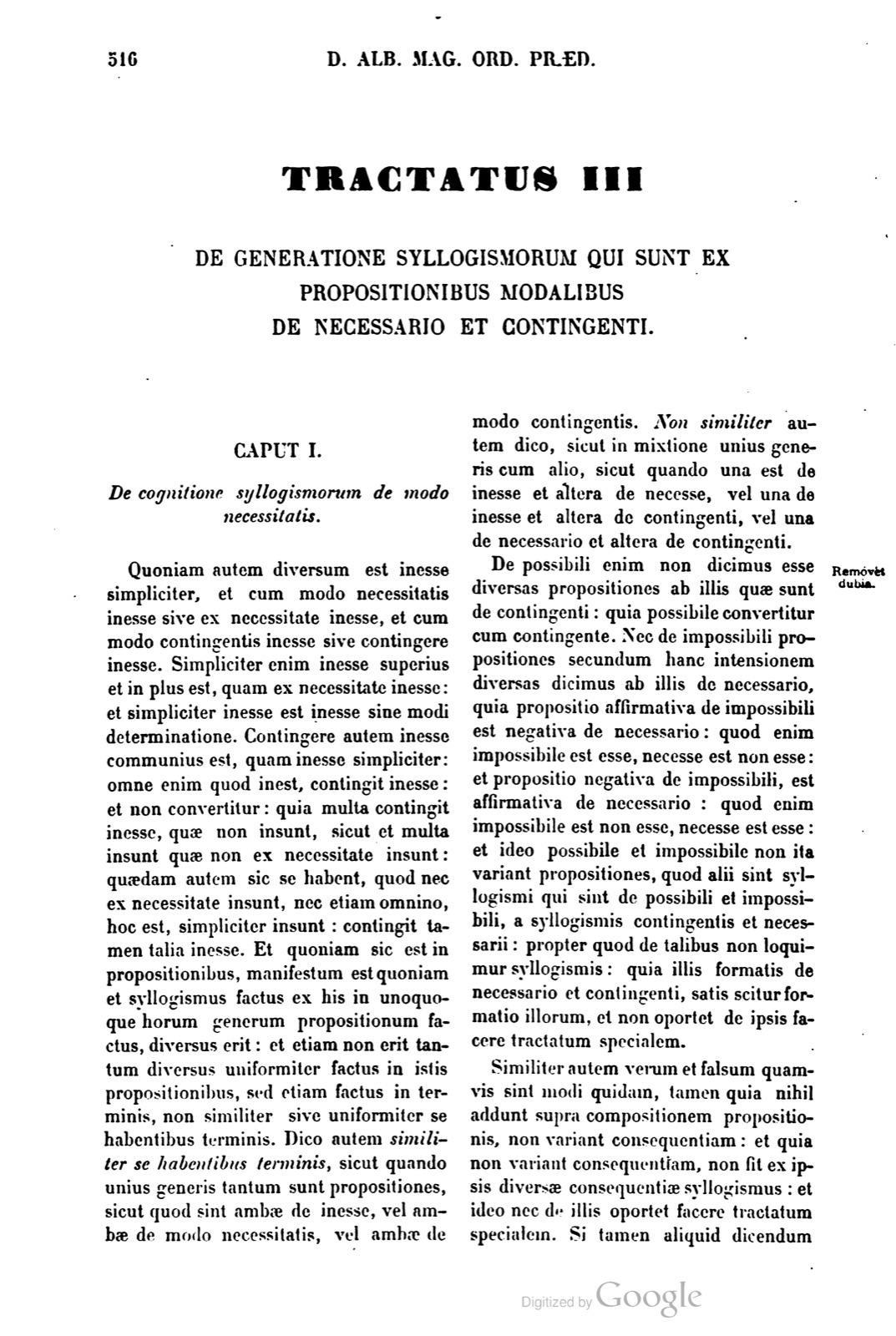
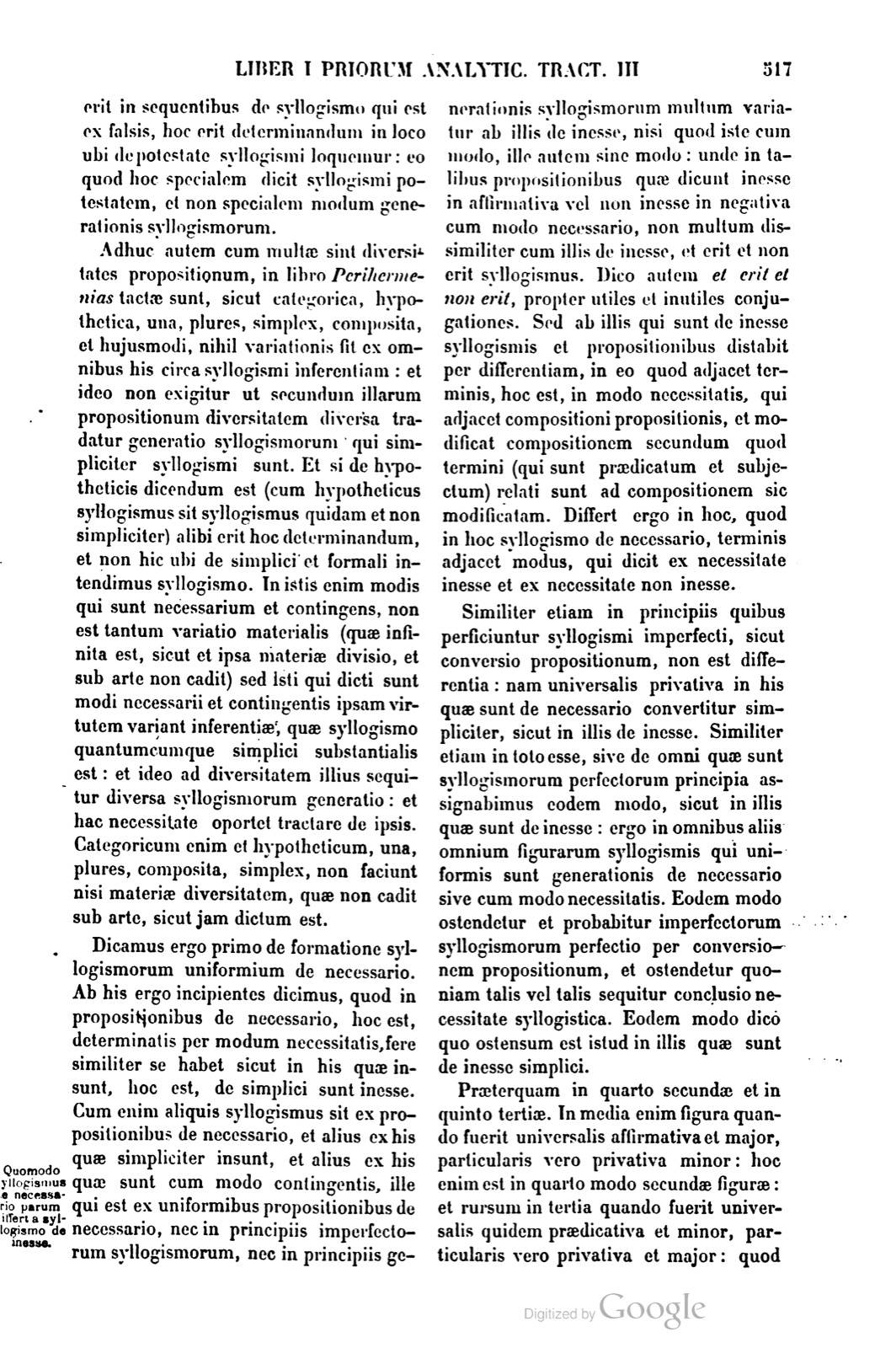
Dicamus ergo primo de formatione syllogismorum uniformium de necessario. Ab his ergo incipientes dicimus, quod in propositionibus de necessario, hoc est, determinatis per modum necessitatis, fere similiter se habet sicut in his quae insunt, hoc est, de simplici sunt inesse. Cum enim aliquis syllogismus sit ex propositionibus de necessario, et alius ex his quae simpliciter insunt, et alius ex his quae sunt cum modo contingentis, ille qui est ex uniformibus propositionibus de necessario, nec in principiis imperfectorum syllogismorum, nec in principiis generationis syllogismorum multum variatur ab illis de inesse, nisi quod iste cum modo, ille autem sine modo: unde in talibus propositionibus quae dicunt inesse in affirmativa vel non inesse in negativa cum modo necessario, non multum dissimiliter cum illis de inesse, et erit et non erit syllogismus. Dico autem et erit et non erit, propter utiles et inutiles conjugationes. Sed ab illis qui sunt de inesse syllogismis et propositionibus distabit per differentiam, in eo quod adjacet terminis, hoc est, in modo necessitatis, qui adjacet compositioni propositionis, et modificat compositionem secundum quod termini (qui sunt praedicatum et subjectum) relati sunt ad compositionem sic modificatam. Differt ergo in hoc, quod in hoc syllogismo de necessario, terminis adjacet modus, qui dicit ex necessitate inesse et ex necessitate non inesse.
Similiter etiam in principiis quibus perficiuntur syllogismi imperfecti, sicut conversio propositionum, non est differentia: nam universalis privativa in his quae sunt de necessario convertitur simpliciter, sicut in illis de inesse. Similiter in toto esse, sive de omni quae sunt syllogismorum perfectorum principia assignabimus eodem modo, sicut in illis quae sunt de inesse: ergo in omnibus aliis omnium figurarum syllogismis qui uniformis sunt generationis de necessario sive cum modo necessitatis. Eodem modo ostendetur et probabitur imperfectorum syllogismorum perfectio per conversionem propositionum, et ostendetur quoniam talis vel talis sequitur conclusio necessitate syllogistica. Eodem modo dico quo ostensum est istud in illis quae sunt de inesse simplici.
Praeterquam in quarto secundae et in quinto tertiae. In media enim figura quando fuerit universalis affirmativa et major, particularis vero privativa minor: hoc enim est in quarto modo secundae figurae: et rursum in tertia quando fuerit universalis quidem praedicativa et minor, particularis vero privativa et major: quod est in quinto modo tertiae figurae: non similiter sicut in illis de inesse erit demonstratio et reductio imperfectorum ad perfectos1. Sed in istis oportet, quod exponentes particularem negativam in utroque syllogismo faciamus demonstrationem. Dico autem exponentes particularem negativam, ostendentes per sensibile aliquod quod est, cui alicui sensibili utrumque particulare non inest, scilicet et illud quod est minor propositio in quarto secundae, et illud similiter particulare negativum quod est major propositio in quinto modo figurae tertiae: et expositione facta oportet de exposito eumdem, hoc est, in eadem figura facere syllogismum. In his enim quae per expositionem sensibiliter demonstrantur, talis syllogismus est necessarius et de necessitate concludens. Si autem de exposito sensibiliter demonstrato est necessarius, sequitur quod etiam de illo aliquo particulariter accepto est necessarius: quia particularis etiam pro uno tantum singulari verificatur. Nam expositum, hoc est, singulare per expositionem acceptum, ipsum secundum se sumptum illud est quod est ipsum particulare, et de quo particulare praedicatur quod expositum est. Fit autem uterque syllogismus, scilicet et expositus et per expositionem probans in propria figura, quando quartus secundae et quintus tertiae probantur per expositionem in propria et eadem figura.
Therefore let us speak first about the formation of uniform syllogisms concerning the necessary. Beginning from these, therefore, we say that in propositions concerning the necessary, that is, determined by the mode of necessity, the matter stands almost similarly as in those which belong, that is, which are of simple inherence. For since one syllogism is from propositions concerning the necessary, another from those which simply belong, and another from those which are with the mode of contingency, that one which is from uniform propositions concerning the necessary is not varied much from those of inherence, either in the principles of imperfect syllogisms or in the principles of the generation of syllogisms, except that this one is with a mode, but that one without a mode. Hence in such propositions which say inherence in the affirmative or non-inherence in the negative with a necessary mode, a syllogism both will be and will not be, not much dissimilarly from those of inherence. But I say both will be and will not be on account of useful and useless conjugations. But it will stand apart from those syllogisms and propositions which are of inherence by a difference in that which is adjacent to the terms, that is, in the mode of necessity, which is adjacent to the composition of the proposition and modifies the composition according as the terms, which are predicate and subject, are related to the composition thus modified. Therefore it differs in this, that in this syllogism concerning the necessary a mode is adjacent to the terms, which says belonging from necessity and not belonging from necessity.
Similarly also in the principles by which imperfect syllogisms are perfected, such as conversion of propositions, there is no difference; for the universal privative in those which are concerning the necessary is converted simply, just as in those of inherence. Similarly, in-being-in-the-whole, or being-said-of-every-one, which are the principles of perfect syllogisms, we shall assign in the same way as in those which are of inherence; therefore in all other syllogisms of all figures which are of uniform generation concerning the necessary or with the mode of necessity. In the same way the perfection of imperfect syllogisms will be shown and proved through conversion of propositions, and it will be shown that such or such a conclusion follows by syllogistic necessity. I say, in the same way in which this was shown in those which are of simple inherence.
Except in the fourth of the second and in the fifth of the third. For in the middle figure, when there is a universal affirmative as major, but a particular privative as minor, for this is in the fourth mode of the second figure; and again in the third, when there is a universal predicative as minor, but a particular privative as major, which is in the fifth mode of the third figure, the demonstration and reduction of the imperfect to the perfect will not be as in those of inherence1. But in these it is necessary that we make the demonstration by expounding the particular negative in each syllogism. Now I call "expounding the particular negative" showing through some sensible thing which is, to which, as to some sensible, each particular does not belong, namely both that which is the minor proposition in the fourth of the second, and likewise that particular negative which is the major proposition in the fifth mode of the third figure; and when the exposition has been made, one must make the same syllogism about the thing expounded, that is, in the same figure. For in these things which are demonstrated sensibly through exposition, such a syllogism is necessary and concludes of necessity. But if it is necessary concerning the thing sensibly demonstrated by exposition, it follows that it is also necessary concerning that thing accepted particularly, because a particular is also verified for one singular alone. For the thing expounded, that is, the singular accepted through exposition, taken according to itself, is itself that which the particular itself is, and that of which the particular that is expounded is predicated. But each syllogism is made, namely both the one expounded and the one proving through exposition, in its proper figure, when the fourth of the second and the fifth of the third are proved through exposition in their proper and same figure.
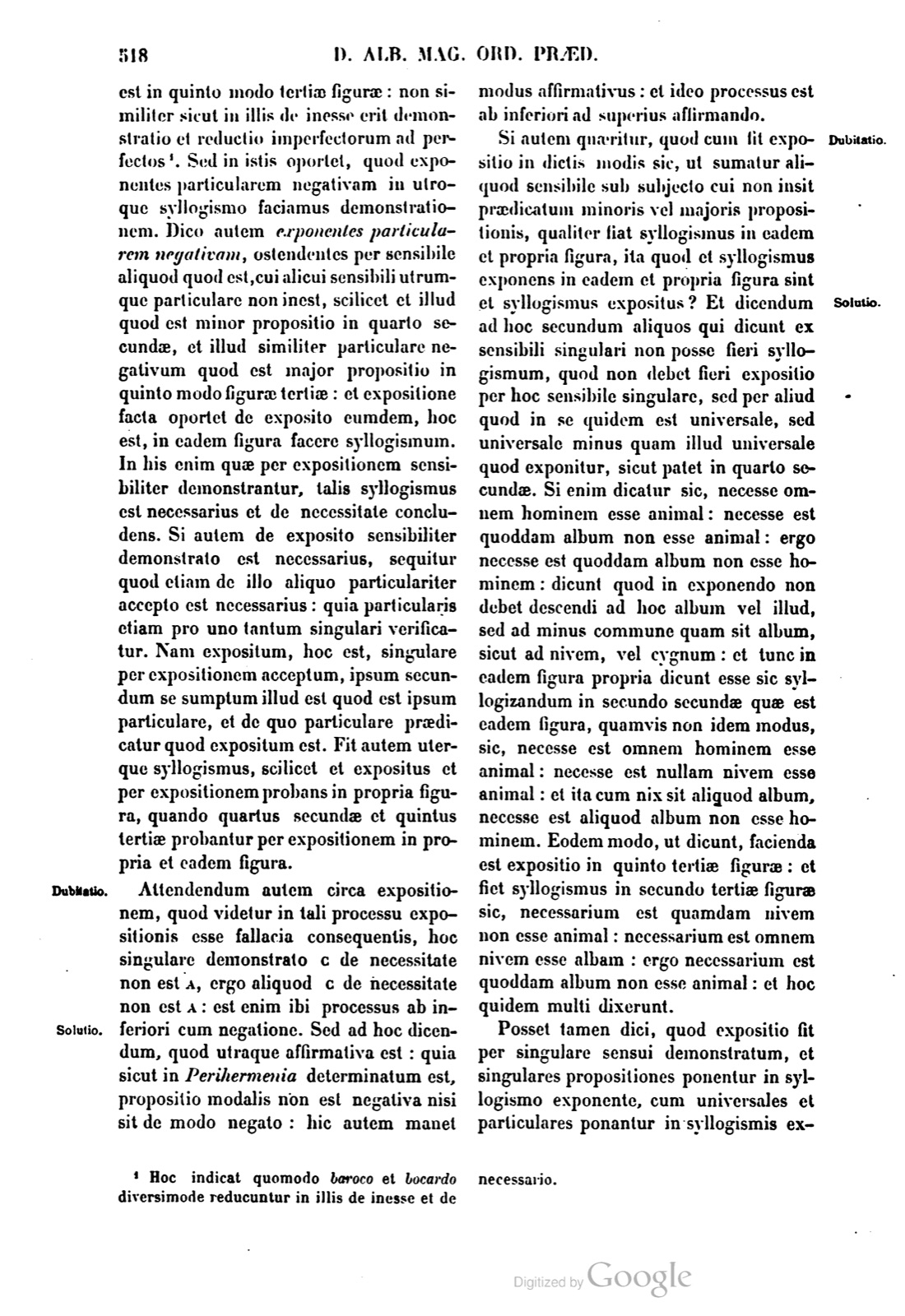
Attendendum autem circa expositionem, quod videtur in tali processu expositionis esse fallacia consequentis, hoc singulare demonstrato C de necessitate non est A, ergo aliquod C de necessitate non est A: est enim ibi processus ab inferiori cum negatione. Sed ad hoc dicendum, quod utraque affirmativa est: quia sicut in Perihermenia determinatum est, propositio modalis non est negativa nisi sit de modo negato: hic autem manet modus affirmativus: et ideo processus est ab inferiori ad superius affirmando.
Si autem quaeritur, quod cum fit expositio in dictis modis sic, ut sumatur aliquod sensibile sub subjecto cui non insit praedicatum minoris vel majoris propositionis, qualiter fiat syllogismus in eadem et propria figura, ita quod et syllogismus exponens in eadem et propria figura sint et syllogismus expositus? Et dicendum ad hoc secundum aliquos qui dicunt ex sensibili singulari non posse fieri syllogismum, quod non debet fieri expositio per hoc sensibile singulare, sed per aliud quod in se quidem est universale, sed universale minus quam illud universale quod exponitur, sicut patet in quarto secundae. Si enim dicatur sic, necesse omnem hominem esse animal: necesse est quoddam album non esse animal: ergo necesse est quoddam album non esse hominem: dicunt quod in exponendo non debet descendi ad hoc album vel illud, sed ad minus commune quam sit album, sicut ad nivem, vel cygnum: et tunc in eadem figura propria dicunt esse sic syllogizandum in secundo secundae quae est eadem figura, quamvis non idem modus, sic, necesse est omnem hominem esse animal: necesse est nullam nivem esse animal: et ita cum nix sit aliquod album, necesse est aliquod album non esse hominem. Eodem modo, ut dicunt, facienda est expositio in quinto tertiae figurae: et fiet syllogismus in secundo tertiae figurae sic, necessarium est quamdam nivem non esse animal: necessarium est omnem nivem esse albam: ergo necessarium est quoddam album non esse animal: et hoc quidem multi dixerunt.
Posset tamen dici, quod expositio fit per singulare sensui demonstratum, et singulares propositiones ponentur in syllogismo exponente, cum universales et particulares ponantur in syllogismis ex
But it must be attended to concerning exposition that in such a process of exposition there seems to be a fallacy of the consequent: this singular C, having been demonstrated, is not A of necessity; therefore some C is not A of necessity. For there is a process there from an inferior with negation. But to this one must say that each proposition is affirmative, because, as was determined in Perihermenia, a modal proposition is not negative unless it is about a negated mode; here, however, the affirmative mode remains, and therefore the process is from inferior to superior by affirming.
But if it is asked, when exposition is made in the stated modes in such a way that some sensible thing is taken under the subject to which the predicate of the minor or major proposition does not belong, how a syllogism is made in the same and proper figure, so that both the syllogism expounding and the syllogism expounded are in the same and proper figure? To this one must say, according to some who say that a syllogism cannot be made from a sensible singular, that exposition should not be made through this sensible singular, but through another thing which is indeed universal in itself, but less universal than that universal which is expounded, as is clear in the fourth of the second. For if it is said thus: necessarily every man is animal; necessarily some white thing is not animal; therefore necessarily some white thing is not man, they say that in expounding one should not descend to this white thing or that one, but to something less common than white, such as to snow or swan; and then in the same proper figure, they say that one must syllogize in the second of the second, which is the same figure, though not the same mode, thus: necessarily every man is animal; necessarily no snow is animal; and so, since snow is some white thing, necessarily some white thing is not man. In the same way, as they say, exposition must be made in the fifth of the third figure; and a syllogism will be made in the second of the third figure thus: it is necessary that some snow is not animal; it is necessary that every snow is white; therefore it is necessary that some white thing is not animal. And many indeed have said this.
Yet it could be said that exposition is made through a singular demonstrated to sense, and singular propositions will be posited in the syllogism expounding, while universal and particular propositions are posited in syllogisms from
Notes
- This indicates how Baroco and Bocardo are reduced in diverse ways in those concerning inherence and concerning the necessary. (Hoc indicat quomodo baroco et bocardo diversimode reducuntur in illis de inesse et de necessario.) ↩
If a page does not appear, its photograph has not been uploaded yet.