Works › Prior Analytics, Books I–II
Volume 1 · pp. 512–515
Chapter XIV. On the premises that have been stated concerning the reduction of syllogisms.
A marker with ≈ is an approximate page boundary, placed by measure of the text; the page photographs remain the authority. In the paired views, clicking a page marker brings that page into view.
CAPUT XIV. De praemissis quae dicta sunt de syllogismorum reductione.
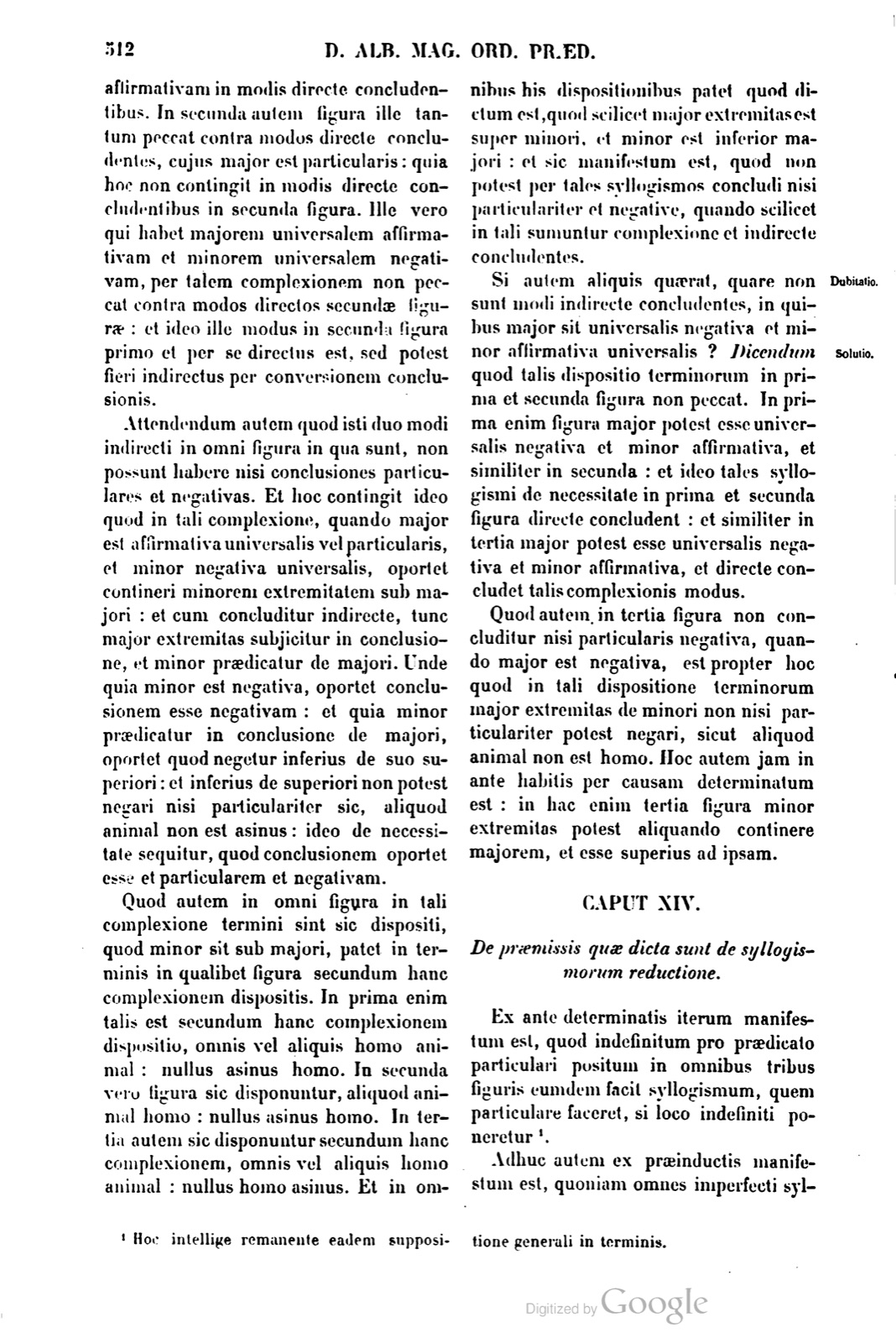
Ex ante determinatis iterum manifestum est, quod indefinitum pro praedicato particulari positum in omnibus tribus figuris eumdem facit syllogismum, quem particulare faceret, si loco indefiniti poneretur1.
Adhuc autem ex praeinductis manifestum est, quoniam omnes imperfecti syllogismi perficiuntur per primam figuram, quae sola perfecta est in seipsa per dici de omni, et dici de nullo. Aut enim clauduntur intra primam figuram et reducuntur per ostensivam probationem, quando propositiones convertuntur vel transponuntur: aut per deductionem ad impossibile in prima figura syllogizantur. Utrinque autem in utroque probationis modo fit prima figura. Sive enim convertantur propositiones, fit prima figura: sive fiat ad impossibile deductio, iterum fit prima figura: conversio enim mutat terminorum dispositionem, et sic mutat figuram. Ad impossibile deductio sumit oppositum conclusionis cum altera praemissarum, in quadam complexione etiam iterum necesse mutari terminorum dispositionem ad dispositionem figurae primae: et ideo quocumque modo fiat probatio, semper fit per primam figuram: ad primam ergo figuram omnes imperfecti modi secundae et tertiae figurae clauduntur. In ostensive vero perfectis ideo reduco ad primam figuram, quia per conversionem et dispositionem terminorum mutatam claudebantur ad primam figuram, ut dictum est. In his autem qui per impossibile demonstrati sunt, fit clausio ad primam figuram in hoc, quod falso posito quod est conclusionis syllogizatae oppositum et sumpto illo falso cum altera praemissarum, in qua complexione iterum mutatur terminorum dispositio, fit syllogismus deducens ad impossibile per primam figuram, sicut patet in primo modo postremae sive tertiae figurae. Si enim ponatur major extremitas quae est A, et minor extremitas quae est B omni C medio inesse, ita quod utraque praemissarum sit universalis affirmativa, scilicet omne C A, omne C B, concluditur, quoniam A alicui B, inest, hoc est, quod aliquod B est A, nam si detur oppositum conclusionis quod nulli B inest A, datum est autem quod B inest omni C, hoc est, quod omne C B, sequitur quod nulli C inerit A: sic syllogizando in secundo primae, nullum B A, et convertitur in hanc, nullum A B, et assumatur minor prioris syllogismi, haec scilicet, omne C B, sequitur in secundo primae quod nullum C A: et dictum fuerat quod omne C esset A, sic ergo etiam illi qui per impossibile probantur, clauduntur intra primam figuram.
Similiter enim est in omnibus aliis syllogismis imperfectis in hoc, quod his duobus modis ad primam figuram reducuntur. Sed tamen non similiter et secundum unum modum omnes reducuntur: sed universales secundae figurae, qui sunt primi duo modi secundae figurae, constat quod per universales primae figurae perficiuntur, et particulares etiam: sed non similiter universales et particulares: sed universales secundae figurae reducuntur in universales primae figurae conversa negativa propositione: et non possunt reduci per impossibile: quia conclusio universalium est universalis: et si sumatur oppositum illius, erit particularis affirmativa: sed in modis universalibus particularis non potest esse praemissa: et ideo modi universales non perficiuntur per ad impossibile deductionem. Particularium autem uterque secundae figurae perficitur per ad impossibile deductionem, sicut in ante habitis dictum est.
CHAPTER XIV. On the premises that have been stated concerning the reduction of syllogisms.
From the things determined before it is again manifest that the indefinite posited in place of the particular predicate makes the same syllogism in all three figures as the particular would make if it were put in place of the indefinite1.
Again, from the things introduced before it is manifest that all imperfect syllogisms are perfected through the first figure, which alone is perfect in itself through being-said-of-every-one and being-said-of-none. For either they are enclosed within the first figure and are reduced through ostensive proof, when propositions are converted or transposed; or they are syllogized through reduction to impossibility in the first figure. In each case, in each mode of proof, the first figure is made. For whether the propositions are converted, the first figure is made; or whether reduction to impossibility is made, again the first figure is made. For conversion changes the disposition of terms, and thus changes the figure. Reduction to impossibility takes the opposite of the conclusion with one of the premises, and in a certain complexion the disposition of terms must again be changed to the disposition of the first figure; and therefore in whatever way the proof is made, it is always made through the first figure. Therefore all imperfect modes of the second and third figure are enclosed to the first figure. But in those perfected ostensively I therefore reduce to the first figure, because through conversion and the changed disposition of terms they were enclosed to the first figure, as has been said. But in those which have been demonstrated through impossibility, enclosure to the first figure occurs in this: that, when the false thing which is the opposite of the syllogized conclusion has been posited and that false thing has been taken with one of the premises, in which complexion the disposition of terms is again changed, a syllogism leading to impossibility is made through the first figure, as is clear in the first mode of the last or third figure. For if the greater extreme, which is A, and the lesser extreme, which is B, are posited as belonging to every C, the middle, so that each premise is universal affirmative, namely every C is A, every C is B, it is concluded that A belongs to some B, that is, that some B is A. For if the opposite of the conclusion is given, that A belongs to no B, but it was given that B belongs to every C, that is, that every C is B, it follows that A will belong to no C, syllogizing thus in the second of the first figure: no B is A, and it is converted into this, no A is B, and let the minor of the prior syllogism be assumed, namely this, every C is B; it follows in the second of the first figure that no C is A. But it had been said that every C was A; therefore in this way even those which are proved through impossibility are enclosed within the first figure.
For it is similar in all the other imperfect syllogisms in this, that they are reduced to the first figure in these two ways. Yet not all are reduced similarly and according to one mode. Rather, as for the universals of the second figure, which are the first two modes of the second figure, it is agreed that they are perfected through universals of the first figure, and the particulars also, but not the universals and particulars in the same way. Rather, the universals of the second figure are reduced into universals of the first figure by conversion of the negative proposition; and they cannot be reduced through impossibility, because the conclusion of universals is universal, and if the opposite of it is taken, it will be a particular affirmative; but in universal modes a particular cannot be a premise, and therefore universal modes are not perfected through reduction to impossibility. But each of the particulars of the second figure is perfected through reduction to impossibility, as was said in what went before.
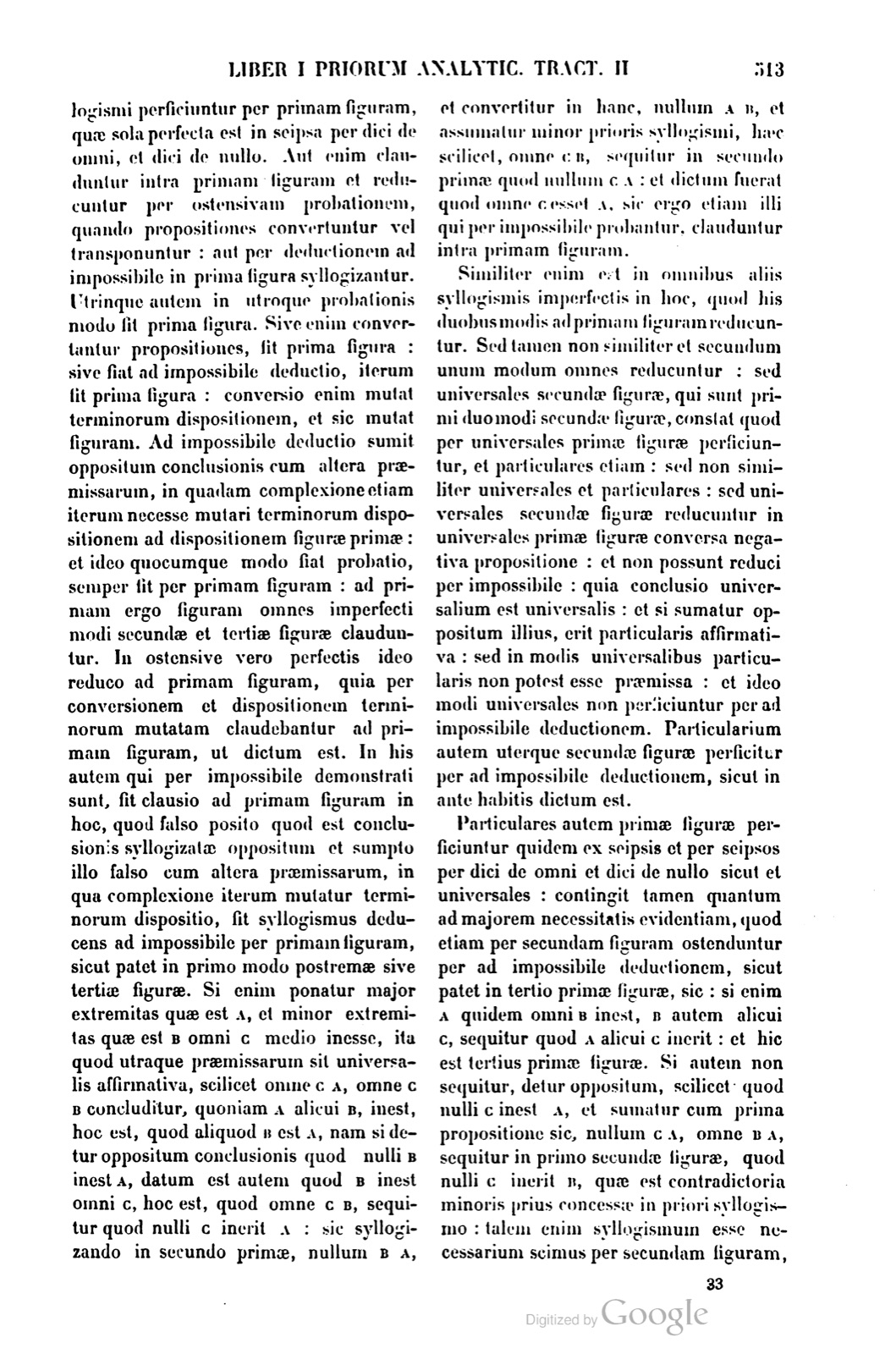
Particulares autem primae figurae perficiuntur quidem ex seipsis et per seipsos per dici de omni et dici de nullo sicut et universales: contingit tamen quantum ad majorem necessitatis evidentiam, quod etiam per secundam figuram ostenduntur per ad impossibile deductionem, sicut patet in tertio primae figurae, sic: si enim A quidem omni B inest, B autem alicui C, sequitur quod A alicui C inerit: et hic est tertius primae figurae. Si autem non sequitur, detur oppositum, scilicet quod nulli C inest A, et sumatur cum prima propositione sic, nullum C A, omne B A, sequitur in primo secundae figurae, quod nulli C inerit B, quae est contradictoria minoris prius concessae in priori syllogismo: talem enim syllogismum esse necessarium scimus per secundam figuram, et per ea quae de dispositione terminorum in secunda figura dicta sunt.
Similiter autem fit demonstratio in quarto primae qui privativus dicitur syllogismus: quia negative concludit. Sic autem hoc probatur. Si enim concedatur A nulli B inesse, sic, nullum B A, et B alicui C concedatur inesse, sic, quod aliquod C B, sequitur in quarto primae, quod A alicui C non inerit. Si enim non sequitur, detur oppositum, scilicet quod A inest omni C, concessum est autem prius quod A nulli B inest: concluditur per primum secundae figurae, quod nulli C inerit B, quod est contradictorium ad hoc quod dictum est in minori propositione prioris syllogismi, quae dixit quod aliquod C fuit B: talis autem syllogismus est in media figura sive secunda.
Propter quod cum syllogismi qui sunt in media figura, omnes reducantur in primae figurae syllogismos universales, quia reducuntur in secundum primae figurae, sicut in ante habitis dictum est: illi vero particulares syllogismi qui sunt in prima figura, reducuntur ad eos qui sunt in media: manifestum est quod etiam particulares primae reducuntur ad illos universales syllogismos qui sunt in prima: et sic omnes syllogismi reducuntur in duos primos primae figurae universales syllogismos: quamvis particulares primae reducantur mediate, et syllogismi aliarum figurarum reducantur immediate.
But the particulars of the first figure are indeed perfected from themselves and through themselves by being-said-of-every-one and being-said-of-none, just as the universals are. Yet with respect to greater evidence of necessity it happens that they are also shown through the second figure by reduction to impossibility, as is clear in the third of the first figure, thus: for if A indeed belongs to every B, but B to some C, it follows that A will belong to some C; and this is the third of the first figure. But if it does not follow, let the opposite be given, namely that A belongs to no C, and let it be taken with the first proposition thus: no C is A; every B is A; it follows in the first of the second figure that B will belong to no C, which is contradictory to the minor previously conceded in the prior syllogism. For we know through the second figure, and through those things which were said about the disposition of terms in the second figure, that such a syllogism is necessary.
Similarly the demonstration is made in the fourth of the first figure, which is called a privative syllogism because it concludes negatively. This is proved in this way. For if A is conceded to belong to no B, thus, no B is A, and B is conceded to belong to some C, thus, that some C is B, it follows in the fourth of the first that A will not belong to some C. For if it does not follow, let the opposite be given, namely that A belongs to every C. But it was previously conceded that A belongs to no B; it is concluded through the first of the second figure that B will belong to no C, which is contradictory to what was said in the minor proposition of the prior syllogism, which said that some C was B. But such a syllogism is in the middle or second figure.
On account of this, since the syllogisms which are in the middle figure are all reduced into universal syllogisms of the first figure, because they are reduced into the second of the first figure, as has been said in what went before, but those particular syllogisms which are in the first figure are reduced to those which are in the middle, it is manifest that even the particulars of the first are reduced to those universal syllogisms which are in the first. And thus all syllogisms are reduced into the two first universal syllogisms of the first figure, although the particulars of the first are reduced mediately, and syllogisms of the other figures are reduced immediately.
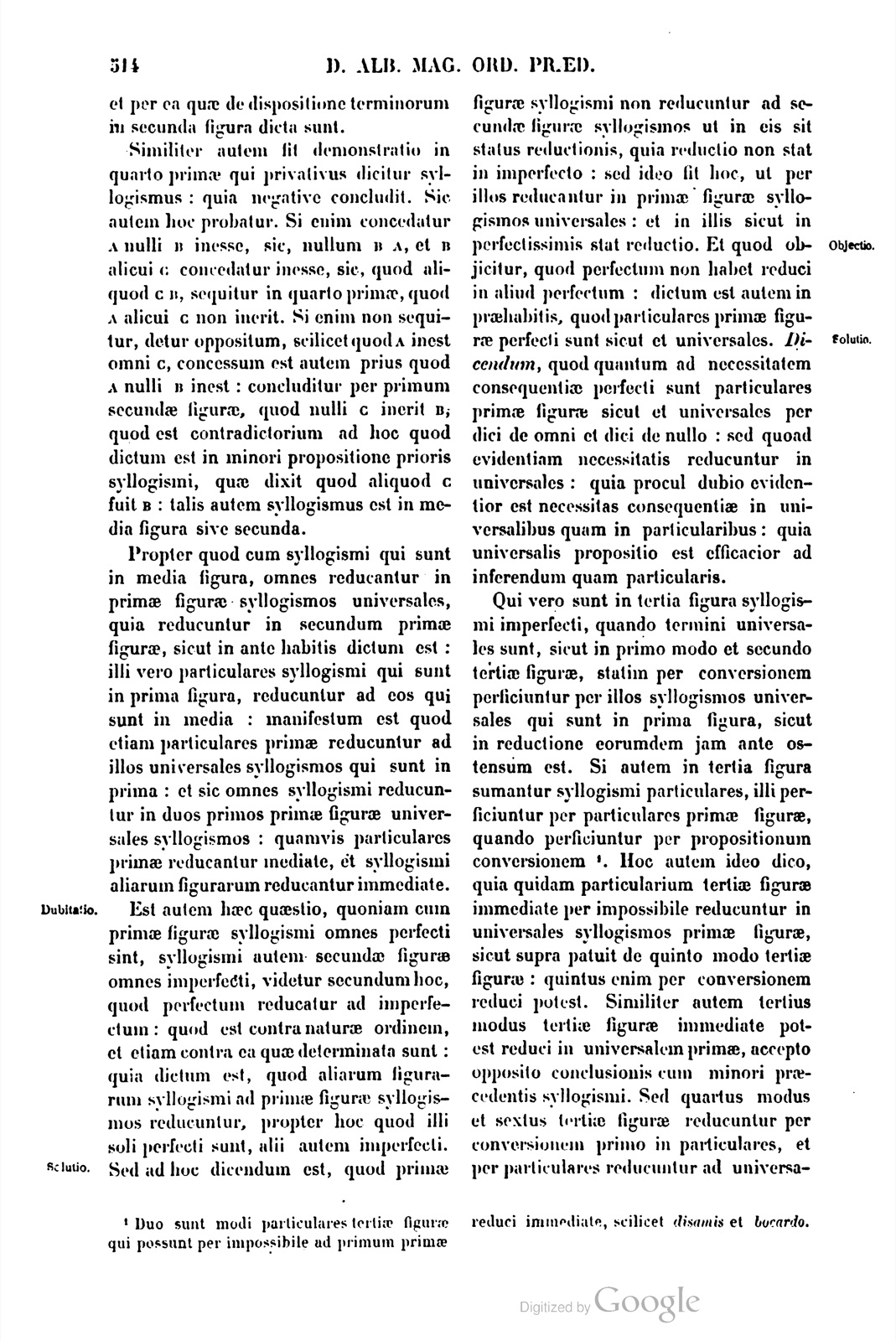
Est autem haec quaestio, quoniam cum primae figurae syllogismi omnes perfecti sint, syllogismi autem secundae figurae omnes imperfecti, videtur secundum hoc, quod perfectum reducatur ad imperfectum: quod est contra naturae ordinem, et etiam contra ea quae determinata sunt: quia dictum est, quod aliarum figurarum syllogismi ad primae figurae syllogismos reducuntur, propter hoc quod illi soli perfecti sunt, alii autem imperfecti. Sed ad hoc dicendum est, quod primae figurae syllogismi non reducuntur ad secundae figurae syllogismos ut in eis sit status reductionis, quia reductio non stat in imperfecto: sed ideo fit hoc, ut per illos reducantur in primae figurae syllogismos universales: et in illis sicut in perfectissimis stat reductio. Et quod objicitur, quod perfectum non habet reduci in aliud perfectum: dictum est autem in praehabitis, quod particulares primae figurae perfecti sunt sicut et universales. Dicendum, quod quantum ad necessitatem consequentiae perfecti sunt particulares primae figurae sicut et universales per dici de omni et dici de nullo: sed quoad evidentiam necessitatis reducuntur in universales: quia procul dubio evidentior est necessitas consequentiae in universalibus quam in particularibus: quia universalis propositio est efficacior ad inferendum quam particularis.
Qui vero sunt in tertia figura syllogismi imperfecti, quando termini universales sunt, sicut in primo modo et secundo tertiae figurae, statim per conversionem perficiuntur per illos syllogismos universales qui sunt in prima figura, sicut in reductione eorumdem jam ante ostensum est. Si autem in tertia figura sumantur syllogismi particulares, illi perficiuntur per particulares primae figurae, quando perficiuntur per propositionum conversionem2. Hoc autem ideo dico, quia quidam particularium tertiae figurae immediate per impossibile reducuntur in universales syllogismos primae figurae, sicut supra patuit de quinto modo tertiae figurae: quintus enim per conversionem reduci potest. Similiter autem tertius modus tertiae figurae immediate potest reduci in universalem primae, accepto opposito conclusionis cum minori praecedentis syllogismi. Sed quartus modus et sextus tertiae figurae reducuntur per conversionem primo in particulares, et per particulares reducuntur ad universales. Tertius autem et per conversionem reducitur in particulares, et per impossibile in universales. Quintus autem per conversionem nullo modo potest reduci, sed per impossibile statim immediate reducitur ad universalem primae.
But there is this question: since syllogisms of the first figure are all perfect, but syllogisms of the second figure are all imperfect, according to this it seems that the perfect is reduced to the imperfect, which is against the order of nature and also against those things which have been determined, because it was said that syllogisms of the other figures are reduced to syllogisms of the first figure because those alone are perfect, but the others are imperfect. But to this one must say that syllogisms of the first figure are not reduced to syllogisms of the second figure so that the standstill of reduction would be in them, because reduction does not stand in the imperfect. But this occurs so that through them they may be reduced into the universal syllogisms of the first figure; and in those, as in the most perfect, the reduction stands. And as to what is objected, that the perfect need not be reduced into another perfect, while it was said in what went before that the particulars of the first figure are perfect just as the universals are, one must say that with respect to the necessity of consequence the particulars of the first figure are perfect, like the universals, through being-said-of-every-one and being-said-of-none. But with respect to the evidence of necessity they are reduced into universals, because without doubt the necessity of consequence is more evident in universals than in particulars, since a universal proposition is more efficacious for inferring than a particular.
But those syllogisms which are imperfect in the third figure, when the terms are universal, as in the first and second mode of the third figure, are immediately perfected through conversion by those universal syllogisms which are in the first figure, as was already shown before in the reduction of the same. But if particular syllogisms are taken in the third figure, those are perfected through particulars of the first figure, when they are perfected through conversion of propositions2. I say this, however, because certain particulars of the third figure are reduced immediately through impossibility into universal syllogisms of the first figure, as was clear above concerning the fifth mode of the third figure; for the fifth can be reduced by conversion. Similarly the third mode of the third figure can be reduced immediately into a universal of the first by taking the opposite of the conclusion with the minor of the preceding syllogism. But the fourth and sixth modes of the third figure are reduced through conversion first into particulars, and through particulars they are reduced to universals. But the third is reduced both through conversion into particulars and through impossibility into universals. The fifth, however, can in no way be reduced through conversion, but through impossibility it is immediately reduced at once to the universal of the first.
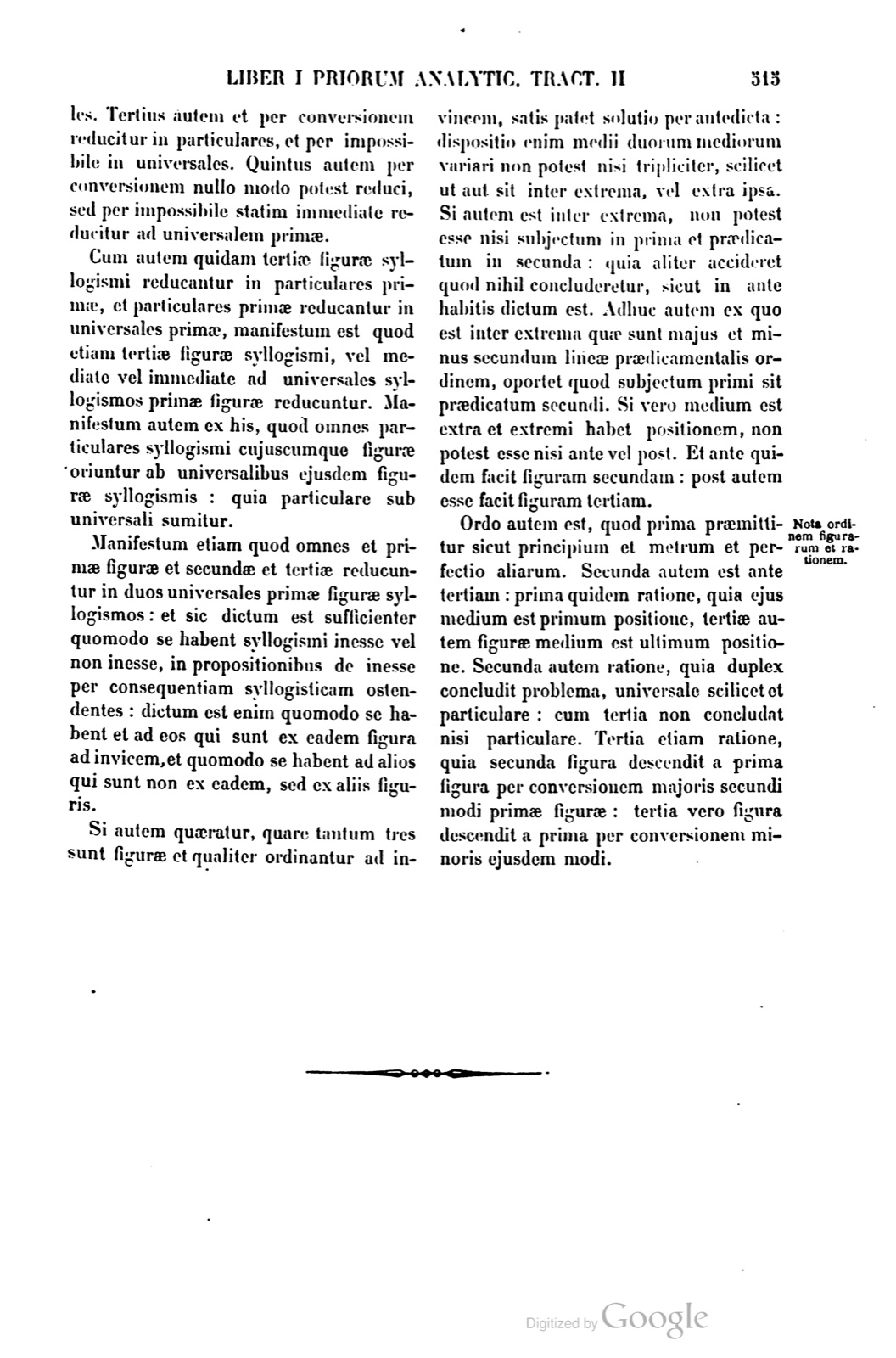
Cum autem quidam tertiae figurae syllogismi reducantur in particulares primae, et particulares primae reducantur in universales primae, manifestum est quod etiam tertiae figurae syllogismi, vel mediate vel immediate ad universales syllogismos primae figurae reducuntur. Manifestum autem ex his, quod omnes particulares syllogismi cujuscumque figurae oriuntur ab universalibus ejusdem figurae syllogismis: quia particulare sub universali sumitur.
Manifestum etiam quod omnes et primae figurae et secundae et tertiae reducuntur in duos universales primae figurae syllogismos: et sic dictum est sufficienter quomodo se habent syllogismi inesse vel non inesse, in propositionibus de inesse per consequentiam syllogisticam ostendentes: dictum est enim quomodo se habent et ad eos qui sunt ex eadem figura ad invicem, et quomodo se habent ad alios qui sunt non ex eadem, sed ex aliis figuris.
Si autem quaeratur, quare tantum tres sunt figurae et qualiter ordinantur ad invicem, satis patet solutio per antedicta: dispositio enim medii duorum mediorum variari non potest nisi tripliciter, scilicet ut aut sit inter extrema, vel extra ipsa. Si autem est inter extrema, non potest esse nisi subjectum in prima et praedicatum in secunda: quia aliter accideret quod nihil concluderetur, sicut in ante habitis dictum est. Adhuc autem ex quo est inter extrema quae sunt majus et minus secundum lineae praedicamentalis ordinem, oportet quod subjectum primi sit praedicatum secundi. Si vero medium est extra et extremi habet positionem, non potest esse nisi ante vel post. Et ante quidem facit figuram secundam: post autem esse facit figuram tertiam.
Ordo autem est, quod prima praemittitur sicut principium et metrum et perfectio aliarum. Secunda autem est ante tertiam: prima quidem ratione, quia ejus medium est primum positione, tertiae autem figurae medium est ultimum positione. Secunda autem ratione, quia duplex concludit problema, universale scilicet et particulare: cum tertia non concludat nisi particulare. Tertia etiam ratione, quia secunda figura descendit a prima figura per conversionem majoris secundi modi primae figurae: tertia vero figura descendit a prima per conversionem minoris ejusdem modi.
But since certain syllogisms of the third figure are reduced into particulars of the first, and particulars of the first are reduced into universals of the first, it is manifest that syllogisms of the third figure too are reduced, either mediately or immediately, to universal syllogisms of the first figure. But from these things it is manifest that all particular syllogisms of whatever figure arise from universal syllogisms of the same figure, because the particular is taken under the universal.
It is also manifest that all syllogisms, both of the first figure and of the second and third, are reduced into the two universal syllogisms of the first figure. And thus it has been said sufficiently how syllogisms of inherence or non-inherence stand, showing in propositions of inherence by syllogistic consequence; for it has been said how they stand both toward those which are from the same figure in relation to one another, and how they stand toward others which are not from the same figure but from other figures.
But if it is asked why there are only three figures, and how they are ordered to one another, the solution is sufficiently clear through the foregoing. For the disposition of the middle of the two middles cannot be varied except triply, namely so that it is either between the extremes, or outside them. But if it is between the extremes, it cannot be except as subject in the first and predicate in the second, because otherwise it would occur that nothing would be concluded, as has been said in what went before. Again, since it is between the extremes, which are greater and lesser according to the order of the categorial line, the subject of the first must be the predicate of the second. But if the middle is outside and has the position of an extreme, it can only be before or after. Being before makes the second figure; being after makes the third figure.
The order, however, is that the first is put before the others as the principle and measure and perfection of the others. But the second is before the third: first, by reason that its middle is first in position, while the middle of the third figure is last in position; second, by reason that it concludes a twofold problem, namely universal and particular, while the third concludes only the particular; third also, by reason that the second figure descends from the first figure through conversion of the major of the second mode of the first figure, while the third figure descends from the first through conversion of the minor of the same mode.
Notes
- Understand this while the same general supposition remains in the terms. (Hoc intellige remanente eadem suppositione generali in terminis.) ↩
- There are two particular modes of the third figure which can be reduced immediately through impossibility to the first of the first figure, namely Disamis and Bocardo. (Duo sunt modi particulares tertiae figurae qui possunt per impossibile ad primum primae reduci immediate, scilicet disamis et bocardo.) ↩
If a page does not appear, its photograph has not been uploaded yet.