Works › Prior Analytics, Books I–II
Volume 1 · p. 507
Continuation of Chapter XI on page 507
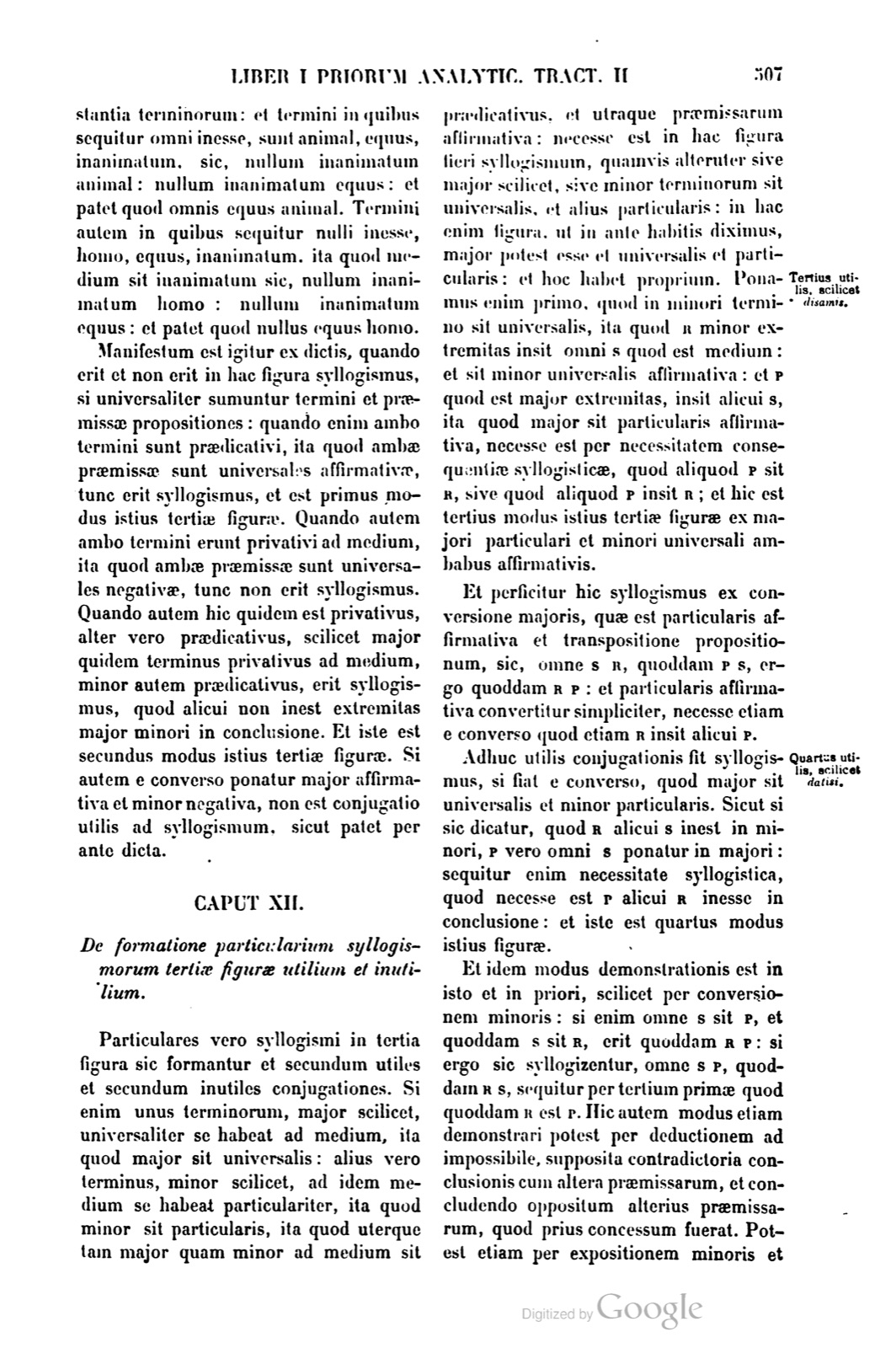
instantia terminorum: et termini in quibus sequitur omni inesse, sunt animal, equus, inanimatum, sic, nullum inanimatum animal: nullum inanimatum equus: et patet quod omnis equus animal. Termini autem in quibus sequitur nulli inesse, homo, equus, inanimatum, ita quod medium sit inanimatum sic, nullum inanimatum homo: nullum inanimatum equus: et patet quod nullus equus homo.
Manifestum est igitur ex dictis, quando erit et non erit in hac figura syllogismus, si universaliter sumuntur termini et praemissae propositiones: quando enim ambo termini sunt praedicativi, ita quod ambae praemissae sunt universales affirmativae, tunc erit syllogismus, et est primus modus istius tertiae figurae. Quando autem ambo termini erunt privativi ad medium, ita quod ambae praemissae sunt universales negativae, tunc non erit syllogismus. Quando autem hic quidem est privativus, alter vero praedicativus, scilicet major quidem terminus privativus ad medium, minor autem praedicativus, erit syllogismus, quod alicui non inest extremitas major minori in conclusione. Et iste est secundus modus istius tertiae figurae. Si autem e converso ponatur major affirmativa et minor negativa, non est conjugatio utilis ad syllogismum, sicut patet per ante dicta.
an instance of terms; and the terms in which belonging to every one follows are animal, horse, inanimate, thus: no inanimate thing is animal; no inanimate thing is horse; and it is clear that every horse is animal. But the terms in which belonging to no one follows are man, horse, inanimate, so that the middle is inanimate, thus: no inanimate thing is man; no inanimate thing is horse; and it is clear that no horse is man.
Therefore it is manifest from the things said when there will and will not be a syllogism in this figure, if the terms and premised propositions are taken universally: for when both terms are predicative, so that both premises are universal affirmatives, then there will be a syllogism, and it is the first mode of this third figure. But when both terms are privative with respect to the middle, so that both premises are universal negatives, then there will not be a syllogism. But when this one is privative and the other predicative, namely when the major term is privative with respect to the middle but the minor is predicative, there will be a syllogism, because the greater extreme does not belong to some lesser in the conclusion. And this is the second mode of this third figure. But if conversely the major is posited as affirmative and the minor negative, it is not a useful conjugation for a syllogism, as is clear through what has been said before.
If a page does not appear, its photograph has not been uploaded yet.