Works › Prior Analytics, Books I–II
Volume 1 · pp. 507–510
Chapter XII. On the formation of particular syllogisms of the third figure, useful and useless.
A marker with ≈ is an approximate page boundary, placed by measure of the text; the page photographs remain the authority. In the paired views, clicking a page marker brings that page into view.
CAPUT XII. De formatione particularium syllogismorum tertiae figurae utilium et inutilium.
Particulares vero syllogismi in tertia figura sic formantur et secundum utiles et secundum inutiles conjugationes. Si enim unus terminorum, major scilicet, universaliter se habeat ad medium, ita quod major sit universalis: alius vero terminus, minor scilicet, ad idem medium se habeat particulariter, ita quod minor sit particularis, ita quod uterque tam major quam minor ad medium sit praedicativus, et utraque praemissarum affirmativa: necesse est in hac figura fieri syllogismum, quamvis alteruter sive major scilicet, sive minor terminorum sit universalis, et alius particularis: in hac enim figura, ut in ante habitis diximus, major potest esse et universalis et particularis: et hoc habet proprium.
Ponamus enim primo, quod in minori termino sit universalis, ita quod R minor extremitas insit omni S quod est medium: et sit minor universalis affirmativa: et P quod est major extremitas, insit alicui S, ita quod major sit particularis affirmativa, necesse est per necessitatem consequentiae syllogisticae, quod aliquod P sit R, sive quod aliquod P insit R; et hic est tertius modus istius tertiae figurae ex majori particulari et minori universali ambabus affirmativis.
Et perficitur hic syllogismus ex conversione majoris, quae est particularis affirmativa et transpositione propositionum, sic, omne S R, quoddam P S, ergo quoddam R P: et particularis affirmativa convertitur simpliciter, necesse etiam e converso quod etiam R insit alicui P.
Adhuc utilis conjugationis fit syllogismus, si fiat e converso, quod major sit universalis et minor particularis. Sicut si sic dicatur, quod R alicui S inest in minori, P vero omni S ponatur in majori: sequitur enim necessitate syllogistica, quod necesse est P alicui R inesse in conclusione: et iste est quartus modus istius figurae.
Et idem modus demonstrationis est in isto et in priori, scilicet per conversionem minoris: si enim omne S sit P, et quoddam S sit R, erit quoddam R P: si ergo sic syllogizentur, omne S P, quoddam R S, sequitur per tertium primae quod quoddam R est P. Hic autem modus etiam demonstrari potest per deductionem ad impossibile, supposita contradictoria conclusionis cum altera praemissarum, et concludendo oppositum alterius praemissarum, quod prius concessum fuerat. Potest etiam per expositionem minoris et conclusionis demonstrari ad sensum: quia quandocumque proferatur particulare sub medio sumptum et ad sensum demonstratum (cui inest major extremitas) tunc verificata erit particularis propositio.
Adhuc autem utilis conjugationis erit syllogismus in hac figura, si unus quidem terminorum fuerit praedicativus et alter privativus, dummodo minor fuerit praedicativus: quia hoc habet proprium ista figura, quod minorem semper vult habere affirmativam: et quando sic se habent termini, tunc erit syllogismus: et est istius figurae modus quintus: nam R minor extremitas inest omni S in minori propositione: et P quod est major extremitas, non inest alicui S in majori propositione: necessitate syllogistica sequitur quod necesse est P majorem extremitatem alicui R hoc est, minori extremitati non inesse, sic syllogizando: quoddam S non est P, omne S est R, ergo quoddam R non est P.
CHAPTER XII. On the formation of particular syllogisms of the third figure, useful and useless.
But particular syllogisms in the third figure are formed in this way, both according to useful and according to useless conjugations. For if one of the terms, namely the major, has itself universally to the middle, so that the major is universal, but the other term, namely the minor, has itself particularly to the same middle, so that the minor is particular, in such a way that each, both major and minor, is predicative with respect to the middle, and each of the premises is affirmative, then it is necessary that a syllogism be made in this figure, although either one, namely either the major or the minor of the terms, is universal and the other particular; for in this figure, as we have said in what went before, the major can be both universal and particular, and it has this as proper.
Therefore let us first posit that there is a universal in the minor term, so that R, the lesser extreme, belongs to every S, which is the middle, and let the minor be universal affirmative; and let P, which is the greater extreme, belong to some S, so that the major is particular affirmative. By the necessity of syllogistic consequence it is necessary that some P be R, or that some P belong to R; and this is the third mode of this third figure from a particular major and universal minor, both affirmative.
And this syllogism is perfected from conversion of the major, which is particular affirmative, and from transposition of the propositions, thus: every S is R; some P is S; therefore some R is P. And the particular affirmative is converted simply; conversely it is also necessary that R belongs to some P.
Again, a syllogism of useful conjugation is made if it occurs conversely, that the major is universal and the minor particular. As if it is said thus, that R belongs to some S in the minor, but P is posited in the major as belonging to every S: for it follows by syllogistic necessity that P must belong to some R in the conclusion; and this is the fourth mode of this figure.
And the same mode of demonstration exists in this one and in the prior one, namely through conversion of the minor: for if every S is P, and some S is R, there will be some R P. Therefore if they are syllogized thus, every S is P; some R is S; it follows through the third of the first figure that some R is P. But this mode can also be demonstrated by reduction to impossibility, when the contradictory of the conclusion is supposed with one of the premises, and the opposite of the other premise, which had previously been conceded, is concluded. It can also be demonstrated to sense through exposition of the minor and conclusion, because whenever a particular taken under the middle and demonstrated to sense is brought forward, to which the greater extreme belongs, then the particular proposition will have been verified.
Again, there will be a syllogism of useful conjugation in this figure if one of the terms is predicative and the other privative, provided the minor is predicative; because this figure has this as proper, that it always wants to have the minor affirmative. And when the terms have themselves in this way, then there will be a syllogism, and it is the fifth mode of this figure: for R, the lesser extreme, belongs to every S in the minor proposition; and P, which is the greater extreme, does not belong to some S in the major proposition. By syllogistic necessity it follows that it is necessary for P, the greater extreme, not to belong to some R, that is, to the lesser extreme, syllogizing thus: some S is not P; every S is R; therefore some R is not P.
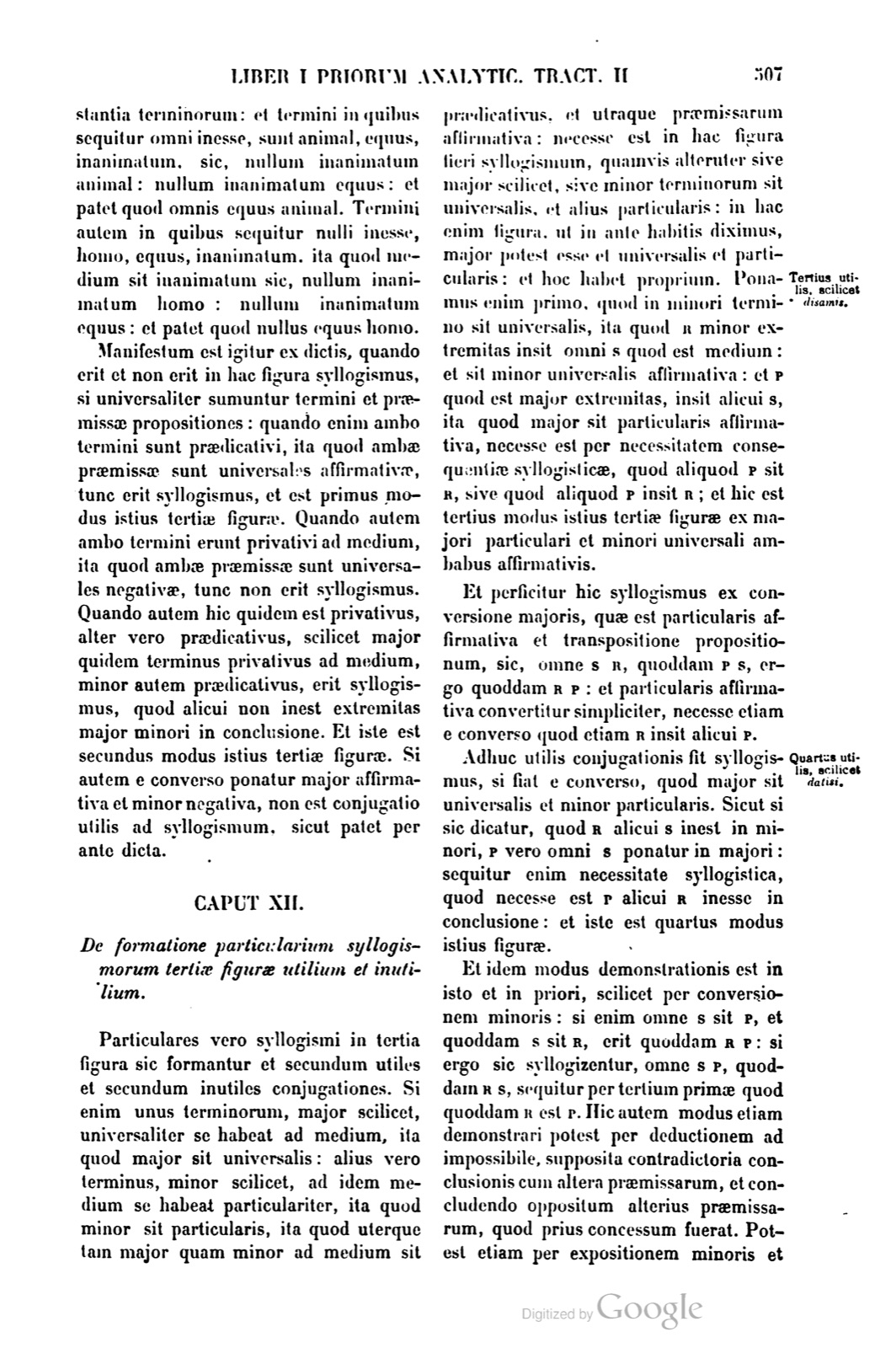
Et probatur hic modus per deductionem ad impossibile: detur enim oppositum conclusionis, quod scilicet P inest omni R, datum est autem quod omni S inest R, sequitur quod omni S inerit P. Datum autem fuerat, quod non omni in majori prioris syllogismi. Hoc autem modo sciatur etiam sine deductione ad impossibile per simplicem expositionem, si sumatur aliquid eorum singularium quae sunt sub S medio, cui non inest P major extremitas: particularis enim pro uno solo singulari verificatur.
Si autem propositiones sint dissimilis qualitatis et dissimilis quantitatis, et major fuerit terminus praedicativus ad medium, et minor privativus, erit inutilis conjugatio, et non syllogismus, ut si dicamus, quod P quidem omni S insit in majori propositione, R autem in minori propositione alicui S non insit: quia sicut diximus, minor in hac figura non potest esse negativa. Et probatur istius conjugationis inutilitas per instantiam terminorum. Termini autem in quibus sequitur omni inesse, sunt animatum, homo, animal, sic, omne animal animatum: quoddam animal non homo: et patet quod omnis homo animatus. In quibus autem sequitur nulli inesse, non est sumere terminos si particularis sit vera particulariter: quia tunc R alicui S inest, et alicui non inest. Probatur autem deducendo ad impossibile, quod terminos ad nulli inesse non est sumere. Si enim omni S inest P, sicut dicit major propositio, R autem alicui inest S, sicut supponit minor particulariter vera propositio: tunc sequitur per tertium primae figurae syllogismum, quod P inest alicui R; sed qui dicit, quod est sumere terminos in quibus sequitur nulli inesse, dicit per consequens, quod nulli R inest P; patet ergo quod terminos nulli inesse non est sumere. Sed conjugationis hujus inutilitas ostendenda est quodam modo in prioribus ex indefinito particularis negativae: alicui enim non inesse est indefinitum, et indefinitam habet causam suae veritatis1: si enim nulli insit, verum est alicui non inesse: et si alicui non insit, verum est cuidam non inesse: quando autem est vera, eo quod nulli insit, ita quod minor sit universalis negativa, non erit syllogismus, ut jam ante probatum est: ergo manifestum est, quoniam omni alicui non inesse non potest esse syllogismus: quia alicui non inesse sequitur ad nulli inesse: et si daretur esse syllogismus omni nulli inesse, concluderetur statim etiam esse syllogismum omni alicui non inesse. Econtra autem negato nulli inesse, negatur alicui non inesse: et ideo non existente syllogismo omni nulli, sequitur non inesse syllogismum omni alicui non.
And this mode is proved through reduction to impossibility. For let the opposite of the conclusion be given, namely that P belongs to every R; but it was given that R belongs to every S; it follows that P will belong to every S. But it had been given in the major of the prior syllogism that it did not belong to every one. In this way this may also be known, even without reduction to impossibility, through simple exposition, if some one of the singulars which are under S, the middle, is taken, to which P, the greater extreme, does not belong; for a particular is verified even for one singular alone.
But if the propositions are of dissimilar quality and dissimilar quantity, and the major term is predicative with respect to the middle, but the minor privative, there will be a useless conjugation and not a syllogism, as if we say that P indeed belongs to every S in the major proposition, but R in the minor proposition does not belong to some S; because, as we have said, the minor in this figure cannot be negative. And the uselessness of this conjugation is proved through an instance of terms. The terms in which belonging to every one follows are animated, man, animal, thus: every animal is animated; some animal is not man; and it is clear that every man is animated. But in the cases in which belonging to no one follows, terms cannot be taken if the particular is particularly true, because then R belongs to some S and does not belong to some. But it is proved by reducing to impossibility that terms for belonging to no one cannot be taken. For if P belongs to every S, as the major proposition says, but R belongs to some S, as the particularly true minor proposition supposes, then it follows through a syllogism in the third mode of the first figure that P belongs to some R. But he who says that terms in which belonging to no one follows can be taken says consequently that P belongs to no R. Therefore it is clear that terms for belonging to no one cannot be taken. But the uselessness of this conjugation must in a certain way be shown in the prior cases from the indefinite character of the particular negative; for "not to belong to some" is indefinite, and has an indefinite cause of its truth1. For if it belongs to none, it is true that it does not belong to some; and if it does not belong to some, it is true that it does not belong to a certain one. But when it is true because it belongs to none, so that the minor is universal negative, there will not be a syllogism, as has already been proved; therefore it is manifest that a syllogism cannot exist in every case of not-belonging-to-some, because not-belonging-to-some follows upon belonging-to-none. And if a syllogism for every belonging-to-none were granted to exist, it would immediately also be concluded that a syllogism exists for every not-belonging-to-some. But conversely, when belonging-to-none is denied, not-belonging-to-some is denied; and therefore, when there is no syllogism for every belonging-to-none, it follows that there is no syllogism for every not-belonging-to-some.
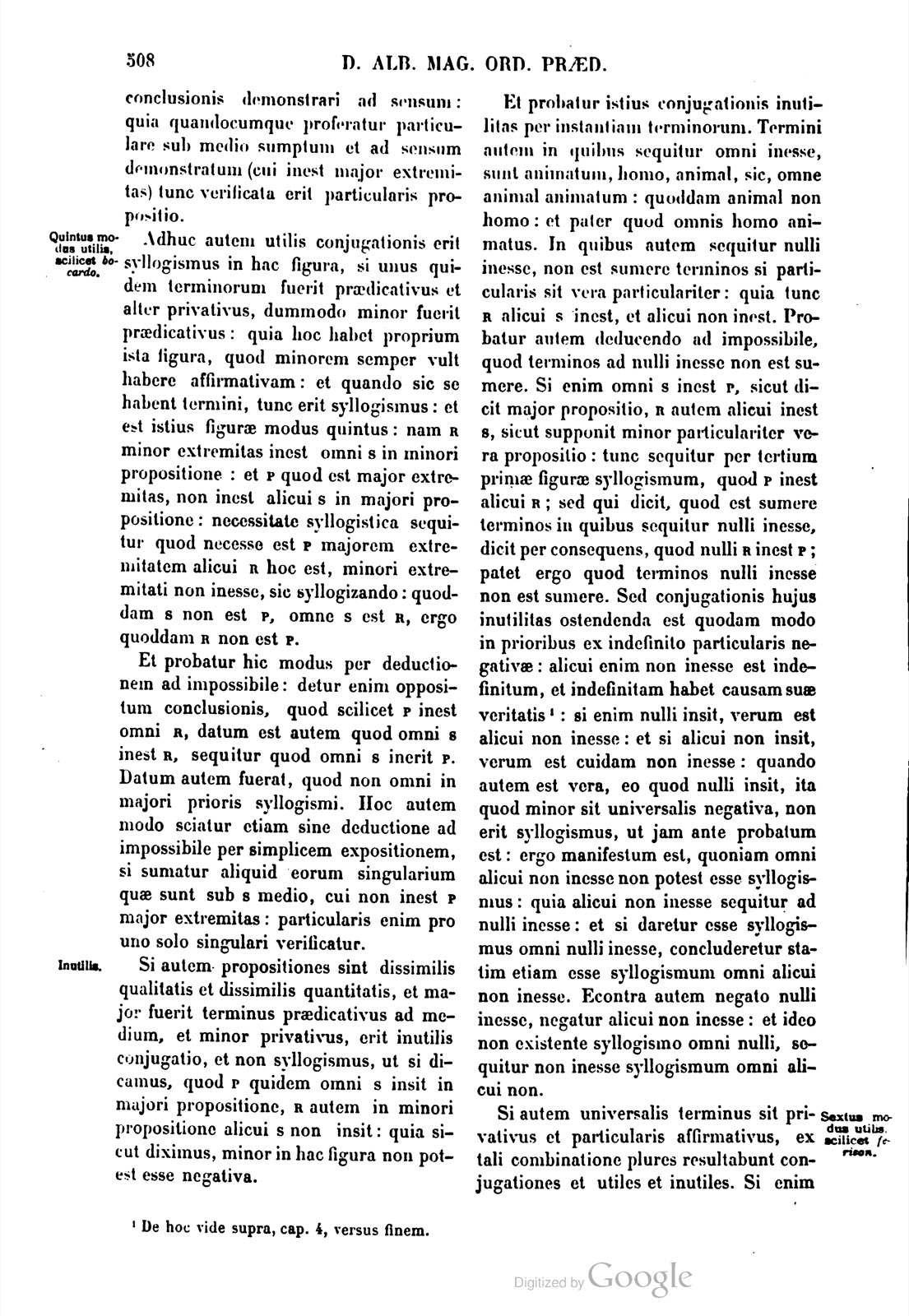
Si autem universalis terminus sit privativus et particularis affirmativus, ex tali combinatione plures resultabunt conjugationes et utiles et inutiles. Si enim major fuerit universalis privativus, et minor terminus ad medium erit particularis et praedicativus, erit utilis conjugationis syllogismus. Si enim P major extremitas nulli insit S in majori propositione, R autem alicui insit S in minori propositione: sequitur de necessitate syllogistica, quod P non inerit alicui R. Erit enim ex isto prima figura per reductionem, quando convertitur minor propositio quae est particularis affirmativa sic, nullum S P, quoddam R S, ergo quoddam R non est P: hic enim est quartus modus primae figurae: hic ergo syllogismus est istius figurae modus sextus.
Quando autem minor terminus erit privativus et major affirmativus, nunquam erit utilis conjugationis syllogismus: inutilitas enim talis conjugationis per instantias probatur terminorum. In his enim terminis, animal, homo, ferrum, sequitur omni inesse sic, omne ferrum animal: quoddam ferrum non est homo: patet quod omnis homo animal. Termini autem in quibus sequitur nulli inesse in eadem complexione, sunt animal, scientia, ferrum, sic, omne ferrum animal: aliquid ferrum non est scientia: patet quod virtute terminorum concluditur nulla scientia animal: medium autem in utrisque his terminis est ferrum secundum hujus tertiae figurae dispositionem.
Nec iterum quando ambo termini ponuntur esse privativi: quia hoc generale est in omnibus figuris, quod ex ambabus negativis nihil sequatur syllogistice: possunt enim esse ambae negativae in dispari quantitate, ita quod unus terminorum sit universalis, et alter particularis. Probatur autem inutilitas istius conjugationis per instantias terminorum: si enim minor sit universalis, et major particularis et ambae negativae, termini in quibus sequitur omni inesse, sunt animal, homo, ferrum, sic, quoddam ferrum non est animal: omne ferrum non est homo: patet quod ex habitudine terminorum sequitur quod omnis homo est animal. Termini in quibus sequitur nulli inesse, sunt animal, scientia, ferrum, sic, quoddam ferrum non est animal: omne ferrum non est scientia: patet quod ex habitudine terminorum sequitur, nulla scientia animal.
Quando autem major est universalis et minor particularis et ambae negativae, termini in quibus sequitur nulli inesse, sunt corvus, nix, album, sic, nullum album corvus: quoddam album non est nix: patet quod ex habitudine terminorum sequetur: ergo nulla nix corvus. Terminos in quibus sequitur omni inesse non contingit dare si minor particulariter sit vera, ita quod alicui S inest R, et alicui non inest, eadem de causa quae saepius dicta est. Si enim dicat aliquis, quod dare contingit in tali complexione terminos ex quibus sequatur omni inesse: tunc accipiatur hoc, et dicatur quod secundum hoc contingit, quod P inest omni R: sed datum erat prius quod R inest alicui S: sequitur de necessario quod P inerit alicui S, et positum fuit nulli inesse in majori propositione: ergo terminos omni inesse non contingit sumere. Sed inutilitas hujus conjugationis monstranda est ex indefinito particularis negativae, per omnem eumdem modum sicut prius, quod scilicet particularis negativa pro sensu universalis verificetur, et universalis negativa in cujus sensu particularis verificatur, loco particularis ponatur, et ex prius dictis concludatur inutilitas conjugationis.
But if the universal term is privative and the particular affirmative, from such a combination many conjugations will result, both useful and useless. For if the major is universal privative and the minor term toward the middle is particular and predicative, there will be a syllogism of useful conjugation. For if P, the greater extreme, belongs to no S in the major proposition, but R belongs to some S in the minor proposition, it follows by syllogistic necessity that P will not belong to some R. For from this there will be the first figure by reduction, when the minor proposition, which is particular affirmative, is converted thus: no S is P; some R is S; therefore some R is not P. For this is the fourth mode of the first figure; therefore this syllogism is the sixth mode of this figure.
But when the minor term is privative and the major affirmative, there will never be a syllogism of useful conjugation; for the uselessness of such a conjugation is proved through instances of terms. For in these terms, animal, man, iron, belonging to every one follows thus: every iron is animal; some iron is not man; it is clear that every man is animal. But the terms in which belonging to no one follows in the same complexion are animal, science, iron, thus: every iron is animal; some iron is not science; it is clear that by the power of the terms no science is concluded to be animal. But the middle in both sets of terms is iron according to the disposition of this third figure.
Nor again when both terms are posited as privative: because this is general in all figures, that from both negatives nothing follows syllogistically. For both negatives can be in unequal quantity, so that one of the terms is universal and the other particular. But the uselessness of this conjugation is proved through instances of terms: for if the minor is universal and the major particular and both are negative, the terms in which belonging to every one follows are animal, man, iron, thus: some iron is not animal; every iron is not man; it is clear that from the relation of the terms it follows that every man is animal. The terms in which belonging to no one follows are animal, science, iron, thus: some iron is not animal; every iron is not science; it is clear that from the relation of the terms it follows that no science is animal.
But when the major is universal and the minor particular, and both are negative, the terms in which belonging to no one follows are raven, snow, white, thus: no white thing is a raven; some white thing is not snow; it is clear that from the relation of the terms it will follow: therefore no snow is a raven. But terms in which belonging to every one follows cannot be given if the minor is particularly true, so that R belongs to some S and does not belong to some, for the same cause that has more often been stated. For if someone says that in such a complexion it is possible to give terms from which belonging to every one follows, then let this be accepted, and let it be said that according to this it happens that P belongs to every R. But it had previously been given that R belongs to some S; it follows necessarily that P will belong to some S, and it had been posited in the major proposition as belonging to none; therefore terms for belonging to every one cannot be taken. But the uselessness of this conjugation must be shown from the indefinite character of the particular negative, in altogether the same way as before, namely that the particular negative is verified according to the sense of the universal, and the universal negative in whose sense the particular is verified is put in place of the particular, and from what was said before the uselessness of the conjugation is concluded.
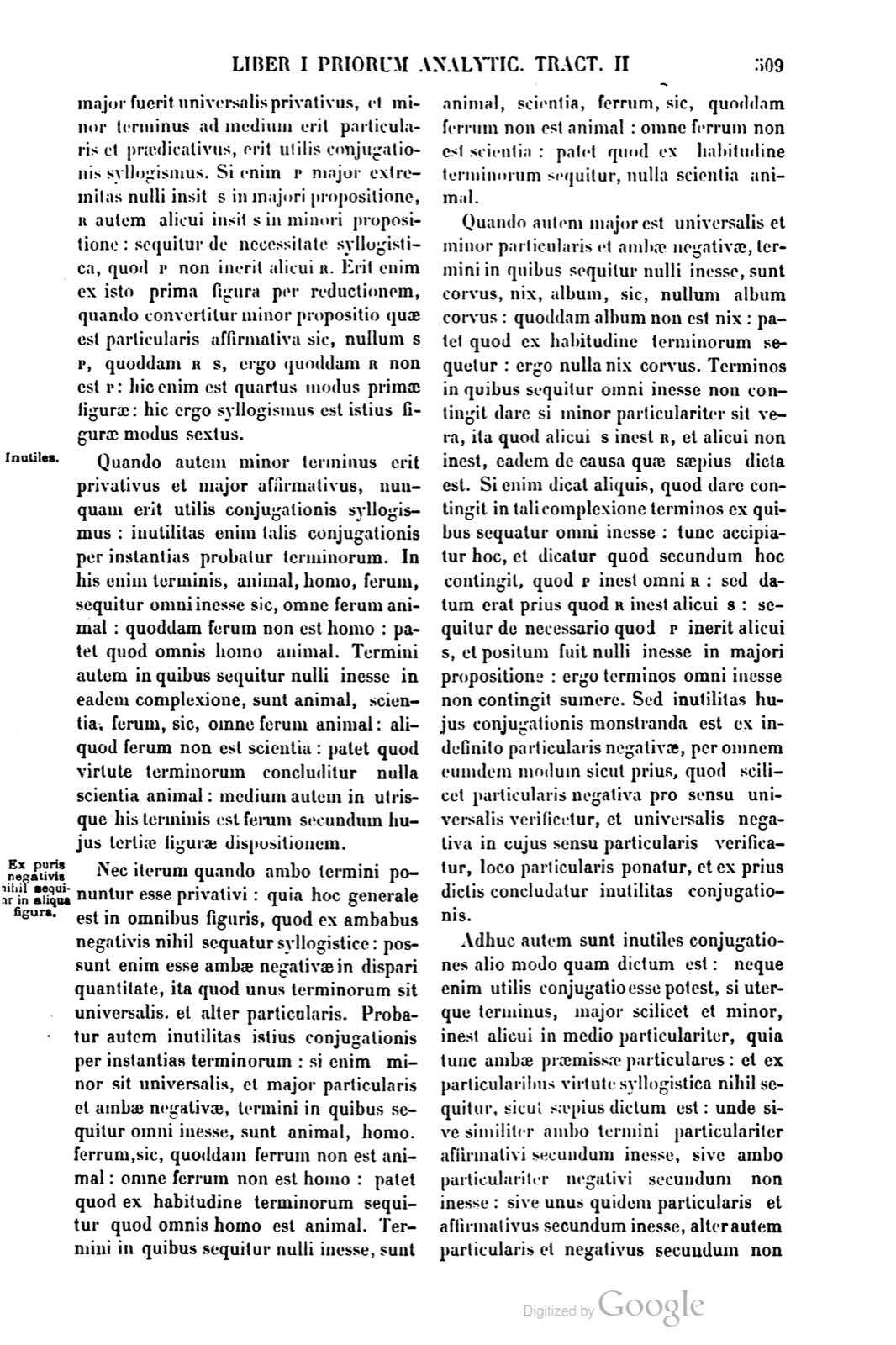
Adhuc autem sunt inutiles conjugationes alio modo quam dictum est: neque enim utilis conjugatio esse potest, si uterque terminus, major scilicet et minor, inest alicui in medio particulariter, quia tunc ambae praemissae particulares: et ex particularibus virtute syllogistica nihil sequitur, sicut saepius dictum est: unde sive similiter ambo termini particulariter affirmativi secundum inesse, sive ambo particulariter negativi secundum non inesse: sive unus quidem particularis et affirmativus secundum inesse, alter autem particularis et negativus secundum non inesse; sive etiam sumantur in eis qui aequipollent particulari affirmativo vel negativo, sicut si unus sumatur particularis secundum inesse alicui: alter autem in aequipollentia ad particularem sumatur negative secundum non inesse omni sive secundum non omni inesse, vel si indefinite sumpti termini in utraque propositione loco particularium ponantur: nullo istorum modorum erit conjugationis syllogismus.
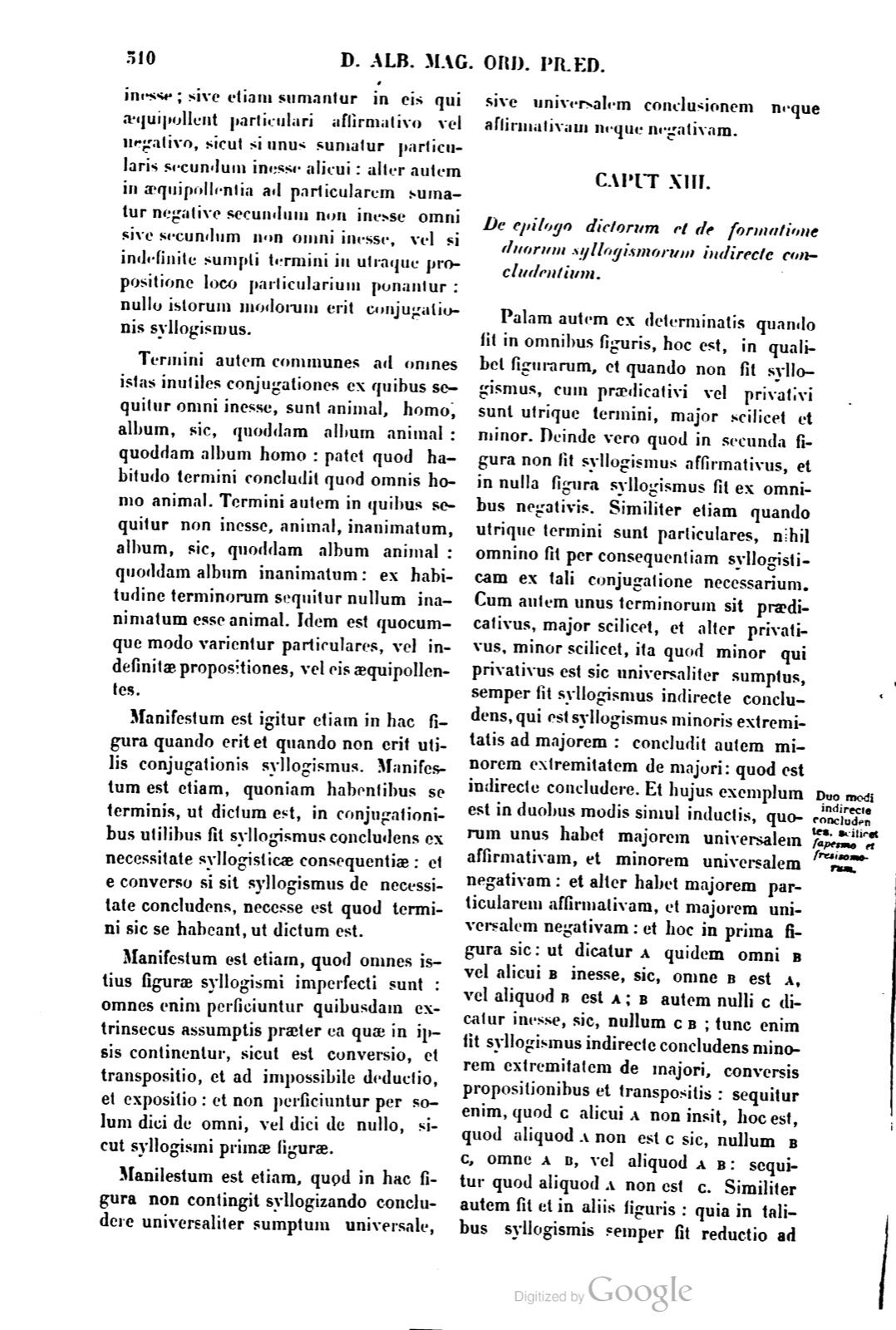
Termini autem communes ad omnes istas inutiles conjugationes ex quibus sequitur omni inesse, sunt animal, homo, album, sic, quoddam album animal: quoddam album homo: patet quod habitudo termini concludit quod omnis homo animal. Termini autem in quibus sequitur non inesse, animal, inanimatum, album, sic, quoddam album animal: quoddam album inanimatum: ex habitudine terminorum sequitur nullum inanimatum esse animal. Idem est quocumque modo varientur particulares, vel indefinitae propositiones, vel eis aequipollentes.
Manifestum est igitur etiam in hac figura quando erit et quando non erit utilis conjugationis syllogismus. Manifestum est etiam, quoniam habentibus se terminis, ut dictum est, in conjugationibus utilibus fit syllogismus concludens ex necessitate syllogisticae consequentiae: et e converso si sit syllogismus de necessitate concludens, necesse est quod termini sic se habeant, ut dictum est.
Manifestum est etiam, quod omnes istius figurae syllogismi imperfecti sunt: omnes enim perficiuntur quibusdam extrinsecus assumptis praeter ea quae in ipsis continentur, sicut est conversio, et transpositio, et ad impossibile deductio, et expositio: et non perficiuntur per solum dici de omni, vel dici de nullo, sicut syllogismi primae figurae.
Manifestum est etiam, quod in hac figura non contingit syllogizando concludere universaliter sumptum universale, sive universalem conclusionem neque affirmativam neque negativam.
Again, there are useless conjugations in another way than has been said; for a useful conjugation cannot exist if each term, namely the major and the minor, belongs particularly to something in the middle, because then both premises are particular, and from particulars nothing follows by syllogistic power, as has often been said. Hence whether similarly both terms are particularly affirmative according to inherence, or both particularly negative according to non-inherence; or whether one is particular and affirmative according to inherence and the other particular and negative according to non-inherence; or also whether in these are taken things equivalent to the particular affirmative or negative, as if one is taken as particular according to belonging to some, but the other is taken negatively, in equivalence to the particular, according to not-belonging-to-every-one or according to not-belonging to every one; or if terms taken indefinitely are put in each proposition in place of particulars: in none of those ways will there be a syllogism of conjugation.
But the common terms for all these useless conjugations from which belonging to every one follows are animal, man, white, thus: some white thing is animal; some white thing is man; it is clear that the relation of the term concludes that every man is animal. But the terms in which not-belonging follows are animal, inanimate, white, thus: some white thing is animal; some white thing is inanimate; from the relation of the terms it follows that no inanimate thing is animal. The same holds however the particular or indefinite propositions, or those equivalent to them, are varied.
Therefore it is also manifest in this figure when there will and will not be a syllogism of useful conjugation. It is also manifest that, when the terms have themselves as has been said, in useful conjugations there is made a syllogism concluding from the necessity of syllogistic consequence; and conversely, if there is a syllogism concluding of necessity, the terms must have themselves as has been said.
It is also manifest that all syllogisms of this figure are imperfect; for they are all perfected by certain things assumed extrinsically beyond those contained in them, such as conversion, transposition, reduction to impossibility, and exposition; and they are not perfected through being-said-of-every-one alone, or being-said-of-none, as syllogisms of the first figure are.
It is also manifest that in this figure it is not possible by syllogizing to conclude a universally taken universal, or a universal conclusion, either affirmative or negative.
Notes
- On this see above, chapter 4, toward the end. (De hoc vide supra, cap. 4, versus finem.) ↩
If a page does not appear, its photograph has not been uploaded yet.