Works › Prior Analytics, Books I–II
Volume 1 · pp. 505–506
Chapter XI. On the formation of universal syllogisms of the third figure, of useful and useless conjugations.
A marker with ≈ is an approximate page boundary, placed by measure of the text; the page photographs remain the authority. In the paired views, clicking a page marker brings that page into view.
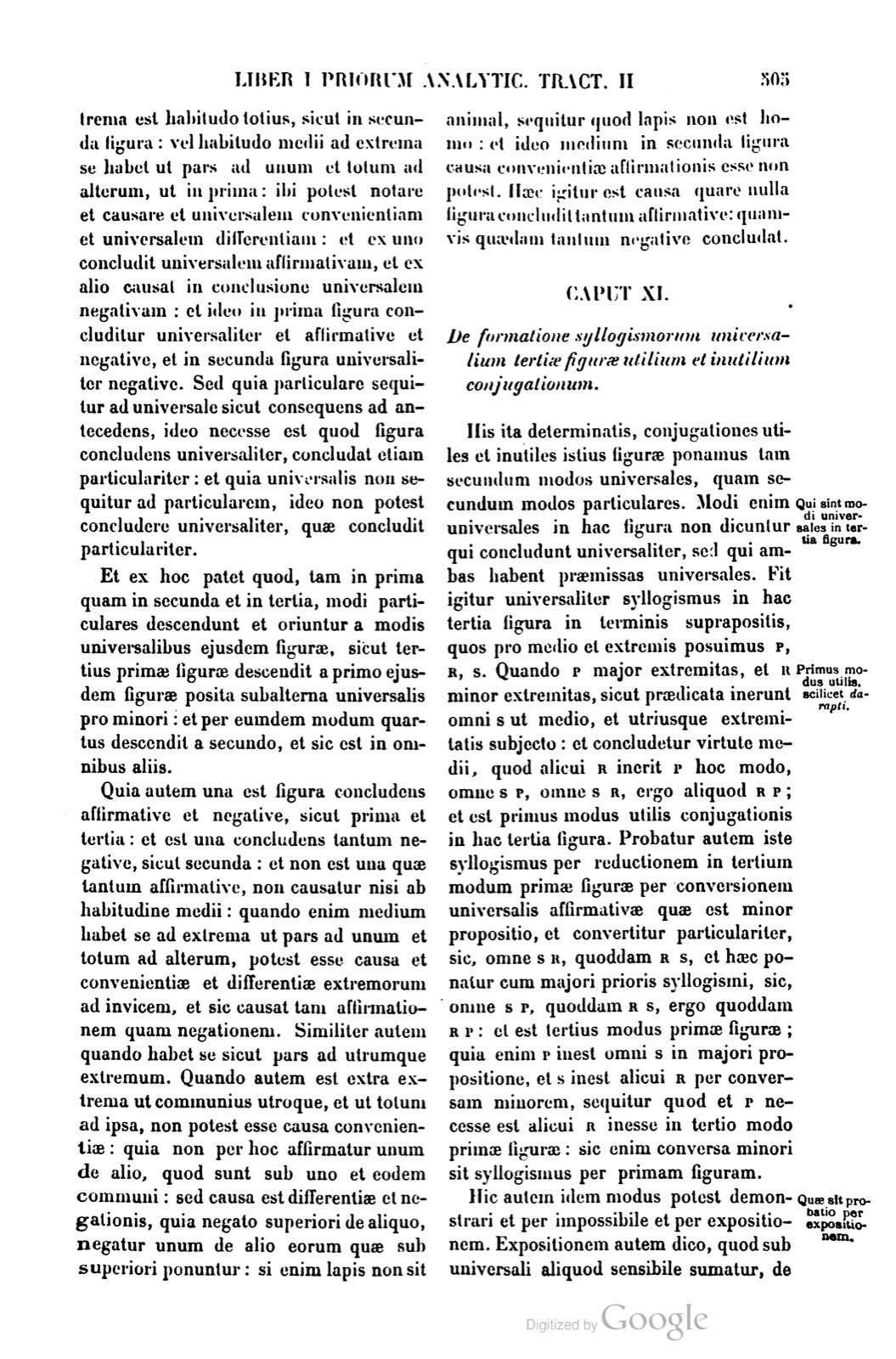
CAPUT XI. De formatione syllogismorum universalium tertiae figurae utilium et inutilium conjugationum.
His ita determinatis, conjugationes utiles et inutiles istius figurae ponamus tam secundum modos universales, quam secundum modos particulares. Modi enim universales in hac figura non dicuntur qui concludunt universaliter, sed qui ambas habent praemissas universales. Fit igitur universaliter syllogismus in hac tertia figura in terminis suprapositis, quos pro medio et extremis posuimus P, R, S. Quando P major extremitas, et R minor extremitas, sicut praedicata inerunt omnis ut medio, et utriusque extremitatis subjecto: et concludetur virtute medii, quod alicui R inerit P hoc modo, omne S P, omne S R, ergo aliquod R P; et est primus modus utilis conjugationis in hac tertia figura. Probatur autem iste syllogismus per reductionem in tertium modum primae figurae per conversionem universalis affirmativae quae est minor propositio, et convertitur particulariter, sic, omne S R, quoddam R S, et haec ponatur cum majori prioris syllogismi, sic, omne S P, quoddam R S, ergo quoddam R P: et est tertius modus primae figurae; quia enim P inest omni S in majori propositione, et S inest alicui R per conversam minorem, sequitur quod et P necesse est alicui R inesse in tertio modo primae figurae: sic enim conversa minori fit syllogismus per primam figuram.
Hic autem idem modus potest demonstrari et per impossibile et per expositionem. Expositionem autem dico, quod sub universali aliquod sensibile sumatur, de quo utraque extremitas universaliter vel particulariter praedicetur, sicut si dicam, omnis homo substantia: omnis homo animal: ergo aliquod animal substantia: et si dicatur quod non sequitur, accipio sub substantia et animali aliquod sensibile de quo praedicetur utraque extremitas, ut hunc hominem, videlicet Socratem et Platonem: quia enim ille est quoddam animal, et quaedam substantia, patet quoniam aliquod animal est quaedam substantia: et hoc est quod dicit Aristoteles, quod si ambo extrema omni S, hoc est, medio insunt, si sumatur aliquod eorum sensibilium et particularium quae sunt sub S, et sic illud S huic necessario sequitur et utrumque inesse, majorem scilicet et minorem extremitatem: eo quod medium utrique extremorum subjicitur: si enim omnis homo est animal: et omne risibile animal: necesse est quoddam risibile animal esse. Si autem insunt major et minor extremitas omni medio, et aliquod sensibile sumatur sub medio, sequitur quod huic sumpto sub medio inerunt extrema P et R, et sic sequitur quod alicui R quod est minor extremitas, inerit P major extremitas. Hic ergo est tertiae figurae modus primus.
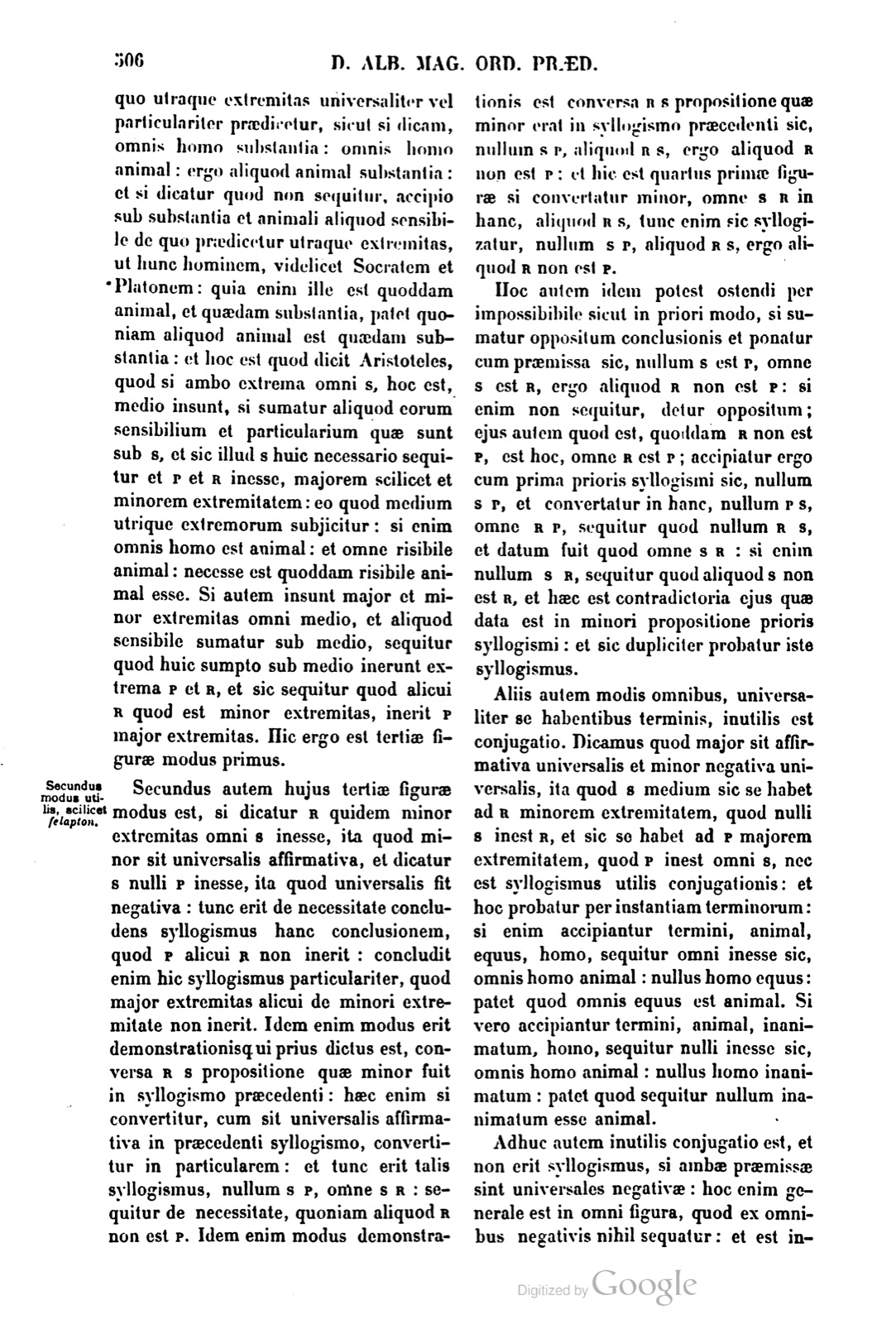
Secundus autem hujus tertiae figurae modus est, si dicatur R quidem minor extremitas omnis inesse, ita quod minor sit universalis affirmativa, et dicatur S nulli P inesse, ita quod universalis fit negativa: tunc erit de necessitate concludens syllogismus hanc conclusionem, quod alicui R non inerit P: concludit enim hic syllogismus particulariter, quod major extremitas alicui de minori extremitate non inerit. Idem enim modus erit demonstrationis qui prius dictus est, conversa R S propositione quae minor fuit in syllogismo praecedenti: haec enim si convertitur, cum sit universalis affirmativa in praecedenti syllogismo, convertitur in particularem: et tunc erit talis syllogismus, nullum S P, quoddam R S: sequitur de necessitate, quoniam aliquod R non est P. Idem enim modus demonstrationis est conversa R S propositione quae minor erat in syllogismo praecedenti sic, nullum S P, aliquod R S, ergo aliquod R non est P: et hic est quartus primae figurae si convertatur minor, omne S R in hanc, aliquod R S, tunc enim sic syllogizatur, nullum S P, aliquod R S, ergo aliquod R non est P.
CHAPTER XI. On the formation of universal syllogisms of the third figure, of useful and useless conjugations.
With these things thus determined, let us posit the useful and useless conjugations of this figure, both according to universal modes and according to particular modes. For in this figure universal modes are not called those which conclude universally, but those which have both premises universal. Therefore a syllogism is made universally in this third figure in the terms set above, which we posited as P, R, S for the middle and the extremes. When P, the greater extreme, and R, the lesser extreme, will belong as predicates to every S as to the middle and the subject of each extreme, it will be concluded by the power of the middle that P will belong to some R in this way: every S is P; every S is R; therefore some R is P. And this is the first useful mode of conjugation in this third figure. But this syllogism is proved by reduction into the third mode of the first figure through conversion of the universal affirmative which is the minor proposition, and it is converted particularly, thus: every S is R, therefore some R is S. And let this be posited with the major of the prior syllogism thus: every S is P; some R is S; therefore some R is P. And it is the third mode of the first figure; for because P belongs to every S in the major proposition, and S belongs to some R through the converted minor, it follows that P too must belong to some R in the third mode of the first figure. For thus, with the minor converted, the syllogism is made through the first figure.
But this same mode can be demonstrated both through impossibility and through exposition. By exposition I mean that some sensible thing is taken under the universal, of which each extreme is predicated universally or particularly, as if I say: every man is substance; every man is animal; therefore some animal is substance. And if it is said that it does not follow, I take under substance and animal some sensible thing of which each extreme is predicated, as this man, namely Socrates and Plato. For because that one is a certain animal and a certain substance, it is clear that some animal is a certain substance. And this is what Aristotle says: that if both extremes belong to every S, that is, to the middle, if some one of the sensible and particular things which are under S is taken, then that S necessarily follows this thing, and so do both belong to it, namely the greater and lesser extreme, because the middle is subjected to each of the extremes. For if every man is animal and every risible is animal, some risible must be animal. But if the greater and lesser extreme belong to every middle, and some sensible thing is taken under the middle, it follows that the extremes P and R will belong to this thing taken under the middle, and thus it follows that P, which is the greater extreme, will belong to some R, which is the lesser extreme. This, therefore, is the first mode of the third figure.
The second mode of this third figure is if R, the lesser extreme, is said to belong to every one, so that the minor is universal affirmative, and S is said to belong to no P, so that it becomes a universal negative; then there will be a syllogism concluding of necessity this conclusion, that P will not belong to some R. For this syllogism concludes particularly that the greater extreme will not belong to some of the lesser extreme. The same mode of demonstration will be as was stated before, with the R S proposition converted, which was the minor in the preceding syllogism. For if this is converted, since it is a universal affirmative in the preceding syllogism, it is converted into a particular; and then there will be such a syllogism: no S is P; some R is S; it follows of necessity that some R is not P. For the same mode of demonstration occurs with the R S proposition converted, which was the minor in the preceding syllogism, thus: no S is P; some R is S; therefore some R is not P. And this is the fourth of the first figure if the minor, every S is R, is converted into this, some R is S; for then it is syllogized thus: no S is P; some R is S; therefore some R is not P.
Hoc autem idem potest ostendi per impossibile sicut in priori modo, si sumatur oppositum conclusionis et ponatur cum praemissa sic, nullum S est P, omne S est R, ergo aliquod R non est P: si enim non sequitur, detur oppositum; ejus autem quod est, quoddam R non est P, est hoc, omne R est P; accipiatur ergo cum prima prioris syllogismi sic, nullum S P, et convertatur in hanc, nullum P S, omne R P, sequitur quod nullum R S, et datum fuit quod omne S R: si enim nullum S R, sequitur quod aliquod S non est R, et haec est contradictoria ejus quae data est in minori propositione prioris syllogismi: et sic dupliciter probatur iste syllogismus.
Aliis autem modis omnibus, universaliter se habentibus terminis, inutilis est conjugatio. Dicamus quod major sit affirmativa universalis et minor negativa universalis, ita quod S medium sic se habet ad R minorem extremitatem, quod nulli S inest R, et sic se habet ad P majorem extremitatem, quod P inest omni S, nec est syllogismus utilis conjugationis: et hoc probatur per instantiam terminorum: si enim accipiantur termini, animal, equus, homo, sequitur omni inesse sic, omnis homo animal: nullus homo equus: patet quod omnis equus est animal. Si vero accipiantur termini, animal, inanimatum, homo, sequitur nulli inesse sic, omnis homo animal: nullus homo inanimatum: patet quod sequitur nullum inanimatum esse animal.
Adhuc autem inutilis conjugatio est, et non erit syllogismus, si ambae praemissae sint universales negativae: hoc enim generale est in omni figura, quod ex omnibus negativis nihil sequatur: et est in
But this same thing can be shown through impossibility as in the prior mode, if the opposite of the conclusion is taken and posited with the premise thus: no S is P; every S is R; therefore some R is not P. For if it does not follow, let the opposite be given; but the opposite of "some R is not P" is this, "every R is P." Therefore let it be taken with the first of the prior syllogism thus: no S is P, and let it be converted into this, no P is S; every R is P; it follows that no R is S. And it had been given that every S is R; for if no S is R, it follows that some S is not R, and this is contradictory to what was given in the minor proposition of the prior syllogism; and thus this syllogism is proved in two ways.
But in all other modes, when the terms have themselves universally, the conjugation is useless. Let us say that the major is universal affirmative and the minor universal negative, so that S, the middle, has itself to R, the lesser extreme, in such a way that R belongs to no S, and it has itself to P, the greater extreme, in such a way that P belongs to every S; nor is there a syllogism of useful conjugation. And this is proved through an instance of terms: for if the terms animal, horse, man are taken, belonging to every one follows thus: every man is animal; no man is horse; it is clear that every horse is animal. But if the terms animal, inanimate, man are taken, belonging to no one follows thus: every man is animal; no man is inanimate; it is clear that no inanimate thing is animal.
Again the conjugation is useless, and there will be no syllogism, if both premises are universal negatives; for this is general in every figure, that from all negatives nothing follows; and it is in
If a page does not appear, its photograph has not been uploaded yet.